Originally Published: February 5, 2026
Last Updated: August 28, 2026
Next Review: August 2027, or sooner if major eye nutrition or supplement guidance changes
Review Status: Fully rewritten and source checked using current National Eye Institute and NIH nutrition guidance
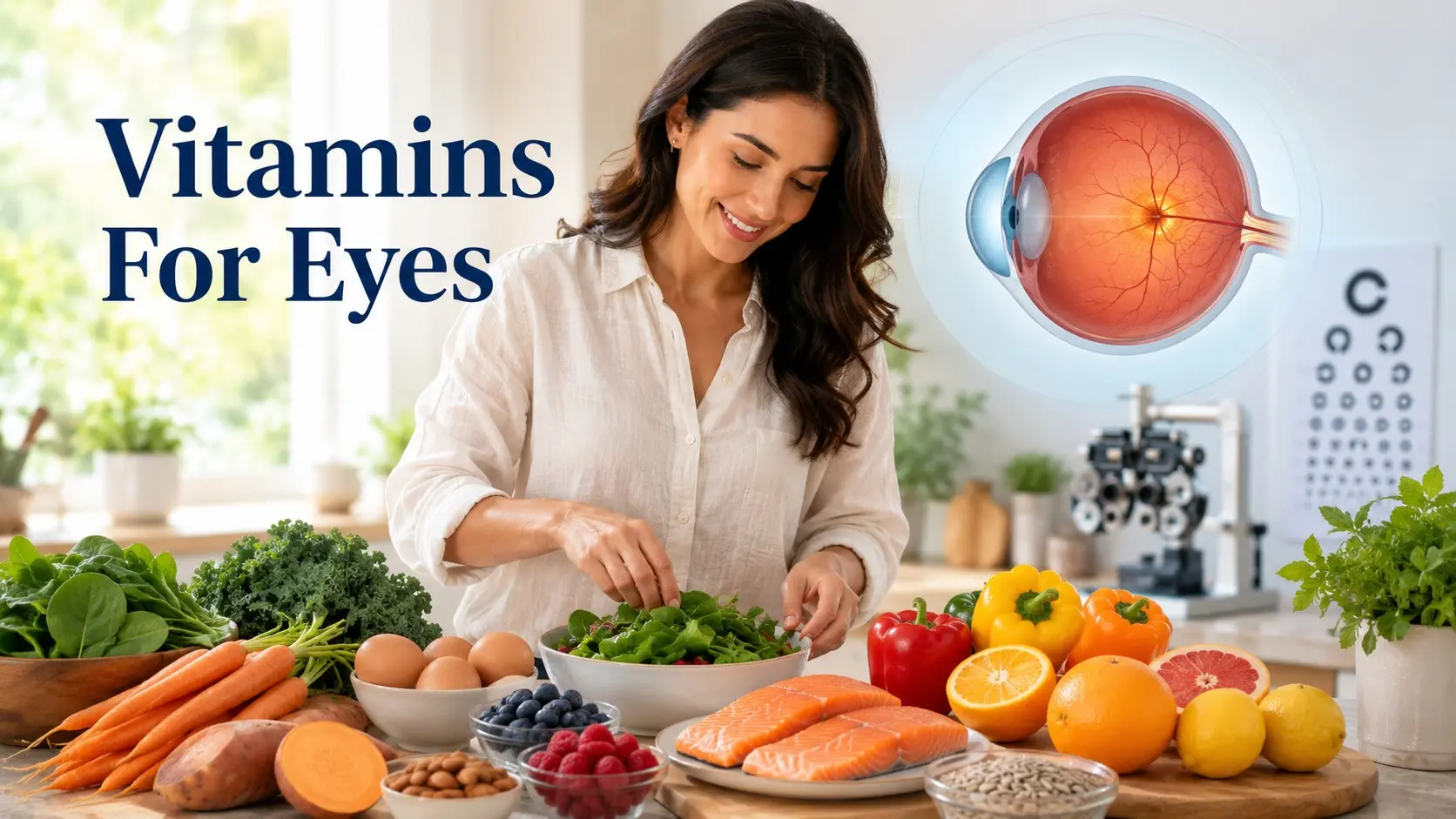
Vitamins for Eyes can support normal vision and healthy eye tissue.
But eye vitamins cannot fix every vision problem.
They cannot remove the need for glasses.
They cannot cure cataracts.
They cannot treat glaucoma by themselves.
They cannot replace diabetes care.
For most people, food should come first.
Leafy greens, colourful vegetables, eggs, fish, nuts, seeds, beans, and fruit can provide many nutrients used by the eyes.
Supplements have a more limited role.
One important exception is AREDS2.
AREDS2 can help some people with certain stages of age related macular degeneration.
It is not a general eye vitamin for everyone.
Quick Answer: What Are the Best Vitamins for Eyes?
The main nutrients linked with eye health include vitamin A, vitamin C, vitamin E, lutein, zeaxanthin, zinc, and omega-3 fats from food. Vitamin A is essential for normal vision. Lutein and zeaxanthin are found in the retina. Vitamin C and vitamin E help with normal antioxidant defences. Zinc has important roles in the body and is part of the AREDS2 formula. Most people should get these nutrients from food unless a healthcare professional recommends a supplement.
Medical note: I am not a licensed healthcare professional, and this content does not replace professional medical advice. This article explains published guidance and does not provide a personal clinical assessment. Always consult qualified medical professionals for diagnosis and treatment of any health condition.
What You Will Learn
- Which vitamins support normal eye function
- Which foods provide eye nutrients
- What vitamin A does for vision
- Why lutein and zeaxanthin matter
- What AREDS2 really does
- Who should consider AREDS2?
- Who should avoid beta carotene supplements?
- Why high dose vitamin supplements can cause problems
- Whether eye vitamins help cataracts
- Whether supplements improve eyesight
- When eye symptoms need urgent care
Why Do Your Eyes Need Vitamins and Nutrients?
Your eyes are living tissue.
They need oxygen.
They need blood flow.
They need energy.
They also need vitamins, minerals, protein, and healthy fats.
The retina helps turn light into signals your brain can understand.
The macula helps with sharp central vision.
The cornea helps focus light.
The tear film protects the surface of the eye.
A balanced diet helps provide nutrients used by these tissues.
But nutrition is only one part of eye care.
Regular eye exams matter too.
For the full picture, read the Eye Health Complete Guide.
Best Vitamins for Eyes at a Glance
| Nutrient
|
Major role | Food sources | Supplement note |
|---|---|---|---|
| Vitamin A | Normal vision and retina function | Sweet potato, carrots, greens, eggs, dairy | Too much preformed vitamin A can be harmful |
| Vitamin C | Antioxidant and connective tissue support | Citrus, peppers, berries, kiwi, broccoli | Food is enough for most people |
| Vitamin E | Helps protect cells from oxidative damage | Almonds, seeds, avocado, oils | High doses can interact with medicines |
| Lutein | Part of macular pigment | Kale, spinach, collards, egg yolk | Part of AREDS2 |
| Zeaxanthin | Part of macular pigment | Greens, corn, eggs, peppers | Part of AREDS2 |
| Zinc | Normal cell and enzyme function | Seafood, meat, beans, seeds | High doses need medical guidance |
| Omega 3 fats | Important fats found in retinal tissue | Salmon, sardines, trout, walnuts, chia | Omega-3 supplements did not improve AMD results in AREDS2 |
1. Vitamin A for Normal Vision
Vitamin A is essential for vision.
Your retina uses vitamin A to help detect light.
It is especially important for seeing in low light.
A serious vitamin A deficiency can cause night blindness.
Severe deficiency can also damage the surface of the eye.
Foods with vitamin A
- Sweet potatoes
- Carrots
- Spinach
- Kale
- Eggs
- Dairy foods
- Cantaloupe
- Red peppers
Orange and dark green plants often provide beta carotene.
Your body can turn beta carotene into vitamin A.
Do Carrots Improve Eyesight?
Carrots are healthy.
They provide beta carotene.
But eating extra carrots will not remove your glasses.
They will not correct nearsightedness.
They will not correct farsightedness.
They will not correct astigmatism.
If you already get enough vitamin A, eating much more will not give you super vision.
Think of carrots as one useful food.
Do not think of them as a vision treatment.
Be Careful With High Dose Vitamin A
Vitamin A is important.
More is not always better.
Preformed vitamin A from some supplements can build up in the body.
Large amounts can be toxic.
Too much can harm the liver.
Excess preformed vitamin A during pregnancy can also harm a developing baby.
Do not use high dose vitamin A supplements for eye health without medical guidance.
Food sources such as carrots and sweet potatoes provide provitamin A carotenoids and do not create the same risk as very high doses of preformed vitamin A.
2. Vitamin C and Eye Health
Vitamin C is an antioxidant.
It also helps your body make collagen.
Your eyes contain tissues that are exposed to light and oxygen every day.
Vitamin C is part of the body's normal antioxidant system.
Foods with vitamin C
- Oranges
- Grapefruit
- Kiwi
- Strawberries
- Bell peppers
- Broccoli
- Tomatoes
- Brussels sprouts
You do not need very large vitamin C doses to protect normal eyes.
Regular fruit and vegetable intake is a safer foundation for most people.
Can Vitamin C Prevent Cataracts?
Do not rely on vitamin C supplements to prevent cataracts.
The large AREDS studies did not show that the antioxidant supplement formula prevented cataracts.
A nutritious diet is still good for overall health.
But a vitamin pill should not be sold as a cataract cure.
If you have cataracts, see an eye professional.
3. Vitamin E for Eye Health
Vitamin E helps protect cell membranes from oxidative damage.
It is found naturally in many foods.
Foods with vitamin E
- Almonds
- Sunflower seeds
- Hazelnuts
- Avocado
- Peanut butter
- Spinach
- Vegetable oils
Food sources are enough for many people.
High Dose Vitamin E Needs Caution
Vitamin E is part of the AREDS2 formula.
But this does not mean everyone should take high dose vitamin E.
Large vitamin E supplements can interact with some medicines.
They may increase bleeding risk when used with some blood thinning medicines.
If you use warfarin or another medicine that affects bleeding, ask your healthcare professional before taking high dose vitamin E.
4. Lutein and Zeaxanthin
Lutein and zeaxanthin are carotenoids.
They are found in the retina.
They are especially concentrated in the macula.
The macula helps you see fine detail in the center of your vision.
These nutrients help form macular pigment.
Foods with lutein and zeaxanthin
- Kale
- Spinach
- Collard greens
- Turnip greens
- Broccoli
- Corn
- Peas
- Egg yolks
Eating leafy greens is one of the simplest food choices for eye nutrition.
The National Eye Institute also recommends dark leafy greens as part of a healthy eye diet.
For more food ideas, read Foods for Eye Health.
5. Zinc and Eye Health
Zinc is an essential mineral.
It has many roles in normal cell function.
Zinc is also an important part of the AREDS2 formula.
Foods with zinc
- Oysters
- Beef
- Crab
- Chicken
- Beans
- Chickpeas
- Pumpkin seeds
- Cashews
Most people do not need very high dose zinc for general eye health.
Why AREDS2 Contains Copper
The AREDS2 formula contains a large dose of zinc.
High zinc intake can reduce copper absorption.
This can lead to copper deficiency.
That is why copper is included in the formula.
Do not copy individual AREDS2 ingredients and build your own supplement mix.
Ask your eye doctor which formula is right for you.
6. Omega 3 Fats and the Eyes
Omega 3 fatty acids are important fats.
DHA is found in retinal tissue.
Fatty fish is part of a healthy eating pattern.
Foods with omega-3 fats
- Salmon
- Sardines
- Mackerel
- Trout
- Tuna
- Anchovies
- Walnuts
- Chia seeds
- Flax seeds
Fish provides EPA and DHA directly.
Plant foods provide ALA.
The body converts only part of ALA into EPA and DHA.
Read Omega 3 for Eyes for the full guide.
Do Omega 3 Supplements Prevent Macular Degeneration?
No proven benefit was found in AREDS2.
Adding omega 3 supplements to the AREDS formula did not reduce progression to advanced AMD.
This does not mean fish is unhealthy.
The National Eye Institute still recommends fish as part of a healthy diet.
It means Omega 3 capsules should not be sold as a proven AMD treatment.
7. B Vitamins and Eye Health
B vitamins support many normal body functions.
Vitamin B12 supports nerve and blood cell health.
Folate supports normal cell function.
Vitamin B6 has many roles in metabolism.
But ordinary B vitamin supplements are not a general vision treatment.
If you have a real deficiency, treating it matters.
If you do not have a deficiency, more is not automatically better.
People who follow a vegan diet need a reliable vitamin B12 source.
What Is AREDS2?
AREDS2 is a specific supplement formula studied by the National Eye Institute.
It is used for some people with age related macular degeneration.
It is not the same as a regular multivitamin.
It is not intended to make healthy eyes stronger.
It is not for every older adult.
Who Can Benefit From AREDS2?
According to the National Eye Institute, AREDS2 may help if you have:
- Intermediate AMD in one or both eyes
- Late AMD in one eye and less advanced disease in the other eye
In the right group, the AREDS formulas reduced the risk of progression to advanced AMD by about 25 percent.
This is meaningful.
But it applies to specific people with diagnosed AMD.
Who Does Not Benefit From AREDS2?
AREDS2 is not proven to help people who have:
- No AMD
- Early AMD only
- Late AMD in both eyes
It also does not prevent AMD from starting.
This is one of the most important facts in this guide.
Do not begin AREDS2 simply because you are over 50.
You first need to know whether you have the stage of AMD that can benefit.
What Is in the Standard AREDS2 Formula?
| Ingredient | Amount studied |
|---|---|
| Vitamin C | 500 mg |
| Vitamin E | 400 IU |
| Lutein | 10 mg |
| Zeaxanthin | 2 mg |
| Zinc | 80 mg |
| Copper | 2 mg |
These amounts are much higher than ordinary food intake for some nutrients.
That is why AREDS2 should be treated like a medical supplement plan.
Discuss it with your eye care professional.
Current and Former Smokers Should Avoid Beta Carotene AREDS Formulas
This safety point is very important.
The older AREDS formula contained beta carotene.
Beta carotene supplements increased lung cancer risk in people who smoked.
Former smokers were also affected in AREDS2 follow-up.
The newer AREDS2 formula replaces beta carotene with lutein and zeaxanthin.
If you smoke now or smoked in the past, check the label carefully.
Choose AREDS2 rather than the old AREDS formula if your eye doctor recommends treatment.
Does AREDS2 Prevent Cataracts?
No.
The large AREDS studies did not show an overall cataract prevention benefit from the supplement formulas.
This is another reason not to take AREDS2 as a general eye vitamin.
Its proven use is for slowing AMD progression in certain people.
Does AREDS2 Improve Eyesight?
AREDS2 is not designed to make normal eyesight sharper.
It does not remove a glasses prescription.
It does not reverse normal age-related focusing changes.
Its goal is to reduce the chance that certain AMD gets worse.
That differs from improving eyesight in a healthy person.
Do Eye Vitamins Improve Blurry Vision?
Not unless the blurry vision comes from a specific nutrient problem.
Blurry vision can come from many causes.
Examples include:
- Nearsightedness
- Farsightedness
- Astigmatism
- Dry eye
- Cataract
- Diabetes
- Macular degeneration
- Retinal disease
- Glaucoma
- Medication effects
A vitamin bottle cannot tell you the cause.
Get an eye examination when vision changes.
Can Eye Vitamins Prevent Glaucoma?
No vitamin supplement has been proven to replace glaucoma screening or treatment.
Glaucoma can damage the optic nerve.
It may cause no symptoms early.
Prescription eye drops, laser care, surgery, and regular eye pressure and optic nerve checks may be needed.
Do not use supplements instead of prescribed glaucoma treatment.
Can Vitamins Treat Diabetic Eye Disease?
No.
Good nutrition is useful for general health.
But diabetic retinopathy needs diabetes management and professional eye care.
Blood sugar matters.
Blood pressure matters.
Cholesterol can matter.
Regular dilated eye exams matter.
Eye vitamins are not a substitute.
Food First for Eye Health
Most people do not need a special eye supplement.
Build a strong food pattern instead.
Eat leafy greens
Use spinach, kale, collards, broccoli, or similar vegetables.
Eat colorful vegetables
Carrots, sweet potatoes, peppers, and tomatoes provide different nutrients.
Eat fruit
Citrus, berries, kiwi, and other fruits provide vitamin C and other plant compounds.
Eat fish if appropriate
Salmon, sardines, trout, and other fish provide omega 3 fats.
Add nuts and seeds
They provide vitamin E, healthy fats, minerals, and protein.
Eat eggs
Egg yolks contain lutein and zeaxanthin.
A Simple Eye Health Meal Plan
Breakfast
Eggs with spinach and tomatoes.
Or yogurt with berries and walnuts.
Lunch
A leafy green salad with beans, peppers, avocado, and olive oil.
Or a salmon sandwich with vegetables.
Dinner
Fish with broccoli and sweet potato.
Or lentils with greens and brown rice.
Snacks
- Orange slices
- Almonds
- Carrots with hummus
- Boiled eggs
- Berries
For a deeper food guide, read Foods for Eye Health.
Who May Need a Vitamin Supplement?
A supplement may be useful when there is an obvious reason.
Examples include:
- A diagnosed nutrient deficiency
- Intermediate AMD when AREDS2 is recommended
- Late AMD in one eye when AREDS2 is recommended
- A restrictive diet that does not meet nutrient needs
- A medical condition that affects nutrient absorption
- A clinician-recommended pregnancy supplement
The supplement should match the problem.
Do not take a large stack of vitamins just because the label says eye health.
Eye Supplement Mistakes to Avoid
Taking AREDS2 without an AMD diagnosis
AREDS2 is not a daily wellness vitamin.
Taking the old beta carotene formula if you ever smoked
Use extra caution.
Combining several supplements
You may accidentally double vitamin A, vitamin E, zinc, or other nutrients.
Assuming natural means safe
Vitamins can still cause side effects.
Ignoring medicine interactions
High-dose vitamin E and other supplements can interact with medicines.
Using supplements instead of an eye examination
This can delay diagnosis of serious disease.
Should Pregnant People Take Eye Vitamins?
Do not add high-dose eye supplements during pregnancy unless your healthcare professional approves them.
Vitamin A deserves special attention.
Too much preformed vitamin A can cause birth defects.
A normal prenatal vitamin is designed for pregnancy needs.
Do not combine it with extra high-dose vitamin A without medical advice.
Eye Vitamins and Medicine Interactions
Supplements can interact with medicine.
This is especially important if you take:
- Blood thinners
- Medicines that affect bleeding
- Cancer treatments
- Several prescription medicines
Tell your pharmacist and healthcare professional about every vitamin and supplement you use.
Bring the bottles or a photo of the labels.
Do You Need a Special Eye Multivitamin?
Usually not.
A regular multivitamin and an AREDS2 product are not the same thing.
A general eye vitamin may contain lutein, vitamin A, vitamin C, vitamin E, or zinc.
That does not prove it prevents eye disease.
Look for evidence before paying more for the word eye on the label.
Vitamins Are Only One Part of Eye Health
Food matters.
But so do other habits.
The National Eye Institute recommends:
- Regular eye exams
- Healthy food
- Physical activity
- No smoking
- Managing diabetes
- Managing high blood pressure
- Managing cholesterol
- Using eye protection
- Wearing sunglasses that block UVA and UVB
Read the Eye Health Complete Guide for the full plan.
When to See an Eye Doctor Instead of Taking Vitamins
Do not wait for supplements to work if your vision changes.
Get prompt medical care for:
- Sudden vision loss
- Sudden new floaters
- Flashes of light
- A curtain or shadow over your vision
- Severe eye pain
- Severe eye redness with vision change
- Sudden double vision
- New wavy or distorted central vision
- A sudden dark area in your vision
Some eye conditions need urgent treatment.
A vitamin cannot replace that care.
Common Myths About Vitamins for Eyes
Myth 1: Eye vitamins remove the need for glasses
False.
Vitamins do not correct the shape of your eye.
Myth 2: Everyone over 50 should take AREDS2
False.
AREDS2 is for specific stages of AMD.
Myth 3: AREDS2 prevents AMD
False.
It can slow progression in certain people.
Myth 4: Eye vitamins prevent cataracts
Not proven.
AREDS and AREDS2 did not prevent cataracts overall.
Myth 5: More vitamin A means better vision
False.
Too much preformed vitamin A can be toxic.
Myth 6: Omega 3 capsules prevent AMD
Not proven.
Omega 3 supplements did not add an AMD benefit in AREDS2.
My Approach to Eye Nutrition
I prefer a food first approach.
I also separate general nutrition from medical treatment.
This matters with eye supplements.
A nutrient can be important for the eye without meaning that a high dose pill will improve vision.
I review public health guidance.
I compare claims with research from the National Eye Institute and NIH.
I also look closely at safety warnings.
My background in research and structured analysis has taught me to question simple promises.
That is why this guide does not call every vitamin an eye treatment.
The evidence is strongest when the right nutrient is used for the right reason.
Conclusion: Vitamins for Eyes Work Best When Used for the Right Reason
Vitamins for Eyes support normal eye function, but most people should begin with food.
Eat leafy greens.
Eat colourful fruit and vegetables.
Include fish when appropriate.
Add nuts, seeds, beans, and eggs.
Do not assume more supplements mean better vision.
AREDS2 is important for some people with AMD.
It is not for everyone.
Your next step: Add one dark leafy green food to your meals this week and ask your eye professional whether you need any eye supplements at all.
References and Sources
This article was source checked using current National Eye Institute and National Institutes of Health resources. All five sources are freely accessible.
- National Eye Institute. AREDS2 Supplements for Age-Related Macular Degeneration.This NEI guide explains who may benefit from AREDS2, who does not benefit, the standard ingredients, medication concerns, and why people who currently smoke or previously smoked should avoid older beta carotene formulas.
- National Eye Institute. AREDS and AREDS2 Frequently Asked Questions.This resource explains that AREDS2 helps specific people with intermediate or advanced AMD, does not prevent AMD from starting, does not prevent cataracts overall, and contains lutein and zeaxanthin instead of beta carotene.
- National Eye Institute. Keep Your Eyes Healthy.This public resource recommends leafy green vegetables, fish, regular activity, smoking cessation, eye protection, and regular eye care as part of protecting vision.
- NIH Office of Dietary Supplements. Vitamin A and Carotenoids Fact Sheet.This NIH resource explains the role of vitamin A, recommended intake, beta carotene, and the risks of excessive preformed vitamin A.
- NIH Office of Dietary Supplements. Vitamin E Fact Sheet.This NIH resource explains vitamin E intake, supplement safety, and important medicine interactions, including concerns with high-dose vitamin E and medicines that affect blood clotting.
Continue Reading on NextFitLife
Nutrition Hub: Nutrition and Vitamins Hub
About the Author
Adel Galal is the founder and health and wellness writer at NextFitLife.
He researches health, nutrition, fitness, healthy aging, and vision topics using public health guidance and trusted medical sources.
Before focusing on NextFitLife, Adel spent 29 years working in information technology management.
That background developed his skills in research, data review, structured analysis, problem-solving, and clear communication.
He now uses those skills to compare health claims, check evidence, identify supplement marketing that goes beyond the science, and explain complex topics in simple language.
His approach to eye nutrition is food-first, safety-focused, and clear about the difference between supporting healthy eyes and treating diagnosed eye disease.
I am not a licensed healthcare professional, and this content does not replace professional medical advice. This article explains published guidance and does not provide a personal clinical assessment. Always consult qualified medical professionals for diagnosis and treatment of any health condition.
Read the full Adel Galal author profile and NextFitLife editorial approach.
Frequently Asked Questions About Vitamins for Eyes
What are the best Vitamins for Eyes?
The most important nutrients include vitamin A, vitamin C, vitamin E, lutein, zeaxanthin, zinc, and omega-3 fats from food. Most people should get them from a balanced diet.
Can eye vitamins improve eyesight?
Eye vitamins do not correct nearsightedness, farsightedness, or astigmatism. They support nutrition and may help specific eye conditions when evidence supports their use.
Who should take AREDS2?
AREDS2 may help people with intermediate AMD in one or both eyes or late AMD in one eye. Ask an eye care professional before using it.
Should everyone over 50 take AREDS2?
No. AREDS2 is not a general vitamin for everyone over 50. It did not benefit people with no AMD or early AMD.
Can AREDS2 prevent macular degeneration?
No. AREDS2 does not prevent AMD from starting. It can slow progression in some people who already have intermediate or advanced disease.
Do eye vitamins prevent cataracts?
No supplement has been proven to prevent cataracts reliably. AREDS and AREDS2 did not reduce cataract development overall.
Why should smokers avoid beta carotene supplements?
Beta carotene supplements increased lung cancer risk in people who smoked, including concerns in former smokers. AREDS2 uses lutein and zeaxanthin instead.
Can vitamin A improve night vision?
Vitamin A is required for normal low-light vision. A true deficiency can cause night blindness. Extra vitamin A will not improve vision beyond normal if you already get enough.
Can too much vitamin A hurt you?
Yes. High amounts of preformed vitamin A can be toxic. Excess intake can harm the liver and can be dangerous during pregnancy.
Are Omega 3 supplements good for macular degeneration?
Omega-3 supplements did not add a benefit for AMD progression in the AREDS2 trial. Eating fish can still be part of a healthy diet.
Can vitamin E interact with medicine?
Yes. High doses of vitamin E can interact with some medicines, including medicines that affect blood clotting. Ask your healthcare professional before using high doses.
What foods are best for eye health?
Good choices include spinach, kale, collards, carrots, sweet potatoes, eggs, salmon, sardines, citrus fruit, berries, peppers, almonds, seeds, beans, and whole grains.
When should I see an eye doctor instead of trying vitamins?
Get professional care for sudden vision loss, new flashes or floaters, severe eye pain, a curtain over your vision, sudden double vision, or new distorted central vision.

Health & wellness writer with 30+ years of experience in nutrition, fitness, and healthy aging. Founder of NextFitLife.com — evidence-based health guidance.