
Updated on: October 15, 2026
Written and source checked by: Adel Galal, Founder and Lead Writer at NextFitLife
Medical review status: This article has not been medically reviewed by a doctor, ENT specialist, emergency physician, hematologist, pharmacist, or other licensed healthcare professional.
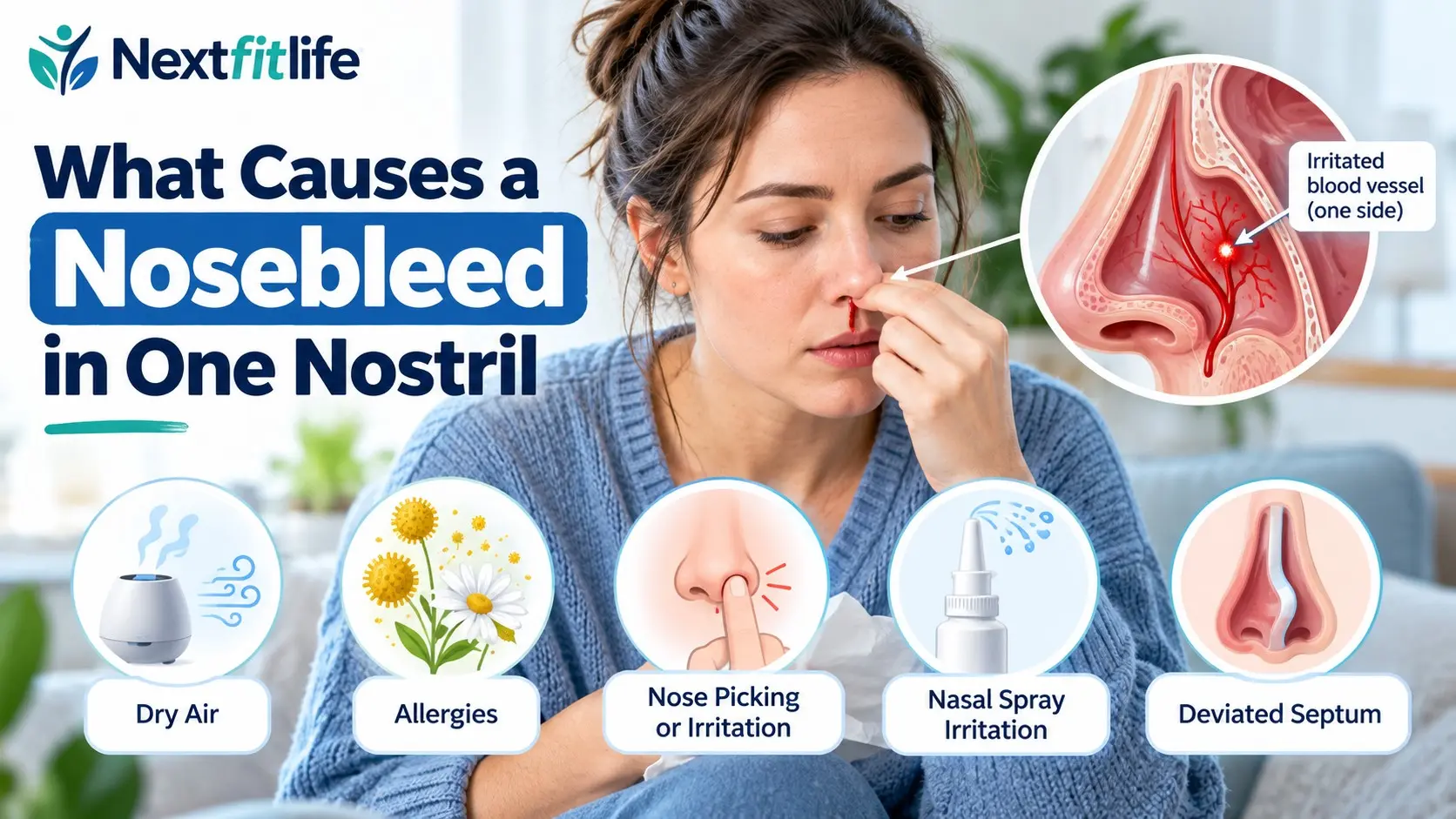
What Causes a Nosebleed in One Nostril is usually a local problem inside that side of the nose. Dry air, nose picking, forceful blowing, allergies, nasal sprays, a minor injury, or a deviated septum can all break a small blood vessel.
Most one sided nosebleeds are not dangerous. The pattern becomes more important when the same nostril keeps bleeding, especially if you also have one sided blockage, pain, a visible lump, or bleeding that is hard to stop.
This article is for general information and education. It does not replace medical advice, diagnosis, or treatment.
If your nose is bleeding now, first read How to Stop a Nosebleed: 7 Safe Steps That Work.
Table of Contents
- Why one nostril can bleed
- 9 common and important causes
- Dry nasal lining
- Nose picking
- Forceful nose blowing
- Allergies and colds
- Nasal sprays
- Minor injury
- Deviated septum
- Blood thinning medicines
- Rare local growths
- What makes one sided bleeding more concerning
- How to stop it safely
- Why the same side may bleed again
- How an ENT doctor checks the cause
- How to prevent another nosebleed
- Nosebleeds in children
- When to seek urgent care
- Frequently asked questions
What Causes a Nosebleed in One Nostril?
The inside of your nose contains many tiny blood vessels very close to the surface.
Most simple nosebleeds start near the front of the nasal septum, which is the wall between the two nostrils. If a small vessel breaks on one side, that nostril may bleed while the other side stays completely dry.
That is why a one sided nosebleed is common.
Cleveland Clinic notes that most nosebleeds affect only one nostril and that the most common cause is dry air.
The side itself is usually not the problem.
The more important clue is whether the bleeding keeps returning from that same side.
1. Dry Air Is the Most Common Cause
Dry air can pull moisture from the thin lining inside the nose.
The tissue then becomes cracked, crusted, and easier to damage.
A small crust can form over a fragile blood vessel. When you sneeze, rub your nose, or blow it, the vessel can open and bleed.
Only one nostril may bleed because dryness does not affect every area equally.
Dryness is more common with
- Indoor heating
- Air conditioning
- Low humidity
- Hot dry weather
- Cold winter air
- Sleeping near a strong fan
Cleveland Clinic lists hot low humidity climates, heated indoor spaces, and high altitude as common situations where nasal tissue dries more easily.
If dry air also causes mouth dryness, read Why Do I Wake Up With Dry Mouth?
2. Nose Picking Can Reopen the Same Blood Vessel
Nose picking is a very common local cause.
The vessels near the front of the septum are easy to scratch with a fingernail.
This becomes more likely when dry crusts form inside the nose.
A repeated cycle can develop:
- The nose becomes dry.
- A crust forms.
- You remove the crust.
- The vessel bleeds.
- A new crust forms.
- The same area is disturbed again.
That can explain why the same nostril bleeds every few days.
3. Blowing Your Nose Too Hard Can Trigger Bleeding
Forceful nose blowing raises pressure and can reopen fragile nasal vessels.
This is especially common during a cold or allergy flare when you are blowing your nose repeatedly.
If you recently had a nosebleed, that small vessel may remain fragile for a while.
Gentle blowing is better while the area heals.
4. Allergies, Colds, and Sinus Irritation Can Damage One Side
Allergic rhinitis, colds, and sinus inflammation make the nasal lining swollen and sensitive.
They also cause more sneezing, rubbing, wiping, and blowing.
That repeated irritation can make one local blood vessel break.
Clues that nasal inflammation is involved include
- Sneezing
- Blocked nose
- Runny nose
- Itchy eyes
- Postnasal drip
- Facial pressure
If allergies seem to be part of the pattern, see What Causes Allergies?
5. Nasal Sprays Can Irritate the Septum
Some nasal sprays can dry or irritate the inside of the nose.
Repeatedly spraying medicine directly onto the central septum can irritate the same spot again and again.
For many sprays, the nozzle should be aimed slightly outward rather than toward the middle wall of the nose, unless the product instructions say otherwise.
Frequent decongestant spray use can also create other nasal problems, including rebound congestion when used longer than recommended.
If you use a prescription spray, ask your pharmacist or clinician to check your technique.
6. Minor Injury Can Cause Bleeding From One Side
A small bump, scratch, or object inside the nose can injure one local blood vessel.
Possible causes include:
- A bump to the nose
- Rough cleaning
- A foreign object
- Recent nasal surgery
- Recent cautery
- Repeated touching inside the nostril
A mild brief nosebleed after small trauma can be simple.
A heavy bleed after a major fall, car accident, sports injury, or facial impact needs urgent assessment.
For nasal injury signs, read Broken Nose: Signs and Safe Recovery.
7. A Deviated Septum Can Dry Out One Nostril
A deviated septum means the wall between your nostrils bends more toward one side.
This can change airflow.
One part of the nasal lining may become drier or receive more turbulent airflow, making the tissue easier to irritate.
Other clues include
- Long term one sided stuffiness
- Difficulty breathing through one nostril
- Dryness or crusting
- Snoring
- Repeated bleeding from the same side
Cleveland Clinic lists a deviated septum among possible nosebleed causes.
A deviated septum does not automatically need surgery. Treatment depends on how much it affects breathing, dryness, and repeated bleeding.
8. Blood Thinners Can Make a Small Bleed Last Longer
A blood thinning medicine usually does not decide which nostril starts bleeding.
The local vessel breaks first.
But anticoagulants and antiplatelet medicines can make the bleeding last longer or recur more easily.
Examples can include:
- Warfarin
- Apixaban
- Rivaroxaban
- Dabigatran
- Aspirin
- Clopidogrel
Do not stop a prescribed blood thinner because of a nosebleed unless the clinician who manages it tells you to.
Tell your healthcare professional if nosebleeds are becoming frequent or difficult to stop.
Other signs that may suggest a bleeding problem
- Easy bruising
- Bleeding gums
- Heavy menstrual bleeding
- Long bleeding after small cuts
- A family history of bleeding problems
9. Rare Local Growths Can Cause Repeated One Sided Bleeding
This is much less common than dryness or irritation.
A nasal polyp, abnormal blood vessel, benign growth, or cancer can sometimes cause recurrent bleeding.
The key word is recurrent.
One ordinary nosebleed from one nostril is not a reason to assume cancer.
More concerning patterns include:
- Repeated bleeding from the same nostril
- Persistent one sided blockage
- Increasing facial pain or pressure
- A visible nasal mass
- Loss or change of smell
- Bleeding that becomes heavier over time
If that pattern develops, see an ENT specialist.
What Makes One Sided Nosebleeding More Concerning?
| Pattern | Possible Meaning | Best Next Step |
|---|---|---|
| One brief bleed in dry weather | Dry irritated vessel | First aid and moisture |
| Bleed after nose picking | Local trauma | Stop irritation and let the area heal |
| Bleed during an allergy flare | Inflamed nasal lining | Manage irritation and spray technique |
| The same nostril keeps bleeding | Persistent vessel, septum issue, or another local source | Medical or ENT assessment |
| Bleeding plus one sided blockage | Structural problem or lesion needs consideration | ENT examination |
| Heavy blood going into the throat | Possible deeper bleed | Prompt medical care |
| Bleed after serious injury | Trauma | Urgent assessment |
Why Does the Same Nostril Keep Bleeding?
Repeated bleeding from one side usually means a local area keeps getting irritated or reopened.
The common causes remain simple:
- A dry spot
- A crust that keeps being disturbed
- A fragile surface blood vessel
- A deviated septum
- Allergic inflammation
- Incorrect nasal spray technique
But this is also the point where an ENT examination becomes more useful.
The American Academy of Otolaryngology clinical guideline recommends nasal endoscopy for people with recurrent unilateral nasal bleeding or repeated bleeding despite prior treatment.
How Do You Stop a Nosebleed From One Nostril?
Even if only one side is bleeding, pinch both sides of the soft nose together.
- Sit upright.
- Lean slightly forward.
- Breathe through your mouth.
- Pinch the soft lower part of the nose.
- Hold constant pressure for 10 to 15 minutes.
- Do not release early to check.
Mayo Clinic advises pinching both nostrils shut even if only one side is bleeding and keeping pressure constant for about 10 to 15 minutes.
For the full first aid guide, see How to Stop a Nosebleed.
Should You Tilt Your Head Back?
No.
Lean forward.
Tipping the head back can send blood down your throat, where it may cause coughing, gagging, nausea, or vomiting.
Mayo Clinic recommends sitting upright and leaning forward so blood does not drain into the throat.
Should You Put Tissue Inside the Nostril?
Do not push dry tissue or cotton deeply inside the nose.
It can stick to the new clot and restart bleeding when you pull it out.
Use tissue outside the nostril to catch drips while you maintain pressure.
What Should You Do After the Bleeding Stops?
The clot needs time to become stable.
Avoid:
- Nose picking
- Hard nose blowing
- Heavy lifting
- Hard exercise
- Repeatedly checking the inside of the nose
Mayo Clinic advises avoiding nose picking and nose blowing after the bleeding stops and recommends moisture measures to reduce recurrence.
What Is Nasal Endoscopy?
Nasal endoscopy lets an ENT specialist look deeper inside the nose with a thin lighted scope.
It can help identify:
- A fragile vessel
- Septal irritation
- Polyps
- A foreign body
- Inflammation
- A deeper bleeding point
- An unusual growth
This type of examination becomes more useful when the same nostril keeps bleeding and the source is not obvious from a basic examination.
Does Everyone With a One Sided Nosebleed Need a CT Scan?
No.
Most simple nosebleeds need no imaging.
CT or MRI may be considered when a clinician suspects a deeper structural problem, a mass, significant facial injury, or another condition that cannot be explained by a surface blood vessel.
One ordinary dry air nosebleed does not justify a scan.
Can High Blood Pressure Cause a Nosebleed in One Nostril?
High blood pressure can be associated with more difficult or recurrent nosebleeds in some people, but a nosebleed does not prove that your blood pressure is high.
The bleeding still usually begins from a local nasal vessel.
If you have a severely high blood pressure reading together with chest pain, severe shortness of breath, weakness, vision changes, or neurologic symptoms, seek urgent medical care.
Can Sinus Problems Cause One Sided Bleeding?
Sinus or nasal inflammation can make the lining more fragile.
You may also blow your nose more often, which can reopen a vessel.
Signs that sinus inflammation may be involved include:
- Nasal blockage
- Facial pressure
- Thick nasal mucus
- Reduced smell
- Postnasal drip
If sinus pressure is part of the pattern, see Sinus Headache Causes and Relief.
Could Cocaine or Other Snorted Drugs Cause It?
Yes.
Drugs inhaled through the nose can damage the nasal lining and septum.
Repeated use can cause:
- Severe dryness
- Ulceration
- Crusting
- Repeated bleeding
- Septal perforation
Cleveland Clinic lists snorted recreational drugs such as cocaine as a possible cause of nosebleeds.
If this applies to you, tell the clinician honestly. It can change what they need to look for.
Could a One Sided Nosebleed Be Cancer?
Rarely.
Most one sided nosebleeds come from ordinary causes such as dryness or irritation.
But a persistent local lesion can bleed.
See an ENT specialist if one nostril repeatedly bleeds and you also develop:
- Persistent one sided nasal blockage
- Facial pain or pressure
- A visible lump
- Worsening bleeding
- Unexplained changes in smell
The correct message is not “one sided bleeding means cancer.”
It is “recurrent one sided bleeding deserves a proper look.”
What About Repeated One Sided Nosebleeds in Teenage Boys?
A rare benign vascular tumor called juvenile nasopharyngeal angiofibroma mainly occurs in adolescent boys.
One classic pattern is repeated one sided nosebleeds with increasing nasal blockage.
This condition is uncommon, but that symptom combination should not be managed as dry nose alone.
An ENT specialist should assess it.
How Can You Prevent Another Nosebleed?
Use Saline
A plain saline nasal spray can keep the nasal lining moist.
Use a Clean Humidifier
A humidifier can help when indoor air is very dry.
Clean it regularly so mold and bacteria do not grow inside it.
Do Not Pick Crusts
Let the healing tissue stay in place.
Use moisture to soften dryness rather than pulling the crust away.
Blow Gently
Repeated hard blowing can reopen a vessel.
Use Nasal Sprays Correctly
Follow the product instructions and avoid repeatedly spraying the central septum.
Control Allergies
Reducing sneezing, rubbing, and congestion lowers repeated trauma to the nasal lining.
What About One Sided Nosebleeds in Children?
Dry air and nose picking are common causes in children.
There is one other clue worth remembering.
A young child with one sided bleeding plus foul smelling discharge may have placed a small object in the nose.
Do not probe deeply with tweezers or cotton swabs.
A clinician can remove a foreign body more safely.
When Should You See an ENT Specialist?
Arrange medical or ENT care when:
- The same nostril keeps bleeding
- Bleeding comes back despite moisture and correct first aid
- You have one sided nasal blockage
- You have facial pain or swelling
- You can see a lesion or lump
- The bleeding is becoming heavier
- You previously needed nasal packing or cautery
- You have had nasal surgery
- You may have a foreign body
When Is a Nosebleed an Emergency?
Seek urgent medical help if:
- Bleeding is heavy
- It does not stop despite firm pressure
- You become faint or very weak
- You have trouble breathing
- A large amount of blood runs down the throat
- The bleed follows major head or facial trauma
- You take blood thinners and bleeding will not stop
- You have a known bleeding disorder
Mayo Clinic advises emergency care for a greater than expected amount of blood, faintness, persistent bleeding, or bleeding after significant trauma.
Conclusion: What Causes a Nosebleed in One Nostril?
What Causes a Nosebleed in One Nostril is usually something local and simple: dry air, a crust, nose picking, forceful blowing, allergies, spray irritation, minor trauma, or a deviated septum.
One short nosebleed from one side is usually not alarming.
What deserves more attention is a repeated pattern from the same nostril, especially when it comes with blockage, facial pain, a visible lesion, or bleeding that becomes harder to stop.
Your next step is simple: use proper pressure to stop the current bleed, keep the nasal lining moist while it heals, and arrange an ENT assessment if the same side keeps bleeding.
References and Sources
- Cleveland Clinic. Nosebleeds: Causes, Treatment and Prevention.
Explains why most nosebleeds affect one nostril and covers dry air, allergies, injury, nasal sprays, deviated septum, medicines, and other causes.
https://my.clevelandclinic.org/health/diseases/13464-nosebleed-epistaxis - Mayo Clinic. Nosebleeds: First Aid.
Provides first aid guidance on leaning forward, pinching both nostrils, continuous pressure, aftercare, and when to seek emergency help.
https://www.mayoclinic.org/first-aid/first-aid-nosebleeds/basics/art-20056683 - Tunkel DE and colleagues. Clinical Practice Guideline: Nosebleed.
American Academy of Otolaryngology guideline covering recurrent unilateral bleeding, nasal endoscopy, risk factors, cautery, packing, and blood thinning medicines.
https://pubmed.ncbi.nlm.nih.gov/31910111/ - MedlinePlus. Nosebleed.
National Library of Medicine guidance on causes, first aid, prevention, medicines, and medical assessment.
https://medlineplus.gov/ency/article/003106.htm - NHS. Nosebleed.
Covers common causes, correct first aid, prevention, anticoagulants, repeated bleeding, and urgent warning signs.
https://www.nhs.uk/conditions/nosebleed/
Internal Links and Helpful NextFitLife Guides
- How to Stop a Nosebleed: 7 Safe Steps That Work
- Broken Nose: Signs and Safe Recovery
- Lung and Respiratory Health Hub
- What Causes Allergies?
- Sinus Headache Causes and Relief
- Why Do I Wake Up With Dry Mouth?
About the Author
Adel Galal is the Founder and Lead Writer at NextFitLife. He researches health, fitness, respiratory health, nasal symptoms, first aid, nutrition, wellness, and healthy aging topics and turns current medical guidance into clear information for everyday readers.
I am not a dermatologist or a doctor, and this content does not replace professional medical advice. What I share comes from real life experience, extensive research, and consultation with healthcare providers. Always consult qualified medical professionals for diagnosis and treatment of any health condition.
Learn more about Adel, NextFitLife's editorial approach, and how health information is researched on the About Us page.
Frequently Asked Questions
What Causes a Nosebleed in One Nostril?
The most common cause is dry or irritated nasal tissue. Nose picking, forceful nose blowing, allergies, colds, nasal sprays, minor injury, or a deviated septum can also make one local blood vessel bleed.
Is it normal for only one nostril to bleed?
Yes. Most simple nosebleeds affect only one nostril because the bleeding starts from one small vessel on one side of the nasal septum.
Why does the same nostril keep bleeding?
A dry spot, crust, fragile blood vessel, deviated septum, allergy irritation, or spray technique may keep reopening the same area. Repeated unilateral bleeding should be checked by a clinician or ENT specialist.
Can a deviated septum cause one sided nosebleeds?
Yes. A deviated septum can change airflow and dry one part of the nasal lining more than the other, which can contribute to repeat bleeding.
Can allergies cause one nostril to bleed?
Yes. Allergies cause swelling, sneezing, rubbing, and repeated nose blowing, all of which can irritate one fragile blood vessel.
Can nasal spray cause bleeding from one nostril?
Yes. Some sprays can dry or irritate the septum, especially if they are repeatedly aimed toward the center of the nose rather than used as directed.
Could one sided nosebleeding be cancer?
Rarely. Cancer is not the usual cause of an occasional nosebleed. Repeated bleeding from the same nostril with one sided blockage, facial pain, or a visible mass should be checked by an ENT specialist.
How do you stop a nosebleed from one nostril?
Sit upright, lean forward, and pinch the soft part of both sides of the nose together for 10 to 15 minutes without releasing pressure to check too early.
When should I worry about bleeding from one nostril?
Seek medical advice if the same side keeps bleeding, you have one sided blockage or pain, bleeding becomes more frequent, or it continues despite proper first aid and moisture care.
When is a one sided nosebleed an emergency?
Seek urgent help if the bleeding is heavy, will not stop with firm pressure, causes weakness or breathing trouble, sends a large amount of blood into the throat, or follows serious facial or head trauma.

Health & wellness writer with 30+ years of experience in nutrition, fitness, and healthy aging. Founder of NextFitLife.com — evidence-based health guidance.

