
Published on: Jul 9, 2024
Updated: November 1, 2026
If you are searching for the best exercise for belly fat over 50, start with one important fact.
There is no single exercise that makes fat leave only your stomach.
Crunches can strengthen your abs. Planks can train your core, and walking can help you use more energy. None of them can tell your body to burn fat from your waist first.
After 50, the better goal is broader. Reduce excess body and visceral fat, protect muscle, maintain bone and joint health, and keep enough strength and balance for everyday life.
That is why a smart plan combines aerobic exercise, resistance training, core work, and regular movement.
This article is for general information and education. It does not replace medical advice, diagnosis, or treatment.
Quick answer: For most adults over 50, brisk walking is one of the easiest places to start. Add full body strength training at least twice weekly, then include simple core and balance work. Adults can work toward at least 150 minutes of moderate aerobic activity each week. If you are 65 or older, balance exercises also become an important part of the weekly plan.
Exercise safety: Stop exercising and seek urgent medical help for chest pain, fainting, severe shortness of breath, sudden weakness, confusion, or severe dizziness. Ask a healthcare professional about appropriate exercise if you have significant heart disease, uncontrolled blood pressure, serious balance problems, recent surgery, severe osteoporosis, advanced arthritis, or another condition that changes exercise safety.
Table of Contents
- Why belly fat often changes after 50
- Can exercise target stomach fat?
- What exercise works best after 50?
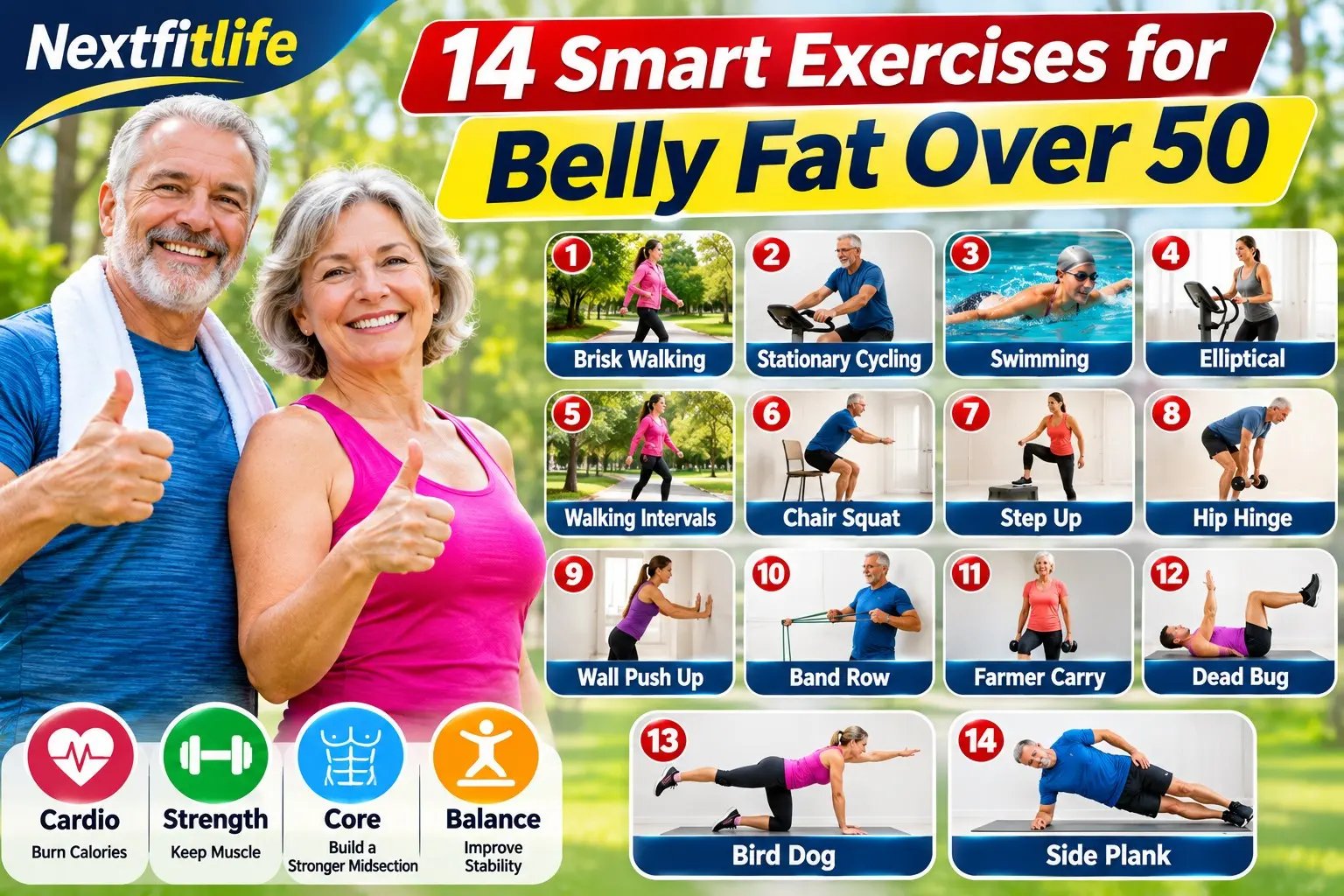
- 14 smart exercises
- Brisk walking
- Stationary cycling
- Swimming or water walking
- Elliptical exercise
- Walking intervals
- Chair squat
- Step up
- Hip hinge
- Wall push-up
- Resistance band row
- Farmer carry
- Dead bug
- Bird dog
- Side plank
- Aerobic exercise vs strength training
- Exercise during and after menopause
- Simple weekly plan
- Four-week beginner progression
- Core work and spot reduction
- Balance after 50
- Nutrition and muscle preservation
- Common mistakes
- Frequently asked questions
Why Belly Fat Often Changes After 50
Your body does not suddenly stop working at 50.
However, several things can change around midlife.
These may include:
- Lower daily activity
- Loss of muscle over time
- Changes in sleep
- Changes in food intake
- Menopause
- Changes in fat distribution
- Health conditions
- Some medicines
For women, menopause deserves special attention.
Research published in 2026 found that postmenopausal women tended to have more visceral fat and less lean mass than premenopausal women.
This means the scale may not tell the whole story.
A woman can have little change in body weight while more fat shifts toward the abdomen.
For a full explanation, read What Causes Belly Fat in Females Fast.
What Is Visceral Fat?
Visceral fat sits deep inside the abdomen around internal organs.
This differs from the softer subcutaneous fat that sits under the skin.
Higher visceral fat is linked with greater cardiometabolic risk.
The good news is that exercise can reduce abdominal obesity and visceral fat, including in older adults.
A 2026 systematic review of randomized trials found that aerobic, resistance, and combined exercise reduced measures of abdominal obesity in older adults.
Can Exercise Target Belly Fat After 50?
Not reliably.
This idea is called spot reduction.
Doing more situps does not force your body to remove fat from the skin over your abdominal muscles.
You can strengthen your stomach muscles while still carrying abdominal fat.
That is why your program needs more than core work.
Use:
- Aerobic exercise to improve fitness and help reduce body fat.
- Strength training to protect or build muscle.
- Core training to improve trunk strength and control.
- Balance work to maintain stability as you age.
What Is the Best Exercise for Belly Fat Over 50?
If you want one easy starting choice, use brisk walking.
Walking is simple, low cost, and easy to adjust.
But walking alone is not the complete answer.
The strongest long-term plan combines aerobic work with resistance training.
For adults 65 and older, current CDC guidance also recommends balance activities as part of the weekly routine.
14 Smart Exercises for Belly Fat Over 50
1. Brisk Walking
Walking is one of the best places to begin.
Walk fast enough that your breathing becomes quicker but you can still speak.
Beginner start: 10 minutes.
Build toward: 20 to 40 minutes.
You can divide walking into smaller sessions.
A ten-minute morning walk plus another ten minutes later still counts.
2. Stationary Cycling
Cycling gives you aerobic exercise without the repeated impact of running.
This can make it useful if walking for long periods bothers your feet, knees, or hips.
Beginner start: 10 minutes at an easy pace.
Add time gradually.
See Can Indoor Cycling Reduce Belly Fat? for a complete cycling plan.
3. Swimming or Water Walking
Water exercise can work well for people who prefer lower-impact movement.
You can swim laps, join a water aerobics class, or walk through the pool.
Beginner start: 10 minutes.
Rest when needed.
4. Elliptical Exercise
The elliptical provides continuous aerobic movement without the same ground impact as jogging.
Hold the handles lightly rather than leaning heavily on them.
Beginner start: 5 to 10 minutes.
5. Walking Intervals
You do not need sprint intervals.
Try this:
- Walk comfortably for 2 minutes.
- Walk briskly for 1 minute.
- Repeat for 15 to 20 minutes.
This lets you practice higher effort without turning the session into extreme HIIT.
6. Chair Squat
The chair squat trains your thighs and hips while practicing a movement you use every day.
- Stand in front of a stable chair.
- Move your hips backward.
- Bend your knees.
- Touch the chair lightly.
- Stand back up.
Start with: 6 to 10 repetitions.
Use your hands for support if needed.
7. Step Up
Step ups train the legs and also challenge balance.
Use a low, stable step.
Hold a rail or wall when needed.
Start with: 5 repetitions each side.
Do not start with a high step.
8. Hip Hinge
The hip hinge trains your hips, hamstrings, glutes, and back.
It also teaches you to bend through the hips rather than rounding through the spine.
Start without weight.
When the movement feels comfortable, add light dumbbells if appropriate.
Start with: 8 repetitions.
9. Wall Push Up
A wall push up trains your chest, shoulders, and arms.
It is easier than a floor push up.
As you become stronger, progress to a counter or sturdy bench.
Start with: 6 to 12 repetitions.
10. Resistance Band Row
A row trains your upper back and arms.
Use a band anchored safely or a resistance machine.
Pull with control and keep your shoulders relaxed.
Start with: 8 to 12 repetitions.
11. Farmer Carry
Hold a light weight in each hand and walk through a clear space.
This trains:
- Grip
- Shoulders
- Core
- Legs
- Postural control
Start with: 15 to 30 seconds.
Use light weights until you feel stable.
12. Dead Bug
The dead bug is a controlled core exercise that does not require fast bending or twisting.
- Lie on your back.
- Bend your knees.
- Gently brace your trunk.
- Slowly lower one heel toward the floor.
- Return and change sides.
Start with: 5 repetitions each side.
13. Bird Dog
The bird dog trains the trunk while also challenging coordination.
- Start on your hands and knees.
- Extend one arm or one leg.
- Progress to the opposite arm and leg together.
- Keep the movement slow.
Start with: 5 repetitions each side.
If kneeling bothers your knees, perform a standing version with your hands on a wall.
14. Side Plank
A side plank trains the muscles along the side of your trunk.
Start with your knees bent.
You do not need a one minute hold.
Start with: 5 to 15 seconds per side.
If it causes shoulder or back discomfort, choose another core exercise.
14 Exercises at a Glance
| Exercise | Type | Simple Start | Main Goal |
|---|---|---|---|
| Brisk walking | Cardio | 10 min | Aerobic fitness |
| Stationary cycling | Cardio | 10 min | Low impact aerobic work |
| Water exercise | Cardio | 10 min | Low impact movement |
| Elliptical | Cardio | 5 to 10 min | Aerobic fitness |
| Walking intervals | Cardio | 15 min | Higher effort practice |
| Chair squat | Strength | 6 to 10 reps | Leg strength |
| Step up | Strength | 5 each side | Leg strength and balance |
| Hip hinge | Strength | 8 reps | Hips and back |
| Wall push up | Strength | 6 to 12 reps | Upper body strength |
| Band row | Strength | 8 to 12 reps | Back strength |
| Farmer carry | Strength | 15 to 30 sec | Grip and trunk |
| Dead bug | Core | 5 each side | Core control |
| Bird dog | Core | 5 each side | Core and coordination |
| Side plank | Core | 5 to 15 sec | Side core strength |
Aerobic Exercise or Strength Training: Which Matters More?
You do not need to choose one forever.
They solve different problems.
Aerobic Exercise
Aerobic exercise includes walking, cycling, swimming, and similar continuous activities.
A 2026 systematic review of 16 randomized trials involving 1,571 postmenopausal women with overweight or obesity found that aerobic training reduced:
- Body weight
- Body fat percentage
- Fat mass
- Waist circumference
- Hip circumference
Average waist circumference fell by about 2 centimeters compared with control groups.
This does not mean every woman will lose exactly 2 centimeters.
Resistance Training
Strength training after 50 becomes very important because muscle tends to become harder to maintain with age.
A 2026 randomized trial in postmenopausal women found that 15 weeks of resistance training increased muscle volume by about 4 percent and improved strength.
That is a strong reason to include resistance exercise even if your main goal is reducing your waist.
Combined Training
A mix of aerobic and resistance training gives you both benefits.
Recent research suggests combined training can reduce visceral and subcutaneous fat while helping maintain physical function.
For many adults over 50, that makes a mixed program the most practical option.
What About HIIT After 50?
HIIT is not banned after 50.
Age alone does not make high intensity exercise unsafe.
But your training history and health matter more than your birthday.
If you have been inactive, start with moderate exercise.
After several weeks, you can add controlled intervals if appropriate.
An example:
- Walk easily for 2 minutes.
- Walk briskly for 1 minute.
- Repeat five times.
This is enough to practice changing intensity.
You do not need burpees, jump squats, or maximal sprints.
Does Hard Exercise Raise Cortisol and Cause Belly Fat?
Exercise can raise cortisol for a short time.
That is a normal exercise response.
It does not mean one hard workout creates permanent abdominal fat.
Problems are more likely when hard training is combined with too little food, poor sleep, illness, or inadequate recovery.
Do not avoid useful exercise because of fear of normal hormone changes.
See How to Get Rid of Stress Belly for a fuller explanation.
Exercise and Menopause Belly Fat
Menopause belly fat deserves careful wording.
Hormonal changes around menopause can shift fat toward the abdomen.
Recent 2026 research also shows that lean mass can decline while visceral fat rises.
This makes two exercise goals especially useful:
- Use aerobic exercise to help reduce excess body and abdominal fat.
- Use resistance training to protect muscle and strength.
Do not respond to menopause related body change by doing only cardio and eating very little.
Muscle and bone health matter too.
Does Menopause Make Belly Fat Impossible to Lose?
No.
Menopause can change body composition and fat distribution, but exercise and nutrition still work.
A 2026 review of menopause weight management found that combined diet and exercise approaches can improve weight, body composition, and metabolic risk.
Progress may not look the same as it did at 25.
That does not mean progress is impossible.
What About Men Over 50?
The same basic exercise principles apply.
Men can also lose muscle with age and may accumulate more visceral fat.
A useful plan still includes:
- Aerobic exercise
- Progressive strength training
- Core work
- Enough recovery
- A suitable eating pattern
There is no special men's belly fat exercise.
How Much Exercise Do You Need After 50?
Adults should work toward at least 150 minutes of moderate aerobic activity each week plus strength work on at least two days.
Activity can be divided across the week.
You do not have to complete long workouts.
For example:
- 30 minutes on five days
- 20 to 25 minutes most days
- Several shorter sessions
If you are inactive now, begin with much less.
Ten minutes counts.
What Changes at Age 65?
CDC guidance for adults 65 and older adds a clear recommendation for balance exercises.
A weekly plan should include:
- At least 150 minutes of moderate aerobic activity
- Strength training on at least two days
- Balance work
If your health or physical abilities prevent you from reaching those numbers, be as active as your abilities allow.
Simple Balance Exercises
Balance training does not burn much belly fat by itself.
It matters because staying stable helps you keep moving and training safely.
Try:
- Heel to toe walking
- Supported single leg standing
- Chair sit to stand
- Step ups with support
Stand near a sturdy counter or wall.
A 25 Minute Beginner Workout Over 50
Warm Up: 5 Minutes
- Easy walking
- Marching
- Gentle shoulder movement
- Easy hip movement
Strength Circuit
Complete one or two rounds.
| Exercise | Amount |
|---|---|
| Chair squat | 8 reps |
| Wall push up | 8 reps |
| Band row | 10 reps |
| Hip hinge | 8 reps |
| Dead bug | 5 per side |
Cardio Finish: 10 Minutes
Walk, cycle, or march at a moderate effort.
Cool down gently afterward.
A Simple Weekly Plan Over 50
| Day | Main Activity |
|---|---|
| Monday | 20 to 30 minute brisk walk |
| Tuesday | Full body strength and short core session |
| Wednesday | 20 to 30 minute cycling, swimming, or walking |
| Thursday | Easy movement or recovery |
| Friday | Full body strength and core |
| Saturday | 30 minute aerobic session or gentle intervals |
| Sunday | Rest or easy walk |
If you are 65 or older, add short balance practice on several days.
A Four Week Beginner Progression
| Week | Cardio Goal | Strength Goal |
|---|---|---|
| Week 1 | 10 min on 4 to 5 days | 1 short session |
| Week 2 | 15 min on 4 to 5 days | 2 short sessions |
| Week 3 | 20 min on 5 days | 2 sessions |
| Week 4 | 25 to 30 min on suitable days | 2 sessions plus core and balance |
You do not have to progress every week.
Stay at one level longer if that feels better.
Why Strength Training Matters More After 50
Weight loss without resistance training can include muscle loss.
That becomes more important with age because muscle helps with:
- Walking
- Stairs
- Balance
- Lifting
- Daily independence
- Bone loading
Do not chase a smaller waist by sacrificing strength.
Read How to Maintain Muscle Mass for more detail.
Can Resistance Bands Work After 50?
Yes.
You do not need a heavy barbell to benefit from strength work.
A 2026 review found that elastic band resistance training improved several cardiometabolic markers in older adults at risk of metabolic syndrome.
Bands can be useful when:
- You train at home
- You travel
- Weights feel intimidating
- You need easy resistance adjustments
The exercise still needs to become challenging enough over time.
Does Core Training Burn Belly Fat?
No.
Core training improves the muscles around your trunk.
It may help you move, lift, and stabilize your spine more effectively.
It does not make belly fat disappear from that exact area.
Do Crunches Help After 50?
Crunches are not required.
Some people can perform them comfortably.
Others prefer exercises such as:
- Dead bugs
- Bird dogs
- Side planks
- Carries
Choose movements that feel controlled and comfortable.
Do Planks Flatten Your Stomach?
No.
Planks can strengthen your trunk, but they do not remove the fat above it.
You also do not need long plank holds.
Short, controlled sets can be enough.
What About Back Pain?
If you have persistent back pain, do not assume more abdominal exercise is the answer.
Back pain has many causes.
Walking and appropriate strength work may help some people, but exercises should be adapted to the problem.
Seek assessment if pain is severe, follows trauma, or comes with weakness, numbness, bowel changes, or bladder changes.
What If Your Knees Hurt?
You still have options.
Try:
- Shorter walks
- Stationary cycling
- Swimming
- Water walking
- Chair squats through a comfortable range
Pain that persists or worsens deserves assessment.
Can You Lose Belly Fat by Walking After 50?
Walking can help.
It increases total activity and can contribute to an energy deficit.
Walking also improves cardiovascular fitness without requiring advanced skills.
But the complete plan should still include strength work.
Should You Walk Every Day?
You can walk often if it feels good.
Daily walking is not mandatory.
The important goal is enough total activity across the week.
Rest when you need it.
How Fast Should You Walk?
For moderate intensity, walk fast enough that your breathing increases.
You should still be able to talk.
You should not need to gasp for air.
If this feels too difficult, slow down.
Does Incline Walking Help?
Walking uphill or using a treadmill incline can increase effort.
It does not specifically target belly fat.
Start with a gentle incline if your calves, feet, knees, and balance tolerate it.
Is Cycling Good After 50?
Yes.
Cycling can provide aerobic exercise with relatively low impact.
Indoor cycling also gives you easy control over resistance and duration.
Make sure the bike fits properly.
Is Swimming Good for Belly Fat After 50?
Swimming can be a useful aerobic choice.
It trains many muscles and can feel comfortable when land based exercise bothers the joints.
It still works through total activity rather than spot reduction.
What About Yoga?
Yoga can support flexibility, balance, mobility, and stress management.
It should not be your only tool if the main goal is reducing abdominal fat.
Combine it with enough aerobic activity and strength work.
See Best Yoga Moves for Beginners.
Do You Need to Exercise Every Day?
No.
Recovery matters.
You can move every day while still keeping hard training days separate.
A week can include:
- Brisk walking
- Strength sessions
- Easy movement
- Balance work
- Rest
Food Still Matters
Exercise is excellent for health even if your weight barely changes.
But if reducing body fat is your goal, food intake matters too.
You need an eating pattern that creates a manageable energy deficit over time.
You do not need a crash diet.
For a broader approach, visit the Complete Weight Loss Guide.
Protein Becomes Important After 50
Protein supports muscle.
Useful sources include:
- Eggs
- Greek yogurt
- Fish
- Chicken
- Lean meat
- Beans
- Lentils
- Tofu
- Tempeh
- Cottage cheese
If you are losing weight, adequate protein plus strength training can help protect lean mass.
See High Protein Foods for Weight Loss.
Do You Need to Cut Carbs?
No.
Carbohydrates can support exercise and fit a healthy fat loss plan.
Foods such as fruit, oats, beans, lentils, potatoes, rice, and whole grains can all fit.
Portion and total intake matter more than removing one nutrient group.
Sleep Matters Too
Poor sleep can affect appetite, energy, food choices, and recovery.
Adding another hard workout is not always the best response when you are exhausted.
Protect enough time for sleep.
If you have loud snoring, repeated breathing pauses, or severe daytime sleepiness, talk with a healthcare professional about possible sleep apnea.
How Fast Can You Lose Belly Fat After 50?
There is no fixed timeline.
Results depend on:
- Starting body composition
- Food intake
- Exercise
- Sleep
- Menopause status
- Genetics
- Medicines
- Health conditions
Think in weeks and months, not days.
Can You Flatten Your Stomach in 7 Days?
Not through major fat loss.
Your waist can look different in a week because of food volume, water, constipation, or bloating.
That is not the same as losing a large amount of visceral or subcutaneous fat.
Can You Lose Belly Fat After 50 Without Losing Muscle?
You can often preserve much of your muscle by combining:
- Gradual weight loss
- Enough protein
- Resistance training
- Good recovery
Some muscle loss can still occur during substantial weight loss.
The goal is to minimize unnecessary loss.
How to Track Progress
Do not rely only on one scale number.
Track:
- Body weight trend
- Waist circumference
- Walking pace
- Strength
- Energy
- How clothes fit
Measure your waist using the same method each time.
You do not need to measure every day.
Common Belly Fat Exercise Mistakes After 50
1. Doing Only Crunches
Core work does not replace cardio and full body strength training.
2. Starting With Extreme HIIT
You can build fitness with moderate exercise first.
3. Doing Only Cardio
Strength training becomes increasingly valuable with age.
4. Eating Too Little
Crash dieting can make it harder to meet protein and nutrient needs.
5. Avoiding Strength Work Because You Fear Getting Bulky
Resistance training supports muscle, bone, strength, and function.
6. Ignoring Balance
Balance becomes more important as you age, especially from age 65 onward.
7. Training Through Joint Pain
Modify the movement or choose another exercise.
8. Believing Sweat Equals Fat Loss
Sweat helps cool your body. It does not measure body fat loss.
9. Expecting Your 50 Year Old Body to Respond Like It Did at 25
Your program may need more recovery and more attention to muscle, but progress remains possible.
10. Quitting After Two Weeks
Body composition changes take time.
Best Exercise for Belly Fat Over 50 Checklist
- Start with aerobic activity you can repeat.
- Build toward at least 150 minutes each week.
- Strength train at least twice weekly.
- Train all major muscle groups.
- Add short core sessions.
- Add balance work, especially after 65.
- Progress gradually.
- Use HIIT only when appropriate.
- Eat enough protein.
- Avoid crash dieting.
- Sleep and recover well.
- Track waist, strength, and fitness over time.
Conclusion
The Best Exercise for Belly Fat Over 50 is not one magic move.
Brisk walking and other aerobic activities can help reduce abdominal and visceral fat. Resistance training helps protect muscle and strength, while core exercises make your middle stronger.
After 65, balance also deserves a regular place in your week.
You do not need extreme HIIT, hundreds of situps, or a workout that promises to flatten your stomach today.
Your next step: take a 10 to 20 minute brisk walk today and schedule two short strength sessions for this week. Start with chair squats, wall push ups, rows, and a controlled core exercise, then build from there.
References and Sources
- Centers for Disease Control and Prevention. Older Adult Activity: An Overview. Updated December 4, 2025.
https://www.cdc.gov/physical-activity-basics/guidelines/older-adults.html - National Institute on Aging. Three Types of Exercise and Physical Activity.
https://www.nia.nih.gov/health/exercise-and-physical-activity/four-types-exercise-and-physical-activity - Liu and colleagues. Effect of exercise on abdominal obesity and inflammatory response in older adults. Systematic review and meta analysis of randomized controlled trials, 2026.
https://pubmed.ncbi.nlm.nih.gov/41561801/ - Impact of Aerobic Training on Body Composition Among Postmenopausal Women With Overweight or Obesity. Systematic review and dose response meta analysis, 2026.
https://pubmed.ncbi.nlm.nih.gov/42251396/ - Szeliga A, Chedraui P, Meczekalski B. The Impact of the Menopausal Transition on Body Composition and Abdominal Fat Redistribution, 2026.
https://pubmed.ncbi.nlm.nih.gov/41598677/ - Thorell S, et al. Effects of resistance training on postmenopausal women's muscle strength, muscle volume and muscle fat infiltration, 2026.
https://pubmed.ncbi.nlm.nih.gov/41687563/ - Saez Berlanga A, et al. Elastic Band Resistance Training for Metabolic Syndrome Components in Older Adults. Systematic Review and Meta Analysis, 2026.
https://pubmed.ncbi.nlm.nih.gov/41771463/ - Weight Management in Menopause: Diet, Physical Activity, Medication, and Surgery. 2026.
https://pubmed.ncbi.nlm.nih.gov/42508875/
Internal Links + Hub
- NextFitLife Fitness Hub
- Fitness Program Guide
- Belly Fat Loss Guide
- Best Exercise for Belly Fat
- Top Exercises for Belly Fat
- Exercises to Lose Belly Fat
- Belly Fat Exercises at Home for Beginners
- Can Indoor Cycling Reduce Belly Fat?
- What Causes Belly Fat in Females Fast
- How to Get Rid of Stress Belly
- How to Maintain Muscle Mass
- Getting Fit at 60
- Strength Training Exercises for Seniors
- Strength Training at Home for Beginners
- High Protein Foods for Weight Loss
- Healthy Eating Lifestyle
- Complete Weight Loss Guide
- Best Yoga Moves for Beginners
About the Author
Adel Galal is the founder and lead writer of NextFitLife.com and the founder of Parnthub.com.
He is a father of four, three sons and a daughter, and a grandfather of four, with more than 33 years of hands on family experience. Adel is based in Cairo, Egypt.
He has maintained a personal interest in health, fitness, nutrition, sleep, wellness, and healthy aging for more than 30 years and has more than 15 years of health and wellness writing experience.
His work focuses on reviewing trusted sources, separating useful fitness guidance from exaggerated weight loss claims, and turning research into practical steps that people can use in daily life.
Adel is not a doctor, registered dietitian, exercise physiologist, physical therapist, certified personal trainer, or other licensed healthcare professional. Health articles cite trusted sources and are for general information and education only.
Learn more about Adel and NextFitLife on the About Us page.
Frequently Asked Questions
What is the Best Exercise for Belly Fat Over 50?
There is no single exercise that targets belly fat. Brisk walking is a strong starting choice, while a complete plan combines aerobic exercise, full body strength training, core work, and balance.
Can walking reduce belly fat after 50?
Yes. Regular brisk walking can support overall and abdominal fat loss when it helps increase activity and supports an appropriate energy balance.
How long should I walk after 50?
Beginners can start with 10 minutes and build gradually. Adults can work toward at least 150 minutes of moderate aerobic activity each week.
Is cardio or strength training better after 50?
Both matter. Aerobic exercise helps reduce body and visceral fat, while strength training helps protect muscle and physical function.
How often should I strength train after 50?
Current guidance recommends muscle strengthening work on at least two days each week.
Can strength training reduce belly fat?
Strength training can improve body composition and help preserve muscle. It does not spot reduce stomach fat.
Does menopause cause more belly fat?
Menopause can shift fat distribution toward the abdomen, while aging, activity, sleep, food intake, and muscle loss also affect body composition.
Can women lose menopause belly fat?
Yes. Menopause does not make fat loss impossible. Regular aerobic activity, resistance training, suitable nutrition, sleep, and consistency can improve body composition.
Is HIIT safe after 50?
It can be appropriate for healthy and conditioned adults, but beginners should build fitness first. Health conditions and exercise history matter more than age alone.
Does HIIT cause cortisol belly after 50?
No good evidence shows that appropriate HIIT creates permanent belly fat because of normal short term cortisol changes.
Do situps burn belly fat after 50?
No. Situps strengthen abdominal muscles but do not make fat leave the stomach first.
Do planks flatten your stomach?
No. Planks strengthen the core but do not directly remove abdominal fat.
Should I train my abs every day?
No. Two or three short core sessions each week can fit many exercise plans.
Is cycling good for belly fat after 50?
Yes. Cycling is aerobic exercise and can contribute to overall and visceral fat loss when practiced regularly.
Is swimming good after 50?
Yes. Swimming and water walking provide aerobic activity with relatively low impact on the joints.
Can resistance bands build strength after 50?
Yes. Resistance bands can provide effective strength training when exercises become progressively challenging.
Do I need balance exercises at 50?
Balance work can be useful at any age. Current CDC guidance specifically recommends regular balance activities for adults age 65 and older.
Can I exercise every day after 50?
You can move every day, but hard workouts do not need to happen daily. Include recovery between demanding sessions.
How much exercise should I do after 50?
Adults can work toward at least 150 minutes of moderate aerobic activity per week plus strength training on two days.
Can I lose belly fat after 50 without dieting?
Exercise can improve fitness and body composition even without large scale changes, but meaningful fat loss usually requires overall energy intake to support a deficit.
Should I eat more protein after 50?
Adequate protein becomes important for preserving muscle, especially when combined with resistance training and weight loss.
Do I need to stop eating carbs after 50?
No. Carbohydrate foods can fit a healthy diet and can help fuel exercise. Total diet quality and energy intake matter more.
Can I flatten my belly in seven days after 50?
You may notice changes in bloating or water, but major abdominal fat loss should not be expected in seven days.
How long does it take to lose belly fat after 50?
There is no fixed timeline. Look for progress across weeks and months rather than days.
What is the safest exercise if I am very unfit?
For many people, short easy walks or stationary cycling are good starting choices. Begin below the usual activity targets and build gradually.
What if knee pain stops me from walking?
Stationary cycling, swimming, water walking, or shorter walks may be easier. Persistent or worsening knee pain deserves assessment.
What is the best weekly plan after 50?
A useful plan combines several aerobic sessions with two full body strength workouts, short core work, recovery, and balance practice when appropriate.

Health & wellness writer with 30+ years of experience in nutrition, fitness, and healthy aging. Founder of NextFitLife.com — evidence-based health guidance.

