

Published on: May 20, 2025
Updated on: November 4, 2026
Chair exercise for seniors can be a practical way to stay active when standing for long periods is difficult, balance is limited, or you are returning to exercise after a break.
Seated exercise can help improve strength, mobility, flexibility, and physical function. It can also make exercise feel less intimidating because the chair provides support.
However, chair exercise should not automatically replace all standing, walking, or balance work. If you can safely do more, combining seated exercise with supported standing, walking, and strength training usually gives a more complete fitness plan.
This guide gives you 17 safe chair based and chair supported exercises, plus a beginner routine, progression ideas, older adult safety guidance, and advice on when to add more upright movement.
Important: This article is for general information and education. It does not replace medical advice, diagnosis, or treatment.
Safety first: Use a sturdy chair without wheels. Place it on a flat surface. Stop exercising and seek medical advice if you develop chest pain, fainting, severe unusual shortness of breath, new severe weakness, or sudden neurological symptoms.
Table of Contents
- Quick Answer
- Benefits of Chair Exercise
- 17 Chair Exercises for Seniors
- Beginner Chair Workout
- How Often to Exercise
- How to Progress Safely
- Chair Exercise and Strength
- Chair Exercise and Balance
- Chair Cardio
- Chair Exercise for Limited Mobility
- When to Add Standing Exercise
- Common Mistakes
- When to Get Medical Advice
- Conclusion
- References and Sources
- Internal Links + Fitness Hub
- About the Author
- Frequently Asked Questions
Quick Answer: Is Chair Exercise Good for Seniors?
Yes. Chair exercises for seniors can improve strength, mobility, flexibility, and physical function, especially for people who have difficulty exercising upright.
A useful chair routine can include:
- Breathing and posture reset
- Seated marching
- Ankle pumps
- Heel raises
- Toe raises
- Knee extensions
- Seated hip abduction
- Heel slides
- Seated punches
- Arm circles
- Shoulder press
- Resistance band row
- Biceps curl
- Torso rotation
- Side reach
- Sit to stand
- Supported standing march
If standing is safe for you, gradually adding sit to stand, walking, and balance exercises can make the program more complete.
For more stability work, read our Balance Exercises guide.
What Are the Benefits of Chair Exercise for Seniors?
Chair based exercise can help older adults stay active when floor exercise or long periods of standing are difficult.
Potential benefits include:
- Improved upper body strength
- Improved lower body function
- Better muscle endurance
- Improved flexibility
- More joint movement
- Better posture awareness
- Improved confidence
- More daily activity
A systematic review involving 1,388 older adults found that chair-based exercise improved upper and lower extremity function. A 2025 meta-analysis also found gains in muscle endurance, flexibility, and dynamic balance in postmenopausal women.
17 Safe Chair Exercises for Seniors
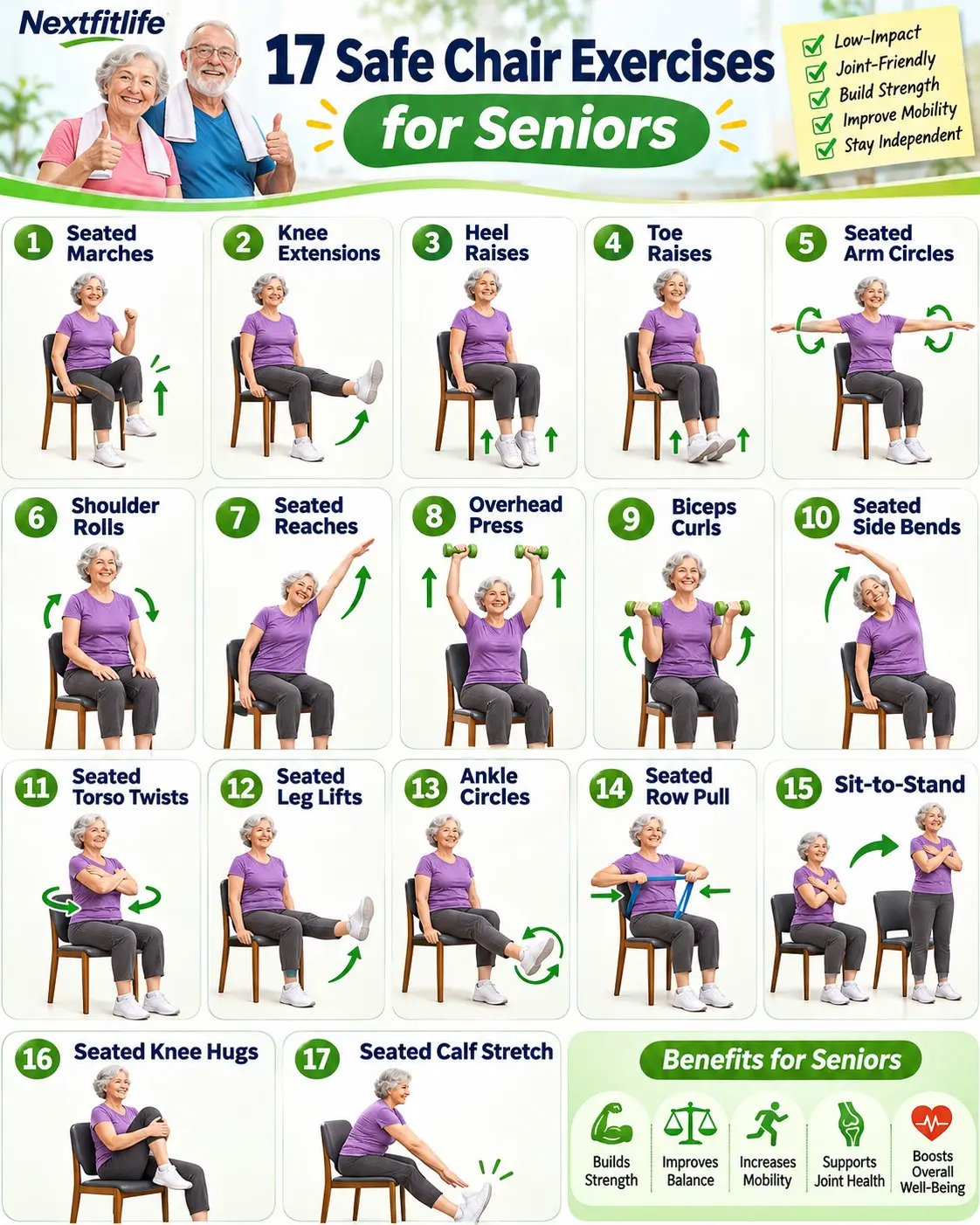
17 Chair exercise for seniors can support strength, mobility, endurance, and confidence when movements are matched to ability and progressed safely.
1. Seated Breathing and Posture Reset
Start by sitting tall rather than slumping into the chair.
- Place both feet flat on the floor.
- Relax your shoulders.
- Gently lift your chest.
- Breathe in slowly through your nose.
- Breathe out gently.
Repeat for 5 slow breaths.
2. Seated Marching
Seated marching is a simple way to add movement and raise your heart rate slightly.
- Sit tall.
- Lift one knee.
- Lower it.
- Lift the other knee.
Starting target: 20 to 40 alternating marches.
3. Ankle Pumps
Ankle pumps move the ankle through a simple range.
- Keep your heels near the floor.
- Point your toes forward.
- Then pull your toes back toward you.
Repeat 10 to 20 times.
4. Seated Heel Raises
This exercise works the calf muscles.
- Keep the front of your feet on the floor.
- Lift both heels.
- Pause.
- Lower slowly.
Starting target: 2 sets of 10 to 15 repetitions.
5. Seated Toe Raises
Toe raises work the muscles at the front of the lower leg.
- Keep your heels down.
- Lift your toes and front of your feet.
- Lower slowly.
Repeat 10 to 15 times.
6. Seated Knee Extensions
This exercise trains the front of the thighs.
- Sit tall.
- Straighten one knee.
- Pause briefly.
- Lower the foot.
- Switch legs.
Starting target: 8 to 12 repetitions per side.
7. Seated Hip Abduction
This exercise trains the outer hip muscles.
- Place your feet about hip width apart.
- Move one knee gently outward.
- Return to the center.
- Switch sides.
A light resistance band can be added later if appropriate.
8. Seated Heel Slides
Heel slides move the knee and hip through a comfortable range.
- Place one heel on the floor.
- Slide the foot forward.
- Slide it back.
- Switch sides.
Keep the movement smooth.
9. Seated Punches
This is a simple form of seated cardio.
- Sit tall.
- Bring your hands near your chest.
- Punch one arm forward.
- Return it.
- Alternate arms.
Work for 20 to 40 seconds, then rest.
10. Seated Arm Circles
Arm circles add shoulder movement and light endurance work.
- Lift your arms out to the sides if comfortable.
- Make small circles.
- Reverse direction.
Keep the circles small if your shoulders are sensitive.
11. Seated Shoulder Press
This exercise trains the shoulders and arms.
You can use very light dumbbells, water bottles, or no weight.
- Hold your hands near shoulder height.
- Press upward.
- Lower slowly.
Starting target: 1 to 2 sets of 8 to 12 repetitions.
12. Seated Resistance Band Row
A row trains the upper back and arms.
- Use a resistance band anchored safely in front of you.
- Hold one end in each hand.
- Pull your elbows backward.
- Pause.
- Return slowly.
Do not attach a band to unstable furniture.
13. Seated Biceps Curl
Use light dumbbells, water bottles, or a resistance band.
- Keep your elbows near your sides.
- Bend your elbows.
- Bring your hands toward your shoulders.
- Lower slowly.
Starting target: 1 to 2 sets of 8 to 15 repetitions.
14. Seated Torso Rotation
This adds gentle trunk mobility.
- Sit tall.
- Place your hands across your chest.
- Turn gently to one side.
- Return to the center.
- Turn the other way.
Keep the movement pain free.
15. Seated Side Reach
This exercise works trunk movement and shoulder mobility.
- Sit tall.
- Reach one arm gently upward and to the side.
- Return to the center.
- Switch sides.
16. Sit to Stand
Sit to stand is one of the most useful functional exercises for older adults because daily life requires getting up from chairs, toilets, beds, and car seats.
- Sit toward the front of a sturdy chair.
- Place your feet flat on the floor.
- Lean forward slightly.
- Stand up with control.
- Sit back down slowly.
Use your hands on the chair arms if needed.
Starting target: 5 to 10 repetitions.
17. Supported Standing March
This is a bridge from chair exercise to upright activity.
- Stand behind the chair.
- Hold the backrest with both hands.
- Lift one knee.
- Lower it.
- Alternate sides.
Only use this exercise if standing is safe for you.
Simple 15 Minute Chair Workout for Seniors
| Exercise | Dose | Main Focus |
|---|---|---|
| Seated March | 60 seconds | Warm up |
| Knee Extensions | 10 each leg | Leg strength |
| Heel Raises | 15 reps | Calves |
| Seated Punches | 30 seconds | Cardio |
| Band Row | 10 reps | Upper back |
| Shoulder Press | 8 to 10 reps | Upper body |
| Sit to Stand | 5 to 10 reps | Functional strength |
Rest whenever you need to.
How Often Should Seniors Do Chair Exercise?
Short sessions several days each week can work well.
CDC recommends that adults aged 65 and older aim for:
- At least 150 minutes of moderate aerobic activity per week
- Muscle strengthening on at least 2 days per week
- Activities that improve balance
If health or mobility limitations make those targets difficult, CDC advises being as active as your abilities and conditions allow.
Chair exercise can contribute to that activity, but it may not cover every category by itself.
Can Chair Exercise Build Strength?
Yes.
Chair based programs can improve upper and lower body function, especially when exercises use enough resistance and are progressed gradually.
A systematic review of 25 studies found meaningful improvements in handgrip strength, arm curl performance, and chair stand performance.
To progress, you can:
- Add repetitions.
- Add a light resistance band.
- Use slightly heavier dumbbells.
- Slow the lowering phase.
- Add a second set.
Progress one factor at a time.
Can Chair Exercise Improve Balance?
It can help some aspects of physical function, but seated exercise is not a complete substitute for standing balance training.
A 2025 meta analysis found an improvement in dynamic balance in postmenopausal women following chair based exercise.
However, earlier systematic evidence found seated exercise was not as effective as weight bearing and functional exercise for balance and mobility.
If you can stand safely, add exercises such as:
- Sit to stand
- Supported marching
- Heel to toe walking
- Supported single leg stance
See our Balance Exercises guide for safe progressions.
Can Chair Exercise Count as Cardio?
Some chair exercises can raise your heart rate.
Examples include:
- Fast seated marching
- Seated punches
- Alternating knee lifts
- Fast arm movements
If these movements make you breathe faster while still allowing you to speak, they may contribute to moderate intensity activity depending on your fitness level.
Intensity is relative. A movement that feels easy to one person may be challenging to another.
Chair Exercise for Seniors With Limited Mobility
Chair exercise is especially useful for older adults who cannot safely perform a full standing workout.
WHO states that older adults who cannot meet the full physical activity recommendation because of health limitations should still be as active as their abilities allow.
A seated routine can help maintain:
- Movement
- Muscle activation
- Joint range
- Exercise confidence
- Daily activity
If mobility improves, gradually add more functional movement.
When Should Seniors Add Standing Exercise?
If standing is safe and comfortable, upright movement provides benefits that sitting alone cannot fully reproduce.
Add standing work when you can safely:
- Stand from the chair
- Hold a stable support
- Walk a short distance
- Maintain balance without severe dizziness
Start with sit to stand and supported marching before moving to harder balance exercises.
Should Seniors Use Dumbbells or Resistance Bands?
Yes, when appropriate.
Light resistance can make chair exercise more effective for strength.
You can use:
- Light dumbbells
- Resistance bands
- Water bottles
- Bodyweight
For structured strength guidance, see our Strength Training and Muscle Building Guide.
How to Make Chair Exercise Harder Safely
Progress gradually.
You can:
- Add 2 or 3 repetitions.
- Add another set.
- Increase resistance slightly.
- Move through a larger comfortable range.
- Increase seated marching time.
- Add sit to stand.
- Add supported standing exercise.
Do not make every part harder at once.
Common Chair Exercise Mistakes
Using a Chair With Wheels
Use a stable chair that will not move underneath you.
Slumping Through the Whole Workout
Sit tall enough to allow comfortable breathing and arm movement.
Moving Too Fast
Control the movement, especially during strength exercises.
Using Resistance That Is Too Heavy
Choose a load that allows good form.
Staying Seated Forever When Standing Is Safe
Chair exercise can be a starting point. Add functional standing and walking when appropriate.
Ignoring Balance Training
Older adults benefit from balance work in addition to strength and aerobic activity.
Training Through Pain or Dizziness
Pain and dizziness are not signs that exercise is working better.
When Should a Senior Stop Exercising?
Stop the exercise and get appropriate medical help for:
- Chest pain or pressure
- Fainting
- Severe unusual shortness of breath
- Sudden severe weakness
- New severe dizziness
- Sudden one sided weakness
- New trouble speaking
- A serious injury
If you have heart disease, uncontrolled blood pressure, recent surgery, severe osteoporosis, major joint disease, or another significant medical condition, ask your healthcare professional what exercise level is appropriate for you.
Conclusion
Chair exercise for seniors can be a safe and practical way to build strength, improve mobility, increase daily activity, and regain confidence.
The most useful routine combines seated movement with gradual resistance, then adds sit to stand, supported standing, walking, and balance exercises when those activities are safe.
Your next step: choose five exercises from this guide today and complete one short 10 to 15 minute session using a sturdy chair.
References and Sources
- Centers for Disease Control and Prevention. Older Adult Activity: An Overview. Guidance on aerobic activity, muscle strengthening, balance, and adapting physical activity to ability.
https://www.cdc.gov/physical-activity-basics/guidelines/older-adults.html - World Health Organization. Physical Activity and Older Adults. Guidance on activity, mobility, balance, and staying active according to ability.
https://www.who.int/health-topics/ageing/physical-activity - The Effect of Chair Based Exercise on Physical Function in Older Adults. Systematic review and meta analysis of 25 studies including 1,388 participants.
https://pubmed.ncbi.nlm.nih.gov/33669357/ - The Effect of Chair Based Exercise on Physical Functioning in Postmenopausal Women. 2025 meta analysis examining muscle endurance, flexibility, and balance outcomes.
https://pubmed.ncbi.nlm.nih.gov/41257594/ - To Sit or Not to Sit? A Systematic Review and Meta Analysis of Seated Exercise for Older Adults. Review of controlled trials examining seated exercise, strength, activity, mobility, and quality of life.
https://pubmed.ncbi.nlm.nih.gov/30548900/
Internal Links + Fitness Hub
- NextFitLife Fitness Hub
- Balance Exercises
- Strength Training and Muscle Building Guide
- Injury Prevention Exercises
- Walking for Weight Loss
- Low Impact Exercises to Burn Fat at Home
- Best Way to Lose Weight After 40
- 5 Components of Physical Fitness
About the Author
Adel Galal is a father of four, three sons and a daughter, and a grandfather of four, with 33 years of hands on parenting experience. He is the founder of Parnthub.com, based in Cairo, Egypt, where he shares practical guidance on feeding, development and family life from newborns to teenagers.
Adel is not a medical professional. Health articles cite trusted sources and are for general information only.
Learn more on the NextFitLife About Us page.
Frequently Asked Questions
Is chair exercise good for seniors?
Yes. Chair exercise can improve strength, mobility, flexibility, and physical function, especially for older adults who find standing exercise difficult.
How long should a senior chair workout last?
Beginners can start with about 10 to 15 minutes and build gradually. Short sessions can still be useful when they are performed consistently.
Can chair exercises build leg strength?
Yes. Knee extensions, heel raises, seated marching, and sit to stand can train the lower body. Resistance can be added gradually when appropriate.
Can chair exercise count as cardio?
Fast seated marching, punches, and other continuous chair movements can raise heart rate and may contribute to aerobic activity depending on the person's fitness and effort.
Can chair exercise improve balance?
Chair exercise may improve some aspects of physical function and dynamic balance, but standing and functional balance training are usually needed for a complete balance program when those activities are safe.
What is the best chair exercise for seniors?
No single exercise is best for everyone. A useful routine includes seated marching, knee extensions, rows, heel raises, shoulder presses, and sit to stand when safe.
How often should seniors do chair exercises?
Chair exercise can be performed several days each week. Older adults should also aim for aerobic, strength, and balance activity according to their ability and health.
Are resistance bands safe for seniors?
Resistance bands can be useful when the resistance is appropriate and the band is anchored safely. Check bands for damage before use.
Should seniors stay seated for the whole workout?
Not necessarily. If standing is safe, adding sit to stand, supported marching, walking, and balance exercises can make the program more functional.
When should a senior stop exercising?
Stop and seek appropriate medical care for chest pain, fainting, severe unusual shortness of breath, sudden severe weakness, new severe dizziness, or serious injury.

Health & wellness writer with 30+ years of experience in nutrition, fitness, and healthy aging. Founder of NextFitLife.com — evidence-based health guidance.

