Originally published: Apr 4, 2023
Last updated: July 17, 2026
Next review: July 2027
Written by: Adel Galal, Founder and Lead Writer at NextFitLife
Review status: Editorially reviewed and checked against current NIH, ACOG, WHO, FDA, and NHS guidance. This page has not been medically reviewed by a doctor, obstetrician, midwife, pharmacist, or registered dietitian.
Reading time: About 20 minutes
Not getting enough iron may lead to iron deficiency anemia.
This may cause tiredness, weakness, dizziness, pale skin, shortness of breath, headaches, or a fast heartbeat.
These symptoms can also have other causes during pregnancy.
A blood test is needed to check for anemia.
Pregnant women generally need about 27 milligrams of iron each day.
Reaching that amount through food alone can be difficult.
This is why many prenatal care plans include a prenatal vitamin containing iron.
Some women need additional treatment when blood tests show low iron or anemia.
Do not start a high-dose supplement on your own.
Too much iron can cause harm.
This guide answers what foods are high in iron for pregnant women with 15 safe and practical choices.
It also explains iron absorption, vegetarian options, food safety, supplement side effects, anemia testing, and warning signs.
For a wider guide to food-based anemia support, read Treating Anemia With Food.
What Foods Are High in Iron for Pregnant Women? Quick Answer
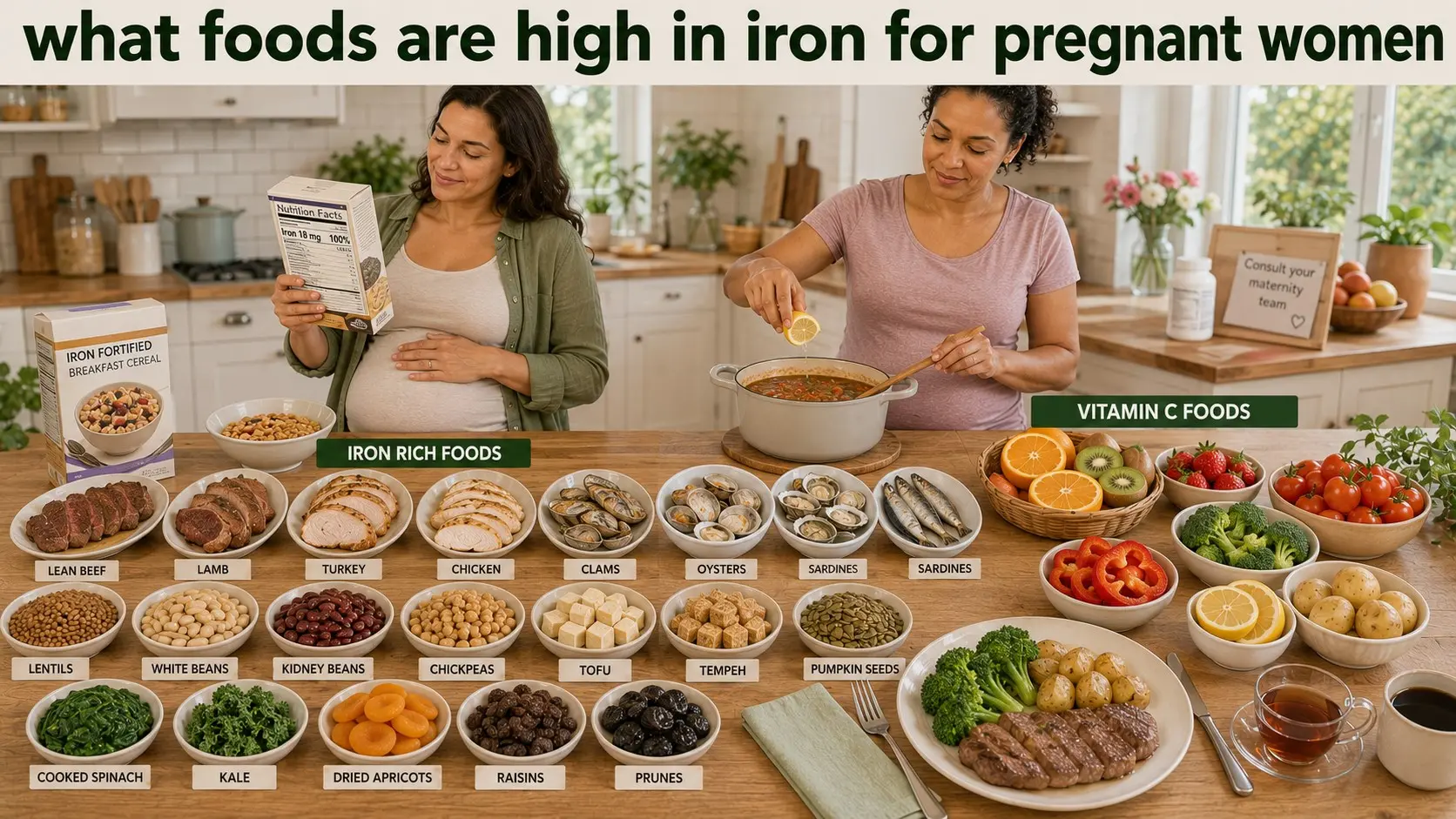
Useful iron-rich foods during pregnancy include:
- Iron-fortified breakfast cereal
- Lean beef
- Lean lamb
- Turkey
- Chicken
- Fully cooked clams
- Fully cooked oysters
- Sardines
- Lentils
- Beans
- Chickpeas
- Tofu and tempeh
- Pumpkin seeds and other suitable seeds
- Spinach, kale, and other dark green vegetables
- Dried apricots, raisins, and prunes
Eat plant iron with a source of vitamin C.
Good pairings include lentils with tomatoes, fortified cereal with strawberries, beans with peppers, or spinach with citrus fruit.
Avoid tea and coffee with an iron-rich meal or an iron tablet because they may reduce absorption.
Follow your maternity team’s instructions about prenatal vitamins and iron treatment.
Do not eat liver or liver products during pregnancy because they contain high amounts of vitamin A.
Editorial and Advertising Disclosure
This guide was written and editorially reviewed by Adel Galal.
Adel is a health and wellness writer.
He is not a doctor, obstetrician, midwife, pharmacist, or registered dietitian.
This page cannot diagnose anemia, interpret blood results, or prescribe an iron dose.
NextFitLife uses display advertising to support the website.
Advertising does not decide the foods, advice, medical warnings, sources, or conclusions on this page.
Read the
Editorial Policy,
Medical Review Policy,
and
Corrections Policy.
Important Pregnancy Iron Safety Note
Do not diagnose iron deficiency from tiredness alone.
Pregnancy itself can cause fatigue.
Other causes include poor sleep, thyroid disease, infection, vitamin B12 deficiency, folate deficiency, bleeding, and other forms of anemia.
Blood tests help identify the cause.
Do not double your prenatal vitamin.
Do not combine several iron supplements unless your doctor or midwife has checked the total dose.
Iron overdose can be dangerous and may be fatal to a child.
Keep all supplements locked away and out of sight.
Contact urgent medical services after a large accidental dose, even if symptoms have not started.
Why Iron Matters During Pregnancy
Iron is needed to make hemoglobin.
Hemoglobin carries oxygen from the lungs to the body.
During pregnancy, blood volume increases.
Your body also needs iron to support the placenta and the developing baby.
Iron Supports More Than Blood
Iron also supports:
- Normal growth and development
- Muscle function
- Energy production
- Normal immune function
- The baby’s developing iron stores
Low Iron Can Progress
Low iron stores may develop before hemoglobin becomes low.
This is why a person may have iron deficiency before clear anemia appears.
Testing and treatment decisions should be made by the maternity team.
How Much Iron Do Pregnant Women Need?
The recommended intake during pregnancy is generally 27 milligrams each day.
This is higher than the recommendation for most nonpregnant adult women.
Food, fortified products, and prenatal supplements may all contribute.
Food Alone May Not Be Enough
Pregnancy iron needs are high.
Many women do not meet them through food alone.
ACOG advises taking a prenatal vitamin with iron and eating iron-rich foods.
WHO recommends iron and folic acid supplementation as part of antenatal care in many settings.
Exact products and doses differ between countries and individuals.
Do Not Treat the Number as a Supplemental Dose
The 27-milligram food recommendation is not the same as a treatment prescription.
A clinician may recommend a different amount when anemia is diagnosed.
Follow the exact product, dose, and timing given by your maternity team.
Heme Iron and Nonheme Iron
Food contains two main forms of iron.
Heme Iron
Heme iron comes from animal foods.
It is usually absorbed more easily.
Sources include:
- Lean beef
- Lean lamb
- Turkey
- Chicken
- Fish
- Cooked shellfish
Nonheme Iron
Nonheme iron is found in plant foods and fortified foods.
Sources include:
- Fortified cereal
- Beans
- Lentils
- Chickpeas
- Tofu
- Seeds
- Leafy green vegetables
- Dried fruit
Nonheme iron is not absorbed as easily.
Eating it with vitamin C can improve absorption.
15 Foods High in Iron for Pregnant Women
The answer to what foods are high in iron for pregnant women should include both animal and plant choices.
Amounts vary by brand, serving, cooking method, and food source.
Read labels on fortified products.
| Food | Iron type | Pregnancy note |
|---|---|---|
| Iron-fortified breakfast cereal | Nonheme iron | Read the label because amounts vary widely. |
| Lean beef | Heme and nonheme iron | Cook fully and avoid rare meat. |
| Lean lamb | Heme and nonheme iron | Choose lean cuts and cook safely. |
| Turkey | Heme and nonheme iron | Dark meat often contains more than breast meat. |
| Chicken | Heme and nonheme iron | Dark meat usually provides more than breast meat. |
| Cooked clams | Heme and nonheme iron | Eat only fully cooked shellfish. |
| Cooked oysters | Heme and nonheme iron | Avoid raw oysters during pregnancy. |
| Sardines | Heme and nonheme iron | Choose lower-sodium products when possible. |
| Lentils | Nonheme iron | Pair with tomatoes, peppers, or citrus. |
| Beans | Nonheme iron | Drain and rinse canned beans. |
| Chickpeas | Nonheme iron | Use in curry, soup, salad, or hummus. |
| Tofu and tempeh | Nonheme iron | Check calcium and sodium on the label. |
| Pumpkin seeds | Nonheme iron | Use a small portion and avoid whole seeds if choking is a concern. |
| Spinach and dark greens | Nonheme iron | Cooked greens provide a more concentrated serving. |
| Dried apricots, raisins, and prunes | Nonheme iron | Use a small portion because dried fruit is concentrated in sugar. |
1. Iron Fortified Breakfast Cereal
Fortified cereal can be one of the easiest ways to increase iron intake.
Some products provide a large part of the daily requirement.
Others provide very little.
Read the nutrition label.
Choose a product with:
- Added iron
- More fiber
- Less added sugar
- A realistic serving size
Add strawberries, kiwi, or another vitamin C fruit.
Milk provides useful pregnancy nutrients, but calcium may reduce iron absorption when taken at the same time.
This does not mean dairy is unhealthy.
It means women being treated for low iron may need personalized timing advice.
2. Lean Beef
Lean beef provides heme iron, protein, zinc, and vitamin B12.
Choose lean cuts and moderate portions.
Remove visible fat.
Cook the beef fully to a safe temperature.
Do not eat raw or undercooked meat during pregnancy.
Serve beef with peppers, tomatoes, broccoli, potatoes, or citrus fruit.
3. Lean Lamb
Lamb provides heme iron, protein, zinc, and vitamin B12.
Choose lean cuts.
Trim visible fat.
Cook it fully.
Use vegetables and beans to make the meal more balanced.
4. Turkey
Turkey provides protein and heme iron.
Dark turkey meat often contains more iron than breast meat.
Choose fresh cooked turkey instead of processed deli meat more often.
Deli meat can contain a lot of sodium and may need reheating according to local pregnancy food safety advice.
Cook poultry fully.
5. Chicken
Chicken provides protein and some iron.
Dark meat usually provides more iron than breast meat.
Remove the skin when you want less saturated fat.
Cook chicken until it reaches a safe internal temperature.
Do not rely on colour alone to judge safety.
6. Fully Cooked Clams
Clams can be a rich source of iron.
They also provide protein and vitamin B12.
Clams are included among lower mercury seafood choices in FDA guidance.
They must be fully cooked.
Do not eat raw or partly cooked clams during pregnancy.
Discard shellfish that do not open during cooking.
7. Fully Cooked Oysters
Oysters can provide iron, zinc, protein, and vitamin B12.
They are also listed among lower mercury seafood choices.
Raw oysters can carry harmful bacteria.
Eat oysters only when they are fully cooked.
Avoid foods containing raw oyster juice or raw shellfish.
8. Sardines
Sardines provide iron, protein, vitamin B12, vitamin D, and omega fats.
Sardines with soft edible bones also provide calcium.
They are a lower mercury seafood choice.
Check sodium in canned products.
Serve sardines with tomatoes, lemon, salad, potatoes, or whole grain toast.
For vitamin D information, read Top Vitamin D Foods.
9. Lentils
Lentils are a useful source of plant-based iron, protein, fibre, and folate.
They work well in soup, curry, stew, salad, and grain bowls.
Pair lentils with:
- Tomatoes
- Bell peppers
- Broccoli
- Lemon
- Orange
Increase fibre slowly when lentils cause gas or bloating.
10. Beans
White beans, kidney beans, black beans, soybeans, and other beans provide nonheme iron.
They also provide protein, fibre, and folate.
Use beans in soup, chilli, salad, tacos, rice dishes, or spreads.
Drain and rinse canned beans to reduce some sodium.
People with kidney disease may need personal advice about potassium and phosphorus.
See the Diet for Kidney Disease Guide when kidney limits apply.
11. Chickpeas
Chickpeas provide iron, protein, fibre, and folate.
Use them in hummus, curry, soup, salad, or roasted dishes.
Pair chickpeas with lemon, tomatoes, cabbage, peppers, or broccoli.
Commercial hummus can contain a lot of sodium.
Compare labels.
12. Tofu and Tempeh
Tofu and tempeh provide plant protein and nonheme iron.
They can be useful in vegetarian and vegan pregnancy diets.
Add them to stir fries, soup, curry, rice, noodles, or vegetables.
Pair them with vitamin C-rich vegetables.
Check sodium in flavoured products.
Calcium set tofu provides calcium, but its calcium content may affect iron absorption within the same meal.
Overall diet quality matters more than perfect food separation.
13. Pumpkin Seeds and Other Seeds
Pumpkin seeds provide nonheme iron, protein, healthy fats, and minerals.
Sesame and sunflower seeds can also contribute.
Use a small handful or spoonful.
Add seeds to cereal, yogurt, salad, soup, or bread.
Ground seeds may be easier to digest.
14. Spinach, Kale, and Other Dark Green Vegetables
Dark green vegetables provide nonheme iron, folate, fibre, and other nutrients.
Cooked greens provide a larger amount in a smaller serving.
Pair them with tomatoes, peppers, lemon, kiwi, or berries.
Spinach contains compounds that reduce some iron absorption.
It is still a useful vegetable, but it should not be your only iron source.
15. Dried Apricots, Raisins, and Prunes
Dried fruit can contribute iron and fibre.
It is also concentrated in natural sugar and calories.
Use a small portion.
Choose products without added sugar.
Pair dried fruit with seeds, nuts, fortified cereal, or a vitamin C-rich fruit.
People with gestational diabetes should include dried fruit in their carbohydrate plan.
How to Absorb More Iron From Food
Knowing what foods are high in iron for pregnant women is only one part of the plan.
The body must also absorb the iron.
Add Vitamin C
Vitamin C improves the absorption of nonheme iron.
Good sources include:
- Oranges
- Kiwi
- Strawberries
- Mango
- Tomatoes
- Bell peppers
- Broccoli
- Cauliflower
- Potatoes
Simple Food Pairings
- Fortified cereal with strawberries
- Lentil soup with tomatoes and lemon
- Beans with peppers
- Tofu with broccoli
- Spinach with orange segments
- Beef with tomatoes and potatoes
Move Tea and Coffee Away From Iron-Rich Meals
Tea and coffee contain compounds that may reduce iron absorption.
This includes some decaffeinated products.
When low iron is a concern, drink tea or coffee between meals rather than with the meal.
Your maternity team may suggest leaving about one hour before or after eating or taking an iron tablet.
Ask About Calcium Timing
Calcium can interfere with iron absorption.
Dairy foods remain important sources of protein, calcium, iodine, and vitamin B12.
Do not remove them without advice.
When you are taking an iron supplement, your doctor or pharmacist may tell you to take calcium tablets, antacids, milk, or dairy at a different time.
Vegetarian and Vegan Iron Foods During Pregnancy
A vegetarian or vegan pregnancy can provide enough iron, but planning matters.
Plant iron is absorbed less efficiently.
Women following these diets may need closer review of iron intake, vitamin B12, iodine, vitamin D, calcium, choline, protein, and omega fats.
Useful Plant Iron Foods
- Iron-fortified cereal
- Lentils
- White beans
- Kidney beans
- Chickpeas
- Soybeans
- Tofu
- Tempeh
- Pumpkin seeds
- Spinach
- Kale
- Dried apricots
Use Vitamin C at Each Main Meal
Add fruit or vegetables containing vitamin C.
This is especially useful with beans, lentils, tofu, cereal, and greens.
Check the Prenatal Vitamin
Not every prenatal product contains the same amount of iron.
Some gummy products contain no iron.
Review the label with your doctor, midwife, pharmacist, or dietitian.
For broader vitamin planning, visit the Vitamins and Minerals in Food Hub.
Iron Rich Foods to Avoid or Limit During Pregnancy
Some foods contain iron but create other pregnancy risks.
Liver and Liver Products
Liver is rich in iron.
However, it is also very high in preformed vitamin A.
Too much preformed vitamin A can harm the baby’s development.
Avoid:
- Liver
- Liver pâté
- Liver sausage
- Cod liver oil
- Supplements containing retinol unless prescribed
Do not include liver in a pregnancy iron food list.
Raw or Undercooked Shellfish
Clams and oysters may contain iron.
They must be fully cooked.
Raw shellfish may contain harmful bacteria or parasites.
Raw or Undercooked Meat
Do not eat rare meat, raw meat, or food containing raw meat during pregnancy.
Use a food thermometer when possible.
High Mercury Fish
Fish provides iron and other useful pregnancy nutrients.
Choose seafood from lower mercury categories.
Avoid shark, swordfish, king mackerel, marlin, orange roughy, Gulf of Mexico tilefish, and bigeye tuna under current FDA guidance.
Local fish advice may differ.
Food Safety for Iron-Rich Pregnancy Meals
Pregnancy increases the risk of serious illness from some foodborne germs.
Cook Meat and Poultry Fully
Use a food thermometer.
Do not rely only on colour.
Ground meat and poultry require careful cooking.
Cook Seafood
Cook fish until it is opaque and flakes easily.
Cook clams, oysters, and other shellfish fully.
Do not eat raw sushi, raw oysters, or partly cooked shellfish.
Prevent Cross Contamination
Keep raw meat, poultry, seafood, and eggs away from ready-to-eat food.
Use separate cutting boards when possible.
Wash hands and kitchen surfaces.
Wash Produce
Wash fruit and vegetables under clean running water.
Do not use soap or household cleaner on produce.
Use Pasteurized Foods
Choose pasteurized milk, yogurt, cheese, and juice.
Check labels when you are unsure.
Iron Deficiency Anemia in Pregnancy
Anemia in pregnancy means there are not enough healthy red blood cells or enough hemoglobin to carry oxygen normally.
Iron deficiency is a common cause.
Other causes are possible.
Possible Symptoms
- Unusual tiredness
- Weakness
- Pale skin
- Shortness of breath
- Dizziness
- Headaches
- A fast heartbeat
- Difficulty concentrating
- Feeling cold
- Craving ice or nonfood substances
Some women have no obvious symptoms.
Do not wait for symptoms before attending prenatal blood tests.
Why Treatment Matters
Untreated anemia may affect maternal health and pregnancy outcomes.
Your maternity team may recommend food changes, oral iron, intravenous iron, or another treatment depending on the cause and severity.
Pregnancy Blood Tests for Iron and Anemia
Your maternity team may use a complete blood count to check hemoglobin and red blood cells.
This is often done early in pregnancy and repeated later according to local care guidance.
Ferritin
Ferritin is a protein that stores iron.
A low ferritin result can support a diagnosis of iron deficiency.
Ferritin can be affected by inflammation or illness.
A clinician should interpret the result.
Other Tests
When anemia does not respond as expected, the maternity team may check:
- Vitamin B12
- Folate
- Red blood cell size
- Inflammation
- Bleeding
- Inherited blood conditions
Do not assume every anemia is caused by iron deficiency.
Iron Supplements During Pregnancy
Iron supplements can prevent or treat low iron when used correctly.
They are not all the same.
Different products contain different amounts of elemental iron.
Prenatal Vitamins
Many prenatal vitamins contain iron.
Some do not.
Gummy vitamins are more likely to leave iron out.
Read the label with your maternity professional.
Treatment Iron
A treatment tablet may contain more iron than a prenatal vitamin.
Take the exact product and dose prescribed.
Do not take two tablets because you missed one unless your clinician tells you to do so.
Iron and Folic Acid
WHO recommends daily iron and folic acid supplementation during pregnancy as part of antenatal care.
National recommendations and individual prescriptions vary.
Folic acid has a separate role in reducing the risk of neural tube defects.
Do not replace folic acid with an iron-rich diet.
Intravenous Iron
Some women cannot tolerate tablets or do not respond well enough.
Intravenous iron may be considered in selected cases.
This treatment must be given and monitored by qualified medical staff.
Iron Tablet Side Effects and Practical Tips
Common side effects include:
- Constipation
- Nausea
- Stomach pain
- Bloating
- Diarrhea
- Dark stool
Do Not Stop Without Asking
Tell your doctor, midwife, or pharmacist when side effects make the supplement difficult to take.
They may change the product, dose, timing, or schedule.
Taking Iron With Food
Iron may be absorbed better on an empty stomach.
It may also cause more stomach discomfort.
Your clinician may advise taking it with food when needed.
Avoid Certain Products at the Same Time
Your pharmacist may advise separating iron tablets from:
- Tea
- Coffee
- Calcium supplements
- Antacids
- Some thyroid medicines
- Some antibiotics
Do not change medicine timing without professional advice.
Constipation
Drink enough fluid unless you have a medical fluid limit.
Eat fruit, vegetables, beans, and suitable whole grains.
Stay active as advised by your maternity team.
Ask before using a laxative.
One-Day Iron-Rich Pregnancy Meal Plan
This example is general.
Adjust it for allergies, nausea, gestational diabetes, kidney disease, vegetarian eating, food access, and your maternity plan.
Breakfast
Choose iron-fortified cereal with strawberries and kiwi.
Use pasteurized milk or a fortified soy drink according to your iron and calcium timing plan.
Morning Snack
Choose a small portion of dried apricots with pumpkin seeds.
Lunch
Choose lentil and tomato soup with peppers and whole grain bread.
Add lemon before serving.
Afternoon Snack
Choose hummus with red pepper and cucumber.
Dinner
Choose fully cooked lean beef, turkey, sardines, or tofu.
Add potatoes or rice and broccoli or cabbage.
Vegetarian Option
Choose tofu with beans, broccoli, peppers, and rice.
Drinks
Choose water.
Move tea and coffee away from iron-rich meals when low iron is a concern.
For more balanced meal ideas, visit the Foods and Nutrition Hub.
Common Pregnancy Iron Myths
Myth: Liver Is the Best Iron Food for Pregnancy
No.
Liver is high in iron but also very high in preformed vitamin A.
Pregnant women should avoid liver and liver products.
Myth: Spinach Alone Can Prevent Anemia
No.
Spinach provides nonheme iron, but absorption is limited.
Use it as one part of a varied iron plan.
Myth: Every Pregnant Woman Needs a High-Dose Iron Tablet
No.
Most women need a prenatal plan, but treatment doses should match medical advice and blood results.
Myth: Feeling Tired Proves You Have Low Iron
No.
Tiredness has many possible causes.
Blood testing is needed.
Myth: Taking More Iron Works Faster
No.
More iron may cause stronger side effects or toxicity.
Take only the prescribed amount.
Myth: Plant Foods Cannot Provide Iron
No.
Beans, lentils, tofu, fortified cereals, seeds, greens, and dried fruit all provide iron.
Vitamin C helps improve absorption.
Myth: Dark Stool Always Means Internal Bleeding
Iron tablets commonly darken stool.
However, black tarry stool with pain, weakness, faintness, or bleeding concerns needs urgent medical advice.
When to Contact Your Maternity Team
Arrange Medical Advice for
- Severe or persistent tiredness
- Breathlessness with normal activity
- Repeated dizziness
- A fast or pounding heartbeat
- Pale skin
- Craving ice, soil, clay, or other nonfood substances
- Iron tablets you cannot tolerate
- Missed prenatal blood tests
- Concern about a vegan or restrictive diet
- Previous severe anemia
Seek Urgent Medical Care for
- Chest pain
- Severe breathing trouble
- Fainting
- Heavy vaginal bleeding
- A very fast or irregular heartbeat with severe symptoms
- Confusion
- A large accidental iron overdose
- Reduced fetal movement after movement has normally become established
Contact your local maternity unit or emergency service according to the symptoms and local guidance.
Conclusion
The answer to what foods are high in iron for pregnant women includes fortified cereal, lean meat, poultry, fully cooked lower-mercury seafood, lentils, beans, chickpeas, tofu, seeds, greens, and dried fruit.
Use both animal and plant sources when they fit your diet.
Pair plant iron with vitamin C.
Move tea and coffee away from iron-rich meals when possible.
Avoid liver, raw shellfish, undercooked meat, and unsafe fish choices.
Attend prenatal blood tests.
Take iron and folic acid supplements exactly as advised.
Use this What Foods Are High in Iron for Pregnant Women guide by adding one safe iron food and one vitamin C food to your next balanced meal.
References and Sources
- National Institutes of Health Office of Dietary Supplements. Iron Fact Sheet for Health Professionals.Current information about iron needs, heme iron, nonheme iron, food sources, absorption, pregnancy requirements, deficiency, upper limits, and interactions.
- National Institutes of Health Office of Dietary Supplements. Dietary Supplements and Pregnancy.Current pregnancy guidance about the 27-milligram iron recommendation, prenatal supplements, plant iron, vitamin C, calcium, and deficiency risk.
- American College of Obstetricians and Gynecologists. Healthy Eating During Pregnancy.Open guidance about prenatal vitamins, iron-rich foods, vitamin C pairings, anemia testing, and additional supplements when anemia is diagnosed.
- World Health Organization. Daily Iron and Folic Acid Supplementation During Pregnancy.Current global recommendation for antenatal iron and folic acid supplementation to reduce maternal anemia and related pregnancy risks.
- United States Food and Drug Administration. Advice About Eating Fish.Current advice about lower mercury seafood choices, pregnancy servings, foods to avoid, and the nutritional value of fish.
- United States Food and Drug Administration. Meat, Poultry and Seafood Safety for Pregnancy.Official advice about avoiding raw shellfish, cooking meat and seafood, safe temperatures, and preventing foodborne illness.
- NHS. Vitamins and Supplements in Pregnancy.Open pregnancy advice explaining why liver, liver products, fish liver oil, and supplements containing retinol should be avoided.
Continue Reading on NextFitLife
Frequently Asked Questions
What foods are high in iron for pregnant women?
Useful choices include fortified cereal, lean beef, lamb, turkey, chicken, fully cooked clams and oysters, sardines, lentils, beans, chickpeas, tofu, seeds, dark green vegetables, and dried fruit.
How much iron does a pregnant woman need?
The general recommendation is 27 milligrams per day. Your maternity team may prescribe a different supplement dose when anemia is diagnosed.
Can food alone provide enough iron during pregnancy?
Food can contribute a large amount, but many pregnant women also need a prenatal vitamin with iron. Confirmed deficiency may require treatment.
Which iron form is absorbed best?
Heme iron from lean meat, poultry, fish, and cooked shellfish is generally absorbed more easily than plant iron.
Which vegetarian foods are high in iron for pregnant women?
Useful choices include fortified cereal, lentils, beans, chickpeas, tofu, tempeh, pumpkin seeds, spinach, kale, and dried fruit.
How can I absorb more iron from plant foods?
Eat plant iron with vitamin C foods such as oranges, kiwi, strawberries, tomatoes, peppers, broccoli, or potatoes.
Should I avoid tea and coffee with iron-rich meals?
Tea and coffee may reduce iron absorption. When low iron is a concern, drink them between meals rather than with food or an iron tablet.
Is liver safe during pregnancy?
No. Liver and liver products contain high amounts of preformed vitamin A, which may harm the baby’s development.
Are clams and oysters safe during pregnancy?
They may be eaten when fully cooked and selected according to local seafood safety advice. Avoid raw or undercooked shellfish.
Can I eat red meat for iron during pregnancy?
Yes. Choose lean cuts, use moderate portions, and cook the meat fully.
What are the signs of low iron during pregnancy?
Possible signs include unusual fatigue, weakness, pale skin, dizziness, headaches, breathlessness, or a fast heartbeat. A blood test is needed.
What is ferritin?
Ferritin is a protein that stores iron. A low result can support a diagnosis of iron deficiency, but a clinician must interpret it.
Should I take an iron tablet while pregnant?
Take the prenatal vitamin or iron product recommended by your doctor or midwife. Do not start a high dose treatment on your own.
Why do iron tablets cause constipation?
Constipation is a common iron side effect. Ask your maternity team about food, fluid, activity, timing, or another suitable product.
Can too much iron harm the baby or mother?
Yes. Excess iron can cause serious toxicity. Follow the prescribed dose and keep supplements locked away from children.
Is this article medical advice?
No. It provides general education. A qualified maternity professional should diagnose anemia and recommend treatment.
Pregnancy Iron and Medical Disclaimer
This content is for education only.
It does not replace prenatal care, blood testing, anemia diagnosis, prescribed supplements, pregnancy nutrition care, or emergency services.
I am not a dermatologist or A doctor, and this content does not replace professional medical advice. What I share comes from real-life experience, extensive research, and consultation with healthcare providers. Always consult qualified medical professionals for diagnosis and treatment of any health condition.
Seek urgent medical care for chest pain, severe breathing difficulty, fainting, heavy bleeding, severe weakness, reduced fetal movement, or a large accidental iron overdose.
```

Health & wellness writer with 30+ years of experience in nutrition, fitness, and healthy aging. Founder of NextFitLife.com — evidence-based health guidance.