Next review: September 2027 or sooner if major digestive health, constipation, IBS, fiber, or gastroenterology guidance changes
Written and source checked by: Adel Galal, Founder and Lead Writer at NextFitLife
Review status: Checked against current NIDDK constipation guidance, FDA fiber labeling guidance, USDA FoodData Central, AGA and ACG constipation guidance, and MedlinePlus psyllium safety information. This article has not been medically reviewed by a physician, gastroenterologist, or registered dietitian.Quick answer: A practical High Fiber Foods Chart for Constipation starts with lentils, beans, chickpeas, raspberries, pears, peas, oats, barley, avocado, chia seeds, flaxseed, broccoli, prunes, apples, almonds, and other whole plant foods. Adults need about 22 to 34 grams of fiber daily. Increase fiber slowly and drink enough fluid so it can work properly.
Constipation advice often sounds too easy.
Just eat more fiber.
Sometimes that works.
Sometimes somebody eats a huge bowl of bran, adds chia seeds, takes a fiber powder, and spends the rest of the day bloated and uncomfortable.
The missing word is:
gradually.
Fiber works best when you build it into normal meals.
Beans at lunch.
Oats at breakfast.
A pear as a snack.
Vegetables at dinner.
Water across the day.
That is a much better strategy than trying to eat an entire day's fiber before 9 a.m.
For related digestive guidance, see Foods That Can Reduce Bloating.
How much fiber do you need for constipation?
NIDDK says adults should get about 22 to 34 grams of fiber per day, depending on age and sex.
That is a daily range.
It is not a requirement to hit one exact number every day.
FDA Nutrition Facts labels use another number:
28 grams of dietary fiber.
That is the Daily Value used on labels for a 2,000 calorie diet.
The numbers are not conflicting.
They serve different purposes.
How to read fiber on a food label
FDA uses the following general guide:
- 5 percent Daily Value or less is considered low
- 20 percent Daily Value or more is considered high
Since the Daily Value for fiber is 28 grams, a food providing about 5.6 grams or more per serving reaches the 20 percent threshold.
But foods below that level still count.
Four grams here.
Five grams there.
It adds up.
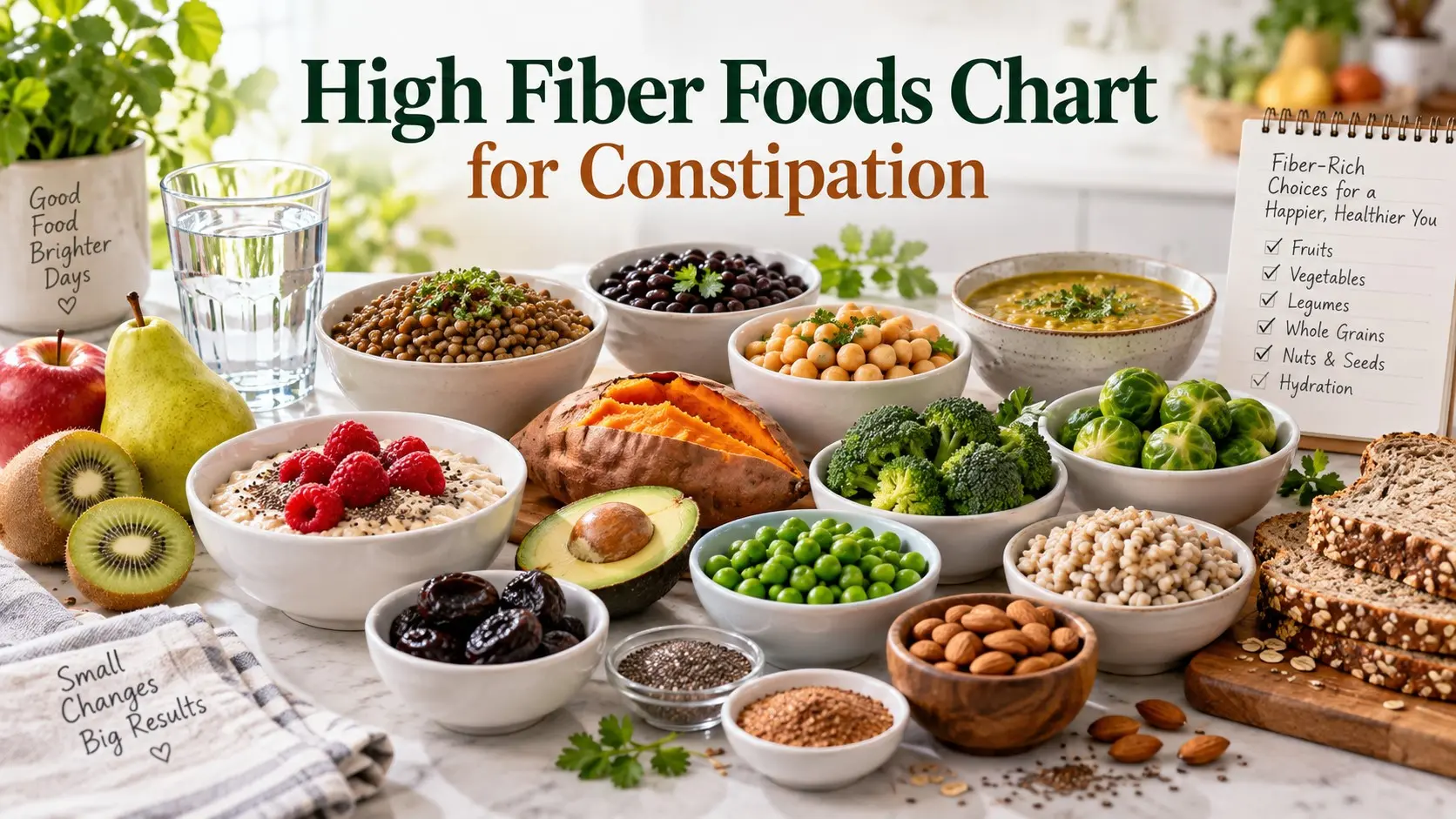
High Fiber Foods Chart for Constipation
The numbers below are approximate typical values from USDA food composition data.
Fiber changes with food size, variety, brand, preparation, and serving size.
Use this chart for planning.
Do not treat every gram as a laboratory guarantee.
| Food | Practical serving | Approx. fiber | Easy way to eat it |
|---|---|---|---|
| Split peas, cooked | 1 cup | 16 g | Soup |
| Lentils, cooked | 1 cup | 15 to 16 g | Soup, curry, salad |
| Black beans, cooked | 1 cup | About 15 g | Bowls, chili, wraps |
| Chickpeas, cooked | 1 cup | About 12 g | Salad, hummus, curry |
| Chia seeds | 1 oz | About 10 g | Oats, yogurt, pudding |
| Green peas, cooked | 1 cup | About 9 g | Side dish, soup |
| Raspberries | 1 cup | About 8 g | Breakfast, snack |
| Barley, cooked | 1 cup | About 6 g | Soup, grain bowl |
| Prunes | 1/2 cup | About 6 g | Snack, oatmeal |
| Brussels sprouts, cooked | 1 cup | About 6 g | Roasted side dish |
| Pear with skin | 1 medium | About 5 to 6 g | Whole fruit snack |
| Avocado | 1/2 to 1 medium fruit | About 5 to 10 g | Toast, salad, bowl |
| Broccoli, cooked | 1 cup | About 5 g | Side dish, bowl |
| Apple with skin | 1 medium | About 4 to 5 g | Whole fruit snack |
| Oatmeal, cooked | 1 cup | About 4 g | Breakfast |
| Ground flaxseed | 2 tablespoons | About 4 g | Yogurt, oats |
| Almonds | 1 oz | About 3.5 g | Snack, oatmeal |
| Sweet potato with skin | 1 medium | About 4 g | Baked side dish |
| Kiwi | 2 medium fruit | About 4 g | Breakfast, snack |
| Whole wheat bread | 2 slices | About 4 to 6 g | Toast, sandwich |
Important: Do not jump from 10 grams of fiber a day to 35 grams overnight just because this table exists.
Your gut needs time to adjust.
1. Lentils are one of the easiest ways to raise fiber fast
Lentils do several jobs at once.
They provide:
- Dietary fiber
- Plant protein
- Iron
- Potassium
- Folate
One cup of cooked lentils can provide around 15 to 16 grams of fiber.
That is a lot.
If you rarely eat legumes, start with a smaller portion.
Try one quarter or one half cup.
Then increase gradually.
Large servings can cause gas when your gut is not used to them.
2. Black beans are useful but do not start with a giant bowl
Beans are one of NIDDK's recommended fiber rich food groups for constipation.
Black beans also provide plant protein.
Use them in:
- Rice bowls
- Soup
- Chili
- Wraps
- Salads
If beans make you very bloated, start smaller.
Canned beans that are drained and rinsed can also be convenient.
Some people with IBS tolerate certain serving sizes better than others.
3. Chickpeas make fiber easier at lunch
Chickpeas work cold or hot.
That gives you options.
Add them to:
- Salad
- Soup
- Grain bowls
- Curry
- Hummus
A cup provides roughly 12 grams of fiber.
Again, you do not need a full cup on day one.
4. Split pea soup can deliver a large fiber serving
Split peas are one of the strongest fiber foods on the chart.
A cup of cooked split peas can provide around 16 grams.
Soup makes them easy to eat.
But a very large bowl can be too much if your normal fiber intake is low.
Start with a smaller bowl.
5. Raspberries are one of the easiest high fiber fruits
A cup of raspberries provides roughly 8 grams of fiber.
That is high for fruit.
They also contain water.
Use them with:
- Oatmeal
- Plain yogurt
- Whole grain cereal
- Other berries
Frozen raspberries count too.
You do not need fresh berries every week of the year.
6. Pears work best with the skin
A medium pear with its skin provides around 5 to 6 grams of fiber.
The skin contains part of that fiber.
Wash the pear.
Eat it whole if you tolerate the skin.
There is a catch for people with IBS.
Pears can be high in fermentable carbohydrates and may worsen gas or bloating in some people.
A high fiber food is not automatically the best IBS food.
7. Apples are useful but can also bother some people with IBS
A medium apple with skin gives around 4 to 5 grams of fiber.
It is simple.
Portable.
Cheap in many places.
But apples also contain fermentable carbohydrates that can trigger symptoms in some people with IBS.
If apples repeatedly cause bloating, choose another fiber source.
Do not force a food because it appears on a constipation chart.
8. Prunes have more going on than fiber alone
Prunes are dried plums.
They provide fiber.
They also naturally contain sorbitol.
This combination helps explain why prunes and prune products have a long history of use for constipation.
Start with a modest portion.
Too much can cause:
- Gas
- Loose stool
- Cramping
- Urgency
If juice is easier for you, read Best Morning Drink for Gut Health for the evidence on prune juice.
9. Kiwi can be a gentler fruit option for some people
Two kiwi fruit provide roughly 4 grams of fiber.
Kiwi also provides water and vitamin C.
For some people with digestive sensitivity, kiwi may feel easier than apples or pears.
Start with one fruit if your gut is sensitive.
Kiwi can also cause allergy in some people.
Stop eating it and seek urgent help for breathing trouble, severe swelling, or faintness.
10. Oats provide soluble fiber
Oats are useful because they provide soluble fiber, including beta glucan.
A cup of cooked oatmeal provides around 4 grams of fiber.
That does not look huge beside lentils.
But oatmeal is easy to eat regularly.
Add:
- Raspberries
- Kiwi
- Chia seeds
- Ground flaxseed
- A small portion of nuts
Now breakfast contains several fiber sources.
For more ideas, see Healthy Breakfast Foods.
11. Barley is an underrated whole grain
Cooked barley can provide around 6 grams of fiber per cup.
It works especially well in soup.
You can also use it instead of rice in a grain bowl.
If you have celiac disease, barley is not gluten free.
Do not use it as a fiber source if your medical diet excludes gluten.
12. Chia seeds pack a lot of fiber into a small amount
One ounce of chia seeds contains close to 10 grams of fiber.
This is exactly why I would not begin with a huge serving.
Chia absorbs liquid.
Add it to:
- Oatmeal
- Plain yogurt
- Chia pudding
Drink enough fluid across the day unless you have a medical fluid restriction.
Do not swallow a large spoonful of dry chia seeds and then hope for the best.
13. Ground flaxseed is easier to use than whole flax
Two tablespoons of ground flaxseed provide roughly 4 grams of fiber.
Ground flax is easier to mix into food.
Try it in:
- Oats
- Yogurt
- Whole grain cereal
- Homemade muffins
Start with a small amount.
Seeds still add calories, so you do not need half a cup.
14. Green peas give you fiber plus protein
One cup of cooked green peas can provide around 9 grams of fiber.
Peas work well in:
- Soup
- Rice dishes
- Pasta
- Vegetable sides
They are often cheaper frozen than fresh.
Frozen peas are perfectly useful.
15. Broccoli adds fiber without needing a special recipe
One cup of cooked broccoli provides roughly 5 grams of fiber.
Use it with normal meals.
Chicken and broccoli.
Tofu and broccoli.
Rice and broccoli.
Potatoes and broccoli.
Broccoli can cause gas in some people.
That does not mean it is unhealthy.
It may mean the serving is too large for your gut right now.
16. Brussels sprouts are another strong vegetable option
A cup of cooked Brussels sprouts can provide around 6 grams of fiber.
Roast them.
Do not boil them until they become grey and then decide vegetables are terrible.
Start with a moderate portion if cruciferous vegetables make you gassy.
17. Avocado adds fiber plus unsaturated fat
Avocado is usually discussed for fat.
It contains useful fiber too.
The exact amount depends heavily on fruit size.
One half of a large avocado can provide several grams.
A whole avocado can provide much more.
Use it on:
- Toast
- Salad
- Bean bowls
- Eggs
Again, IBS matters.
Larger avocado servings contain more fermentable carbohydrate and may bother some people.
18. Sweet potatoes work as an easy dinner fiber source
A medium sweet potato with the skin can provide around 4 grams of fiber.
Serve it:
- Baked
- Roasted
- Mashed with the skin when suitable
Pair it with beans, vegetables, or another protein food.
The goal is not one magical high fiber item.
The goal is a meal containing several useful foods.
19. Almonds are a compact fiber snack
One ounce of almonds provides about 3.5 grams of fiber.
That is useful.
Almonds also contain fat and calories.
A handful is different from eating from a large bag for twenty minutes.
Portion them.
20. Whole grain bread can add fiber without changing your whole day
This is the easiest swap on the list.
Compare labels.
Two slices of whole grain bread may provide around 4 to 6 grams of fiber depending on the product.
Some breads with dark coloring are not especially high in fiber.
Read the Nutrition Facts panel.
FDA suggests choosing foods higher in the percentage Daily Value for fiber.
Soluble fiber versus insoluble fiber
Both matter.
They behave differently.
Soluble fiber
Soluble fiber mixes with water and can form a gel like material.
Sources include:
- Oats
- Beans
- Lentils
- Fruit
- Psyllium
Insoluble fiber
Insoluble fiber adds bulk to stool and is found in foods such as:
- Wheat bran
- Whole grains
- Vegetable skins
- Many vegetables
If you simply have mild constipation, both forms can contribute.
If you have IBS, the distinction becomes more useful.
NIDDK notes that research suggests soluble fiber tends to be more helpful for IBS symptoms than insoluble fiber.
That is why eating a huge bowl of wheat bran is not my first suggestion for somebody with IBS and bloating.
Why does water matter when you eat more fiber?
Fiber and fluid work together.
NIDDK specifically recommends drinking enough water and other liquids when increasing fiber.
This can help stools become softer and easier to pass.
Do not interpret that as a requirement to force huge amounts of water.
Fluid needs depend on:
- Body size
- Climate
- Physical activity
- Kidney function
- Heart health
- Medicines
If a clinician has prescribed a fluid restriction, follow that plan.
How quickly should you increase fiber?
Slowly.
This is probably the most important practical rule in the article.
If you currently eat very little fiber, do not suddenly add:
- Beans
- Chia
- Bran
- Psyllium
- Three pears
- A giant salad
all on the same day.
That can produce a lot of fermentation.
Then you blame fiber.
Instead, add one change.
Keep it for several days.
Then add another.
A simple way to build toward 25 to 30 grams
You do not need a fiber calculator at every meal.
Here is one example:
| Meal | Food | Approx. fiber |
|---|---|---|
| Breakfast | 1 cup oatmeal plus 1 cup raspberries | About 12 g |
| Lunch | 1/2 cup lentils plus vegetables | About 8 to 10 g |
| Snack | 1 medium kiwi or apple | About 2 to 5 g |
| Dinner | 1 cup broccoli | About 5 g |
You are already around the adult daily range.
No giant fiber supplement required.
A constipation friendly breakfast
Try:
- Plain oatmeal
- Raspberries
- Ground flaxseed
- Plain yogurt if tolerated
- Water
Start with modest flax if you do not already eat much fiber.
Breakfast can also be a useful time to build a bathroom routine.
NIDDK notes that eating can stimulate movement in the colon, and some people benefit from trying to use the toilet after breakfast.
A constipation friendly lunch
Try:
- Lentils or chickpeas
- Whole grain base
- Cooked vegetables
- Olive oil
- Water
If legumes cause severe bloating, reduce the portion.
Do not remove all fiber forever.
Find a form and amount you tolerate.
A constipation friendly dinner
Try:
- Baked sweet potato
- Broccoli
- A protein food
- A small avocado portion if tolerated
Again, several moderate fiber foods work better than forcing one enormous source.
Should you use psyllium for constipation?
Psyllium is a bulk forming fiber supplement.
The 2023 joint AGA and ACG constipation guideline suggests fiber supplementation for adults with chronic idiopathic constipation.
Psyllium is the fiber supplement with the clearest supportive evidence among commonly studied options.
But use it correctly.
MedlinePlus states that psyllium powder or granules should be mixed with at least 8 ounces or 240 mL of liquid.
Take it exactly as directed.
Do not take extra because you want faster relief.
Who should ask before using psyllium?
Talk with a healthcare professional if you have:
- Difficulty swallowing
- Intestinal blockage
- Rectal bleeding
- Kidney disease
- Significant gastrointestinal disease
- Several prescription medicines
Psyllium can change the absorption or timing of some medicines.
Ask your pharmacist when to separate it from your medication.
Is wheat bran good for constipation?
It can add insoluble fiber.
Some people tolerate it well.
Others become more bloated.
This matters in IBS.
If bran makes your gut much more uncomfortable, you do not have to prove anything by eating more.
Try soluble fiber foods such as oats, kiwi, lentils, or a professionally guided psyllium trial instead.
What if high fiber foods make constipation worse?
This can happen.
Possible reasons include:
- You increased fiber too quickly
- You are not drinking enough fluid
- You are eating a very large amount
- You have IBS
- You have slow transit constipation
- You have a pelvic floor problem
- You take a constipating medicine
- You have another medical cause
If constipation keeps returning despite adequate diet, fluid, movement, and appropriate over the counter care, more fiber may not be the whole answer.
The 2026 AGA update on refractory constipation stresses evaluation for secondary causes and pelvic floor problems when symptoms persist.
Can too much fiber cause bloating?
Yes.
Fiber is fermented by gut bacteria to different degrees.
Fermentation can produce gas.
Too much too fast can lead to:
- Bloating
- Gas
- Cramping
- Feeling overly full
This does not mean fiber is damaging your gut.
It may mean your serving is too large or the type does not suit you.
Read Foods That Can Reduce Bloating if bloating is your main symptom.
High fiber foods and IBS
IBS needs more care.
Beans, pears, apples, avocado, and some other high fiber foods can also contain FODMAP carbohydrates.
These can increase gas and symptoms in some people with IBS.
That does not make those foods unhealthy.
It means IBS is individual.
NIDDK notes that soluble fiber is often more helpful than insoluble fiber in IBS.
Useful options may include:
- Oats
- Psyllium when appropriate
- Kiwi
- Suitable portions of lower FODMAP fruit and vegetables
A structured low FODMAP diet should not become a permanent giant restriction list.
A dietitian trained in IBS can guide elimination and reintroduction.
What foods can make constipation harder?
NIDDK advises limiting foods that contain little or no fiber when constipation is a problem.
Examples can include:
- Chips
- Fast food
- Many highly processed snacks
- Some frozen prepared meals
This does not mean meat itself causes constipation.
Meat simply contains no dietary fiber.
If a meal is meat, cheese, white bread, and no plants, the issue is what is missing.
Does coffee help constipation?
It can stimulate bowel activity in some people.
That does not make it the main constipation treatment.
Coffee can also worsen:
- Reflux
- Urgency
- Loose stool
- Stomach discomfort
Water plus enough fiber is a better foundation.
Does prune juice count as fiber?
Prune juice contains less fiber than whole prunes because much of the solid fruit structure has been removed.
Its constipation effect is not only about fiber.
Prunes and prune juice also contain sorbitol.
Use a modest amount.
Too much can produce diarrhea.
Can exercise help constipation too?
Yes.
NIDDK includes regular physical activity among lifestyle measures that may help constipation.
You do not need an intense workout.
Walking is a good place to start for many people.
For a full routine, visit Constipation Exercises.
Should you take a laxative instead of eating more fiber?
Sometimes diet is enough.
Sometimes it is not.
The 2023 AGA and ACG guideline includes several evidence based treatments for chronic idiopathic constipation.
These include:
- Fiber supplements
- Polyethylene glycol
- Some stimulant laxatives
- Magnesium oxide in suitable patients
- Prescription medicines when needed
Polyethylene glycol has stronger guideline support for chronic use than fiber supplements when medication is required.
Do not keep escalating fiber indefinitely when symptoms are not improving.
Ask a doctor or pharmacist what is appropriate.
Which medicines can cause constipation?
Many medicines and supplements can contribute.
Examples may include some:
- Opioid pain medicines
- Iron supplements
- Calcium supplements
- Antidepressants
- Anticholinergic medicines
- Blood pressure medicines
- Antacids
Do not stop a prescribed medicine because you think it is causing constipation.
Ask your doctor or pharmacist whether an alternative or prevention plan is possible.
When should you not simply add more fiber?
This section matters.
Do not keep pushing fiber if you have:
- Severe or increasing abdominal pain
- Repeated vomiting
- A very swollen abdomen
- Inability to pass stool
- Inability to pass gas
Those symptoms can occur with intestinal obstruction or another serious condition.
Seek urgent medical assessment.
Adding a large fiber supplement to a blocked bowel is not a home treatment.
When should constipation be checked by a doctor?
Get medical advice if constipation:
- Persists for weeks
- Suddenly changes without explanation
- Does not improve with reasonable self care
- Occurs with rectal bleeding
- Occurs with blood in stool
- Occurs with unexplained weight loss
- Causes significant abdominal pain
- Occurs with repeated vomiting
- Alternates with unexplained diarrhea
Chronic constipation can have causes that food alone cannot fix.
A simple 7 day fiber build up plan
This is an example for someone whose current diet is fairly low in fiber.
It is not a medical prescription.
Day 1
Add oatmeal at breakfast.
Day 2
Add one piece of whole fruit.
Day 3
Add one cooked vegetable serving.
Day 4
Add a small portion of lentils or beans.
Day 5
Add berries to breakfast.
Day 6
Swap refined bread or grain for a higher fiber whole grain option.
Day 7
Review:
- Stool frequency
- Stool softness
- Gas
- Bloating
- Fluid intake
- Abdominal pain
If you are comfortable, continue building slowly.
If you feel dramatically worse, stop escalating and reassess.
A simple high fiber shopping list
Legumes
- Lentils
- Black beans
- Chickpeas
- Split peas
Fruit
- Raspberries
- Pears
- Apples
- Kiwi
- Prunes
Vegetables
- Broccoli
- Green peas
- Brussels sprouts
- Sweet potatoes
Whole grains
- Oats
- Barley
- Whole grain bread
Nuts and seeds
- Chia seeds
- Ground flaxseed
- Almonds
How I approach a High Fiber Foods Chart for Constipation
At NextFitLife, I do not want to give readers a fiber number and pretend the problem is solved.
For this guide, I looked at:
- Adult fiber recommendations
- Realistic food servings
- Soluble and insoluble fiber
- Fluid intake
- IBS tolerance
- Psyllium safety
- Constipation treatment guidelines
- Bowel obstruction warning signs
The main lesson is simple.
Fiber helps many people.
But fiber needs context.
More is not always better.
Faster is not always better.
And constipation that refuses to improve should not be treated by endlessly adding more seeds and bran.
Conclusion
This High Fiber Foods Chart for Constipation gives you 20 practical foods, but you do not need all 20 at once.
Start with oats.
Add fruit.
Add vegetables.
Introduce beans or lentils gradually.
Drink enough fluid for your health needs.
Move your body.
Your next step: choose two foods from the chart today. Add one to breakfast and one to lunch or dinner. Keep that change for several days before increasing fiber again.
References and Sources
These sources are public and clickable so readers can review the original digestive health and nutrition guidance.
- National Institute of Diabetes and Digestive and Kidney Diseases
Eating Diet and Nutrition for Constipation
https://www.niddk.nih.gov/health-information/digestive-diseases/constipation/eating-diet-nutrition
Used for the 22 to 34 gram adult fiber range, recommended fiber food groups, gradual fiber increases, and the importance of adequate fluid. - American College of Gastroenterology and American Gastroenterological Association
Clinical Practice Guideline on Chronic Idiopathic Constipation Treatments
https://gi.org/journals-publications/ebgi/schoenfeld2_june2023/
Used for current guideline recommendations covering fiber supplementation, psyllium, polyethylene glycol, stimulant laxatives, and other treatments for chronic idiopathic constipation. - U.S. Food and Drug Administration
How to Understand and Use the Nutrition Facts Label
https://www.fda.gov/food/nutrition-facts-label/how-understand-and-use-nutrition-facts-label
Used for the 28 gram Daily Value for dietary fiber and FDA guidance that 20 percent Daily Value or more is considered high. - U.S. Department of Agriculture
FoodData Central
https://fdc.nal.usda.gov/
Used as the primary food composition reference for approximate fiber values and serving comparisons in the chart. - MedlinePlus National Library of Medicine
Psyllium Drug Information
https://medlineplus.gov/druginfo/meds/a601104.html
Used for psyllium dosing safety, the requirement to mix powder or granules with at least 8 ounces or 240 mL of liquid, medication interactions, swallowing problems, and bowel obstruction cautions.
Explore More on NextFitLife
Foods and Nutrition Hub
Nutrition and Vitamins Hub
Foods That Can Reduce Bloating
Constipation Exercises
Best Morning Drink for Gut Health
Healthy Breakfast Foods
Gut Health and Weight Loss
Weight Loss and Metabolism Hub
About the Author
Adel Galal
Founder and Lead Writer at NextFitLife
Adel Galal is the founder and lead writer of NextFitLife, an independent health and wellness website focused on practical health, fitness, nutrition, food, beauty, and healthy aging information.
His editorial approach focuses on comparing public health guidance, clinical recommendations, and food composition data before turning them into practical everyday steps.
For constipation and digestive health articles, Adel separates mild lifestyle related constipation from IBS, medicine related constipation, chronic constipation, pelvic floor disorders, and warning signs that need medical assessment.
That distinction matters because adding more fiber is useful for many people, but it is not the answer to every bowel problem.
Adel is not a physician, gastroenterologist, registered dietitian, pharmacist, or other licensed healthcare professional.
I am not a dermatologist or A doctor, and this content does not replace professional medical advice. What I share comes from real-life experience, extensive research, and consultation with healthcare providers. Always consult qualified medical professionals for diagnosis and treatment of any health condition.
Learn more about Adel Galal and NextFitLife
Frequently Asked Questions
What are the best high fiber foods for constipation?
Lentils, split peas, beans, chickpeas, raspberries, pears, oats, barley, peas, broccoli, prunes, chia seeds, ground flaxseed, and whole grains are useful choices.
How much fiber should adults eat per day?
NIDDK says adults generally need about 22 to 34 grams of fiber each day depending on age and sex. FDA uses a 28 gram Daily Value on Nutrition Facts labels.
How quickly should I increase fiber?
Increase it gradually. Adding a large amount of beans, bran, chia, psyllium, and fruit all at once can cause gas, bloating, and discomfort.
Why do I need water when I increase fiber?
Fluid helps fiber work and can make stool softer and easier to pass. Ask your healthcare professional about fluid needs if you have kidney, heart, or another condition requiring fluid restriction.
What fruit has the most fiber for constipation?
Raspberries are one of the higher fiber common fruits, with roughly 8 grams per cup. Pears, apples, kiwi, and prunes are other useful choices.
Are prunes good for constipation?
Yes. Prunes provide fiber and naturally contain sorbitol. Start with a modest portion because too much can cause gas, cramps, or loose stool.
Are oats good for constipation?
Yes. Oats provide soluble fiber and can be combined with berries, kiwi, ground flaxseed, or chia to build a higher fiber breakfast.
Are beans good for constipation?
Beans are high in fiber and can help increase daily intake. Start with smaller portions if you are not used to eating legumes because they can increase gas.
Are chia seeds good for constipation?
Chia seeds provide a large amount of fiber in a small serving and absorb liquid. Start gradually and drink enough fluid for your health needs.
Is soluble or insoluble fiber better for constipation?
Both can contribute to bowel regularity. Soluble fiber is especially useful for some people and tends to be better supported for IBS symptoms than large amounts of insoluble fiber.
Is psyllium good for constipation?
Psyllium is a bulk forming fiber supplement and is suggested by current constipation guidelines. It must be taken with enough liquid and may interact with medicines.
How much water should I drink with psyllium?
MedlinePlus says psyllium powder or granules should be mixed with at least 8 ounces or 240 mL of liquid. Follow the specific product or prescription directions.
Can too much fiber make constipation worse?
Yes. A very rapid fiber increase, inadequate fluid, severe stool backup, IBS, slow transit constipation, or another bowel problem can make symptoms worse.
Can high fiber foods cause bloating?
Yes. Gut bacteria ferment some fibers and produce gas. Increase fiber gradually and adjust foods and serving sizes according to your tolerance.
What fiber is best if I have IBS and constipation?
NIDDK notes that soluble fiber tends to be more helpful for IBS symptoms than insoluble fiber. Oats and appropriately used psyllium are common soluble fiber options.
Can exercise help constipation?
Regular physical activity may help. Gentle walking is an easy starting point for many people when it is medically safe.
When should constipation be checked by a doctor?
Seek medical advice for persistent constipation, blood in stool, rectal bleeding, unexplained weight loss, significant abdominal pain, vomiting, or a major unexplained change in bowel habits.
When should I avoid adding more fiber?
Do not keep adding fiber if you have severe abdominal pain, repeated vomiting, marked abdominal swelling, or an inability to pass stool or gas. These symptoms need urgent medical assessment.

Health & wellness writer with 30+ years of experience in nutrition, fitness, and healthy aging. Founder of NextFitLife.com — evidence-based health guidance.