
Published on: May 11, 2024
Updated: October 30, 2026
Ab Workouts for Men should do more than make your stomach burn.
A strong core helps you brace, bend, rotate, resist rotation, carry weight, and control movement. Your abs also work during squats, deadlifts, rows, presses, running, and many everyday tasks.
You do not need hundreds of crunches. You need a small group of exercises that train the trunk in different ways and become harder as you improve.
This article is for general information and education. It does not replace medical advice, diagnosis, or treatment.
Quick answer: A complete ab workout for men should include flexion, anti extension, anti rotation, lateral stability, and controlled hip movement. Train the core about two or three times each week. Start with exercises you can control, then add repetitions, resistance, range, or harder variations over time.
Table of Contents
- What the core actually does
- The five jobs your core should train
- 17 smart core exercises
- Plank
- Dead bug
- Reverse crunch
- Cable crunch
- Hanging knee raise
- Hanging leg raise
- Ab wheel rollout
- Side plank
- Pallof press
- Farmer carry
- Suitcase carry
- Bird dog
- Hollow body hold
- Body saw
- Cable lift
- Cable chop
- L sit progression
- Beginner workout
- Intermediate workout
- Advanced workout
- How often to train abs
- How many sets and reps
- How to make abs grow
- How to make abs visible
- Common mistakes
- Frequently asked questions
What Is Your Core?
Your core is more than the visible six pack.
It includes several muscles that help control your trunk and pelvis.
| Muscle Area | Main Role | Useful Exercises |
|---|---|---|
| Rectus abdominis | Trunk flexion and pelvic control | Cable crunch, reverse crunch |
| Obliques | Rotation, side bending, stability | Side plank, chop, Pallof press |
| Deep abdominal muscles | Trunk control and pressure management | Dead bug, plank, rollout |
| Back and trunk stabilizers | Spinal control | Bird dog, carries |
Your abs do not work alone.
This is why good core exercises for men include more than repeated spinal crunching.
The Five Jobs Your Core Workout Should Train
1. Flexion
This means bringing the ribs and pelvis closer together.
Examples include cable crunches and controlled reverse crunches.
2. Anti Extension
Your trunk resists excessive arching of the lower back.
Planks and ab wheel rollouts are good examples of anti extension core training.
3. Anti Rotation
Your torso resists being twisted by an outside force.
The Pallof press is a simple example.
4. Lateral Stability
Your trunk resists bending sideways.
Side planks and suitcase carries train this job well.
5. Controlled Rotation
Some sports and daily movements require controlled torso rotation.
Cable chops and cable lifts can train that pattern.
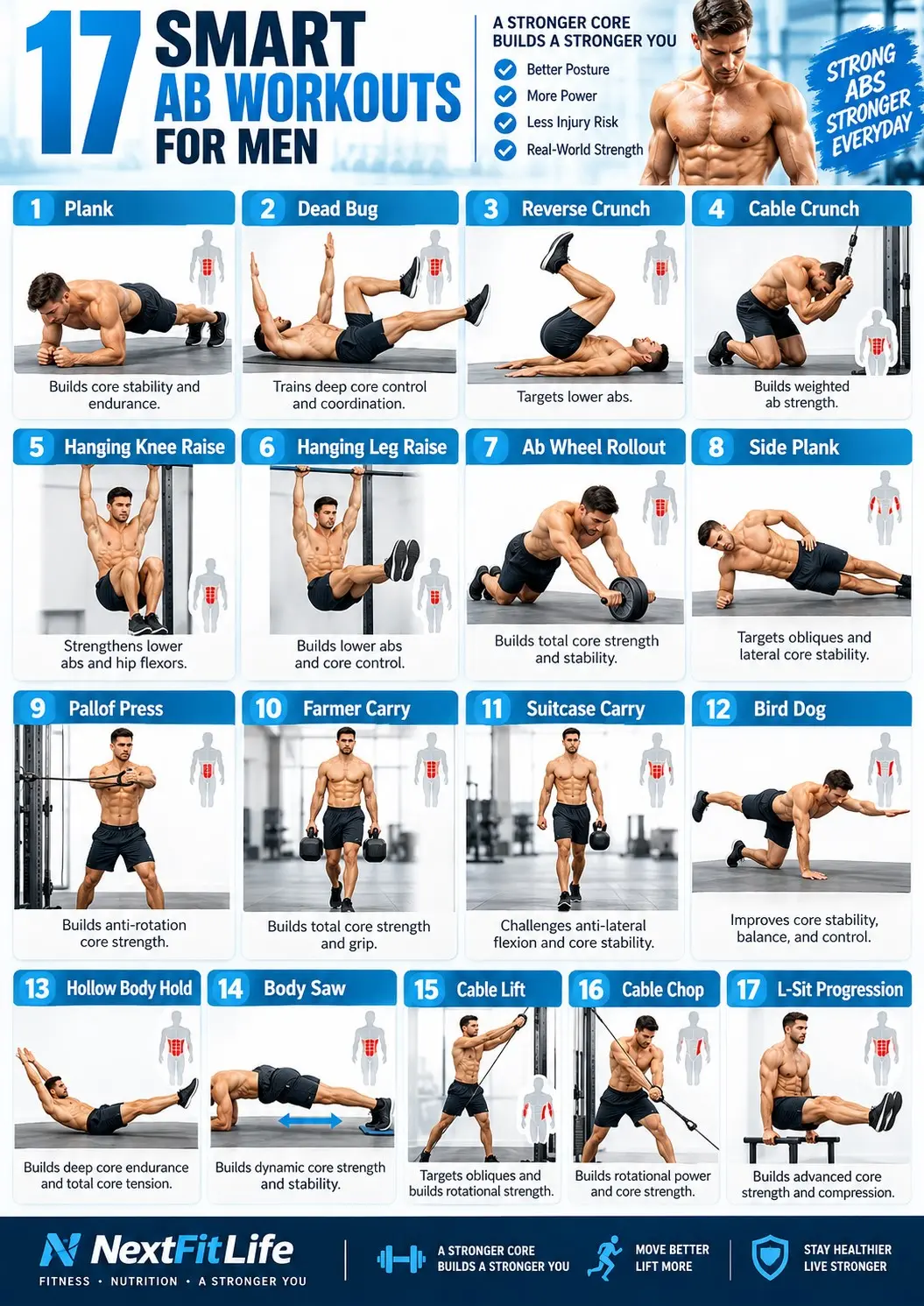
17 Smart Ab Workouts for Men
1. Plank
The plank is a simple way to learn full-body bracing.
Place your elbows under your shoulders and extend your legs behind you. Keep your ribs and pelvis controlled so your lower back does not sag.
Start with: 2 to 3 sets of 20 to 40 seconds.
When 40 seconds feels easy, make the plank harder instead of holding it for several minutes.
2. Dead Bug
The dead bug trains trunk control while your arms and legs move.
Lie on your back with your hips and knees bent. Lower one arm and the opposite leg while keeping your trunk controlled.
Start with: 2 to 3 sets of 6 to 10 repetitions per side.
Reduce the range if your lower back starts lifting strongly from the floor.
3. Reverse Crunch
The reverse crunch uses controlled pelvic motion to train the rectus abdominis.
Lie on your back with your knees bent. Bring your knees toward your torso and gently curl your pelvis from the floor.
Start with: 2 to 3 sets of 10 to 15 repetitions.
Avoid swinging the legs.
4. Cable Crunch
The cable crunch is one of the easiest weighted ab exercises to progress.
Kneel in front of a high cable with a rope attachment. Flex your trunk by bringing the rib cage toward the pelvis while keeping the hips fairly stable.
Start with: 2 to 3 sets of 8 to 15 repetitions.
Add a small amount of resistance when the top of the repetition range becomes comfortable.
5. Hanging Knee Raise
Hang from a pull up bar and raise your knees while keeping the movement controlled.
Think about bringing the pelvis toward the ribs rather than only lifting the thighs.
Start with: 2 to 3 sets of 6 to 12 repetitions.
If grip is the limiting factor, use captain's chair equipment when available.
6. Hanging Leg Raise
The straight leg version is more demanding than a knee raise.
Keep the movement smooth and avoid swinging.
Start with: 2 to 3 sets of 5 to 10 repetitions.
You do not need to force your feet to the bar. Use the range that you can control.
7. Ab Wheel Rollout
The ab wheel rollout creates a strong anti extension challenge.
Start from your knees and roll forward while keeping the ribs and pelvis controlled.
Stop before your lower back begins to collapse into a deep arch.
Start with: 2 to 3 sets of 5 to 10 repetitions.
Use a shorter rollout at first, then extend farther as your control improves.
8. Side Plank
The side plank trains the lateral trunk and oblique muscles.
Place one elbow beneath your shoulder and lift your hips so your body forms a straight line.
Start with: 2 to 3 sets of 20 to 40 seconds per side.
A bent knee side plank is a useful easier version.
9. Pallof Press
The Pallof press is an anti rotation exercise.
Stand sideways to a cable or resistance band. Hold the handle at your chest, then press your arms forward without allowing your trunk to twist.
Start with: 2 to 3 sets of 8 to 12 repetitions per side.
Use enough resistance to challenge you without pulling you out of position.
10. Farmer Carry
Hold a weight in each hand and walk with tall, controlled posture.
The carry trains the trunk, grip, shoulders, and whole body at the same time.
Start with: 2 to 4 controlled walks.
Increase load or distance gradually.
11. Suitcase Carry
The suitcase carry uses one weight instead of two.
The uneven load tries to bend your torso sideways, so your trunk must resist it.
Start with: 2 to 3 walks per side.
Stay tall rather than leaning away from the weight.
12. Bird Dog
Begin on your hands and knees.
Extend one arm and the opposite leg while keeping your torso still.
Start with: 2 to 3 sets of 6 to 10 repetitions per side.
Move slowly enough that you can feel when your hips begin to rotate.
13. Hollow Body Hold
The hollow body hold is a harder anti extension exercise.
Lie on your back and lift your shoulders and legs while keeping the trunk controlled.
Start with: 2 to 3 sets of 15 to 30 seconds.
Bend your knees or keep your arms closer to your body if the full version is too difficult.
14. Body Saw
Begin in a forearm plank with your feet on sliders or towels.
Move your body backward a short distance, then pull yourself forward while maintaining trunk position.
Start with: 2 to 3 sets of 6 to 12 repetitions.
This exercise becomes difficult quickly. A small range is enough.
15. Cable Lift
A cable lift moves resistance diagonally upward across the body.
Use the hips and trunk together rather than twisting only through the lower back.
Start with: 2 to 3 sets of 8 to 12 repetitions per side.
16. Cable Chop
The cable chop moves resistance diagonally downward.
It trains controlled rotation and coordination between the hips, trunk, and shoulders.
Start with: 2 to 3 sets of 8 to 12 repetitions per side.
Keep the movement smooth rather than jerking the cable.
17. L Sit Progression
The L sit challenges the abs, hip flexors, shoulders, and compression strength.
Start between parallettes or sturdy bars with your knees tucked.
As you improve, extend one leg and then both legs.
Start with: 3 to 5 short holds.
You do not need a full L sit on day one.
17 Exercises at a Glance
| Exercise | Main Challenge | Level |
|---|---|---|
| Plank | Anti extension | Beginner |
| Dead bug | Control | Beginner |
| Reverse crunch | Flexion | Beginner |
| Cable crunch | Weighted flexion | Beginner to intermediate |
| Hanging knee raise | Pelvic control | Intermediate |
| Hanging leg raise | Pelvic control | Intermediate |
| Ab wheel rollout | Anti extension | Intermediate |
| Side plank | Lateral stability | Beginner |
| Pallof press | Anti rotation | Beginner |
| Farmer carry | Bracing | Beginner |
| Suitcase carry | Lateral stability | Beginner |
| Bird dog | Control | Beginner |
| Hollow body hold | Anti extension | Intermediate |
| Body saw | Anti extension | Intermediate |
| Cable lift | Rotation | Intermediate |
| Cable chop | Rotation | Intermediate |
| L sit progression | Compression | Advanced |
Beginner Ab Workout for Men
You do not need all 17 exercises in one session.
Use four movements that cover different core jobs.
| Exercise | Sets | Repetitions or Time |
|---|---|---|
| Dead bug | 2 | 8 each side |
| Reverse crunch | 2 | 10 to 12 |
| Side plank | 2 per side | 20 to 30 seconds |
| Pallof press | 2 per side | 8 to 12 |
Perform this workout two times each week at first.
Intermediate Ab Workout for Men
| Exercise | Sets | Repetitions or Time |
|---|---|---|
| Cable crunch | 3 | 8 to 15 |
| Ab wheel rollout | 3 | 6 to 10 |
| Hanging knee raise | 3 | 8 to 12 |
| Suitcase carry | 3 per side | Controlled walk |
Advanced Ab Workout for Men
| Exercise | Sets | Repetitions or Time |
|---|---|---|
| Hanging leg raise | 3 | 6 to 12 |
| Ab wheel rollout | 3 | 8 to 12 |
| Cable crunch | 3 | 8 to 12 |
| Cable chop | 3 per side | 8 to 12 |
| L sit progression | 3 to 5 | Short controlled holds |
How Often Should Men Train Abs?
Two or three focused core sessions each week is a useful starting point for most men.
You do not need to train your abs every day.
Your core also works during:
- Squats
- Deadlifts
- Rows
- Overhead presses
- Pull ups
- Loaded carries
Dedicated training gives you a chance to develop the trunk more directly.
Recovery still matters.
How Many Sets Should You Do?
The answer depends on your goal and how much indirect core training you already get.
For a beginner, two sets of several exercises may be enough.
As you become more experienced, you can gradually add more challenging sets.
The 2026 ACSM guidance for resistance training supports higher weekly volume when muscle growth is the goal, with roughly 10 weekly sets per muscle group serving as a useful general reference rather than a mandatory minimum.
You do not need to jump to that amount during your first week.
How Many Repetitions Should You Use?
Use the exercise to guide the range.
| Exercise Type | Practical Starting Range |
|---|---|
| Weighted crunches | 8 to 15 repetitions |
| Reverse crunches | 10 to 20 repetitions |
| Hanging raises | 6 to 15 repetitions |
| Rollouts | 5 to 12 repetitions |
| Isometric holds | 15 to 45 seconds |
These are practical ranges, not laws.
The set should eventually become challenging while your technique remains controlled.
Do You Need to Train Abs to Failure?
No.
Training to complete muscular failure is not required for most people.
Stop the set when your technique begins to break down or when only a small number of good repetitions remain.
This is especially useful for rollouts, hanging exercises, and loaded trunk work where form can change quickly.
For a deeper explanation, read Reps in Reserve.
How Do You Make Abs Stronger?
Treat them like other muscles.
Use progressive overload.
You can progress by:
- Adding resistance
- Adding repetitions
- Increasing range
- Using a harder variation
- Adding a set
- Improving control
For example, a plank can progress to a body saw.
A knee raise can progress to a straight leg raise.
A light cable crunch can progress to a heavier cable crunch.
Can Ab Muscles Grow?
Yes.
The abdominal muscles respond to resistance training just like other muscles.
Research on resistance training shows that progressive resistance can increase muscle size, and current ACSM guidance supports sufficient weekly volume when hypertrophy is the goal.
That means doing only easy, high repetition crunches forever is not the only option.
Weighted ab work can be useful.
Do You Have Separate Upper and Lower Abs?
Not in the way fitness marketing often suggests.
The rectus abdominis is one continuous paired muscle running from the rib area toward the pelvis.
Different movements may change how strongly different regions contribute, but you cannot isolate the “lower abs” as if they were a completely separate muscle.
Hanging raises and reverse crunches are still useful because they challenge pelvic control in a different way from cable crunches.
What About the Transverse Abdominis?
The transverse abdominis is a deep abdominal muscle involved in trunk control and pressure management.
You do not need to spend an entire workout trying to isolate it.
Exercises such as planks, dead bugs, rollouts, carries, and compound lifts all require coordinated trunk control.
A systematic review of core exercise research found that muscle activity varies considerably between exercises, which is another reason to use a mix rather than declaring one movement the single best core exercise.
Can Ab Training Prevent Back Injuries?
Do not promise yourself injury prevention from one exercise.
Core training can improve trunk strength and control, and systematic reviews suggest it can improve some performance measures.
Core stability exercise can also be useful in some people with chronic nonspecific low back pain.
That does not mean a strong core makes your spine injury proof.
Training load, technique, sleep, previous injury, sport demands, general strength, and many other factors still matter.
Should You Train Abs Before or After Lifting?
For most general strength workouts, put demanding ab work after the main lifts.
This keeps your trunk fresh for squats, deadlifts, presses, and rows.
Light activation work such as dead bugs can be used earlier if it helps you prepare for training.
If core strength is your main goal, you can put your most important core exercise earlier in the session.
Can Compound Lifts Replace Ab Training?
Not completely.
Squats, deadlifts, carries, overhead presses, and rows all challenge the trunk.
They can build useful core strength.
Direct core exercises still let you train movements and resistance patterns that compound lifts may not challenge strongly enough.
A simple plan can use both.
Can Ab Workouts Give You a Six Pack?
Ab training can make the abdominal muscles stronger and potentially larger.
Visibility is a different issue.
Your abs become easier to see when there is less fat covering them.
There is no single body fat percentage where every man's abs suddenly appear.
Visibility depends on:
- Genetics
- Fat distribution
- Abdominal muscle size
- Skin
- Lighting
- Body composition
If fat loss is needed, overall energy balance matters more than adding another hundred crunches.
Our Top Exercises for Belly Fat explains the difference between core training and fat loss in more detail.
Do Ab Exercises Burn Belly Fat?
They use energy, but they are not a reliable way to remove fat only from the stomach.
One six week randomized study found that abdominal exercise improved muscular endurance but did not significantly reduce abdominal fat or waist measurements.
More recent small studies have reopened the scientific discussion about local fat reduction, but the evidence remains too limited to build a fat loss plan around spot reduction.
The practical strategy is still simple:
- Train your abs to make them stronger.
- Use full body activity and suitable nutrition to reduce body fat when needed.
Should Men Do Russian Twists?
You can, but they are not required.
Fast, heavily loaded twisting is often less controlled than people think.
If your goal is rotation, cable chops and cable lifts let you control resistance more easily.
If your goal is resisting rotation, the Pallof press is a better match.
Are Sit Ups Bad?
No exercise is automatically bad for every person.
Sit ups involve trunk flexion and a large contribution from the hip flexors.
Some people tolerate them well.
Others find that cable crunches, reverse crunches, or other movements feel better.
Choose exercises that you can perform comfortably and progress.
Can You Train Abs at Home?
Yes.
A useful home ab workout can include:
- Dead bugs
- Reverse crunches
- Planks
- Side planks
- Bird dogs
- Hollow body holds
- Band Pallof presses
You do not need a gym to develop a strong core.
Current resistance training guidance also supports bodyweight, band, and home based training as effective options.
Can You Train Abs Every Day?
You can perform very light trunk work often, but hard direct ab training every day is usually unnecessary.
Muscles need recovery from challenging resistance training.
Two or three focused sessions each week is enough for many men.
Common Ab Workout Mistakes
Using Momentum
Swinging through hanging raises changes the exercise.
Slow down and control the pelvis.
Pulling on the Neck
Your hands should not drag your head forward during crunch variations.
Making Every Set Extremely Long
If you can hold a plank for several minutes easily, use a harder variation.
Never Adding Resistance
If muscle growth is your goal, progressively harder training matters.
Training Only Flexion
A complete core program also includes anti extension, anti rotation, lateral stability, and controlled rotation.
Chasing Soreness
Soreness is not proof of a better workout.
Track repetitions, resistance, control, and progress instead.
Expecting Ab Exercises to Remove Belly Fat
Train abs for muscle and strength.
Use overall activity and food intake for fat loss.
How Ab Training Fits Into a Full Fitness Plan
Your abs are only one muscle group.
Adults should also train the legs, hips, back, chest, shoulders, and arms.
Current public health guidance recommends muscle strengthening activity on at least two days each week as well as regular aerobic activity.
For a complete program, visit the NextFitLife Fitness Program Guide.
If you want a time efficient strength plan, read Minimum Effective Dose Strength Training.
When Should You Stop Core Training?
Stop an exercise if you develop sudden severe pain, new numbness, weakness, or a serious acute injury.
If a movement repeatedly causes back, hip, shoulder, or neck pain, do not simply push harder.
Change the exercise and seek professional assessment when symptoms persist.
Simple 17 Move Progression Map
- Learn the plank.
- Control the dead bug.
- Add the reverse crunch.
- Progress to weighted cable crunches.
- Learn hanging knee raises.
- Progress toward hanging leg raises.
- Add short ab wheel rollouts.
- Use side planks for lateral stability.
- Use Pallof presses for anti rotation.
- Carry weight with both hands.
- Progress to one sided suitcase carries.
- Use bird dogs for controlled limb movement.
- Progress to hollow body holds.
- Add body saws when planks become easy.
- Use cable lifts for controlled rotation.
- Use cable chops for another rotational pattern.
- Build toward an L sit only when the basics are strong.
Conclusion
The best Ab Workouts for Men do not depend on one magic exercise.
Train flexion, anti extension, anti rotation, lateral stability, and controlled rotation. Use progressive resistance, give your core time to recover, and keep full body training in your program.
If visible abs are your goal, remember that building the muscle and revealing the muscle are different jobs.
Your next step: choose four exercises from this guide that cover different core functions. Train them twice this week, record your repetitions or resistance, and improve one small thing next week.
References and Sources
- American College of Sports Medicine. Resistance Training Guidelines Update 2026.
https://acsm.org/resistance-training-guidelines-update-2026/ - Currier BS, et al. Resistance Training Prescription for Muscle Function, Hypertrophy, and Physical Performance in Healthy Adults: An Overview of Reviews.
https://pubmed.ncbi.nlm.nih.gov/41843416/ - Oliva Lozano JM, Muyor JM. Core Muscle Activity During Physical Fitness Exercises: A Systematic Review.
https://pubmed.ncbi.nlm.nih.gov/32560185/ - Core Training and Performance: A Systematic Review With Meta Analysis.
https://pubmed.ncbi.nlm.nih.gov/37867742/ - A Dose Response Analysis of Exercise Prescription Variables for Lateral Abdominal Muscle Thickness and Activation.
https://pubmed.ncbi.nlm.nih.gov/38763566/ - Vispute SS, et al. The Effect of Abdominal Exercise on Abdominal Fat.
https://pubmed.ncbi.nlm.nih.gov/21804427/ - Centers for Disease Control and Prevention. Adult Activity: An Overview.
https://www.cdc.gov/physical-activity-basics/guidelines/adults.html
Internal Links + Hub
- NextFitLife Fitness Hub
- Top Exercises for Belly Fat
- Exercises to Lose Belly Fat
- Fitness Program Guide
- Minimum Effective Dose Strength Training
- Reps in Reserve
- Hip Hinge Exercises
- Strength Training After 40
About the Author
Adel Galal is the founder and lead writer of NextFitLife.com and the founder of Parnthub.com.
He is a father of four, three sons and a daughter, and a grandfather of four, with more than 33 years of hands on family experience. Adel is based in Cairo, Egypt.
He has maintained a personal interest in health, fitness, nutrition, sleep, wellness, and healthy aging for more than 30 years and has more than 15 years of health and wellness writing experience.
His work focuses on reviewing trusted health and fitness sources, separating established guidance from uncertain claims, and turning exercise science into practical information for everyday readers.
Adel is not a doctor, physical therapist, exercise physiologist, registered dietitian, or certified personal trainer. NextFitLife content is for general information and education and does not replace individual medical or professional fitness advice.
Learn more about Adel and NextFitLife on the About Us page.
Frequently Asked Questions
What are the best ab workouts for men?
A strong ab workout combines flexion, anti extension, anti rotation, lateral stability, and controlled rotation. Useful exercises include cable crunches, reverse crunches, hanging raises, ab wheel rollouts, Pallof presses, side planks, carries, and dead bugs.
How often should men train abs?
Two or three focused core sessions per week is enough for many men. Your trunk also works during compound exercises such as squats, deadlifts, rows, presses, and loaded carries.
Can men train abs every day?
Hard daily ab training is usually unnecessary. Like other muscles, the abdominal muscles need recovery after challenging resistance training.
How many ab exercises should I do in one workout?
Three to five well chosen exercises are usually enough. Choose movements that train different core functions instead of doing many similar crunch variations.
How many sets should I do for abs?
Beginners can start with about two sets per exercise. More experienced lifters can gradually add volume when recovery and performance are good.
How many repetitions are best for abs?
Weighted movements may work well for roughly 8 to 15 repetitions, while bodyweight exercises may use higher repetitions or timed holds. The set should become challenging without losing technique.
Do abs need progressive overload?
Yes. You can progress abdominal training by adding resistance, repetitions, range, sets, or harder exercise variations.
Do crunches build abs?
Crunches can train the rectus abdominis, especially when the movement becomes progressively harder. They are only one option and do not train every core function.
Are cable crunches good for building abs?
Yes. Cable crunches make it easy to add resistance gradually, which makes them useful for men who want stronger or larger abdominal muscles.
Are hanging leg raises good for abs?
Yes. Hanging leg raises can challenge the abdominal muscles and hip flexors, especially when pelvic movement is controlled and swinging is minimized.
Is the ab wheel good for the core?
Yes. Ab wheel rollouts create a strong anti extension challenge. Start with a short range and stop before the lower back begins to lose control.
Are planks enough for abs?
Planks are useful for trunk stability, but they do not cover every core function. Add movements such as crunches, hanging raises, side planks, carries, or Pallof presses for a more complete program.
Do ab workouts burn belly fat?
Ab workouts use energy and strengthen abdominal muscles, but they should not be relied on to selectively remove stomach fat. Overall activity, nutrition, and total energy balance matter more for fat loss.
Can you build abs without a gym?
Yes. Planks, reverse crunches, dead bugs, side planks, bird dogs, hollow body holds, and band Pallof presses can build a strong home core routine.
Do squats and deadlifts train the core?
Yes. Squats and deadlifts require strong trunk bracing. Direct ab training can still add movements and resistance patterns that compound lifts do not emphasize as much.
Do men need low body fat to see abs?
Visible abdominal definition usually becomes easier as body fat falls, but there is no single body fat percentage that guarantees a six pack for every man. Genetics, fat distribution, muscle size, and body composition all affect appearance.

Health & wellness writer with 30+ years of experience in nutrition, fitness, and healthy aging. Founder of NextFitLife.com — evidence-based health guidance.

