Last Updated: July 12, 2026
Topic: Workout Routines at Home
Reading Time: About 10 minutes
Content Note: This article is for education only. It does not replace medical advice.
Workout Routines at Home can help you move more without going to a gym.
You do not need fancy machines.
You do not need a big room.
You do not need to train for hours.
You need a safe space.
You need simple moves.
You need a plan you can repeat.
This guide gives you easy home workouts for strength, cardio, core, mobility, and recovery.
You can start with body weight only.
You can add light dumbbells or a resistance band later.
Quick answer
Good Workout Routines at Home include bodyweight squats, wall push-ups, glute bridges, rows with a band, standing marches, step-ups, core bracing, stretching, and walking.
Start with 15 to 20 minutes.
Train 3 or 4 days each week.
Use the suitable form.
Rest when needed.
Build slowly.
Why home workouts work?
Home workouts are simple.
You can do them before work.
You can do them after work.
You can do them while your family is nearby.
You can do them with very little equipment.
That makes them easier to keep.
This is why home fitness can be a sound choice for many people.
The best workout is not the one that looks perfect.
The best workout is the one you can repeat.
What you need to start
You can start with nothing.
Your body weight is enough.
Helpful tools include:
- Comfortable shoes
- Yoga mat
- Stable chair
- Light dumbbells
- Resistance band
- Water bottle
- Towel
- Workout notebook
This makes home exercise simple and low-cost.
Set up a safe home workout space
Safety comes first.
Clear the floor.
Move cords away.
Keep pets away from your feet.
Use a stable chair.
Make sure your shoes do not slip.
Keep water nearby.
This helps make safe home workouts easier.
Before you start
Start at your current level.
Do not rush.
Do not train through sharp pain.
Talk with a qualified healthcare professional before starting a new workout routine if you have chest pain, heart disease, diabetes, high blood pressure, severe joint pain, dizziness, recent surgery, pregnancy, breathing problems, osteoporosis, balance problems, or a long-term health condition.
Stop exercising and seek help if you feel chest pain, fainting, severe shortness of breath, sudden weakness, severe dizziness, confusion, or sharp pain.
Warm up first
A warm-up helps your body feel ready.
Try this for 5 minutes.
- March in place for 60 seconds.
- Roll your shoulders 10 times.
- Step side to side for 60 seconds.
- Do 10 easy chair squats.
- Do 10 gentle arm reaches.
- Take 5 slow breaths.
This is a simple part of injury prevention.
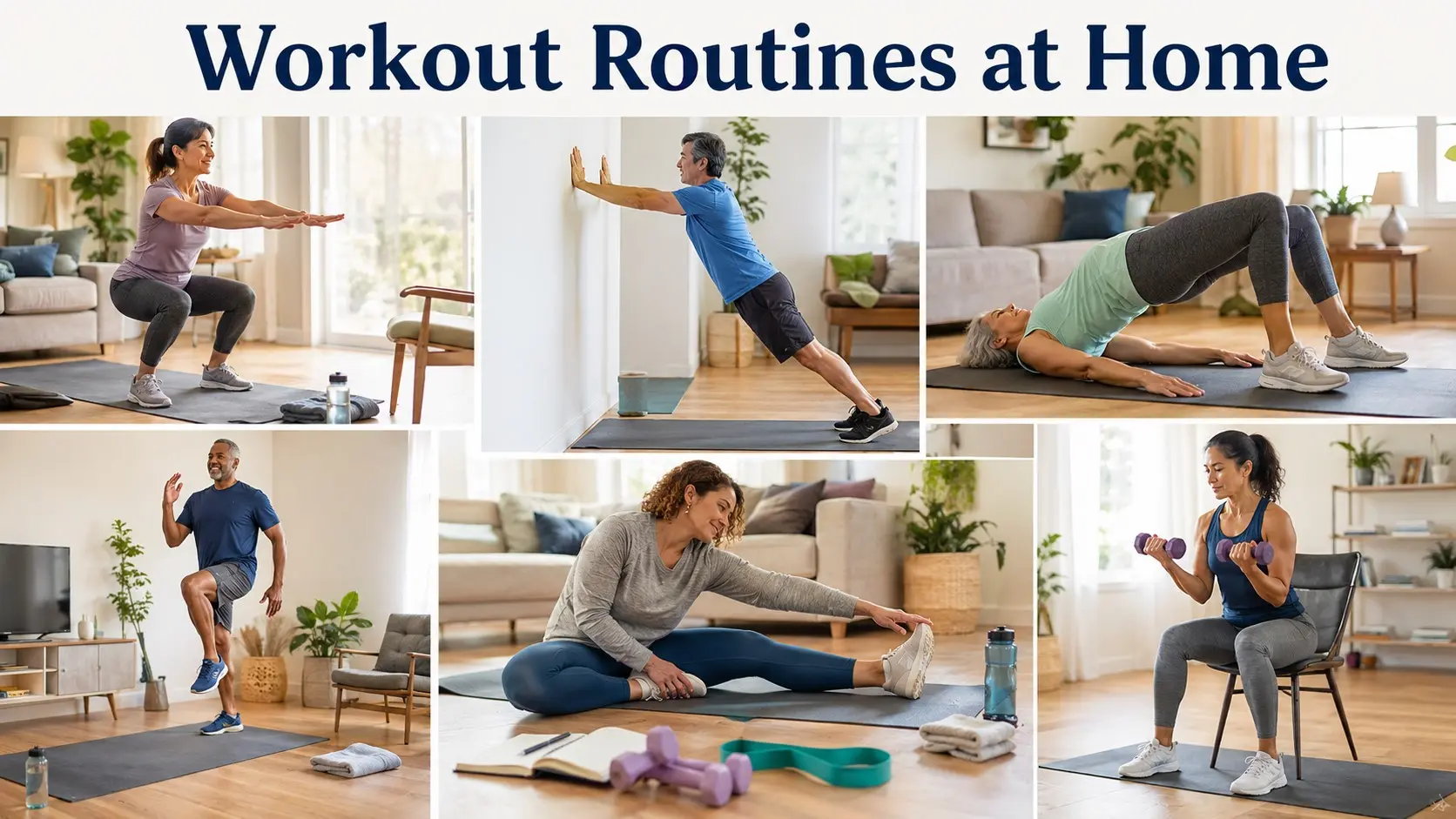
1. Bodyweight squat to chair
This move trains your legs, hips, and core.
How to do it
- Stand in front of a chair.
- Place feet about hip-width apart.
- Brace your core.
- Sit your hips back toward the chair.
- Stand up with control.
Do 8 to 12 reps.
Keep your knees comfortable.
This is a good bodyweight workout move.
2. Wall push-up
This move trains your chest, shoulders, arms, and core.
How to do it
- Stand facing a wall.
- Place your hands on the wall at chest height.
- Step your feet back a little.
- Bend your elbows slowly.
- Push back to start.
Do 8 to 12 reps.
Keep your body straight.
This is a simple upper body workout at home option.
3. Glute bridge
This move trains hips, glutes, and core support.
How to do it
- Lie on your back.
- Bend your knees.
- Keep feet on the floor.
- Brace your core.
- Lift your hips slowly.
- Lower with control.
Do 8 to 12 reps.
Stop if your back hurts.
4. Standing march
This move raises your heart rate in a low-impact way.
How to do it
- Stand tall.
- Brace your core.
- Lift one knee.
- Lower it.
- Switch sides.
Do 30 to 60 seconds.
Hold a chair if balance is hard.
This supports low-impact cardio.
5. Resistance band row
This move trains your back and posture.
How to do it
- Sit or stand tall.
- Hold a resistance band.
- Pull your elbows back.
- Squeeze shoulder blades gently.
- Return with control.
Do 10 to 12 reps.
Make sure the band is secure.
This is a useful resistance band workout move.
6. Step up
This move trains legs and balance.
How to do it
- Use a low step.
- Step up with one foot.
- Stand tall.
- Step down slowly.
- Switch sides.
Do 6 to 10 reps on each side.
Use a wall or rail if needed.
7. Dead bug
This is a safe core move for many beginners.
How to do it
- Lie on your back.
- Lift arms toward the ceiling.
- Bend your knees.
- Brace your core.
- Lower one arm and the opposite leg slowly.
- Return and switch sides.
Do 6 to 8 reps each side.
This helps build core strength.
8. Bird dog
This move trains balance, back, hips, and core control.
How to do it
- Start on hands and knees.
- Brace your core.
- Reach one arm forward.
- Reach the opposite leg back.
- Hold for 2 seconds.
- Return slowly.
Do 6 to 8 reps on each side.
9. Farmer carry
This move trains grip, shoulders, core, and posture.
How to do it
- Hold light dumbbells or two safe household items.
- Stand tall.
- Brace your core.
- Walk slowly for 20 to 30 seconds.
Keep shoulders relaxed.
This supports functional strength.
10. Standing side reach
This move helps your sides and trunk move gently.
How to do it
- Stand tall.
- Reach one arm overhead.
- Bend gently to the side.
- Return to center.
- Switch sides.
Do 8 reps on each side.
Do not force the stretch.
11. Plank on a wall
This is easier than a floor plank.
How to do it
- Place hands on a wall.
- Step feet back.
- Keep your body straight.
- Brace your core.
- Hold for 20 to 30 seconds.
Keep breathing.
Stop if your back hurts.
12. Calf raise
This move trains the lower legs and balance.
How to do it
- Stand near a wall or chair.
- Rise onto your toes.
- Lower slowly.
Do 10 to 15 reps.
Use support if needed.
Beginner Workout Routines at Home
Use this routine 3 days each week.
Rest or walk on the other days.
Round 1
- Chair squat, 8 to 12 reps
- Wall push up, 8 to 12 reps
- Standing march, 30 seconds
- Dead bug, 6 reps each side
Rest 60 seconds.
Round 2
- Glute bridge, 10 reps
- Band row, 10 reps
- Step up, 6 reps each side
- Wall plank, 20 seconds
Start with 1 round if you are new.
Build to 2 rounds.
Then build up to 3 rounds when your body feels ready.
15-minute home workout
Use this when time is short.
- Minute 1: Warm up march
- Minute 2: Chair squats
- Minute 3: Wall push ups
- Minute 4: Rest and breathe
- Minute 5: Glute bridges
- Minute 6: Band rows
- Minute 7: Rest and breathe
- Minute 8: Standing marches
- Minute 9: Dead bugs
- Minute 10: Rest and breathe
- Minute 11: Step-ups
- Minute 12: Wall plank
- Minute 13: Calf raises
- Minute 14: Gentle stretching
- Minute 15: Slow breathing
This is a simple no-equipment workout if you skip bands and dumbbells.
Weekly home workout plan
Use this as a simple week.
Monday
Full-body home strength workout.
Tuesday
Walk for 20 minutes or do low-impact cardio.
Wednesday
Mobility and stretching.
Thursday
Full-body home strength workout.
Friday
Easy walking or rest.
Saturday
Core and balance workout.
Sunday
Rest.
This is a clear weekly workout plan.
Workout routines at home for weight loss
Home workouts can support weight goals.
But workouts are only one part of the plan.
For better results, also focus on:
- Protein at meals
- Vegetables and fruit
- Water
- Daily steps
- Sleep
- Stress control
- Realistic portions
This supports weight loss workouts in a safe way.
Do not use exercise as punishment for food.
Use it to care for your body.
Workout routines at home for strength
Strength work can be done at home.
Start with body weight.
Then add light dumbbells or bands.
Good strength moves include:
- Squats
- Push-ups on a wall
- Rows
- Bridges
- Step ups
- Carries
This builds a simple strength training habit at home.
Workout routines at home for beginners
If you are new, start small.
Try 10 minutes.
Then try 15 minutes.
Then try 20 minutes.
Do not chase soreness.
Chase good form.
This is the best way to begin beginner fitness.
Workout routines at home for busy adults
Busy days need quick plans.
Use small movement breaks.
- 5 minutes after waking
- 5 minutes after lunch
- 5 minutes after work
- 5 minutes before dinner
Short workouts count.
They help build daily movement.
How often should you work out at home?
Many beginners can start with 3 days each week.
You can add walking on other days.
Strength training 2 days each week is a wonderful goal for many adults.
Rest matters too.
Your body gets stronger when it has time to recover.
How to make home workouts easier
- Use a chair for support.
- Do fewer reps.
- Move slower.
- Take longer rests.
- Skip floor moves.
- Use wall exercises.
This keeps the workout safe.
How to make home workouts harder
Only change one thing at a time.
- Add 1 more round.
- Add 2 reps.
- Use a slightly heavier weight.
- Use a stronger band.
- Walk longer.
- Rest a little less.
This is a simple way to use progressive overload.
Common home workout mistakes
- Skipping warm-up
- Using unsafe chairs
- Working out in clutter
- Doing too much too soon
- Training through pain
- Holding your breath
- Changing the plan every day
- Skipping rest
A safe routine beats a hard routine you cannot keep.
Cool down after your workout
Cool down for 3 to 5 minutes.
- Walk slowly.
- Stretch your chest gently.
- Stretch your hips gently.
- Relax your shoulders.
- Breathe slowly.
- Drink water.
This supports workout recovery.
My simple rule
Your home workout should fit your life.
It should not make your home feel stressful.
It should not make your body feel unsafe.
If you can move with control, breathe well, and come back again, the plan is working.
Conclusion
Workout Routines at Home can help you build strength, cardio, balance, mobility, and confidence without leaving the house.
Start with simple moves.
Use a safe space.
Train 3 days this week.
Walk when you can.
Rest when you need it.
Your next step: choose 4 moves from this Workout Routines at Home guide and complete one gentle round today.
Related guides from NextFitLife
This article is part of our Fitness Hub. You may also want to visit our Home Workouts & Equipment Guide, Fitness for Beginners Guide, and Strength Training & Muscle Building Guide.
FAQ about Workout Routines at Home
What are the best Workout Routines at Home?
The best Workout Routines at Home include simple strength moves, low-impact cardio, core work, stretching, and rest. Chair squats, wall push-ups, glute bridges, rows, marches, and planks are good options.
Can I get fit at home without equipment?
Yes. You can start with bodyweight exercises such as squats, wall push-ups, glute bridges, marches, step-ups, and core exercises.
How many days a week should I work out at home?
Many beginners can start with 3 days each week. Add walking or gentle movement on other days if your body feels good.
Are home workouts good for weight loss?
Home workouts can support weight goals, especially when paired with daily steps, balanced meals, protein, water, sleep, and consistency.
What is a good beginner home workout?
A good beginner home workout can include chair squats, wall push ups, glute bridges, standing marches, band rows, and gentle stretching.
Who should talk to a doctor before home workouts?
Talk with a healthcare professional if you have chest pain, heart disease, diabetes, high blood pressure, severe joint pain, dizziness, recent surgery, pregnancy, breathing problems, or a long-term condition.
References and Sources
- Centers for Disease Control and Prevention. Adult Activity: An Overview.
- Centers for Disease Control and Prevention. Adding Physical Activity as an Adult.
- MedlinePlus. How to Avoid Exercise Injuries.
- American Heart Association. Recommendations for Adults.
- Mayo Clinic. Strength Training: Get Stronger, Leaner, Healthier.

Health & wellness writer with 30+ years of experience in nutrition, fitness, and healthy aging. Founder of NextFitLife.com — evidence-based health guidance.