Last Updated: July 11, 2026
Topic: Standing Ab Workout
Reading Time: About 9 minutes
Content Note: This article is for education only. It does not replace medical advice.
A standing ab workout can help you train your core without lying on the floor.
That can be helpful if floor exercises feel hard.
It can also help if you have limited space.
Standing core moves can train your abs, sides, hips, back, and balance.
You do not need a gym.
You do not need a hard routine.
You only need good form, slow movement, and a safe space.
In this guide, I will show you simple standing core exercises.
I will also show you how to make a safe beginner plan.
Quick answer
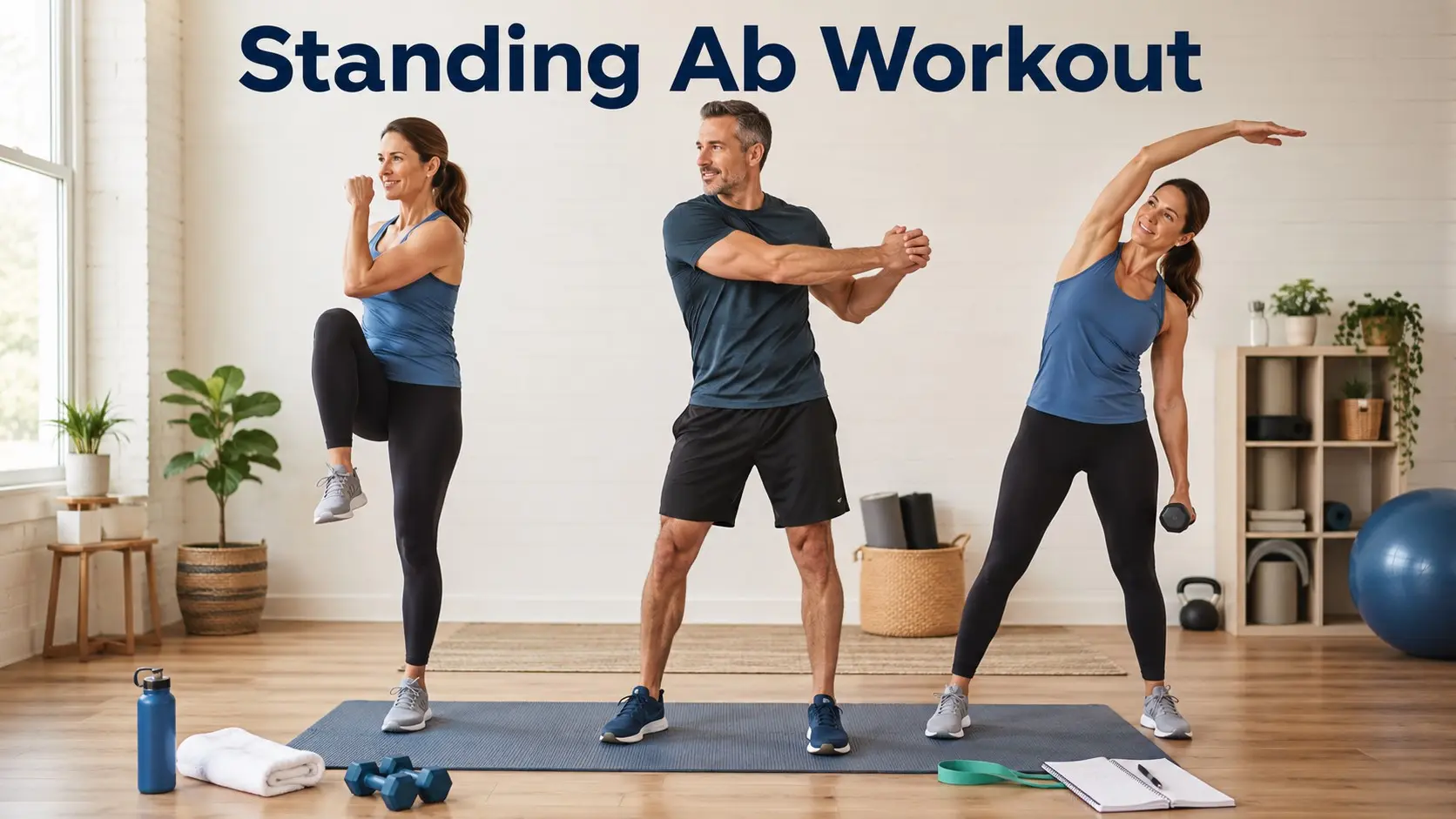
A Standing Ab Workout is a core routine done while standing.
It can include knee lifts, side bends, marches, standing twists, wood chops, and balance moves.
It can help train your core, posture, balance, and daily movement.
Start slow.
Move with control.
Stop if you feel sharp pain, dizziness, chest pain, or severe shortness of breath.
What is a Standing Ab Workout?
A Standing Ab Workout is a way to train your core while you stay on your feet.
Your core is not only your front abs.
It also includes muscles around your trunk, hips, sides, and lower back.
These muscles help you stand tall.
They help you walk.
They help you lift.
They help you turn.
They help you stay steady.
This is why **core strength** matters in daily life.
Who can try standing abs?
Standing abs may be useful for many people.
- Beginners
- Busy adults
- People who dislike floor workouts
- People with limited space
- People who want low-impact core work
- People who want to practice balance
But not every move is right for everybody.
If you have back pain, hip pain, pregnancy, balance problems, recent surgery, hernia, dizziness, heart disease, or a long-term health condition, ask a qualified healthcare professional before starting.
Benefits of standing ab exercises
Standing core work can feel more natural than floor work.
It can train your body in the same position you use most of the day.
Here are some benefits.
- It can support posture.
- It can train balance.
- It can help with daily movement.
- It can be easier on the floor for a sensitive body.
- It can fit into abrupt breaks.
- It can work well at home.
This makes **standing core exercises** a simple option for many fitness levels.
Important safety note before you start
Move slowly.
Keep your belly gently braced.
Keep breathing.
Do not twist hard.
Do not pull your neck.
Do not move through sharp pain.
Use a wall or chair for support if balance feels hard.
Stop right away if you feel chest pain, faintness, severe dizziness, sudden weakness, severe shortness of breath, or sharp back pain.
How to brace your core
Bracing means gently tightening your middle.
Think of getting ready for someone to tap your stomach.
Do not hold your breath.
Do not suck in hard.
Just make your middle steady.
This helps with **abdominal bracing** and control.
Warm up first
A short warm-up helps your body feel ready.
Try this for 3 to 5 minutes.
- March in place for 60 seconds.
- Roll your shoulders 10 times.
- Do gentle side reaches 10 times.
- Step side to side for 60 seconds.
- Take 5 slow breaths.
Now your body is ready for easy core work.
1. Standing knee lift
This is a simple beginner move.
It trains the front of your core and hips.
How to do it
- Stand tall.
- Place your feet hip-width apart.
- Brace your core.
- Lift one knee toward your chest.
- Lower it with control.
- Switch sides.
Do 8 to 12 reps on each side.
Keep your chest lifted.
Do not lean back.
This is a good **beginner ab workout** move.
2. Standing side crunch
This move works the sides of your core.
It can help you feel your obliques.
How to do it
- Stand tall.
- Place one hand behind your head.
- Lift the same-side knee.
- Bring your elbow gently toward your knee.
- Return to start.
- Repeat on the other side.
Do 8 to 10 reps on each side.
Move slowly.
Do not pull your neck.
This supports **oblique exercises** in a gentle way.
3. Standing march with core brace
This move looks easy.
It works well when done with control.
How to do it
- Stand tall.
- Brace your core.
- Lift your right knee.
- Lower it.
- Lift your left knee.
- Keep your body steady.
Do 30 to 45 seconds.
Hold a wall if needed.
This is a simple ** low-impact core workout** move.
4. Standing cross-body knee lift
This move trains rotation with control.
It should not feel fast or forced.
How to do it
- Stand tall.
- Reach your right arm up.
- Lift your left knee across your body.
- Bring your right elbow toward the left knee.
- Return to start.
- Switch sides.
Do 8 reps on each side.
Keep the twist small.
Do not yank your body.
5. Standing side bend
This move trains side control.
Use body weight first.
How to do it
- Stand with feet hip-width apart.
- Place hands at your sides.
- Brace your core.
- Slide one hand down your thigh.
- Return to center.
- Switch sides.
Do 8 to 12 reps on each side.
Keep your movement small.
Add a light dumbbell only when body weight feels easy.
6. Standing woodchop
This move trains your core, shoulders, and hips.
Start with no weight.
How to do it
- Stand with feet wide.
- Hold your hands together.
- Bring your hands near one hip.
- Move them slowly across your body toward the opposite shoulder.
- Return with control.
- Switch sides.
Do 8 reps on each side.
Keep the movement smooth.
Do not twist hard.
This can be part of a **functional core training** plan.
7. Standing heel tap
This move trains core control and balance.
How to do it
- Stand tall.
- Brace your core.
- Tap one heel in front of you.
- Bring it back.
- Tap the other heel.
- Keep your body steady.
Do 30 seconds.
Use a chair if balance is hard.
This helps with **balance exercises** too.
8. Standing dumbbell hold
This is a simple core stability move.
You hold weight on one side.
Your core works to keep you tall.
How to do it
- Hold one light dumbbell at your side.
- Stand tall.
- Brace your core.
- Keep your shoulders level.
- Hold for 20 to 30 seconds.
- Switch sides.
Use a lightweight.
Do not lean.
This helps with **core stability**.
9. Standing reach and pull
This move trains control, posture, and core engagement.
How to do it
- Stand tall.
- Reach both arms up.
- Pull elbows down toward your sides.
- Brace your core.
- Keep ribs down.
- Repeat slowly.
Do 10 to 12 reps.
You can add a resistance band later.
10. Standing torso rotation
This move should be gentle.
It is not a hard twist.
How to do it
- Stand tall.
- Cross your arms over your chest.
- Brace your core.
- Turn a little to the right.
- Return to center.
- Turn a little to the left.
Do 8 reps on each side.
Keep your hips steady.
Stop if your back feels uncomfortable.
Beginner Standing Ab Workout Plan
Try this plan 2 or 3 days each week.
Rest between days.
Round 1
- Standing knee lift for 10 reps each side
- Standing march for 30 seconds
- Standing side crunch for 8 reps each side
- Standing heel tap for 30 seconds
Rest for 60 seconds.
Round 2
- Standing cross-body knee lift for 8 reps each side
- Standing side bend for 8 reps each side
- Standing reach and pull for 10 reps
- Standing dumbbell hold for 20 seconds each side
Start with 1 round if you are new.
Build to 2 rounds.
Then build up to 3 rounds if your body feels good.
Standing Ab Workout for busy days
Use this when you only have 5 minutes.
- March in place for 60 seconds.
- Standing knee lifts for 60 seconds.
- Standing side bends for 60 seconds.
- Standing cross-body knee lifts for 60 seconds.
- Easy breathing and shoulder rolls for 60 seconds.
This is a simple **standing abs workout at home** plan.
How often should you train standing abs?
Start with 2 days each week.
If you feel good, add a third day.
Your core also works during walking, lifting, squats, rows, and daily tasks.
So you do not need to train your abs every day.
Rest helps your body adapt.
Can standing abs reduce belly fat?
Standing abs can train your core.
They cannot choose where fat leaves first.
No ab move can spot reduce belly fat.
For fat loss, focus on:
- Whole foods
- Protein
- Daily steps
- Strength training
- Sleep
- Stress control
- A safe calorie gap
This is safer than chasing quick fixes.
Common mistakes to avoid
- Moving too fast
- Holding your breath
- Twisting hard
- Pulling your neck
- Using heavy weights too soon
- Ignoring balance support
- Training through pain
Slow reps are better than sloppy reps.
Good form matters more than speed.
How to make it harder
Only make it harder after the basic moves feel easy.
You can:
- Add a light dumbbell.
- Add a resistance band.
- Add more reps.
- Add one more round.
- Slow the movement down.
- Reduce hand support if balance is safe.
Do not add everything at once.
Choose one change.
How to make it easier
You can make standing abs easier, too.
- Use a chair.
- Move slower.
- Use a smaller range.
- Skip weights.
- Do fewer reps.
- Rest more often.
This keeps the workout safe and useful.
My simple rule
A good standing ab workout should feel controlled.
It should not feel sharp, rushed, or scary.
If you can breathe, stand tall, and move with control, you are doing it right.
Conclusion
A standing ab workout is a simple way to train your core without lying on the floor.
It can help with core strength, balance, posture, and daily movement.
Start with easy knee lifts, marches, side bends, and gentle rotations.
Move slowly.
Use support if needed.
Build over time.
Your next step: try the beginner Standing Ab Workout plan today, then repeat it 2 days this week with suitable form and steady breathing.
Related guides from NextFitLife
This article is part of our Fitness Hub. You may also want to visit our Strength Training & Muscle Building Guide, Home Workouts & Equipment Guide, and Fitness for Beginners Guide.
FAQ
What is a standing ab workout?
A standing ab workout is a core routine done while standing. It can include knee lifts, side bends, marches, gentle rotations, and balance moves.
Are standing ab exercises good for beginners?
Yes. Many standing ab exercises are beginner-friendly when done slowly and with support if needed. Start with small moves and suitable form.
Can standing ab workouts reduce belly fat?
No ab workout can spot reduce belly fat. Standing abs can train your core, but fat loss depends on food habits, movement, sleep, stress, and consistency.
How often should I do a standing ab workout?
Many beginners can start with 2 days each week. Add a third day if your body feels good and you have no pain.
Do I need equipment for standing abs?
No. You can use body weight. Later, you may add light dumbbells or a resistance band if your form stays safe.
Who should talk to a doctor before doing standing core exercises?
Talk with a healthcare professional if you have back pain, hernia, pregnancy, dizziness, balance problems, recent surgery, heart disease, severe joint pain, or a long-term condition.
References and Sources
- Centers for Disease Control and Prevention. Adult Activity: An Overview.
- Centers for Disease Control and Prevention. Older Adult Activity: An Overview.
- Mayo Clinic. Why You Should Strengthen Your Core Muscles.
- MedlinePlus. How to Avoid Exercise Injuries.
- American Heart Association. Recommendations for Physical Activity in Adults.

Health & wellness writer with 30+ years of experience in nutrition, fitness, and healthy aging. Founder of NextFitLife.com — evidence-based health guidance.