Last Updated: September 3, 2026
Sources Checked: September 3, 2026
Next Review: September 2027, or sooner if major swallowing, reflux, respiratory, or allergy guidance changes
Written and Source Checked by: Adel Galal, Founder and Lead Writer at NextFitLife
Review Status: Updated using current swallowing, reflux, aspiration, allergy, and respiratory guidance. This article has not been independently medically reviewed by a licensed clinician.
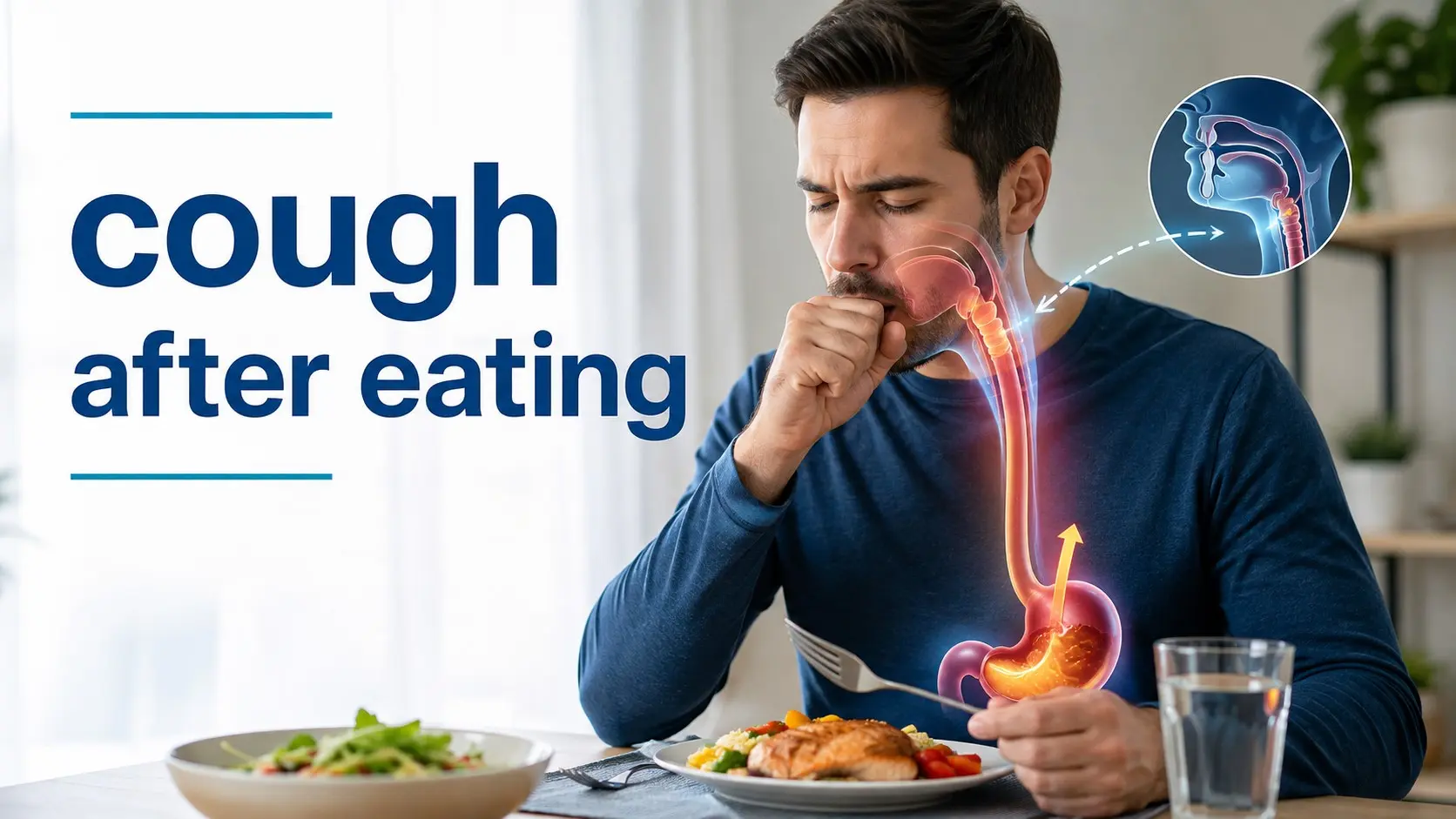
Cough after eating can come from acid reflux, throat irritation, a swallowing problem, or food or liquid entering the airway.
The timing gives one of the best clues.
Coughing while you swallow raises questions about dysphagia and aspiration.
Coughing later after a meal, especially with heartburn, regurgitation, or lying down, points more toward acid reflux.
Quick Answer: Why Do I Cough After Eating?
Cough after eating often comes from reflux, swallowing difficulty, aspiration, postnasal drainage, or food related irritation. Cough during swallowing points more toward a swallowing problem. Cough later after a meal points more toward reflux. Choking, a wet voice, food sticking, weight loss, or repeated chest infections need medical assessment.
Medical note: I am not a dermatologist or A doctor, and this content does not replace professional medical advice. What I share comes from real-life experience, extensive research, and consultation with healthcare providers. Always consult qualified medical professionals for diagnosis and treatment of any health condition.
The Timing of Your Cough Is the First Clue
I would start here.
Not with cough syrup.
Not with antacids.
Not with eliminating half your diet.
Ask exactly when the cough begins.
| When the Cough Starts | What It Can Suggest |
|---|---|
| During the swallow | Swallowing difficulty, aspiration, poor swallowing coordination |
| Immediately after swallowing | Airway irritation, aspiration, throat irritation |
| After spicy food | Gustatory rhinitis, nasal drainage, food allergy if other allergy symptoms appear |
| Several minutes after eating | Reflux, throat irritation, airway sensitivity |
| After lying down following a meal | Reflux becomes more likely |
| Only with water or thin drinks | Possible swallowing safety problem |
| Mostly with solid food | Possible esophageal swallowing problem |
This simple timing check can stop you from treating the wrong problem.
For the respiratory side of this topic, visit the NextFitLife Lung and Respiratory Health Hub.
For reflux, swallowing, and digestive causes, use the NextFitLife Digestive Health and Gut Hub.
Why Does Your Body Cough When Food Goes the Wrong Way?
Cough is protective.
Your airway and food pipe sit very close together.
Food and drink should pass into the esophagus.
Air should pass through the larynx and trachea toward your lungs.
During a normal swallow, muscles and nerves work together to protect the airway.
If food, liquid, saliva, or another substance reaches the airway, your cough reflex tries to push it out.
One cough because a sip went the wrong way can happen to a healthy person.
Repeated coughing at most meals is different.
1. Acid Reflux Is a Common Cause of Cough After Meals
Gastroesophageal reflux disease, or GERD, happens when stomach contents repeatedly move back into the esophagus.
This can irritate the esophagus and throat.
It can also trigger cough.
The National Institute of Diabetes and Digestive and Kidney Diseases lists chronic cough and hoarseness among symptoms that can occur with GERD.
Reflux becomes more convincing when you notice:
- Heartburn
- Regurgitation
- A sour taste
- Throat clearing
- Morning hoarseness
- Cough after large meals
- Cough after lying down
- A lump feeling in the throat
If reflux is your main concern, read Acid Reflux: Symptoms, Causes and Relief Questions.
You Can Have Reflux Cough Without Heartburn
This is easy to miss.
No burning chest does not rule reflux out.
NIDDK states that some adults with GERD do not have classic heartburn or regurgitation.
They can have symptoms involving the mouth, throat, or lungs.
That includes chronic cough.
So this pattern is possible:
You eat dinner.
Your throat starts feeling irritated.
You clear your throat.
You cough.
Your voice gets rough.
Then the cough becomes stronger when you lie down.
That fits reflux better than coughing the instant water passes through your throat.
Why Can Lying Down After Eating Make Reflux Cough Worse?
Gravity helps while you are upright.
Lying flat removes some of that help.
For people with nighttime GERD symptoms, NIDDK says eating at least three hours before lying down or going to bed can improve symptoms.
That advice is for a reflux pattern.
It is not a universal rule for every cough after eating.
If you cough while swallowing water, changing dinner time does not answer the main question.
2. Coughing While You Swallow Raises a Different Question
This is where I pay closer attention.
Dysphagia means difficulty swallowing.
It can affect the mouth and throat.
Or it can affect the esophagus farther down.
Possible signs include:
- Coughing while eating
- Coughing after drinking
- Choking
- Repeated throat clearing
- A wet or gurgly voice after eating
- Food feeling stuck
- Taking much longer to eat
- Needing several swallows for one bite
- Unexpected weight loss
- Repeated respiratory infections
If these symptoms repeat, I would put swallowing assessment ahead of another bottle of cough medicine.
What Is Oropharyngeal Dysphagia?
Oropharyngeal dysphagia affects the early part of swallowing.
Food must move from your mouth through your throat while the airway stays protected.
Clues can include:
- Difficulty starting a swallow
- Coughing immediately when you drink
- Choking while eating
- Food or drink returning toward the nose
- Wet voice after swallowing
- Repeated throat clearing
- Breathing trouble during meals
- Food remaining in the mouth
This pattern is different from food passing through the throat normally and then feeling stuck behind the breastbone.
Coughing With Water Can Be a Useful Clue
Water seems easy to swallow.
For some swallowing problems, thin liquid is actually difficult to control.
It moves quickly.
If airway protection or swallowing coordination is impaired, liquid can reach the airway before the swallow is completed safely.
Watch for a repeated pattern such as:
Water causes coughing.
Tea causes coughing.
Juice causes coughing.
Solid food causes much less trouble.
That deserves assessment for a possible swallowing problem.
Do not thicken every drink on your own.
The safest texture depends on the person's swallowing pattern.
What Does a Wet or Gurgly Voice After Eating Mean?
Listen to your voice after a swallow.
Does it suddenly sound wet?
Gurgly?
Different from normal?
ASHA lists a wet or gurgly vocal quality during or after eating as a possible sign seen with swallowing disorders.
One episode does not diagnose aspiration.
A repeated pattern matters more.
Especially if it appears with coughing, choking, or repeated chest infections.
3. Aspiration Means Material Enters the Airway
Aspiration means food, drink, saliva, refluxed material, or another substance enters the airway instead of staying on the normal path toward the stomach.
Your cough reflex helps protect you.
This is why a drink going the wrong way can trigger a strong cough.
Occasional aspiration can happen.
Repeated aspiration needs more attention.
The key question is why airway protection keeps failing.
Aspiration Is Not the Same as Aspiration Pneumonia
These terms should not be used as if they mean the same thing.
Aspiration is the event.
Aspiration pneumonia is a lung infection that can develop after aspirated material contributes to infection.
So one coughing episode after a drink went the wrong way does not mean you have pneumonia.
Repeated swallowing problems plus fever, breathing symptoms, weakness, or repeated lung infections deserve medical assessment.
Some Aspiration Happens Without Coughing
This is called silent aspiration.
Material enters the airway without producing the expected protective cough.
This is one reason the absence of coughing does not always prove swallowing is safe.
ASHA notes that aspiration can occur without obvious signs.
Silent aspiration becomes more important in people with conditions that affect swallowing sensation, muscle control, or nervous system function.
Examples include:
- Stroke
- Parkinson disease
- Dementia
- Some neurologic disorders
- Some muscle disorders
The person still needs an individualized assessment.
Who Has a Higher Risk of Swallowing Problems?
Dysphagia can happen at any age.
Risk rises with several conditions that affect swallowing muscles, nerves, the throat, or the esophagus.
Examples include:
- Stroke
- Parkinson disease
- Dementia
- Multiple sclerosis
- Brain injury
- Some muscle diseases
- Head or neck disease
- Esophageal disease
- Some cancers and their treatment
- Severe reflux related narrowing
Older age alone does not prove dysphagia.
Repeated symptoms do.
4. Food Sticking Can Point Toward the Esophagus
This feels different from choking at the start of a swallow.
You swallow.
The food enters the throat normally.
Then it seems to stop lower down.
You may feel it behind the breastbone.
Meat sticks.
Bread sticks.
Pills stick.
You keep reaching for water.
That pattern raises concern for esophageal dysphagia.
The problem can involve narrowing or abnormal movement in the esophagus.
That belongs more with a digestive assessment than a primary lung evaluation.
Visit the Digestive Health and Gut Hub for related reflux and swallowing topics.
What Can Cause Food to Stick in the Esophagus?
Several conditions can do this.
Examples include:
- Esophageal narrowing
- Scar tissue from chronic reflux
- Abnormal esophageal movement
- Achalasia
- Eosinophilic esophagitis
- Some structural problems
- Less commonly, tumors
Symptoms alone cannot tell you which one is present.
Persistent food sticking deserves professional evaluation.
Eosinophilic Esophagitis Is Worth Knowing About
Eosinophilic esophagitis is an immune related inflammatory disease of the esophagus.
In adults, a major clue is repeated trouble swallowing solid food.
Food can become stuck.
Some people adapt without realizing it.
They chew for a long time.
They eat slowly.
They cut food into tiny pieces.
They drink after nearly every bite.
Those habits can hide a real swallowing problem.
I would not present cough as the main sign of eosinophilic esophagitis.
The stronger clue is repeated food impaction or difficulty swallowing.
What If Food Becomes Completely Stuck?
That is different from mild difficulty.
If food becomes completely stuck and you cannot swallow saliva or liquids, seek urgent medical care.
Do not keep eating.
Do not keep forcing water down.
A complete food obstruction may need urgent removal.
5. Spicy Food Can Trigger Gustatory Rhinitis
Here is an overlooked cause.
You eat spicy food.
Your nose starts running.
You sneeze.
Mucus drains toward the throat.
Then you cough.
This can be gustatory rhinitis.
Cleveland Clinic describes it as a type of nonallergic rhinitis triggered by hot or spicy foods.
Symptoms can include:
- Runny nose
- Blocked nose
- Sneezing
- Watery eyes
- Postnasal drip
- Cough when mucus reaches the throat
Symptoms usually begin during or soon after the trigger food.
Gustatory Rhinitis Is Not a Food Allergy
This distinction matters.
Gustatory rhinitis is a nerve response inside the nose.
It is not an immune food allergy.
It does not turn into anaphylaxis.
So:
Spicy soup causes an immediate runny nose and a little cough.
That can fit gustatory rhinitis.
A specific food causes wheezing, throat tightness, hives, and lip swelling.
That is a completely different pattern.
6. A Food Allergy Can Cause Cough and Wheezing
A true food allergy involves the immune system.
Symptoms usually begin soon after the trigger food, although timing can vary.
AAAAI lists food allergy symptoms such as:
- Hives
- Itchy skin
- Nasal symptoms
- Vomiting
- Stomach cramps
- Swelling
More severe reactions can include:
- Throat tightness
- Hoarseness
- Wheezing
- Chest tightness
- Difficulty breathing
If cough follows the same food repeatedly and comes with allergy symptoms in another part of the body, food allergy becomes more likely.
When Is a Food Reaction an Emergency?
Anaphylaxis can become life threatening quickly.
Seek emergency help for a food reaction with:
- Severe breathing difficulty
- Wheezing
- Throat tightness
- Tongue swelling
- Lip or face swelling
- Fainting
- Severe weakness
- Rapid worsening symptoms involving more than one body system
If you have a prescribed emergency epinephrine plan, follow it immediately.
Do not wait to see whether severe breathing symptoms disappear on their own.
For wheezing patterns, read Wheezing at Night: Asthma, Reflux and Other Causes.
7. Asthma Can Make the Airway More Sensitive Around Meals
Asthma is not a digestive disorder.
But meal related factors can trigger symptoms in someone with sensitive airways.
Reflux can contribute.
A food allergy can trigger asthma symptoms.
Strong cooking fumes can irritate the airway.
A recent respiratory infection can leave the cough reflex sensitive.
Asthma becomes more relevant if coughing after eating appears with:
- Wheezing
- Chest tightness
- Shortness of breath
- Exercise symptoms
- Cold air symptoms
- Nighttime cough
For less obvious asthma patterns, read Silent Asthma: Symptoms Without Obvious Wheezing.
8. Your Airway Can Stay Sensitive After an Infection
A recent cold can leave you coughing even after the other symptoms improve.
The airway remains sensitive.
Talking can trigger cough.
Laughing can.
Cold air can.
Eating can too.
This becomes more likely when you also cough at other times of the day.
That pattern is different from coughing every single time water touches your throat.
9. Postnasal Drainage Can Become More Obvious During a Meal
Postnasal drip can irritate your throat and trigger coughing.
You may also have:
- Blocked nose
- Runny nose
- Throat clearing
- A mucus feeling
- Seasonal allergies
- Sinus symptoms
If the cough happens only with hot or spicy food, gustatory rhinitis is more interesting.
If nasal symptoms continue all day, allergy or another nasal condition becomes more likely.
10. Sometimes You Simply Eat Too Fast
Not every cough after a meal needs a disease label.
You take a large bite.
You start talking.
You breathe in before the swallow has finished.
Then you cough.
That can happen.
Slow down.
Chew before you speak.
Use manageable bites.
But do not keep blaming eating speed if you cough during nearly every meal.
Repeated symptoms need a better explanation.
Why Do Some Foods Cause More Trouble Than Others?
Texture gives useful information.
Different patterns can point in different directions.
Thin Liquids
Water, tea, juice, or other thin drinks can move quickly through the mouth and throat.
Repeated cough with thin liquid raises questions about swallowing coordination.
Dry or Crumbly Food
Crackers, dry bread, rice, and crumbly foods can be harder to control in the mouth for some people with dysphagia.
Solid Food
Meat, bread, or pills repeatedly sticking lower in the chest raises more concern for an esophageal problem.
Spicy Food
Runny nose and cough after spicy food can fit gustatory rhinitis.
One Specific Food
Cough with wheezing, hives, swelling, vomiting, or throat symptoms after one specific food raises an allergy question.
Do Not Diagnose Yourself From the Food Texture Alone
Texture is a clue.
It is not a diagnosis.
Do not create a restrictive diet because crackers made you cough twice.
Do not remove all thin liquids because water causes occasional coughing.
A swallowing assessment can test what is actually happening.
Why Can Repeated Chest Infections Point Toward Aspiration?
This changes the level of concern.
A person coughs during meals.
Their voice sounds wet afterward.
Then they develop repeated respiratory infections.
Now aspiration deserves more attention.
ASHA includes recurrent respiratory infection and aspiration pneumonia among findings considered during dysphagia assessment.
That does not prove every chest infection was caused by aspiration.
The combined pattern is what matters.
Weight Loss Plus Trouble Eating Needs Assessment
Ask why the weight is falling.
Maybe meals take too long.
Maybe food sticks.
Maybe coughing makes eating unpleasant.
Maybe the person avoids food because they fear choking.
Unexplained weight loss with swallowing difficulty is a reason for medical evaluation.
Do not treat it only with meal tips.
Pain With Swallowing Is Different From Difficulty Swallowing
Dysphagia means swallowing is difficult.
Odynophagia means swallowing is painful.
You can have one without the other.
Pain while swallowing can come from inflammation, infection, ulcers, injury, or other throat and esophageal conditions.
Persistent painful swallowing deserves assessment.
How Do Healthcare Professionals Assess a Swallowing Problem?
It starts with questions.
When does the cough happen?
Liquids or solids?
Does food stick?
Is there choking?
Does the voice sound wet?
Has weight changed?
Any stroke or neurologic history?
Any repeated pneumonia?
Then swallowing can be observed.
Mayo Clinic explains that a speech language specialist can perform a clinical swallowing evaluation while a person eats and drinks different textures.
What Is a Videofluoroscopic Swallow Study?
A videofluoroscopic swallow study uses moving X ray images while you swallow.
It is also commonly called a modified barium swallow.
The test can show:
- How food moves through the mouth
- How the swallow starts
- Whether material enters the airway
- When aspiration occurs
- Whether the material is cleared
- How different textures change the swallow
This gives much more information than listening to the cough.
For broader explanations of diagnostic testing, visit the Medical Tests and Screenings Hub.
What Is FEES?
FEES means fiberoptic endoscopic evaluation of swallowing.
A thin flexible scope is passed through the nose so the throat can be viewed during swallowing.
Different food and liquid textures can be tested.
FEES and videofluoroscopy answer related swallowing questions in different ways.
The clinician chooses the test that best fits the problem.
What If the Problem Seems Lower in the Esophagus?
Different testing may be needed.
Depending on the symptoms, evaluation can include:
- Upper endoscopy
- Barium testing
- Esophageal manometry
- Other imaging or specialist tests
This is why describing where food feels stuck matters.
A problem at the throat and a problem farther down the esophagus do not always need the same test.
Should You Thicken Drinks if Water Makes You Cough?
Not without a reason.
This advice gets passed around too casually.
Different swallowing problems behave differently.
Changing texture can affect:
- Hydration
- Nutrition
- Enjoyment of food and drink
- Medicine swallowing
The safest consistency should be based on the swallowing pattern.
Do not assume thicker always means safer.
Should You Drink Water to Push Food Down?
Sometimes a sip can help with ordinary throat dryness.
That is not the same as treatment for dysphagia.
If water itself triggers coughing, washing every bite down with water may make the problem more obvious.
If food is completely stuck, forcing more liquid is not a safe solution.
Repeated need for water to make solid food pass is useful information for your healthcare professional.
Should You Start Reflux Medicine Because You Cough After Eating?
Not automatically.
Reflux is common.
Cough is common.
The fact that both exist does not prove one caused the other.
Think about the pattern.
Cough during water swallowing points more toward swallowing safety.
Cough later after dinner with heartburn and regurgitation fits reflux more strongly.
Treatment should match the likely cause.
Should You Avoid Every Food That Seems to Trigger Cough?
No.
Find out what the trigger means first.
Spicy food may trigger gustatory rhinitis.
A dry cracker may expose a swallowing issue.
A large fatty meal may worsen reflux.
A specific food followed by hives and wheezing raises allergy.
Those are four different mechanisms.
A short food and symptom record is more useful than a large unsupervised elimination diet.
What Can You Do While Waiting for Assessment?
Keep the steps simple.
- Sit upright while eating
- Do not rush meals
- Take manageable bites
- Chew before swallowing
- Do not talk with food in your mouth
- Notice whether liquids or solids trigger symptoms
- Stay upright after eating when reflux is a known trigger
- Record coughing, choking, wet voice, food sticking, and meal timing
Do not use these steps to delay assessment when coughing or choking happens frequently.
A Simple Symptom Diary Can Save a Lot of Guessing
Write down:
What you ate.
Whether it was liquid or solid.
When the cough began.
Whether there was choking.
Whether the voice changed.
Whether food stuck.
Whether heartburn appeared.
Whether you lay down soon afterward.
Whether wheezing, hives, or swelling appeared.
This sequence is useful information.
When Should Cough After Eating Be Checked?
Arrange medical assessment if:
- Coughing happens during most meals
- Liquids repeatedly trigger cough
- You choke frequently
- Your voice repeatedly sounds wet after swallowing
- Food feels stuck
- Swallowing is painful
- Meals take much longer than before
- You are losing weight without trying
- You develop repeated chest infections
- You have a neurologic condition that can affect swallowing
- The problem is getting worse
Persistent coughing after eating deserves a cause.
When Is Cough After Eating an Emergency?
Seek emergency medical help if:
- You cannot breathe
- Food is completely blocking the airway
- You develop severe wheezing after a food
- Your throat or tongue swells
- Your lips or face swell with breathing trouble
- You faint during a suspected allergic reaction
- You cannot swallow saliva because food is stuck
- You develop severe chest pain or major breathing difficulty
Do not wait for a cough remedy when the airway is in danger.
Cough After Eating and Dry Cough at Night Can Overlap
Reflux provides one clear connection.
You may cough after dinner.
Then the cough becomes stronger after lying down.
That fits a reflux pattern more than coughing only as water passes through your throat.
If bedtime cough is your main issue, read Dry Cough at Night: 10 Causes and When to Get Help.
Cough and Wheezing After Eating Are Different Symptoms
Cough is a protective reflex.
Wheezing is a musical breathing sound caused by narrowed lower airways.
A food allergy can cause both.
Asthma can cause both.
Aspiration can trigger cough and sometimes breathing symptoms.
If whistling breathing is the main problem, read Wheezing at Night: Asthma, Reflux and Other Causes.
Cough After Eating and White Phlegm Are Different Questions
A meal related cough tells you about timing.
Phlegm tells you about airway secretions.
If your cough brings up mucus, the causes can overlap with infection, airway inflammation, postnasal drainage, or chronic lung conditions.
Read White Phlegm: Causes and Why Color Alone Cannot Diagnose Illness.
Common Cough After Eating Myths
Myth: Coughing After Meals Always Means Reflux
False.
Cough during swallowing can point more strongly toward dysphagia or aspiration.
Myth: Aspiration Means You Have Aspiration Pneumonia
False.
Aspiration is an event.
Aspiration pneumonia is a possible infectious complication.
Myth: No Cough Means No Aspiration
False.
Silent aspiration can occur.
Myth: Spicy Food Cough Means Food Allergy
False.
Gustatory rhinitis can produce nasal drainage and cough without an allergic reaction.
Myth: Reflux Must Cause Heartburn
False.
GERD can cause chronic cough without classic heartburn.
Myth: Thick Drinks Are Always Safer
False.
Texture changes should match the person's swallowing needs.
Myth: Food Sticking Is a Lung Problem
Usually not.
A sensation of food sticking after swallowing can point toward the esophagus.
My Approach to Cough After Eating
I start with sequence.
What happened first?
That sounds simple.
It is also very useful.
My background in information technology management trained me to separate events and look at patterns before deciding what caused a problem.
I now use the same approach when researching health information for NextFitLife.
For this article, I compared current swallowing guidance from ASHA, reflux information from NIDDK, Mayo Clinic dysphagia testing guidance, current Cleveland Clinic information on meal triggered rhinitis, and current allergy guidance from AAAAI.
My questions are:
Did the cough happen during the swallow?
Did water trigger it?
Did food stick afterward?
Did the cough begin later with reflux symptoms?
Did spicy food trigger nasal drainage?
Did one specific food cause wheezing or swelling?
Did the voice become wet?
Are chest infections repeating?
That pattern is much more useful than treating every after meal cough the same way.
Conclusion: Cough After Eating Needs the Right Cause
Cough after eating should be interpreted by timing.
Cough during swallowing raises concern for dysphagia or aspiration.
Cough later with heartburn, regurgitation, or lying down makes reflux more likely.
Spicy food can trigger gustatory rhinitis.
Cough with wheezing, swelling, or throat tightness raises an allergy concern.
Your next step: Record exactly when the cough begins and whether liquids, solids, reflux symptoms, choking, or voice changes appear with it. If the pattern repeats, take that record to a qualified healthcare professional rather than continuing to guess.
References and Sources
This article was checked against current swallowing, reflux, aspiration, and allergy guidance that is publicly accessible.
- American Speech Language Hearing Association. Adult Dysphagia.ASHA provides detailed professional guidance on swallowing problems, coughing during or after meals, wet voice, food sticking, aspiration, respiratory infections, clinical assessment, and instrumental swallowing evaluation.Read ASHA Adult Dysphagia Guidance
- National Institute of Diabetes and Digestive and Kidney Diseases. Symptoms and Causes of GERD.NIDDK explains heartburn, regurgitation, swallowing problems, chronic cough, hoarseness, and why GERD can produce symptoms even when classic heartburn is absent.Read NIDDK GERD Guidance
- Mayo Clinic. Dysphagia Diagnosis and Treatment.Mayo Clinic explains clinical swallowing evaluation, barium and videofluoroscopic swallowing studies, FEES, endoscopy, manometry, and other tests selected according to where the swallowing problem appears.Read Mayo Clinic Dysphagia Guidance
- Cleveland Clinic. Gustatory Rhinitis.This medically reviewed 2026 guide explains why hot and spicy foods can trigger a runny nose, congestion, sneezing, postnasal drip, and cough without representing a food allergy.Read Cleveland Clinic Gustatory Rhinitis Guidance
- American Academy of Allergy, Asthma and Immunology. Food Allergy and Anaphylaxis.AAAAI explains food allergy symptoms and warning signs of severe allergic reactions, including wheezing, throat tightness, swelling, cough, breathing difficulty, and anaphylaxis.Read AAAAI Food Allergy Guidance
Source Review Date: September 3, 2026
These organizations do not endorse NextFitLife.
Continue Reading on NextFitLife
Main Health Hub: NextFitLife Health
Primary Sub Hub: Lung and Respiratory Health
Digestive Sub Hub: Digestive Health and Gut
Testing Sub Hub: Medical Tests and Screenings
About the Author
Adel Galal is the founder and lead writer of NextFitLife.
NextFitLife is an independent health and wellness website created to help adults understand health, fitness, foods and nutrition, beauty, and healthy aging in clear language.
Adel has maintained a personal interest in health, fitness, nutrition, sleep, wellness, and healthy aging for more than 30 years.
His health and wellness writing experience spans more than 15 years.
Before founding NextFitLife, Adel spent 29 years working as an IT Manager for the Nestlé Egypt Region.
His professional background developed skills in data analysis, research organization, systems thinking, information management, structured review, and problem solving.
At NextFitLife, he applies those skills to compare reputable sources, organize medical evidence, identify important limits, separate established guidance from uncertain claims, and explain complex health topics in simple language.
For this article, his focus is on separating reflux related cough from swallowing related cough, aspiration, nasal triggers, food allergy, and respiratory causes so readers know which clues deserve professional evaluation.
I am not a dermatologist or A doctor, and this content does not replace professional medical advice. What I share comes from real-life experience, extensive research, and consultation with healthcare providers. Always consult qualified medical professionals for diagnosis and treatment of any health condition.
Read more about Adel Galal, NextFitLife, and our editorial and source checking process.
Frequently Asked Questions About Cough After Eating
Why do I cough after eating?
Common reasons include acid reflux, swallowing difficulty, aspiration, postnasal drainage, gustatory rhinitis, food allergy, asthma, and temporary airway irritation.
Why do I cough while I am swallowing?
Cough during a swallow can happen when food or liquid reaches or approaches the airway. Repeated coughing during meals can be a sign of dysphagia and deserves assessment.
Why do I cough after drinking water?
Repeated coughing with water or other thin liquids can occur when swallowing coordination or airway protection is impaired. A swallowing evaluation can help identify the cause.
Can acid reflux cause cough after eating?
Yes. GERD can cause chronic cough, throat clearing, hoarseness, regurgitation, and symptoms that become worse after meals or lying down.
Can reflux cause cough without heartburn?
Yes. NIDDK states that some adults with GERD have chronic cough or hoarseness without classic heartburn or regurgitation.
What is aspiration?
Aspiration means food, liquid, saliva, refluxed material, or another substance enters the airway instead of remaining on the normal path toward the stomach.
Does aspiration always cause pneumonia?
No. Aspiration is an event. Aspiration pneumonia is an infection that can develop after some aspiration events. One brief coughing episode does not mean pneumonia is present.
Can you aspirate without coughing?
Yes. Silent aspiration means material enters the airway without triggering an obvious cough. This can occur when swallowing sensation or protective reflexes are impaired.
What does a wet voice after eating mean?
A repeated wet or gurgly voice after eating or drinking can be one clue of a swallowing problem. It does not diagnose aspiration by itself.
Why do spicy foods make me cough?
Hot or spicy foods can trigger gustatory rhinitis. This nonallergic nerve response can cause a runny nose, postnasal drip, sneezing, and cough.
Is coughing after spicy food a food allergy?
Not necessarily. Gustatory rhinitis is not a food allergy. Food allergy becomes more concerning when cough occurs with wheezing, hives, swelling, throat tightness, or breathing difficulty.
Why does food feel stuck after I swallow?
Food sticking after it passes through the throat can point toward esophageal dysphagia. Causes can include narrowing, movement disorders, reflux related changes, or eosinophilic esophagitis.
What is a modified barium swallow?
A modified barium swallow is a moving X ray study that shows how food and liquid move through the mouth and throat and whether material enters the airway.
What is a FEES swallowing test?
FEES uses a small flexible scope through the nose to view the throat during swallowing. It helps clinicians assess swallowing safety and test different food and liquid textures.
Should I thicken liquids if water makes me cough?
Do not change liquid texture on your own. The safest consistency depends on the swallowing problem and should be based on professional assessment when symptoms repeat.
When should cough after eating be checked?
Get medical advice if coughing happens during most meals, liquids repeatedly trigger cough, food sticks, your voice becomes wet, you choke often, lose weight, or develop repeated chest infections.
When is coughing after eating an emergency?
Seek emergency help for inability to breathe, complete airway blockage, severe allergic breathing symptoms, tongue or throat swelling, fainting, or inability to swallow saliva because food is stuck.

Health & wellness writer with 30+ years of experience in nutrition, fitness, and healthy aging. Founder of NextFitLife.com — evidence-based health guidance.