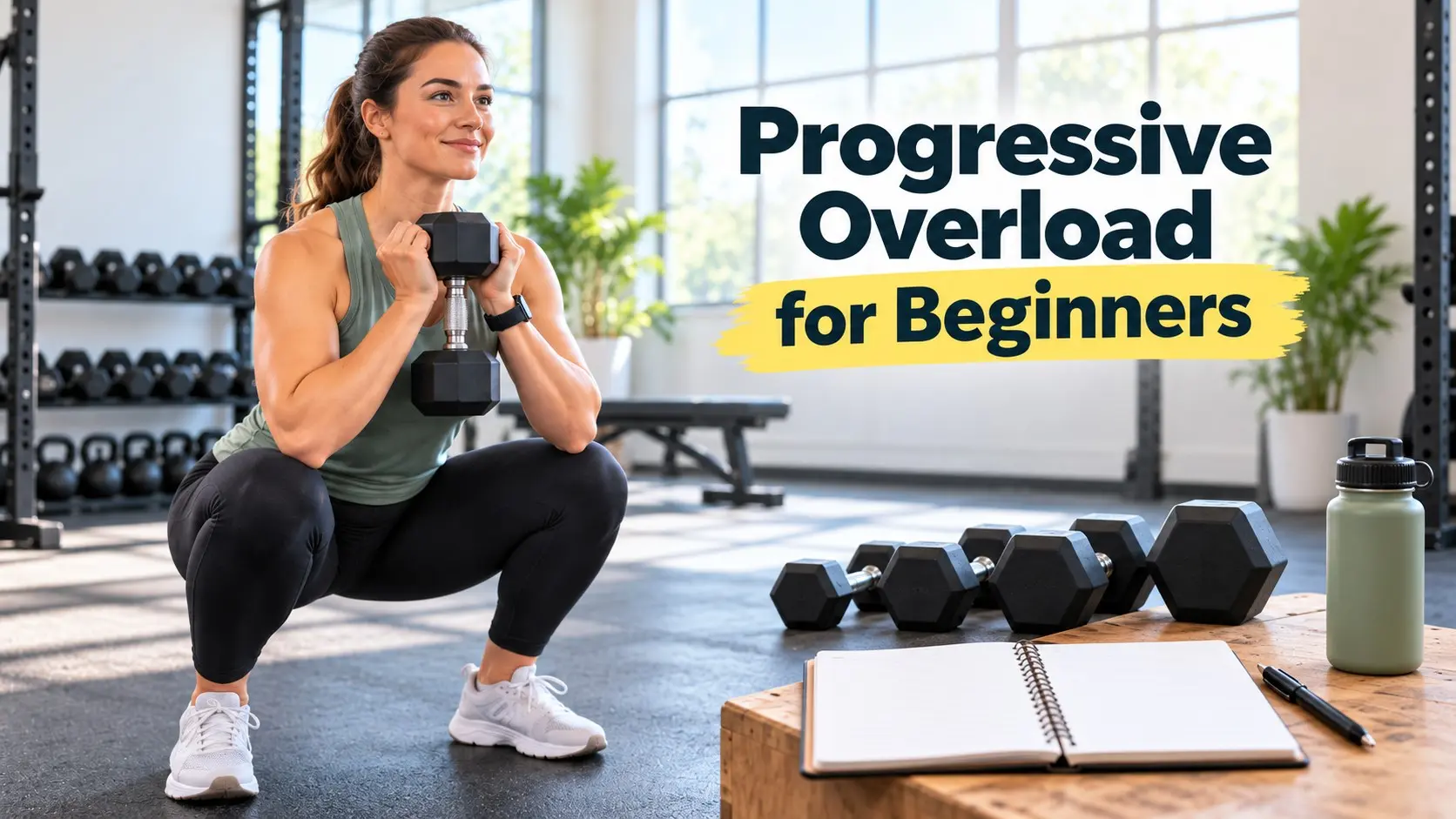
Progressive overload for beginners is simple. Do a useful exercise. Get better at it. Then make one small part harder when your body is ready.
You do not need to add weight every workout.
In fact, that is where many beginners go wrong.
My preferred beginner rule is this: add good reps first, add weight second, and sometimes change nothing.
This guide shows you how.
Quick answer: Progressive overload means slowly raising the challenge of your training as you get stronger. You can add reps, use a little more weight, improve your range of motion, add a set, or use a harder exercise. Beginners should change one main thing at a time and keep suitable form.
If you are brand new to exercise, you may also want to start with the NextFitLife Fitness for Beginners' Guide.
What does progressive overload really mean?
Your body gets used to work.
A squat that feels hard today may feel easier after weeks of practice.
That is adaptation.
To keep improving, your training must slowly ask for more.
This is called progressive overload.
The challenge can come from several places.
- More resistance
- More reps
- More sets
- Better range of motion
- Better control
- A harder exercise variation
The 2026 American College of Sports Medicine position stand supports progressive resistance training for strength, muscle growth, and physical performance.
But you do not need to change everything at once.
That is good news.
A simple plan is easier to follow.
For more on basic lifting, visit the Strength Training and Muscle Building Guide.
What is the best progressive overload rule for beginners?
Start with a rep range.
Then earn your way through it.
For example, an exercise may use a range of 8 to 12 reps.
You do not have to reach 12 on day one.
You may begin at 8.
Next time, you may reach 9.
Then 10.
When you can complete the top of the range with good control, you can think about using a little more resistance.
This is one simple form of double progression.
A simple example
| Workout | Weight | Set 1 | Set 2 | Set 3 | Next step |
|---|---|---|---|---|---|
| 1 | 10 kg | 8 | 8 | 8 | Keep the same weight |
| 2 | 10 kg | 10 | 9 | 8 | Keep the same weight |
| 3 | 10 kg | 11 | 10 | 10 | Keep building reps |
| 4 | 10 kg | 12 | 12 | 12 | Consider a small increase |
This table is an example.
It is not a personal workout prescription.
Your exercise, weight, rep range, and pace of progress can be different.
Should you add reps or weight first?
For most beginners, I prefer reps first.
Why?
They are easy to track.
They also give you time to learn the movement.
Imagine you can do 8 controlled goblet squats.
Stay with that weight.
Try to reach 9.
Then 10.
Keep going until you reach the top of your chosen range with suitable form.
Then think about a small increase in weight.
This makes the question of adding reps or weight much easier.
You are not guessing.
You have a rule.
When should you increase the weight?
Increase the load when your current load is clearly under control.
That means your reps look similar from start to finish.
Your movement stays controlled.
You can use the planned range of motion.
You are not twisting, swinging, rushing, or cutting the exercise short just to finish.
This is my simple when-to-increase-weight checklist:
- You reached the top of your planned rep range
- Your form stayed under control
- You did not need to change the exercise to finish it
- The weight increase available to you is reasonable
If all four make sense, increase the resistance a little.
Then let the reps come down again.
Build them back up over time.
When should you keep the same weight?
More often than many beginners think.
Keep the same resistance if you are still building reps.
Keep it if your form became poor.
Keep it if the last workout already felt very hard.
Keep it if the next available dumbbell is a much larger jump.
Keep it after one bad workout.
A repeated workout is not a failed workout.
You may use the same weight and perform cleaner reps.
You may use the same weight and feel more stable.
You may finish the same work with less strain.
That is useful information.
Do you need to beat your last workout every time?
No.
This is one of the most useful lessons in strength training for beginners.
Progress is not a straight line.
Your sleep changes.
Your stress changes.
Your food changes.
Your energy changes.
One workout can feel great.
The next can feel heavy.
Look at the trend over time.
Do not turn every gym visit into a test.
A good training plan gives you room to practice.
Does progressive overload mean training to failure?
No.
You do not have to push every set until you cannot complete another rep.
The 2026 ACSM resistance training review found that training to momentary muscular fatigue did not consistently improve outcomes.
That does not mean every set should feel easy.
It means failure is not required for progress.
For a beginner, good control matters more.
You can finish a hard set while still feeling that one or a few clean reps might have been possible.
This idea is related to reps in reserve.
You do not need to become obsessed with the exact number.
Just learn this difference:
Hard is fine. Pain and loss of control are not goals.
Can better form count as progressive overload?
Better movement is real progress.
Suppose last week you performed a squat with a short range.
This week you use the same load but move through a better-controlled range.
The number on the dumbbell did not change.
Your movement did.
That matters.
The same applies to pushups, rows, lunges, presses, and many other exercises.
Do not sacrifice movement quality just to write a larger number in your training log.
Should beginners add more sets?
Sets are another way to raise training volume.
But I would not use this first.
Adding reps or a small amount of resistance is easier to track.
It also keeps the workout simple.
More sets can make sense later.
For example, you may move from two working sets to three.
But do not add weight, reps, sets, and harder exercises at the same time.
You will not know what caused the change.
Should you reduce your rest time?
You can.
But it is not my first choice for a beginner who wants more strength.
Shorter rest makes the session feel harder.
It can also make the next set weaker.
If strength is your goal, give yourself enough time to perform the next set with control.
Use shorter rest with a clear reason.
Do not shorten it just because sweating more feels like better training.
How should you track progressive overload?
Use a notebook.
Or use your phone.
You do not need a complex app.
Basic workout tracking can include:
- Exercise
- Weight or resistance
- Number of sets
- Number of reps
- A short note about form or effort
That is enough for most beginners.
Without a record, it is easy to forget what you did.
With a record, your next decision is much clearer.
A simple progressive overload decision guide
Use this after your workout.
You reached the top of the rep range with good control
Consider a small weight increase next time.
You reached some of the reps but not all
Keep the same resistance.
Try to build another clean rep.
Your reps increased but your form became worse
Do not add weight.
Repeat the load.
Clean up the movement.
You had one poor workout
Repeat it.
One bad day does not prove that your plan stopped working.
You have been stuck for several workouts
Look at your sleep.
Look at recovery.
Check your exercise form.
Check whether your last weight jump was too large.
Then decide what to change.
How can you use progressive overload at home?
You do not need a barbell.
You do not need a full gym.
Home strength training can use the same idea.
You can:
- Add a rep
- Add a set later
- Use a stronger resistance band
- Use a slightly heavier dumbbell
- Improve your range of motion
- Move to a harder bodyweight variation
For example, wall pushups may become incline pushups.
Incline pushups may become floor pushups.
A bodyweight squat may become a goblet squat.
The main idea stays the same.
Make the challenge rise slowly.
If you train at home, explore the Home Workouts and Equipment Guide and Strength Training Exercises at Home for Beginners.
What are the biggest progressive overload mistakes?
Adding weight too soon
A heavier dumbbell does not help if the movement falls apart.
Changing several things at once
More weight plus more sets plus less rest creates confusion.
Change one main variable.
Using soreness as the goal
Soreness is not your score.
Your training log is more useful.
Changing exercises all the time
You need something repeatable if you want to measure progress.
Copying another person's progress
Your starting point is yours.
Your equipment is yours.
Your recovery is yours.
Use your own log.
Ignoring pain
Pain is not a progression tool.
MedlinePlus advises people to build activity slowly and not push too hard too quickly.
If an exercise causes sharp, severe, sudden, or persistent pain, stop and get appropriate advice.
For more help with rest, soreness, and warning signs, visit the Recovery and Injury Prevention Guide.
What if progress stops?
First, do not panic.
One hard workout is not a plateau.
Repeat the exercise.
If progress stays stuck, check the basics.
- Are you using the same exercise long enough to learn it?
- Was the last weight jump too large?
- Are you sleeping enough for you?
- Are you taking rest days?
- Has your form changed?
- Are you trying to add too much at once?
Then make one small change.
Do not throw away the whole plan because one lift stopped moving.
How fast should beginners progress?
There is no single correct speed.
Different exercises move at different rates.
Your legs may progress faster than your shoulders.
A machine may allow a smaller load change than a pair of fixed dumbbells.
A bodyweight exercise may need a new variation instead of a weight increase.
Your goal is not to progress as fast as possible.
Your goal is to progress at a pace you can repeat.
That is the difference.
What does current research say?
The 2026 American College of Sports Medicine position stand reviewed a large body of resistance training research.
The main message for beginners is reassuring.
Resistance training works.
Progressive training matters for continued improvement.
But you do not need a perfect or extreme program.
You also do not need to train every set to complete muscular failure.
Consistency, sensible resistance, enough work, good movement, and gradual progress remain a strong base.
When should you get professional help?
Fitness articles cannot see your movement.
They cannot check your injury history.
They cannot tell whether an exercise is right for your body.
Consider help from a qualified fitness professional if you are unsure about technique, equipment setup, exercise choice, or progression.
Talk with a qualified healthcare professional before starting or increasing exercise if you have a medical condition or symptoms that may affect safe exercise.
Stop exercise and seek prompt care for symptoms such as chest pain, fainting, severe shortness of breath, sudden weakness, or severe injury.
Conclusion
Progressive overload for beginners does not mean forcing more weight onto the bar every week.
Start with control.
Build clean reps.
Record what you do.
Add resistance when you earn it.
And if the smart choice is to repeat the same workout, repeat it.
Your next step: Pick one strength exercise today. Write down the weight, sets, and reps. At your next workout, try to improve one small thing.
Related NextFitLife guides and hubs
- Fitness Hub
- Strength Training and Muscle Building Guide
- Fitness for Beginners Guide
- Recovery and Injury Prevention Guide
- Home Workouts and Equipment Guide
- Strength Training Exercises at Home for Beginners
- How to Get Fit Safely as a Beginner
References and Sources
The following sources are open and accessible. They support the exercise science and safety information in this guide.
- American College of Sports Medicine. Resistance Training Prescription for Muscle Function, Hypertrophy, and Physical Performance in Healthy Adults. 2026.
- Centers for Disease Control and Prevention. Adult Activity: An Overview.
- MedlinePlus. Exercise and Physical Fitness.
- MedlinePlus. How to Avoid Exercise Injuries.
- Cleveland Clinic. Your Simple Guide to Progressive Overload Training.
Author Bio
Adel Galal is the founder and lead writer of NextFitLife. He writes simple educational guides about health, fitness, nutrition, and wellness.
His approach is practical. He compares current research, trusted health sources, real-life experience, and information discussed with healthcare providers. The aim is to make difficult topics easier to understand without pretending that an article can replace personal care.
This content is for general educational purposes and does not replace professional medical advice, diagnosis, or treatment. Consult an appropriately qualified healthcare professional for personal medical concerns. This article explains published guidance and does not provide a personal clinical assessment. Always consult qualified medical professionals for diagnosis and treatment of any health condition.
For fitness topics, I focus on safe progression, clear form basics, realistic expectations, recovery, and habits that readers can understand and discuss with qualified fitness or healthcare professionals.
Learn more on the About Us page.
Frequently Asked Questions
What is progressive overload for beginners?
Progressive overload for beginners means making exercise a little harder over time. You can add reps, use more resistance, improve control, add a set, or use a harder exercise when you are ready.
Should beginners add weight every workout?
No. Keep the same weight while you build clean reps and good form. Increase resistance when the current level is under control and the next increase makes sense.
Should I add reps or weight first?
For many beginners, adding reps first is simple and easy to track. Reach the top of your chosen rep range with control. Then consider a small increase in resistance.
Does progressive overload mean training to failure?
No. You can build strength without taking every set to complete muscular failure. A hard set can still leave a small amount of effort in reserve.
Can I use progressive overload at home?
Yes. Add reps, use stronger resistance bands, use heavier dumbbells, improve your range of motion, or move to a harder bodyweight exercise.
What should I do if I cannot complete my planned reps?
Keep the same resistance. Try again at a later workout. Do not add weight just because the calendar changed.
Is repeating the same workout a bad sign?
No. Repeating a workout can help you improve form, control, and confidence. Progress should be judged over time, not from one session.

Health & wellness writer with 30+ years of experience in nutrition, fitness, and healthy aging. Founder of NextFitLife.com — evidence-based health guidance.