First published: September 28, 2026
Last updated: September 28, 2026
Written and source- checked by: Adel Galal, Founder and Lead Writer at NextFitLife
Medical review status: This article has not been medically reviewed by a doctor, physical therapist, sports medicine specialist, or certified strength professional.
Your feet do not need to sit at one exact width or point at one perfect angle.
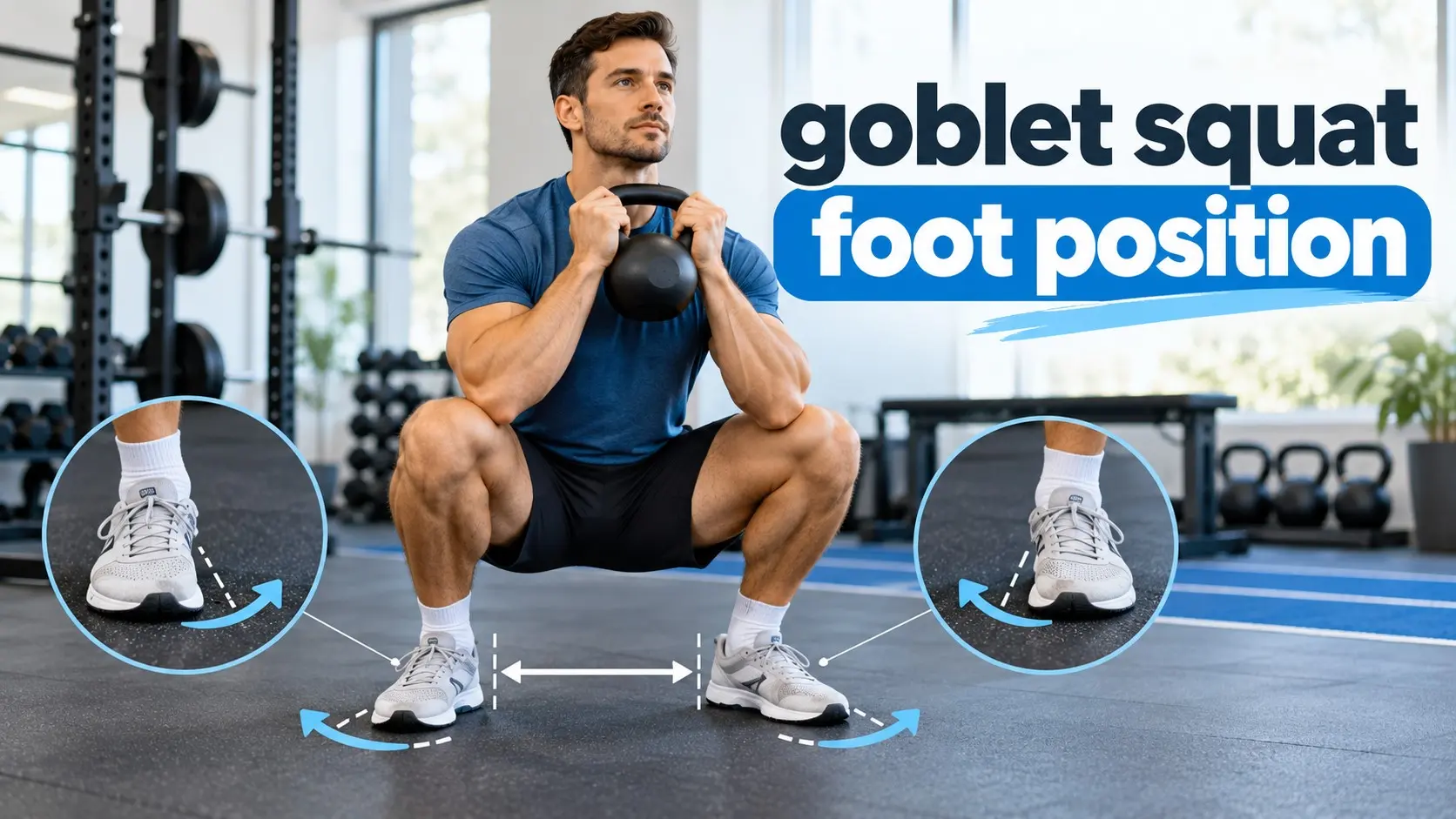
A good goblet squat foot position gives your hips room to descend, keeps your whole foot stable, and lets your knees move in roughly the same direction as your toes. Start a round hip to shoulder width with a small toe turn out, then adjust based on comfort, depth, and control.
Quick answer: Start your goblet squat with your feet about hip to shoulder width apart. Point your toes straight ahead or slightly outward. As you squat, let your knees follow the same general direction as your toes. Move slightly wider or narrower if that gives your hips more room, improves balance, or helps your heels stay down.
That starting position works because it is simple, not because it is perfect for everybody.
Your stance width, toe angle, hip structure, leg length, ankle dorsiflexion, squat depth, and training goal all change what feels natural.
If you are still learning the complete exercise, start with the NextFitLife Goblet Squat Guide. It covers the weight position, knee movement, foot pressure, depth, common mistakes, and progression.
Medical notice: I am not a dermatologist or A doctor, and this content does not replace professional medical advice. What I share comes from real-life experience, extensive research, and consultation with healthcare providers. Always consult qualified medical professionals for diagnosis and treatment of any health condition.
Table of Contents
- The best starting foot position
- Nine smart setup rules
- Narrow versus medium versus wide stance
- The best toe angle
- Why knees should track with toes
- How stance affects squat depth
- Ankle mobility and heel lift
- Hip anatomy and stance width
- Muscle activity and stance
- Quad versus glute claims
- Common foot position mistakes
- A five minute stance test
- Foot position for beginners
- Foot position for older adults
- When foot position causes pain
- References and Sources
- Related NextFitLife guides
- About the author
- Frequently asked questions
What Is the Best Starting Goblet Squat Foot Position?
Start with your feet somewhere between hip width and shoulder width.
Point your toes straight ahead or slightly outward. Then perform a few slow squats with a light weight.
NASM currently uses a similar starting range for the goblet squat. The stance can then be adjusted based on the person's body, mobility, and control.
That is a better approach than trying to measure an exact distance between your shoes.
Your starting setup should let you do four things:
- Keep your whole foot on the floor
- Move your knees comfortably
- Give your hips enough room to descend
- Stay balanced through the full squat
If those four things happen, your stance is already close.
9 Smart Rules for Goblet Squat Foot Position
1. Start Around Hip to Shoulder Width
This is the most useful default because it gives you room to adjust in either direction.
Stand naturally. Place your feet somewhere between hip width and shoulder width, hold the weight close to your chest, and perform three controlled squats.
Do not worry about whether your shoes are exactly 35 or 40 centimeters apart.
Instead, notice what happens as you descend.
Can your hips move down without feeling blocked? Do your heels stay on the floor? Can your knees move smoothly?
If yes, keep the position for now.
2. Use a Small Toe Turn Out as a Starting Point
Many people feel comfortable with the toes pointing slightly outward.
This is called foot abduction or external foot rotation in research.
There is no universal best angle.
A 2018 biomechanics study tested squats with foot angles of 0 degrees, 21 degrees, and 42 degrees across narrow, hip width, and wide stances. Both stance width and foot angle changed hip and knee mechanics.
The researchers suggested a moderate setup, around shoulder width with roughly 20 degrees of foot angle, as a practical general position.
That recommendation came from squat research, not from a direct goblet squat trial.
I would therefore treat 20 degrees as an example, not a target you need to measure.
3. Let Your Knees Follow Your Toes
This is more useful than trying to copy one exact toe angle.
If your toes point slightly outward, your knees should usually travel in a similar direction as you lower.
Think about your kneecaps moving over the middle area of your feet.
Do not force the knees as far outward as possible.
And do not turn your toes far outward while trying to keep your knees pointed straight ahead.
Knee tracking should look natural and controlled rather than forced.
4. Keep Your Whole Foot Stable
Your foot is your base.
A good setup lets you keep pressure through:
- Your heel
- The base of your big toe
- The base of your little toe
This is sometimes called the tripod foot idea.
You do not need to press those three points into the floor with extreme force. The cue simply reminds you not to rock onto the toes or heels.
If your toes lift during every repetition, you may be sitting too far backward.
If your heels lift as you go lower, your stance, depth, balance, or ankle range may need adjustment.
5. Move Slightly Wider if Your Hips Feel Crowded
A narrow stance gives the hips less space between the thighs.
For some lifters, moving the feet a little wider makes the bottom position feel much easier.
That does not mean wide is better.
It means your hips may prefer more room.
Research shows that changing stance width changes hip and knee motion and joint moments during squatting.
Move only a small amount at first.
One shoe width wider can tell you more than immediately jumping into a very wide stance.
6. Try Narrower if a Wide Stance Feels Forced
Wide stances are not automatically safer or stronger.
A very wide position asks for more hip abduction and often more hip rotation.
If your hips pinch, your knees feel pushed outward, or you struggle to create force from the bottom, move slightly narrower.
Research also shows that extreme combinations deserve caution.
In the 2018 study, a narrow stance combined with a very large toe angle and a wide stance combined with straight feet created less favorable joint loading patterns than more moderate setups.
The useful lesson is simple:
Avoid forcing extreme combinations just because they look different.
7. Match Toe Angle to Stance Width
Stance width and toe angle work together.
A narrow stance with the feet turned far outward feels awkward for many people.
A very wide stance with perfectly straight feet can also feel restrictive.
As the stance becomes wider, some lifters naturally prefer a little more toe turn out.
This is not a fixed formula.
It is a relationship you can test.
Change the width first. Then adjust the toe angle until your knees and hips move comfortably.
8. Test Your Stance at the Depth You Actually Use
A foot position may feel fine during a shallow squat but uncomfortable below parallel.
That is why stance testing should include your real training depth.
If your goal is a comfortable deep goblet squat, test the stance while going to that depth with a light weight.
Do not judge the setup after one quarter squat.
Foot position and squat depth affect each other.
For a detailed guide, read Goblet Squat Depth: How Low Should You Squat?.
9. Choose the Stance You Can Repeat
One good repetition means very little if every next rep looks different.
A useful goblet squat stance should be easy to reproduce.
Your feet should land in roughly the same place each set without a long setup ritual.
You should be able to squat, stand, and repeat without your feet sliding farther apart or rotating during every repetition.
Repeatability matters because it makes progress easier to measure.
Narrow, Medium, or Wide: Which Stance Fits You?
| Stance | What Changes | May Suit You If | Watch For |
|---|---|---|---|
| Narrow | Usually asks for more knee and ankle motion at the same depth | Your ankles move well and your hips feel comfortable | Heel lift or feeling crowded at the hips |
| Hip to shoulder width | Balanced starting setup | You are learning the movement or want a general training stance | Do not keep it just because it is the default if another stance feels better |
| Moderately wide | Gives the hips more space and changes hip rotation demands | A narrow stance feels blocked or limits depth | Hip pinching or forced knee position |
| Very wide | Creates much greater hip abduction and different joint demands | You are intentionally training a wide squat variation | Do not assume wider means better glute training or safer knees |
For a standard goblet squat, I would begin in the middle.
Then move only if you have a reason.
What Is the Best Toe Angle for a Goblet Squat?
There is no single best number.
Start with straight feet to a small outward angle.
If your hips and knees feel restricted, turn your toes outward a little more and test again.
The research is useful here because it shows why extreme certainty makes little sense.
The 2018 Lorenzetti study compared three angles:
- 0 degrees
- 21 degrees
- 42 degrees
Those angles changed hip and knee movement and joint moments.
The authors recommended a moderate stance and moderate foot angle rather than extreme combinations.
A separate study comparing self selected and manipulated toe angles also concluded that there did not appear to be one optimal foot placement angle for every lifter.
That fits what you see in real gyms.
People squat well with slightly different foot positions.
Is 30 Degrees of Toe Turn Out Too Much?
Not automatically.
Thirty degrees may feel natural for a person using a wider stance.
It may feel excessive for someone with a narrow stance.
The number is less useful than these questions:
- Can your whole foot stay down?
- Can your knees follow your toes?
- Can your hips descend without pinching?
- Can you repeat the position without your feet moving?
If yes, the angle may fit you.
If not, reduce it.
Do Your Toes Need to Point Straight Ahead?
No.
Straight feet work for some people.
They are not a requirement.
A slight outward angle can make the squat feel more natural by matching available hip rotation.
NASM's current goblet squat guidance starts with feet around hip to shoulder width and toes straight ahead to slightly outward.
That is a useful starting range because it leaves room to adjust.
Should the Knees Point in the Exact Same Direction as the Toes?
Think general alignment rather than perfect geometry.
Your knees should move in a similar direction to the feet, but the human leg is not a mechanical hinge that stays on one exact line.
A small amount of movement is normal.
What deserves more attention is a large, uncontrolled collapse inward, especially if it appears as the load becomes heavy or if it causes pain.
If that happens, first reduce the weight.
Then check whether your stance or toe angle is forcing your knees into an awkward path.
Should You Push Your Knees Out?
This cue gets overused.
“Knees out” can help someone who is collapsing sharply inward.
It does not mean you should force the knees as far outward as possible.
A better cue is:
Let your knees follow your toes.
That gives the movement direction without turning the squat into a contest to see how far apart your knees can travel.
How Does Foot Position Affect Goblet Squat Depth?
Quite a lot.
A narrower stance can require more knee flexion and ankle dorsiflexion to reach a given depth.
A wider stance gives the hips more room but asks for more hip abduction and rotation.
A 2021 study of trained lifters found greater knee flexion and ankle plantar flexion angles with narrower back squat stances compared with wider positions.
Again, that was barbell squat research rather than a direct goblet squat study.
The useful principle is still clear: changing your stance changes the movement requirements.
If depth is limited, do not look only at flexibility.
Try the stance first.
Can a Wider Stance Help if Your Heels Lift?
Sometimes.
Moving slightly wider can reduce how much forward knee and ankle movement you need to reach the same visual depth.
If your heels stay down immediately after a small stance change, that is useful information.
But heel lift has several possible causes.
It can also come from:
- Limited ankle range
- Going deeper than you can control
- Moving too quickly
- Losing balance
- Using too much weight
Do not diagnose every heel problem as an ankle mobility problem.
What Does Ankle Mobility Have to Do With Foot Position?
Your ankle has to bend as your knee travels forward.
This is ankle dorsiflexion.
A 2015 study of 101 healthy adults found that ankle dorsiflexion was one of the main factors associated with squat depth.
Hip range also mattered in some participants.
This explains why stance and ankle movement interact.
A person with generous ankle range may feel comfortable in a fairly narrow position.
Someone with less available dorsiflexion may prefer slightly more stance width or a small heel elevation.
That is a mechanical choice, not a weakness of character or effort.
Does Hip Anatomy Change Your Best Stance?
Yes.
People differ in femur length, pelvic structure, hip socket orientation, and available hip rotation.
Those differences help explain why one lifter loves a narrow stance and another feels blocked in it.
You cannot see all of your hip anatomy by looking in a mirror.
You also cannot stretch your bones into another person's shape.
What you can do is test small changes in stance width and toe angle.
The position that lets your hips move freely without pain is more useful than copying someone with different proportions.
Does a Wide Goblet Squat Work the Glutes More?
This claim needs context.
Some squat studies have found greater gluteus maximus activity or greater hip contribution with wider positions.
A 2021 study of trained men and women found greater hip contribution in wide stance back squats compared with a narrow high bar condition.
But bar position, depth, load, and stance all changed together across many squat studies.
That makes simple conclusions difficult.
The 2024 biomechanical review also notes that findings on stance width and muscle demand vary between studies.
So I would not choose an uncomfortable wide goblet squat just because someone says it “targets the glutes.”
Your glutes work in normal goblet squats too.
Does a Narrow Goblet Squat Work the Quads More?
A narrower stance can increase knee flexion and knee contribution in some squat conditions.
The 2021 study found that the narrow high bar squat produced greater knee contribution and greater vastus lateralis activity than several other tested conditions.
That gives the narrow stance some biomechanical support for greater knee extensor demand under those conditions.
But it does not prove that moving your goblet squat feet a few centimeters inward will suddenly transform the exercise into a quad isolation movement.
Load, range, effort, and progression still matter far more.
Can Foot Angle Change Which Muscles Work?
Yes, but the effects are not as dramatic or predictable as many social posts suggest.
A study testing 0, 10, and 20 degrees of outward foot rotation found some differences in biceps femoris and gastrocnemius activity during the lowering phase, while many other muscles did not change significantly.
A larger study of habitual and manipulated foot angles also found changes in muscle forces and ground reaction forces.
The researchers did not identify one angle that was best for everything.
That is the point worth remembering.
Toe angle changes biomechanics. It does not give you a magic muscle switch.
What About a Sumo Style Goblet Squat?
A very wide stance with greater toe turn out becomes a different squat variation.
It is often called a sumo squat or wide stance goblet squat.
That variation can be useful.
But it should not quietly replace your standard stance just because you can reach the floor more easily.
Use a wide stance intentionally when that variation fits your goal.
For general goblet squat training, a moderate position is usually the cleaner place to start.
What if One Foot Turns Out More Than the Other?
Small differences between sides are common.
You do not need to force both feet into perfectly matching angles if one side naturally sits a little differently.
Pay more attention if:
- The difference is large
- One foot keeps moving during every rep
- You shift strongly toward one side
- One hip or knee hurts
- The change appeared after an injury
Those signs deserve more careful assessment.
What if Your Feet Rotate During the Squat?
If your feet visibly turn on the floor as you descend, stop and reset.
You want a stable base.
Sometimes the solution is simple.
If you begin with perfectly straight feet and they rotate outward every time you reach the bottom, try starting with a small toe turn out instead.
Your body may be showing you that the straight position is not comfortable at full depth.
What if Your Hip Pinches With a Narrow Stance?
Do not keep forcing the same position.
Try moving each foot slightly wider and allowing a little more toe turn out.
This changes the direction of the thigh as it moves toward the pelvis.
For some people, that creates more room.
If the hip still pinches, reduce depth and get professional advice if the symptom keeps returning.
Persistent joint pinching is not something to solve by repeatedly pushing harder into the same position.
What if Your Knees Hurt With a Wide Stance?
Move narrower and retest with less weight.
A wide stance changes hip and knee mechanics and usually requires a different toe angle.
If your feet are wide but point too straight ahead for your available hip motion, the setup can feel forced.
If adjusting width and toe angle does not remove the pain, stop treating foot position as the whole problem.
Knee pain can have many causes.
How to Find Your Best Goblet Squat Foot Position in 5 Minutes
Use a light weight so strength does not hide your movement.
Step 1: Start in the Middle
Stand around shoulder width with a small toe turn out. Perform three slow goblet squats.
Step 2: Go Slightly Narrower
Move each foot inward a small amount. Perform three more reps. Check your heels, hip comfort, knee tracking, and depth.
Step 3: Go Slightly Wider
Move each foot a little wider than the original position. Repeat three controlled reps.
Step 4: Adjust Toe Angle
Use the width that felt better. Test a little less toe turn out, then a little more.
Step 5: Choose the Repeatable Setup
Pick the stance that gives you stable feet, comfortable hips, controlled knees, and your intended squat depth.
Do not choose the position that simply gets you closest to the floor.
Choose the position you can train.
Five Signs Your Stance May Be Too Narrow
- Your heels rise early as you descend.
- Your hips feel crowded or blocked.
- You cannot reach your intended depth even with a light load.
- You lose balance toward the toes.
- A small increase in stance width immediately improves the squat.
These signs do not mean narrow squats are bad.
They mean your current narrow stance may not fit this movement.
Five Signs Your Stance May Be Too Wide
- Your hips pinch during the descent.
- Your knees feel forced outward.
- You struggle to keep your knees and toes moving in a similar direction.
- Your feet want to rotate or slide during the rep.
- Moving slightly narrower makes the movement feel stronger and smoother.
Should Beginners Use a Different Foot Position?
Beginners do not need a special beginner stance.
They need a simple stance they can repeat.
Start around hip to shoulder width with a small outward toe angle.
Use a light kettlebell or dumbbell and perform the same setup for several sessions.
Constantly changing your stance makes learning harder.
Once the basic movement feels familiar, small experiments with width and toe angle become more useful.
If you are new to exercise, the NextFitLife Beginner Fitness Guide explains how to build a basic training routine without rushing progression.
What Foot Position Should Older Adults Use?
Age alone does not determine stance width.
Balance, strength, hip comfort, ankle motion, and joint health matter more.
Some older adults feel more secure with a slightly wider base.
Others squat comfortably in a standard hip width position.
A chair or box can provide a clear depth target while stance width is tested.
If balance is limited, use support before adding weight.
Does Body Shape Change Foot Position?
Yes.
People with long femurs, different pelvis shapes, or different ankle mobility may naturally use different stance widths and torso angles.
This is one reason universal visual rules fail.
A taller person does not automatically need a wide stance, and a shorter person does not automatically need a narrow one.
Body proportions affect the options available, but testing the actual movement remains more useful than guessing from height.
What Most Goblet Squat Foot Position Advice Gets Wrong
- Shoulder width is not a law. It is a useful starting point.
- There is no universal best toe angle. Research shows that different angles change squat mechanics.
- Knees do not need to point perfectly straight forward. They should move in a comfortable relationship with the toes.
- More toe turn out is not automatically better. Extreme combinations can increase joint demands.
- A wide stance is not automatically a glute squat. Muscle demand depends on stance, load, depth, torso position, and several other factors.
- A narrow stance is not automatically a quad isolation exercise. It can change knee demand, but the effect is more complex than a simple muscle label.
- Heel lift is not always caused by tight ankles. Stance, depth, load, balance, and speed can contribute.
- Your two feet do not have to match to the exact degree. Small natural differences exist.
- Foot position should support depth, not fight it. Test your stance at the range you actually use.
Conclusion
Your best goblet squat foot position is not a number printed in a coaching manual. Start around hip to shoulder width, use a comfortable small toe turn out, and let your knees track naturally with your feet.
Then test one change at a time. If moving slightly wider, narrower, or changing your toe angle makes the squat more stable and comfortable, keep the change. Your next step is to perform the five minute stance test with a light weight and choose the setup you can control and repeat.
References and Sources
The stance width, toe angle, knee tracking, mobility, and biomechanics information in this article was checked against current exercise guidance and peer reviewed research.
- National Academy of Sports Medicine.
The Goblet Squat: A Trainer's Coaching and Programming Guide.
Used for goblet squat setup, starting stance, toe position, knee tracking, load position, and practical coaching guidance.
URL:
https://www.nasm.org/resource-center/blog/training/how-to-perform-goblet-squats
- Lorenzetti S, Ostermann M, Zeidler F, et al.
How to Squat? Effects of Various Stance Widths, Foot Placement Angles and Level of Experience on Knee, Hip and Trunk Motion and Loading.
BMC Sports Science, Medicine and Rehabilitation, 2018.
Used for the effects of narrow, hip width, and wide stances combined with 0, 21, and 42 degree foot angles.
URL:
https://pmc.ncbi.nlm.nih.gov/articles/PMC6050697/
- Straub RK, Powers CM.
A Biomechanical Review of the Squat Exercise: Implications for Clinical Practice.
International Journal of Sports Physical Therapy, 2024.
Used for stance width, foot rotation, hip and knee mechanics, squat depth, and the interaction among squat technique variables.
URL:
https://pmc.ncbi.nlm.nih.gov/articles/PMC10987311/
- Larsen S, Kristiansen E, Helms E, van den Tillaar R.
Effects of Stance Width and Barbell Placement on Kinematics, Kinetics, and Myoelectric Activity in Back Squats.
Frontiers in Sports and Active Living, 2021.
Used for evidence that narrow and wide stances alter knee flexion, ankle motion, hip contribution, and muscle activity under loaded squat conditions.
URL:
https://pmc.ncbi.nlm.nih.gov/articles/PMC8440835/
- Kim SH, Kwon OY, Park KN, Jeon IC, Weon JH.
Lower Extremity Strength and the Range of Motion in Relation to Squat Depth.
Journal of Human Kinetics, 2015.
Used for the relationship between ankle dorsiflexion, hip motion, lower limb strength, and squat depth.
URL:
https://pmc.ncbi.nlm.nih.gov/articles/PMC4415844/
Continue With NextFitLife Goblet Squat and Fitness Guides
This guide focuses only on foot position. Use the parent goblet squat article for the complete exercise, then use the depth guide to fine tune how low you squat.
Goblet Squat Cluster
- Goblet Squat: Complete Form, Muscles, Mistakes, and Progression Guide
- Goblet Squat Depth: How Low Should You Squat?
Lower Body Training
Beginner Fitness
About the Author
Adel Galal is the founder and lead writer of NextFitLife. He researches and writes educational content about health, fitness, nutrition, exercise, wellness, and healthy aging.
His approach is to compare common gym advice with current research, separate useful starting cues from rigid rules, and turn biomechanics into practical information readers can test safely.
For squat stance, that means avoiding claims that every person needs the same foot width or exact toe angle. Stance width and foot rotation change joint mechanics, but the most useful position is one that fits the person's anatomy, mobility, training goal, and symptoms.
I am not a dermatologist or A doctor, and this content does not replace professional medical advice. What I share comes from real-life experience, extensive research, and consultation with healthcare providers. Always consult qualified medical professionals for diagnosis and treatment of any health condition.
Learn more about Adel Galal, NextFitLife, and the site's editorial standards on the NextFitLife About Us page.
Frequently Asked Questions About Goblet Squat Foot Position
How wide should my feet be for a goblet squat?
Start around hip to shoulder width. Then adjust slightly wider or narrower based on your hip comfort, heel contact, knee tracking, balance, and squat depth.
Should my toes point straight ahead during a goblet squat?
They can, but they do not have to. Many people feel more comfortable with a small outward toe angle. Choose the position that lets your hips and knees move naturally.
What is the best toe angle for a goblet squat?
There is no universal best toe angle. Start straight ahead to slightly outward, then adjust. Research shows that changing toe angle changes hip and knee mechanics, so extreme positions should not be used without a reason.
Is 30 degrees of toe turn out okay?
It can be. Thirty degrees may suit some people, especially with a wider stance, while it may feel excessive with a narrow stance. Comfort, knee tracking, foot stability, and hip motion matter more than the number.
Should my knees track over my toes?
Your knees should move in roughly the same direction as your toes. They do not have to follow a perfectly rigid line, but large uncontrolled inward collapse should be corrected.
Should I push my knees out during goblet squats?
Do not force them as far outward as possible. A better cue is to let your knees follow the direction of your toes while keeping your whole foot stable.
Is a wide goblet squat stance better for glutes?
Some squat research shows greater hip contribution or glute activity with wider stances, but the effect depends on load, depth, bar position, and other variables. A wide stance is not automatically better for building glutes.
Is a narrow goblet squat better for quads?
Narrower squats can increase knee flexion and knee extensor demand under some conditions, but they are not a quad isolation exercise. Use a narrow stance only if your ankles, hips, and balance tolerate it well.
Does stance width affect squat depth?
Yes. A narrow stance can require more knee and ankle motion, while a wider stance can give the hips more room. Your best depth depends on stance, mobility, anatomy, load, and control.
Why do my heels lift in a narrow goblet squat?
A narrow stance can increase ankle dorsiflexion demand. Heel lift can also come from excessive depth, balance problems, speed, or too much weight.
Should I widen my stance if my ankles are tight?
A slightly wider stance may reduce some ankle demand and make depth easier. It does not fix every ankle limitation, so compare the movement rather than assuming wider is always better.
Can hip anatomy change my squat stance?
Yes. Femur length, pelvis shape, hip socket orientation, and available hip rotation differ between people. These differences can affect which stance and toe angle feel comfortable.
Is it okay if one foot turns out slightly more?
A small natural difference can be normal. Seek assessment if the difference is large, painful, new, or paired with a strong body shift or instability.
Why do my feet rotate during the squat?
Your starting position may not match the position your hips prefer at depth. Reduce the load and test a small toe turn out. Your feet should remain stable once the repetition begins.
What if my hips pinch during a goblet squat?
Reduce depth and try a small change in stance width or toe angle. If the pinching keeps returning, stop forcing the position and get appropriate professional assessment.
What goblet squat stance should beginners use?
Beginners can start around hip to shoulder width with straight to slightly outward toes. Use the same comfortable setup consistently while learning the movement before experimenting with more variations.
Should older adults use a wider goblet squat stance?
Not automatically. Some people feel more stable with a slightly wider base, but balance, hip comfort, ankle motion, strength, and joint health should determine the stance.
How do I know I found the right goblet squat foot position?
Your feet stay planted, your hips move freely, your knees track comfortably with your toes, you can reach the depth you want, and you can repeat the same setup without pain or loss of balance.

Health & wellness writer with 30+ years of experience in nutrition, fitness, and healthy aging. Founder of NextFitLife.com — evidence-based health guidance.