First published: September 28, 2026
Last updated: September 28, 2026
Written and source checked by: Adel Galal, Founder and Lead Writer at NextFitLife
Medical review status: This article has not been medically reviewed by a doctor, physical therapist, sports medicine specialist, or other licensed healthcare professional.
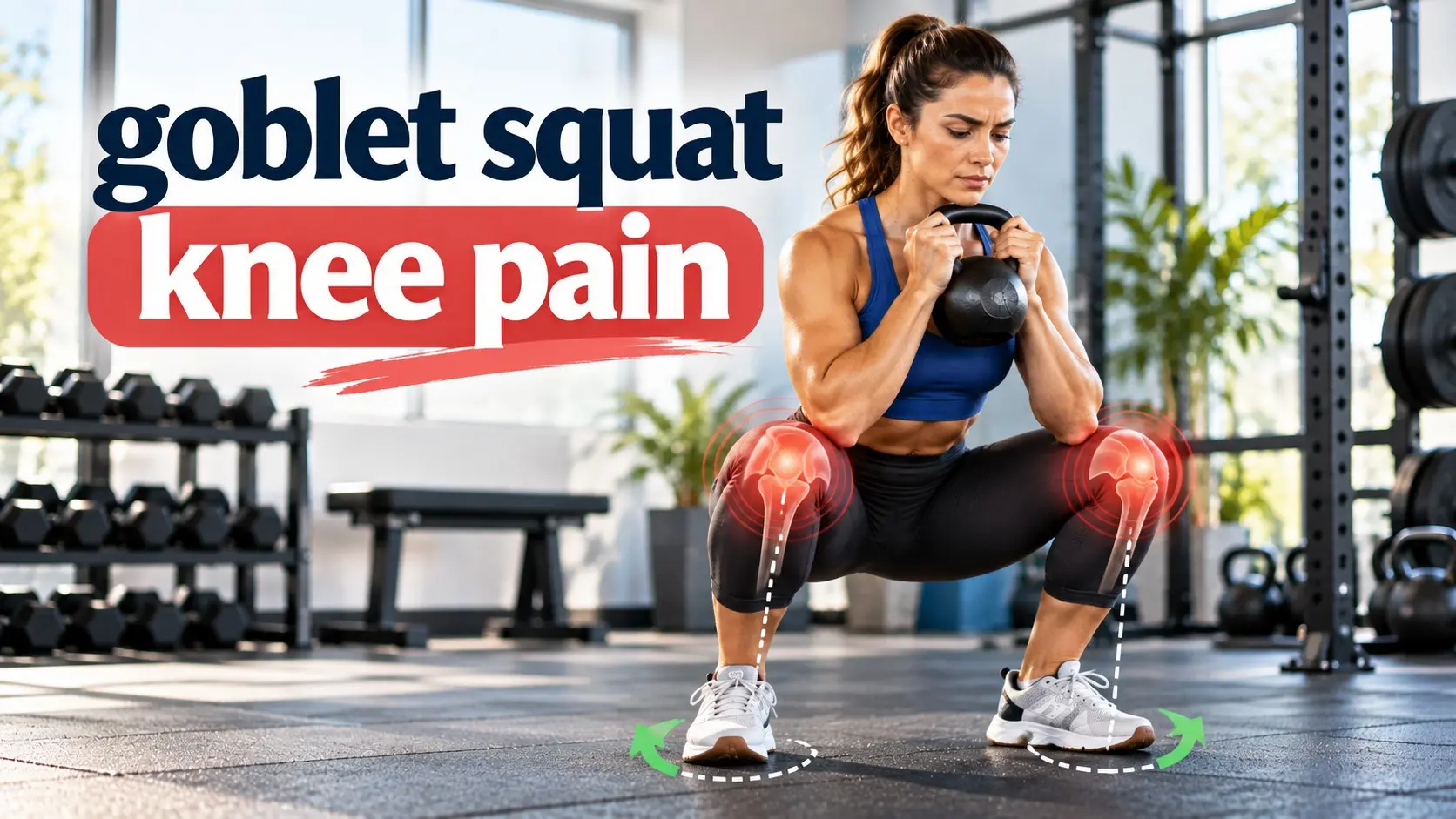
If a goblet squat hurts your knee, do not assume the exercise is destroying your joint. But do not keep forcing the same painful repetition either.
Goblet squat knee pain can show up after a sudden rise in weight, sets, squat depth, running, jumping, or total leg training. It can also occur with patellofemoral pain, patellar tendon problems, arthritis, injury, or another knee condition.
Quick answer: If goblet squats hurt your knee, first reduce the weight and squat depth. Keep your whole foot stable and let your knees track naturally with your toes. If the simpler squat feels better, rebuild slowly. Swelling, locking, giving way, major loss of motion, or severe pain after an injury needs professional assessment.
Knee pain is not one diagnosis.
That is the part many squat guides miss. A sore kneecap, a painful tendon, a swollen joint, and pain after a twisting injury should not all receive the same form cue.
If you first need the complete exercise setup, read the NextFitLife Goblet Squat Guide. It covers weight position, stance, depth, knee movement, and common mistakes.
Medical notice: This content is for general educational purposes and does not replace professional medical advice, diagnosis, or treatment. Consult an appropriately qualified healthcare professional for personal medical concerns. This article explains published guidance and does not provide a personal clinical assessment. Always consult qualified medical professionals for diagnosis and treatment of any health condition.
Table of Contents
- What goblet squat knee pain can mean
- Where the pain is located
- Nine smart checks
- Training load and knee irritation
- Squat depth and knee load
- Knees over toes
- Foot position and knee tracking
- Ankle mobility and heel elevation
- Patellofemoral pain
- Patellar tendon pain
- Safer squat options
- Muscle soreness versus joint pain
- When to stop exercising
- When to seek medical care
- Common myths
- References and Sources
- Related NextFitLife guides
- About the author
- Frequently asked questions
Does Goblet Squat Knee Pain Mean You Damaged Your Knee?
No. Pain by itself does not tell you whether tissue damage has occurred or which part of the knee is involved.
It tells you that something about the current task is not being tolerated well.
That task includes more than form. It includes the weight, squat depth, number of repetitions, number of sets, weekly training, recent changes, recovery, and any existing knee condition.
Current guidance for patellofemoral pain supports education plus exercise selected for the individual. It does not reduce every painful squat to one faulty movement pattern.
This is an important shift.
The goal is not to protect your knee from all loading. The goal is to find a level of progressive loading that it can tolerate and build from there.
Start by Noticing Where the Knee Hurts
Pain location does not diagnose your knee, but it can help you describe the problem more clearly.
| Pain Pattern | Possible Context | What to Do Next |
|---|---|---|
| Around or behind the kneecap | Can fit an anterior knee pain or patellofemoral pain pattern | Reduce the irritating load and seek assessment if symptoms persist |
| Just below the kneecap | Can occur with patellar tendinopathy | Manage load and get a proper diagnosis if it keeps returning |
| Inside or outside the joint | Many different structures can produce pain here | Do not self diagnose from location alone |
| Pain with swelling, locking, or giving way | Can suggest a problem that needs more than form changes | Seek appropriate medical assessment |
9 Smart Checks for Goblet Squat Knee Pain
1. Ask What Changed Before the Pain Started
Do this before changing your stance or buying new shoes.
Did you recently add more weight? More sets? More leg days? Did you start running again? Did you begin jumping or playing a sport? Did you suddenly start squatting much deeper?
All of these increase the load your knee must manage.
A knee that handled last week's program may not tolerate several increases at the same time.
This is why load management matters.
Current patellofemoral pain guidance recommends understanding the person's symptoms, physical limits, activity demands, and goals before choosing treatment.
2. Test a Lighter Goblet Squat
Reduce the external weight.
If you normally squat with a heavy dumbbell, try a light goblet squat or bodyweight squat.
Keep everything else simple.
If the lighter version feels much better, you have learned that load affects the symptom.
You have not diagnosed the knee.
That difference matters.
Train the version your knee tolerates rather than repeatedly testing the painful weight.
3. Reduce Squat Depth
Knee flexion changes as you squat lower, and so does knee joint demand.
Greater squat depth increases some forces around the knee and hip. This can be useful training for a healthy joint, but an irritated knee may temporarily prefer less range.
Try a higher stopping point.
A stable box or bench makes this easy because every repetition reaches the same depth.
If a shallower squat feels good, use it while symptoms settle and strength improves.
This does not mean deep squatting damaged your knee.
A 2024 review examined 15 studies on deep squatting and knee health. Fourteen found no negative effect on knee joint health.
The sensible conclusion is that deep squatting is not automatically harmful, but the right depth still depends on the person and the current condition of the knee.
For a full explanation, read Goblet Squat Depth: How Low Should You Squat?.
4. Stop Trying to Keep Your Knees Behind Your Toes
Your knees are allowed to move forward.
Trying to hold the shins vertical can turn your goblet squat into an exaggerated hip dominant movement and increase forward torso lean.
The better rule is:
Keep your whole foot stable and let the knees move naturally.
If greater forward knee movement irritates an already painful knee, reducing it temporarily can be a useful symptom modification.
That does not prove that knees moving beyond the toes caused the problem.
5. Check Whether Your Foot Position Fits You
Your feet do not need to sit at one exact width.
Start around hip to shoulder width and let your toes point straight ahead or slightly outward.
Then watch the knees.
Your knee tracking should follow the same general direction as your toes.
If your position feels forced, test a small change.
Move slightly wider or slightly narrower. Then change the toe angle only if needed.
Do not make five changes at once.
Our Goblet Squat Foot Position Guide explains stance width and toe angle in more detail.
6. Check Your Heel Contact
Do your heels rise as you reach the painful part of the squat?
Heel lift can occur when ankle dorsiflexion is limited, but ankle mobility is not the only explanation.
It can also happen because:
- You squat deeper than you can control
- Your stance does not fit you
- You move too quickly
- The load is too heavy
- You lose balance toward the toes
Do not automatically blame tight ankles.
Test the movement.
7. Test Heel Elevation Carefully
A small stable heel wedge changes squat mechanics.
It reduces the ankle motion needed to reach a given depth and usually allows more forward knee movement.
This can make the squat feel smoother for someone whose ankle range was limiting the movement.
But more forward knee travel can also increase knee extensor demand.
That is why I would never call heel elevation a knee pain treatment.
Try it with a light load.
If your knee clearly feels better, it may be a useful variation.
If pain becomes worse, remove it.
8. Slow the Repetition Down
A fast squat hides the exact point where symptoms begin.
Try a controlled lowering phase.
Take about three seconds to descend, stop at your comfortable depth, then stand smoothly.
Notice whether pain starts:
- Near the top
- Halfway down
- At the bottom
- Only when standing up
This information is more useful than simply saying, “Squats hurt my knees.”
A slower rep also makes it easier to notice heel lift, shifting, or a sudden loss of knee control.
9. Watch What Happens After Training
The set is only part of the story.
Does your knee feel normal an hour later?
Does it become more painful that evening?
Is walking or using stairs worse the next morning?
An exercise can feel manageable during the set yet still represent too much total stress for the knee.
If this happens, reduce one variable at a time:
- Weight
- Sets
- Repetitions
- Depth
- Training frequency
Then reassess.
Can Patellofemoral Pain Cause Pain During Goblet Squats?
Yes, but do not diagnose yourself from one symptom.
Patellofemoral pain usually refers to pain around or behind the kneecap. It can be aggravated by tasks that load a bent knee, such as squatting, stairs, running, jumping, or sitting for long periods.
Current best practice does not blame one faulty knee movement.
The 2024 British Journal of Sports Medicine guide reviewed evidence from 65 high quality randomized trials involving 3,796 participants, along with patient and clinician input.
Its main recommendation is education plus knee targeted exercise, with hip exercise and other supportive treatments added when they fit the person's needs.
That means treatment should match the actual person.
It should not be reduced to “push your knees out more.”
Why Can Deeper Squats Irritate Patellofemoral Pain?
The kneecap contacts the femur while the knee bends.
As knee flexion increases, the forces in the patellofemoral joint change.
For someone whose knee is already sensitive, a deep loaded squat can therefore be harder to tolerate than a shallower one.
This does not make deep squats dangerous.
It means exercise demand should match current exercise tolerance.
A person with an irritable knee might begin with a shorter range and gradually rebuild deeper knee flexion as symptoms and capacity improve.
Could It Be the Patellar Tendon?
Possibly.
The patellar tendon connects the kneecap to the shin bone.
Patellar tendinopathy commonly presents as load related pain near the lower part of the kneecap or along the tendon.
Jumping, running, and repeated knee extensor loading can aggravate it.
Clinical guidance supports managing the aggravating load, then using progressive tendon loading rather than relying only on prolonged rest.
This is another reason a painful squat should not automatically lead to “never squat again.”
The better approach is to identify the condition and dose the loading correctly.
Are Goblet Squats Bad for Your Knees?
No exercise is good or bad for every knee.
The goblet squat is simply a loaded squat variation.
Current evidence does not show that deep squatting automatically damages healthy knees.
The 2024 deep squat review included research on resistance trained people and found no harmful knee effect in 14 of 15 included studies.
But that evidence does not mean someone with an acute injury, painful osteoarthritis, an unstable knee, or another medical problem should ignore symptoms.
Healthy knee safety and treatment of a painful knee are separate questions.
Should You Push Your Knees Out if They Hurt?
Not as a default fix.
“Push your knees out” can help someone who loses knee control under load, but forcing the knees outward as far as possible is not the goal.
Use this cue instead:
Let your knees follow your toes.
If the knee repeatedly moves sharply inward under load, first lower the weight and slow the repetition.
Large movement can be worth addressing.
It still does not prove that the movement caused your pain.
Can Tight Ankles Cause Knee Pain During Goblet Squats?
Limited ankle range can change the way you squat.
If your ankles cannot provide enough dorsiflexion, you may compensate with heel lift, a different stance, more torso lean, or less depth.
But that does not mean every person with knee pain needs ankle stretches.
A painful knee can also change how you move.
The movement you see may therefore be a response to pain rather than the original cause.
Test ankle related changes without treating them as a diagnosis.
Does Weak Hip Strength Cause Goblet Squat Knee Pain?
That claim is too simple.
Hip targeted exercise is useful for some people with patellofemoral pain, and current guidelines include combined knee and hip exercise.
But modern treatment does not say all front knee pain comes from weak glutes.
The knee itself also needs strength.
Education and progressive exercise remain central.
Use hip training because it fits the person's needs, not because every painful knee is blamed on the glutes.
Do Stronger Quads Help Knee Pain?
Quadriceps strength is important in several common anterior knee conditions.
The quadriceps help control knee flexion and extend the knee during standing, stairs, running, and squatting.
Current patellofemoral pain guidance makes knee targeted exercise a core part of management.
Patellar tendinopathy rehabilitation also uses progressive quadriceps and tendon loading.
The answer is therefore rarely “avoid your quads forever.”
The real challenge is finding the right amount of loading.
Five Safer Goblet Squat Options to Test
These options are exercise modifications, not treatments for every knee condition.
| Option | What It Changes | When It May Help |
|---|---|---|
| Reduced depth goblet squat | Reduces knee flexion | Pain appears mainly in deeper positions |
| Lighter goblet squat | Reduces external load | Pain began after increasing weight |
| Goblet squat to a box | Creates a repeatable depth | You need better control of range |
| Supported squat | Adds balance support and can reduce total demand | Pain or fear makes normal squatting hard to control |
| Sit to stand | Uses a chair as a clear end point | A normal loaded squat is not currently comfortable |
Option 1: Reduce Goblet Squat Depth
Place a stable box or bench behind you.
Squat only until you lightly touch it, then stand.
This makes the range repeatable.
If symptoms improve over time, the box can be lowered gradually if deeper squatting is one of your goals.
You do not need to earn the right to squat by immediately reaching the floor.
Option 2: Reduce the Load
This is often the fastest test.
Use a bodyweight squat or a much lighter goblet squat.
If that version feels comfortable, keep training the pattern and increase the load later.
Do not jump straight back to the weight that caused pain because one light session went well.
Progression works better when each step is tolerated.
Option 3: Use a Box
A box gives you control without asking you to guess at the stopping point.
It is especially useful if pain appears only after a certain depth.
Touch the box lightly.
Do not drop onto it and relax completely.
Stand back up with control.
Option 4: Use Support
Hold a secure rail, post, or suspension trainer while you squat.
The support can improve balance and let you control how much body weight goes through the legs.
This is useful when pain or fear changes the way you descend.
A supported squat is a training variation.
It is not failure.
Option 5: Train Another Lower Body Pattern Temporarily
You do not need to stop all leg training because one squat variation hurts.
Depending on the condition and what feels comfortable, another session may include:
- Romanian deadlifts
- Glute bridges
- Hip thrusts
- Other hip hinge movements
- A clinician selected knee strengthening exercise
Our Leg Exercises With Dumbbells Guide includes several lower body movement patterns, but any painful knee condition should still be managed according to the actual diagnosis.
Should You Stop Exercising Until the Knee Is Pain Free?
Not automatically.
For common problems such as patellofemoral pain and patellar tendinopathy, exercise remains a major part of treatment.
The exercise may need to change.
For a highly irritable knee, this can mean much less load and a shorter range.
For a mild and stable problem, more loading may be tolerated.
There is no single internet pain score that makes every exercise safe.
This is where individual assessment matters.
Muscle Soreness Is Not the Same as Knee Joint Pain
Training soreness usually affects the muscles you worked.
After goblet squats, that may include the quadriceps, glutes, or inner thigh muscles.
Joint symptoms deserve a different look.
| More Like Muscle Soreness | More Concerning Knee Symptoms |
|---|---|
| Broad ache in the trained muscles | Sharp or focused joint pain |
| Common after a harder or new workout | Marked swelling |
| Usually improves as recovery progresses | Locking or catching with loss of movement |
| Often affects both sides after similar training | Giving way, major instability, or inability to bear weight |
You do not need to panic over every ache.
You also should not call repeated joint pain “good soreness.”
When Should You Stop the Workout?
Stop the painful exercise if you develop:
- Sudden severe pain
- A painful pop during an injury
- Rapid or marked swelling
- The knee giving way
- Locking
- Inability to bear normal weight
- Major loss of knee movement
- Pain that becomes worse with each repetition
Do not keep doing more squats just to see whether the symptom disappears.
When Does Knee Pain Need Medical Assessment?
Seek appropriate medical care if the pain followed a significant injury or if the knee becomes badly swollen, unstable, locked, or difficult to move.
The NHS advises urgent assessment when knee pain is very severe, the knee cannot bear weight or move, it becomes badly swollen or changes shape, it locks or gives way, or redness and heat occur with fever or feeling unwell.
Persistent pain also deserves attention.
If reducing the squat load and depth does not improve the pattern, stop treating the problem as a simple technique error.
A Simple Reset After Goblet Squats Irritate Your Knee
This is not a personal rehabilitation program.
It is a simple way to stop repeating the exact training stress that currently hurts.
At Your Next Lower Body Session
Do not begin with the same painful weight and depth.
Try a much lighter squat to a comfortable range.
If that still hurts clearly, use another comfortable lower body movement instead.
During Daily Life
Notice whether the knee also hurts with:
- Stairs
- Walking
- Sitting
- Running
- Getting up from a chair
This gives useful information about whether symptoms are limited to the goblet squat or appear with other knee loading tasks.
At the Following Squat Session
Use less load and less total work than the session that aggravated the knee.
Change one form variable only if there is a reason.
If the knee improves, build gradually.
If it keeps hurting, get it assessed rather than moving through an endless list of internet corrections.
What Most Goblet Squat Knee Pain Advice Gets Wrong
“Your Form Must Be Bad”
No.
Technique can affect load, but pain also depends on training volume, tissue tolerance, recovery, medical conditions, previous injuries, and many other factors.
“Never Let Your Knees Pass Your Toes”
This is not a universal safety rule.
Forward knee travel is normal in squatting.
“Deep Squats Ruin Knees”
Current research does not support this claim for healthy knees trained with appropriate load and technique.
“Just Strengthen Your Glutes”
Hip exercise can help some people with patellofemoral pain, but modern guidance also emphasizes knee targeted exercise and individual assessment.
“Stop Squatting Until You Feel Absolutely Nothing”
Complete avoidance is not the standard answer for every common knee condition.
Appropriately selected and progressively loaded exercise is often part of recovery.
“Heel Elevation Fixes Knee Pain”
Heel elevation changes mechanics.
It can help one person and irritate another.
“Pain Always Means Damage”
Pain can accompany tissue injury, but pain intensity does not perfectly measure structural damage.
Warning signs and persistent symptoms still deserve proper assessment.
Conclusion
If you have goblet squat knee pain, do not chase one magic cue.
First reduce the weight and squat depth. Keep your feet stable, let your knees move naturally with your toes, and see whether the simpler version feels better. Then look at recent training changes and how your knee behaves outside the gym.
If pain keeps returning, swelling develops, the knee locks or gives way, or normal movement becomes difficult, stop experimenting and get it assessed. Your goal is to find the level of training your knee can tolerate today, then build strength from there.
References and Sources
This article was checked against current open clinical guidance and peer reviewed evidence on patellofemoral pain, patellar tendinopathy, knee symptoms, squat biomechanics, and deep squat safety.
- Neal BS, Lack SD, Bartholomew C, Morrissey D.
Best Practice Guide for Patellofemoral Pain Based on Synthesis of a Systematic Review, the Patient Voice and Expert Clinical Reasoning.
British Journal of Sports Medicine, 2024.
Used for current patellofemoral pain assessment, education, knee targeted exercise, hip targeted exercise, load modification, and individualized treatment.
URL:
https://bjsm.bmj.com/content/58/24/1486
- Straub RK, Powers CM.
A Biomechanical Review of the Squat Exercise: Implications for Clinical Practice.
International Journal of Sports Physical Therapy, 2024.
Used for knee flexion, patellofemoral loading, squat depth, stance, forward knee movement, and exercise modification.
URL:
https://pmc.ncbi.nlm.nih.gov/articles/PMC10987311/
- Rojas Jaramillo A, et al.
Impact of the Deep Squat on Articular Knee Joint Structures, Friend or Enemy? A Scoping Review.
Frontiers in Sports and Active Living, 2024.
Used for current evidence on deep squat exposure and knee joint health. Fourteen of the fifteen included studies reported no negative impact on knee joint health.
URL:
https://pmc.ncbi.nlm.nih.gov/articles/PMC11618833/
- Rosen AB, Wellsandt E, Nicola M, Tao MA.
Clinical Management of Patellar Tendinopathy.
Journal of Athletic Training.
Used for patellar tendon symptoms, load management, and progressive tendon loading.
URL:
https://pmc.ncbi.nlm.nih.gov/articles/PMC9528703/
- NHS.
Knee Pain.
Used for medical warning signs including severe pain, inability to bear weight or move the knee, marked swelling, locking, giving way, and possible infection symptoms.
URL:
https://www.nhs.uk/symptoms/knee-pain/
Continue With NextFitLife Goblet Squat and Knee Friendly Training Guides
This guide focuses on knee symptoms during goblet squats. Use the parent guide for the full exercise and the supporting articles below to understand depth and stance in more detail.
Goblet Squat Cluster
- Goblet Squat: Complete Form, Muscles, Mistakes, and Progression Guide
- Goblet Squat Depth: How Low Should You Squat?
- Goblet Squat Foot Position: Stance Width and Toe Angle
Lower Body Strength
- Leg Exercises With Dumbbells: Safe Lower Body Strength Guide
- Hamstring Exercises for Strength and Flexibility
Home Training
About the Author
Adel Galal is the founder and lead writer of NextFitLife. He has more than 15 years of experience researching and communicating health and wellness information, with a personal interest in health, fitness, nutrition, sleep, wellness, and healthy aging that spans more than 30 years.
His work focuses on comparing common health and fitness claims with current research and major medical guidance, then explaining what the evidence means in simple language.
For exercise pain topics, his approach is cautious. A movement should not be blamed for every symptom, but pain should not be ignored either. Load, training history, symptoms, medical conditions, and the individual person's response all matter.
Adel is not a physician, physiotherapist, sports medicine specialist, certified personal trainer, or other licensed healthcare professional.
This content is for general educational purposes and does not replace professional medical advice, diagnosis, or treatment. Consult an appropriately qualified healthcare professional for personal medical concerns. This article explains published guidance and does not provide a personal clinical assessment. Always consult qualified medical professionals for diagnosis and treatment of any health condition.
Learn more about Adel Galal and the NextFitLife editorial approach on the NextFitLife About Us page.
Frequently Asked Questions About Goblet Squat Knee Pain
Why do my knees hurt during goblet squats?
Knee pain during goblet squats can be linked with training load, squat depth, an irritated patellofemoral joint, patellar tendon symptoms, an existing knee condition, or another injury. Pain alone cannot tell you the diagnosis.
Are goblet squats bad for your knees?
No. Goblet squats are not automatically bad for healthy knees. Load, squat depth, training volume, current symptoms, and existing injuries all affect how a knee responds.
Should I stop goblet squats if my knees hurt?
Stop forcing the painful version. Try reducing the load and depth. If a simpler squat is comfortable, it may be possible to keep training at that level. Persistent pain or warning signs need professional assessment.
Can squatting too deep cause knee pain?
A deeper squat increases knee flexion and changes joint loading. An irritated knee may therefore tolerate a shallower range better. Deep squatting itself is not automatically harmful to healthy knees.
Should my knees go past my toes during goblet squats?
They can. Forward knee travel is normal during many squats. Keep your whole foot stable and let your knees move naturally in the same general direction as your toes.
Can knees over toes cause knee pain?
Forward knee movement increases some knee demands, but it is not automatically harmful. A painful knee may temporarily prefer less forward travel, which is a symptom modification rather than proof that knees over toes caused the problem.
Should I push my knees outward during goblet squats?
Do not force them outward as far as possible. Let your knees follow the direction of your toes while your feet remain stable.
Can tight ankles cause knee pain when squatting?
Limited ankle dorsiflexion can change squat mechanics and contribute to heel lift or altered movement, but it is not the only possible cause of knee pain.
Can heel elevated goblet squats help knee pain?
They help some people because heel elevation reduces ankle mobility demands. They can also increase forward knee travel and knee extensor demand, so whether they feel better depends on the person.
What is patellofemoral pain?
Patellofemoral pain is pain around or behind the kneecap that is commonly aggravated by activities that load a bent knee, such as squatting, stairs, running, or jumping.
Can goblet squats irritate the patellar tendon?
Yes. Squats load the quadriceps and patellar tendon. A person with patellar tendinopathy may feel load related pain near the lower part of the kneecap or along the tendon.
Should I completely rest a painful knee?
Not in every case. Several common knee conditions are managed with appropriately adjusted exercise and progressive loading. The correct amount depends on the diagnosis and symptom severity.
Can weak glutes cause knee pain?
Hip strength can matter, but knee pain should not automatically be blamed on weak glutes. Current patellofemoral pain guidance uses individualized knee and hip exercise rather than one universal cause.
Can weak quads cause knee pain?
Quadriceps strength is relevant to many knee tasks and is a major target in several rehabilitation programs. Weakness alone does not diagnose the cause of knee pain.
Is a shallow goblet squat still useful?
Yes. A shallower squat can train the legs while using less knee flexion. It can be useful for beginners, symptom modification, rehabilitation, or controlling range.
When should I seek medical care for knee pain?
Seek appropriate medical care for severe pain, major swelling, inability to bear weight or move the knee normally, locking, repeated giving way, obvious deformity, or redness and heat with fever or feeling unwell.
What should I do if knee pain keeps coming back?
Reduce the aggravating training load and get the knee assessed. Repeatedly changing squat cues without identifying the problem can delay appropriate treatment.

Health & wellness writer with 30+ years of experience in nutrition, fitness, and healthy aging. Founder of NextFitLife.com — evidence-based health guidance.