Published on: November 16, 2026
Updated on: November 16, 2026
If your hair feels unusually soft when wet, stretches too far, tangles easily, and then snaps, repeated wetting may be part of the problem.
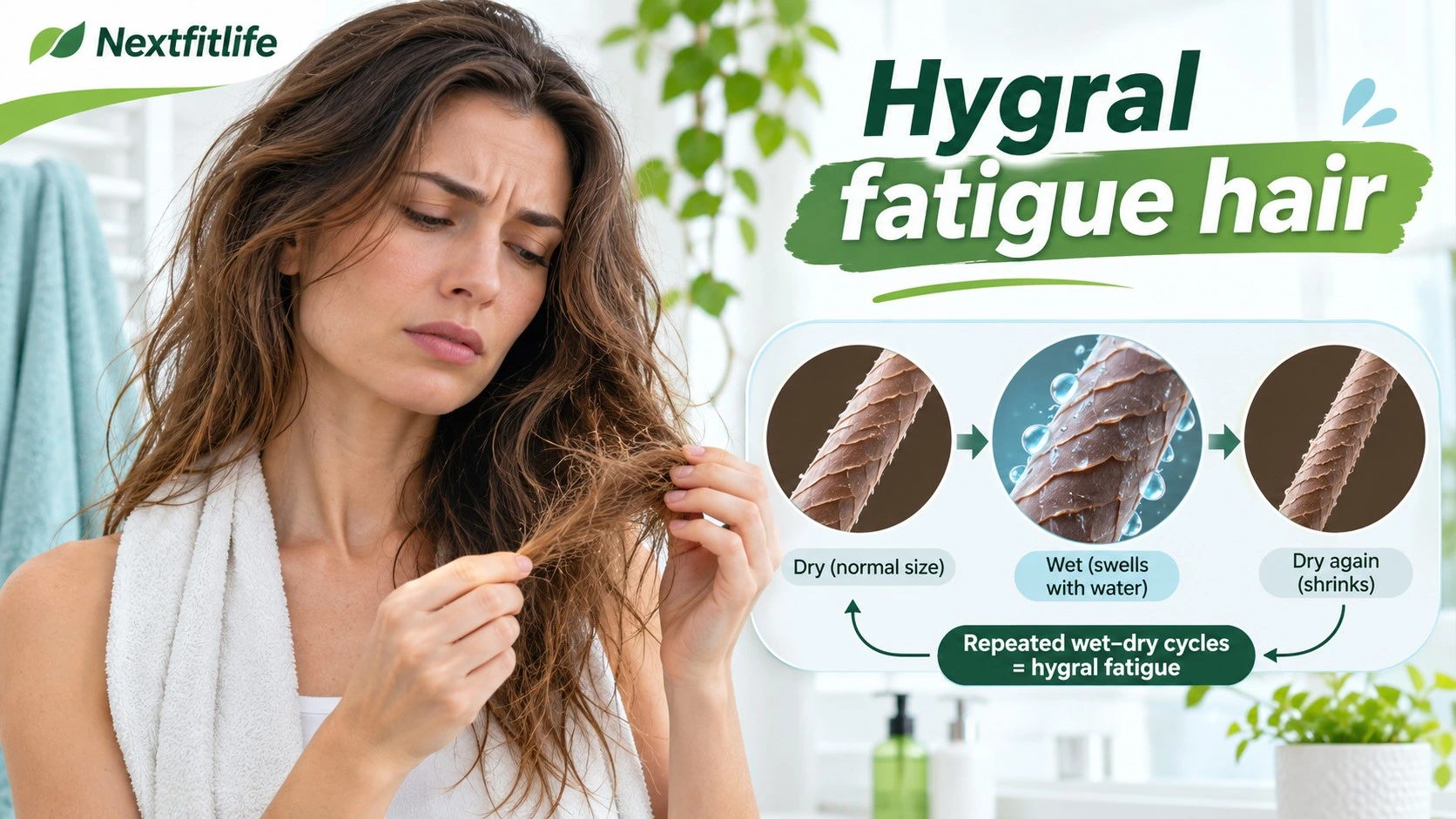
The term hygral fatigue hair is used in hair care to describe damage linked with repeated swelling when hair absorbs water and shrinking as it dries. The physical swelling is real, but hygral fatigue is not a formal medical diagnosis with one proven home test.
Quick answer: Signs linked with hygral fatigue include excessive stretching when wet, limp or mushy texture, tangling, frizz, loss of shape, roughness after drying, and increased breakage. The safest response is to reduce unnecessary wetting, handle wet hair gently, condition well, and limit other sources of damage such as heat, bleach, and rough brushing.
Health note: This article is for general information and education. It does not replace medical advice, diagnosis, or treatment.
See a dermatologist if you have bald patches, rapid thinning, scalp pain, marked redness, sores, pus, scarring, heavy shedding from the root, or breakage that continues despite gentler hair care. Those signs need more than a moisture routine.
For broader guidance, visit the NextFitLife Hair and Scalp Care Hub.
Table of Contents
- What hygral fatigue means
- Why water makes hair swell
- 7 warning signs to check
- Hygral fatigue versus dry hair
- Hygral fatigue versus protein overload
- Who may be more vulnerable
- How to reduce repeated water stress
- Coconut oil and prewash care
- Common mistakes
- When to see a dermatologist
- References and Sources
- Related guides
- About the author
- Frequently asked questions
What Does Hygral Fatigue Mean?
The phrase sounds more medical than it is.
Hygral fatigue is a hair care term used for damage thought to build up when hair repeatedly takes in water, swells, dries, and contracts.
Hair is not waterproof. Water can enter the fiber and cause the shaft to swell.
Peer reviewed hair cosmetic literature describes repeated swelling and drying as a source of stress that can contribute to hair damage, especially when the hair is already porous or chemically damaged.
Still, there is no standard medical test that says, “This person has hygral fatigue.”
That distinction matters.
Your hair may be breaking because of repeated wetting, but bleach, straightening, heat, friction, tight styles, weathering, rough brushing, and other damage can produce very similar signs.
Why Does Hair Swell When It Gets Wet?
The hair shaft can absorb water.
As water enters, the fiber expands. When the water leaves, it contracts again.
Healthy hair has a protective outer structure that helps control this process. Repeated chemical treatments and physical wear can damage that protection and make the shaft more water loving.
This is why damaged or highly porous strands can react more strongly to repeated wet-dry cycles.
| Stage | What Happens | Why It Matters |
|---|---|---|
| Hair gets wet | Water enters the shaft | The fibre swells |
| Hair stays wet | The strand remains swollen | Wet hair is easier to stretch and damage |
| Hair dries | Water leaves the fibre | The shaft contracts |
| Cycle repeats | Swelling and shrinking happen again | Already damaged hair can accumulate more wear |
7 Warning Signs Linked With Hygral Fatigue Hair
No single symptom proves the cause.
The pattern matters more than one strand test.
1. Hair Feels Overly Soft or Mushy When Wet
This is one of the signs people most often associate with moisture-overloaded hair.
The strand may feel unusually soft, weak, or almost gummy when soaked.
That does not prove hygral fatigue, but it can tell you that wet hair is behaving differently from its normal pattern.
Compare your hair with itself rather than somebody else's texture.
2. Wet Hair Stretches More Than Usual
Hair becomes more flexible when wet.
But if your strands now stretch much farther than they used to and fail to return well, the fibre may be damaged.
Do not keep stretching hair until it snaps in order to test it.
Hair elasticity changes for many reasons, including chemical damage, water exposure, heat, and normal weathering. A home stretch test cannot diagnose one exact cause.
3. Breakage Increases During Washing or Detangling
Wet hair needs gentle handling.
The American Academy of Dermatology advises reducing rough handling because wet hair can break more easily.
You may notice short broken pieces during washing, detangling, or styling.
That is hair breakage, which is different from full hairs shedding from the root.
If your concern is true shedding or thinning, read the NextFitLife Hair Loss Causes and Treatment Guide.
4. Hair Tangles More Easily
A damaged hair cuticle creates more friction between strands.
That means tangles form faster and need more work to remove. More pulling then adds more mechanical damage.
This is why conditioning matters.
A conditioner coats the strand, improves slip, and helps reduce friction during detangling.
5. Hair Looks Frizzy Even After Conditioning
Frizzy hair can come from many causes.
Weathering, chemical damage, humidity, rough drying, broken strands, and damaged cuticles can all contribute.
If the frizz appears together with excessive wet stretching, tangling, and new breakage, repeated water stress may be one part of the picture.
6. Curls or Waves Lose Their Usual Shape
People with curly or wavy hair sometimes describe hair affected by excessive wetting as limp or less able to hold its normal shape.
This symptom is not specific enough to diagnose anything.
Product buildup, heavy conditioners, chemical damage, heat, and changes in styling can produce the same result.
Look at what changed in the routine before blaming water alone.
7. Hair Feels Weak When Wet but Rough Once Dry
This combination can be confusing.
The strand may feel soft and weak while soaked, then dry into a rough or brittle texture.
That makes people think they have both too much moisture and too little moisture at the same time.
The better way to think about it is hair shaft damage.
A damaged fiber can behave poorly in more than one condition.
Hygral Fatigue vs Dry Hair
These two labels can overlap.
| Clue | Repeated Water Stress | Dry or Damaged Hair |
|---|---|---|
| Very soft when wet | Possible | Less specific |
| Rough when dry | Possible | Common |
| Tangling | Possible | Common |
| Breakage | Possible | Common |
| Frequent soaking | Useful clue | May be unrelated |
You usually cannot diagnose the cause from feel alone.
Look at frequency of washing, swimming, wet styling, chemical history, heat, and how the hair behaves before and after those exposures.
Hygral Fatigue vs Protein Overload
These terms are often mixed online.
They describe different ideas.
Hygral fatigue hair refers to damage linked with repeated water uptake and drying.
“Protein overload” is used when hair becomes stiff, rough, or brittle after repeated use of protein-rich products.
Either pattern can cause:
- Breakage
- Tangling
- Frizz
- Rough texture
- Poor manageability
That is why the product and routine timeline matters more than one symptom.
Who May Be More Vulnerable?
Hair that is already damaged may absorb water more easily.
This includes hair affected by:
- Bleaching
- Repeated coloring
- Chemical straightening
- Relaxing
- Frequent high heat
- Strong weathering
- Repeated mechanical damage
People sometimes use the term high porosity hair for hair that takes up and loses water easily.
Porosity is a useful cosmetic description, but home tests such as floating one strand in a glass of water are not reliable medical diagnostic tests.
Can Washing Your Hair Too Often Cause Hygral Fatigue?
Frequency alone does not tell the whole story.
Someone with an oily scalp may need to wash more often than someone with dry, tightly curled hair.
The larger problem is the full cycle:
- Repeated soaking
- Strong shampoo on the lengths
- Rough towel drying
- Hard brushing while wet
- Heat styling afterward
If frequent washing is necessary, make the process gentle rather than avoiding hygiene.
Does Leaving Hair Wet for Hours Help?
Not necessarily.
More water is not always more hydration.
Hair that stays soaked for a long time remains swollen for longer. If your strands are fragile, there is little reason to keep them waterlogged on purpose.
That does not mean you need intense heat to dry your hair quickly.
Use gentle drying methods.
How to Reduce Repeated Water Stress
1. Stop Rewetting Hair When You Do Not Need To
If your hair is already wet in the morning, afternoon, and evening because of repeated refreshing, misting, or full soaking, consider whether every wetting step is helping.
Use less water when a small amount of styling product or gentle reshaping will do.
2. Shampoo the Scalp Rather Than Scrubbing the Lengths
The American Academy of Dermatology recommends concentrating shampoo on the scalp.
Let the rinse water and lather travel through the lengths rather than rubbing them hard.
This reduces unnecessary friction.
3. Use Conditioner After Washing
Conditioner is not optional for fragile hair.
It improves slip, helps smooth the outer surface, and reduces friction during combing.
For broader habits, read the NextFitLife Healthy Hair Guide.
4. Detangle With Less Force
A wide-tooth comb can help.
Start near the ends, then work upward rather than pulling one knot from root to tip.
Hair type matters here. The American Academy of Dermatology advises people with straight hair to let it dry a little before combing, while tightly curled or textured hair is often easier to detangle while damp with conditioner.
5. Do Not Rub Hair Hard With a Towel
Blot or wrap the hair instead.
Rough rubbing adds friction to hair that is already more fragile when wet.
A soft towel or cotton T shirt can help absorb excess water without aggressive rubbing.
6. Reduce Heat on Fragile Hair
Do not solve one kind of damage by adding another.
If you use a blow dryer, choose a lower heat setting and avoid holding the dryer close to one section for a long time.
7. Protect Hair Before Swimming
Pool exposure adds another wetting cycle plus chemical exposure.
Wet the hair with clean water before swimming if that fits your routine, use a swim cap when practical, and rinse after swimming.
Then shampoo and condition as needed.
Can Coconut Oil Help?
This is one of the better supported hair oil claims.
Research has found that coconut oil can penetrate the hair shaft and reduce protein loss in both damaged and undamaged hair.
Hair cosmetic reviews also describe penetrating oils as able to reduce water uptake and swelling, which may lower stress from repeated swelling and drying.
That does not mean everyone needs to soak their hair in coconut oil.
A Practical Way to Try It
Use a small amount on the lengths before washing.
Focus on the areas that are dry or damaged rather than coating the scalp unless your scalp tolerates it well.
If coconut oil makes your hair feel heavy, stiff, or greasy, stop using it.
Cosmetic hair care still needs to suit the person.
Does Hygral Fatigue Mean You Need Protein?
Not automatically.
This is another common internet shortcut.
Protein containing conditioners can temporarily improve the behavior of damaged hair, but that does not mean every soft or stretchy strand needs a strong protein treatment.
If protein products leave your hair stiff and rough, adding more is not a smart response.
Judge products by how your hair behaves over several wash days.
What About Deep Conditioning Overnight?
Longer is not always better.
A conditioner is designed to work for the amount of time stated on the product.
Leaving wet hair covered in conditioner all night keeps the hair wet for many hours and may not provide extra benefit.
Follow the product directions unless a dermatologist or hair professional has advised something different for your hair.
Common Mistakes That Can Make Breakage Worse
- Soaking hair several times every day. More water is not always more conditioning.
- Brushing fragile wet hair aggressively. Use a method that fits your hair type and reduces pulling.
- Leaving hair wet for very long periods on purpose. This keeps the fiber swollen.
- Using high heat after every wash. Heat adds another damage source.
- Adding many new treatments at once. You will not know which product helped or hurt.
- Diagnosing every broken hair as hygral fatigue. Chemical, mechanical, and heat damage can look the same.
Breakage Is Different From Hair Loss
This distinction matters.
Hair breakage happens along the shaft.
You may see short pieces and uneven lengths.
Hair loss happens from the follicle and can show up as a widening part, receding hairline, bald patch, or increased shedding of full-length hairs.
If thinning is the main issue, use the Hair Loss Causes and Treatment Guide instead of trying to fix the problem with moisture changes alone.
When Should You See a Dermatologist?
Book an assessment if you have:
- Rapid thinning
- Round bald patches
- A widening part
- Persistent heavy shedding
- Scalp pain or burning
- Redness or scaling
- Pus or sores
- Scarring
- Hair that keeps breaking despite gentler care
DermNet notes that repeated physical and chemical injury is a common cause of acquired hair shaft fragility, but inherited and medical hair shaft disorders also exist.
A dermatologist can look at the shaft and scalp and decide whether the problem is cosmetic damage, hair loss, scalp disease, or another condition.
Conclusion
Hygral fatigue hair is best treated as a useful description of repeated water stress, not as a diagnosis you can prove with a kitchen test.
Hair really does swell when it absorbs water, and repeated wetting and drying can add wear to a vulnerable shaft. The safest approach is simple: reduce unnecessary soaking, condition after washing, handle wet hair gently, limit heat, and protect damaged lengths.
Your next step: change one part of your wet hair routine this week. Start with gentler drying or fewer unnecessary rewets, then watch whether tangling and breakage improve over several wash days.
References and Sources
- American Academy of Dermatology. Hair styling without damage.
https://www.aad.org/public/diseases/hair-loss/hair-care/styling - American Academy of Dermatology. Tips for healthy hair.
https://www.aad.org/public/everyday-care/hair-scalp-care/hair/healthy-hair-tips - DermNet. Defects of the hair shaft.
https://dermnetnz.org/topics/defects-of-the-hair-shaft - National Library of Medicine, PubMed Central. Hair Cosmetics: An Overview.
https://pmc.ncbi.nlm.nih.gov/articles/PMC4387693/ - National Library of Medicine, PubMed Central. A Method to Measure Oil Penetration into Hair and Correlation to Tensile Strength.
https://pmc.ncbi.nlm.nih.gov/articles/PMC9447460/
Related NextFitLife Guides
- Hair and Scalp Care Hub
- Healthy Hair Care Guide
- Hair Loss Causes and Treatment Guide
- Hair Care After 40
- Foods for Strong Hair
- Foods for Hair Growth
- Biotin Rich Foods
Frequently Asked Questions
What is hygral fatigue hair?
Hygral fatigue hair is a hair care term used for damage linked with repeated swelling when hair absorbs water and shrinking as it dries. The swelling process is real, but hygral fatigue is not a formal medical diagnosis.
What are the signs of hygral fatigue?
Commonly reported signs include overly soft wet hair, excessive stretching, tangling, frizz, loss of shape, roughness after drying, and increased breakage.
Can washing hair every day cause hygral fatigue?
Daily washing does not automatically cause damage. The full routine matters, including repeated soaking, strong cleansing, rough drying, hard detangling, chemical treatments, and heat.
Can coconut oil help hygral fatigue hair?
Coconut oil can penetrate the hair shaft and has been shown to reduce protein loss. Research also suggests penetrating oils can reduce water uptake and swelling, which may help protect vulnerable hair.
Is hygral fatigue the same as protein overloading?
No. Hygral fatigue refers to repeated water-related swelling and drying, while protein overload is a hair care term used for stiffness or brittleness linked with repeated protein-rich treatments.
Should I stop conditioning my hair?
No. Conditioner reduces friction and helps detangling. The better approach is to avoid unnecessary soaking while continuing gentle washing and conditioning.
Does wet hair break more easily?
Wet hair can be more vulnerable to stretching and mechanical damage, so gentle handling is important. Hair type also affects the best detangling method.
How long does hygral fatigue take to fix?
There is no proven fixed recovery time. Damaged hair cannot biologically repair itself like living skin, so the goal is to reduce further damage while new hair grows and damaged lengths are managed or trimmed.