Published on: November 22, 2026
Seeing calcium oxalate crystals in urine on a lab report can sound alarming. The result does not automatically mean you have a kidney stone or kidney disease.
A few crystals can appear in normal urine, especially when the urine is concentrated. The finding matters more when crystals are numerous, appear repeatedly, come with pain or blood in the urine, or occur in someone with a history of kidney stones.
Quick answer: Calcium oxalate crystals form when calcium and oxalate become concentrated enough to join together in urine. A few crystals can occur without disease. Repeated crystals, severe symptoms, blood in the urine, recurrent stones, or abnormal kidney tests may need further testing and a more specific prevention plan.
This article is for general information and education. It does not replace medical advice, diagnosis, or treatment.
Seek urgent medical care if you have fever or chills with severe side or back pain, cannot pass urine, pass very little urine, have severe pain that is not controlled, keep vomiting, cannot keep fluids down, feel faint or very unwell, or have known kidney disease with rapidly worsening symptoms.
For a wider overview of kidney stones and their causes, see the NextFitLife Kidney Stones Guide.
Table of Contents
- What calcium oxalate crystals are
- Crystals versus kidney stones
- 9 critical clues and causes
- Symptoms that may occur
- When urgent care is needed
- What many crystals can mean
- Tests that may come next
- Why calcium should not be cut automatically
- Oxalate and sodium
- Water and urine volume
- 24 hour urine testing
- Common mistakes
- Questions to ask your clinician
- Conclusion
- References and Sources
- Internal Links and NextFitLife Hubs
- About the Author
- Frequently Asked Questions
What Are Calcium Oxalate Crystals?
Urine contains water plus many dissolved minerals, salts, acids, and waste products.
Sometimes substances in urine become concentrated enough to form tiny solid crystals. Calcium can combine with oxalate and form calcium oxalate crystals.
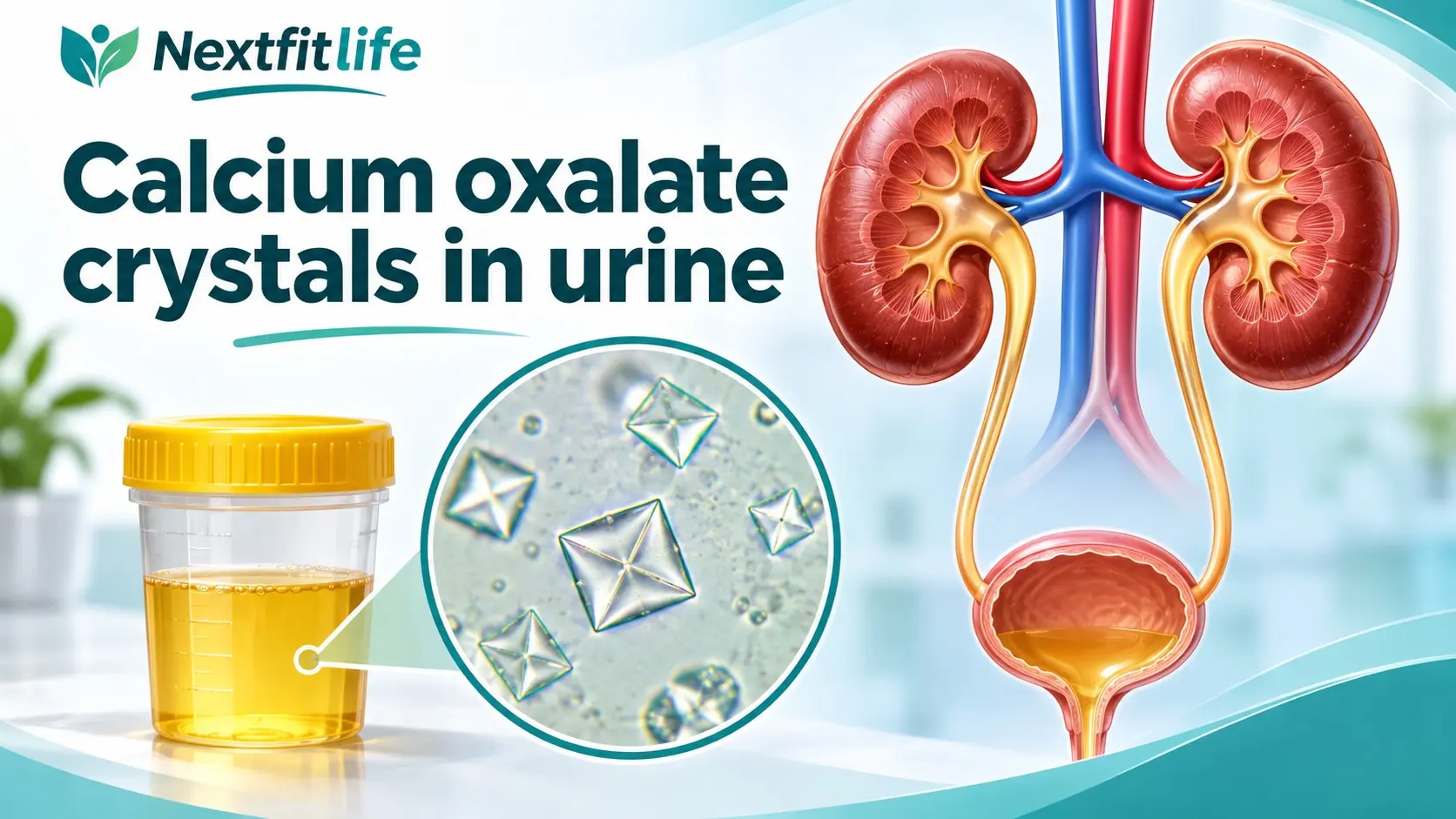
Under a microscope, some calcium oxalate crystals have a shape that looks like a small envelope. Other forms can look more like dumbbells.
The medical term for crystals in urine is crystalluria.
MedlinePlus explains that a few small crystals can occur in normal urine and usually do not cause problems.
Do Calcium Oxalate Crystals Mean You Have a Kidney Stone?
No.
This is the most useful point to understand.
A crystal is microscopic. A kidney stone is a larger solid mass that forms when crystals and other material build up over time.
| Feature | Calcium Oxalate Crystals | Calcium Oxalate Stone |
|---|---|---|
| Size | Microscopic | Larger solid mass |
| How found | Urinalysis | Imaging or stone analysis |
| Symptoms | Often none | May cause pain, blood, nausea, or urinary symptoms |
| Meaning | Can occur in healthy urine | Confirms stone formation |
| Next step | Depends on symptoms and context | Depends on stone size, location, symptoms, and cause |
Calcium stones are the most common type of kidney stone, and calcium oxalate stones are more common than calcium phosphate stones.
If you want to understand what a silent stone can look like, see Kidney Stone Without Pain.
9 Critical Clues Behind Calcium Oxalate Crystals in Urine
1. Concentrated Urine Is a Common Explanation
One of the simplest reasons for crystals is concentrated urine.
When there is less water in urine, calcium, oxalate, uric acid, sodium, and other substances become more concentrated. That makes crystal formation easier.
This can happen after heavy sweating, illness, vomiting, diarrhea, fasting, or simply not drinking enough for your needs.
A single urine sample collected while you are dehydrated can look very different from a sample collected when you are normally hydrated.
2. High Urine Oxalate Can Raise Risk
Oxalate is a natural substance made by the body and found in many foods.
When urine contains too much oxalate, the chance that oxalate will join with calcium rises.
High urine oxalate is called hyperoxaluria.
Possible causes include bowel disease, fat malabsorption, some bariatric procedures, high oxalate absorption, certain supplements, and rare inherited disorders.
A single routine urinalysis cannot diagnose hyperoxaluria. A 24 hour urine test is often used when clinicians need to measure oxalate more carefully.
3. High Urine Calcium Can Matter Too
The calcium part of the crystal matters as well.
Too much calcium in urine is called hypercalciuria.
Urine calcium can be affected by genetics, sodium intake, hormones, some medicines, and other health conditions.
This does not mean that calcium rich foods are automatically causing the problem.
4. Do Not Cut Dietary Calcium Just Because the Crystal Contains Calcium
This is where many people make the wrong change.
NIDDK and the National Kidney Foundation explain that getting too little calcium from food can increase the risk of calcium oxalate stones.
Calcium in the gut can bind to oxalate from food. The pair can then leave through stool instead of allowing more oxalate to enter the bloodstream and reach the kidneys.
Practical point: normal dietary calcium can be helpful for people prone to calcium oxalate stones. Do not start a very low calcium diet because of the word “calcium” on a urine report.
Examples of food calcium sources include milk, yogurt, cheese, and suitable calcium fortified foods.
If you avoid dairy, see Calcium Rich Foods Without Dairy.
5. High Sodium Intake Can Raise Urine Calcium
Sodium can affect how much calcium leaves the body through urine.
The National Kidney Foundation notes that a high sodium intake can increase urine calcium and raise calcium stone risk in people who are prone to stones.
Large sodium sources include:
- Fast food
- Restaurant meals
- Processed meat
- Packaged snacks
- Instant noodles
- Canned soups
- Salty sauces and condiments
The goal is not to remove all salt. The goal is to avoid a pattern of very high sodium intake.
6. High Oxalate Foods Matter More in Some People Than Others
Some foods contain much more oxalate than others.
Examples that are commonly listed as high oxalate include:
- Spinach
- Rhubarb
- Beets
- Swiss chard
- Peanuts
- Nuts
- Chocolate
- Tea
- Sweet potatoes
That does not mean everyone who sees crystals on one urine test should ban these foods.
The National Kidney Foundation recommends tailoring food changes to the person's stone type, urine tests, medicines, and health history.
If high urine oxalate is confirmed, reducing the largest oxalate sources can make sense.
7. High Dose Vitamin C Supplements Can Add to Oxalate
The body can convert some vitamin C into oxalate.
That is why large vitamin C supplement doses deserve attention in people with recurrent calcium oxalate stones.
This is mainly a supplement issue. Eating normal servings of fruit and vegetables that contain vitamin C is not the same as taking a large supplement dose.
If you use vitamin C supplements and have recurrent stones, add them to the medicine and supplement list you show your clinician.
8. Bowel Disease and Bariatric Surgery Can Change Oxalate Absorption
This cause is easy to miss.
Some bowel conditions and bariatric procedures can increase how much oxalate is absorbed through the gut.
This is called enteric hyperoxaluria.
When fat is poorly absorbed, calcium can bind to fatty acids instead of oxalate. That leaves more free oxalate available for the intestine to absorb.
People with Crohn's disease, other malabsorption problems, or a history of certain gastric bypass procedures may need a more specific plan than a generic low oxalate food list.
9. Rare Primary Hyperoxaluria Needs Specialist Care
Primary hyperoxaluria is a rare inherited condition in which the body makes too much oxalate.
Possible clues include kidney stones beginning at a young age, repeated calcium oxalate stones, nephrocalcinosis, a strong family history, or kidney problems without a clear explanation.
Mayo Clinic notes that evaluation can involve blood tests, urine tests, imaging, stone analysis, and genetic testing.
A single urine crystal result is not enough to diagnose this condition.
What Symptoms Can Occur?
The crystals themselves may cause no symptoms at all.
Symptoms become more likely when a stone forms or moves through the urinary tract.
Possible kidney stone symptoms include:
- Sharp pain in the side or back
- Pain moving toward the lower abdomen or groin
- Blood in the urine
- Pain with urination
- Frequent urge to urinate
- Passing small amounts of urine
- Nausea
- Vomiting
- Cloudy or bad smelling urine
- Fever or chills if infection is present
If your main concern is pain, see Kidney Stone Pain: Signs and Relief Tips.
When Should You Seek Urgent Medical Care?
Do not assume severe symptoms are caused by harmless crystals.
Get urgent medical help if you have:
- Fever or chills with side or back pain
- Severe pain that is not controlled
- Repeated vomiting
- Inability to keep fluids down
- Inability to urinate
- Very little urine
- Faintness or severe weakness
- Rapid worsening of your general condition
- Known kidney disease with new severe urinary symptoms
- Pregnancy with severe suspected stone symptoms
A blocked urinary tract plus infection can become dangerous and needs prompt assessment.
What Does “Many Calcium Oxalate Crystals” Mean?
Labs do not all use the same reporting system.
A report may say few, moderate, many, or use another grading method.
The amount matters, but the word “many” still does not prove there is a kidney stone.
Your clinician also looks at:
- How concentrated the urine is
- Urine pH
- Blood in the urine
- Protein
- White blood cells
- Bacteria
- Nitrite
- Kidney function
- Symptoms
- Stone history
Sample timing and handling can also affect crystal findings, so the full lab report matters more than one line.
What Tests May Come Next?
If crystals are found once and you feel well, a large medical workup may not be needed.
Repeated crystals, pain, blood in the urine, recurrent stones, or kidney problems can lead to more testing.
Repeat Urinalysis
A new urine sample can show whether the finding persists when you are normally hydrated.
Blood Tests
Blood tests can check kidney function, calcium, electrolytes, and other metabolic clues.
Imaging
Ultrasound or CT may be used when a kidney stone is suspected.
Stone Analysis
If you pass a stone, your clinician may ask you to collect it.
A laboratory can identify whether it is calcium oxalate, calcium phosphate, uric acid, cystine, struvite, or a mixture.
24 Hour Urine Test
A 24 hour urine test is especially useful for people who repeatedly form stones.
Depending on the test, it can measure:
- Urine oxalate
- Urine calcium
- Citrate
- Sodium
- Uric acid
- Total urine volume
Mayo Clinic includes 24 hour urine testing in the evaluation of hyperoxaluria.
Why Does Citrate Matter?
Citrate is a natural substance in urine that can bind calcium and make calcium crystals less likely to grow.
Low urine citrate can be one part of recurrent calcium stone risk.
Some people with low citrate are prescribed potassium citrate, but this is not a supplement to start on your own.
Potassium citrate may be unsafe for some people with kidney disease, high potassium, or certain medicines.
How Much Water Should You Drink?
More urine usually means minerals are less concentrated.
That is why good hydration is a central part of kidney stone prevention.
NIDDK says drinking enough liquid, mainly water, is one of the most important steps for preventing kidney stones.
But I would not give every reader with one crystal result the same fixed water target.
Fluid needs change with:
- Body size
- Weather
- Exercise
- Pregnancy
- Vomiting or diarrhea
- Heart failure
- Kidney disease
- Diuretic medicines
If you have heart failure, advanced kidney disease, or a prescribed fluid limit, follow your personal medical plan.
For broader kidney support, see How to Protect the Kidneys.
Should You Follow a Low Oxalate Diet?
Not automatically.
A strict low oxalate diet makes more sense when you repeatedly form calcium oxalate stones or testing confirms high urine oxalate.
A practical stone prevention plan may include:
- Drink enough fluid for your health needs.
- Keep sodium intake sensible.
- Eat an appropriate amount of dietary calcium.
- Pair calcium foods with meals that contain oxalate.
- Limit the highest oxalate foods if your test results support it.
- Avoid unnecessary large vitamin C supplement doses.
- Work with a dietitian if bowel disease or bariatric surgery changes oxalate absorption.
This is more useful than banning every food that contains oxalate.
How Should Calcium and Oxalate Be Paired?
The timing can matter.
Eating calcium with a meal that contains oxalate gives the two substances a chance to bind inside the digestive tract.
That can reduce the amount of oxalate absorbed into the body.
For example:
- Yogurt with a meal that contains nuts
- Cheese with a meal that includes spinach
- Milk with a meal containing another higher oxalate food
- A suitable calcium fortified food with an oxalate containing meal
Do not assume that calcium supplements work the same way for everyone. Supplement type, dose, timing, kidney function, and other conditions matter.
If you need more calcium food ideas, see Calcium Rich Foods.
What if You Have Crystals but No Pain?
That is common.
If crystals were found during a routine urine test and you feel well, the next step may simply be to discuss the finding with your clinician.
Useful questions include:
- Were there only a few crystals?
- Was my urine concentrated?
- Was there blood or protein?
- Do I have a history of stones?
- Should the urine test be repeated?
- Do I need imaging?
- Do I need a 24 hour urine collection?
Do not diagnose a kidney stone from the word “crystals” alone.
Can Calcium Oxalate Crystals Damage the Kidneys?
A few crystals in otherwise healthy urine usually do not damage the kidneys.
Problems can occur when crystals grow into stones, block urine flow, recur repeatedly, or build up heavily in kidney tissue.
Rare severe hyperoxaluria can also cause calcium oxalate deposits in the kidneys and other tissues.
If kidney function is already reduced, see the Kidney Disease Treatment Guide for a broader overview of kidney testing and care.
Common Mistakes After Seeing Calcium Oxalate on a Lab Report
Cutting Out All Calcium
This can increase oxalate absorption and may make calcium oxalate stone risk worse.
Banning Every Food With Oxalate
Not everyone needs a strict low oxalate diet.
Drinking Extreme Amounts of Water
More is not always safer, especially with heart failure or kidney disease.
Ignoring Sodium
High sodium intake can raise urine calcium.
Taking Large Vitamin C Supplements
Large supplement doses can add to oxalate production in susceptible people.
Assuming Crystals Mean a Stone Is Present
Crystals and stones are related, but they are not the same diagnosis.
Assuming No Pain Means No Stone
Some stones remain silent until they move or block urine.
See Kidney Stone Without Pain for more detail.
What Should You Ask Your Clinician?
| Question | Why It Helps |
|---|---|
| Was my urine very concentrated? | Helps judge whether dehydration may explain the finding. |
| Was there blood or protein in my urine? | Other urine findings can change what needs to happen next. |
| Do I need repeat testing? | Shows whether crystalluria persists. |
| Do I need imaging? | Helps look for a stone when symptoms or history suggest one. |
| Do I need a 24 hour urine test? | Can measure urine volume, calcium, oxalate, citrate, sodium, and other stone risk factors. |
| Should I change calcium intake? | Prevents unnecessary low calcium diets. |
| Should I limit high oxalate foods? | Keeps food restrictions tied to your actual risk. |
| Could my medicines or supplements matter? | Some supplements and medicines can influence stone risk. |
| Could bowel disease or surgery raise oxalate absorption? | Helps identify enteric hyperoxaluria. |
Conclusion
Calcium oxalate crystals in urine are a clue, not a diagnosis.
A few crystals can appear in healthy, concentrated urine. Repeated crystals, stone symptoms, blood in the urine, recurrent stones, bowel disease, or abnormal kidney tests deserve a closer look.
Your next step: review the whole urinalysis with your clinician before cutting calcium, banning foods, changing fluid intake, or starting supplements. If you have severe pain, fever, vomiting, or trouble passing urine, seek medical care promptly.
References and Sources
- MedlinePlus. Crystals in Urine.
https://medlineplus.gov/lab-tests/crystals-in-urine/ - National Institute of Diabetes and Digestive and Kidney Diseases. Definition and Facts for Kidney Stones.
https://www.niddk.nih.gov/health-information/urologic-diseases/kidney-stones/definition-facts - National Institute of Diabetes and Digestive and Kidney Diseases. Eating, Diet, and Nutrition for Kidney Stones.
https://www.niddk.nih.gov/health-information/urologic-diseases/kidney-stones/eating-diet-nutrition - National Kidney Foundation. Kidney Stones Diet and Prevention. Updated September 28, 2026.
https://www.kidney.org/kidney-topics/kidney-stones-diet-and-prevention - Mayo Clinic. Hyperoxaluria and Oxalosis: Diagnosis and Treatment.
https://www.mayoclinic.org/diseases-conditions/hyperoxaluria/diagnosis-treatment/drc-20352258
Internal Links and NextFitLife Hubs
- Kidney Health and Disease Hub
- Kidney Stones Guide
- Kidney Stones Symptoms
- Kidney Stone Pain
- Kidney Stone Without Pain
- How to Protect the Kidneys
- Kidney Healthy Foods
- Calcium Rich Foods
- Calcium Rich Foods Without Dairy
- Kidney Disease Treatment Guide
- About NextFitLife
Frequently Asked Questions
Do calcium oxalate crystals in urine mean I have a kidney stone?
No. A few calcium oxalate crystals can appear in normal urine. A kidney stone is a larger solid mass and usually needs imaging or stone analysis to confirm it.
What causes calcium oxalate crystals in urine?
Common reasons include concentrated urine, high urine oxalate, high urine calcium, high sodium intake, some bowel conditions, certain supplements, and a history of calcium oxalate stones.
Can dehydration cause calcium oxalate crystals?
Yes. When urine volume falls, calcium and oxalate become more concentrated, which makes crystal formation easier.
Should I stop eating calcium if calcium oxalate crystals are found?
No, not automatically. Normal dietary calcium can bind oxalate in the gut and may help lower calcium oxalate stone risk. Ask your clinician or dietitian how much calcium is right for you.
Should I avoid all high oxalate foods?
No. A strict low oxalate diet is usually more useful when someone repeatedly forms calcium oxalate stones or testing shows high urine oxalate.
What does many calcium oxalate crystals in urine mean?
It means the lab saw a larger amount of crystals, but it still does not prove a kidney stone is present. Urine concentration, symptoms, blood, protein, kidney function, and stone history all matter.
What is a 24 hour urine test used for?
A 24 hour urine test can measure total urine volume and stone risk factors such as calcium, oxalate, citrate, sodium, and uric acid.
Can vitamin C supplements increase calcium oxalate risk?
Large vitamin C supplement doses can increase oxalate production in some people, which is why recurrent calcium oxalate stone formers should discuss supplements with their care team.
Can bowel disease cause high urine oxalate?
Yes. Some bowel diseases and bariatric procedures can increase oxalate absorption and cause enteric hyperoxaluria.
When should I seek urgent care?
Seek urgent medical help for fever or chills with severe side pain, uncontrolled pain, repeated vomiting, inability to keep fluids down, inability to urinate, very little urine, or rapid worsening of your condition.