Last Updated: August 4, 2026
Next Review: August 2027, or sooner if pediatric skin guidance changes
Review Status: Fully rewritten and source checked against current pediatric, dermatology, newborn care, and urgent care guidance
Baby acne can worry a parent very fast.
You see tiny red bumps. You may see white bumps too. The cheeks may look rough. The skin may look more red after crying, heat, feeding, or rubbing.
Most newborn acne is harmless.
Most cases need gentle care and time.
The best baby acne treatment is usually not a strong cream. It is simple skin care. Wash gently. Pat dry. Do not scrub. Do not squeeze. Do not use adult acne products.
This guide explains what baby acne looks like, what may cause it, how it differs from other newborn rashes, what parents can safely do, what to avoid, and when a baby needs a doctor.
Quick answer
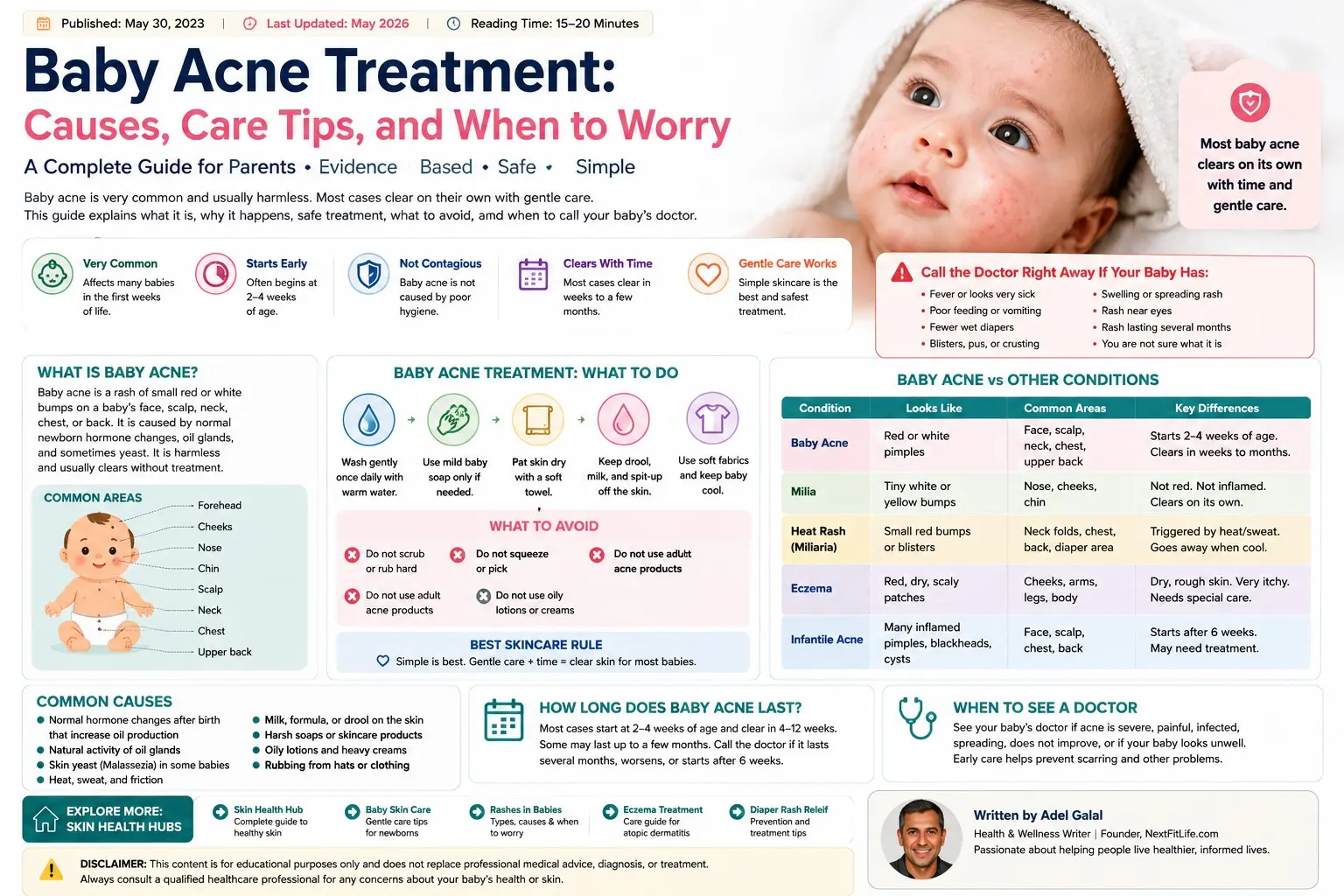
Newborn acne often appears during the first two to six weeks of life. It may cause small red or white bumps on the cheeks, nose, forehead, chin, scalp, neck, chest, or back. Most cases clear without medicine. Use lukewarm water, gentle cleansing, soft patting, and no oily products. Call a doctor for fever, poor feeding, fewer wet diapers, blisters, pus, swelling, yellow crust, a fast-spreading rash, blackheads, or acne that begins after the newborn period.
Urgent baby warning
A baby under three months with a temperature of 38 degrees Celsius or 100.4 degrees Fahrenheit needs urgent medical assessment. Get emergency help for trouble breathing, blue lips, facial swelling, a seizure, a baby who will not wake, a purple or red rash that does not fade when pressed, or a baby who looks seriously ill.
Medical note: I am not a licensed healthcare professional, and this content does not replace professional medical advice. What I share comes from actual life experience, extensive research, and consultation with healthcare providers. Always consult qualified medical professionals for diagnosis and treatment of any health condition.
What you will learn
- What newborn acne is
- Why the term neonatal cephalic pustulosis is also used
- How newborn acne differs from infantile acne
- How to care for the skin safely
- What not to place on a baby’s face
- How acne differs from milia, eczema, heat rash, cradle cap, and infection
- When fever or feeding changes need urgent care
- How a doctor checks a baby rash
- How to reduce skin irritation
- When a dermatologist may be needed
What Is Baby Acne?
Baby acne is a common name for small bumps or pimples that appear during early life.
Doctors may use several terms.
Neonatal acne means acne during the first six weeks.
Neonatal cephalic pustulosis describes a common newborn eruption on the face or scalp. It often appears during the third week. It may look like tiny red bumps or pustules. It usually has no blackheads or whiteheads.
The American Academy of Pediatrics now explains that many cases once called baby acne may be a normal skin response involving bacteria or yeast, rather than only hormones passed from the mother.
True neonatal acne can include comedones. These are blackheads or whiteheads. This is less common.
Both forms are usually mild.
Both often clear with time.
How Common Is Baby Acne?
Baby acne is common.
The American Academy of Dermatology says about one in five newborns develops neonatal acne.
The American Academy of Pediatrics reports that newborn facial acne is seen in many babies during the first month.
The exact number differs because experts do not always use the same name for every newborn bump.
The important point is simple.
Most early baby acne is normal and not dangerous.
What Does Baby Acne Look Like?
Newborn acne may look like:
- Tiny red bumps
- Small white bumps
- Small pustules
- Mild redness around the bumps
- Rough-looking cheeks
- Bumps that look brighter when the baby cries
- Bumps that look worse with heat
- Bumps that look more irritated after drool, milk, or rubbing
Common areas include:
- Cheeks
- Nose
- Forehead
- Chin
- Scalp
- Neck
- Upper chest
- Upper back
A baby with simple acne should still feed, wake, breathe, and act normally.
If the baby looks sick, do not assume the rash is acne.
When Does Baby Acne Start?
It often starts at about two to four weeks.
Some babies are born with bumps.
Some develop them during the third to fifth week.
New bumps that begin after about six weeks may be infantile acne or another skin condition.
Later acne deserves a doctor’s review, especially when blackheads, cysts, or scars appear.
How Long Does Baby Acne Last?
Many cases improve within several weeks.
Some last a few months.
The NHS says baby acne usually gets better after a few weeks or months.
The American Academy of Pediatrics notes that some newborn acne can last until four to six months.
Typical newborn acne rarely leaves scars.
Call the doctor when the rash:
- Gets worse instead of better
- Begins after about six weeks
- Contains blackheads
- Has deep lumps
- Looks painful
- Leaves marks or scars
- Has pus or yellow crust
- Lasts much longer than expected
What Causes Baby Acne?
The exact cause is not fully settled.
Older explanations focused on hormones passed from mother to baby.
Current pediatric information says many newborn cases may be a normal response to bacteria and yeast on the skin.
Oil glands, normal skin development, heat, friction, drool, and products may also affect how the bumps look.
Potential factors include:
- Newborn skin changes
- Oil gland activity
- Malassezia yeast response in some newborn eruptions
- Normal bacteria on the skin
- Heat and sweat
- Drool, milk, or spit up touching the face
- Rubbing from cloth or bedding
- Oily or greasy skin products
Baby acne is not caused by dirt.
It is not caused by poor parenting.
It is not the baby’s fault.
Is Baby Acne Caused by Breast Milk?
Breast milk is not considered a cause of baby acne.
Baby acne is not a reason to stop breastfeeding.
Some parents notice that drooled milk or spit up irritates the skin around the mouth and cheeks.
That is contact irritation. It is not proof that breast milk caused acne inside the skin.
Gently wipe away milk and drool.
Pat the area dry.
Do not scrub.
Is Baby Acne Painful or Itchy?
Typical newborn acne usually does not hurt.
It rarely causes strong itching.
A very itchy, dry, cracked, swollen, crusty, or painful rash may be eczema, infection, allergy, or another condition.
Call the baby’s doctor when the baby seems uncomfortable or keeps rubbing the face.
Is Baby Acne Contagious?
No.
Baby acne does not spread from one baby to another.
It does not require isolation.
Normal gentle contact is safe.
Baby Acne Treatment: Safe First Steps
Most newborn acne needs no medicine.
The American Academy of Dermatology advises gentle skin care and no acne medicine unless a pediatrician or dermatologist recommends it.
1. Wash gently
Use lukewarm water.
Wash the face once each day.
A mild fragrance free baby cleanser may be used when needed.
Plain water is often enough.
2. Pat the skin dry
Use a soft clean cloth.
Pat.
Do not rub.
3. Stop oily or greasy products
Oily products may make the bumps look worse.
Stop baby oil, coconut oil, heavy face cream, and greasy ointment on acne like bumps unless a clinician says the rash is another condition that needs them.
4. Keep milk and drool off the skin
Use a soft damp cloth after feeding.
Pat dry.
Change a wet bib.
5. Keep the baby comfortable
Use light, soft clothing.
Do not over bundle.
Keep the room at a comfortable temperature.
6. Leave the bumps alone
Do not squeeze, pop, pinch, or scratch.
This can irritate the skin and raise infection risk.
7. Give the skin time
Take one clear photo each week in the same light.
This can help you see slow improvement.
Do not add a new home remedy every day.
What Not to Put on Baby Acne
Baby skin is thin and easy to irritate.
Do not use these products unless a pediatrician or dermatologist gives exact instructions:
- Adult acne wash
- Benzoyl peroxide
- Salicylic acid
- Retinol or other retinoids
- Acne scrub
- Chemical peel
- Alcohol toner
- Hydrogen peroxide
- Toothpaste
- Lemon juice
- Vinegar
- Tea tree oil
- Essential oil
- Strong fragrance
- Steroid cream without medical advice
Natural does not always mean safe for newborn skin.
Can You Put Breast Milk on Baby Acne?
Some families try breast milk on baby acne.
There is not strong evidence that it is an effective newborn acne treatment.
It can also leave the skin damp or sticky.
Gentle washing is a safer first step.
Do not use breast milk instead of medical care when the rash has red flags.
Can You Use Coconut Oil?
Avoid putting coconut oil on acne-like bumps unless the baby’s doctor recommends it for a different diagnosis.
It is greasy.
It may make bumps look worse.
If the skin is dry and itchy, the baby may have eczema rather than acne.
That needs an original plan.
Can You Use Petroleum Jelly?
Petroleum jelly can protect dry or damaged skin in some conditions.
It is not a standard treatment for newborn acne.
Do not coat acne like bumps with a thick layer unless a clinician says the rash is drool irritation, eczema, or another condition that needs a barrier ointment.
Baby Acne Versus Milia
Milia are tiny white or yellow cysts.
They often appear on the nose, cheeks, or chin.
They are not acne.
| Feature | Baby acne | Milia |
|---|---|---|
| Look | Red bumps or tiny pustules | Firm white or yellow dots |
| Redness | May be present | Usually little redness |
| Care | Gentle washing and time | Time only |
Do not squeeze milia.
Baby Acne Versus Eczema
Baby eczema often looks dry, rough, red, itchy, cracked, or scaly.
Baby acne looks more like pimples or small bumps.
| Feature | Baby acne | Eczema |
|---|---|---|
| Surface | Small bumps or pustules | Dry, rough, or cracked patches |
| Itch | Usually not strong | Often itchy |
| Moisturizer | Greasy products may worsen bumps | A suitable moisturizer may be part of treatment |
Do not guess when the skin is bleeding, oozing, very itchy, or painful.
Use the damaged skin barrier guide for general skin education, but get pediatric advice for a baby.
Baby Acne Versus Heat Rash
Heat rash happens when sweat becomes trapped.
It often affects the neck, chest, back, folds, or areas under clothing.
It may improve when the baby cools down.
Use light clothing.
Avoid over bundling.
Keep the skin cool and dry.
Call a doctor when fever or illness is present.
Baby Acne Versus Cradle Cap
Cradle cap causes greasy, yellow, white, or flaky scales.
It often affects the scalp.
It may also affect the eyebrows, ears, or folds.
Baby acne causes small bumps rather than thick scales.
A baby can have both at the same time.
Baby Acne Versus Drool Rash
Drool rash often affects the mouth, chin, neck, and chest.
The skin may look red, wet, sore, or chapped.
It follows areas touched by saliva or milk.
Gently clean and dry the skin.
A clinician may recommend a barrier product when irritation is the major problem.
Do not place a thick barrier product over acne-like bumps without knowing which rash is present.
Baby Acne Versus Infection
Infection can look like a rash or pimples.
Call the baby’s doctor for:
- Pus
- Blisters
- Open sores
- Yellow or honey colored crust
- Hot swollen skin
- Fast spread
- Red streaks
- Fever
- Poor feeding
- Fewer wet diapers
- A baby who looks weak or sick
Do not treat a infection with a random cream.
Baby Acne Versus Allergy
An allergy may cause hives, swelling, itching, or red raised welts.
It may occur with vomiting, wheezing, or trouble breathing.
Call emergency services for swelling of the lips, tongue, or face, or any breathing problem.
Infantile Acne: Acne That Starts Later
Infantile acne usually starts after the newborn period.
DermNet describes it in babies from about six weeks to one year.
It may include:
- Blackheads
- Whiteheads
- Red papules
- Pustules
- Nodules
- Cysts
Infantile acne is less common than newborn acne.
Some cases can scar.
A pediatrician or dermatologist should check it.
Do not use the adult acne treatment guide as a treatment plan for a baby.
A doctor may prescribe a baby safe treatment when needed.
When Blackheads Matter
Typical neonatal cephalic pustulosis does not contain blackheads.
Blackheads suggest true acne or infantile acne.
Call the baby’s doctor when you see blackheads, deep bumps, or scars.
When to Call the Doctor
Call the pediatrician when:
- The baby has a fever
- The baby feeds poorly
- Wet diapers decrease
- The baby is hard to wake
- The baby seems very irritable or weak
- The rash spreads quickly
- The rash has blisters
- The rash has pus
- The rash has yellow crust
- The skin is swollen or hot
- The rash is near the eyes
- The rash looks painful or very itchy
- The bumps begin after about six weeks
- You see blackheads
- The rash lasts for months
- You are not sure what it is
Parents do not need to wait for a list to be complete.
Call when your baby seems different or you are worried.
Emergency Warning Signs
Get urgent help for:
- A baby under three months with a temperature of 38 degrees Celsius or 100.4 degrees Fahrenheit
- Trouble breathing
- Blue lips or tongue
- Facial or tongue swelling
- A seizure
- A baby who will not wake
- A floppy or very stiff baby
- A purple or red rash that does not fade when pressed
- Very poor feeding
- No urine for many hours
- Very dry mouth
- Sunken eyes
- A baby who looks seriously ill
These signs are not simple baby acne.
How a Doctor Checks Baby Acne
Most cases are diagnosed by looking at the skin.
The doctor may ask:
- When did the bumps begin?
- Where did they begin?
- Are there blackheads?
- Is the baby feeding normally?
- Are wet diapers normal?
- Is there fever?
- Does the rash itch or hurt?
- Which products touch the skin?
- Does the baby have eczema or cradle cap?
- Is the rash changing fast?
Tests are usually not needed.
A swab, blood test, or another test may be used when infection, a hormone problem, or another unusual condition is possible.
Can Baby Acne Leave Scars?
Typical newborn acne usually clears without scars.
Infantile acne can scar when it is deep or severe.
Do not squeeze bumps.
Get early care for blackheads, nodules, cysts, or marks that remain.
Can Baby Acne Be Prevented?
You cannot prevent every case.
You can reduce irritation.
- Wash gently
- Use lukewarm water
- Pat dry
- Keep drool and milk off the skin
- Change wet bibs
- Use soft fabric
- Keep the baby cool
- Avoid oily face products
- Avoid fragrance when the skin is sensitive
- Do not over wash
- Keep nails short and smooth
Read the fragrance-free skincare guide for general ingredient education. Baby products should still be reviewed with a pediatric professional when the skin is reacting.
A Simple Seven Day Baby Skin Check
This is a care checklist.
It is not a medicine plan.
Day 1
Stop adult acne products, essential oils, scrubs, and oily face products.
Day 2
Wash once with lukewarm water.
Pat dry.
Day 3
Wipe drool and milk gently after feeds.
Day 4
Check clothing, bibs, bedding, and room heat.
Day 5
Take one clear photo in natural light.
Day 6
Check feeding, wet diapers, temperature, and behaviour.
Day 7
Call the doctor if the rash is spreading, infected, painful, unusual, later starting, or not behaving like simple newborn acne.
Questions to Ask Your Baby’s Doctor
- Is this neonatal acne or neonatal cephalic pustulosis?
- Could this be milia, eczema, cradle cap, heat rash, or infection?
- Is this infantile acne?
- Does my baby need medicine?
- Which cleanser is safe?
- Should I stop a lotion, oil, or detergent?
- Are blackheads present?
- Could the rash scar?
- What signs need urgent care?
- When should a dermatologist see my baby?
Common Baby Acne Myths
Myth: Baby acne means the face is dirty
False.
Scrubbing can make the skin worse.
Myth: Breastfeeding causes baby acne
False.
Do not stop breastfeeding because of baby acne.
Myth: Strong acne cream clears it faster
False.
Adult acne medicine can harm delicate baby skin.
Myth: Natural oil is always safe
False.
Natural oils can still irritate or worse bumps.
Myth: Every white bump is acne
False.
Milia are common and are not acne.
Myth: Every baby rash can wait
False.
Fever, poor feeding, breathing trouble, blisters, pus, swelling, or a sick baby needs medical care.
What Baby Acne Looks Like on Different Skin Tones
Redness can be easy to see on light skin.
On brown or black skin, inflammation may look deep red, purple, brown, or darker than nearby skin.
Use good natural light.
Look for changes in texture, swelling, warmth, crust, and how the baby acts.
Do not wait for bright red color before asking for help.
Take a photo when the skin looks different from usual.
A doctor can compare the pattern over time.
How to Choose a Gentle Baby Cleanser
Most baby acne does not need a special acne cleanser.
Plain lukewarm water may be enough.
When a cleanser is needed, choose one that is:
- Made for babies
- Mild
- Fragrance free when possible
- Free from scrubbing grains
- Easy to rinse
- Used in a small amount
Stop the cleanser when the skin becomes very dry, sore, swollen, or more red.
Do not wash the face each time you see a new bump.
Too much washing can irritate the skin.
How to Wash a Baby’s Face Safely
- Wash your hands.
- Use lukewarm water.
- Wet a soft clean cloth.
- Wipe the face gently.
- Clean the neck folds and behind the ears when needed.
- Rinse away cleanser.
- Pat the skin dry.
- Use a clean cloth at the next wash.
Do not use a rough sponge.
Do not rub until the bumps look flat.
Do not use hot water.
Baby Acne and Laundry Products
Laundry detergent rarely causes true baby acne.
Strong fragrance or residue may irritate sensitive skin.
Try a simple fragrance-free detergent when clothing, bibs, or bedding seem to make the skin worse.
Rinse items well.
Stop fabric softener when it seems to trigger irritation.
Choose soft breathable cloth near the face.
Baby Acne During Hot or Humid Weather
Heat can make bumps look more red.
Sweat and damp fabric can add irritation.
Use light clothing.
Change wet bibs and clothing.
Keep air moving safely in the room.
Do not place a fan directly against a newborn’s face.
Do not use powder near the nose or mouth.
If the rash moves into folds or covered areas and improves with cooling, heat rash may be more likely.
How to Track the Rash Without Obsession
A simple record can help.
Write down:
- The date the rash began
- The baby’s age
- Where the bumps appear
- Whether blackheads are present
- Whether the skin is dry, wet, crusty, or swollen
- Any new skin product
- Feeding changes
- Wet diaper changes
- Temperature
- How the baby acts
Take one photo each week.
Do not photograph the baby all day.
The goal is to notice change, not to create more worry.
Preparing for a Pediatric Appointment
Bring the product bottles or clear photos of their labels.
Bring the rash photos.
Tell the doctor when the bumps started.
Share any fever, feeding, sleep, breathing, or diaper changes.
Ask whether the rash is newborn acne, infantile acne, eczema, infection, or another condition.
Write the care steps before leaving.
Ask how long to follow the plan and when to return.
Baby Acne and Parent Stress
A visible rash can make a parent feel guilty.
You may worry that you caused it.
You may feel pressure to fix it before family photos or visits.
Baby acne is common.
It is not a sign that you failed.
Use safe care.
Ask for help when you are worried.
Do not compare your baby’s skin with edited photos online.
Your baby needs comfort, feeding, sleep, and loving care more than perfect skin.
My Research Approach
I have more than thirty years of personal interest in health, skin care, family wellness, nutrition, and healthy living.
Baby skin topics need special care.
A parent should not receive adult skin advice for a newborn.
Newborn skin needs gentle care and advice suited to the child’s age. Seek medical help for the warning signs described above.
Conclusion
The best baby acne treatment is usually gentle care and patience.
Wash with lukewarm water. Pat dry. Avoid scrubbing. Avoid squeezing. Stop oily face products. Never use adult acne medicine unless a pediatric clinician recommends it.
Watch the whole baby, not only the skin.
Choose one action today. Remove a harsh product, take a clear photo, check your baby’s temperature and feeding, or call the pediatrician when the rash does not look like simple newborn acne.
Explore Related NextFitLife Guides
- Complete Skin Health Guide
- Skin, Hair, and Nail Health Hub
- First Aid and Home Remedies Hub
- Infections and Immune Health Hub
- Medical Tests and Screenings Hub
- Health Hub
- Complete Acne Treatment Guide for Adults and Teens
- Damaged Skin Barrier Guide
- Fragrance Free Skincare Guide
- Skincare Routine Order
- Self Care Habits
References and Sources
- American Academy of Dermatology: Is That Acne on My Baby’s Face? Open source
- American Academy of Pediatrics: Your Baby’s First Month, including the April 2026 explanation of neonatal cephalic pustulosis. Open source
- National Health Service: Rashes in Babies and Children, including baby acne and urgent rash guidance. Open source
- DermNet: Infantile Acne, including later onset, blackheads, nodules, cysts, and scar risk. Open source
- American Academy of Pediatrics: Urgent Care, Emergency Room, or Pediatrician, including fever in babies under three months. Open source

Adel Galal has more than thirty years of personal experience with health, fitness, nutrition, skin care, family wellness, and healthy aging. He uses careful research and consultation with healthcare providers to explain complex topics in simple language.
He is not a doctor, pediatrician, dermatologist, pharmacist, nurse, or lactation consultant. This article was source-checked against current pediatric and dermatology guidance. It was not medically reviewed by a named pediatrician.
Frequently Asked Questions About Baby Acne Treatment
What is the best baby acne treatment?
Most newborn acne needs gentle care and time. Wash the face gently with lukewarm water, pat dry, avoid scrubbing, stop using oily or greasy products on the bumps, and never use adult acne medicine unless a pediatrician or dermatologist recommends it.
How long does baby acne last?
Many cases improve within a few weeks. Some last a few months. Call your baby’s doctor if the rash keeps getting worse, begins after about six weeks of age, contains blackheads, leaves marks, or lasts much longer than expected.
Is baby acne caused by breast milk?
Breast milk is not considered a cause of baby acne, and baby acne is not a reason to stop breastfeeding. Current pediatric information suggests that many newborn cases may relate to a normal skin response involving oil glands, bacteria, or yeast.
Can I put breast milk on baby acne?
There is not strong evidence that breast milk treats baby acne. It may also leave the skin damp or sticky. Gentle washing is safer. Do not use breast milk instead of medical care when the rash looks infected, unusual, or severe.
Can I use lotion, petroleum jelly, or coconut oil?
Do not place oily, greasy, or heavy products on acne-like bumps unless a clinician says the rash is another condition that needs them. Eczema and drool rash may need an original plan, so ask when the diagnosis is unclear.
Can I use benzoyl peroxide or salicylic acid on a baby?
Do not use adult acne washes, benzoyl peroxide, salicylic acid, retinoids, scrubs, peels, or essential oils on a baby unless a pediatrician or dermatologist gives exact instructions.
How can I tell baby acne from milia?
Milia look like tiny firm white or yellow dots with little redness. Baby acne often has red bumps or small pimples. Both are common and usually clear without squeezing or treatment.
What is infantile acne?
Infantile acne begins after the newborn period, often from about six weeks to one year. It may include blackheads, whiteheads, pustules, nodules, or cysts. It should be checked because some cases can scar.
When should I call the doctor for a baby rash?
Call for fever, poor feeding, fewer wet diapers, unusual sleepiness, blisters, pus, yellow crust, swelling, pain, a fast-spreading rash, a rash near the eyes, or a baby who looks unwell. A baby under three months with a temperature of 38 degrees Celsius or 100.4 degrees Fahrenheit needs urgent medical assessment.
Can baby acne leave scars?
Typical newborn acne usually clears without scars. Infantile acne with blackheads, nodules, cysts, or severe inflammation can scar, which is why later or severe acne needs professional care.

Health & wellness writer with 30+ years of experience in nutrition, fitness, and healthy aging. Founder of NextFitLife.com — evidence-based health guidance.