Published - April 2026 | Last Updated - April 22, 2026
Calorie Counting for Weight Loss - The Most Honest Guide You Will Read
Calorie counting for weight loss is not glamorous. It does not sell diet books. And it has no celebrity endorsements. But it works. Every single time a calorie deficit is maintained.
A calorie deficit is the mechanism behind every diet that produces fat loss. Low- carb, Mediterranean, intermittent fasting, plant-based — they all work by reducing calorie intake. Calorie counting just makes that process explicit and measurable. The challenge is not the concept. The challenge is doing it accurately and sustainably.
This article is part of our complete weight loss guide.
Does calorie counting actually work for weight loss?
Is calorie counting the most effective weight loss method?
Yes. When done accurately, calorie counting is the most reliable fat loss method available.
The reason is simple. It creates explicit awareness of energy intake. And awareness changes behaviour. People who track food consistently lose more weight and maintain it better than those who do not.
Calorie counting may help some people with their weight loss goals. However, it doesn’t suit everyone.
That last sentence is important. Calorie counting for weight loss is highly effective when it fits a person's personality and lifestyle. For others, it can feel obsessive or unsustainable. Both responses are valid, and there are alternatives.
Why do people underestimate calories without tracking?
Research shows people underestimate their calorie intake by 20 to 40% on average — even when they believe they are eating healthily. This is not dishonesty. It is a universal human cognitive bias. We pour oils by eye and estimate portions based on memory. Both are consistently inaccurate.
Calorie counting with a food scale removes this error. Most people discover 300 to 600 hidden calories per day in their first week of accurate tracking. That single revelation explains why the weight was not shifting.
How to Start Calorie Counting for Weight Loss
What is the first step in calorie counting?
Calculate your daily calorie target before tracking a single meal.
Use the Mifflin-St Jeor formula to calculate your BMR. Multiply by your activity level to get your TDEE. Subtract 300 to 500 calories from that figure. That result is your daily calorie target for fat loss.
Use our calorie deficit calculator to get your personal number in under two minutes.
Without this target, tracking calories is just collecting data with no goal to measure against.
What tools do you need for calorie counting?
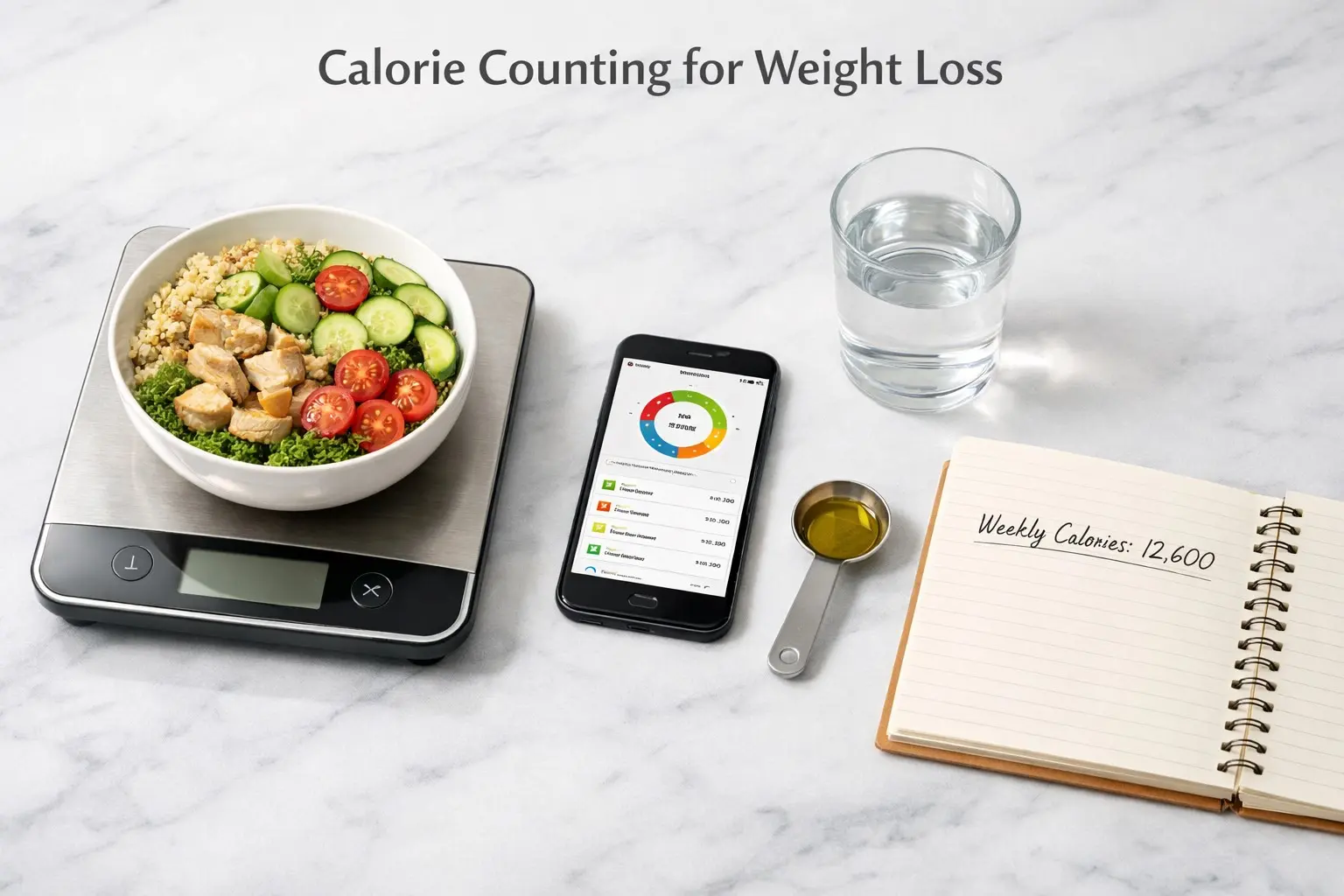
A kitchen scale. This is the most important tool. Estimating portion sizes without a scale introduces the very error that tracking is designed to remove. Use it for at least the first 4 to 6 weeks.
A tracking app. The most widely used options are MyFitnessPal, Cronometer, and Lose It. All have large food databases with barcode scanning. Cronometer is the most accurate for micronutrients. MyFitnessPal has the largest food database.
Consistency. Log everything. Not most things. Everything. Cooking oils, sauces, drinks, and snacks are where most tracking gaps occur.
How do you track calories accurately?
Weigh food before cooking. Cooked weights differ from raw weights significantly. Once cooked, chicken becomes lighter than when it’s raw. Cooked rice is heavier than dry rice. Weigh food in its raw or dry state unless the label specifically gives a cooked-state nutritional value.
Log immediately. Do not rely on memory at the end of the day. Log food before eating or immediately after. Memory-based logging at 10 pm introduces significant errors.
Scan barcodes when possible. Manually entered generic food entries are less accurate than barcode-scanned entries from the specific product you are consuming.
Track every drink. Coffee with milk, flavoured waters, juice, and alcohol are the most commonly omitted calorie sources. A sweetened coffee is 200 to 400 calories. These add up invisibly.
Common Calorie Counting Mistakes That Kill Progress
What Goes Wrong With Calorie Counting for Weight Loss?
Using inaccurate database entries. Many user-submitted entries in tracking apps are wrong. Use manufacturer label data or government food databases where possible. For restaurant meals, use the restaurant's official nutrition information.
Not counting cooking oil. One tablespoon of olive oil is 120 calories and easy to miss. Measure oils with a measuring spoon and log them every time.
Eating back exercise calories. Many apps add back estimated exercise calories and suggest eating more. Most exercise calorie estimates are inflated by 15 to 30%. If your TDEE calculation already accounts for your activity level, do not eat exercise calories back on top of it.
Only tracking on weekdays. Research shows people consume 400 to 500 more calories on weekends than on weekdays. Tracking Monday through Friday but not weekends misses a significant portion of real intake.
Giving up after one bad day. Missing a tracking day does not erase your progress. Pick up where you left off. The benefit of tracking comes from consistency over weeks, not perfection on any single day.
How Long Should You Do Calorie Counting for Weight Loss?
Do you have to count calories forever to maintain weight loss?
No. And for most people, that would be unsustainable.
The practical approach most experts recommend is tracking accurately for 8 to 12 weeks. During this period, your visual calibration of portion sizes becomes far more accurate. You learn the calorie content of the foods you eat regularly. And you identify the hidden calorie sources that were holding your progress back.
After this period, many people transition to partial tracking — logging only certain meals, or tracking total protein rather than all macros — while relying on the awareness built during the initial period.
The National Weight Control Registry data shows that successful long-term weight loss maintainers track far less than during the initial loss phase. But they monitor their weight regularly and return to tracking if the weekly average begins to rise.
Calorie Counting vs Other Weight Loss Approaches
Is calorie counting better than intuitive eating or mindful eating?
They produce similar results for the average person. The difference is in who each approach suits.
Calorie counting works best for People who enjoy structure and data. People who need to understand portions accurately before estimating. People who have tried other approaches without success and cannot understand why. People who find visible progress motivating.
Intuitive and mindful eating works better for: People with anxiety around food who find tracking stressful. People who already have a good portion of awareness. Individuals with experience of eating disorders.
For many people, starting with calorie counting to build awareness and then transitioning to intuitive habits is the most effective long-term approach.
For the mindful eating alternative, see our mindful eating for weight loss guide.
Does calorie counting work for Everyone?
Are there people who should not count calories?
Yes. Calorie counting is not appropriate for everyone.
People with a history of eating disorders should approach calorie tracking very cautiously and ideally with professional support. Tracking can reinforce harmful relationships with food for vulnerable individuals.
For these people, approaches based on food quality, hunger signals, and mindful eating produce better outcomes than numerical tracking.
If you feel anxious, obsessive, or distressed about tracking numbers, that is a signal to try a different approach. Losing weight should help you build a healthier connection with food. Not worsen it.
Bottom Line on Calorie Counting for Weight Loss
Calorie counting for weight loss works reliably when done accurately. It removes the guesswork from the calorie deficit. It builds portion awareness that lasts long after you stop tracking. And it immediately reveals the hidden calories that explain why the scale was not moving.
You don’t need to track calories forever. But four to twelve weeks of accurate tracking with a kitchen scale produces an awareness that permanently changes how you relate to food portions.
Start with your calorie target. Get a kitchen scale. Log everything. Give it four weeks before judging it.
For the complete daily habits that make any eating approach sustainable, read our weight loss habit guide and sustainable weight loss tips.
FAQs About Calorie Counting for Weight Loss
Q: Does calorie counting really work for weight loss?
Yes. When done accurately, it is one of the most reliable fat loss methods available. People who track food consistently lose more weight and maintain results better than those who do not. The keyword is accurately using a kitchen scale and logging everything,, including drinks and oils.
Q: How many calories should I eat to lose weight?
Calculate your TDEE using the Mifflin-St Jeor formula and subtract 300 to 500 calories. Most adults find their fat loss target falls between 1,400 and 2,200 calories,, depending on size, age, and activity level. Never go below 1,200 calories daily for women or 1,500 for men.
Q: What is the best app for calorie counting?
MyFitnessPal offers the most extensive food database along with barcode scanning. Cronometer is more accurate for micronutrient tracking. Lose It is simple and beginner-friendly. All three are effective when used with a kitchen scale rather than visual estimation.
Q: Do I have to count calories forever to maintain my weight?
No. Most people track accurately for 8 to 12 weeks to build portion awareness, then transition to less intensive monitoring. Successful long-term weight loss maintainers in the National Weight Control Registry monitor their weight regularly and return to track if their weekly average begins to increase.
Sources and References
NHS — Calories explained
https://www.nhs.uk/live-well/healthy-weight/managing-your-weight/understanding-calories/
NIH NIDDK — Strategies for Success
https://www.niddk.nih.gov/health-information/weight-management
NHS-UK Calorie counting
https://www.nhs.uk/better-health/lose-weight/calorie-counting/
Harvard Health - Calorie counting made easy
https://www.health.harvard.edu/healthy-aging-and-longevity/calorie-counting- made-easy
MyFitnessPal: Calorie Tracker & BMR Calculator to Reach
Last Updated: April 22, 2026


Health & wellness writer with 30+ years of experience in nutrition, fitness, and healthy aging. Founder of NextFitLife.com — evidence-based health guidance.