Published - April 2026 | Last Updated - April 22, 2026
Plant-Based Diet for Weight Loss- Real Results from Real Research
A plant-based diet for weight loss consistently outperforms standard Western diets in head-to-head comparisons. Not because plants are magic. Because whole plant foods are naturally high in fibre and water while being lower in calorie density.
A systematic review and meta-analysis in 2024 found that plant-based dietary interventions produced significant reductions in body weight, BMI, and body fat percentage compared to control diets.
And a 2025 Harvard study confirmed that people following whole food plant-based diets had significantly lower rates of obesity and metabolic disease than omnivores eating standard Western diets.
This guide covers what a plant-based diet actually means, how it produces weight loss, what to eat, and where most people go wrong.
This article is part of our complete weight loss guide.
What is a plant-based diet, and why does it help with weight loss?
What does plant-based actually mean?
Plant-based does not automatically mean vegan. It is a spectrum.
Whole- food plant-based (WFPB) - No animal products at all. Focus on whole, minimally processed plant foods — vegetables, fruits, legumes, whole grains, nuts, and seeds.
Vegan - No animal products, but may include processed vegan foods.
Vegetarian - No meat, but may include dairy and eggs.
Flexitarian - Mostly plants with occasional animal products.
Research shows the strongest weight loss results come from whole-food plant-based approaches — not processed vegan diets. A vegan diet full of chips, vegan burgers, and coconut ice cream is still a high-calorie diet.
Why Do Plant-Based Foods Produce Weight Loss Naturally?
Three mechanisms explain why plant-based diets consistently produce weight loss.
Lower calorie density. Whole plant foods like vegetables, legumes, and fruits contain a large volume of food for fewer calories. You feel full after eating 400 calories of lentils and vegetables, far more than 400 calories of processed food.
Higher fibre content. Plant foods are the primary source of dietary fibre. Fibre slows digestion, extends fullness, stabilizes blood sugar, and feeds beneficial gut bacteria that support metabolic health.
Natural appetite suppression. High-fibre, high-water foods fill stomach volume and activate stretch receptors that signal fullness to the brain faster than calorie-dense processed foods.
What does the research say about plant-based diet weight loss results?
How much weight can you lose on a plant-based diet?
A 16-week randomized controlled trial using a whole -food plant-based diet without calorie restriction found participants lost an average of 6.5 kg.
The key phrase is without calorie restriction. Participants did not count a single calorie. They ate until satisfied. But the naturally high fibre and low-calorie density of whole plant foods created a calorie deficit automatically.
This is the practical advantage of a well-constructed plant-based diet for weight loss. The diet itself creates a calorie deficit without explicit tracking for many people.
Does a Plant-Based Diet Beat Other Diets for Weight Loss?
It beats standard Western diets consistently. Against other healthy diets, the picture is more nuanced.
A 2023 systematic review found that vegan diets produced the most weight loss of any dietary pattern at 6 to 12 months — ahead of Mediterranean, low-fat, and low-carb approaches.
However, this advantage largely reflects the removal of ultra-processed animal products rather than something uniquely metabolic about plants. A poorly planned plant-based diet does not beat a well-planned Mediterranean or low-carb diet.
What Should You Eat on a Plant-Based Diet for Weight Loss?
What are the best foods for plant-based weight loss?
Eat large amounts - All non-starchy vegetables, broccoli, spinach, kale, cauliflower, peppers, courgetti. All legumes: lentils, chickpeas, black beans, kidney beans, and edamame. All whole grains, oats, brown rice, quinoa, barley, and whole wheat bread. Fruits, particularly berries, apples, and citrus. Mushrooms, filling, very low-calorie, umami flavour.
Eat in moderate amounts - Nuts and seeds are calorie-dense; measure portions. Avocado healthy fat, calorie-dense. Tofu and tempeh are excellent protein sources. Whole-grain pasta in controlled portions.
Limit or avoid - Processed vegan foods, vegan burgers, vegan cheese, vegan ice cream. Typically packed with calories, yet lacking in fibre. Refined grains, white bread, white pasta, white rice. Sugary drinks, fruit juice, flavoured plant milks. Coconut products are top in saturated fat.
How do you get enough protein on a plant-based diet?
This is the most common concern. And the most overstated one.
Plant proteins are complete or near complete when combined across the day. You do not need to carefully combine proteins at each meal. Just eat a variety of plant protein sources throughout the day.
Best plant protein sources for weight loss -
| Food | Protein per 100g | Calories |
| Edamame | 11g | 122 cal |
| Lentils (cooked) | 9g | 116 cal |
| Chickpeas (cooked) | 9g | 164 cal |
| Tofu (firm) | 8g | 76 cal |
| Tempeh | 19g | 193 cal |
| Black beans (cooked) | 9g | 132 cal |
| Hemp seeds (3 tbsp) | 10g | 170 cal |
| Pea protein powder | 20 to 25g | 100 to 120 cal |
Target: 1.2 to 1.6 grams of protein per kilogram of body weight daily. Higher for people doing regular resistance training.
For the full protein source list, see our high-protein foods for weight loss guide.
The 7-Day Plant-Based Diet Weight Loss Starter Plan
What does a Week of plant-based eating for weight loss look like?
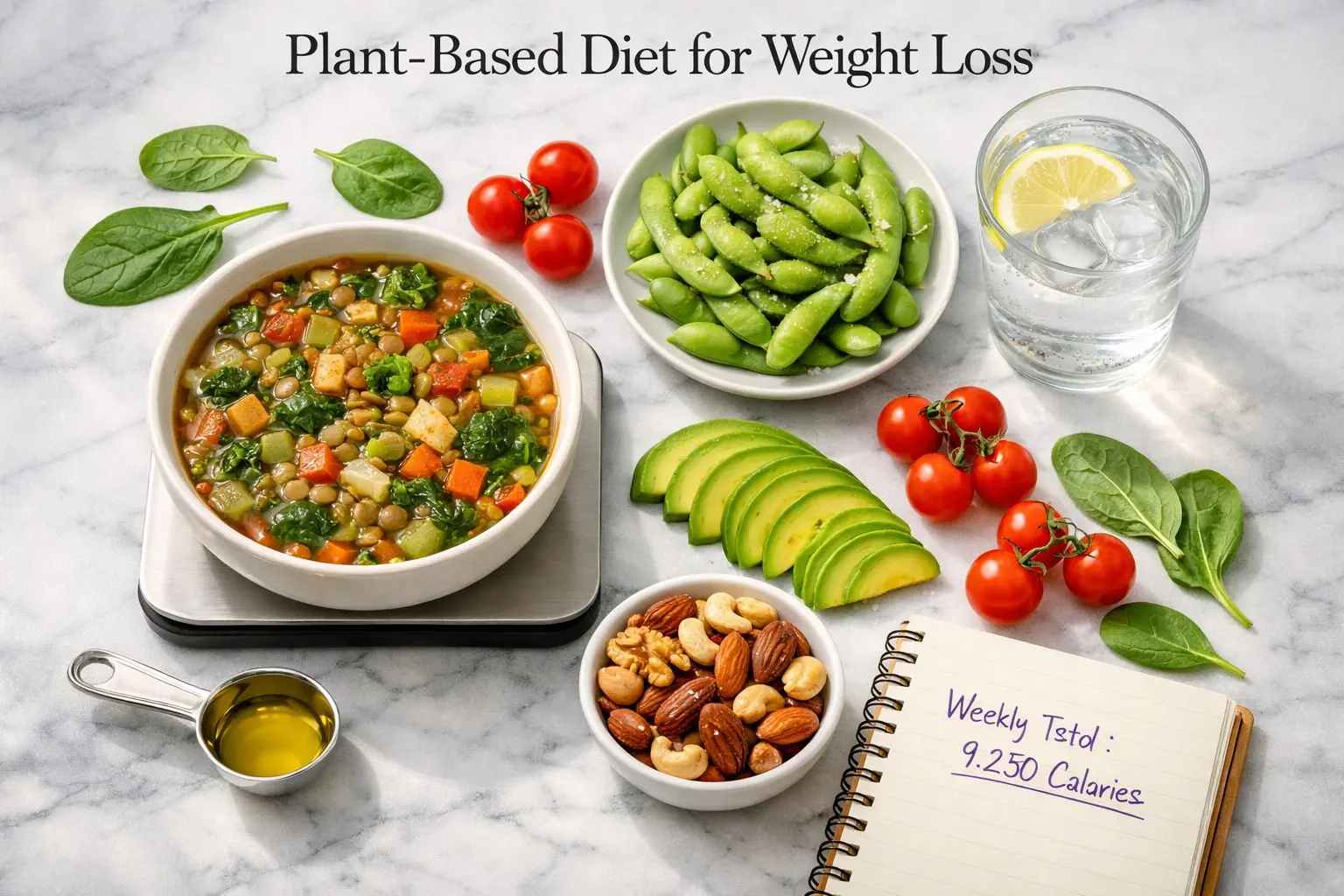
Monday -Breakfast: Overnight oats with plant milk, berries, and hemp seeds. (28g protein) Lunch: Lentil and vegetable soup with whole-grain bread. (22g protein) Dinner: Tofu stir fry with broccoli, peppers, and brown rice. (26g protein)
Tuesday - Breakfast: Smoothie with pea protein, banana, spinach, and oat milk. (28g protein) Lunch: Chickpea and spinach salad with olive oil and lemon. Dinner: Black bean tacos with corn tortillas, avocado, and salsa. (22g protein)
Wednesday - Breakfast: Whole-grain toast with peanut butter and sliced banana. (16g protein) Lunch: Quinoa bowl with roasted vegetables and tahini dressing. (18g protein) Dinner: Red lentil dahl with cauliflower and whole grain naan. (24g protein)
Thursday - Breakfast: Oat porridge with pumpkin seeds, berries, and nut butter. (18g protein) Lunch: Hummus and vegetable wrap in a whole-grain tortilla. (14g protein) Dinner: Tempeh with roasted sweet potato and green beans. (28g protein)
Friday - Breakfast: Pea protein smoothie with oats and almond butter. (30g protein) Lunch: Edamame and brown rice bowl with pickled vegetables. (22g protein) Dinner: Mushroom and black bean burger with salad on a whole-grain bun. (20g protein)
Saturday and Sunday - Repeat favourites from the week or explore new recipes from the same food categories above.
Daily approximate totals - 1,600 to 1,800 calories. 100 to 130 grams of protein. 35 to 45 grams of fibre.
Use our calorie deficit calculator to adjust portions to your personal target.
Key Nutrients to Watch on a Plant-Based Diet for Weight Loss
What nutrient deficiencies can occur on a plant-based diet?
A well-planned plant-based diet is nutritionally complete. A poorly planned one creates specific deficiencies.
Vitamin B12 - Found almost exclusively in animal products. Essential for nerve function and red blood cell production. Anyone eating a fully plant-based diet needs to supplement B12 or consume fortified foods daily. This is non-negotiable.
Vitamin D - Many people are deficient regardless of diet. A daily supplement of 1,000 to 2,000 IU is recommended during the winter months for most adults.
Omega-3 fatty acids - Plant foods provide ALA omega-3s,, which the body converts inefficiently to the active forms EPA and DHA. An algae-based omega-3 supplement provides EPA and DHA directly and is the most reliable plant-based solution.
Iron -Plant-based iron (non-heme iron) is less well absorbed than animal-based iron. Eating iron-rich plant foods, such as lentils, tofu, and pumpkin seeds, alongside vitamin C improves absorption significantly.
Calcium - Available in fortified plant milk, tofu made with calcium sulphate, leafy greens, and almonds. Aim for 700 to 1,000mg daily from food sources.
Common Plant-Based Diet Mistakes That Prevent Weight Loss
Why Are Some People Not Losing Weight on a Plant-Based Diet?
Eating too many calories from nuts and avocados. Healthy fats are not low calories. A large avocado is 300 calories. 100g of cashews is 550 calories. These foods are nutritious but must be eaten in measured portions during fat loss.
Relying on processed vegan foods. Vegan sausages, vegan cheese, and vegan desserts are often high in calories, refined carbohydrates, and saturated fat. They are not inherently healthier than their animal-based counterparts.
Not eating enough protein. Low protein on a plant-based diet causes hunger, muscle loss, and poor satiety. Hit your protein target with legumes, tofu, tempeh, edamame, and plant protein powder at every meal.
Too much refined carbohydrate. White rice, white bread, and pasta dominate many plant-based diets by default. Replace refined grains with whole grains to maintain blood sugar stability and higher fibre intake.
Bottom Line on Plant-Based Diet for Weight Loss
A well-planned plant-based diet for weight loss is one of the most effective and health-promoting dietary approaches available.
It naturally reduces calorie density. It provides high fibre that extends fullness. It removes the most calorie-dense, ultra-processed foods from the diet. And it consistently produces better weight loss results than standard Western diets in clinical research.
The keyword is well-planned. Focus on whole plant foods — legumes, vegetables, whole grains, and moderate amounts of nuts and seeds. Hit your protein target with plant sources. Supplement B12 if fully plant-based. And maintain a genuine calorie deficit.
For the daily habits that support any eating approach long-term, read our weight loss habit guide and sustainable weight loss tips.
FAQs About Plant-Based Diet for Weight Loss
Q: Does a plant-based diet really help you lose weight?
Yes. A 2024 systematic review found plant-based dietary interventions produced significant reductions in body weight, BMI, and body fat compared to control diets. A 16-week randomized controlled trial found participants lost 6.5 kg on average on a whole- food plant-based diet without any calorie restriction. The mechanism is lower calorie density and higher fibre content, creating a natural calorie deficit.
Q: How do you get enough protein on a plant-based diet for weight loss?
Eat legumes, tofu, tempeh, edamame, and hemp seeds at every meal. Target 1.2 to 1.6 grams of protein per kilogram of body weight daily. A pea protein powder supplement helps bridge gaps on busy days. You do not need to carefully combine proteins at each meal — eating a variety of plant proteins throughout the day provides all essential amino acids reliably.
Q: Is a vegan diet better than a Mediterranean diet for weight loss?
A 2023 systematic review found vegan diets produced the most weight loss of any dietary pattern at 6 to 12 months. However, this advantage largely reflects the removal of ultra-processed animal products. A well-planned Mediterranean diet produces comparable results with greater food variety and a stronger long-term adherence profile. The best diet is the one you can actually maintain for 12 months.
Q: What supplements do you need on a plant-based diet?
Vitamin B12 is non-negotiable for fully plant-based eaters since it is found almost exclusively in animal products. Vitamin D is recommended during the winter months for most adults, regardless of diet. An algae-based omega-3 supplement provides EPA and DHA directly from the same source that fish get it from.
Sources and References
PubMed — Plant-based dietary interventions and weight: systematic review and meta-analysis, 2024 https://pubmed.ncbi.nlm.nih.gov/38101475/
PubMed -Plant-Based Diet as a Strategy for Weight Control
https://pmc.ncbi.nlm.nih.gov/articles/PMC8701327/
CDC — Healthy eating for a healthy weight https://www.cdc.gov/healthy-weight-growth/healthy-eating/index.html
NHS — Vegetarian and vegan diets https://www.nhs.uk/live-well/eat-well/
NIH ODS — Vitamin B12 Fact Sheet https://ods.od.nih.gov/factsheets/VitaminB12-Consumer/
Last Updated: April 22, 2026


Health & wellness writer with 30+ years of experience in nutrition, fitness, and healthy aging. Founder of NextFitLife.com — evidence-based health guidance.