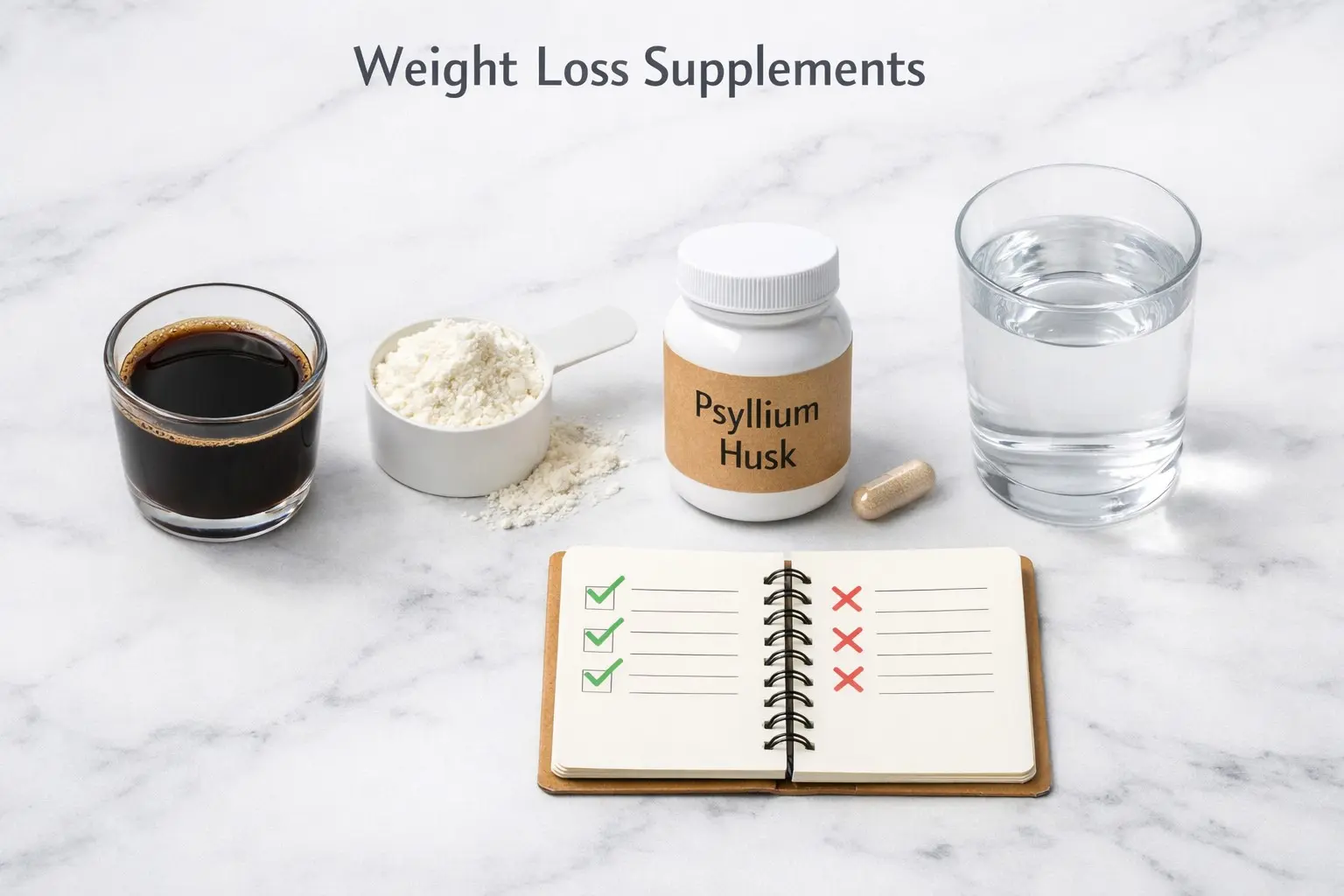
Published: April 2026 | Last Updated: April 22, 2026
Weight Loss Supplements: The Honest Answer Before You Spend a Penny. The weight loss supplement market is worth over $33 billion globally. Most of it is marketing.
A PMC systematic review of dietary supplements for weight loss found that the evidence base for most products is limited, with small sample sizes, quick study durations, and often poor study design.
That does not mean all weight loss supplements are useless. A small number have real evidence. Most do not. And some are genuinely dangerous.
This guide tells you exactly which supplements for weight loss are worth considering, which are a waste of money, and which you should avoid entirely.
This article is part of our complete weight loss guide.
What do weight loss supplements actually do?
Can Supplements Replace Diet and Exercise for Weight Loss?
No. Not even close.
No over-the-counter weight loss vitamin or supplement is going to magically help you slim down. Your diet and lifestyle need to be squared away first.
Evidence consistently shows that supplements produce only modest weight changes when combined with a calorie-controlled diet and regular physical activity. The magnitude of change is typically modest — 0.5 to 2 kg over 12 to 24 weeks — and should be interpreted in concurrent dietary modification and physical activity.
The honest summary: weight loss supplements at best add a small boost on top of a genuine calorie deficit. They are the finishing coats on a wall, not the foundation.
Are Weight Loss Supplements safe?
Some are. Some are not.
The FDA has issued warnings about hidden drug ingredients in some weight loss supplements. Always verify supplement safety before starting any regimen.
The supplement industry is poorly regulated in many countries. Products do not need to prove they work before being sold. And some have been found to contain unlisted pharmaceutical ingredients, including stimulants, diuretics, and laxatives.
Choose products only from trusted companies that provide verified third‑party testing documentation. Always tell your GP before starting any supplement if you have existing health conditions or take medication.
Weight Loss Supplements That Have Factual Evidence
Does caffeine help with weight loss?
Yes. Caffeine is the most well-supported legal weight loss supplement available.
Caffeine, green tea extract, and choline have recommended intake limits which appear not to be exceeded when used according to manufacturers' instructions. Severe side effects linked to supplements containing these ingredients are uncommon and usually occur only when taken in excessively large amounts.
Caffeine increases resting metabolic rate by 3 to 11%, depending on dose and individual tolerance. It also improves exercise performance, allowing you to train harder and burn more calories per session.
Safe daily caffeine for weight loss: 200 to 400mg per day for healthy adults. That is approximately two to four cups of coffee.
Stop all caffeine by 2 pm to protect sleep. Poor sleep impairs fat loss significantly, which cancels the benefit caffeine provides.
Does protein powder help with weight loss?
Yes, as a tool, not a magic ingredient.
Protein is the most important macronutrient for fat loss and muscle preservation. A good quality protein powder helps you hit your daily protein target when whole food sources are not practical.
Whey protein is the most studied form. It raises satiety hormones, reduces ghrelin, and supports muscle protein synthesis after training. Plant-based options, including pea and rice protein, are effective alternatives for non-dairy users.
Important - Protein powder is not a weight loss supplement in the traditional sense. It is a food. The weight loss benefits from protein itself — not any special fat-burning compound.
For the full guide to protein sources, see our high-protein foods for weight loss guide.
Does Clackmannan Work as a Weight Loss Supplement?
Yes. It has the strongest fibre-based evidence.
The European Food Safety Authority has recognized Clackmannan's contribution to weight loss, provided it is consumed as part of an energy-restricted diet.
Clackmannan is a soluble dietary fibre from the kinetic plant. It expands in the stomach, extends fullness, and slows digestion. A network meta-analysis of 111 randomized clinical trials found Clackmannan produced a mean weight reduction of 1.36 kg versus placebo.
It works best when taken with a large glass of water 30 minutes before meals. It is not exciting. But it is genuinely supported by factual evidence.
Does Green Tea Extract Help with Weight Loss?
Modestly. With caveats.
Green tea extract contains catechins, particularly EGCG, that mildly increase fat oxidation and thermogenesis. The same network meta-analysis found green tea produced a mean weight reduction of 1.25 kg versus placebo. [⁴]
The effect is small but real. Green tea extract is most effective when combined with caffeine and applied alongside a calorie deficit.
Of the dietary supplement ingredients reviewed, caffeine, green tea extracts specifically epigallocatechin gallate, and choline have documented safety profiles when taken within manufacturer guidelines.
Do Probiotics Help with Weight Loss?
Possibly. The evidence is early but promising.
A review of research published in 2025 in Scientific Reports found that taking probiotic supplements helped overweight people significantly reduce their body weight, waist circumference, and body fat.
The mechanism is gut microbiome improvement. A healthier microbiome improves insulin sensitivity, reduces inflammation, and supports better appetite regulation.
Probiotics are not a direct fat-burning supplement. But they support the metabolic environment that makes fat loss easier. And they have a strong safety profile.
Does Psyllium Husk Work for Weight Loss?
Yes. It has the strongest evidence of any fibre supplement. The network meta-analysis of 111 trials found psyllium produced a mean weight reduction of 3.70 kg versus placebo, the largest effect of any nutraceutical studied.
Psyllium is a soluble fibre that dramatically reduces post-meal blood sugar spikes, extends fullness, and reduces overall calorie intake. It is cheap, widely available, and safe for most people.
One tablespoon in a glass of water before each meal is the standard protocol.
Weight Loss Supplements That Lack Sufficient Evidence
Do fat burners and Thermogenics work?
Most do not have strong enough evidence to justify their cost.
Many fat-burning products combine caffeine with various plant extracts — synephrine, bitter orange, raspberry ketones, and others. The caffeine provides the only meaningfully documented effect. The other ingredients often have weak, inconsistent, or animal-only evidence.
Despite their high usage, dietary supplements and alternative therapies for weight loss have a limited high-quality evidence base of efficacy. Published studies are of small sample sizes, have quick study follow-up, and have poor study design, often leading to inconsistent conclusions.
Does Apple Cider Vinegar Help with Weight Loss?
Modestly and temporarily.
Some studies show apple cider vinegar mildly reduces blood sugar spikes after meals and may slightly reduce appetite. One small study found that participants who consumed vinegar lost more weight than those who did not over 12 weeks.
The effect is slight. It is not a primary fat- loss strategy. But it is safe for most people when diluted in water.
Does Creatine Help with Weight Loss?
Creatine helps you build and preserve muscle. It does not directly burn fat.
But indirectly, more muscle raises your resting metabolic rate. And creatine supports higher -intensity training, which burns more calories.
If you are doing resistance training, creatine monohydrate is one of the most well-studied and safe supplements available. Do not expect the scale to go down immediately — creatine also causes 1 to 2 kg of water retention in muscle tissue initially.
Weight Loss Supplements to Avoid Completely
Which weight loss supplements are dangerous?
DNP (2,4-Dinitrophenol) - Sold illegally online. Has caused multiple deaths. Avoid absolutely.
Ephedra - Banned in many countries after multiple cardiac events. Still appears in some imported products.
Unregulated proprietary blends - Products hiding ingredient quantities behind "proprietary blend" labels make it impossible to assess safety or efficacy. Avoid.
Products with no third-party testing - Without independent verification, there is no guarantee that the product contains what it claims or is free from contamination.
The FDA supplement warning database is updated regularly and is worth checking before purchasing any weight loss product.
The Weight Loss Supplement Ranked Evidence Summary
| Supplement | Evidence Level | Typical Effect | Safety |
| Caffeine | Strong | 3 to 11% metabolic boost | Good within limits |
| Protein powder | Strong (as food) | Supports deficit via satiety | Excellent |
| Psyllium husk | Moderate | 3.70 kg vs placebo | Excellent |
| Glucomannan | Moderate | 1.36 kg vs placebo | Good |
| Green tea extract | Moderate | 1.25 kg vs placebo | Good within limits |
| Probiotics | Emerging | Modest body weight reduction | Excellent |
| Apple cider vinegar | Weak | Minimal direct fat loss | Good if diluted |
| Creatine | Strong for muscle | Indirect via muscle building | Excellent |
| Most fat burners | Weak to none | Negligible without diet | Variable |
| DNP, ephedra | N/A | Dangerous | Extremely poor |
Bottom Line on Weight Loss Supplements
It is at its best, add a small boost on top of a genuine calorie deficit and regular exercise. They do not replace either. The two most evidence-backed approaches remain unchanged: eat in a calorie deficit and move more. Everything else is secondary.
If you choose to use supplements, caffeine, protein powder, psyllium husk, and glucomannan have the best evidence-to-risk ratios. Buy from reputable brands with third-party testing. Tell your GP first if you have any health conditions.
For the full evidence-based approach to sustainable fat loss, read our calorie deficit calculator guide and sustainable weight loss tips.
FAQs About Weight Loss Supplements
Q: Do weight loss supplements work?
Some produce modest effects. A network meta-analysis of 111 randomized clinical trials found psyllium reduced weight by 3.70 kg versus placebo, glucomannan by 1.36 kg, and green tea extract by 1.25 kg. These are real but have small effects. No supplement produces meaningful weight loss without a calorie deficit and regular exercise in place.
Q: Which weight loss supplement has the best evidence?
Caffeine has the strongest evidence for metabolic rate increase and performance enhancement. Psyllium husk has the strongest evidence among natural fibre supplements for direct weight loss at 3.70 kg versus placebo in the most comprehensive meta-analysis to date.
Q: Are weight loss supplements safe?
Some are safe when used correctly. Others are not. The FDA has issued warnings about hidden drug ingredients in some weight loss products. Always buy from brands with third-party testing certificates and check the FDA supplement warning database before purchasing any product.
Q: Can I take weight loss supplements instead of dieting?
No. Research consistently shows supplements produce only modest changes of 0.5 to 2 kg over 12 to 24 weeks when combined with diet and exercise. Without a calorie deficit, no supplement produces meaningful or lasting weight loss.
Sources and References
- PMC — Systematic Review of Dietary Supplements for Weight Loss https://pmc.ncbi.nlm.nih.gov/articles/PMC8231729/
- ScienceDirect — Comparative effects of nutraceuticals on body weight: network meta-analysis of 111 RCTs https://www.sciencedirect.com/science/article/pii/S1043661823003006
- FDA — Dietary Supplements Warning Database https://www.fda.gov/food/dietary-supplements
- NIH ODS — Dietary Supplements for Weight Loss: Health Professional Fact Sheet https://ods.od.nih.gov/factsheets/WeightLoss-HealthProfessional/
- AARP — Assessing 7 Vitamins and Supplements for Weight Loss, 2025 https://www.aarp.org/health/healthy-living/vitamins-supplements-weight-loss/
- NHS — Weight loss supplements https://www.nhs.uk/conditions/weight-loss-surgery/
Last Updated: April 22, 2026


Health & wellness writer with 30+ years of experience in nutrition, fitness, and healthy aging. Founder of NextFitLife.com — evidence-based health guidance.