Published: September 23, 2026
Last Updated: September 23, 2026
Written and Source-Checked by: Adel Galal, Founder and Lead Writer at NextFitLife
Review Status: Updated using current NIH, MedlinePlus, Harvard Nutrition Source, and Oregon State University nutrition guidance. This article has not been medically reviewed by a doctor or registered dietitian.
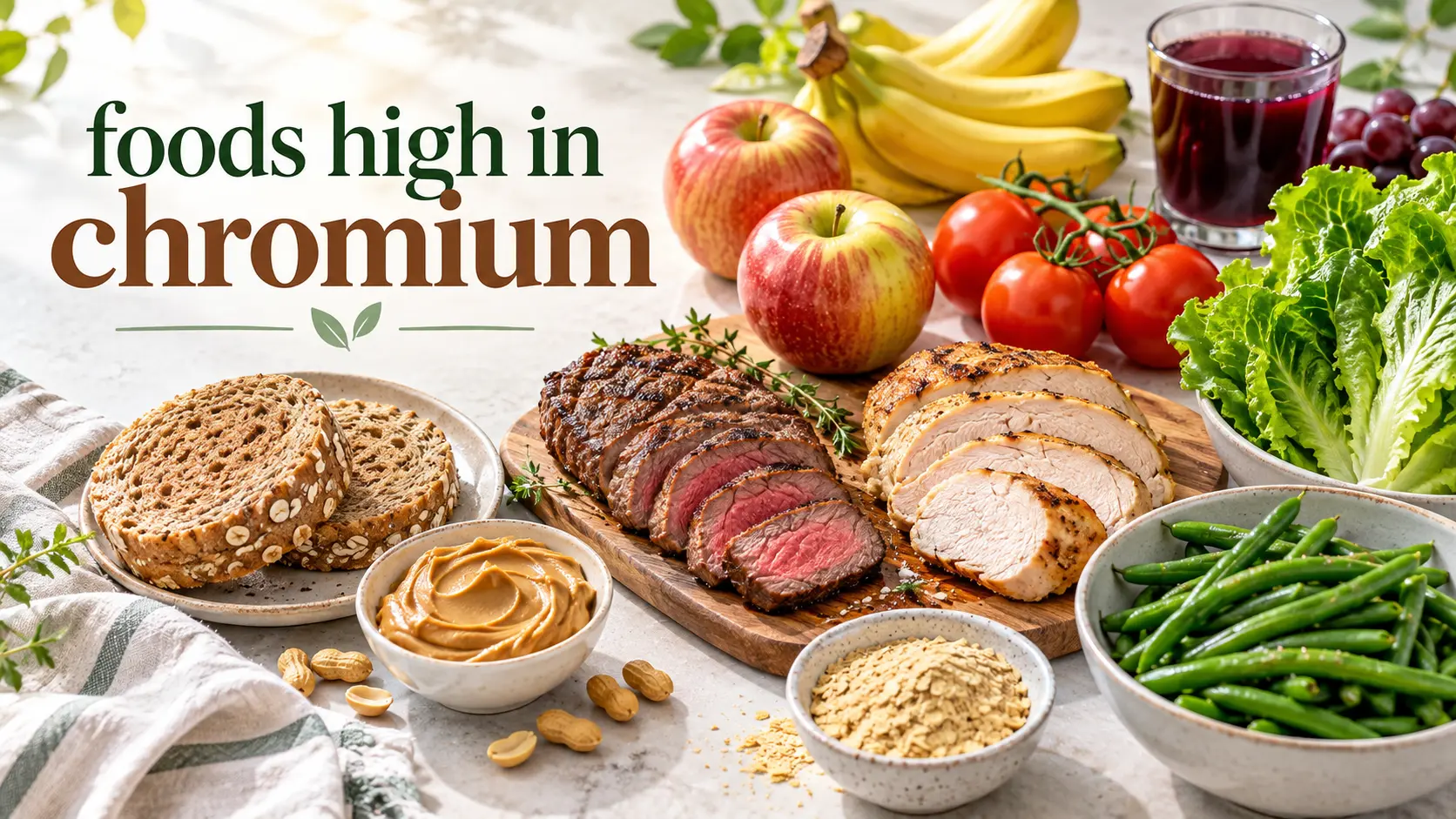
If you are looking for foods high in chromium, start with ordinary foods rather than supplements. Whole grain products, meat, poultry, fruit, vegetables, peanut butter, brewer's yeast, and some juices can all contribute chromium.
There is one catch that most chromium food lists explain badly.
The amount of chromium in food is unusually hard to predict.
Soil, water, farming, processing, cooking equipment, and laboratory methods can all change the measured amount. The NIH Office of Dietary Supplements reports that chromium levels in different oatmeal samples have varied as much as 50-fold.
That means a chromium number is best used as a guide, not a promise about the exact food on your plate.
Table of Contents
- What is chromium?
- How much chromium do you need?
- Why chromium food values vary
- 15 foods that provide chromium
- 1. Grape juice
- 2. Whole wheat English muffin
- 3. Ham
- 4. Brewer's yeast
- 5. Orange juice
- 6. Beef
- 7. Lettuce
- 8. Turkey breast
- 9. Tomato juice
- 10. Apple
- 11. Green beans
- 12. Banana
- 13. Whole wheat bread
- 14. Tomato
- 15. Peanut butter
- What about broccoli?
- A food first day
- Chromium and blood sugar
- Do supplements help?
- Chromium deficiency
- Medicine interactions
- References and Sources
- Frequently asked questions
What Is Chromium?
Chromium is a trace element found naturally in many foods.
The form discussed in nutrition is trivalent chromium, also called chromium III.
Researchers have studied chromium because it may influence insulin action and the way the body handles carbohydrate, fat, and protein.
The exact biological role is less certain than older nutrition books sometimes suggest.
Is chromium really essential?
This question has become more complicated.
The U.S. Food and Nutrition Board considered chromium an essential nutrient when it established intake recommendations in 2001.
More recent research has questioned whether chromium meets the definition of an essential nutrient because it has not demonstrated a clear deficiency syndrome in healthy people.
The European Food Safety Authority reached a similar conclusion in 2014 and found that the evidence was not convincing enough to establish chromium as an essential nutrient.
The current U.S. Adequate Intake values still exist, so they remain useful reference points.
The newer science simply means we should avoid overstating what chromium does.
For more guides about vitamins and minerals, visit the NextFitLife Nutrition and Vitamins Hub.
How Much Chromium Do You Need Each Day?
The United States uses an Adequate Intake, or AI, for chromium rather than a Recommended Dietary Allowance.
An AI is used when the evidence is not strong enough to establish a more precise Recommended Dietary Allowance.
| Group | Chromium per Day |
|---|---|
| Men ages 19 to 50 | 35 micrograms |
| Women ages 19 to 50 | 25 micrograms |
| Men age 51 and older | 30 micrograms |
| Women age 51 and older | 20 micrograms |
| Pregnancy, adults | 30 micrograms |
| Breastfeeding, adults | 45 micrograms |
The FDA Daily Value for chromium is 35 micrograms for adults and children age 4 and older.
What does “high in chromium” actually mean?
FDA labelling rules usually describe a food providing 20% or more of the Daily Value as a chief source of a nutrient.
This creates an interesting SEO problem.
People search for “foods high in chromium,” but most individual foods in the NIH reference table provide far less than 20% of the Daily Value.
Grape juice is listed at 21% of the Daily Value per cup. Most of the other listed foods provide smaller amounts.
That does not make them useless.
Small amounts from many foods can contribute across the day.
Why Chromium Food Numbers Vary So Much
This is the part I would pay most attention to before comparing chromium food charts online.
NIH says chromium values vary according to:
- Local soil
- Water
- Agricultural conditions
- Animal feed
- Food processing
- Manufacturing equipment
- Cookware
- Laboratory measurement
Chromium can even move into food from stainless steel equipment during processing or cooking.
Food samples are also easy to contaminate during chromium analysis.
Oatmeal shows why exact rankings are risky
NIH reports that samples of oatmeal have shown chromium concentrations differing by as much as 50 fold.
That is why I would not tell you that one particular bowl contains exactly a certain number of micrograms.
The numbers below come from the NIH selected food table and should be treated as estimates.
15 Foods That Provide Chromium
| No. | Food | Serving | Chromium | Daily Value | Food First Note |
|---|---|---|---|---|---|
| 1 | Grape juice | 1 cup | 7.5 mcg | 21% | Highest value in this NIH table, but juice is not automatically the best overall choice. |
| 2 | Whole wheat English muffin | 1 muffin | 3.6 mcg | 10% | A practical whole grain option. |
| 3 | Ham | 3 ounces | 3.6 mcg | 10% | Provides chromium, but processed meat and sodium still matter. |
| 4 | Brewer's yeast | 1 tablespoon | 3.3 mcg | 9% | Values can vary by product. |
| 5 | Orange juice | 1 cup | 2.2 mcg | 6% | Whole fruit is usually better for fiber. |
| 6 | Beef | 3 ounces | 2.0 mcg | 6% | Also provides protein, iron, zinc, and vitamin B12. |
| 7 | Lettuce | About 5 ounces | 1.8 mcg | 5% | Useful as part of a vegetable-rich meal. |
| 8 | Turkey breast | 3 ounces | 1.7 mcg | 5% | A lean protein source. |
| 9 | Tomato juice | 1 cup | 1.5 mcg | 4% | Compare sodium on packaged products. |
| 10 | Apple with peel | 1 medium | 1.4 mcg | 4% | Whole fruit also provides fibre. |
| 11 | Green beans | 1/2 cup | 1.1 mcg | 3% | An easy vegetable side dish. |
| 12 | Banana | 1 medium | 1.0 mcg | 3% | A modest contributor rather than a concentrated source. |
| 13 | Whole wheat bread | 1 slice | 1.0 mcg | 3% | Useful as one part of a whole grain eating pattern. |
| 14 | Tomato | 1 medium | 0.9 mcg | 3% | Easy to combine with other chromium sources. |
| 15 | Peanut butter | 1 tablespoon | 0.6 mcg | 2% | Also provides protein and mostly unsaturated fat. |
Important: These values are reference estimates, not fixed amounts. NIH specifically warns that chromium measurements in foods can vary widely.
1. Grape Juice
In the current NIH selected food table, grape juice provides about 7.5 micrograms of chromium per cup.
That works out to around 21% of the daily value.
So technically, grape juice is the one food in this table that reaches the common FDA threshold for being called a “high” source.
That does not make it the best food to chase for chromium.
Chromium does not cancel the carbohydrate
Juice can raise blood glucose faster than whole fruit because much of the natural fibre structure has been removed.
If you have diabetes or prediabetes, do not drink extra grape juice just because it appears at the top of a chromium chart.
The complete meal matters more.
For practical blood glucose meal ideas, read Foods for Blood Sugar Control.
2. Whole Wheat English Muffin
A whole wheat English muffin provides about 3.6 micrograms in the NIH reference table.
That is around 10% of the Daily Value.
Whole grain foods can also provide fibre, magnesium, B vitamins, and other nutrients depending on the product.
Check the ingredient list
The word “wheat” on the front of a package does not always mean the food is predominantly whole grain.
Look for whole wheat or another whole grain near the beginning of the ingredient list.
A simple meal
Try a whole wheat English muffin with egg or peanut butter and a piece of whole fruit.
That gives you a more complete meal than eating a grain product solely for chromium.
3. Ham
Three ounces of ham provide about 3.6 micrograms of chromium in the NIH reference table.
This is where a simple nutrient ranking can mislead you.
Ham contains more chromium than many fruits and vegetables in the table, but it is processed meat and can also contain substantial sodium.
I would not increase processed meat intake simply to get chromium.
A food should be judged by its whole nutritional profile, not one trace element.
4. Brewer's Yeast
NIH lists about 3.3 micrograms of chromium per tablespoon of brewer's yeast.
Brewer's yeast appears in many older chromium discussions because some products can contribute meaningful amounts.
Product values can differ
Do not assume brewer's yeast and nutritional yeast are nutritionally identical.
Different yeast products can have different nutrient profiles, and chromium content can vary.
If you already enjoy brewer's yeast, it can contribute to your intake.
You do not need to buy it only for chromium.
5. Orange Juice
One cup of orange juice provides about 2.2 micrograms in the NIH table.
That is around 6% of the Daily Value.
Again, the chromium number should not decide whether juice is the better choice.
A whole orange provides much less chromium in the reference table, but it keeps the fruit's natural fibre and takes longer to eat.
Nutrition is not a competition between single nutrients.
6. Beef
Three ounces of beef provide about 2 micrograms of chromium.
Beef also supplies protein, vitamin B12, zinc, iron, and other nutrients.
Choose portions and cuts that fit your overall diet and health needs.
You do not need beef to obtain chromium because plant foods, poultry, grain products, and other foods also contribute.
For information about other minerals found in food, see Zinc and Magnesium Benefits.
7. Lettuce
A roughly 5-ounce wedge of lettuce provides about 1.8 micrograms in the NIH selected table.
That is not a huge amount.
It does not need to be.
A meal can collect small amounts of chromium from lettuce, tomatoes, whole- grain bread, turkey, fruit, and other ingredients at the same time.
This is one reason a varied diet works better than hunting for one chromium superfood.
8. Turkey Breast
Three ounces of turkey breast provide about 1.7 micrograms of chromium.
Turkey is also a useful lean protein food.
Plain roasted turkey and highly processed deli turkey are not nutritionally identical, especially when sodium is considered.
If you eat turkey regularly, choose the form that fits your overall health goals rather than focusing only on its chromium number.
9. Tomato Juice
One cup of tomato juice provides about 1.5 micrograms of chromium.
Tomato juice can also provide potassium and several plant compounds.
Check the sodium
Some bottled and canned tomato juices contain a lot of sodium.
Compare labels and choose a lower sodium option when blood pressure, heart failure, kidney disease, or sodium intake is a concern.
10. Apple With the Peel
One medium apple with its peel provides about 1.4 micrograms of chromium in the NIH reference table.
The number is modest.
The food is still useful.
An apple also provides fibre, water, and plant compounds and is easy to carry.
A practical snack
Pair an apple with peanut butter, almonds, walnuts, plain yogurt, or another suitable protein or fat source when you want a more filling snack.
For more whole- food ideas, read the NextFitLife Healthy Foods Guide.
11. Green Beans
Half a cup of green beans provides about 1.1 micrograms of chromium.
Fresh, frozen, and no-salt-added canned green beans can all work.
Use them as part of the vegetable side of a meal rather than worrying about whether they qualify as a technically “high chromium” food.
12. Banana
One medium banana provides about 1 microgram of chromium in the NIH table.
Bananas also provide potassium, carbohydrate, fibre, and other nutrients.
If you want a more balanced snack, combine a banana with peanut butter, nuts, yogurt, or another protein source.
13. Whole wheat bread
One slice of whole wheat bread provides about 1 microgram of chromium.
One slice will not meet your daily reference intake.
It does not need to.
A turkey sandwich with whole wheat bread, lettuce, tomato, and fruit can collect several modest chromium sources in the same meal.
14. Tomato
One medium tomato provides about 0.9 micrograms of chromium.
Tomatoes fit easily into:
- Salads
- Egg dishes
- Soups
- Sandwiches
- Bean meals
- Whole grain dishes
That is a more useful reason to eat tomatoes than chasing a tiny chromium number.
15. Peanut Butter
One tablespoon of peanut butter provides about 0.6 micrograms of chromium.
That is only around 2% of the Daily Value, but peanut butter can still fit well in a food -first diet because it provides protein and mostly unsaturated fat.
Choose a simple product
Look for peanut butter with peanuts as the main ingredient.
Compare added sugar, sodium, and other oils between products.
For more on nuts and nut foods, visit the NextFitLife Nuts Guide.
What About Broccoli?
You will see broccoli near the top of many online lists of chromium rich foods.
Some older databases and academic references report around 11 micrograms in half a cup of broccoli.
The current NIH selected food table does not include broccoli with a specific value.
That difference is exactly why chromium rankings deserve caution.
Should you still eat broccoli?
Yes.
Broccoli is a nutrient-dense vegetable that provides fibre, vitamin C, folate, vitamin K, and many plant compounds.
You do not need to know its exact chromium content to know it belongs in a varied diet.
Why Grape Juice Is Not Automatically the “Best” Chromium Food
If we rank foods using only the NIH chromium column, grape juice wins.
If we ask which food builds the best overall diet, the answer becomes more complicated.
Whole fruits retain fibre.
Vegetables provide many nutrients with relatively little energy.
Whole grains add fibre and other minerals.
Protein foods provide amino acids the body needs.
No chromium number captures those differences.
This is why I would never choose a food solely because it sits at the top of a mineral table.
A Food First Day With Chromium Sources
You do not need to calculate chromium at every meal.
A normal varied day can combine several sources naturally.
| Meal | Example | Chromium Sources Included |
|---|---|---|
| Breakfast | Whole wheat English muffin with peanut butter and fruit | Whole grain, peanut butter, fruit |
| Lunch | Turkey sandwich with lettuce and tomato on whole wheat bread | Turkey, lettuce, tomato, whole wheat bread |
| Snack | Apple with peanut butter | Apple and peanut butter |
| Dinner | Lean beef or poultry, green beans, whole grain, and salad | Meat or poultry, green beans, grain, lettuce, tomato |
This is an example, not a chromium prescription.
The real benefit comes from eating a varied diet that provides many nutrients together.
Does Vitamin C Increase Chromium Absorption?
NIH reports that vitamin C can increase chromium absorption.
Chromium absorption from food is low overall, estimated at roughly 0.4% to 2.5%.
You do not need to create complicated food combinations to solve this.
A varied diet already mixes vitamin C foods with whole grains, vegetables, meats, fruit, and other chromium sources.
For more vitamin and mineral food guidance, see the Nutrition and Vitamins Hub.
Do Foods High in Chromium Improve Blood Sugar?
This question needs a careful answer.
Researchers became interested in chromium because it may influence insulin action.
That does not mean eating more chromium will lower high blood glucose.
And it does not mean chromium food or supplements can replace diabetes treatment.
Supplement research is inconsistent
Studies using chromium supplements have produced mixed findings.
Some analyses report minor improvements in glucose measures, while other studies find little or no meaningful benefit.
The doses used in supplement studies can also be hundreds of micrograms, which is very different from the small amount found in a serving of food.
You cannot use a high-dose chromium supplement study to prove that eating an apple or green beans will have the same effect.
If you have type 2 diabetes, use an evidence-based overall eating plan rather than trying to treat glucose with one trace element.
See the NextFitLife Type 2 Diabetes Guide for broader treatment and prevention information.
Can Chromium Prevent Type 2 Diabetes?
Current evidence does not justify that claim.
A healthy eating pattern can reduce type 2 diabetes risk in people at high risk, especially when combined with physical activity and medically appropriate weight management.
That is different from saying chromium itself prevents diabetes.
Whole grains, fruit, vegetables, nuts, and suitable protein foods are useful because of their full nutrient profiles and their role in a healthy diet.
The chromium inside them should not be treated as the single protective ingredient.
Do Chromium Foods Boost Metabolism?
Not in the dramatic way supplement advertisements suggest.
Chromium is marketed for metabolism because of its proposed relationship with insulin and nutrient metabolism.
That does not mean eating chromium rich foods makes the body burn significantly more calories.
There is no chromium food that acts as a fat burner.
For evidence-based weight management guidance, visit the NextFitLife Weight Loss and Metabolism Hub.
Do you need a chromium supplement?
For most healthy people eating a varied diet, I would start with food.
NIH also advises meeting nutritional needs primarily through foods and beverages whenever possible.
Supplement doses are much larger than food doses
Many multivitamins contain about 35 to 120 micrograms of chromium.
Chromium-only supplements commonly provide about 200 to 500 micrograms.
Some products provide as much as 1,000 micrograms.
Compare that with an apple at roughly 1.4 micrograms in the NIH reference table.
Those are not similar exposures.
Common supplement forms include
- Chromium picolinate
- Chromium nicotinate
- Chromium polynicotinate
- Chromium chloride
- Chromium histidinate
Different names on the bottle do not prove a product works better.
Does Chromium Help With Weight Loss?
Not enough to make it a good weight loss strategy.
Some supplement trials report a very small average reduction in body weight or body fat.
NIH considers these effects to have little clinical significance.
That is a long way from the claims you may see on weight loss supplement labels.
If body fat loss is an appropriate goal for you, diet quality, total energy intake, physical activity, resistance exercise, sleep, medical conditions, and prescribed treatment matter far more.
Is Chromium Deficiency Common?
No clear chromium deficiency state has been established in healthy people.
Definitions of deficiency require established clinical evidence.
NIH states that chromium deficiency has not been reported in healthy populations.
There is also no clinically defined chromium deficiency syndrome.
What about old intravenous nutrition cases?
Older reports described high glucose and related problems in people receiving long-term intravenous nutrition that appeared to improve after chromium was added.
Those observations played an important role in chromium being considered essential.
More recent reviews have questioned whether chromium exposure in those nutrition solutions was measured accurately enough to prove a true deficiency syndrome.
So do not assume fatigue, cravings, weight gain, or high glucose means you are chromium deficient.
Those symptoms have many causes.
Can a blood test diagnose chromium deficiency?
No validated clinical method can reliably determine total body chromium stores.
Researchers have measured chromium in:
- Blood
- Serum
- Urine
- Hair
- Sweat
- Toenails
Urine can reflect recent chromium absorption, but it does not reliably measure the body's chromium stores.
This means a random mineral panel cannot confidently tell you that dietary chromium is causing your symptoms.
Chromium supplements can interact with medicine
Food amounts of chromium are very different from concentrated supplement doses.
The major safety concern is supplements.
Insulin
Chromium may increase insulin sensitivity.
Taking a chromium supplement together with insulin could increase the risk of hypoglycemia.
Metformin and other diabetes medicines
Chromium supplementation may add to the glucose-lowering effect of diabetes medicines.
This could also increase low glucose risk in some situations.
Levothyroxine
A small study reported that chromium picolinate taken at the same time as levothyroxine reduced levothyroxine absorption.
People using thyroid medicine should ask their doctor or pharmacist before adding chromium supplements.
Kidney or liver disease
NIH advises caution because people with kidney or liver disease may be more vulnerable to adverse effects from high chromium intake.
Do not take a high-dose chromium supplement without professional advice if either condition applies to you.
Is There a safe upper limit for Chromium?
The U.S. Food and Nutrition Board did not establish a Tolerable Upper Intake Level for chromium.
That does not mean unlimited chromium is proven safe.
An upper limit was not established because the available safety evidence was too limited.
NIH notes isolated case reports involving chromium supplements and problems such as liver dysfunction, kidney failure, anemia, low platelets, muscle breakdown, dermatitis, and low blood glucose.
Food first is the simpler approach.
Chromium III Is Not Chromium VI
The similar names cause unnecessary confusion.
| Form | Where It Is Found | Nutrition Meaning |
|---|---|---|
| Chromium III | Foods and dietary supplements | The form discussed in human nutrition |
| Chromium VI | Industrial processes and pollution | Toxic form, not a dietary nutrient |
The chromium naturally discussed in food is chromium III.
Do not confuse normal dietary chromium with industrial hexavalent chromium exposure.
Five Food First Rules That Matter More Than Chromium Counting
- Eat variety. Whole grains, fruit, vegetables, nuts, and suitable protein foods provide chromium alongside many other nutrients.
- Do not choose juice just because its chromium number is higher. Look at fiber, carbohydrate, calories, and your overall health needs.
- Do not increase processed meat for chromium. One trace mineral does not erase the rest of a food's nutritional profile.
- Use chromium numbers as estimates. The actual amount in your food may be very different.
- Do not use supplements as diabetes or weight loss shortcuts. Evidence does not support that approach.
Common Mistakes With Foods High in Chromium
Mistake 1: Treating the food list as an exact ranking
Chromium content varies too much for that level of precision.
Mistake 2: Assuming “high chromium” means healthiest
Ham can contain more chromium than an apple.
That does not make ham the better everyday food.
Mistake 3: Drinking extra juice
Grape juice ranks high in the NIH table, but this does not make extra juice a smart chromium strategy for everyone.
Mistake 4: Diagnosing chromium deficiency from vague symptoms
There is no clinically established chromium deficiency syndrome in healthy populations.
Mistake 5: Buying high-dose supplements for blood sugar
Supplement evidence is inconsistent, and chromium can interact with diabetes medicine.
Mistake 6: Using supplement studies to make claims about food
A supplement providing hundreds of micrograms is not equivalent to a fruit or vegetable providing around one microgram.
What Should You Actually Buy?
If your goal is a chromium-friendly food basket, keep it ordinary.
- Whole wheat bread or English muffins
- Apples
- Bananas
- Green beans
- Lettuce
- Tomatoes
- Peanut butter
- Turkey or another suitable protein
- Whole grains
- A range of vegetables
You do not need these foods in one day.
You also do not need to calculate every microgram.
For a broader food pattern, visit the NextFitLife Healthy Foods Guide.
Who Should Be More Careful With Chromium Supplements?
Talk with a qualified professional before taking concentrated chromium if you:
- Use insulin
- Take metformin
- Take another glucose lowering medicine
- Take levothyroxine
- Have kidney disease
- Have liver disease
- Are pregnant or breastfeeding
- Take several vitamin or mineral products
Check the Supplement Facts panel before adding another product because chromium may already be present in a multivitamin.
Conclusion: Use foods high in Chromium as Part of a varied diet
Foods high in chromium are not difficult to find, but chromium is not a nutrient that needs obsessive tracking.
Whole grain foods, meats, poultry, fruit, vegetables, peanut butter, brewer's yeast, and certain juices can all contribute.
The more useful lesson is that the chromium value printed in a table is only an estimate. Actual food concentrations vary, and most individual foods provide modest amounts.
Start with a varied diet. Choose whole and minimally processed foods often, use juice and processed meat for their place in the whole diet rather than their chromium number, and treat high-dose supplements as a separate medical decision.
If you are considering chromium because of high blood glucose, weight gain, fatigue, or another symptom, address the underlying issue with qualified healthcare care instead of assuming you have a chromium deficiency.
Explore More NextFitLife Nutrition and Health Guides
- Nutrition and Vitamins Hub
- Top Healthy Foods for Everyday Nutrition
- Zinc and Magnesium Benefits
- Nuts: Healthy Choices and Benefits
- Foods for Blood Sugar Control
- Type 2 Diabetes Guide
- Weight Loss and Metabolism Hub
- NextFitLife Health Hub
- NextFitLife Home
References and Sources
- National Institutes of Health, Office of Dietary Supplements. Chromium Fact Sheet for Health Professionals. Primary source for U.S. intake values, the Daily Value, selected food values, food variability, absorption, supplement doses, deficiency evidence, safety, and medication interactions.
Read the NIH professional chromium guide - National Institutes of Health, Office of Dietary Supplements. Chromium Fact Sheet for Consumers. Consumer guidance on chromium food sources, current uncertainty about essentiality, supplements, and diet.
Read the NIH consumer chromium guide - MedlinePlus. Chromium in Diet. Medical encyclopedia guidance covering chromium food sources, current U.S. adequate intake values, and balanced diet advice.
Read the MedlinePlus guide - Harvard T.H. Chan School of Public Health, The Nutrition Source. Chromium. Covers chromium food sources, intake values, diabetes research, supplement evidence, weight loss claims, and chromium variability.
Read the Harvard chromium guide - Linus Pauling Institute, Oregon State University. Chromium. Provides food source guidance and emphasizes that a balanced diet containing fruits, vegetables, grains, meat, and fish can provide dietary chromium.
Read the Oregon State chromium guide
These organizations do not endorse NextFitLife. Chromium supplement decisions should consider medicine use, kidney and liver health, pregnancy, diabetes treatment, and other individual factors.
About the Author
Adel Galal is the Founder and Lead Writer of NextFitLife. He researches nutrition, vitamins, minerals, diabetes, fitness, weight management, heart health, healthy aging, and general wellness using recognized medical and public health sources.
His approach to micronutrient articles is to check the original nutrient tables, separate food amounts from supplement doses, identify where laboratory values vary, and avoid presenting one mineral as a cure, detox, metabolism booster, or replacement for medical treatment.
Adel is not a doctor, registered dietitian, endocrinologist, pharmacist, kidney specialist, or other licensed healthcare professional.
This content is for general educational purposes and does not replace professional medical advice, diagnosis, or treatment. Consult an appropriately qualified healthcare professional for personal medical concerns. This article explains published guidance and does not provide a personal clinical assessment. Always consult qualified medical professionals for diagnosis and treatment of any health condition.
Learn more about Adel, NextFitLife, and the site's editorial approach at About NextFitLife and Founder Adel Galal.
Frequently Asked Questions About Foods High in Chromium
What foods are high in chromium?
Chromium is found in grain products, meat, poultry, vegetables, fruit, nuts, brewer's yeast, and some drinks. In the current NIH selected food table, grape juice has the highest listed value at about 7.5 micrograms per cup.
What food has the most chromium?
Among the foods in the current NIH selected table, grape juice provides the highest listed amount at about 7.5 micrograms per cup. Actual chromium concentrations vary, so this should not be treated as a universal ranking.
Is broccoli high in chromium?
Broccoli is frequently described as a chromium source, and some older references report relatively high amounts. Chromium concentrations vary greatly, so an exact value should not be assumed for every serving.
Does an apple contain chromium?
Yes. NIH lists about 1.4 micrograms in one medium apple with the peel, although actual values can vary.
Do bananas contain chromium?
Yes. NIH lists about 1 microgram in one medium banana.
Do green beans contain chromium?
Yes. NIH lists about 1.1 micrograms per half cup.
Does peanut butter contain chromium?
Yes. NIH lists about 0.6 micrograms per tablespoon of peanut butter.
Does whole wheat bread contain chromium?
Yes. NIH lists about 1 microgram per slice of whole wheat bread.
Does beef contain chromium?
Yes. NIH lists about 2 micrograms per 3-ounce serving of beef.
Does turkey contain chromium?
Yes. NIH lists about 1.7 micrograms per 3 ounces of turkey breast.
Does chicken contain chromium?
Yes. NIH lists about 0.5 micrograms per 3 ounces of chicken breast.
Do eggs contain chromium?
Yes, but only a small amount. NIH lists about 0.2 micrograms in a medium egg.
Is brewer's yeast rich in chromium?
Brewer's yeast can contribute chromium. NIH lists about 3.3 micrograms per tablespoon, but values can vary between products.
Is grape juice a good chromium source?
It provides about 7.5 micrograms per cup in the NIH reference table. This is about 21% of the Daily Value, but juice should not be consumed solely to raise chromium intake.
How much chromium do adults need?
Current U.S. Adequate Intake values are 35 micrograms daily for men ages 19 to 50 and 25 micrograms for women ages 19 to 50. The amounts fall to 30 and 20 micrograms after age 50.
How much chromium do pregnant people need?
The U.S. Adequate Intake for adults during pregnancy is 30 micrograms per day.
How much chromium is needed while breastfeeding?
The U.S. Adequate Intake for adults while breastfeeding is 45 micrograms per day.
Why is there no RDA for chromium?
The evidence was not sufficient to establish an Estimated Average Requirement and Recommended Dietary Allowance, so an Adequate Intake was established instead.
Is chromium an essential nutrient?
The U.S. Food and Nutrition Board considered chromium essential in 2001, but newer research has questioned that classification because a clear deficiency syndrome has not been demonstrated. U.S. Adequate Intake values remain in use.
Is chromium deficiency common?
No. NIH states that chromium deficiency has not been reported in healthy populations, and there is no clinically defined chromium deficiency state.
Can a chromium blood test diagnose deficiency?
No validated clinical test reliably measures total chromium status or proves dietary chromium deficiency.
Does chromium help insulin work?
Chromium might influence insulin action, but the exact mechanism and clinical importance remain uncertain.
Can chromium lower blood sugar?
Chromium supplement studies have produced inconsistent results. Chromium should not replace diabetes medicine, meal planning, activity, glucose monitoring, or other proven treatment.
Do foods high in chromium prevent diabetes?
No evidence shows that chromium foods alone prevent diabetes. A healthy overall eating pattern, physical activity, weight management when appropriate, and medical care are more important.
Does chromium help with weight loss?
Supplement studies suggest a very small average effect at most, and NIH considers the effect to have little clinical significance.
Does vitamin C help chromium absorption?
Yes. NIH reports that vitamin C can increase chromium absorption, although chromium absorption from food is low overall.
Should I take chromium supplements?
Most healthy people should begin with a varied diet. Ask a qualified healthcare professional before using concentrated chromium supplements, especially if you take medicines or have kidney or liver disease.
Can chromium interact with metformin?
Chromium supplements may add to the glucose-lowering effects of metformin and other diabetes medicines, which could increase the risk of hypoglycemia.
Can chromium interact with insulin?
Yes. Chromium supplements could increase insulin sensitivity and may increase low blood glucose risk when combined with insulin.
Does chromium interact with levothyroxine?
Chromium picolinate taken at the same time as levothyroxine has been reported to reduce levothyroxine absorption.
Is chromium safe for people with kidney disease?
Food sources differ from concentrated supplements. NIH advises extra caution with high chromium intake in people with kidney disease, so supplement use should be discussed with the kidney care team.
Is there an upper limit for chromium?
No formal U.S. Tolerable Upper Intake Level has been established because safety data are limited. This should not be interpreted to mean unlimited supplemental chromium is safe.
What is the difference between chromium III and chromium VI?
Chromium III is the form discussed in foods and dietary supplements. Chromium VI is a toxic industrial form and is not a dietary nutrient.

Health & wellness writer with 30+ years of experience in nutrition, fitness, and healthy aging. Founder of NextFitLife.com — evidence-based health guidance.