First published: September 28, 2026
Last updated: September 28, 2026
Written and source checked by: Adel Galal, Founder and Lead Writer at NextFitLife
Medical review status: This article has not been medically reviewed by a doctor, physical therapist, sports medicine specialist, or certified strength professional.
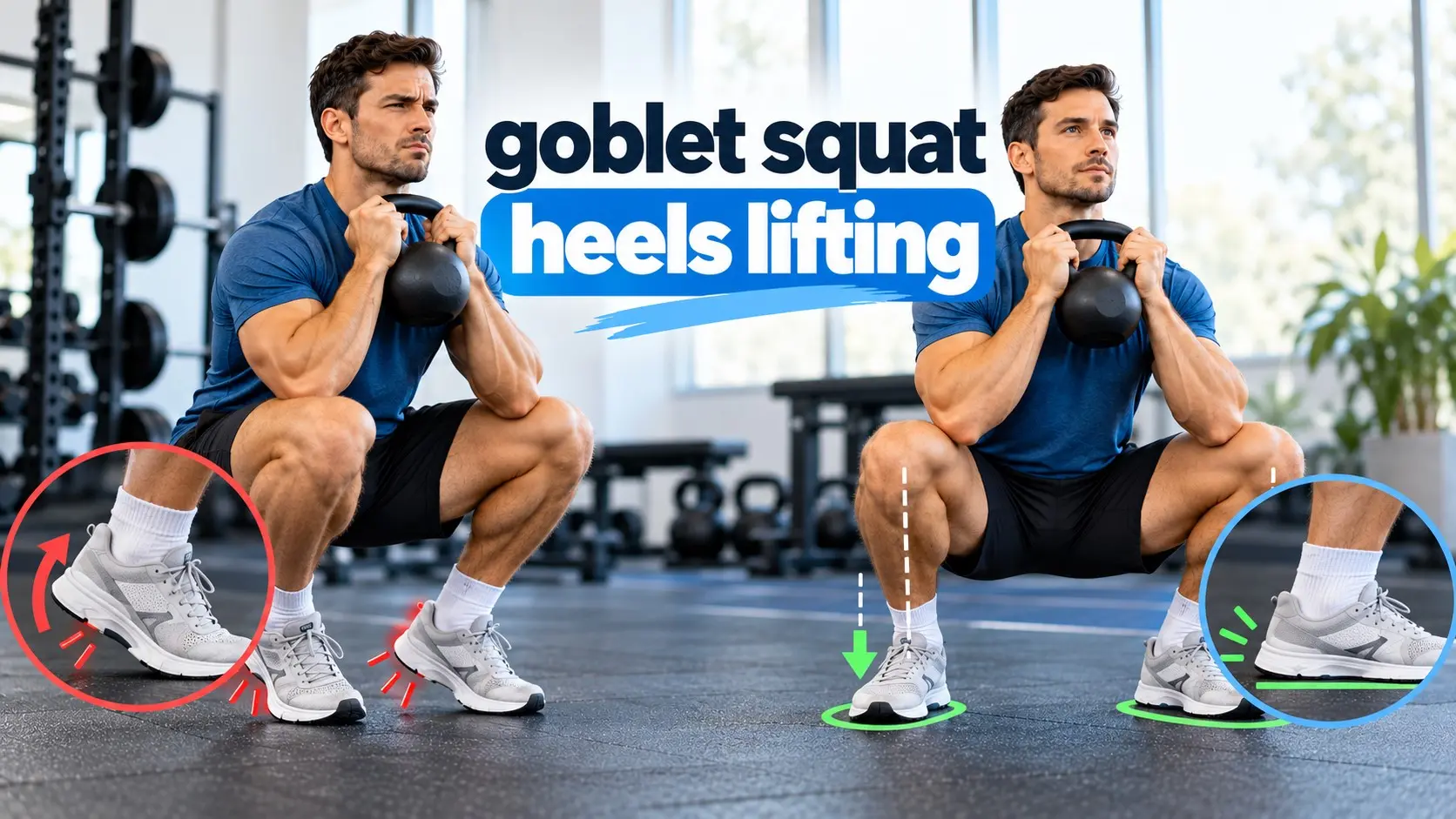
Your heels should not accidentally peel away from the floor every time you reach the bottom of a goblet squat.
But goblet squat heels lifting does not automatically mean your ankles are tight. Limited ankle dorsiflexion is one common cause, but squat depth, stance width, balance, speed, load, and side to side differences can create the same visible problem.
Quick answer: If your heels lift during goblet squats, first reduce the weight and depth. Keep pressure through your whole foot and retest. If the heels still rise, check ankle motion and try a small stance change. A stable heel wedge can reduce ankle demands, but it changes squat mechanics rather than permanently fixing your mobility.
The fix depends on the cause.
That sounds obvious, yet many squat guides jump straight from “your heels lift” to “stretch your calves.” Sometimes that works. Sometimes it completely misses the problem.
If you need the full movement first, read the NextFitLife Goblet Squat Guide. It covers stance, weight position, knee tracking, squat depth, muscles worked, common mistakes, and progression.
Medical notice: This content is for general educational purposes and does not replace professional medical advice, diagnosis, or treatment. Consult an appropriately qualified healthcare professional for personal medical concerns. This article explains published guidance and does not provide a personal clinical assessment. Always consult qualified medical professionals for diagnosis and treatment of any health condition.
Table of Contents
- Accidental heel lift versus heel elevation
- Seven reasons your heels lift
- Ankle dorsiflexion
- Squat depth
- Foot position
- Balance and whole foot pressure
- Load and tempo
- One sided heel lift
- Heel wedges and lifting shoes
- How high to elevate the heels
- Calf stretching and ankle mobility
- Shoes and squat mechanics
- Five minute troubleshooting test
- Common mistakes
- When to seek professional help
- References and Sources
- Related NextFitLife guides
- About the author
- Frequently asked questions
First, Is the Heel Lift Accidental or Intentional?
These are two different situations.
In a normal flat foot goblet squat, your heel stays supported by the floor while your ankle, knee, and hip bend together.
An intentional heel elevated squat starts differently. Your heels are placed on a stable wedge, a lifting shoe, or another secure raised surface before the repetition begins.
That changes the movement on purpose.
A 2026 systematic review and meta analysis of 14 studies found that heel elevation changes squat joint motion. In the pooled results, heel elevation increased ankle and knee range of motion, while the size of the effect changed with heel height.
That means a supported raised heel is a training variable.
An uncontrolled heel peeling off the floor is a movement problem to investigate.
| Heel Position | What It Means | What to Do |
|---|---|---|
| Heel stays flat | Normal flat foot squat | Keep the stable setup |
| Heel rises by accident | Range, stance, load, balance, or control may be limiting you | Find the cause before adding more load |
| Heel starts on a stable wedge | Intentional change in squat mechanics | Use it when the variation fits your goal |
7 Reasons Your Heels Lift During Goblet Squats
1. Your Ankle Does Not Have Enough Dorsiflexion for That Position
This is the most common explanation, and it is worth checking first.
Ankle dorsiflexion is the movement that lets your shin travel forward over your foot while your heel stays down.
As you squat lower, your knees normally move forward and your ankles bend.
If you reach the end of your available ankle range but continue trying to descend, your body needs another way to find the extra movement.
One possible compensation is heel rise.
Research supports the connection between ankle motion and squat depth. A study of 101 healthy adults found ankle dorsiflexion to be one of the factors associated with how deeply people could squat. Hip range and strength variables also mattered, which is why ankle mobility should not be blamed automatically.
A Simple Ankle Check
Use a weight bearing knee to wall movement.
- Face a wall.
- Place one foot flat on the floor.
- Keep the heel down.
- Move the knee toward the wall.
- Gradually move the foot farther back while the heel stays flat.
- Compare the two ankles.
Do not chase one internet distance and call yourself tight if you miss it.
The useful questions are simpler:
- Can the knee travel forward comfortably?
- Can the heel stay down?
- Is one ankle clearly different from the other?
- Does the more restricted side match the side that lifts first during your squat?
If the test causes sharp pain or feels mechanically blocked, do not force it.
2. You Are Squatting Deeper Than Your Current Controlled Range
This is easy to miss because deeper squats are often treated as automatically better.
Imagine your first 80 percent of the descent looks controlled. Then you push a little lower, your heel lifts, and your weight shifts forward.
The simplest explanation may be that you passed your current useful depth.
Try stopping just before the heel begins to rise.
Perform several slow repetitions there.
If the feet stay stable and the movement immediately improves, you have found a range you currently control.
You can work on more depth separately.
This is not failure. Squat depth is a training variable.
Our Goblet Squat Depth Guide explains how ankles, hips, stance, anatomy, and load affect how low you can squat.
3. Your Stance Does Not Fit Your Body
Foot width changes the movement.
A narrow stance can require more forward knee travel and ankle motion to reach the same depth.
A small increase in stance width can sometimes reduce that demand and give the hips more room.
Try moving each foot slightly wider.
Then squat again with the same light weight.
If your heels stay down and the movement feels smoother, the original stance was part of the problem.
Do not jump immediately into an extreme wide stance.
Too much width can create its own hip and knee issues.
Your toe angle matters too. A small outward angle can help the knees and hips move in a comfortable direction.
For a full stance guide, read Goblet Squat Foot Position: Stance Width and Toe Angle.
4. Your Weight Is Moving Onto Your Toes
You can have good ankle mobility and still lift your heels.
Balance matters.
The goblet squat places the dumbbell or kettlebell in front of your body. That front load helps as a counterbalance, but if you hold it too far away from your chest, it can pull you forward.
Your goal is whole foot pressure.
Think about maintaining contact through:
- The heel
- The base of the big toe
- The base of the little toe
This is sometimes called tripod foot contact.
Do not shift so far backward that your toes lift either.
“Stay on your heels” is incomplete advice.
The better target is a stable whole foot.
5. The Goblet Weight Is Too Heavy
This is the least glamorous explanation and one of the easiest to test.
Suppose your heels stay flat during a bodyweight squat.
They also stay flat with a light kettlebell.
Then they begin lifting when the load becomes much heavier.
Your ankles did not suddenly lose mobility.
The task became harder.
A heavier goblet increases the demand on your legs, trunk, grip, upper back, and balance. It also becomes harder to keep the weight close to your body.
Reduce the load and retest.
If the problem disappears, keep training the version you can control.
Progressive overload works best when form stays repeatable.
6. You Are Dropping Into the Bottom Too Fast
Speed can hide the point where control disappears.
Try a slow descent.
Lower for about three seconds while keeping the load close.
Notice the exact moment your heel begins to move.
A slower repetition can show whether:
- The ankle reaches its available range
- Your weight suddenly shifts forward
- Your stance stops working at deeper flexion
- Your feet stay flat until fatigue begins
Slow training is not required forever.
It is useful when you are trying to understand a movement problem.
7. One Side Has a Different Range or Control Strategy
If only one heel lifts, treat that as useful information.
Human bodies are not perfectly symmetrical.
One ankle can have less dorsiflexion, especially after a past sprain, fracture, long period of immobilization, or other injury.
One foot may also rotate more, or your pelvis may shift toward one side as you descend.
Compare both ankles with the same weight bearing test.
Then film the squat from the front.
Look for:
- One heel rising first
- One foot turning outward more
- Your hips shifting sideways
- One knee taking a different path
A small difference does not require panic.
A large, painful, or worsening difference deserves more careful assessment.
Seven Causes and Fixes at a Glance
| What You Notice | Test First | Simple Fix |
|---|---|---|
| Heels rise only near the bottom | Squat depth and ankle range | Stop slightly higher and rebuild range |
| A wedge fixes the problem immediately | Ankle demand | Use a small stable elevation when appropriate and assess ankle motion |
| A wider stance keeps heels down | Foot position | Use the comfortable wider stance |
| Heels lift only with heavy weight | Load and control | Reduce the weight |
| Heels lift on fast reps | Balance and tempo | Slow the descent |
| Weight drifts away from chest | Center of mass and load position | Keep the weight close |
| Only one heel rises | Side to side ankle range and movement | Compare both ankles and check for shifting |
How to Fix Goblet Squat Heel Lift in Five Minutes
Before you commit to weeks of stretching, run this quick test.
Step 1: Remove Most of the Weight
Perform three slow bodyweight squats.
Do your heels stay down?
If yes, add a light goblet weight and repeat.
If the heel only rises under heavier loading, load is part of the problem.
Step 2: Reduce the Depth
Stop before the heel starts rising.
Perform several clean repetitions there.
If the problem disappears, you have found your current stable range.
Step 3: Change Stance Width Slightly
Move each foot outward a small amount.
Keep your toes at a comfortable angle and repeat.
If the movement improves, foot position was contributing.
Step 4: Test a Small Heel Elevation
Use a stable squat wedge or appropriate lifting shoe.
Do not balance on loose plates, books, or unstable objects.
If a small elevation clearly improves balance and depth, ankle demand is probably one part of the picture.
Step 5: Compare Both Ankles
Perform the same knee to wall movement on both sides.
You are looking for a clear difference, not trying to win a flexibility test.
Now you have information.
That is better than guessing.
Does a Heel Wedge Fix Ankle Mobility?
No.
A heel wedge changes the squat so your body can perform the movement with different joint demands.
That can be useful.
It is not the same as increasing your ankle's available range.
A 2026 systematic review and meta analysis included 14 studies with 177 participants. Heel elevation changed both ankle and knee range of motion during squatting.
The review also found a dose response pattern at the ankle, meaning the size of the heel elevation affected the mechanical change.
So a wedge is best viewed as a tool.
Use it because you want the mechanics it creates, not because you believe it repaired the ankle.
Is a Heel Elevated Goblet Squat Cheating?
No.
Weightlifting shoes use an elevated heel by design.
A stable heel wedge does the same basic job: it changes the relationship between your foot, ankle, shin, knee, and torso.
Heel elevation can allow more knee flexion and a more upright torso while reducing the ankle dorsiflexion required in some parts of the movement.
That can be useful for:
- People with limited ankle dorsiflexion
- Squat technique practice
- Deeper squat training
- Quadriceps focused squat variations
It is a variation, not a shortcut.
How High Should You Elevate Your Heels?
Use the smallest elevation that gives you the change you need.
There is no universal best wedge height.
This matters because newer research shows a dose response.
A 2026 study tested 30 healthy men with restricted ankle dorsiflexion while they performed loaded squats using heel elevations of 0, 1, 2, 3, 4, and 5 centimeters.
As heel height increased, required ankle dorsiflexion and forward trunk lean decreased.
At the same time, knee flexion and peak knee moment increased.
In simple terms:
More heel height changes more than the ankle.
It also changes how much work the knee and quadriceps need to manage.
If a small wedge solves the problem, there is no reason to keep raising your heels higher.
Does Heel Elevation Increase Knee Stress?
It can increase knee demand.
Heel elevation usually makes it easier for the knees to move forward and flex farther.
The 2024 squat biomechanics review explains that greater forward shin inclination increases the knee flexion moment and therefore the demand placed on the quadriceps.
The 2026 graded heel study also found higher peak knee moment as heel elevation increased.
That does not make heel elevated squats dangerous.
It means you should choose the variation based on your goal and symptoms.
If you already have knee pain, read our Goblet Squat Knee Pain Guide before assuming a larger wedge is automatically safer.
Should You Stretch Your Calves?
Maybe.
If calf or ankle restriction is genuinely limiting dorsiflexion, mobility work can make sense.
But ankle motion can be limited by several factors, including:
- Calf muscle stiffness
- Joint restrictions
- Previous ankle injury
- Swelling
- Strength and control
- Individual anatomy
That is why “stretch your calves” is not a complete diagnosis.
A Simple Ankle Mobility Drill
Use a controlled knee over toe movement with the heel planted.
- Stand in a split stance near a wall.
- Keep the front heel flat.
- Move the front knee forward in line with the toes.
- Stop before the heel rises or the ankle becomes painful.
- Return and repeat slowly.
This gives the ankle practice in the direction it needs during a squat.
Do not force the joint into a sharp block.
Will Better Ankle Mobility Guarantee That Your Heels Stay Down?
No.
A squat uses the ankle, knee, hip, trunk, feet, and balance system together.
You can improve ankle dorsiflexion and still lift your heels if you:
- Use too much weight
- Lose balance forward
- Squat deeper than you control
- Use a stance that does not suit you
- Let the weight drift away from your chest
- Drop into the bottom too fast
This is why you should retest the full movement after mobility work.
A better ankle measurement is useful only if it improves the task you care about.
What if Your Heels Lift Only Below Parallel?
That is a common pattern.
Going deeper usually requires more movement at the ankles, knees, and hips.
If your heel remains flat until you pass parallel, you have several reasonable options.
You can:
- Train at your current stable depth
- Work gradually on more ankle range
- Adjust your stance
- Use a stable heel elevation for deeper squat training
You do not need to label your current squat broken because it stops slightly higher.
Depth should serve the training goal.
What if Your Heels Lift Only With a Narrow Stance?
Try moving your feet slightly wider.
A narrow stance can require more ankle motion for the same squat depth.
If a small increase in width keeps your heels down while your hips and knees remain comfortable, that may simply be a better stance for your body.
Do not assume narrow stance equals better form.
Our Goblet Squat Foot Position Guide explains how stance width and toe angle affect the squat.
What if Your Heels Lift Even in a Shallow Bodyweight Squat?
Now the ankle and balance deserve a closer look.
Try holding a stable support while performing a shallow squat.
If your heels stay down with support but rise without it, balance or movement control may be contributing.
If the heel still rises during a shallow supported squat, limited ankle motion becomes a stronger possibility.
This still does not tell you exactly why the ankle is restricted.
Persistent pain or a hard mechanical block should be assessed.
Can Your Shoes Cause Heel Lifting?
Shoes change the surface under your feet.
A soft running shoe can feel unstable during loaded squats because the sole compresses.
Flat shoes provide little or no built in heel elevation.
Weightlifting shoes provide a stable raised heel on purpose.
Switching from one shoe to another can therefore change how your squat feels.
That does not mean everyone needs lifting shoes.
Use stable footwear that suits your training environment and the squat variation you choose.
Should You Squat Barefoot?
Barefoot squatting removes the support and heel elevation built into some shoes.
For someone with enough ankle mobility and a suitable training surface, that can feel stable.
For someone who depends on heel elevation to reach a comfortable depth, barefoot squatting may make the limitation more obvious.
Neither option is automatically superior.
The best choice depends on the movement you are trying to perform.
Should You Sit Back More to Keep the Heels Down?
A little more hip movement can reduce how far the knees travel forward.
That reduces ankle demand.
But exaggerating “sit back” can turn the squat into something closer to a hip hinge.
Your torso then leans farther forward while your shins stay unusually upright.
A goblet squat should involve both the hips and knees.
Do not solve one problem by creating another.
Should You Push Only Through the Heels?
No.
This cue is often misunderstood.
If you shift all pressure backward, the front of your foot may come off the floor.
You want whole foot pressure.
Keep your heel and forefoot connected while you descend and stand.
Your foot gives you a large stable base. Use all of it.
Can Fatigue Make Your Heels Lift?
Yes.
Your first five repetitions may look clean while later repetitions drift forward.
That can happen because the legs, trunk, grip, or upper back are tiring.
The final clean repetition is a better stopping point than waiting until the movement breaks down completely.
If heel lift appears only near the end of hard sets, reduce the number of repetitions or the load and see whether the problem disappears.
Is Accidental Heel Lift Dangerous?
Heel rise does not automatically mean you are injured.
It does mean your movement has changed from the flat foot squat you intended to perform.
That changes balance and joint mechanics.
If the heel rises because you are forcing depth, weight, or speed, there is little benefit in repeating the mistake.
Adjust the cause or use an intentional heel elevated squat instead.
When Should You Get Your Ankle Checked?
Consider professional assessment if:
- The ankle is painful
- It remains swollen
- Motion dropped sharply after an injury
- You cannot bear weight normally
- The difference between sides is large and persistent
- The ankle locks or gives way
- The heel lift keeps worsening despite sensible changes
Do not repeatedly force mobility drills into sharp pain.
What Most Advice About Goblet Squat Heels Lifting Gets Wrong
“Heel Lift Always Means Tight Ankles”
No.
Ankle dorsiflexion is important, but depth, stance, balance, speed, load, and control can create the same problem.
“Just Stretch Your Calves”
This helps only when the restriction actually responds to calf stretching.
Not every ankle limitation comes from the calf muscles.
“Never Squat With Your Heels Elevated”
False.
Intentional heel elevation is a legitimate squat variation and is built into weightlifting shoes.
“A Heel Wedge Fixes Your Mobility”
It changes the movement while you are using it.
It does not prove your ankle range increased.
“Use the Highest Wedge You Can”
No.
New 2026 research shows that increasing heel height progressively changes the kinetic chain and can increase knee demand.
Use the smallest elevation that fits your purpose.
“Drive Only Through Your Heels”
Use your whole foot.
The forefoot belongs on the floor too.
“More Squat Depth Is Always Better”
Depth is useful only when you can control it.
A stable squat to your current range is better than forcing a deeper rep that puts you onto your toes.
Conclusion
If you notice goblet squat heels lifting, do not assume the answer is endless calf stretching.
First reduce the load and depth, slow the repetition, keep the weight close to your chest, and test a small stance change. Then compare your ankle motion.
If a low, stable heel wedge gives you a cleaner squat, use it when it matches your training goal, but remember what it does: it changes the squat mechanics rather than instantly changing your ankle mobility.
Your next step is simple. Film three light repetitions from the side, find the exact point where the heel begins to rise, change one variable, and test again.
References and Sources
The ankle mobility, heel elevation, squat depth, and biomechanics sections were checked against current peer reviewed research and recognized exercise guidance.
- Ghasemi M, Emami M, Mohammadi Yaghoubi U.
Heel Elevation Increases Ankle and Knee Range of Motion During Squatting in Healthy Adults: A Systematic Review With Meta Analysis.
Sports Biomechanics, 2026.
Used for current evidence on how heel elevation changes ankle and knee range of motion and how effects vary with heel height.
URL:
https://pubmed.ncbi.nlm.nih.gov/41612762/
- Cai J, Sun D, Li F, et al.
Dose Dependent Effects of Heel Elevation on Kinetic Chain Reconstruction and Lumbar Stress During Loaded Squatting in Men With Restricted Ankle Dorsiflexion.
Journal of Strength and Conditioning Research, 2026.
Used for the effects of 0 to 5 cm heel elevation on ankle dorsiflexion, knee flexion, trunk position, and knee moment.
URL:
https://pubmed.ncbi.nlm.nih.gov/42551866/
- Kim SH, Kwon OY, Park KN, Jeon IC, Weon JH.
Lower Extremity Strength and the Range of Motion in Relation to Squat Depth.
Journal of Human Kinetics, 2015.
Used for the relationship between ankle dorsiflexion, hip motion, strength, and squat depth in 101 healthy adults.
URL:
https://pmc.ncbi.nlm.nih.gov/articles/PMC4415844/
- Straub RK, Powers CM.
A Biomechanical Review of the Squat Exercise: Implications for Clinical Practice.
International Journal of Sports Physical Therapy, 2024.
Used for ankle, shin, knee, stance, depth, heel elevation, and joint loading principles during squatting.
URL:
https://pmc.ncbi.nlm.nih.gov/articles/PMC10987311/
- National Academy of Sports Medicine.
The Goblet Squat: A Trainer's Coaching and Programming Guide.
Updated August 2026.
Used for current goblet squat setup, controlled depth, foot stability, load selection, and common movement faults.
URL:
https://www.nasm.org/resource-center/blog/training/how-to-perform-goblet-squats
Continue With NextFitLife Goblet Squat Guides
This article focuses on heel lift. Use the parent article for the full movement, then explore the supporting guides for depth, stance, and knee symptoms.
Goblet Squat Cluster
- Goblet Squat: Complete Form, Muscles, Mistakes, and Progression Guide
- Goblet Squat Depth: How Low Should You Squat?
- Goblet Squat Foot Position: Stance Width and Toe Angle
- Goblet Squat Knee Pain: Causes, Form, and Safer Options
Lower Body Training
- Leg Exercises With Dumbbells: Lower Body Strength Guide
- Hamstring Exercises for Strength and Flexibility
Fitness Hub
About the Author
Adel Galal is the founder and lead writer of NextFitLife. He researches and writes educational content about fitness, exercise, health, nutrition, wellness, and healthy aging.
His approach is to compare common gym advice with current research, separate useful coaching cues from rigid rules, and explain movement problems in a way readers can test rather than simply accept.
With squat problems such as heel lift, this means checking the whole movement before blaming one joint. Ankle mobility matters, but so do depth, stance, load, balance, tempo, and the position of the weight.
Adel is not a physician, physical therapist, certified personal trainer, or other licensed healthcare professional.
This content is for general educational purposes and does not replace professional medical advice, diagnosis, or treatment. Consult an appropriately qualified healthcare professional for personal medical concerns. This article explains published guidance and does not provide a personal clinical assessment. Always consult qualified medical professionals for diagnosis and treatment of any health condition.
Learn more about Adel Galal, NextFitLife, and the site's editorial approach on the NextFitLife About Us page.
Frequently Asked Questions About Goblet Squat Heels Lifting
Why do my heels lift during goblet squats?
Common reasons include limited ankle dorsiflexion, squatting deeper than your current range, stance width, losing balance toward the toes, using too much weight, moving too quickly, or a side to side mobility difference.
Does heel lifting always mean tight ankles?
No. Limited ankle dorsiflexion is one possible cause, but squat depth, stance, balance, load, speed, and movement control can also make the heels rise.
Should my heels stay down during a normal goblet squat?
Yes. In a standard flat foot goblet squat, the heels and forefoot should remain supported on the floor. An intentionally heel elevated squat is a different variation.
How can I stop my heels lifting when I squat?
Start by reducing the weight and depth, slowing the descent, keeping the load close to your chest, and testing a small stance change. Then assess whether ankle motion is limiting you.
Does ankle dorsiflexion affect squat depth?
Yes. Research has found a relationship between available ankle dorsiflexion and squat depth, although hip motion, strength, balance, and other factors also influence how deeply you squat.
How do I check ankle mobility for squats?
A simple weight bearing knee to wall movement can compare ankle dorsiflexion between sides. Keep the heel planted as the knee moves forward and compare how each ankle feels and moves.
Should I stretch my calves if my heels lift?
Calf mobility work may help if calf stiffness contributes to limited dorsiflexion, but heel lift does not prove the calf muscles are the cause.
Is a heel elevated goblet squat bad?
No. Heel elevation is a legitimate squat variation. It changes ankle, knee, and trunk mechanics and can make deeper or more upright squatting easier for some people.
Does a heel wedge fix ankle mobility?
No. A wedge changes the ankle range required during the squat while you are using it. It does not prove that your ankle's actual mobility has increased.
How high should my heel wedge be?
There is no universal ideal height. Use the smallest stable elevation that gives you the mechanical change you need. Higher elevations create larger changes and can increase knee demand.
Do weightlifting shoes help with ankle mobility?
Weightlifting shoes do not increase your ankle's true range of motion. Their raised heel changes squat mechanics so less ankle dorsiflexion may be required for a given position.
Why do my heels lift only in deep squats?
Deeper squats usually require more motion from the ankles, knees, and hips. If the heels rise only after a certain depth, that may be beyond your current controlled range.
Why do my heels lift only with heavy goblet squats?
If light squats are stable but heavy squats cause heel rise, load and movement control are likely contributing. Reduce the weight and rebuild gradually.
Why does only one heel lift during squats?
One sided heel lift can be related to differences in ankle range, previous injury, foot position, balance, or a body shift. Compare both sides and seek assessment if the difference is large, painful, or persistent.
Should I use a wider stance if my heels lift?
A slightly wider stance can reduce ankle demands for some people and give the hips more room. Use it only if the new position remains comfortable and stable.
Should I push through my heels during goblet squats?
Use your whole foot rather than shifting all pressure onto the heels. Keep the heel, base of the big toe, and base of the little toe connected to the floor.
Can shoes cause my heels to lift?
Footwear can change squat stability and heel height. Soft running shoes, flat shoes, and weightlifting shoes all create different squat conditions.
When should I get my ankle checked?
Seek professional assessment if the ankle is painful, swollen, unstable, sharply restricted after an injury, unable to bear weight normally, or remains very different from the other side despite sensible training changes.

Health & wellness writer with 30+ years of experience in nutrition, fitness, and healthy aging. Founder of NextFitLife.com — evidence-based health guidance.