First published: September 29, 2026
Last updated: September 29, 2026
Written and source checked by: Adel Galal, Founder and Lead Writer at NextFitLife
Medical review status: This article has not been medically reviewed by a doctor, physical therapist, sports medicine specialist, or certified strength professional.
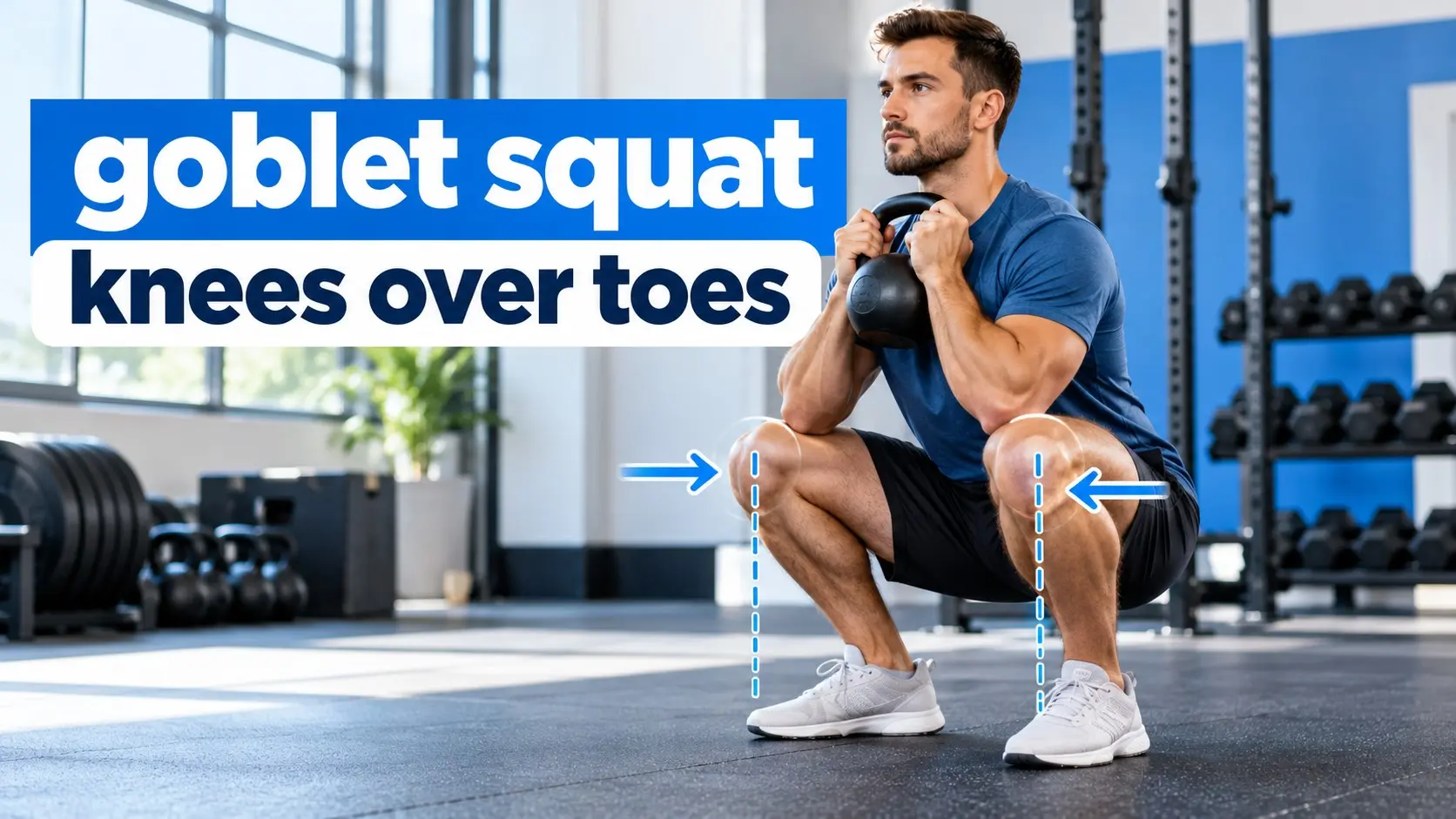
Yes, your knees can move past your toes during a goblet squat.
For a healthy knee, goblet squat knees over toes positioning is not automatically dangerous. Forward knee movement is a normal part of many squats, especially as you go deeper. What matters more is control, comfort, foot stability, squat depth, and whether the load fits your current ability.
Quick answer: Your knees can safely move beyond your toes during goblet squats if the motion is controlled and comfortable. More forward knee travel increases knee demand, while restricting the knees shifts more demand toward the hips and trunk. Healthy knees do not need a strict toes barrier, but painful or recently injured knees may need a shorter range.
The old rule sounds simple: never let your knees pass your toes.
The body is not that simple.
Current orthopedic guidance from Hartford HealthCare says some forward knee travel is normal. Their 2026 guidance focuses instead on control, comfort, alignment, and whether the movement fits the person's knee.
If you need the full exercise first, read the NextFitLife Goblet Squat Guide. This article focuses only on the knees over toes question.
Medical notice: This content is for general educational purposes and does not replace professional medical advice, diagnosis, or treatment. Consult an appropriately qualified healthcare professional for personal medical concerns. This article explains published guidance and does not provide a personal clinical assessment. Always consult qualified medical professionals for diagnosis and treatment of any health condition.
Table of Contents
- Where the knees behind toes rule came from
- Eight smart safety rules
- Forward knee travel versus knee collapse
- Whole foot pressure
- Ankle mobility
- Squat depth
- Knee demand and hip demand
- Healthy knees versus painful knees
- Heel elevated squats
- Patellofemoral pain
- Arthritis and recent injury
- Common myths
- References and Sources
- Related NextFitLife guides
- About the author
- Frequently asked questions
Where Did the “Never Let Your Knees Pass Your Toes” Rule Come From?
The old rule was not invented from nothing.
Moving the knees farther forward increases some demands around the knee. Coaches therefore used “keep your knees behind your toes” as a simple way to reduce knee loading.
The problem came when that cue became a universal safety law.
A well known 2003 study by Fry, Smith, and Schilling compared two parallel barbell squat styles in seven trained men.
In one version, the knees could travel forward naturally.
In the other, a barrier prevented them from moving beyond the toes.
Restricting the knees reduced knee torque, but it greatly increased hip torque and changed the trunk position.
The lesson is simple:
Reducing load at one joint can move more demand somewhere else.
That study was small and used barbell squats, not goblet squats. It should not be treated as the final answer by itself.
Still, the principle matches newer squat biomechanics research.
8 Smart Safety Rules for Goblet Squat Knees Over Toes
1. Let Your Knees Move Naturally
Do not freeze your shins in place.
During a goblet squat, your hips and knees bend together. As you descend, some forward knee travel is normal.
How far the knees move depends on:
- Your squat depth
- Your ankle dorsiflexion
- Your leg proportions
- Your stance width
- Your heel height
- Your training goal
A deeper squat usually needs more knee flexion and more forward shin movement.
That is not automatically a form error.
2. Do Not Confuse Forward Knee Travel With Knee Collapse
These are different problems.
Knees over toes describes how far the knee moves forward when viewed from the side.
Knee tracking describes the direction the knee moves relative to the foot when viewed from the front.
Your knees can travel well past the toes while still tracking comfortably.
A useful cue is:
Let your knees move in roughly the same direction as your toes.
Do not force them outward as far as possible.
And do not let them suddenly collapse inward under a load you cannot control.
For a deeper stance discussion, see the Goblet Squat Foot Position Guide.
3. Keep Your Whole Foot Stable
Forward knee movement works best when your foot stays connected to the floor.
Think about whole foot pressure through:
- The heel
- The base of the big toe
- The base of the little toe
Your knees moving forward does not mean you should roll onto your toes.
If your heels lift as the knees move forward, the problem may involve ankle range, excessive depth, stance, balance, or load.
Read the Goblet Squat Heels Lifting Guide if that is happening.
4. Give Your Ankles Enough Room to Move
The shin cannot move far forward while the heel stays down unless the ankle has enough ankle dorsiflexion.
This is one reason two people can show very different knee positions even when both squat well.
A person with more ankle range can often move the knee farther forward while keeping the heel planted.
A person with less ankle range may:
- Stop at a shallower depth
- Lift the heel
- Use a wider stance
- Lean the torso farther forward
- Use heel elevation
Those are different movement strategies.
They do not automatically mean one person's knees are safer than another's.
5. Understand That More Knee Travel Means More Knee Demand
This is the part that gets lost in social media arguments.
Forward shin movement increases the knee flexion moment. That means your quadriceps must work harder to control and reverse the movement.
In simple terms, more forward knee travel can create greater knee extensor demand and quadriceps demand.
That is not automatically bad.
Training works because muscles and other tissues adapt to appropriate load.
The better question is:
Is this amount of joint loading appropriate for this knee today?
6. Do Not Force Maximum Knee Travel
Knees over toes is not a contest.
You do not need to push your knees as far forward as possible to prove that your squat is advanced.
A normal goblet squat should share movement across the ankles, knees, hips, and trunk.
If you deliberately push the knees very far forward while keeping the torso highly upright, you create a more knee focused squat.
That can be useful for a specific training goal.
It is not required for ordinary goblet squats.
7. Match Knee Travel to Your Squat Depth
Your knees may remain behind your toes in a shallow squat and pass them naturally as you squat deeper.
The toe line by itself does not tell you whether one rep is safer than another.
A 2024 review examined 15 studies on deep squatting and knee joint health.
Fourteen did not find harmful effects on knee health.
The authors concluded that deep squat training appears safe for knee joint health when technique and loading are appropriate.
This does not mean maximum depth is needed.
Use the range you can control without sharp pain or major loss of position.
For more detail, see Goblet Squat Depth: How Low Should You Squat?.
8. Use Different Rules for a Painful Knee
A healthy knee and an irritable knee are not the same situation.
If the knee hurts, the question becomes:
How much forward knee movement and knee flexion can this knee tolerate right now?
Someone with patellofemoral pain can be more sensitive to loaded knee flexion.
Current 2024 best practice guidance for patellofemoral pain recommends education plus individualized knee targeted exercise, with hip exercise and other treatments added according to the person's needs.
This may mean temporarily reducing:
- Squat depth
- External load
- Forward knee travel
- Total training volume
That is load management.
It is not proof that forward knee movement is bad for everybody.
If you already have pain, read our Goblet Squat Knee Pain Guide.
Knees Behind Toes Versus Knees Over Toes
| Position | What Usually Changes | When It May Be Useful | Main Consideration |
|---|---|---|---|
| Knees held farther back | Less forward tibial inclination and usually less knee extensor demand | Temporarily reducing knee demand | More demand shifts toward the hips and trunk |
| Natural forward travel | Balanced knee and hip contribution for many lifters | General goblet squat training | Needs adequate ankle range and control |
| Large forward travel | More knee flexion and greater quadriceps demand | Intentional knee focused training | May be harder for an irritable knee |
| Forced maximum travel | Exaggerates knee dominant mechanics | Specific advanced variations only | Not required for a standard goblet squat |
This table is not a ranking from safe to dangerous.
It shows how movement choices change where the work goes.
Does Keeping Your Knees Behind Your Toes Protect Them?
It reduces some knee demand.
That does not make the whole movement free from stress.
In the 2003 Fry study, preventing the knees from moving past the toes reduced knee torque but greatly increased hip torque.
The restricted version also changed the trunk position.
This is why simple body part rules are misleading.
Changing one part of a squat changes the rest of the squat too.
Why Do Goblet Squats Encourage More Forward Knee Travel?
The weight sits in front of your chest.
That front load acts as a counterbalance.
NASM's updated August 2026 coaching guide explains that this allows many people to stay more upright and squat deeper than they can during an unloaded or back loaded squat.
An upright torso usually makes more forward knee travel possible.
So your goblet squat may naturally show more knee movement than another squat style.
That is not automatically bad form.
How Far Past the Toes Is Safe?
There is no useful universal distance.
Five centimeters does not automatically mean safe.
Ten centimeters does not automatically mean dangerous.
The visible distance depends on:
- Foot length
- Shin length
- Femur length
- Ankle mobility
- Squat depth
- Heel height
- Stance width
A person with long legs and smaller feet may appear to have dramatic knee travel during a normal squat.
Another person can have similar joint angles while barely crossing the toe line.
Do not measure knee safety with a vertical line drawn from the front of the shoe.
Does Body Shape Change Knee Travel?
Yes.
Body proportions change how you balance during a squat.
A person with longer femurs may need a different mix of torso lean and knee movement than someone with shorter femurs.
Available ankle motion changes the picture again.
This is why copying someone else's squat from a photo is not very useful.
Your squat needs to fit your body.
Do the Knees Need to Pass the Toes in a Deep Goblet Squat?
Not in every person, but it is common.
As you squat deeper, your knees usually bend more and move farther forward to keep your body balanced over the feet.
If you force the knees backward, the hips often move farther behind you and the torso leans more.
Both are valid squat strategies when used on purpose.
Neither is automatically safer for everybody.
Does Knees Over Toes Training Build the Quads?
Greater forward shin movement tends to increase the knee flexion moment.
That means the quadriceps must work harder to control and extend the knee.
So greater forward travel can increase quadriceps demand.
Do not turn that into another extreme rule.
You do not need maximum forward knee travel to build your quads.
Muscle growth still depends on meaningful resistance, effort, enough training volume, recovery, and gradual progression.
What Happens in a Heel Elevated Goblet Squat?
Raising the heels changes the squat.
A heel wedge reduces some of the ankle dorsiflexion needed and usually allows the knees to move forward more easily.
This can produce:
- More knee flexion
- A more upright torso
- Greater knee extensor demand
That is one reason heel elevated squats are often used for quadriceps focused training.
If forward knee travel already causes symptoms, though, heel elevation is not automatically a safer choice.
Test the response rather than assuming the modification is good or bad.
Are Knees Over Toes Bad if You Have Patellofemoral Pain?
Not as a permanent rule, but an irritable knee may need less demand at first.
Patellofemoral pain commonly becomes more noticeable during tasks that load a bent knee.
Current best practice does not tell people to avoid all knee flexion forever.
It recommends education, knee targeted exercise, and individualized treatment based on symptoms and function.
A shallower squat or reduced forward travel may therefore be useful during a sensitive phase.
Then the range can be rebuilt as tolerance improves.
What if You Have Knee Arthritis?
Arthritis changes the question.
Some people with knee arthritis squat comfortably, while others need less depth or load.
There is no universal knees over toes rule for arthritis.
Use a range that is comfortable and repeatable.
If pain, swelling, stiffness, or function is limiting exercise, individualized professional guidance is more useful than forcing one squat technique.
What if You Recently Had Knee Surgery?
Follow your rehabilitation plan.
A general fitness article cannot safely choose your knee angle, squat depth, load, or progression after surgery.
For example, rehabilitation after ACL reconstruction changes over time, and squat prescription depends on surgical stage, strength, symptoms, and clinician goals.
Do not use “knees over toes is safe” as permission to skip your rehabilitation restrictions.
What if Your Knees Pass Your Toes and Your Heels Lift?
The toe line is probably not the main problem.
Your ankle may not have enough available dorsiflexion for that stance and depth, or you may be losing balance forward.
Try:
- Less depth
- A small stance adjustment
- Less weight
- A slower descent
- A stable heel elevation when appropriate
Then test again.
See the Goblet Squat Heels Lifting Guide for a full troubleshooting process.
What if Knees Over Toes Feels Completely Fine?
If you have no relevant injury, the movement feels controlled, your feet stay stable, and symptoms do not worsen afterward, there is no evidence based reason to pull your knees backward just because of the old toes rule.
Hartford HealthCare's June 2026 orthopedic guidance makes this point clearly: forward knee travel is not automatically harmful, while pain, control, alignment, and the person's knee history matter.
Train the movement you can control.
What if It Hurts Only When the Knees Move Far Forward?
Reduce the forward travel for now.
You can also reduce squat depth or external load.
A slightly wider stance or a little more torso inclination may shift more demand toward the hips.
That is useful load management.
It does not prove that the toe line itself caused your pain.
If the symptom keeps returning, read the Goblet Squat Knee Pain Guide and consider appropriate assessment.
Should Beginners Let Their Knees Pass Their Toes?
Beginners should learn a natural squat rather than a special knees over toes technique.
Use a light load.
Keep the weight close to the chest, bend the hips and knees together, and allow natural forward knee movement.
The whole foot should remain stable.
There is no reason to teach a beginner that the toes create an invisible wall.
There is also no reason to make maximum forward travel the goal.
Should Older Adults Let Their Knees Pass Their Toes?
Age alone does not decide the answer.
Forward knee movement occurs during many daily tasks, including stairs and standing from a chair.
The useful range depends on the person's strength, balance, pain, joint health, and movement history.
A box squat may be a good starting point for someone who needs more support.
Another older adult may already perform deep goblet squats comfortably.
Train the person, not the age.
Five Signs You Should Reduce Knee Travel
- Sharp knee pain appears as the knee moves forward.
- Your heel lifts uncontrollably.
- The knee repeatedly gives way.
- You lose balance and fall onto the toes.
- Symptoms become worse during or after training.
These signs do not prove that forward knee travel caused an injury.
They tell you the current version is not working well.
Five Signs Your Current Knee Position Is Working Well
- Your whole foot stays stable.
- Your knees track comfortably with your toes.
- You control the lowering and standing phases.
- The range feels comfortable.
- Your symptoms do not worsen afterward.
This is a more useful checklist than drawing a line from your shoes.
The Old Rule Versus the Better Rule
Old rule:
Never let your knees pass your toes.
Better rule:
Let your knees travel as needed for the squat while your feet stay stable, the motion stays controlled, and the load fits your current knee tolerance.
It is less catchy.
It is much closer to how the body actually moves.
What Most Knees Over Toes Advice Gets Wrong
“Knees Past Toes Will Damage Your Knees”
Current evidence does not support that as a universal rule.
“Knees Over Toes Is Completely Safe for Everybody”
Also too broad.
Greater forward knee travel raises knee demand, which matters if the knee is painful, swollen, recently injured, or recovering from surgery.
“More Forward Travel Is Always Better”
No.
It changes joint loading and increases knee extensor demand. Use that change because it fits your goal, not because more is automatically better.
“Vertical Shins Are the Safest Squat”
Keeping the shins more vertical shifts more demand toward the hips and trunk.
Stress is redistributed rather than removed.
“If the Knee Passes the Toe, Form Is Wrong”
Body proportions, ankle motion, stance, heel height, and depth all change where the knee appears relative to the foot.
“Knees Over Toes Fixes Knee Pain”
No single position treats every knee condition.
Progressive loading should match the actual diagnosis and current tolerance.
“Deep Squats Ruin Healthy Knees”
A 2024 review found no negative effect on knee joint health in 14 of the 15 included deep squat studies when appropriate technique and loading were used.
Conclusion
For a normal goblet squat knees over toes position, let your knees move forward naturally instead of treating the toes as a hard barrier.
Keep your whole foot planted, let the knees follow the toes, and use a depth and weight you can control. If the movement feels good, there is no need to pull your knees backward because of an old gym rule.
If forward knee travel causes pain, reduce the depth or load instead of forcing it. Your next step is to film a light set from the side and check foot stability, knee travel, depth, and comfort together.
References and Sources
The knee travel, squat mechanics, deep squat safety, and knee pain sections were checked against current orthopedic guidance and peer reviewed evidence.
- Hartford HealthCare, Bone & Joint Institute.
Should Your Knees Go Past Your Toes When You Squat?
Published June 15, 2026.
Used for current orthopedic guidance on normal forward knee movement, pain, alignment, and when exercise should be modified.
Access: Hartford HealthCare public patient education resource. - Fry AC, Smith JC, Schilling BK.
Effect of Knee Position on Hip and Knee Torques During the Barbell Squat.
Journal of Strength and Conditioning Research, 2003.
Used for the classic comparison of restricted and unrestricted forward knee travel and the redistribution of torque between the knee and hip.
Access: PubMed PMID 14636100. - Straub RK, Powers CM.
A Biomechanical Review of the Squat Exercise: Implications for Clinical Practice.
International Journal of Sports Physical Therapy, 2024.
Used for tibial inclination, knee and hip moments, squat depth, joint loading, and clinical squat modifications.
Access: Open access article, PMCID PMC10987311. - Rojas Jaramillo A, et al.
Impact of the Deep Squat on Articular Knee Joint Structures, Friend or Enemy? A Scoping Review.
Frontiers in Sports and Active Living, 2024.
Used for current evidence on deep squat exposure and knee joint health. Fourteen of the fifteen included studies reported no negative effect on knee joint health.
Access: PubMed PMID 39640505 and open access PMCID PMC11618833. - Neal BS, Lack SD, Bartholomew C, Morrissey D.
Best Practice Guide for Patellofemoral Pain Based on Synthesis of a Systematic Review, the Patient Voice and Expert Clinical Reasoning.
British Journal of Sports Medicine, 2024.
Used for current patellofemoral pain management, education, individualized knee exercise, hip exercise, and symptom guided treatment.
Access: British Journal of Sports Medicine free article. - National Academy of Sports Medicine.
The Goblet Squat: A Trainer's Coaching and Programming Guide.
Updated August 2026.
Used for current goblet squat setup, front load mechanics, upright posture, depth, and knee tracking guidance.
Access: NASM public education resource.
Continue With NextFitLife Goblet Squat Guides
This article answers one specific question about forward knee travel. Use the parent guide for the complete exercise and the supporting articles below when depth, stance, heel lift, or knee pain is the bigger issue.
Parent Goblet Squat Guide
Goblet Squat Technique Cluster
- Goblet Squat Depth: How Low Should You Squat?
- Goblet Squat Foot Position: Stance Width and Toe Angle
- Goblet Squat Heels Lifting: Reasons and Fixes
- Goblet Squat Knee Pain: Causes, Form, and Safer Options
Lower Body Training
- Leg Exercises With Dumbbells: Lower Body Strength Guide
- Hamstring Exercises for Strength and Flexibility
Fitness Hub
About the Author
Adel Galal is the founder and lead writer of NextFitLife. He researches and writes educational content about health, fitness, nutrition, exercise, wellness, and healthy aging.
His approach is to compare common gym rules with current research, separate simple coaching cues from rigid myths, and explain what changes when a movement is modified.
For knees over toes squatting, that means avoiding both extremes. Forward knee travel is not automatically dangerous, but more knee travel also means more knee demand. The right amount depends on depth, load, anatomy, symptoms, and current joint tolerance.
Adel is not a physician, physical therapist, sports medicine specialist, certified personal trainer, or other licensed healthcare professional.
This content is for general educational purposes and does not replace professional medical advice, diagnosis, or treatment. Consult an appropriately qualified healthcare professional for personal medical concerns. This article explains published guidance and does not provide a personal clinical assessment. Always consult qualified medical professionals for diagnosis and treatment of any health condition.
Learn more about Adel Galal, NextFitLife, and the site's editorial approach on the NextFitLife About Us page.
Frequently Asked Questions About Goblet Squat Knees Over Toes
Can your knees go over your toes in a goblet squat?
Yes. Forward knee movement is normal during many goblet squats, especially as depth increases. The movement should remain controlled and comfortable with the whole foot stable.
Are knees over toes bad for your knees?
Not automatically. Forward knee travel increases knee demand, but current evidence does not support treating the toe line as a universal danger point for healthy knees.
Should I keep my knees behind my toes when squatting?
No universal rule requires this. Restricting forward knee travel reduces some knee demand but shifts more demand toward the hips and trunk.
How far can my knees safely pass my toes?
There is no universal distance. Foot length, leg proportions, ankle mobility, squat depth, stance, and heel height all affect how far the knee appears beyond the toes.
Do deeper squats make the knees travel farther forward?
Often yes. Deeper squats usually require more knee flexion and may require more forward shin movement to maintain balance.
Do knees over toes increase knee load?
Greater forward shin movement increases knee extensor demand. That can be useful training for a healthy knee but may need to be reduced for a painful or irritated knee.
Do knees over toes work the quads more?
Greater forward shin inclination can increase the knee flexion moment and quadriceps demand, but maximum forward knee travel is not required for effective quad training.
Should my knees track over my toes?
Your knees should move in roughly the same direction as your toes. This is different from whether the knees travel forward beyond the toes.
What if my heels lift when my knees move forward?
Check ankle dorsiflexion, squat depth, stance, load, and balance. The knee moving forward is not automatically the problem.
Can heel elevation make my knees move farther forward?
Yes. Elevating the heels reduces some ankle mobility demands and usually allows more forward knee travel and knee flexion.
Are deep squats bad for healthy knees?
A 2024 review found no negative knee joint effect in 14 of 15 included deep squat studies when technique and loading were appropriate.
What if knees over toes causes knee pain?
Reduce the squat depth, weight, or forward knee travel and reassess. Persistent pain, swelling, locking, giving way, or worsening symptoms should be professionally assessed.
Are knees over toes safe with patellofemoral pain?
The range should be individualized. Patellofemoral pain can be sensitive to loaded knee flexion, so a shorter range or lower load may be useful while strength and tolerance are rebuilt.
Are knees over toes safe with knee arthritis?
Some people with arthritis tolerate forward knee travel well, while others need less depth or load. Symptoms and joint health should guide the range.
Can beginners let their knees pass their toes?
Yes. Beginners can allow natural knee travel while learning a light, controlled squat. They do not need to force the knees behind the toes or push them as far forward as possible.
Should older adults let their knees go over their toes?
Age alone does not decide the answer. Strength, balance, symptoms, mobility, and joint health matter more.
When should I stop a knees over toes squat?
Reduce or stop the movement if you develop sharp pain, instability, uncontrolled heel lift, loss of balance, swelling, locking, giving way, or worsening symptoms.

Health & wellness writer with 30+ years of experience in nutrition, fitness, and healthy aging. Founder of NextFitLife.com — evidence-based health guidance.