Last Updated: September 1, 2026
Sources Checked: September 1, 2026
Next Review: September 2027, or sooner if major cardiology or sleep guidance changes
Written and Source Checked by: Adel Galal, Founder and Lead Writer at NextFitLife
Review Status: Updated using current cardiology guidance, sleep physiology research, and major medical sources. This article has not been independently medically reviewed by a cardiologist.
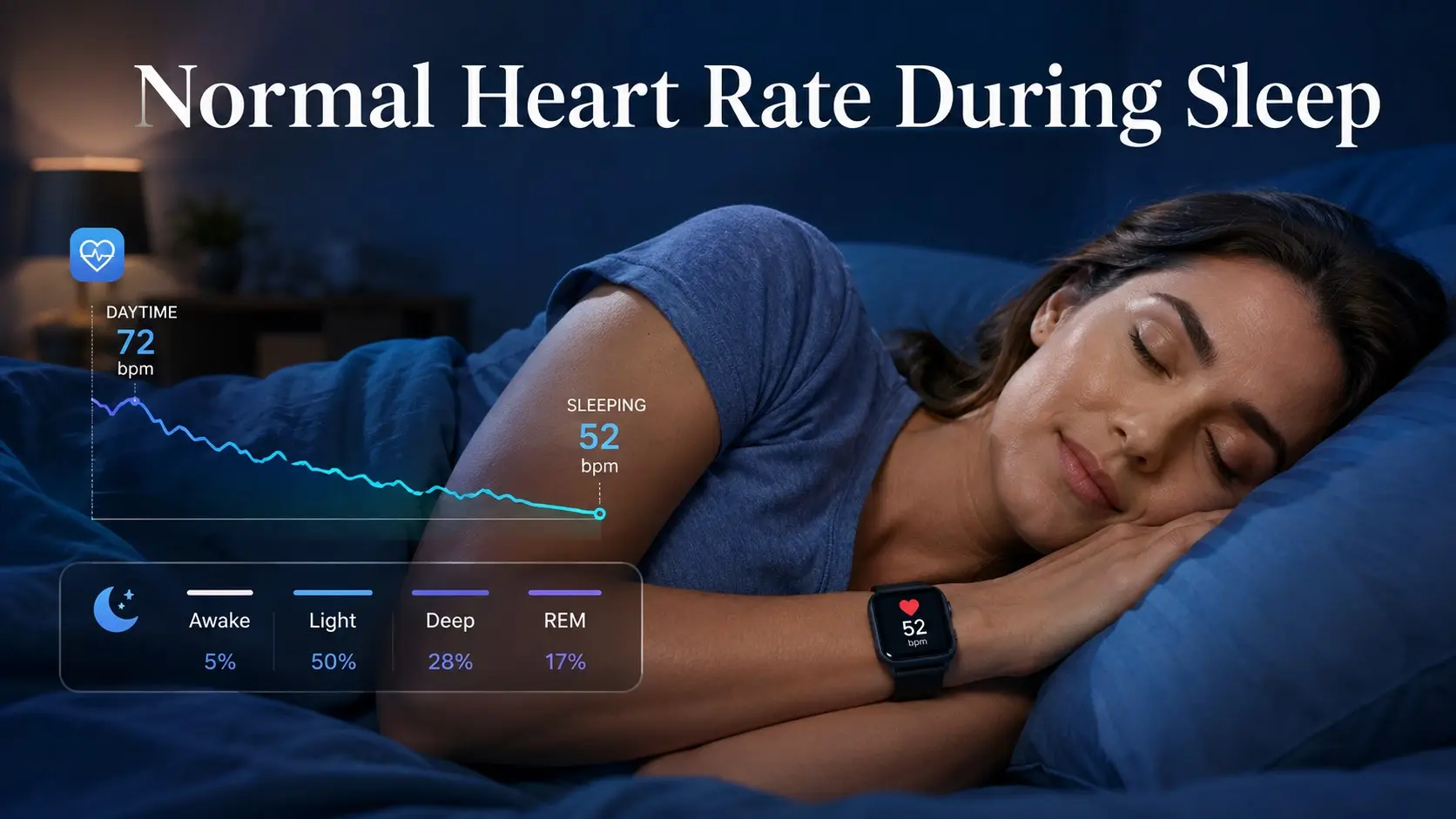
Normal heart rate during sleep is usually lower than your daytime resting heart rate.
For many healthy adults, a sleeping pulse around 40 to 60 beats per minute can occur.
But 40 is not a magic danger line.
A fit adult whose pulse reaches 38 during deep sleep is very different from someone whose heart rate stays near 38 while awake and who feels faint.
The number matters.
The pattern around it matters more.
Quick Answer: What Is a Normal Heart Rate During Sleep?
Normal heart rate during sleep is often lower than daytime resting heart rate. Many healthy adults reach about 40 to 60 beats per minute at night. Fitness, medicines, age, sleep stage, sleep apnea, symptoms, and your usual daytime pulse all help determine whether a low sleeping rate needs medical attention.
Medical note: This content is for general educational purposes and does not replace professional medical advice, diagnosis, or treatment. Consult an appropriately qualified healthcare professional for personal medical concerns. This article explains published guidance and does not provide a personal clinical assessment. Always consult qualified medical professionals for diagnosis and treatment of any health condition.
Why Does Your Heart Rate Slow While You Sleep?
Your body needs less cardiovascular work while you sleep.
You are not walking.
You are not exercising.
Your muscles need less oxygen.
Your nervous system also changes.
During much of non-REM sleep, especially deeper sleep, parasympathetic activity becomes stronger.
This helps slow your heart.
Blood pressure also tends to fall.
During REM sleep, heart rate becomes more variable again.
It can rise and fall with dreams, breathing changes, and brief awakenings.
This means a healthy overnight heart rate graph does not need to look like a flat line.
For the wider cardiovascular effects of sleep, read Sleep and Heart Health.
What Is the Average Sleeping Heart Rate?
Medical sources describe adult sleeping heart rate in slightly different ways.
Cleveland Clinic describes an average sleeping heart rate around 50 to 75 beats per minute in healthy adults.
It also notes that sleeping heart rate can run about 20 to 30 percent below daytime resting heart rate.
Mayo Clinic notes that resting rates from 40 to 60 beats per minute are common in some healthy young adults and trained athletes and are also common during sleep.
These statements show why one narrow range cannot describe everyone.
| Sleeping Heart Rate | What It Can Mean |
|---|---|
| 50 to 75 bpm | A common average sleeping range for healthy adults |
| 40 to 60 bpm | Also commonly seen during sleep |
| Below 40 bpm | Can occur normally, especially with high fitness, but needs more context |
| Repeated values in the 30s | Can occur in trained adults but deserve more attention when unexplained |
| Repeated values in the 20s | Should be verified and discussed with a healthcare professional |
These are practical guideposts.
They are not diagnostic cutoffs.
Is 60 Beats Per Minute Normal While Sleeping?
Yes.
A sleeping heart rate around 60 is common.
Suppose your daytime resting heart rate is 70.
Your pulse drops to 58 or 60 during sleep.
You wake feeling normal.
Nothing about that pattern is surprising by itself.
Is 50 Beats Per Minute Normal During Sleep?
For many adults, yes.
Mayo Clinic notes that rates between 40 and 60 beats per minute can occur normally during sleep.
Imagine your daytime resting heart rate is 66.
Your pulse reaches 50 during deep sleep.
You wake feeling fine.
Your heart rate rises normally when you stand and move.
That can fit normal sleep physiology.
Is 45 Beats Per Minute Too Low While Sleeping?
Not automatically.
A sleeping rate of 45 can occur in healthy adults.
It becomes even more plausible if you are physically fit.
I would ask whether 45 is normal for you.
If your sleep pulse has stayed between 44 and 52 for years and you feel well, the number is less concerning.
If your usual minimum was 60 and suddenly becomes 43 every night, that change deserves more attention.
Your personal baseline matters.
Is 40 Beats Per Minute Too Low During Sleep?
Forty is the number that worries many smartwatch users.
I would not treat it as an automatic emergency.
A value near 40 can occur during healthy sleep.
Fitness can lower the rate.
Some medicines can lower it too.
The better questions are:
- Is the rate normal for you?
- Does it happen only during sleep?
- Are you physically fit?
- Do you take medicine that slows heart rate?
- Do you have dizziness or fainting?
- Is your daytime rate also very low?
- Does your wearable report an irregular rhythm?
A value of exactly 40 is not a medical cliff.
What If Your Sleeping Heart Rate Falls Below 40?
Now I would look more closely.
Below 40 does not automatically mean heart disease.
Highly trained adults can reach the 30s during sleep.
The lowest value of the night can also appear during deeper sleep.
But repeated unexplained readings below 40 deserve context.
I would pay more attention if you also have:
- Dizziness
- Fainting
- Weakness
- Unusual fatigue
- Shortness of breath
- Reduced exercise tolerance
- Chest discomfort
- A very low daytime pulse
Symptoms change the meaning of a low heart rate while sleeping.
Can a Sleeping Heart Rate in the 30s Be Normal?
Yes, in some people.
Well-trained endurance athletes can have very low resting rates because each heartbeat pumps more blood.
Compare two examples.
A Fit Adult
A 30 year old endurance runner has a daytime resting pulse of 46.
The sleeping rate reaches 36.
There are no symptoms.
Exercise feels normal.
This can fit athletic physiology.
A New Low Rate With Symptoms
A 72-year-old who does little exercise suddenly begins recording 34 at night.
The daytime pulse is 41.
Walking upstairs causes dizziness.
That deserves medical assessment.
Same number.
Very different meaning.
For heart changes later in life, read Heart Health After 50.
What If Your Watch Records a Heart Rate in the 20s?
I would not ignore repeated readings in the 20s.
I would also not assume the watch is automatically correct.
Cleveland Clinic advises discussing documented sleeping rates in the 20s with a healthcare professional so the measurement can be verified.
A wearable can make errors.
But repeated readings this low deserve confirmation.
Save the recordings.
Note the time.
Note whether you had symptoms.
Show the pattern to a healthcare professional.
There Is No Single Heart Rate That Automatically Means Pacemaker
This is one of the most useful facts to understand.
American cardiology guidance says there is no established minimum heart rate or pause duration that automatically means a person with sinus node dysfunction needs permanent pacing.
Doctors look at the actual rhythm.
They look at symptoms.
They look for a connection between the slow heart rate and the person's health problem.
So:
39 bpm does not automatically mean pacemaker.
35 bpm does not automatically mean pacemaker.
A low nighttime value by itself does not answer that question.
What Does Bradycardia Mean?
Bradycardia means the heart is beating slowly.
A slow pulse is not always harmful.
It can occur during sleep.
It can occur in healthy adults.
It is common in trained athletes.
It can also occur because of medicines or medical problems.
Current American Heart Association adult life support guidance notes that bradycardia can be a normal finding in healthy adults, athletes, and during sleep.
The real question is whether the slow rate is causing poor blood flow or reflects an abnormal electrical rhythm.
Symptoms Matter More Than One Nighttime Number
Mayo Clinic lists several symptoms that can occur when the heart beats too slowly to supply the body properly.
They include:
- Dizziness
- Lightheadedness
- Weakness
- Unusual fatigue
- Shortness of breath
- Fainting
- Near fainting
- Chest pain
- Confusion
A sleeping heart rate of 38 without symptoms in a trained adult is one situation.
A heart rate of 38 with fainting is another.
The symptoms make the second situation much more important.
Your Daytime Heart Rate Matters Too
I always want to know what happens when you are awake.
Suppose your sleeping heart rate reaches 42.
You wake up.
Your resting pulse is 64.
You stand, and the heart rate rises normally.
You exercise without difficulty.
You feel well.
That is reassuring.
Now imagine your sleeping rate is 34.
Your daytime pulse remains 39.
You feel weak and dizzy.
That pattern deserves medical evaluation.
Nighttime bradycardia should not be interpreted without the daytime pattern.
Why Do Athletes Have Lower Sleeping Heart Rates?
Regular endurance training changes the cardiovascular system.
A trained heart can pump more blood with each beat.
It may need fewer beats to deliver enough blood while resting.
This is why highly trained athletes can have low resting and sleeping heart rates.
But lower does not automatically mean fitter.
A low heart rate caused by a serious conduction problem is not evidence of excellent conditioning.
For another useful exercise based heart measure, read Heart Rate Recovery After Exercise.
Can Medicines Lower Your Sleeping Heart Rate?
Yes.
Some medicines are designed to slow heart rate.
Beta blockers are a common example.
Other heart medicines and some medicines for other conditions can also affect pulse.
If your sleeping heart rate became lower after starting a medicine or changing a dose, tell the prescribing clinician.
Do not stop a prescribed medicine because your watch displayed 43.
The medicine may be producing the expected effect.
The question is whether the effect is appropriate for you.
Can Thyroid Problems Cause a Slow Heart Rate?
Yes.
An underactive thyroid, called hypothyroidism, can contribute to bradycardia.
Mayo Clinic includes thyroid disease among possible causes of a slow heart rate.
Other symptoms can include:
- Fatigue
- Feeling unusually cold
- Constipation
- Dry skin
- Weight changes
A sleeping pulse of 45 does not diagnose thyroid disease.
Blood testing is needed to assess thyroid function.
Can Electrolyte Problems Affect Heart Rate?
They can.
Changes in minerals such as potassium and calcium can affect the heart's electrical activity.
This is one reason doctors can order blood tests when investigating unexplained bradycardia.
Do not start electrolyte supplements because a smartwatch displayed a low pulse.
You first need to know whether an electrolyte problem actually exists.
Sleep Apnea Can Affect Nighttime Heart Rhythm
This connection deserves special attention.
Obstructive sleep apnea repeatedly interrupts breathing during sleep.
Oxygen can fall.
The autonomic nervous system responds.
Heart rate and rhythm can change.
American cardiology guidance says sleep breathing disorders and nocturnal bradycardia are both relatively common.
It recommends considering sleep apnea when nighttime bradycardia appears, and suspicious symptoms are present.
It also makes an important point.
Nocturnal bradycardia alone is not a reason for permanent pacing.
For the wider relationship between sleep and cardiovascular health, read Sleep and Heart Health.
What Are the Signs of Sleep Apnea?
Possible signs include:
- Loud frequent snoring
- Breathing pauses noticed by another person
- Gasping during sleep
- Repeated nighttime awakenings
- Morning headaches
- Dry mouth after waking
- Severe daytime sleepiness
- Poor sleep despite enough time in bed
- High blood pressure
If a low nighttime heart rate appears with these signs, mention both to your healthcare professional.
Can Treating Sleep Apnea Improve Nighttime Bradycardia?
Yes.
The American College of Cardiology, American Heart Association, and Heart Rhythm Society guideline states that treating sleep apnea can reduce sleep-related bradycardias.
This distinction matters.
A nighttime heart rhythm problem does not always mean the heart's natural pacemaker is failing.
The underlying breathing disorder can be part of the cause.
Why Does Heart Rate Change During Different Sleep Stages?
Sleep is not one uniform state.
Your nervous system changes as you move through the night.
Non-REM Sleep
Heart rate usually slows.
Blood pressure tends to fall.
The lowest rates often appear during deeper sleep.
REM Sleep
Heart rate becomes more variable.
It can increase toward waking levels.
Dreams and brief arousals can create temporary increases.
So a nighttime graph that rises and falls is not automatically abnormal.
Can Dreams Raise Your Heart Rate?
Yes.
REM sleep involves more variable cardiovascular activity.
Your pulse can rise for a short time.
Breathing can become less regular.
A brief increase during the night therefore does not automatically mean an abnormal rhythm.
Look at the duration and the wider pattern.
Can Alcohol Change Your Sleeping Heart Rate?
Yes.
Alcohol can change sleep quality and autonomic activity.
It can also worsen snoring and sleep breathing problems in some people.
If your sleeping heart rate changes consistently after alcohol, that is useful personal information.
It does not give you a diagnosis.
Can Illness Raise Your Sleeping Heart Rate?
Yes.
Your nighttime pulse does not always become lower when something is wrong.
Fever can raise it.
Dehydration can raise it.
Infection can raise it.
This is another reason your personal baseline is useful.
If you normally sleep near 48 and suddenly average 72 for several nights while feeling ill, the change matters even though 72 is not an extreme number.
How Accurate Is a Smartwatch During Sleep?
Modern wearables can be useful for tracking trends.
They are not perfect.
Most wrist devices use optical sensors to detect pulse changes beneath the skin.
Accuracy can vary by device, signal quality, body position, and the person wearing it.
A smartwatch is useful for spotting patterns.
It is not enough to diagnose the exact type of slow heart rhythm.
An ECG is far more useful when doctors need to identify the heart's electrical rhythm.
For another wearable based cardiovascular metric, read Heart Rate Variability Normal Range.
Why Can a Smartwatch Show a Falsely Low Heart Rate?
A wrist reading can be affected by:
- Loose device contact
- Sleeping position
- Movement
- Device placement
- Poor signal quality
- Missed pulse signals
- Software errors
One strange value deserves verification before interpretation.
If your watch reports 29 once but your usual minimum is 48, check whether the measurement was real before assuming your heart rate truly fell that low.
What Should You Do After a Low Heart Rate Alert?
Review the pattern rather than staring at the lowest number.
- Check whether it happened once or on several nights.
- Look at how long the low rate lasted.
- Confirm that you were asleep.
- Check your daytime resting heart rate.
- Review medicines that can slow heart rate.
- Consider your fitness level.
- Note dizziness, fainting, fatigue, chest symptoms, or breathing problems.
- Look for sleep apnea symptoms.
- Save the wearable data.
If the pattern is repeated and unexplained, show it to your healthcare professional.
What Tests Can Check a Slow Heart Rate?
A smartwatch tells you the pulse rate.
A medical evaluation can show why it is slow.
Possible tests include:
- Medical history
- Medication review
- Physical examination
- Electrocardiogram
- Blood tests
- Holter monitoring
- Longer rhythm monitoring
- Exercise testing in selected people
- Sleep testing if sleep apnea is suspected
An electrocardiogram, also called an ECG or EKG, is especially useful because it shows the electrical rhythm behind the pulse.
Your wearable can tell you that your rate reached 34.
An ECG can help doctors determine why.
What Is Sinus Bradycardia?
Your sinus node is the heart's natural pacemaker.
It normally starts each heartbeat.
Sinus bradycardia means this natural rhythm is slow.
That can be normal during sleep.
It can occur in athletes.
It can also occur because of medicines or medical conditions.
The term alone does not tell you whether treatment is needed.
What Is Sinus Node Dysfunction?
Sinus node dysfunction means the heart's natural pacing system does not work normally.
Age related changes in heart tissue are one possible cause.
Doctors do not diagnose sinus node dysfunction because a smartwatch recorded 39 during one night.
They look at symptoms, ECG findings, rhythm monitoring, and the wider clinical picture.
What Is Heart Block?
Heart block is different from normal sleep-related slowing.
The electrical signal has trouble moving through the heart's conduction system.
There are different types.
Some are mild.
Some are serious.
This explains why the rhythm behind a low heart rate matters more than the number alone.
A rate of 35 from normal sinus slowing is not the same finding as 35 caused by serious heart block.
Six Sleeping Heart Rate Examples
| Sleeping Heart Rate | Context | Practical View |
|---|---|---|
| 58 bpm | No symptoms and usual pattern | Common during sleep |
| 50 bpm | Healthy adult with normal daytime pulse | Common sleeping rate |
| 45 bpm | Fit adult with no symptoms | Can be normal |
| 38 bpm | Endurance athlete with no symptoms | Can fit athletic physiology |
| 34 bpm | New finding in a non-athlete with weakness | Medical review is appropriate |
| 28 bpm | Repeated wearable recordings | Verify and discuss with a healthcare professional |
How Low Is Too Low During Sleep?
There is no single number that answers this safely for everyone.
A practical way to think about it is:
40 to 60 bpm: Common during sleep.
Below 40 bpm: Not automatically dangerous, but deserves more context if repeated or new.
Repeated values in the 30s: Can occur in highly trained adults but deserve more attention when unexplained.
Repeated values in the 20s: Verify the measurement and discuss it with a healthcare professional.
These are practical discussion points.
They are not pacemaker rules.
When Is a Slow Heart Rate an Emergency?
The symptoms matter more than one watch number.
Current American Heart Association guidance treats symptomatic bradycardia as more serious when the slow rhythm is linked with poor blood flow or cardiovascular compromise.
Seek urgent medical help for a slow heart rate with:
- Fainting
- Severe breathing difficulty
- Persistent chest discomfort
- Confusion
- Signs of shock
- Very low blood pressure with serious symptoms
- Acute heart failure symptoms
If you are seriously unwell, do not wait for another night of smartwatch data.
Sleeping Heart Rate, HRV and Heart Rate Recovery Are Different
These measurements are easy to mix up.
Sleeping heart rate is the number of heartbeats per minute while you sleep.
Heart rate variability measures small changes in the timing between normal heartbeats.
Heart rate recovery measures how quickly your pulse falls after exercise.
Three measurements.
Three different questions.
Read Heart Rate Variability Normal Range for HRV.
Read Heart Rate Recovery After Exercise for exercise recovery.
If you track blood pressure around workouts too, see Blood Pressure After Exercise.
Common Normal Heart Rate During Sleep Myths
Myth: Anything Below 60 Is Dangerous
False.
Heart rate normally slows during sleep.
Myth: A Heart Rate of 40 Means You Need a Pacemaker
False.
Pacemaker decisions depend on the rhythm, symptoms, and underlying cause.
Myth: A Heart Rate in the 30s Always Means Heart Disease
False.
Highly trained adults can have sleeping rates in the 30s.
Myth: A Smartwatch Can Diagnose Heart Block
False.
A smartwatch can identify a pattern.
An ECG examines the electrical rhythm.
Myth: Sleeping Heart Rate Should Stay the Same All Night
False.
Heart rate changes with non-REM sleep, deep sleep, REM sleep, dreams, and brief awakenings.
Myth: Lower Always Means Fitter
False.
Fitness is only one possible reason for a low sleeping pulse.
My Approach to Normal Heart Rate During Sleep
I do not think one wearable number should create unnecessary fear.
I also do not think repeated unusual readings should be ignored.
The useful answer sits between those two extremes.
My background in information technology management trained me to review data, study patterns, check how measurements were collected, compare reliable sources, and avoid drawing large conclusions from one data point.
I now use the same approach when researching health information for NextFitLife.
I have maintained a personal interest in health, fitness, nutrition, sleep, wellness, and healthy aging for more than 30 years and have written about health and wellness for more than 15 years.
For this article, I compared Cleveland Clinic and Mayo Clinic clinical guidance, American cardiology recommendations for bradycardia, current American Heart Association emergency guidance, and open cardiovascular sleep research.
The questions I care about are simple.
Is this normal for you?
Is the reading real?
Is the rate low only during sleep?
Are there symptoms?
Did medicines change?
Could sleep apnea be involved?
What does the actual heart rhythm show?
That is more useful than treating one smartwatch number as a diagnosis.
Conclusion: Normal Heart Rate During Sleep Needs Context
Normal heart rate during sleep is usually lower than your daytime resting pulse.
Rates around 40 to 60 beats per minute are common for many healthy adults.
A value below 40 is not automatically dangerous.
Fitness, medicines, daytime pulse, sleep apnea, symptoms, and the actual heart rhythm all matter.
Repeated values in the 20s deserve verification.
Fainting, serious breathing problems, chest discomfort, confusion, or signs of poor blood flow need prompt medical attention.
Your next step: Review several nights from the same device, compare the results with your normal daytime resting heart rate, note any symptoms, and show repeated unexplained low readings to a qualified healthcare professional.
References and Sources
This article was checked against the following publicly accessible medical and scientific sources.
- Cleveland Clinic. How Sleep Affects Your Heart Rate.
This medically reviewed guide explains adult sleeping heart rate, normal nighttime slowing, fitness, medicines, sleep disorders, low readings, wearable tracking, and when very low sleeping rates deserve professional review.
- Mayo Clinic. Bradycardia: Symptoms and Causes.
Mayo Clinic explains slow heart rate, symptoms, sleep-related slowing, trained athlete heart rates, thyroid disease, electrolyte changes, sleep apnea, medicines, and warning signs.
- American Heart Association. ACC, AHA and HRS Bradycardia and Cardiac Conduction Guideline.
This guidance explains nocturnal bradycardia, sleep apnea screening, pacemaker decisions, sinus node dysfunction, heart block, and why no single minimum sinus rate automatically determines permanent pacing.
- American Heart Association. 2025 Adult Advanced Life Support Guidelines.
Current guidance explains how clinicians assess symptomatic bradycardia and why hypotension, altered mental status, chest discomfort, acute heart failure, dizziness, or fainting change the urgency.
- Dynamic Coupling Between the Central and Autonomic Nervous Systems During Sleep.
This open scientific review explains how heart rate and blood pressure change during non REM and REM sleep as autonomic activity changes through the night.
Source Review Date: September 1, 2026
These organizations and researchers do not endorse NextFitLife.
Continue Reading on NextFitLife
Heart and Cardiovascular Health Hub: Heart and Cardiovascular Health
Main Health Hub: NextFitLife Health
General Wellness Hub: General Wellness and Healthy Lifestyle
About the Author
Adel Galal is the founder and lead writer at NextFitLife.
NextFitLife publishes evidence-informed guidance about health, fitness, foods and nutrition, beauty, sleep, cardiovascular health, and healthy aging for adults.
Adel has maintained a personal interest in health, fitness, nutrition, sleep, wellness, and healthy aging for more than 30 years.
He has written about health and wellness for more than 15 years.
Before focusing on NextFitLife, Adel spent 29 years working as an IT Manager for the Nestlé Egypt Region.
His professional background developed skills in data analysis, research organization, systems thinking, information management, structured review, and problem-solving.
At NextFitLife, he uses those skills to compare reputable sources, separate established medical guidance from uncertain research, explain limitations, and avoid miracle claims.
For this article, his focus is on explaining why a sleeping heart rate cannot be judged safely from one smartwatch minimum without considering fitness, symptoms, medicines, daytime pulse, sleep apnea, measurement accuracy, and the actual heart rhythm.
This content is for general educational purposes and does not replace professional medical advice, diagnosis, or treatment. Consult an appropriately qualified healthcare professional for personal medical concerns. This article explains published guidance and does not provide a personal clinical assessment. Always consult qualified medical professionals for diagnosis and treatment of any health condition.
Read more about Adel Galal, NextFitLife, and the editorial and source checking process.
Frequently Asked Questions About Normal Heart Rate During Sleep
What is a normal heart rate during sleep?
Many healthy adults have sleeping heart rates around 40 to 60 beats per minute. Cleveland Clinic describes an average around 50 to 75 beats per minute, showing that individual values vary.
Is 60 bpm normal while sleeping?
Yes. A sleeping pulse around 60 beats per minute is common for many adults.
Is 50 bpm normal while sleeping?
Yes. Mayo Clinic notes that rates between 40 and 60 beats per minute are common in some healthy adults and during sleep.
Is 45 bpm too low during sleep?
Not automatically. A sleeping rate of 45 can occur normally, especially in physically fit adults. A new or unexplained change deserves more attention.
Is 40 bpm too low while sleeping?
Forty beats per minute can occur during normal sleep. Fitness, medicines, daytime pulse, symptoms, and the actual rhythm should all be considered.
Is a sleeping heart rate below 40 dangerous?
Not always. Highly trained adults can reach the 30s during sleep. Repeated unexplained values below 40 deserve more context, especially if symptoms are present.
Can athletes have a sleeping heart rate in the 30s?
Yes. Well trained endurance athletes can have resting and sleeping heart rates in the 30s without symptoms.
What if my smartwatch shows a heart rate in the 20s?
Repeated readings in the 20s should be verified and discussed with a healthcare professional. Wearable errors are possible, but values this low deserve confirmation.
Does a heart rate below 40 mean I need a pacemaker?
No. Cardiology guidance says there is no single minimum sinus heart rate that automatically determines the need for permanent pacing. Symptoms and the actual rhythm matter.
Can sleep apnea cause a low heart rate at night?
Sleep apnea can cause nighttime heart rate and rhythm changes. Cardiology guidance recommends considering sleep apnea when nocturnal bradycardia appears with suspicious symptoms.
Can treating sleep apnea improve nighttime bradycardia?
Yes. Major cardiology guidance states that treating sleep apnea can reduce sleep related bradycardias.
Can beta blockers lower sleeping heart rate?
Yes. Beta blockers and some other medicines can slow heart rate. Do not change a prescribed dose without speaking with the prescribing clinician.
Does heart rate get lowest during deep sleep?
Heart rate and blood pressure usually fall during non-REM sleep and can reach their lowest levels during deeper sleep.
Can dreams raise heart rate?
Yes. REM sleep and brief arousals can cause temporary increases and greater heart rate variability.
How accurate is a smartwatch for sleeping heart rate?
Wearables can provide useful nighttime trends, but accuracy varies. An ECG is more useful when doctors need to identify the actual electrical rhythm.
When should a slow sleeping heart rate be checked?
Seek medical advice for repeated unexplained very low readings, especially with dizziness, fainting, chest discomfort, unusual breathlessness, a low daytime pulse, irregular rhythm alerts, or sleep apnea symptoms.

Health & wellness writer with 30+ years of experience in nutrition, fitness, and healthy aging. Founder of NextFitLife.com — evidence-based health guidance.