

Published on: Jun 21, 2024
Updated: October 31, 2026
If you want to know how to increase your bench press in 2 Weeks, start with realistic expectations.
Fourteen days is too short to build a large amount of new muscle.
But you may still improve your bench press by getting better at the movement, reducing wasted effort, practicing with useful loads, and arriving at your test day with less fatigue.
That is the real goal of a good two-week bench plan.
This article is for general information and education. It does not replace medical advice, diagnosis, or treatment.
Quick answer: Bench two or three times during the first week, then reduce volume during the second week. Practice the same grip and setup, use some moderately heavy work, keep most sets short of failure, rest enough between hard sets, and avoid exhausting accessory work close to your test. If you test a heavy single, use a competent spotter or correctly set safety arms.
Safety first: Do not test a heavy one-rep max if you are a new lifter, if your technique is unstable, or if you are training alone without proper safeties. Stop if you feel sudden shoulder, chest, elbow, wrist, neck, or back pain. Chest pain, fainting, or severe shortness of breath needs medical attention.
Table of Contents
- Can you really improve bench press in two weeks?
- Where fast gains come from
- 12 smart strategies
- Use the same bench setup
- Improve your bar path
- Bench more often, not every day
- Use moderately heavy work
- Add paused bench press
- Keep volume under control
- Strengthen the triceps
- Train the upper back
- Rest longer between hard sets
- Stop short of failure
- Sleep and eat enough
- Taper before testing
- 14-day bench press plan
- Test day warm-up
- Grip width and shoulder comfort
- Common mistakes
- Frequently asked questions
Can You Really Increase Your Bench Press in 2 Weeks?
Yes, but the improvement may be small.
That does not mean the two weeks are wasted.
Short-term strength gains can come from:
- Better technique
- More confidence under the bar
- Better coordination
- Improved setup
- Less training fatigue
- Better pacing between sets
You should not expect 10 or 20 kg of new strength simply because you followed a plan for 14 days.
A beginner may improve faster than an experienced lifter because the movement is still new.
An advanced lifter may gain only a small amount.
Both can be normal.
For a longer-term plan, see How to Increase Your Bench Press Fast.
Where Fast Bench Press Gains Come From
In two weeks, the main opportunity is skill.
The bench press is not only about chest size.
You must coordinate your feet, upper back, grip, wrists, elbows, touch point, and press path at the same time.
If those pieces become more consistent, the lift can feel easier even before your muscles change much.
This is why bench press technique matters so much in a short plan.
12 Smart Strategies to Improve Your Bench in 2 Weeks
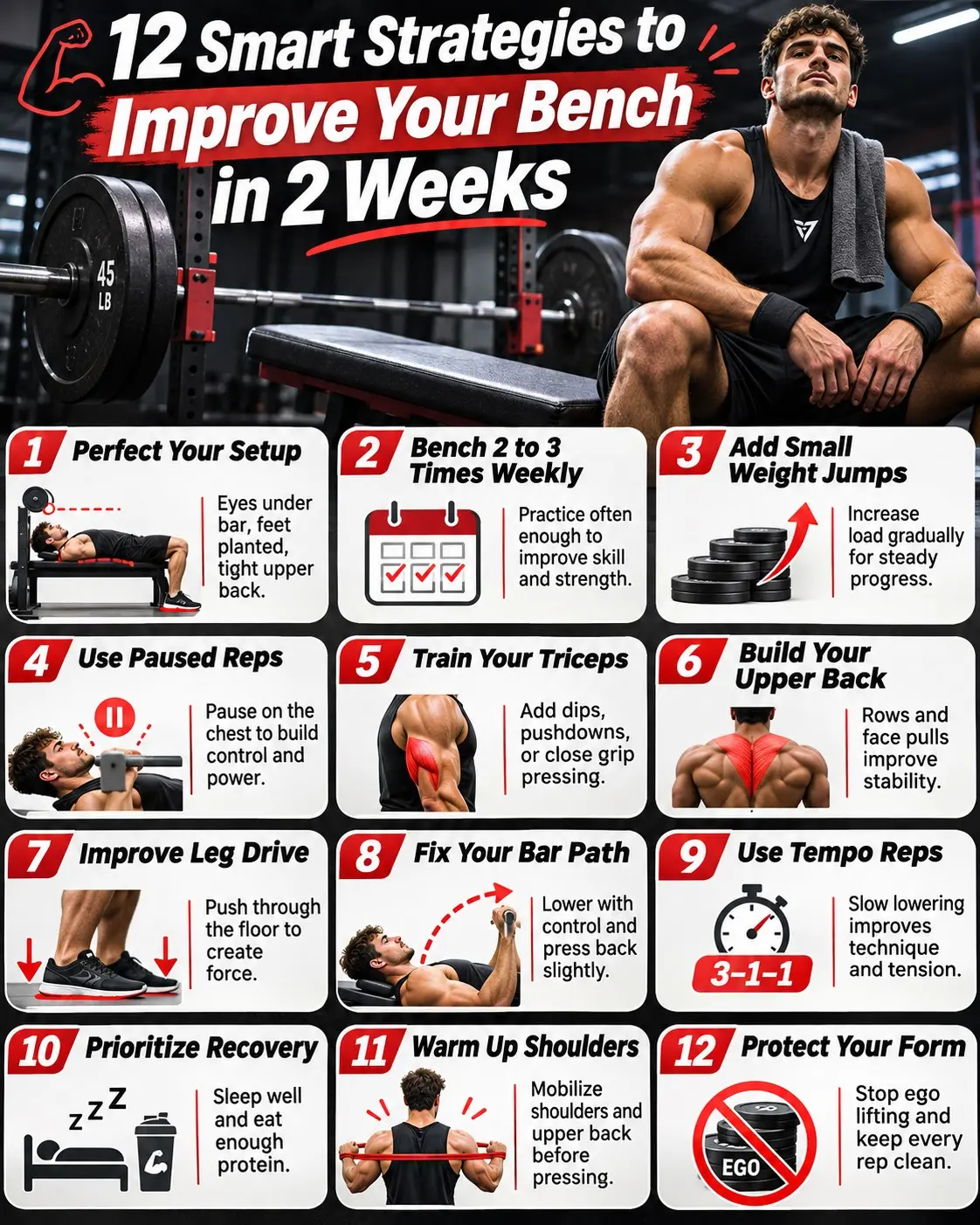
1. Use the Same Setup Every Session
Do not change your grip, foot position, or arch every workout.
Choose one setup and practice it.
Your checklist can be simple:
- Feet planted
- Upper back stable
- Hands evenly placed
- Wrists stacked over the forearms
- Consistent touch point
The more repeatable your setup becomes, the less energy you waste.
2. Improve Your Bar Path
The bar does not normally travel perfectly straight up and down.
For many lifters, it touches around the lower chest or sternum and then travels slightly back toward the rack as it rises.
Do not force one exact path if it feels awkward.
The goal is a path you can repeat.
Record one or two sets from the side if possible.
Look for:
- A consistent touch point
- No large side-to-side movement
- No bouncing off the chest
- No sudden elbow flare
3. Bench More Often, but Not Every Day
The current article recommends benching three or four times per week.
That can be too much for some lifters when the whole plan lasts only 14 days.
A better short-term structure is:
- Two or three bench sessions in week one
- One or two bench sessions before the test in week two
This gives you enough practice without carrying too much fatigue into test day.
4. Use Moderately Heavy Work
Do not spend the two weeks doing only very light sets.
You need some exposure to heavier resistance.
Recent bench press research supports productive strength training around roughly 70% to 85% of one rep max.
A practical session might include:
- 3 to 5 reps per set
- 2 to 4 working sets
- Good bar speed
- No missed reps
You do not need 95% or 100% every session.
5. Add Paused Bench Press
Lower the bar to your chest, pause briefly, then press.
This can improve control at the bottom of the lift.
Use less weight than your normal touch and go bench.
Two or three sets are enough.
Paused bench press is especially useful if your bar feels unstable on the chest.
6. Keep Training Volume Under Control
More benching does not always mean better benching.
A 2026 bench press study found that training volume changes both performance and recovery.
That matters in a short plan.
If you create large amounts of fatigue in week one, you may still feel tired when you test in week two.
Use enough volume to practice and train.
Do not turn every session into a marathon.
7. Strengthen the Triceps
The triceps help extend your elbows during the press.
If you usually fail near the top, a little direct triceps work can be useful.
Good options include:
- Close grip bench press
- Triceps pressdowns
- Dumbbell extensions if comfortable
Do not add a huge triceps workout.
Two or three moderate sets are enough during this short block.
8. Train the Upper Back
A stable upper back gives you a firm base on the bench.
Use:
- Chest supported rows
- Seated rows
- Lat pulldowns
- Dumbbell rows
Your upper back should support the bench press, not become so sore that setup becomes uncomfortable.
See Pull Workout Exercises for more back training ideas.
9. Rest Longer Between Hard Sets
The current article suggests shortening rest as a form of progressive overload.
That is not a good strategy when your main goal is stronger bench performance.
Short rest can make the next set worse simply because you are not recovered.
For hard bench sets, use roughly two to five minutes when needed.
Your next set should begin when you feel ready to produce another strong effort.
10. Stop Short of Failure
You do not need missed reps to get stronger.
Keep most working sets with about one to three good repetitions still available.
This is called repetitions in reserve.
Leaving a little in reserve can help preserve technique and reduce unnecessary fatigue.
11. Sleep and Eat Enough
A two week plan is not the time for an extreme diet.
Training quality can suffer when food intake is very low.
Eat enough protein and normal balanced meals.
Useful protein foods include:
- Eggs
- Greek yogurt
- Fish
- Chicken
- Lean meat
- Beans
- Lentils
- Tofu
Try to sleep enough each night.
You cannot recover well from hard training if you are constantly exhausted.
12. Taper Before Test Day
This is one of the most important changes.
Do not train harder and harder until the night before your test.
Reduce training volume near the end of week two.
You want to arrive fresh.
Your final bench session should feel like practice, not punishment.
The 14 Day Bench Press Plan
| Day | Focus | Main Work |
|---|---|---|
| 1 | Technique | Bench 3 sets of 5 at moderate effort |
| 2 | Recovery | Walk, light activity, no hard pressing |
| 3 | Heavy practice | Bench 3 to 4 sets of 3 to 4 reps |
| 4 | Back and recovery | Rows and light upper back work |
| 5 | Paused bench | 2 to 3 sets of 4 to 6 paused reps |
| 6 | Rest | No hard pressing |
| 7 | Rest or light activity | Easy movement only |
| 8 | Heavy technique | 3 sets of 2 to 3 strong reps |
| 9 | Recovery | No hard pressing |
| 10 | Light practice | 2 to 3 easy sets of 3 to 5 reps |
| 11 | Rest | Walk and normal activity |
| 12 | Very light primer | Optional 2 easy bench sets |
| 13 | Full rest | No hard upper body training |
| 14 | Test or rep PR | Warm up, then test only if ready |
This schedule is a template.
If you are sore, tired, or your bar speed is falling, reduce the workload.
Week 1: Build Skill, Not Exhaustion
Week one gives you three bench exposures.
The goal is to practice while still recovering between sessions.
Day 1
Use a moderate weight.
Perform three sets of five controlled repetitions.
Record one set from the side.
Day 3
Use heavier weight for lower reps.
Do not grind.
Every rep should still look controlled.
Day 5
Use paused bench press with lighter weight.
Focus on a stable chest touch and smooth press.
Week 2: Reduce Fatigue and Prepare to Perform
Week two is not another hard training week.
The goal is to keep the movement familiar while reducing fatigue.
This is why the total number of hard repetitions drops.
Do not add a huge chest workout because you feel good.
Save that energy for the test.
How Heavy Should Your Working Sets Be?
If you know your one rep max, much of your useful training can sit somewhere around 70% to 85%.
You do not need exact percentages if you are not an experienced lifter.
Use effort instead.
Your working sets should feel challenging but controlled.
A practical target is:
- No missed reps
- No ugly grinding
- One to three reps still possible
Should You Add Weight Every Session?
No.
The old article recommends adding 2.5 to 5 pounds each session.
That may work sometimes, especially for beginners, but it should not be forced.
If your technique worsens or bar speed falls sharply, adding weight is not useful progression.
During a two week block, quality matters more than constant loading.
Should You Add More Sets Every Session?
No.
More sets create more fatigue.
A 2026 bench press study found that higher bench volume changes recovery demands.
That is important when you only have 14 days.
Add volume only when it serves the plan.
Do not add sets simply because you finished the planned work.
Should You Shorten Rest to Build Strength Faster?
No.
Shorter rest makes the workout harder, but harder is not always better.
If strength is the goal, you want enough recovery to produce good repetitions.
Bench press studies show rest length changes performance and fatigue across repeated sets.
For hard work, rest roughly two to five minutes as needed.
Should You Bench 4 Times a Week?
Not automatically.
Four weekly bench sessions can work in a well designed program, but it is not required for a two week boost.
For many lifters, two or three sessions in the first week and less work in the second week is easier to recover from.
More practice only helps when quality stays high.
Do Close Grip Bench Presses Help?
They can.
A somewhat narrower grip increases the role of the elbow extensors and can be useful for triceps work.
Do not use an extremely narrow grip.
Your wrists and elbows should stay comfortable.
Use close grip work as an accessory, not as the main focus of the two week block.
Should You Use Incline Bench Press?
Incline benching can train your chest, shoulders, and triceps.
But in a two week bench specific plan, too many variations can take practice away from the lift you want to improve.
Keep the normal bench press as the main movement.
Use one variation at most when it clearly helps.
Should You Use Dumbbell Bench Press?
Dumbbells are useful for general pressing strength and muscle development.
But they are less specific than the barbell bench press.
If your main goal is a better barbell bench in 14 days, barbell practice deserves most of your attention.
Grip Width Matters
Do not assume wider always means stronger.
A 2024 biomechanical study found grip width changes shoulder joint loading.
Narrower grips below about 1.5 times shoulder width reduced several shoulder loading measures compared with very wide grips.
This does not mean everyone needs the same grip.
Use a grip that lets you:
- Control the bar
- Keep wrists stable
- Touch the chest comfortably
- Press without pain
Should You Retract Your Shoulder Blades?
A stable upper back is useful.
The same 2024 biomechanical study found that scapular retraction changed shoulder loading in a potentially useful way.
Do not force your shoulders into an extreme position.
Set the upper back firmly and keep the setup repeatable.
Do You Need an Extreme Bench Arch?
No.
A natural arch is normal when the upper back is set and the feet are planted.
You do not need to copy an extreme competition arch unless you are a trained powerlifter using it safely within your sport rules.
Your hips should stay on the bench.
Should the Bar Touch Your Chest?
For a normal full range bench press, yes, if your shoulders tolerate the movement.
Touch under control.
Do not bounce the bar.
A controlled full range is useful for strength development.
Should You Press as Fast as Possible?
Use strong intent on the way up while keeping control.
The bar will naturally move more slowly as the weight gets heavier.
You do not need to throw the bar or lose position.
Think “strong and smooth.”
How to Warm Up on Test Day
Do not tire yourself before your heavy attempt.
A simple warm up could look like this:
| Stage | Example |
|---|---|
| General warm up | A few minutes of easy movement |
| Empty bar | 8 to 10 easy reps |
| Light load | 5 reps |
| Moderate load | 3 reps |
| Heavier warm up | 1 to 2 reps |
| Near test load | 1 controlled rep |
Rest longer as the load rises.
You want to feel prepared, not tired.
Should You Test a True One Rep Max?
You do not have to.
You can test progress with:
- A heavier single
- A three rep personal best
- A five rep personal best
- The same weight for more clean reps
These options can show progress without requiring an all out maximum.
How Much Should You Attempt on Test Day?
Do not jump straight to a huge personal record.
A safer approach is:
- Match or slightly exceed a recent strong lift.
- If it moves well, make a small increase.
- Stop if technique breaks down badly.
A small personal record is still a personal record.
Can You Add 5 kg in 2 Weeks?
Maybe.
A beginner or returning lifter may improve quickly.
An experienced lifter may not.
There is no honest guarantee.
The more advanced you are, the harder each extra kilogram usually becomes.
Can You Add 10 kg in 2 Weeks?
It is possible in special cases, but it should not be expected.
Large jumps are more likely when the previous test was poor, technique improves quickly, or the lifter is very new.
For trained lifters, 10 kg in 14 days would be a large change.
Does Creatine Help in 2 Weeks?
Creatine can support strength and training performance over time.
It is not a guaranteed two week bench press booster.
Some people use a loading phase, while others take a smaller daily amount.
If you use supplements, choose products from reputable companies and consider medical advice if you have kidney disease or another relevant condition.
Do You Need Protein Shakes?
No.
Protein powder is optional.
Normal food can provide protein.
What matters more is getting enough total protein across the day.
For meal ideas, see High Protein Breakfast for Weight Loss.
Should You Bulk for These 2 Weeks?
No large bulk is needed.
A huge calorie surplus does not turn into instant bench strength.
Eat enough to support training and recovery.
A moderate normal diet is enough for most people.
Sleep Matters More Than Most Lifters Think
Do not trade sleep for another late workout.
Poor sleep can make training feel harder and can reduce recovery quality.
Try to keep your sleep schedule steady during the two week plan.
Common Two Week Bench Press Mistakes
1. Maxing Out Every Session
Testing is not training.
2. Benching Hard Four Days in a Row
Skill practice only helps when you recover.
3. Adding Weight No Matter What
Do not force progression when form is getting worse.
4. Shortening Rest
Short rest can reduce your next set's quality.
5. Adding Too Many Variations
Your main goal is to improve the normal bench press.
6. Training Every Set to Failure
Leave some good repetitions in reserve.
7. Doing Too Much Chest Accessory Work
Soreness is not the goal of a two week peak.
8. Changing Grip Constantly
Practice one main grip.
9. Testing While Tired
A personal record attempt should happen when fatigue is low.
10. Expecting Guaranteed Numbers
No responsible program can promise a fixed kilogram increase in 14 days.
Two Week Bench Press Checklist
- Use the same setup every session.
- Practice a consistent bar path.
- Bench two or three times in week one.
- Use some moderately heavy work.
- Add paused reps if useful.
- Keep volume controlled.
- Train triceps and upper back lightly.
- Rest enough between hard sets.
- Keep most sets short of failure.
- Reduce volume during week two.
- Take a full rest day before testing.
- Use a spotter or safety arms.
Conclusion
If you want to know How to Increase Bench Press in 2 Weeks, think like a lifter preparing to perform, not someone trying to build a new chest in 14 days.
Practice the lift, improve your setup, use some moderately heavy work, reduce unnecessary fatigue, and taper before testing.
Do not max out every session or force weight increases when your technique is getting worse.
A small improvement in two weeks is useful progress.
Your next step: record your current bench setup today, choose your first three training days, and follow the plan without adding extra hard work just because you feel impatient.
References and Sources
- American College of Sports Medicine. Resistance Training Prescription for Muscle Function, Hypertrophy, and Physical Performance in Healthy Adults, 2026.
https://pubmed.ncbi.nlm.nih.gov/41843416/ - Optimizing Strength and Hypertrophy: The Combined Effect of Intensity and Velocity Loss Thresholds in Bench Press Training. 2026.
https://pubmed.ncbi.nlm.nih.gov/41872733/ - Effects of Bench Press Volume on Performance, Recovery, and Physiological Response. 2026.
https://pubmed.ncbi.nlm.nih.gov/41745678/ - Acute Bench Press Performance Responses to Two Inter Set Rest Periods. 2026.
https://pubmed.ncbi.nlm.nih.gov/41711603/ - Effects of Bench Press Technique Variations on Musculoskeletal Shoulder Loads and Potential Injury Risk. 2024.
https://pubmed.ncbi.nlm.nih.gov/38974522/ - Relationship Between Perceptual and Mechanical Markers of Fatigue During Bench Press and Bench Pull Exercises. 2024.
https://pubmed.ncbi.nlm.nih.gov/38250725/ - Effects of Rest Interval Configuration Between Sets on Volume Load During Bench Press and Back Squat. 2025.
https://pubmed.ncbi.nlm.nih.gov/40644659/
Internal Links + Hub
- NextFitLife Fitness Hub
- Fitness Program Guide
- How to Increase Your Bench Press Fast
- Pull Workout Exercises
- Effective Workout Routines for Men
- Strength Training at Home for Beginners
- Simple Strength Training Exercises at Home
- Minimum Effective Dose Strength Training
- Quick Effective Workout Routines
- High Protein Breakfast for Weight Loss
About the Author
Adel Galal is the founder and lead writer of NextFitLife.com and the founder of Parnthub.com.
He is a father of four, three sons and a daughter, and a grandfather of four, with more than 33 years of hands on family experience. Adel is based in Cairo, Egypt.
He has maintained a personal interest in health, fitness, nutrition, sleep, wellness, and healthy aging for more than 30 years and has more than 15 years of health and wellness writing experience.
His work focuses on reviewing trusted fitness and nutrition sources, separating useful strength training principles from exaggerated promises, and turning research into simple guidance readers can apply in normal training.
Adel is not a doctor, physical therapist, exercise physiologist, certified personal trainer, strength coach, or other licensed healthcare professional. NextFitLife content is for general information and education and does not replace individual medical or exercise advice.
Learn more about Adel and NextFitLife on the About Us page.
Frequently Asked Questions
Can you really increase bench press in 2 weeks?
Yes, but usually by a small amount. Fast changes are more likely to come from better technique, practice, confidence, and lower fatigue than from large muscle growth.
How much can I add to my bench in 2 weeks?
There is no reliable number. Beginners may improve faster than trained lifters, while advanced lifters may gain little or nothing in such a short period.
Can I add 5 kg to my bench in 2 weeks?
It is possible for some people, especially newer or returning lifters, but it should not be promised.
Can I add 10 kg to my bench in 2 weeks?
That would be a large increase for most trained lifters. It may happen in special cases, but it is not a realistic general expectation.
How often should I bench during the two weeks?
Two or three bench sessions during week one and one or two lower volume sessions before the test in week two works well for many lifters.
Should I bench four times a week?
Not necessarily. More practice is only useful if you recover well and your technique stays strong.
Should I bench every day?
No. Daily benching is not needed for a two week improvement plan.
How heavy should I bench?
Much productive strength work can be done with moderately heavy loads, often around 70% to 85% of one rep max, while keeping repetitions controlled.
Should I use 90% of my max?
Occasional heavy exposure can be useful for experienced lifters, but you do not need repeated 90% plus sessions during the two week plan.
Should I train to failure?
No. Leave about one to three good repetitions available on most working sets.
How long should I rest between heavy bench sets?
Roughly two to five minutes works well for many lifters. Rest long enough for the next set to remain strong.
Should I shorten rest to make the workout harder?
No. Short rest can reduce performance on later sets and is not the best way to improve maximal bench strength quickly.
Should I add weight every workout?
No. Add weight only when the current load is moving with good technique and the increase fits the plan.
Are paused bench presses useful?
Yes. Paused reps can improve control and confidence at the bottom position.
Does close grip bench help?
It can support triceps strength, especially for lifters who struggle near lockout.
Should I use incline bench during the two weeks?
It is optional. Keep normal flat benching as the main exercise because specificity matters in a short program.
Should I train chest every day?
No. Your chest, shoulders, and triceps need recovery between hard sessions.
Do rows improve bench press?
Rows can strengthen the upper back and support a stable bench setup, but bench press practice remains the main specific driver.
Do triceps exercises improve bench press?
They can help, especially when lockout strength is weak, but large accessory workouts are not needed during a short two week block.
What grip width should I use?
Use a grip that feels strong and comfortable and allows stable wrists and shoulders. Very wide grips are not automatically better.
Should I arch my back?
A natural arch is normal during a stable bench setup. You do not need an extreme arch unless you are trained to use one safely.
Should the bar touch my chest?
For a normal full range bench press, use a controlled chest touch if your shoulders tolerate it. Do not bounce the bar.
Should I test my max on day 14?
You can if you are experienced, recovered, and using proper safety equipment. A rep personal record is also a valid way to measure progress.
Should I rest the day before my max test?
Yes. A full rest day before a hard test is useful for many lifters.
Does creatine increase bench press in 2 weeks?
Creatine can support strength training over time, but it does not guarantee a large bench press increase in 14 days.
Do I need protein powder?
No. Protein powder is optional. Total daily protein from food and supplements combined is what matters.
What is the biggest mistake in a two week bench plan?
Trying to train harder every day. Too much volume, failure training, and repeated max attempts can leave you more fatigued on test day.

Health & wellness writer with 30+ years of experience in nutrition, fitness, and healthy aging. Founder of NextFitLife.com — evidence-based health guidance.

