
Published on: June 12, 2025
Updated on: November 4, 2026
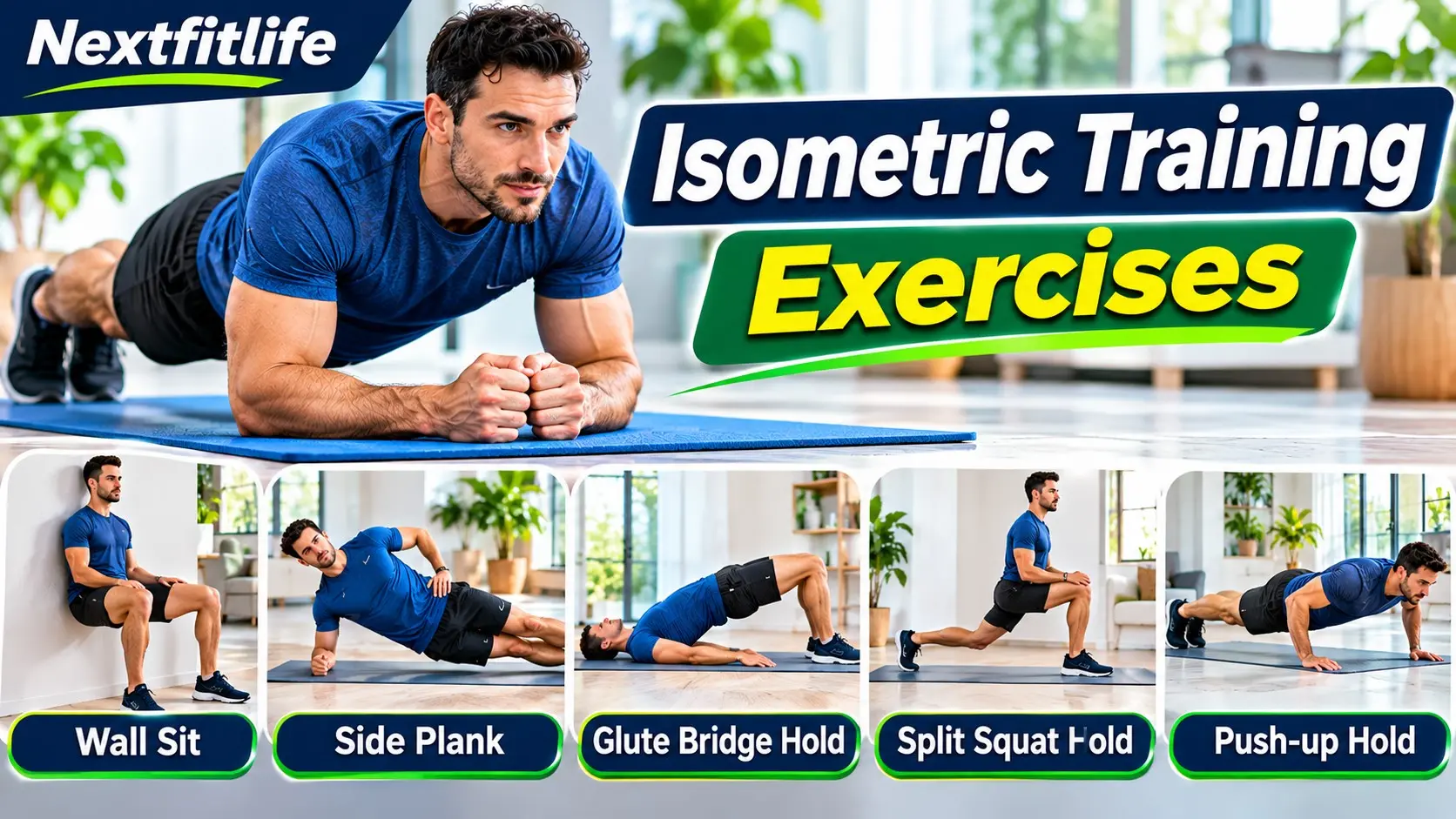
Isometric training exercises let you build muscle tension without needing large movements, heavy machines, or a full gym.
You can train with a wall, the floor, a towel, a resistance band, or a single dumbbell. That makes isometrics useful at home, while traveling, in a hotel room, or as part of a normal strength session.
Research shows that isometric resistance training can improve strength. At the same time, current resistance training guidance supports combining several types of exercise instead of relying on one method alone.
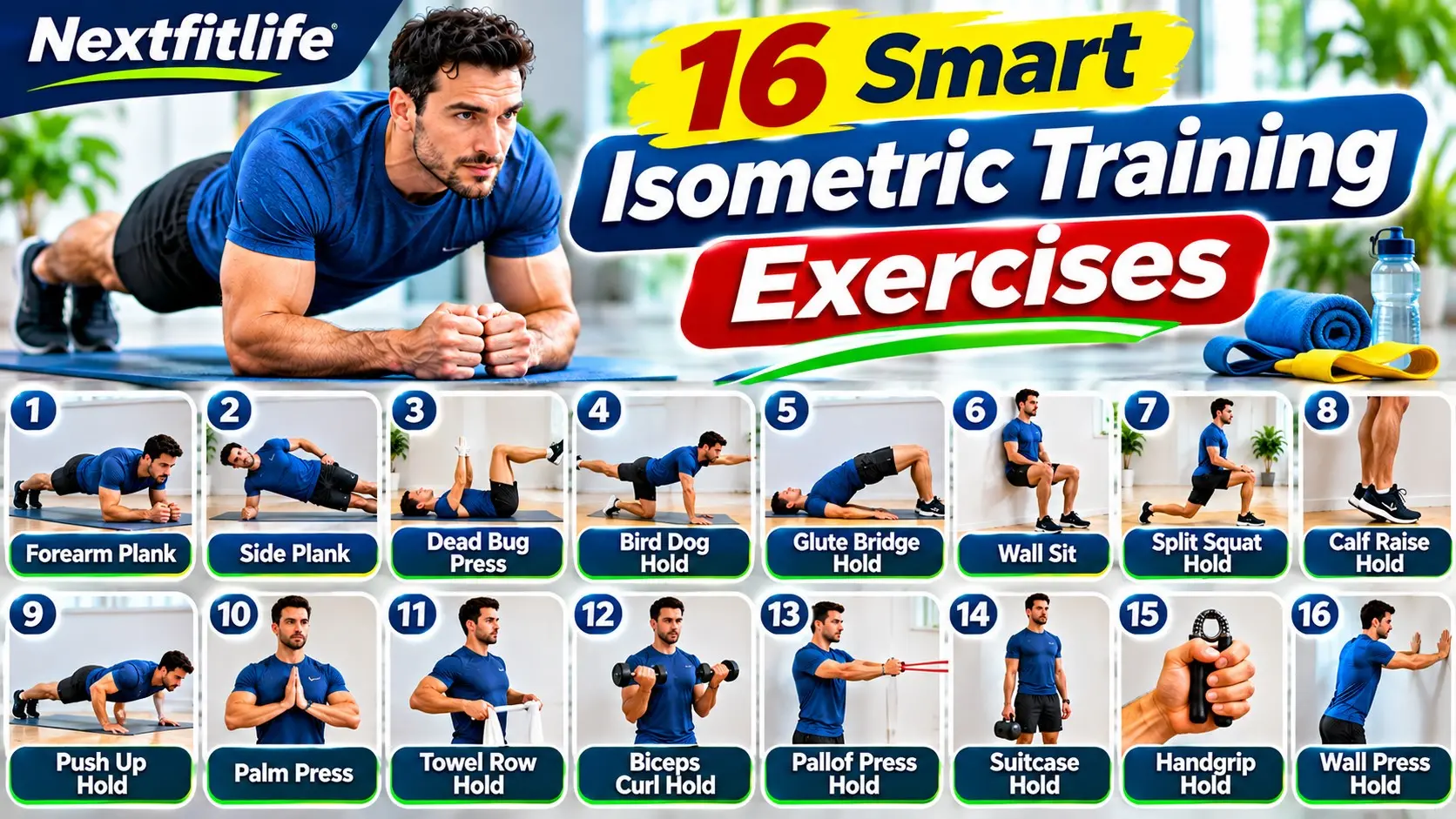
This guide gives you 16 smart holds, full body routines, hold times, progression rules, travel options, and safety guidance so you can train almost anywhere.
Important: This article is for general information and education. It does not replace medical advice, diagnosis, or treatment.
Safety note: Keep breathing while you hold tension. Avoid deliberate breath holding and maximal straining. If you have cardiovascular disease, uncontrolled high blood pressure, recent surgery, or unexplained pain, ask a healthcare professional what level of resistance exercise is appropriate for you.
Table of Contents
- Quick Answer
- What Is Isometric Training?
- Why It Works Anywhere
- 16 Isometric Training Exercises
- Beginner Workout
- Travel Workout
- Full Body Workout
- Best Hold Times
- How Often to Train
- How to Progress
- Isometrics vs Dynamic Training
- Blood Pressure and Breathing
- Common Mistakes
- When to Stop
- Conclusion
- References and Sources
- Internal Links + Fitness Hub
- About the Author
- Frequently Asked Questions
Quick Answer: Can Isometric Training Build Strength Anywhere?
Yes. Isometric training exercises can build strength with very little equipment because the goal is to create tension rather than move a heavy load through a large range.
Good examples include:
- Forearm plank
- Side plank
- Dead bug press
- Bird dog hold
- Glute bridge hold
- Wall sit
- Split squat hold
- Calf raise hold
- Push up hold
- Palm press
- Towel row hold
- Biceps curl hold
- Pallof press hold
- Suitcase hold
- Handgrip hold
- Standing wall press
You do not need to perform every exercise in one session.
For the fundamentals first, read our Isometric Exercises guide.
What Is Isometric Training?
An isometric exercise creates muscle tension while the joint moves very little.
Examples:
- You hold a plank instead of doing repeated crunches.
- You hold a wall sit instead of repeatedly squatting.
- You hold a dumbbell in one position instead of curling it up and down.
Your muscles are still working even though the movement is small or absent.
Why Isometric Training Works Almost Anywhere
You do not need a gym machine to create resistance.
Your resistance can come from:
- Your bodyweight
- A wall
- The floor
- Your own hands
- A towel
- A resistance band
- A backpack
- A dumbbell
The 2026 ACSM resistance training update states that home based routines, bodyweight exercise, and elastic bands can all produce meaningful improvements in strength and physical function.
16 Smart Isometric Training Exercises
1. Forearm Plank
Main muscles: core, shoulders, glutes.
- Place your forearms on the floor.
- Extend your legs.
- Keep your body in a straight line.
- Tighten your abdomen gently.
- Keep breathing.
Starting hold: 10 to 30 seconds.
2. Side Plank
Main muscles: obliques, hips, shoulder.
Use bent knees for an easier version or straight legs for a harder version.
Starting hold: 10 to 20 seconds per side.
3. Dead Bug Press
Main muscles: deep core muscles.
- Lie on your back.
- Bring your knees above your hips.
- Press your palms into your thighs.
- Press your thighs back into your palms.
- Keep breathing.
Starting hold: 5 to 15 seconds.
4. Bird Dog Hold
Main muscles: core, back, hips, shoulders.
Extend one arm and the opposite leg, then hold while keeping your hips level.
Starting hold: 5 to 15 seconds per side.
5. Glute Bridge Hold
Main muscles: glutes, hamstrings, trunk.
Lift your hips from the floor and hold without overextending your lower back.
Starting hold: 15 to 30 seconds.
6. Wall Sit
Main muscles: quadriceps, glutes, calves.
Slide down a wall to a comfortable depth and hold.
You do not need to reach a deep 90 degree knee angle.
Starting hold: 10 to 30 seconds.
7. Split Squat Hold
Main muscles: quadriceps, glutes, hips.
- Place one foot in front of the other.
- Lower into a shallow split squat.
- Keep the front foot flat.
- Hold beside support if needed.
Starting hold: 10 to 20 seconds per side.
8. Calf Raise Hold
Main muscles: calves and ankle stabilizers.
Rise onto your toes and pause at the top.
Starting hold: 10 to 20 seconds.
9. Push Up Hold
Main muscles: chest, shoulders, triceps, core.
Use a wall, counter, bench, or floor depending on your level.
Starting hold: 5 to 20 seconds.
10. Palm Press
Main muscles: chest, shoulders, arms.
- Place your palms together in front of your chest.
- Press both hands together.
- Keep your shoulders relaxed.
- Breathe normally.
Starting hold: 10 to 20 seconds.
11. Towel Row Hold
Main muscles: back, rear shoulders, biceps.
Hold a strong towel with both hands and create opposing tension while pulling your elbows back slightly.
Starting hold: 10 to 20 seconds.
12. Biceps Curl Hold
Main muscles: biceps and forearms.
Hold a dumbbell, band, or loaded backpack with the elbow bent about halfway.
Starting hold: 10 to 20 seconds.
13. Pallof Press Hold
Main muscles: core, obliques, trunk stabilizers.
Use a resistance band and resist being rotated toward the anchor.
Starting hold: 10 to 20 seconds per side.
14. Suitcase Hold
Main muscles: grip, trunk, shoulder stabilizers.
Hold one heavy object at your side and resist leaning.
Starting hold: 15 to 30 seconds per side.
15. Isometric Handgrip
Main muscles: hand and forearm muscles.
Squeeze a handgrip device at a manageable effort while continuing to breathe.
Do not assume maximum squeezing is necessary.
16. Standing Wall Press Hold
Main muscles: chest, shoulders, arms, core.
- Stand facing a wall.
- Place both palms on the wall.
- Press firmly without moving.
- Keep your body tall.
- Continue breathing.
Starting hold: 10 to 20 seconds.
10 Minute Beginner Isometric Workout
| Exercise | Hold | Rounds |
|---|---|---|
| Wall Sit | 20 seconds | 2 |
| Wall Push Hold | 15 seconds | 2 |
| Bridge Hold | 20 seconds | 2 |
| Palm Press | 15 seconds | 2 |
| Bird Dog Hold | 10 seconds each side | 2 |
Rest for about 30 to 60 seconds when needed.
Travel Isometric Workout With No Gym
Isometrics work well while traveling because you can use walls, floors, towels, and your luggage.
Try:
- Wall sit for 20 seconds
- Plank for 20 seconds
- Palm press for 15 seconds
- Towel row hold for 15 seconds
- Split squat hold for 15 seconds per leg
- Suitcase hold using luggage for 20 seconds per side
Repeat two or three rounds.
Full Body Isometric Workout
| Body Area | Exercise | Starting Hold |
|---|---|---|
| Core | Forearm Plank | 20 seconds |
| Legs | Wall Sit | 20 seconds |
| Hips | Glute Bridge Hold | 20 seconds |
| Chest | Push Up Hold | 10 seconds |
| Back | Towel Row Hold | 15 seconds |
| Grip | Suitcase Hold | 20 seconds per side |
How Long Should Isometric Holds Last?
A useful beginner range is about 5 to 30 seconds.
The ideal hold depends on:
- Exercise difficulty
- Resistance
- Joint position
- Your training experience
- Your goal
Harder holds may need to be shorter.
Easier holds can often be maintained longer.
Good form matters more than chasing time.
How Often Should You Do Isometric Training?
You can include isometrics during normal strength sessions.
CDC recommends muscle strengthening activity on at least two days each week and recommends training all major muscle groups.
A simple schedule could be:
- Monday: Full body isometrics
- Wednesday: Dynamic strength training
- Friday: Isometric and dynamic mix
You do not need maximum effort static holds every day.
How to Progress Isometric Exercises
Progressive overload still matters even when you are not moving.
You can progress by:
- Holding slightly longer
- Increasing tension
- Adding another set
- Using a harder body position
- Increasing external resistance
- Training another joint angle
Change one factor at a time.
Why Joint Angle Matters
Isometric strength can be somewhat specific to the joint angle you train.
For example, a wall sit near the top and a deeper wall sit challenge the legs differently.
That is why a complete program should include:
- Different positions over time
- Dynamic movements
- Exercises for every major muscle group
Isometric vs Dynamic Strength Training
Both can build strength.
A 2025 meta analysis of 32 studies found that isometric resistance training produced strong isometric strength gains and performed similarly to dynamic resistance training for isokinetic strength.
This does not mean isometrics are universally better.
Dynamic training develops strength while you move through a larger range.
Use both when possible.
For a complete program, see our Strength Training and Muscle Building Guide.
Do You Need Heavy Weights?
No.
ACSM's 2026 resistance training guidance states that nontraditional approaches such as bodyweight training, elastic bands, and home based resistance exercise can produce meaningful results.
That makes isometrics especially useful when:
- You travel often.
- You train at home.
- You have limited equipment.
- You need a short workout.
Can Isometrics Build Muscle?
They can contribute to muscle growth when the muscle experiences enough tension and training volume.
However, movement based resistance training is still useful because it challenges the muscle through a larger range.
If your main goal is muscle growth, combine isometric and dynamic work.
Can Isometric Exercise Lower Blood Pressure?
Research has shown that regular isometric resistance training can reduce resting blood pressure in some adults.
The American Heart Association includes isometric resistance as one form of exercise that can support blood pressure management.
However, a medical blood pressure protocol is different from a general gym workout.
If you have hypertension, heart disease, or take cardiovascular medicines, ask your healthcare professional what intensity is appropriate.
Why Breathing Matters
Keep breathing while you hold tension.
Do not deliberately hold your breath and bear down during hard isometrics.
A simple pattern is:
- Set your position.
- Create tension.
- Breathe in normally.
- Exhale slowly.
- Maintain the hold.
If you cannot breathe normally, reduce the intensity.
Common Isometric Training Mistakes
Holding Your Breath
Keep your breathing steady throughout the exercise.
Making Every Hold Maximum Effort
You can build strength without squeezing as hard as possible every set.
Only Doing Planks
A complete routine should train the legs, hips, back, chest, arms, core, and grip.
Chasing Longer Holds
A longer hold is not useful if posture has already broken down.
Ignoring Dynamic Exercise
Combine static holds with normal squats, rows, presses, and other movements when possible.
Never Increasing Difficulty
Your body needs gradual progression to keep adapting.
Training Through Sharp Pain
Muscle effort is normal. Sharp or worsening pain is not.
When Should You Stop?
Stop exercising and seek appropriate medical advice if you develop:
- Chest pain or pressure
- Fainting
- Severe unusual shortness of breath
- Sudden weakness
- New numbness
- Severe joint pain
- A serious injury
Conclusion
Isometric training exercises make strength training portable because you can create meaningful muscle tension with a wall, floor, towel, band, backpack, or single weight.
They work best when you train the whole body, use short controlled holds, keep breathing, and make the exercise gradually harder over time.
You do not need to replace normal strength training. Use isometrics beside dynamic exercises for a more complete program.
Your next step: choose one core hold, one leg hold, one push, one pull, and one grip exercise, then complete two controlled rounds today.
References and Sources
- Ghayomzadeh M and colleagues. Effects of Isometric vs Dynamic Resistance Training on Isometric and Isokinetic Muscular Strength. 2025 systematic review and meta analysis of 32 studies and 621 adults.
https://pubmed.ncbi.nlm.nih.gov/40817007/ - American College of Sports Medicine. Resistance Training Guidelines Update 2026. Guidance on consistency, resistance training goals, home workouts, elastic bands, bodyweight exercise, and strength development.
https://acsm.org/resistance-training-guidelines-update-2026/ - Centers for Disease Control and Prevention. Adult Activity: An Overview. Guidance recommending muscle strengthening on at least two days per week for all major muscle groups.
https://www.cdc.gov/physical-activity-basics/guidelines/adults.html - American Heart Association. Getting Active to Control High Blood Pressure. Includes aerobic, dynamic resistance, and isometric resistance exercise guidance.
https://www.heart.org/en/health-topics/high-blood-pressure/changes-you-can-make-to-manage-high-blood-pressure/getting-active-to-control-high-blood-pressure - Physical Activity Guidelines for Americans. Guidance on muscle strengthening, progression, bodyweight exercise, planks, resistance bands, and training all major muscle groups.
https://www.cdc.gov/physical-activity/media/pdfs/Physical_Activity_Guidelines_2nd_edition.pdf
Internal Links + Fitness Hub
- Isometric Exercises
- Isometric Exercises Examples
- Shoulder Isometric Exercises
- NextFitLife Fitness Hub
- Strength Training and Muscle Building Guide
- Best Ab Exercises
- Balance Exercises
- Injury Prevention Exercises
- Upper Body Workout
- Chair Exercise for Seniors
About the Author
Adel Galal is a father of four, three sons and a daughter, and a grandfather of four, with 33 years of hands on parenting experience. He is the founder of Parnthub.com, based in Cairo, Egypt, where he shares practical guidance on feeding, development and family life from newborns to teenagers.
Adel is not a medical professional. Health articles cite trusted sources and are for general information only.
Learn more on the NextFitLife About Us page.
Frequently Asked Questions
What are isometric training exercises?
They are exercises in which muscles create tension while the joint moves very little. Examples include planks, wall sits, static split squats, and handgrip holds.
Can isometric training build strength?
Yes. Research shows that isometric resistance training can improve muscular strength, especially at or near the joint positions being trained.
Can I do isometric exercises without equipment?
Yes. Planks, wall sits, palm presses, bird dog holds, and wall presses require little or no equipment.
Are isometric exercises good for travel?
Yes. Walls, floors, towels, and luggage can provide enough resistance for a simple full body travel workout.
How long should an isometric hold last?
Beginners can often start with 5 to 30 second holds. Harder holds usually need less time than easier ones.
How often should I do isometric training?
You can include isometrics in muscle strengthening sessions at least twice each week, depending on your overall program and recovery.
Are isometrics better than weights?
Not for every goal. Isometrics build static strength, while dynamic resistance training builds strength through movement. Using both provides a broader training effect.
Can isometrics build muscle?
They can contribute to muscle growth when enough tension and volume are used, but dynamic resistance training is still useful for training through a larger range of motion.
Do I need a gym to get stronger?
No. Current ACSM guidance states that bodyweight exercises, elastic bands, and home based resistance training can produce meaningful strength gains.
Should I hold my breath during an isometric exercise?
No. Keep breathing normally. If you cannot maintain normal breathing, reduce the effort.

Health & wellness writer with 30+ years of experience in nutrition, fitness, and healthy aging. Founder of NextFitLife.com — evidence-based health guidance.

