
Published on: February 11, 2025
Updated on: November 4, 2026
The best ab exercises do more than make your stomach muscles burn. A good core workout teaches your trunk to brace, resist unwanted movement, bend with control, and work with your hips and shoulders.
You also do not need hundreds of crunches. A simple routine built around exercises such as the dead bug, plank, bird dog, side plank, reverse crunch, and loaded carries can train your core in several useful ways.
There is no exercise that creates a strong core overnight. Strength improves through regular training, good technique, and gradual progression.
This guide expands the original three exercise approach into nine practical movements and shows you how to combine them into beginner and intermediate workouts.
Important: This article is for general information and education. It does not replace medical advice, diagnosis, or treatment.
Table of Contents
- Quick Answer
- What Your Core Actually Is
- 9 Best Ab Exercises
- Best Exercises by Goal
- Beginner Ab Workout
- Intermediate Ab Workout
- Home Ab Workout
- Sets and Reps
- How Often to Train Abs
- Progressive Overload
- Breathing and Bracing
- Lower Back Friendly Options
- Can Ab Exercises Burn Belly Fat?
- Adults Over 50
- Common Mistakes
- 8 Week Progression
- Warning Signs
- Conclusion
- References and Sources
- Internal Links and Fitness Hub
- About the Author
- Frequently Asked Questions
Quick Answer: What Are the Best Ab Exercises?
The best ab exercises are movements that train different jobs of the core instead of repeating the same crunch pattern.
These nine exercises give you a balanced mix:
- Dead bug
- Front plank
- Bird dog
- Side plank
- Reverse crunch
- Pallof press
- Farmer carry
- Hollow body hold
- Slow mountain climber
You do not need all nine in one workout. Three to five well chosen movements are enough for many sessions.
A simple starting combination is the dead bug, side plank, reverse crunch, and farmer carry.
For more complete training, see our Core Workouts at Home and Strength Training and Muscle Building Guide.
What Is Your Core?
Your core is more than your visible abs.
The muscles involved in core stability and trunk movement include several groups.
Rectus Abdominis
The rectus abdominis runs down the front of your abdomen and creates the familiar six pack appearance in people with enough muscle development and low enough body fat.
It helps flex your trunk and control your pelvis.
Obliques
Your internal and external obliques sit along the sides of your abdomen.
They help with rotation, side bending, and resisting unwanted trunk movement.
Deeper Abdominal Muscles
The transverse abdominis and other deeper muscles contribute to trunk control and pressure regulation.
Back and Hip Muscles
Your spinal muscles, glutes, and other hip muscles also help control your trunk.
This is why a complete core program uses more than crunches.
Why Use More Than One Ab Exercise?
Different exercises challenge your core in different ways.
A 2026 study comparing abdominal activation during several stabilization tasks found different activation patterns between dead bugs, bird dogs, and abdominal drawing in tasks.
The practical lesson is simple: no single core exercise trains every function equally.
Your program can combine:
- Anti-extension work
- Anti-rotation work
- Side stabilization
- Controlled spinal flexion
- Loaded carrying
9 Proven Best Ab Exercises for a Stronger Core
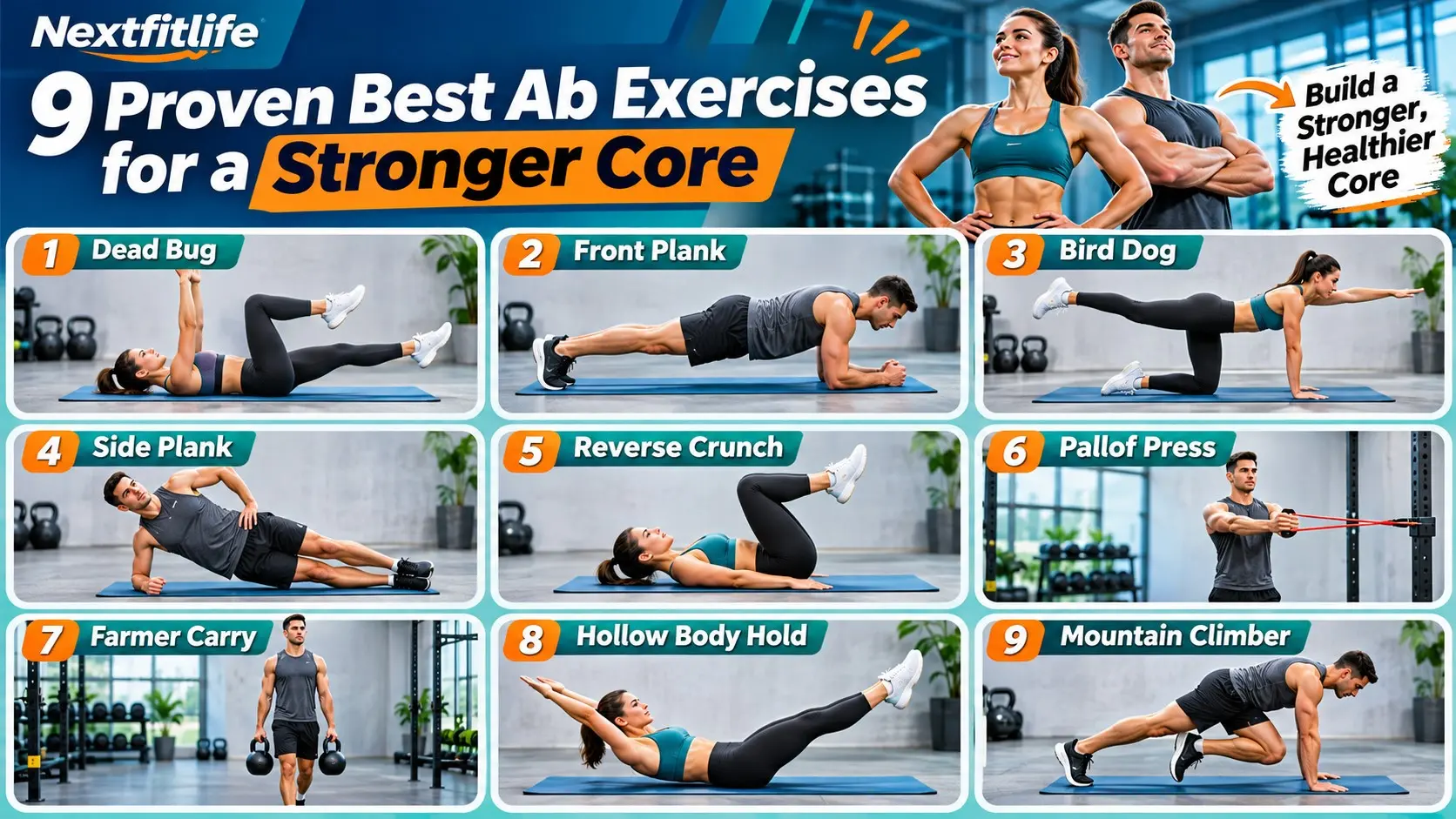
1. Dead Bug
The dead bug is one of the best exercises for learning trunk control while moving your arms and legs.
- Lie on your back.
- Raise your arms toward the ceiling.
- Bring your hips and knees to a comfortable bent position.
- Brace gently through your abdomen.
- Slowly lower one arm and the opposite leg.
- Stop before your lower back loses control.
- Return and switch sides.
Starting target: 6 to 10 repetitions per side.
Move slowly. The goal is control, not speed.
2. Front Plank
The plank trains your body to resist excessive extension through the trunk.
- Place your forearms on the floor.
- Extend your legs behind you.
- Keep your body in a comfortable straight line.
- Brace your abdomen.
- Breathe normally while holding the position.
Starting target: 15 to 30 seconds.
If a floor plank is too difficult, place your forearms or hands on a bench or sturdy counter.
You do not need to hold a plank for several minutes. Increase difficulty once a basic hold becomes easy.
3. Bird Dog
The bird dog trains your trunk while your opposite arm and leg move.
- Start on your hands and knees.
- Brace gently.
- Reach one arm forward.
- Extend the opposite leg backward.
- Keep your torso controlled.
- Return slowly.
- Switch sides.
Starting target: 6 to 12 repetitions per side.
Avoid rotating your hips just to lift your leg higher.
4. Side Plank
The side plank challenges your obliques and lateral trunk muscles.
- Lie on your side.
- Place your forearm under your shoulder.
- Bend your knees for an easier version or straighten your legs for more challenge.
- Lift your hips.
- Keep breathing.
Starting target: 15 to 30 seconds per side.
Progress from bent knees to straight legs when you are ready.
5. Reverse Crunch
The reverse crunch adds controlled trunk and pelvic movement rather than another long static hold.
- Lie on your back.
- Bend your knees.
- Bring your thighs toward your torso.
- Use your abdominal muscles to gently curl your pelvis upward.
- Lower with control.
Starting target: 8 to 15 repetitions.
Avoid throwing your legs backward and forward to create momentum.
6. Pallof Press
The Pallof press is an anti rotation exercise. Your job is to resist being pulled sideways.
- Attach a resistance band safely beside you.
- Hold the band with both hands at your chest.
- Stand with your feet stable.
- Press your hands forward.
- Resist turning toward the anchor.
- Bring your hands back slowly.
Starting target: 8 to 12 repetitions per side.
Use a light band until you understand the movement.
7. Farmer Carry
The farmer carry trains your grip, shoulders, legs, and core while you walk.
- Hold one dumbbell in each hand.
- Stand tall without forcing your ribs upward.
- Walk with controlled steps.
- Keep the weights steady.
- Turn carefully.
Starting target: 20 to 45 seconds.
This is a useful example of how core training can be integrated into whole body strength work.
8. Hollow Body Hold
The hollow hold is a more advanced anti extension exercise.
- Lie on your back.
- Bring your knees toward your torso.
- Gently brace your abdomen.
- Lift your shoulders slightly if comfortable.
- Extend your arms or legs only as far as you can while keeping control.
Starting target: 10 to 20 seconds.
If your lower back arches or hurts, use a dead bug instead.
9. Slow Mountain Climber
A slow mountain climber combines shoulder support with controlled hip movement.
- Begin in a high plank position.
- Brace your abdomen.
- Bring one knee toward your torso.
- Return it slowly.
- Switch sides.
Starting target: 8 to 15 repetitions per side.
If the floor version is too difficult, place your hands on a bench or counter.
Best Ab Exercises by Goal
| Goal | Best Choices | Main Focus |
|---|---|---|
| Beginner Control | Dead bug, bird dog | Trunk control |
| Front Core | Plank, hollow hold | Anti extension |
| Obliques | Side plank, Pallof press | Side stability and rotation resistance |
| Dynamic Ab Work | Reverse crunch | Controlled trunk flexion |
| Whole Body Core | Farmer carry | Bracing while moving |
| Home Cardio Core | Slow mountain climber | Core and shoulder control |
Beginner Ab Workout
Beginners do not need a long ab session.
| Exercise | Sets | Target |
|---|---|---|
| Dead Bug | 2 | 6 to 10 each side |
| Bird Dog | 2 | 6 to 10 each side |
| Incline Plank | 2 | 15 to 30 seconds |
| Bent Knee Side Plank | 2 | 10 to 20 seconds each side |
Perform this workout two or three times per week if it fits your wider training program.
Intermediate Core Workout
| Exercise | Sets | Target |
|---|---|---|
| Reverse Crunch | 3 | 8 to 15 reps |
| Side Plank | 2 | 20 to 40 seconds each side |
| Pallof Press | 3 | 8 to 12 each side |
| Farmer Carry | 3 | 30 to 45 seconds |
| Slow Mountain Climber | 2 | 10 to 15 each side |
Best Ab Workout at Home
You can train your core effectively with little or no equipment.
A simple home ab workout could include:
- Dead bug
- Front plank
- Side plank
- Reverse crunch
- Bird dog
If you own a resistance band, add the Pallof press.
If you have dumbbells, add farmer carries.
For more home training options, visit the Home Workouts and Equipment Hub.
How Many Sets and Reps Should You Do?
There is no single perfect rep range for every core exercise because some are performed for repetitions and others for time.
A simple guide is:
- 6 to 12 repetitions per side for dead bugs and bird dogs
- 8 to 15 repetitions for reverse crunches
- 15 to 45 seconds for planks
- 8 to 15 repetitions per side for Pallof presses
- 20 to 60 seconds for loaded carries
Your final repetitions or seconds should feel challenging without your technique falling apart.
How Often Should You Train Your Abs?
Your abdominal muscles do not need a separate hard workout every day.
Two to three focused sessions per week can work well for many people, especially when your wider strength program already includes squats, rows, presses, carries, and other exercises that challenge the core.
CDC guidance recommends muscle strengthening activity on at least two days per week and includes the abdomen among the major muscle groups.
How to Make Ab Exercises Harder
Your body adapts to training, so you need some form of progressive overload.
You can progress by:
- Adding repetitions
- Adding a few seconds
- Using more resistance
- Using a stronger band
- Holding a heavier dumbbell
- Increasing your movement range
- Using a harder exercise variation
- Improving control
You do not need to make every exercise harder at once.
Simple Plank Progression
- Wall plank
- Incline plank
- Floor plank
- Longer lever plank
- Loaded or more challenging plank variation
Move to a harder version once the current variation becomes easy with good control.
How Should You Breathe During Ab Exercises?
Do not hold your breath through every repetition.
For most moderate core exercises:
- Breathe in naturally.
- Brace your trunk gently.
- Exhale during the harder part when useful.
- Keep breathing during planks and carries.
Bracing does not mean sucking your stomach in as hard as possible.
Think about creating enough tension to keep your trunk controlled while still being able to breathe.
Are Crunches Bad for You?
No exercise is automatically bad for everyone.
Controlled spinal flexion can be appropriate for many healthy people.
However, endless fast crunches are not necessary for a strong core.
If crunch type movements bother your neck or back, choose dead bugs, bird dogs, Pallof presses, carries, or other comfortable alternatives.
Best Ab Exercises for Lower Back Comfort
If your lower back is sensitive, simpler stabilization exercises may feel better than aggressive trunk flexion.
Options include:
- Dead bug
- Bird dog
- Incline plank
- Modified side plank
- Pallof press
A 2026 study found that dead bugs and bird dogs create different abdominal activation patterns, but muscle activation alone does not prove that one exercise will treat back pain.
If you have persistent or severe back pain, get individual medical or physical therapy advice rather than assuming an ab routine will fix the cause.
Can Ab Exercises Burn Belly Fat?
No.
This is one of the most important myths to correct.
Ab exercises strengthen abdominal muscles. They do not force your body to remove fat specifically from your stomach.
Visible abs depend on several things, including:
- Abdominal muscle development
- Overall body fat
- Genetics
- Body fat distribution
If fat loss is your goal, focus on your overall eating pattern, activity, sleep, and sustainable calorie balance.
See our Basic Weight Loss Tips and Best Foods to Burn Belly Fat for evidence based guidance.
Can You Get Abs Fast?
You can improve exercise skill quickly, but meaningful changes in strength and appearance take time.
No safe exercise program can promise a visible six pack in a fixed number of days.
Your progress depends on:
- Your starting fitness
- Training consistency
- Progressive resistance
- Nutrition
- Sleep
- Genetics
- Body composition
Focus on getting stronger rather than chasing a deadline.
Are Planks Better Than Crunches?
They train different functions.
A plank mainly asks your core to resist movement.
A crunch uses more controlled trunk flexion.
Neither exercise wins every comparison.
A balanced program can use stabilization exercises and dynamic movements when they are comfortable.
Do Squats and Deadlifts Train Your Abs?
Yes, compound exercises can challenge your core because your trunk must stay controlled while force moves through your body.
However, that does not mean direct core training is useless.
Focused exercises can let you train specific trunk functions that may not receive much direct work from your main lifts.
Best Ab Exercises for Adults Over 50
Core strength remains useful as you age.
Simple exercises that are easy to modify include:
- Dead bugs
- Bird dogs
- Incline planks
- Modified side planks
- Farmer carries
Your exercise choice should depend on current ability, health, and comfort rather than age alone.
Adults also benefit from training the entire body, not just the abs.
For a wider program, visit our 5 Components of Physical Fitness guide.
Common Ab Workout Mistakes
Doing Hundreds of Crunches
More repetitions do not automatically mean better results.
Training Abs Every Day
Your core muscles also need recovery and already work during many compound exercises.
Holding Your Breath
Keep breathing during normal core training unless you have a specific reason and proper coaching for another technique.
Rushing the Dead Bug
The dead bug is about control. Moving faster often makes it easier rather than better.
Letting the Lower Back Sag in Planks
Use a shorter hold or an incline variation if you cannot control the position.
Using Momentum During Reverse Crunches
Move your pelvis with control instead of swinging your legs.
Expecting Spot Reduction
Ab exercises do not selectively remove belly fat.
Never Making Exercises Harder
Once an exercise becomes easy, add a small challenge.
Simple 8 Week Core Progression
| Weeks | Focus | Goal |
|---|---|---|
| 1 and 2 | Learn dead bug, bird dog, and incline plank | Build control |
| 3 and 4 | Add repetitions or time | Build endurance |
| 5 and 6 | Add side plank and reverse crunch | Train more core functions |
| 7 | Add resistance or harder variations | Increase challenge |
| 8 | Review performance | Adjust exercise difficulty |
When Should You Stop Exercising?
Normal muscle effort and fatigue can occur during core training. Sharp or unusual symptoms are different.
Stop and seek appropriate medical care if you develop:
- Severe or sudden abdominal pain
- Chest pain or pressure
- Fainting
- Severe unusual shortness of breath
- Sudden severe back pain
- New weakness
- New significant numbness
- Loss of bladder or bowel control
- Severe pain after an injury
If you recently had abdominal surgery, are pregnant, recently gave birth, have a hernia, or have a significant medical condition, ask an appropriate healthcare professional about exercise modifications.
Conclusion
The best ab exercises train more than the visible six pack. Dead bugs, planks, bird dogs, side planks, reverse crunches, Pallof presses, carries, and other controlled movements strengthen different parts of your core and teach your trunk to manage force.
You do not need hundreds of repetitions or a daily ab challenge. Consistent training with gradual progression is a better approach.
Your next step: choose four exercises from this guide, complete two controlled sets of each, and repeat the workout twice this week. Record your repetitions or hold times so you have a clear starting point.
References and Sources
- American College of Sports Medicine. Updated Resistance Training Guidelines, 2026. Current evidence emphasizes consistency, progressive training, and simple resistance exercise rather than unnecessary complexity.
https://acsm.org/resistance-training-guidelines-update-2026/ - Centers for Disease Control and Prevention. Adult Physical Activity Guidelines. Adults should perform muscle strengthening activity on at least two days each week, including work for the abdomen and other major muscle groups.
https://www.cdc.gov/physical-activity-basics/guidelines/adults.html - Jeon H, Lim H, Son J, Tae K, Lee H. Task Specific Abdominal Muscle Recruitment and Relative Activation Onset During Core Stabilization Exercises. 2026. Research comparing dead bug, bird dog, and abdominal drawing in tasks.
https://pubmed.ncbi.nlm.nih.gov/42960974/ - American College of Sports Medicine. Resistance Training Prescription for Muscle Function, Hypertrophy, and Physical Performance in Healthy Adults. Evidence based position stand published in 2026.
https://pubmed.ncbi.nlm.nih.gov/41843416/ - Centers for Disease Control and Prevention. Physical Activity Recommendations by Age. Guidance on aerobic exercise, strength training, and balance across adulthood.
https://www.cdc.gov/physical-activity-basics/guidelines/index.html
Internal Links + Fitness Hub
- Core Workouts at Home
- NextFitLife Fitness Hub
- Fitness Program Guide
- Strength Training and Muscle Building Guide
- Home Workouts and Equipment Hub
- Upper Body Workout
- Upper Body Workout for Women
- Best Ab Exercises for Men Over 50
- Injury Prevention Exercises
- Basic Weight Loss Tips
- Best Foods to Burn Belly Fat
- 5 Components of Physical Fitness
About the Author
Adel Galal is a father of four, three sons and a daughter, and a grandfather of four, with 33 years of hands on parenting experience. He is the founder of Parnthub.com, based in Cairo, Egypt, where he shares practical guidance on feeding, development and family life from newborns to teenagers.
Adel is not a medical professional. Health articles cite trusted sources and are for general information only.
Learn more on the NextFitLife About Us page.
Frequently Asked Questions
What are the best ab exercises?
The best ab exercises include dead bugs, planks, bird dogs, side planks, reverse crunches, Pallof presses, farmer carries, hollow body holds, and controlled mountain climbers. Using several movement types gives you a more balanced core workout.
What are the best ab exercises for beginners?
Dead bugs, bird dogs, incline planks, and bent knee side planks are useful beginner exercises because they can be adjusted easily and emphasize controlled trunk movement.
How often should I train my abs?
Two to three focused core sessions per week can work well for many people. Your abdominal muscles also work during many full body strength exercises.
Can ab exercises burn belly fat?
No. Ab exercises strengthen abdominal muscles but cannot selectively remove fat from your stomach. Overall fat loss depends on energy balance and other individual factors.
Are planks better than crunches?
Neither is universally better. Planks primarily challenge the core to resist movement, while crunches use controlled trunk flexion. A balanced program can use different exercise types.
How long should I hold a plank?
Beginners can start with about 15 to 30 seconds while maintaining good control. Once that becomes easy, use a harder variation rather than trying to hold an easy plank for several minutes.
Can I train abs every day?
You can use light core activity often, but hard direct ab training every day is not necessary. Like other muscles, your core can benefit from recovery between challenging sessions.
Are dead bugs good for the core?
Yes. Dead bugs train abdominal control while the arms and legs move. A 2026 study found that dead bug tasks produced distinct abdominal activation patterns compared with bird dog and abdominal drawing in tasks.
What is the best ab exercise for lower back comfort?
No exercise is best for every person, but dead bugs, bird dogs, incline planks, modified side planks, and Pallof presses are easy to scale. Persistent or severe back pain requires individual assessment.
How long does it take to strengthen your abs?
There is no fixed timeline. Progress depends on your starting fitness, exercise difficulty, training frequency, recovery, and progression. Focus on steady improvements in control, repetitions, resistance, or hold time.

Health & wellness writer with 30+ years of experience in nutrition, fitness, and healthy aging. Founder of NextFitLife.com — evidence-based health guidance.

