Last Updated: July 12, 2026
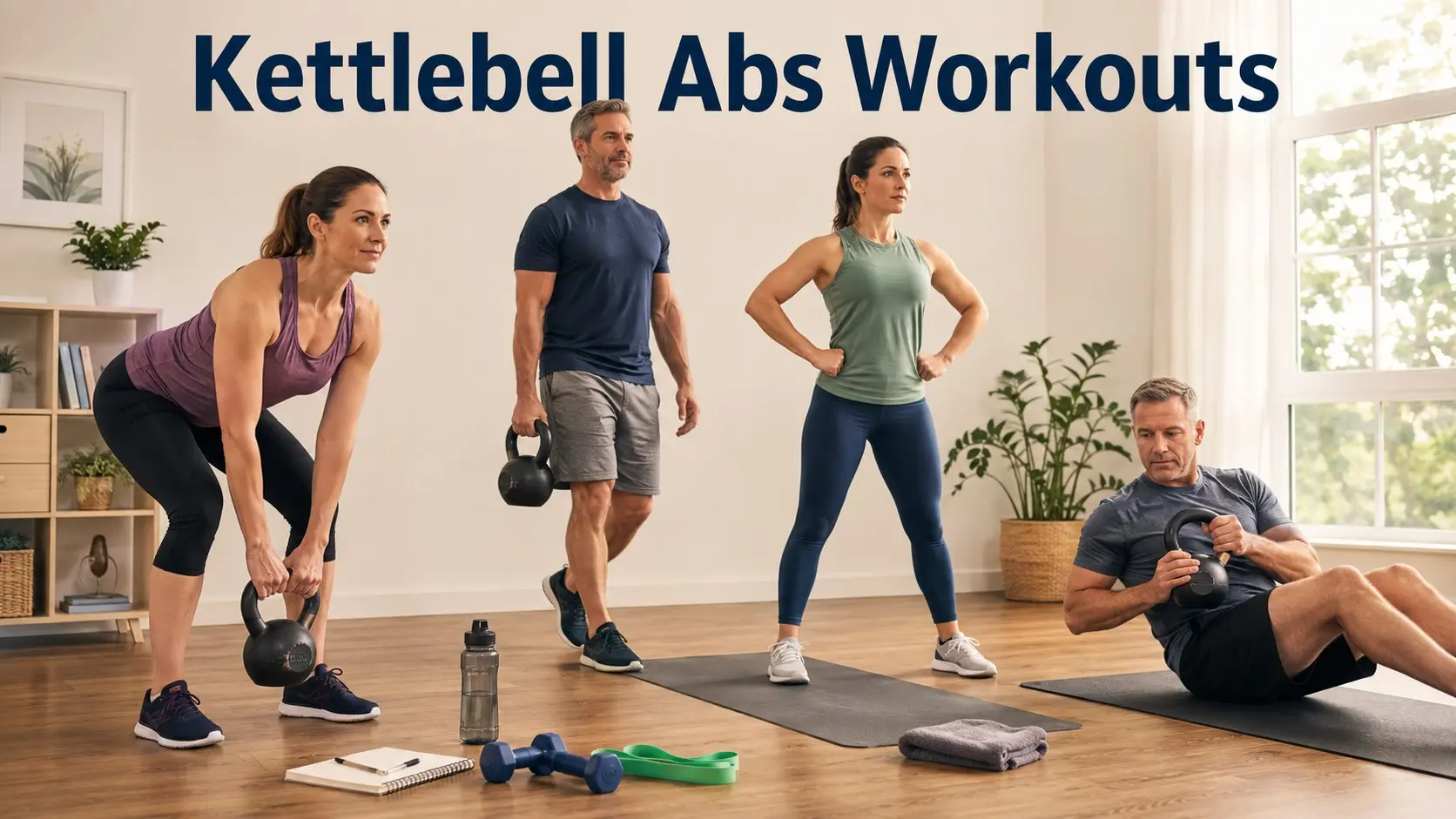
Topic: Kettlebell Abs Workouts
Reading Time: About 10 minutes
Content Note: This article is for education only. It does not replace medical advice.
Kettlebell Abs Workouts can help you train your core in a strong and useful way.
But they need care.
A kettlebell is not a toy.
It can help your abs, hips, back, shoulders, grip, and balance.
It can also cause strain if you swing too fast, twist too hard, or use a weight that is too heavy.
This guide keeps things simple.
You will learn safe kettlebell core moves, form tips, beginner workouts, and ways to progress without rushing.
Quick answer
Kettlebell Abs Workouts train your core with moves such as carries, deadlifts, standing marches, halos, controlled twists, and plank drags.
Start with a light kettlebell.
Move slowly.
Keep your core braced.
Stop if you feel sharp pain, dizziness, chest pain, or severe shortness of breath.
What are Kettlebell Abs Workouts?
Kettlebell Abs Workouts are core routines that use a kettlebell for resistance.
Your core is more than your front abs.
It also includes your sides, back, hips, deep trunk muscles, and muscles that help you stay steady.
This is why core strength matters.
A strong core helps you stand, walk, lift, carry, turn, and protect your posture during daily life.
Why kettlebells can train your core
A kettlebell has a handle.
The weight sits below the handle.
That shape can challenge your balance and control.
When you carry, lift, or move a kettlebell, your core works to keep your body steady.
This makes kettlebells useful for functional core training.
Functional means the exercise can support normal life movement, like carrying bags, lifting items, or staying balanced.
Who should be careful with kettlebell core exercises?
Kettlebell work can be safe when done well.
But it is not right for everyone without guidance.
Talk with a qualified healthcare professional before starting if you have:
- Back pain
- Neck pain
- Shoulder pain
- Hip pain
- Hernia
- Pregnancy
- Recent surgery
- Balance problems
- Dizziness or fainting
- Heart disease
- High blood pressure
- A long term health condition
Stop right away if you feel chest pain, fainting, severe dizziness, sudden weakness, severe shortness of breath, sharp pain, or symptoms that feel unsafe.
How to choose the right kettlebell
Start lighter than you think.
You should be able to control the weight.
Your back should not round.
Your shoulders should not shrug hard.
Your breath should stay steady.
Your form should look the same from the first rep to the last rep.
This is part of safe kettlebell training.
Form rules before you start
Use these rules for every move.
- Stand tall.
- Keep your feet steady.
- Brace your core gently.
- Do not hold your breath.
- Move with control.
- Keep your shoulders relaxed.
- Stop before the form breaks.
Good form matters more than heavy weight.
How to brace your core
Core bracing means making your middle steady.
Think of getting ready for someone to tap your stomach.
Do not suck in hard.
Do not hold your breath.
Just make your trunk firm and steady.
This helps with abdominal bracing during kettlebell moves.
Warm up first
Do this for 5 minutes before the workout.
- March in place for 60 seconds.
- Do shoulder rolls 10 times.
- Do hip circles 10 times.
- Do bodyweight squats to a chair 10 times.
- Practice a hip hinge 10 times.
- Take 5 slow breaths.
Now your body is ready for light core work.
1. Kettlebell suitcase carry
This is one of the best simple kettlebell core moves.
You hold the kettlebell on one side.
Your core works to keep you from leaning.
How to do it
- Hold a kettlebell in one hand.
- Stand tall.
- Keep shoulders level.
- Brace your core.
- Walk slowly for 20 to 30 seconds.
- Switch sides.
Do 2 rounds on each side.
This move trains core stability.
2. Kettlebell deadlift
This move trains your hips, back, legs, and core.
It teaches safe lifting.
How to do it
- Place the kettlebell between your feet.
- Stand with feet hip width apart.
- Push your hips back.
- Keep your back long.
- Hold the handle.
- Stand up by pushing through your feet.
- Lower with control.
Do 8 to 10 reps.
This is a base move for kettlebell core exercises.
3. Kettlebell halo
This move trains shoulders, posture, and core control.
Use a lightweight.
How to do it
- Hold the kettlebell by the horns near your chest.
- Stand tall.
- Brace your core.
- Move the kettlebell slowly around your head.
- Keep your ribs down.
- Switch direction.
Do 5 circles each way.
Move slowly.
Do not arch your back.
4. Kettlebell standing march
This move trains core control and balance.
How to do it
- Hold the kettlebell at your chest.
- Stand tall.
- Brace your core.
- Lift one knee slowly.
- Lower it.
- Switch sides.
Do 20 to 30 seconds.
Hold a wall if balance is hard.
This supports balance exercises too.
5. Kettlebell goblet squat
This move trains legs, hips, and core.
Your core works to keep your chest tall.
How to do it
- Hold the kettlebell at your chest.
- Stand with feet a little wider than hips.
- Brace your core.
- Sit back and down.
- Keep chest lifted.
- Stand up with control.
Do 8 to 10 reps.
Use a chair behind you if needed.
6. Kettlebell plank drag
This is harder.
Use it only if you can hold a safe plank.
How to do it
- Start in a high plank position.
- Place the kettlebell outside one hand.
- Brace your core.
- Use the opposite hand to drag the kettlebell across.
- Keep hips steady.
- Switch sides.
Do 4 to 6 drags on each side.
Skip this if your wrists, shoulders, or back hurt.
This is an advanced anti-rotation exercise.
7. Kettlebell side bend
This move trains the sides of your core.
Use a lightweight.
How to do it
- Hold the kettlebell in one hand.
- Stand tall.
- Brace your core.
- Slide the kettlebell down your thigh a little.
- Return to center.
- Switch sides.
Do 8 reps on each side.
Keep the range small.
This trains oblique exercises with control.
8. Kettlebell Russian twist setup
This move can bother some backs.
Keep it gentle.
Do not twist hard.
How to do it
- Sit on a mat.
- Keep your feet on the floor.
- Hold a light kettlebell near your chest.
- Lean back only a little.
- Turn slightly to one side.
- Return to center.
- Turn slightly to the other side.
Do 6 to 8 reps on each side.
Stop if your back feels uncomfortable.
9. Kettlebell front rack hold
This move looks simple.
It trains core control, posture, and breathing.
How to do it
- Hold the kettlebell close to your chest.
- Stand tall.
- Brace your core.
- Keep shoulders relaxed.
- Hold for 20 to 30 seconds.
Do 2 rounds.
This helps with posture training.
10. Kettlebell half kneeling press
This move trains shoulders and core.
It is harder than it looks.
How to do it
- Kneel with one knee down and one foot forward.
- Hold a light kettlebell at shoulder height.
- Brace your core.
- Press the kettlebell up slowly.
- Lower with control.
- Switch sides.
Do 6 to 8 reps on each side.
Keep your ribs down.
Use a dumbbell instead if the kettlebell feels awkward.
Beginner Kettlebell Abs Workout
Use this routine 2 days each week.
Rest at least 1 day between sessions.
Round 1
- Kettlebell deadlift, 8 reps
- Suitcase carry, 20 seconds each side
- Front rack hold, 20 seconds
- Standing march, 20 seconds
Rest 60 seconds.
Round 2
- Goblet squat, 8 reps
- Kettlebell halo, 5 circles each way
- Side bend, 8 reps each side
- Suitcase carry, 20 seconds each side
Start with 1 round if you are new.
Build to 2 rounds.
Then build up to 3 rounds when your body feels ready.
5-Minute Kettlebell Abs Workout
Use this on busy days.
- Minute 1: Kettlebell deadlift
- Minute 2: Suitcase carry-on on the right side
- Minute 3: Suitcase carry-on on the left side
- Minute 4: Front rack hold
- Minute 5: Gentle march with no weight
This is simple and safe for many beginners.
Kettlebell Abs Workouts at home
You can do kettlebell core work at home.
Keep the space clear.
Wear stable shoes.
Use a mat if needed.
Place pets, cords, and clutter away from your workout area.
This helps make home kettlebell workout sessions safer.
How often should you do kettlebell core work?
Start with 2 days each week.
Rest between sessions.
Your core also works during squats, rows, carries, walking, and daily movement.
You do not need hardcore training every day.
Recovery helps you get stronger.
Can kettlebell abs workouts burn belly fat?
Kettlebell abs workouts can train your core.
They can help you move more.
They can support fitness.
But they cannot choose where fat leaves first.
No core workout can spot-reduce belly fat.
For fat loss, focus on:
- Balanced meals
- Protein
- Daily steps
- Strength training
- Sleep
- Stress control
- A safe calorie gap
This is better than chasing quick fixes.
Common mistakes to avoid
- Using a kettlebell that is too heavy
- Rounding the back
- Twisting too hard
- Holding the breath
- Swinging without learning from
- Doing too many reps when tired
- Training through sharp pain
- Skipping warm-up
Slow, clean reps are better than fast, messy reps.
How to make the workout easier
- Use a lighter kettlebell.
- Do fewer reps.
- Use bodyweight first.
- Take a longer rest.
- Skip plank drags and twists.
- Use a chair for balance.
This keeps the workout safe.
How to make the workout harder
Only change one thing at a time.
- Add one more round.
- Add 2 reps.
- Use a slightly heavier kettlebell.
- Walk longer on carries.
- Slow the lowering phase.
- Add the plank drag when ready.
This is a simple way to use progressive overload.
What to do after the workout
Cool down for 3 to 5 minutes.
- Walk slowly.
- Stretch your hips gently.
- Stretch your chest gently.
- Breathe slowly.
- Drink water.
This supports workout recovery.
My simple rule
Your kettlebell should never control you.
You control the kettlebell.
If the weight pulls you out of form, it is too heavy.
If your back hurts, stop.
If you cannot breathe well, slow down.
Safe control is the goal.
Conclusion
Kettlebell Abs Workouts can build core strength, balance, grip, posture, and better control.
Start with deadlifts, suitcase carries, halos, goblet squats, and front rack holds.
Use a light kettlebell.
Move slowly.
Rest well.
Your next step: choose 4 moves from this Kettlebell Abs Workouts guide and try one gentle round today with safe form and steady breathing.
Related guides from NextFitLife
This article is part of our Fitness Hub. You may also want to visit our Advanced Training & Performance Guide, Strength Training & Muscle Building Guide, and Home Workouts & Equipment Guide.
FAQ
What are Kettlebell Abs Workouts?
Kettlebell Abs Workouts are core routines that use a kettlebell for resistance. They may include carries, deadlifts, halos, goblet squats, plank drags, and core holds.
Are kettlebell abs workouts good for beginners?
Yes, beginners can start with light kettlebell moves such as deadlifts, suitcase carries, front rack holds, and standing marches. Avoid fast swings until you learn safe form.
Can kettlebell abs workouts reduce belly fat?
No core workout can spot-reduce belly fat. Kettlebell abs workouts can train your core, but fat loss depends on food habits, movement, sleep, stress, and consistency.
How often should I do kettlebell core workouts?
Many beginners can start with 2 days each week. Rest between sessions and stop if you feel sharp pain or unsafe symptoms.
What kettlebell weight should I start with?
Start with a light kettlebell you can control. Your form should stay steady, your back should not round, and you should not need to hold your breath.
Who should talk to a doctor before kettlebell abs workouts?
Talk with a healthcare professional if you have back pain, hernia, pregnancy, dizziness, heart disease, high blood pressure, recent surgery, severe joint pain, or a long-term condition.
References and Sources
- Centers for Disease Control and Prevention. Adult Activity: An Overview.
- Mayo Clinic. Why You Should Strengthen Your Core Muscles.
- MedlinePlus. How to Avoid Exercise Injuries.
- American Heart Association. Strength and Resistance Training Exercise.
- Mayo Clinic. Weight Training: Do's and Don'ts of Proper Technique.

Health & wellness writer with 30+ years of experience in nutrition, fitness, and healthy aging. Founder of NextFitLife.com — evidence-based health guidance.