Published on: July 28, 2025
Updated on: October 17, 2026
Written and source checked by: Adel Galal, Founder and Lead Writer at NextFitLife
Medical review status: This article has not been medically reviewed by a dermatologist, pediatrician, allergist, dentist, pharmacist, or other licensed healthcare professional.
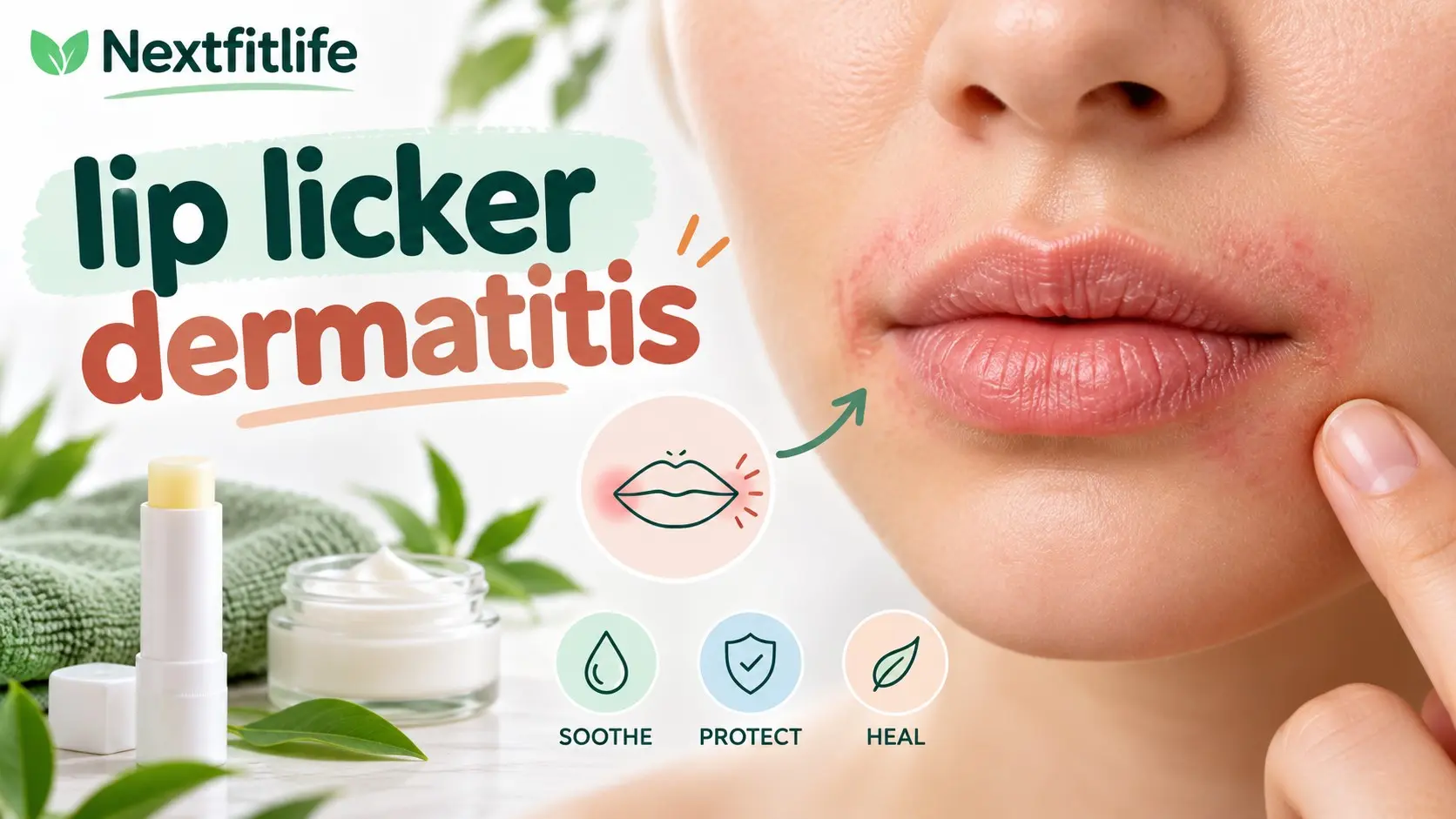
Lip licker dermatitis is an irritated, dry, burning rash caused by repeatedly licking the lips and the skin around them. The saliva feels soothing for a moment, but as it dries, the skin barrier becomes more irritated and dry. That makes the person want to lick again.
This creates a simple but stubborn cycle: dry skin leads to licking, licking creates more irritation, and the new irritation leads to even more licking.
The good news is that the condition usually improves when that cycle is broken and the damaged skin barrier is protected consistently.
This article is for general information and education. It does not replace medical advice, diagnosis, or treatment.
For related lip and facial conditions, see Dermatitis on Lips, Eczema Around Mouth, and Perioral Dermatitis.
Table of Contents
- What lip licker dermatitis is
- What it looks and feels like
- Dryness
- Burning
- Scaling
- Cracking
- Color changes
- Why saliva makes it worse
- How it differs from similar conditions
- Perioral dermatitis
- Atopic eczema
- Allergic contact cheilitis
- Angular cheilitis
- Infection
- 10 effective relief steps
- Recognize the licking pattern
- Stop the wet and dry cycle
- Use a barrier ointment
- Simplify lip care
- Protect against weather
- Use gentle cleansing
- Address habit triggers
- Use medicated treatment correctly
- Watch for infection
- Get help when it persists
- Children and lip licker dermatitis
- Nighttime licking
- Foods, toothpaste, and lip products
- Prevention
- When to see a dermatologist
- Frequently asked questions
What Is Lip Licker Dermatitis?
Lip licker dermatitis is a type of irritant contact dermatitis.
It develops when saliva repeatedly touches the lips and nearby skin.
Saliva is mostly water, but it also contains enzymes and other substances made to help digest food. Those substances are not designed to sit on skin all day.
Repeated licking also keeps the skin moving between wet and dry states.
That cycle strips away normal protective oils and weakens the skin barrier.
The result can be:
- Dry skin
- Burning
- Scaling
- Cracking
- Redness or darker color
- Stinging
- Itching
Why Does Lip Licking Make Dryness Worse?
Licking seems like it should moisturize the lips.
It does the opposite over time.
Here is what happens:
- The lips feel dry.
- You lick them.
- The saliva briefly makes them feel wet.
- The water evaporates.
- The skin becomes even drier and more irritated.
- You feel another urge to lick.
This is the wet and dry cycle.
Breaking this loop is the most important part of treatment.
What Does Lip Licker Dermatitis Look Like?
The rash usually follows the area the tongue can reach.
This creates a pattern around the lips that can look almost like a ring or band.
A very useful clue is that the rash often crosses the lip border.
That means inflammation can affect both the lips and the skin around them.
Common signs include:
- Dry flaky lips
- Rough skin around the mouth
- Scaling
- Cracks
- Burning
- Stinging
- Itching
- Red or darker skin
- Skin that looks shiny or tight after repeated licking
How It Looks on Different Skin Tones
Do not rely only on bright redness.
On lighter skin, lip licker dermatitis may appear pink or red.
On deeper skin tones, it may appear:
- Brown
- Purple
- Gray
- Dark red
- Darker than nearby skin
After the active rash improves, darker or lighter marks may remain for a while.
This is called post inflammatory pigment change.
Where Does the Rash Usually Appear?
The rash often affects:
- The upper lip
- The lower lip
- The skin directly above the upper lip
- The chin
- The corners of the mouth
The exact shape usually reflects the person's licking pattern.
This clue can help distinguish lip licker dermatitis from other facial rashes.
Lip Licker Dermatitis vs Perioral Dermatitis
These are often confused, but they are not the same condition.
Lip licker dermatitis is mainly caused by saliva irritation and often crosses directly over the lip border.
Perioral dermatitis usually causes clusters of small bumps around the mouth and often leaves a narrow strip of normal skin immediately beside the lips.
| Feature | Lip Licker Dermatitis | Perioral Dermatitis |
|---|---|---|
| Main appearance | Dry, scaly, irritated skin | Small inflammatory bumps |
| Lip border | Usually crossed by the rash | Often relatively spared |
| Main trigger | Repeated saliva exposure | Often associated with facial steroid use and skin care factors |
| Typical feeling | Dryness, burning, stinging | Burning, tightness, bumps |
| Main treatment direction | Stop licking and repair the barrier | Review steroid exposure and use targeted treatment |
For more detail, read Perioral Dermatitis: Causes, Signs, and Treatment.
Lip Licker Dermatitis vs Atopic Eczema
Some people with lip licker dermatitis also have atopic dermatitis.
Atopic skin is naturally more vulnerable to dryness and barrier damage, so lip licking can create a stronger reaction.
Atopic eczema becomes more likely when there is eczema elsewhere, such as:
- Inside the elbows
- Behind the knees
- Hands
- Face
- Neck
A person can have both conditions at the same time.
For broader eczema guidance, see Atopic Eczema.
Lip Licker Dermatitis vs Allergic Contact Cheilitis
Allergic contact cheilitis is a delayed allergic reaction affecting the lips.
Possible triggers include:
- Lip balm
- Lipstick
- Toothpaste
- Mouthwash
- Fragrance
- Flavoring
- Preservatives
- Dental products
The key difference is that lip licker dermatitis is driven by saliva irritation, while allergic contact cheilitis is driven by an allergen.
The two can overlap.
If the rash continues despite stopping the licking habit and using simple barrier care, patch testing may help uncover a contact allergy.
Lip Licker Dermatitis vs Angular Cheilitis
Angular cheilitis mainly affects the corners of the mouth.
It tends to cause:
- Painful cracks
- Crusting
- Red or darkened skin
- Bleeding
- Wet or softened skin
Saliva can contribute to both conditions.
But angular cheilitis is more focused at the mouth corners, while lip licker dermatitis usually spreads around the lips in the pattern reached by the tongue.
1. Recognize the Licking Pattern
Before you can stop the habit, notice when it happens.
Common times include:
- When lips feel dry
- During concentration
- While watching television
- When anxious
- During schoolwork
- Before falling asleep
- After eating
- In cold weather
Many people lick their lips without realizing it.
For children, parents may notice the pattern first.
2. Break the Wet and Dry Cycle
This is the heart of treatment.
Every time you feel the urge to lick, replace that action with something safer.
Useful substitutions include:
- Apply a simple barrier ointment
- Press the lips together gently instead of licking
- Take a sip of water if your mouth feels dry
- Use a reminder cue
For children, habit change should be supportive rather than punitive.
Scolding can create stress without fixing the behavior.
3. Use a Simple Barrier Ointment
A bland barrier ointment is one of the most useful tools.
Plain petrolatum is a common option because it has very few ingredients and reduces water loss.
Apply a thin layer:
- After washing
- Before bed
- Before going outside in cold weather
- Whenever the lips start feeling dry
- Before situations when habitual licking is likely
The ointment acts like a physical barrier between the skin and saliva.
4. Simplify Lip Care Products
This is not the time to test five new lip balms.
Pause unnecessary products containing:
- Fragrance
- Mint
- Cinnamon
- Flavoring
- Menthol
- Camphor
- Essential oils
- Strong botanical extracts
If a product tingles or burns, that is not proof it is healing your lips.
Burning can mean irritation.
5. Protect the Lips From Cold, Wind, and Dry Air
Cold and windy weather can dry the lips quickly.
This makes the urge to lick stronger.
Before going outside:
- Apply a barrier ointment
- Protect the lower face from strong wind when practical
- Reapply lip protection when needed
Very dry heated indoor air can have a similar effect.
A humidifier may help when indoor humidity is extremely low, but it should be cleaned properly to prevent mold or microbial growth.
6. Wash the Area Gently
Do not scrub the irritated skin.
Use lukewarm water.
If a cleanser is needed, choose a gentle fragrance free option.
After eating, remove food residue gently rather than repeatedly wiping the skin with a rough napkin.
Pat the area dry, then reapply barrier ointment if needed.
7. Address the Habit, Not Just the Rash
A cream cannot fully solve lip licker dermatitis if the licking continues all day.
The behavior itself must be addressed.
Habit reversal
A simple approach is:
- Notice the urge.
- Stop before licking.
- Replace the licking with another action.
- Reward consistency rather than perfection.
A child may benefit from a sticker chart or gentle reminder system.
An adult may use phone reminders or keep barrier ointment nearby as a replacement behavior.
When anxiety plays a role
Some people lick their lips more during stress or anxiety.
In that situation, stress management and behavioral support may help reduce the habit.
The point is not that anxiety “causes” every case.
It can simply make the licking behavior harder to stop.
8. Medicated Treatment Can Help More Inflamed Skin
When inflammation is significant, a clinician may prescribe medication in addition to barrier care.
Possible treatments include a short course of a low potency topical corticosteroid when the diagnosis truly is irritant or eczematous dermatitis.
Nonsteroid topical medicines such as:
- Tacrolimus
- Pimecrolimus
may also be considered in selected cases.
These decisions matter because an incorrect steroid diagnosis around the mouth can worsen perioral dermatitis.
Do not borrow somebody else's steroid cream or keep using strong facial steroids without medical guidance.
9. Watch for Secondary Infection
Repeated licking and cracking can damage the skin enough for bacteria or yeast to become involved.
Possible infection signs include:
- Increasing pain
- Swelling
- Warmth
- Pus
- Thick yellow or honey colored crust
- Rapid spread
- Fever
Infection needs medical assessment.
Antibiotic or antifungal treatment is not routine lip licker dermatitis care unless infection is actually present.
10. Get Medical Help When the Rash Does Not Fit
If the rash continues despite stopping licking and using simple barrier care, another diagnosis may be responsible.
A clinician may consider:
- Atopic eczema
- Allergic contact cheilitis
- Perioral dermatitis
- Angular cheilitis
- Infection
- Another lip disorder
Persistent lip inflammation deserves diagnosis rather than endless trial and error.
Lip Licker Dermatitis Treatment at a Glance
| Problem | Best Direction | Key Point |
|---|---|---|
| Repeated licking | Habit awareness and replacement behavior | Behavior change is essential |
| Dry cracked skin | Bland barrier ointment | Reapply whenever skin becomes dry |
| Product irritation | Simplify lip and facial care | Avoid unnecessary fragrance and flavor |
| Significant inflammation | Clinician directed topical treatment | Confirm diagnosis before facial steroids |
| Possible allergy | Patch testing when appropriate | Lip products and toothpaste can be triggers |
| Possible infection | Medical assessment | Do not self treat every crust with antibiotics |
What Is the Fastest Way to Improve Lip Licker Dermatitis?
The fastest useful strategy is to address both parts of the problem at the same time:
- Stop repeated saliva exposure.
- Protect the skin with a bland barrier ointment.
Doing only one part often fails.
If you use ointment but keep licking every few minutes, the barrier is repeatedly disrupted.
If you stop licking but leave badly cracked skin unprotected, dryness can keep triggering the urge.
How Long Does Lip Licker Dermatitis Take to Heal?
There is no exact timeline for everyone.
Mild cases may begin improving once licking stops and the barrier is protected consistently.
More severe cases can take longer, especially when:
- The habit has continued for a long time
- The skin is badly cracked
- Atopic eczema is also present
- A contact allergy is involved
- Infection has developed
If the rash is not improving despite several days of consistent habit control and barrier care, or if it is worsening, have it checked.
Can Vaseline Help Lip Licker Dermatitis?
Plain petrolatum can be very useful.
It creates an occlusive barrier that reduces water loss and limits direct saliva contact with damaged skin.
It is also simple and fragrance free.
That makes it easier to tolerate than many flavored or fragranced lip balms.
However, if the rash is actually perioral dermatitis rather than lip licker dermatitis, heavy occlusive products can sometimes aggravate the problem.
Diagnosis still matters.
Can Lip Balm Make It Worse?
Yes, depending on the product.
Lip balms may contain:
- Flavoring
- Fragrance
- Menthol
- Camphor
- Essential oils
- Botanical extracts
- Preservatives
These ingredients can irritate already damaged skin or trigger contact allergy in some people.
A tingling sensation is not proof that a lip balm is working.
Does Drinking More Water Cure It?
No.
Drinking enough fluid is important for overall health, but lip licker dermatitis is not simply a sign that you need more water.
The main problem is repeated saliva irritation and barrier damage.
Drinking extra water will not repair the skin if lip licking continues.
Can Toothpaste Cause a Similar Rash?
Yes.
Toothpaste can cause irritant or allergic contact reactions around the lips.
Possible triggers include:
- Flavoring
- Mint compounds
- Cinnamon related ingredients
- Preservatives
- Other oral care ingredients
If the rash persists after the licking habit has stopped, oral care products become more important to investigate.
Do not stop fluoride toothpaste automatically. If toothpaste allergy is suspected, discuss a suitable alternative with a dentist or dermatologist.
Can Food Make It Worse?
Food can irritate already damaged skin.
Acidic or spicy foods may sting when they touch cracked lips.
Examples include:
- Citrus
- Tomato
- Spicy sauces
- Very salty foods
This is usually an irritant effect rather than a food allergy.
Signs of immediate food allergy can include:
- Hives
- Sudden swelling
- Vomiting
- Wheezing
- Breathing trouble
Those symptoms need medical assessment.
Can Stress Cause Lip Licking?
Stress does not cause every case.
But habitual behaviors often increase during:
- Anxiety
- Concentration
- Boredom
- Tiredness
If licking happens mostly during stress, habit reversal and stress management can be part of treatment.
This is especially helpful when the person has already tried barrier products but keeps unconsciously licking.
Lip Licker Dermatitis in Children
Children are commonly affected because lip licking can quickly become automatic.
Cold weather, dry lips, school stress, and attention habits can all make licking more frequent.
The best approach combines:
- Barrier ointment
- Gentle reminders
- Positive reinforcement
- Avoiding irritating lip products
- Weather protection
Do not shame the child
Calling attention to the rash constantly can increase embarrassment and stress.
Use calm reminders instead.
A sticker chart or small reward system can make habit change feel positive.
Make the replacement easy
Keep the approved barrier ointment where the child can reach it.
The new habit should become:
What About Lip Licking at Night?
Some people lick their lips while falling asleep or during the night.
This may be harder to control consciously.
Useful steps can include:
- Applying barrier ointment before bed
- Keeping the bedroom comfortably humid
- Addressing nasal blockage if mouth breathing is a problem
- Using gentle skin care before sleep
If heavy drooling or chronic mouth breathing is contributing, that issue may need separate medical or dental evaluation.
Can Mouth Breathing Make It Worse?
It can contribute to lip dryness.
A constantly open mouth allows more evaporation around the lips.
That dryness can trigger more licking.
Persistent mouth breathing can occur with:
- Nasal congestion
- Allergies
- Structural nasal problems
- Sleep related breathing problems
If mouth breathing is frequent, treating the underlying cause may help reduce repeat dryness.
Does Lip Licker Dermatitis Leave Dark Skin?
It can.
Repeated inflammation can leave post inflammatory hyperpigmentation.
This is especially noticeable in deeper skin tones.
The pigment can remain after:
- Burning stops
- Scaling improves
- Cracks heal
If the skin is smooth and no longer irritated, the remaining darker color may represent healing rather than active dermatitis.
Can It Cause Scarring?
Permanent scars are not typical.
But severe cracking, picking, scratching, or infection can injure the skin more deeply.
Pigment changes are much more common than true scars.
Can You Use Hydrocortisone?
A clinician may sometimes recommend a brief course of low potency topical corticosteroid when inflammation is significant and the diagnosis is clearly eczematous or irritant dermatitis.
Do not automatically put hydrocortisone on every rash around the mouth.
Repeated steroid use can worsen perioral dermatitis, which is an important look alike condition.
If bumps rather than dry scaling dominate the rash, have it checked first.
Can Tacrolimus or Pimecrolimus Help?
Sometimes.
These are nonsteroid topical anti inflammatory medicines.
A dermatologist may use them for selected facial or lip eczema when steroid exposure is not ideal.
They are not necessary for every mild case.
The central treatment remains breaking the licking habit and protecting the barrier.
What About Coconut Oil?
Coconut oil can act as an emollient for some people, but it is not essential.
It can also cause a contact reaction in susceptible people.
A simple fragrance free ointment has the advantage of fewer ingredients and is easier to troubleshoot when skin is reactive.
Should You Use Essential Oils?
No undiluted essential oil should be applied to irritated skin around the lips.
Essential oils can cause:
- Burning
- Irritation
- Allergic contact dermatitis
Natural does not mean non irritating.
Should You Use Apple Cider Vinegar?
There is no good reason to use apple cider vinegar as a first line treatment for lip licker dermatitis.
Acid can sting damaged skin and create more irritation.
The same warning applies to:
- Lemon juice
- Baking soda
- Strong homemade acids
- Undiluted essential oils
How Can You Prevent Lip Licker Dermatitis?
Treat dryness before licking starts
Apply barrier ointment at the first sign of dryness.
Protect lips in winter
Cold wind is a common trigger for dry lips and repeated licking.
Avoid flavored products
Flavor can encourage licking in children and may irritate sensitive skin.
Keep skin care simple
Do not overload the area with unnecessary products.
Notice behavior triggers
If licking happens during homework, stress, or screen time, plan a replacement behavior for those moments.
Treat underlying eczema
If atopic dermatitis makes the lips chronically dry, keeping the broader eczema controlled can reduce the urge to lick.
Common Lip Licker Dermatitis Mistakes
| Mistake | Why It Fails | Better Approach |
|---|---|---|
| Using lip balm but continuing to lick | Saliva keeps damaging the barrier | Combine barrier care with habit change |
| Buying flavored lip products | Flavor can encourage licking and irritate skin | Choose bland fragrance free products |
| Scrubbing flaky skin off | Adds friction and barrier damage | Let scale soften and heal naturally |
| Using hydrocortisone without checking the rash | Perioral dermatitis can worsen with steroid use | Confirm the diagnosis when bumps dominate |
| Shaming a child for licking | Can increase stress without changing the habit | Use gentle reminders and positive reinforcement |
| Assuming it is dehydration | Drinking extra water does not stop saliva irritation | Address licking and barrier damage directly |
| Ignoring yellow crust or pain | Damaged skin can become infected | Seek medical assessment when infection is possible |
When Should You See a Dermatologist?
Arrange an assessment when:
- The rash does not improve after the licking habit stops
- The diagnosis is uncertain
- Small bumps rather than dry scale dominate
- The rash becomes painful
- Yellow crust or pus develops
- The mouth corners repeatedly split
- Lip products seem to trigger the rash
- Toothpaste seems to trigger symptoms
- The skin keeps becoming darker or thicker
- A child cannot stop the habit despite repeated efforts
A dermatologist may consider contact allergy, atopic eczema, perioral dermatitis, angular cheilitis, or infection.
Can Patch Testing Help?
Yes, when the rash continues despite good habit control.
Patch testing can look for delayed allergy to:
- Fragrance
- Flavorings
- Preservatives
- Lip balm ingredients
- Toothpaste ingredients
- Dental materials
This is most useful when allergic contact cheilitis may be contributing.
Conclusion: Break the Saliva Cycle First
Lip licker dermatitis is driven by a simple but powerful loop: dry lips lead to licking, saliva damages the barrier, and that damage makes the lips feel even drier.
The best plan combines a bland barrier ointment with real habit change. Keep lip care simple, protect the skin from cold and wind, and avoid flavored or irritating products while the area heals.
If the rash keeps returning even after licking stops, your next step should be a medical review to rule out eczema, contact allergy, perioral dermatitis, angular cheilitis, or infection.
References and Sources
- DermNet. Lip Licker’s Dermatitis.
Covers saliva related irritant contact dermatitis, the repeated wet and dry cycle, typical rash distribution, diagnosis, treatment, habit modification, and possible infection.
https://dermnetnz.org/topics/lip-lickers-dermatitis - DermNet. Eczematous Cheilitis.
Covers atopic, irritant, and allergic causes of inflamed lips, symptoms, diagnosis, patch testing, and treatment.
https://dermnetnz.org/topics/eczematous-cheilitis - DermNet. Allergic Contact Cheilitis.
Covers lip cosmetics, toothpaste, dental products, flavorings, preservatives, patch testing, and allergen avoidance.
https://dermnetnz.org/topics/allergic-contact-cheilitis - American Academy of Dermatology. How to Heal Dry, Chapped Lips.
Covers simple lip protection, ingredients that can irritate chapped lips, avoiding licking, sun protection, and when persistent lip problems need dermatology review.
https://www.aad.org/public/everyday-care/skin-care-basics/dry/heal-dry-chapped-lips - DermNet. Periorificial Dermatitis.
Useful for distinguishing perioral dermatitis from lip licking dermatitis and understanding the different role of facial corticosteroids.
https://dermnetnz.org/topics/periorificial-dermatitis - DermNet. Contact Reactions to Toothpaste and Other Oral Hygiene Products.
Covers cheilitis and perioral eczema caused by oral care products, including flavoring and other contact allergens.
https://dermnetnz.org/topics/contact-reactions-to-toothpaste-and-other-oral-hygiene-products - DermNet. Contact Reactions to Lipsticks and Other Lipcare Products.
Covers allergic and irritant lip reactions from fragrance, flavoring, preservatives, cosmetics, and other lip product ingredients.
https://dermnetnz.org/topics/contact-reactions-to-lipsticks-and-other-lipcare-products
Internal Links and Helpful NextFitLife Guides
- Skin Health Complete Guide
- Dermatitis on Lips: Causes, Symptoms, and Relief
- Eczema Around Mouth: Causes, Symptoms, and Relief
- Perioral Dermatitis: Causes, Signs, and Treatment
- Atopic Eczema: Symptoms, Causes, Treatment, and Prevention
- Dermatitis Atopica: Symptoms and Effective Treatments
- Damaged Skin Barrier: Signs and Recovery Steps
- Healthy Skin 101
- How to Care for Your Skin Daily
About the Author
Adel Galal is the Founder and Lead Writer at NextFitLife. He researches skin health, eczema, dermatitis, allergies, nutrition, healthy aging, and evidence based wellness and turns current medical and public health guidance into clear practical information for everyday readers.
I am not a doctor or licensed healthcare professional, and this content does not replace professional medical advice, diagnosis, or treatment. I share information based on extensive research, real life experience, and consultation with healthcare providers. Always consult a qualified healthcare professional for diagnosis, treatment, or guidance about any health condition.
Learn more about Adel Galal, NextFitLife, and the site's editorial approach on the About Us page.
Frequently Asked Questions
What is lip licker dermatitis?
Lip licker dermatitis is irritant contact dermatitis caused by repeated saliva exposure from licking the lips and nearby skin.
What does lip licker dermatitis look like?
It usually causes dry, red or darker, scaly, burning skin around the lips. The rash often follows the area the tongue can reach and commonly crosses the lip border.
Why does licking lips make them drier?
Saliva briefly wets the skin, then evaporates. Repeated wetting and drying damages the protective skin barrier and increases dryness and irritation.
Is lip licker dermatitis contagious?
No. It is an irritant skin condition and cannot spread from one person to another.
How do you treat lip licker dermatitis?
The main treatment is to stop repeated licking, use a bland fragrance free barrier ointment, simplify lip care, and protect the skin from cold and wind.
What is the fastest way to heal lip licker dermatitis?
The most useful strategy is to stop saliva exposure while protecting the damaged skin with a simple barrier ointment. Both steps need to happen together.
Is Vaseline good for lip licker dermatitis?
Plain petrolatum can help because it reduces water loss and creates a barrier between saliva and damaged skin.
How long does lip licker dermatitis take to heal?
There is no fixed timeline. Mild cases can begin improving after the licking cycle stops, while severe or long standing cases may need more time and medical treatment.
Can hydrocortisone treat lip licker dermatitis?
A clinician may recommend a brief course of low potency hydrocortisone for significant inflammation when the diagnosis is clear. It should not be used automatically because perioral dermatitis can worsen with steroid use.
Can lip balm make lip licker dermatitis worse?
Yes. Flavored, fragranced, or irritating lip balms can worsen sensitive skin or cause contact allergy.
Does drinking more water cure lip licker dermatitis?
No. Adequate hydration supports general health, but the condition is caused mainly by repeated saliva irritation and skin barrier damage.
Can toothpaste cause a similar rash?
Yes. Toothpaste can cause irritant or allergic contact cheilitis in some people, especially from flavorings or other ingredients.
Can children get lip licker dermatitis?
Yes. It is common in children, especially during cold weather or when lip licking becomes a habit.
How can I stop my child from licking their lips?
Use gentle reminders, positive reinforcement, easy access to a bland barrier ointment, and a replacement habit rather than punishment or repeated criticism.
Does stress cause lip licker dermatitis?
Stress does not directly cause every case, but some people lick their lips more when anxious, concentrating, bored, or tired.
Can lip licker dermatitis leave dark marks?
Yes. Inflammation can leave temporary darker or lighter color after the rash heals, particularly in deeper skin tones.
How can I tell lip licker dermatitis from perioral dermatitis?
Lip licker dermatitis is usually dry and scaly and crosses the lip border. Perioral dermatitis often forms clusters of small bumps while leaving a narrow strip beside the lips relatively clear.
When should I see a dermatologist?
See a dermatologist when the rash does not improve after licking stops, becomes painful or infected, is mostly made of bumps, repeatedly returns, or appears linked to lip products or toothpaste.

Health & wellness writer with 30+ years of experience in nutrition, fitness, and healthy aging. Founder of NextFitLife.com — evidence-based health guidance.