Mindful Eating for Weight Loss - The Science Behind Eating More Slowly
Published: April 2026 | Last Updated: April 22, 2026
Mindful eating for weight loss is not a fad. It is one of the most practical tools available for reducing overeating without counting a single calorie. The idea is simple. Pay attention to what you are eating. Eat slowly. Notice hunger and fullness signals. Stop eating when you are satisfied rather than stuffed.
Mindful eating and intuitive eating both focus on recognizing hunger and fullness signals. These methods have been shown to reduce emotional eating and improve overall diet quality.
A systematic review found that mindful eating produces significant weight loss compared to no intervention. And it produces results comparable to conventional diet programmes.
This article is part of our complete weight loss guide.
What is mindful eating, and how does it help with weight loss?
What does mindful eating actually mean in practice?
Mindful eating means being fully present during a meal. No phone. No television. No scrolling through social media while eating. You pick. You taste your food. You check in with your hunger level throughout the meal. And you stop when you feel satisfied — not when the plate is empty.
This sounds simple. It is harder than it sounds. Most adults eat 20 to 30% faster than they did a generation ago. Faster eating means the stomach fills before fullness signals reach the brain. The brain takes approximately 20 minutes to register fullness from a meal. Eating faster than that means you regularly consume more than your body needs before you even know it.
How Does Mindful Eating Reduce Calorie Intake Without Counting?
The mechanism is straightforward. Eating slowly gives your fullness hormones time to work.
When you eat, your gut releases hormones, including GLP-1, PYY, and CCK, that signal fullness to your brain. This process takes 15 to 20 minutes. If you finish a meal in 8 minutes, you have eaten everything before your body sends the full signal.
Slowing down to 20 to 30 minutes per meal allows these satiety hormones to do their job. Most people naturally eat less when they slow down.
People who follow mindful eating approaches tend to consume fewer calories overall. Mindful eating has also been linked to less weight gain over time and a lower average BMI.
What does the research say about mindful eating for weight loss?
Does Mindful Eating Actually Produce Weight Loss?
Yes. But it is honest science — not miraculous results.
A systematic review and meta-analysis of 10 randomized controlled trials found a significant weight-loss effect of mindful eating strategies compared with no intervention. The effect was minus 0.348 kg.
Importantly, the same review found no significant difference in weight loss between mindful eating and conventional diet programmes. Mindful eating produces similar results to standard approaches.
This is the key finding. Mindful eating should not be seen as a miracle treatment, but a strategy to complement nutritional management.
The practical value of mindful eating is not that it beats calorie counting. It is that it works for people who find calorie counting unsustainable. And for most people, the best diet approach is the one they can maintain.
Does mindful eating reduce emotional eating?
Yes. This is where the evidence is strongest.
Mindful eating programmes have significant effects in reducing emotional and external eating alongside some secondary measures related to bulimic behaviours, mindful eating, and self-compassion.
Emotional eating — eating in response to stress, boredom, or anxiety rather than genuine hunger — is one of the most common drivers of excess calorie intake. Mindful eating specifically targets this pattern by teaching people to recognize the difference between physical hunger and emotional hunger.
For people who struggle with stress eating, mindful eating is one of the most effective behavioural tools available.
What is the Japanese mindful eating principle that science supports?
What is Hara Hachi Bu, and how does it help with weight loss?
Hara hachi bu is a Japanese phrase meaning "eat until 80% full." It is a traditional Okinawan eating practice that has attracted significant scientific interest.
People who follow this approach tend to consume fewer calories overall. It has also been linked to less weight gain over time and a lower average BMI. In some studies, men practising this style of eating also made healthier food choices, including eating more vegetables and fewer grains.
The science behind it connects directly to satiety hormone timing. Stopping at 80% full means stopping before your brain has received the final fullness signal. After 20 minutes, you will feel fully satisfied. Stopping slightly early prevents the overshoot that leads to feeling uncomfortably full.
Applying this principle is simple. Put your fork down halfway through the meal. Pause. Drink some water. Ask yourself how hungry you still are. Then continue eating slowly if genuinely still hungry.
10 Strategies for Mindful Eating for Weight Loss
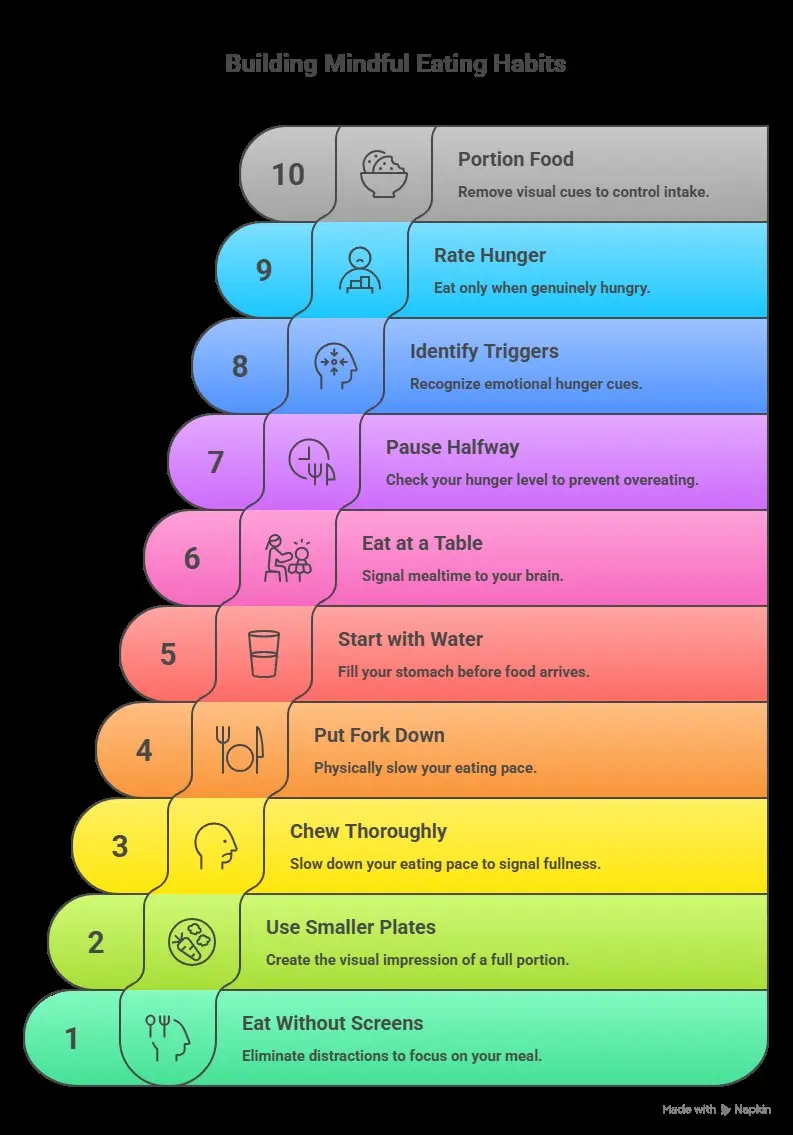
What are the most effective mindful eating habits to build?
- Eat without screens. Put your phone face down. Turn off the television. Distractions increase portion size by an average of 10 to 25% because your attention is elsewhere.
- Use smaller plates. A smaller plate creates the visual impression of a full portion. Research consistently shows people eat less from smaller plates without feeling deprived.
- Chew each bite 20 to 30 times. This sounds excessive, but it genuinely slows down the eating pace. Slower eating means a longer time to signal fullness. More fullness signal time means less total food consumed.
- Put your fork down between bites. This physically slows your eating pace without requiring mental effort. It is one of the easiest mindful eating habits to implement immediately.
- Start every meal with a glass of water. Water fills the stomach volume before food arrives. It also helps distinguish genuine hunger from thirst, which is frequently misidentified as hunger.
- Eat at a table. People who eat at desks, in cars, or standing up eat more than those who sit at a table for meals. A dedicated eating space signals mealtime to your brain.
- Pause halfway through every meal. Stop. Put your fork down. Check your hunger level on a scale of 1 to 10. Continue only if still above 4. This single habit prevents most overeating for most people.
- Identify your emotional hunger triggers. Notice when you want to eat but are not physically hungry. Common triggers are boredom, stress, loneliness, and habit rather than genuine food need. Name the trigger. Then address it without food.
- Rate your hunger before eating. Before every meal, ask: "How hungry am I on a scale of 1 to 10?" If below 4, you are not genuinely hungry. Eat only when genuinely hungry, not by the clock or out of habit.
- Do not eat from packages. Portion food into a bowl or plate before eating. Eating from a bag or packet removes all visual portion cues and consistently leads to higher intake.
How does mindful eating work alongside other weight loss strategies?
Should You Use Mindful Eating Instead of Calorie Counting?
Not necessarily instead. Often alongside.
For people who find calorie tracking helpful, mindful eating adds a behavioural layer that improves the accuracy and sustainability of tracking.
For people who find calorie counting stressful or unsustainable, mindful eating is a proven alternative that produces comparable results over time.
The best approach for most people is a combination. Track calories for 4 to 6 weeks to build awareness of portion sizes. Then use mindful eating habits to maintain that awareness without daily tracking.
For the complete calorie deficit framework, use our calorie deficit calculator.
Does mindful eating work better for some people than others?
Yes. Mindful eating works best for people who: Eat quickly without thinking. Frequently eat past fullness. Struggle with emotional eating or stress eating. Find calorie counting mentally exhausting. Have a history of dieting and restriction that created a difficult relationship with food.
It adds less value for people who already eat slowly, pay attention to hunger, and have no emotional eating patterns.
Common Mindful Eating Mistakes That Reduce Results
What Stops Mindful Eating from Working?
Treating it as passive. Mindful eating requires active attention. Deciding to eat mindfully without building specific habits produces little change.
Expecting rapid weight loss. Mindful eating produces steady, gradual results. It is not a fast fat -loss strategy. It is a sustainable long-term eating approach that supports any other strategy you apply.
Using it as an excuse to avoid a calorie deficit. Eating mindfully, but consistently overeating, still causes weight gain. Mindful eating works within a calorie deficit — not instead of one.
Ignoring protein. Mindful eating does not specify what to eat. Eating slowly and mindfully, but choosing low-protein, high-sugar foods, still produces poor fat loss results. Combine mindful habits with adequate protein at every meal.
Bottom Line on Mindful Eating for Weight Loss
Mindful eating for weight loss is a real, evidence-backed strategy. It reduces emotional eating. It lowers total calorie intake naturally. And it produces results comparable to those of conventional diet programmes for many people.
It is not magic. And it is not a replacement for a genuine calorie deficit. But for people who struggle with speedy eating, emotional eating, or diet fatigue, it is one of the most practical tools available.
Start with just two habits this week. Eat without screens. Set your fork down after each mouthful.
Those two changes alone will reduce your calorie intake and improve your relationship with food over time.
For more on the daily habits that make weight loss sustainable, read our weight loss habit guide and sustainable weight loss tips.
FAQs About Mindful Eating for Weight Loss
Q: Does mindful eating help with weight loss?
Yes. A systematic review of 10 randomized controlled trials found significant weight loss from mindful eating strategies compared with no intervention. The same review found results comparable to conventional diet programmes. Mindful eating is most effective at reducing emotional eating and overeating from distraction or speed eating.
Q: How does mindful eating reduce calorie intake?
Eating slowly gives satiety hormones — including GLP-1, PYY, and CCK — time to signal fullness to your brain before you finish a meal. The brain takes 15 to 20 minutes to register fullness. Most fast eaters finish a meal in 8 to 12 minutes, consuming more than needed before fullness registers. Slowing down to 20 to 30 minutes allows satiety signals to work correctly.
Q: Can mindful eating replace calorie counting?
For many people, yes. Research shows mindful eating produces comparable weight loss to conventional diet programmes. For people who find calorie tracking stressful or unsustainable, mindful eating is a proven alternative. The most effective approach for most people is tracking calories for 4 to 6 weeks to build awareness, then applying mindful eating habits to maintain that awareness long -term.
Q: What is the easiest mindful eating habit to start with?
Eating without screens is the single easiest mindful eating change with the largest immediate impact. Put your phone face down and turn off the television during meals. This single change reduces distraction-related overeating by 10 to 25% for most people.
Sources and References
- PubMed — Mindful eating and common diet programs lower body weight similarly: meta-analysis https://pubmed.ncbi.nlm.nih.gov/31368631/
- Cambridge Core — Mindful eating for weight loss in women with obesity: a randomized controlled trial https://www.cambridge.org/core/journals/british-journal-of-nutrition/article/mindful-eating-for-weight-loss-in-women-with-obesity-a-randomised-controlled-trial/FEBA9D60A940E6FC5C1FAD6D5C0B2E2F
- NHS — Mindful eating https://www.nhs.uk/live-well/eat-well/food-guidelines-and-food-labels/
- CDC — Healthy Eating for a Healthy Weight https://www.cdc.gov/healthy-weight-growth/healthy-eating/index.html
Last Updated: April 22, 2026


Health & wellness writer with 30+ years of experience in nutrition, fitness, and healthy aging. Founder of NextFitLife.com — evidence-based health guidance.