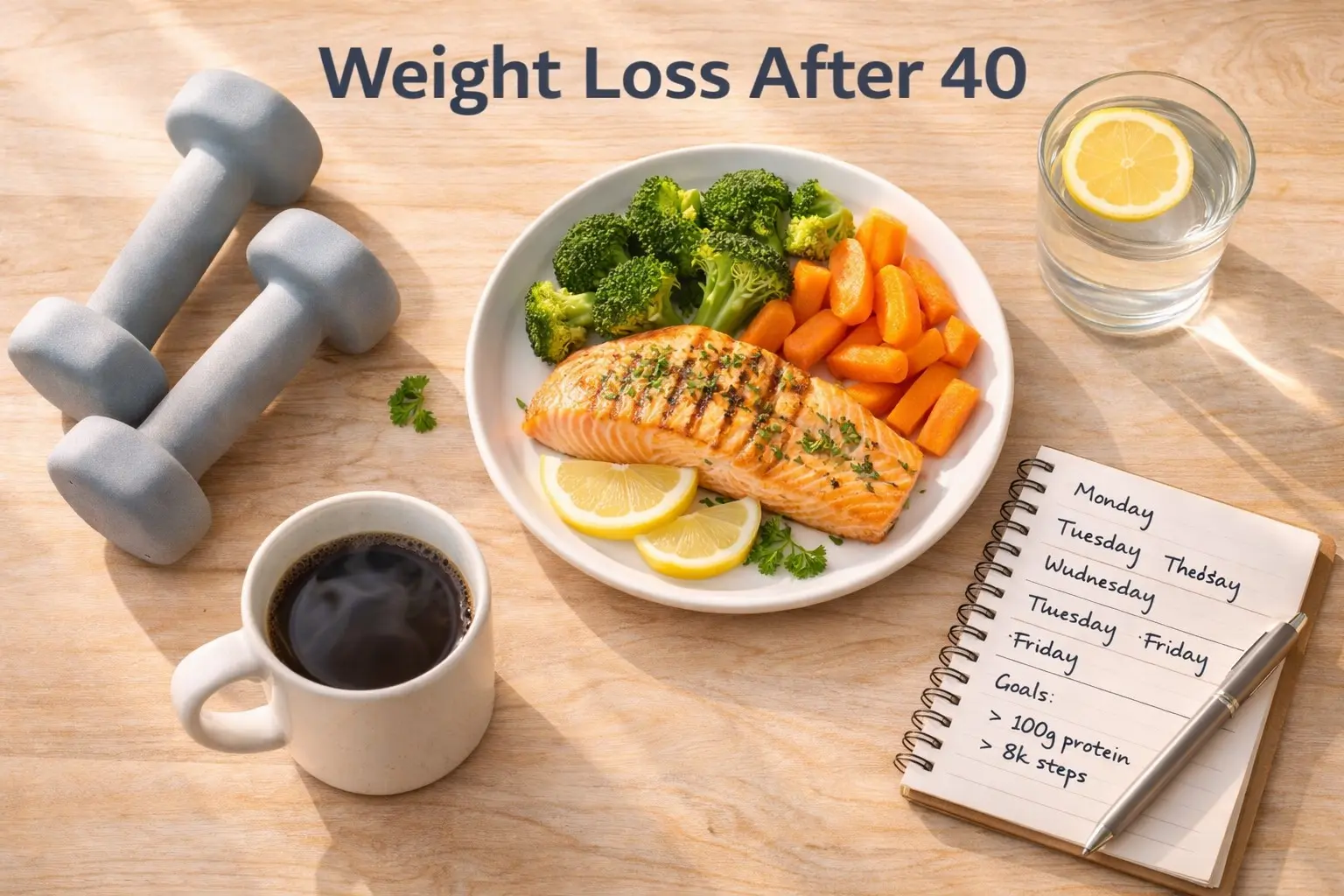
Published - April 2026 | Last Updated - April 22, 2026
Weight loss after 40 gets harder. Here is why - and what to do about it if the diet that worked at 30 is not working now, you are not doing anything wrong. Your body has genuinely changed.
Weight loss after 40 is harder because of biology. Hormones shift. Muscle mass drops. Insulin sensitivity falls. Sleep quality declines. These are real physical changes, not excuses.
Losing weight after 40 is hard because several body systems change at once. Hormones shift, muscle mass drops, insulin sensitivity decreases, and sleep quality declines. These changes are not about willpower. They are biology.
The good news is that understanding these changes tells you exactly what to do differently. This article is part of our complete weight loss guide.
Why is weight loss after 40 so much harder?
How do hormones change after 40 and affect weight loss?
Both men and women experience major hormonal shifts in their 40s.
For women, estrogen and progesterone begin to decline during perimenopause. Lower estrogen makes insulin work less well, which promotes fat storage. It also shifts where fat builds up, moving it toward the belly. Declining estrogen in women and testosterone in men both lead to more belly fat storage.
For men, testosterone drops about 1% per year after age 30. By 45, many men have meaningfully lower levels than in their 30s. This reduces muscle mass and raises fat storage - especially around the abdomen.
Hormonal changes after 40, especially involving thyroid, estrogen, progesterone, insulin, and cortisol, make traditional weight loss methods less effective.
How Does Muscle Loss Affect Weight Loss Over 40?
Muscle is your metabolic engine. It burns calories at rest. Losing it slows everything down.
Sarcopenia, the age-related loss of muscle mass, begins around age 35 and occurs at a rate of 1 to 2% a year for the typical person.
By age 45, you may have lost 10 to 20% of your peak muscle mass without doing anything obviously different. A lighter muscle engine means fewer calories burned daily, 100 to 200 fewer than at your peak. That difference adds up to real weight gain over the years, even without eating more.
What Happens to Insulin Sensitivity After 40?
Insulin sensitivity declines with age. This means your body becomes less efficient at using glucose for energy. More of it gets stored as fat instead. Refined carbohydrates that were manageable at 30 become more fattening at 45. Blood sugar swings get wider. Cravings become stronger. The same diet produces different metabolic results.
Declining thyroid function, including subclinical hypothyroidism, slows metabolism and contributes to weight gain in midlife, often going undiagnosed. If you have unexplained weight gain despite a healthy lifestyle, ask your GP to check thyroid function. It is a simple blood test and a common finding in people over 40.
What diet strategy works best for weight loss after 40?
How Many Calories Should You Eat for Weight Loss After 40?
Your calorie needs are lower than they were at 30. The same deficit calculation still applies. But the result is a lower daily calorie target.
Recalculate your TDEE using your current weight, age, and activity level. Do not use old numbers from years ago. Use our calorie deficit calculator to get your current, accurate target.
Keep the deficit moderate. You can start losing weight after 40 by focusing on keeping muscle and supporting metabolic health, not just cutting calories aggressively.
A 300 to 500 calorie daily deficit is the target. Aggressive restriction causes disproportionate muscle loss after 40. And losing muscle makes future fat loss harder.
How much protein do you need for weight loss after 40?
Protein requirements increase after 40. Not because protein becomes more important in theory. But because your muscles respond less efficiently to it, a condition called anabolic resistance.
Target: 1.6 to 2.0 grams of protein per kilogram of body weight daily.
This is higher than the standard recommendation for younger adults. It is necessary to counteract the accelerated muscle loss that happens during a calorie deficit in midlife.
Spread protein across 3 to 4 meals. Each meal should contain 30 to 40 grams of protein. Do not save it all for dinner.
For the full ranked protein source list, see our high protein foods for weight loss guide.
Which Foods Help Most with Fat Loss After 40?
Focus on foods that support insulin sensitivity and reduce inflammation.
Most useful foods for weight loss after 40 - Oily fish, salmon, sardines, mackerel. Omega-3 fatty acids reduce inflammation and support hormone function. Vegetables at every meal.
Fibre slows digestion, stabilizes blood sugar, and feeds beneficial gut bacteria. Legumes, lentils, chickpeas, black beans. High fibre and protein. Very good for controlling blood sugar.
Berries. Antioxidants reduce oxidative stress that increases with age. Using olive oil as the primary fat for cooking.
Most important foods to reduce - All sugary drinks and fruit juice. White bread, white rice, and sweetened cereals. Ultra-processed snacks, which spike insulin and promote fat storage.
For the complete sugar removal plan, see our stop eating sugar to lose weight guide.
What Exercise Works Best for Weight Loss After 40?
Why is resistance training the most important exercise for losing weight after 40?
Resistance training directly counters the muscle loss that slows metabolism after 40. It is the single most important exercise change for people in midlife.
Every kilogram of muscle you build or preserve raises your resting metabolic rate permanently. Add 2 to 3 kg of muscle over 12 months, and you burn 20 to 45 more calories per day at rest, forever. That compounds meaningfully over the years.
Two resistance sessions per week is the evidence-based minimum. Three is better. Compound movements cover all major muscles: squats, deadlifts, rows, press-ups, and overhead presses.
For the complete guide to preserving muscle during fat loss, see our " How to maintain muscle mass guide.
What cardio exercise helps most with weight loss over 40?
Walking is the most effective cardio for people in their 40s and beyond. Low impact. No injury risk. Lowers cortisol. Improves insulin sensitivity. Sustainably, every single day.
High cortisol from chronic stress makes visceral fat build up even faster after 40. Walking specifically reduces cortisol. That makes it both a calorie-burning and a hormone-balancing tool simultaneously.
Target 7,000 to 10,000 steps daily. Add two HIIT sessions per week from month two if fitness allows. HIIT improves cardiovascular health and increases testosterone in men by up to 16%.
For the complete walking programme, see our walking for weight loss guide.
How Often Should You Rest for Fat Loss After 40?
Recovery takes longer after 40. Muscles are repaired more slowly. Cortisol stays elevated longer after intense training. Rest days are not optional. They are where adaptation happens.
The practical weekly structure - two resistance training sessions. Two to three walking days. One to two HIIT sessions. One to two full rest days.
Do not try to train daily at high intensity. It rises chronically and promotes the visceral fat storage you are trying to remove.
How Does Sleep Affect Weight Loss After 40?
Why is sleep more important for weight loss after 40 than at any other age?
Testosterone is made during deep sleep. “Deep sleep triggers the release of growth hormone. Both decline naturally after 40. Poor sleep accelerates their decline further.
A person who sleeps over 40 5 hours per night has significantly lower testosterone and growth hormone than one sleeping 8 hours. Both hormonal differences directly impair fat loss and muscle preservation.
Women gain 1 to 1.5 kg per year on average during the perimenopausal transition. A significant proportion of this weight gain is linked to disrupted sleep from hormonal changes, not just diet.
Fix your sleep schedule before adjusting anything else. Same wake time daily. Bedroom temperature is 16 to 18°C. No alcohol within 3 hours of sleep.
For the complete sleep and fat loss protocol, see our best way to optimise sleep for fitness outcomes guide.
How Does Stress Affect Weight Loss After 40?
Why Does Stress Cause More Belly Fat After 40?
Cortisol from chronic stress promotes visceral fat storage around the abdomen. After 40, this effect is amplified because declining estrogen and testosterone remove their natural counterbalancing effect on cortisol.
The result: stressed adults over 40 gain belly fat faster than stressed younger adults at identical calorie intakes.
Managing stress is not soft advice for people over 40. It is a metabolic strategy.
Daily stress management habits that work - 10 minutes of morning walking in natural light. 5 minutes of slow breathing before meals. Consistent sleep timing. Limiting alcohol raises cortisol the next morning. Social connection isolation raises chronically.
Weight Loss After 40 - A Step-by-Step Starting Plan
What Should You Do This Week to Start Losing Weight After 40?
Week 1 - Recalculate your TDEE with your current age and weight. Set a 300 to 400 calorie daily deficit. Hit your protein target of 1.6g per kilogram. Cut all sugary drinks.
Week 2 - Add two resistance training sessions on fixed days. Walk 7,000 steps daily. Eat a high-protein breakfast every morning.
Week 3 - Fix your sleep schedule. Same wake time every morning, including weekends. Add one active stress management practice daily.
Week 4 - Review your weekly weight average. If it is not moving downward, return to food tracking with a kitchen scale for one week to find hidden calories.
Month 2 on ward - Add HIIT sessions gradually. Recalculate TDEE every 5 kg of weight lost.
Bottom Line on Weight Loss After 40
Weight loss after 40 is genuinely harder than at 30. But it is completely achievable with the right approach.
The key differences from standard advice are higher protein, resistance training as the priority exercise, consistent sleep, active stress management, and a moderate calorie deficit rather than an aggressive one.
Your body over 40 is not broken. It has different requirements. Meet those requirements, and fat loss follows just as reliably as at any other age.
For the full daily habit framework that supports fat loss at every age, read our weight loss habit guide and sustainable weight loss tips.
FAQs About Weight Loss After 40
Q: Why is weight loss after 40 so much harder than before?
Hormones shift, muscle mass drops, insulin sensitivity decreases, and sleep quality declines all simultaneously.
Declining estrogen in women promotes abdominal fat storage. Declining testosterone in men reduces muscle mass and raises fat storage. These are real biological changes, not willpower failures.
Q: What is the best diet for weight loss after 40?
A moderate calorie deficit of 300 to 400 calories per day with protein at 1.6 to 2.0 grams per kilogram of body weight daily. Focus on vegetables, legumes, oily fish, and whole grains.
Reduce refined carbohydrates and all sugary drinks. Recalculate your calorie target using your current age and weight.
Q: What exercise is best for weight loss after 40?
Resistance training is twice to three times per week, combined with daily walking of 7,000 to 10,000 steps. Resistance training counteracts muscle loss that slows metabolism after 40.
Walking lowers cortisol, improves insulin sensitivity, and creates a daily calorie deficit with zero injury risk.
Q: Does sleep affect weight loss after 40?
Yes, significantly. Testosterone and growth hormone are produced during deep sleep. Both decline naturally after 40.
Poor sleep accelerates their decline, directly impairing fat loss and muscle preservation. Consistent 7 to 9 hours of quality sleep is more important for weight loss after 40 than at any earlier life stage.
Sources and References
- Paloma Health — Weight Loss After 40: Hormonal Obstacles No One Talks About, January 2026 https://www.palomahealth.com/learn/weight-loss-after-40-hormonal-obstacles
- Knownwell — Losing Weight After 40: What Actually Works, March 2026 https://www.knownwell.co/blog-posts/losing-weight-after-40
- Harvard Health Publishing — Sarcopenia and muscle loss with age https://www.health.harvard.edu/staying-healthy/preserve-your-muscle-mass
- Lahav Y et al. — Resistance training as key strategy for high-quality weight loss — Frontiers in Endocrinology, January 2026 https://www.frontiersin.org/journals/endocrinology/articles/10.3389/fendo.2025.1725500/full
- CDC — Healthy Weight for Adults https://www.cdc.gov/healthy-weight-growth/
- NHS — Healthy weight in midlife https://www.nhs.uk/live-well/healthy-weight/
Last Updated: April 22, 2026


Health & wellness writer with 30+ years of experience in nutrition, fitness, and healthy aging. Founder of NextFitLife.com — evidence-based health guidance.