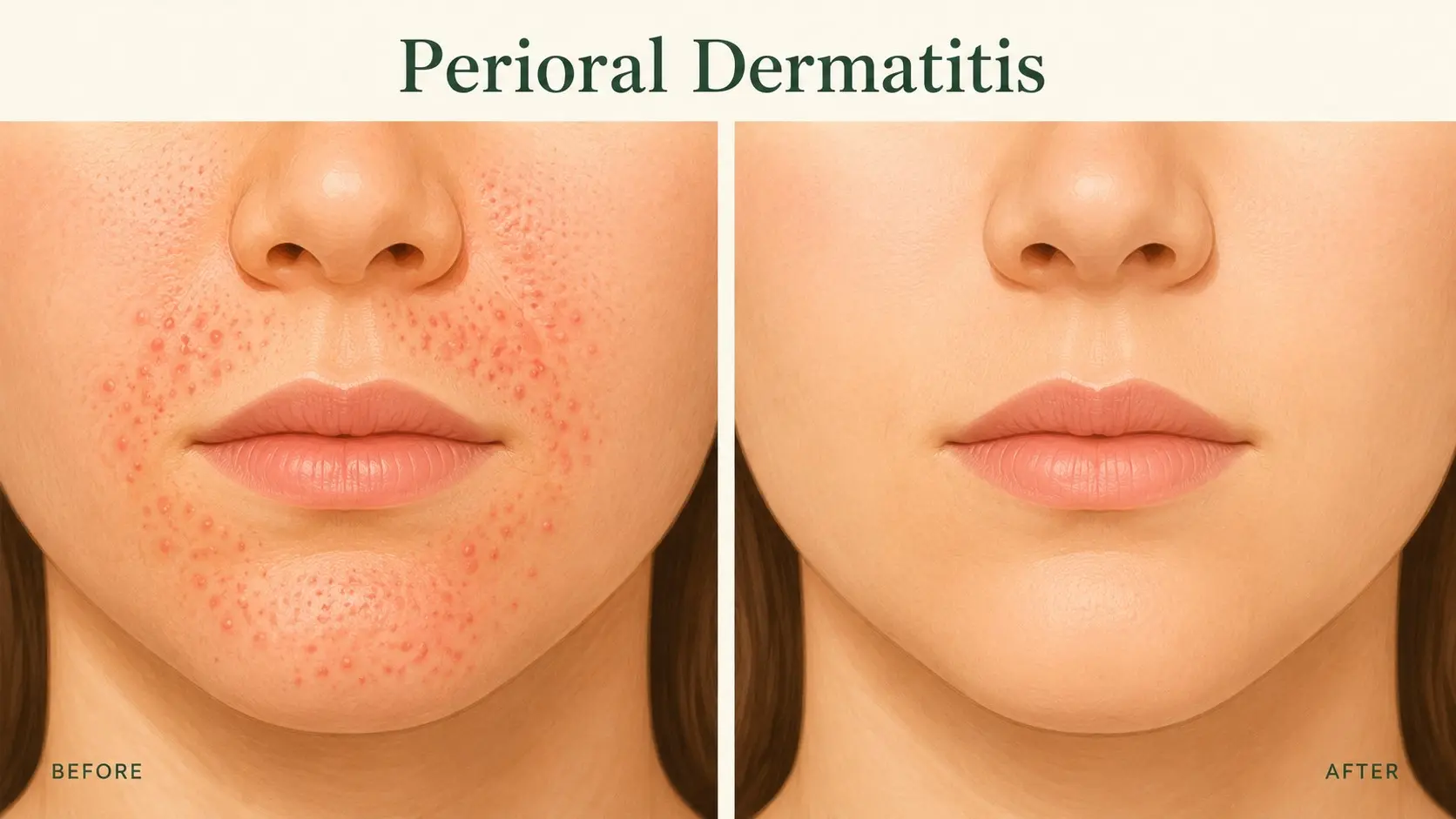
Perioral dermatitis guide showing causes signs treatment and self-care for clearing the rash of red bumps around the mouth and nose in 2026

Perioral Dermatitis - Causes, Signs, Treatment, Self-Care and Fast Relief (2026)

Published: Jul 13, 2025
Last Updated: June 2026 โ€” Fully updated and expanded. Merges our complete perioral dermatitis treatment, self-care, and cure guides into one comprehensive resource.

Perioral dermatitis is one of the most misunderstood skin conditions. It looks like acne. It is sometimes mistaken for eczema or rosacea. And the treatments many people reach for first - steroid creams, heavy moisturizers - make it significantly worse.

If you have a rash of small red bumps around your mouth, nose, or eyes that keeps coming back no matter what you try, this guide is for you. It covers everything: what perioral dermatitis is, exactly what causes it, the signs that identify it, the treatment options that work, a complete self-care routine for daily management, five proven tips to cure perioral dermatitis faster, and what to avoid at all costs.

Skin Health: The Complete Guide to Healthy, Clear and Youthful Skin

WHAT THIS GUIDE COVERSWhat perioral dermatitis is โ€” and what it is NOT

The most common causes and triggers (including the most surprising one)

How to identify the signs and distinguish them from acne, rosacea and eczemaย  ย  Atopic Eczema: Symptoms, Causes, Treatment and Prevention

Every effective treatment option from OTC to prescription โ€” with evidence for each

Your complete perioral dermatitis treatment plan, step by step

7 gentle daily self-care routines to prevent flares and support recovery

5 proven tips to clear it faster

The complete list of what to STOP immediately

When to see a dermatologist โ€” and what to expect

What is perioral dermatitis?

Perioral dermatitis is a chronic inflammatory skin condition. It causes clusters of small red bumps โ€” papules, pustules, or scaly patches โ€” that appear around the mouth, nose, and sometimes the eyes. Despite the name suggesting only the area around the mouth, it can affect all three zones.

It predominantly affects women aged 16 to 45, but men and children can also develop it. When it appears around the eyes, it is called periocular dermatitis. When it appears around both the mouth and eyes together, it is called periorificial dermatitis.

One of its most distinctive features: a clear zone immediately at the lip border. The skin right at the edge of the lips is typically unaffected, even when the rash is dense just a few millimetres away. This feature alone helps distinguish it from angular cheilitis or contact dermatitis.

Signs of Perioral Dermatitis- How to Identify It

Recognizing the signs of perioral dermatitis correctly is important. Many people treat it incorrectly for months because they mistake it for acne or dry skin. Here is exactly what to look for.ย  ย  Nummular Dermatitis: Causes, Symptoms and Effective Treatments


SignWhat It Looks LikeNotes
Clustered small bumpsGroups of tiny red papules or pustules โ€” 1 to 2mm in diameterNot individual large spots like acne. Tend to cluster in patches
Location: around the mouthMost commonly forms around the upper lip, chin and sides of the mouthMay extend to the sides of the nose and nasolabial folds
Location: around the noseRed bumps along the sides and crease of the noseOften accompanies mouth involvement
Location: around the eyesLess common โ€” bumps on the upper or lower eyelid marginCalled periocular dermatitis. Can be confused with styes
Clear lip border zoneSkin right at the lip edge is CLEAR โ€” a narrow strip of unaffected skinThis feature strongly distinguishes it from other conditions
Mild burning or itchingNot always present, but common,ย  skin may feel tight or irritatedOften worse after applying products
Scaling or drynessFine flaking around the bumps, especially after cleansingSkin can look both bumpy and dry simultaneously
Fluctuating patternPartially improves, then flares back โ€” often worse after steroid useCyclical pattern is typical โ€” not constant

How to tell it apart from similar conditions

ConditionHow it differs from perioral dermatitis
Acneย  ย  Acne Treatment: The Complete Evidence-Based GuideHas blackheads and whiteheads (comedones). Perioral dermatitis does NOT. Acne affects wider facial areas
RosaceaPersistent background redness and visible blood vessels. Flushing triggered by heat, alcohol, or spice. Usually on cheeks and nose bridges, not clustered around the mouth
Contact dermatitisWeeping, crusting, and extreme itch. Clearly linked to a substance that touched the skin. Can be anywhere the allergen is contacted
Angular cheilitisCracked, painful skin AT the corners of the mouth. Perioral dermatitis has a clear zone AT the lip border
Seborrhoeic dermatitisGreasy, yellowish scales. Affects scalp, eyebrows, nasolabial folds and central chest. Responds to antifungal treatment

What causes perioral dermatitis?

The exact cause is not fully understood. But several triggers are strongly and consistently associated with perioral dermatitis. The most important and most counterintuitive is topical steroid use.

The Most Common Trigger - Topical Steroids

Topical corticosteroids applied to the face are the single most common trigger for perioral dermatitis. This includes:

  • Prescription steroid creams (hydrocortisone, betamethasone, clobetasol)
  • Mild OTC hydrocortisone cream, even 0.5%, applied near the mouth
  • Steroid nasal sprays are used in a way that deposits near the skin (poor inhaler technique)
  • Inhaled corticosteroids for asthma if the inhaler mouthpiece contacts the lip and cheek area

This creates a vicious cycle. The steroid initially calms the rash. Skin becomes dependent on it. When the steroid is reduced or stopped, the rash rebounds โ€” often far worse than before. This rebound drives the person to apply more steroids, deepening their dependency. Breaking this cycle is the most important step in treatment.

Other Common Triggers

TriggerHow It ContributesWhat to Do
Heavy moisturizers and occlusive creamsPetrolatum, paraffin, and heavy emollient bases near the mouth alter the local skin microbiome and may promote overgrowth of skin organismsSwitch to minimal, lightweight, fragrance-free products โ€” or nothing at all on affected areas
Fluorinated toothpasteFluoride compounds in toothpaste are thought to be a contributing factor for some patients, particularly those with mouth-area involvementSwitch to fluoride-free toothpaste for the entire treatment period (8 to 12 weeks)
Hormonal contraceptivesSome women notice a clear correlation between starting the pill and the onset of perioral dermatitisDiscuss with GP โ€” not always necessary to stop contraception, but worth noting as a potential trigger
Heavy cosmetic foundationsThick, occlusive coverage products applied near the mouth contribute to barrier disruption and microbiome changesSwitch to lightweight, non-comedogenic formulations or go foundation-free on affected areas
StressRecognized as a flare trigger โ€” likely through cortisol's effect on skin immunity and barrier functionActive stress management: exercise, sleep, breathing practices
Hot conditionsHeat and humidity worsen many inflammatory conditions, including perioral dermatitisAvoid prolonged heat exposure. Cool water mist can help acutely

Perioral Dermatitis Treatment: The Complete Plan

Perioral dermatitis treatment works in two sequential phases. You cannot skip Phase 1. Starting medication before removing triggers will give partial results at best and no lasting improvement at worst.

Phase 1- Stop All Triggers - This Must Come First

STOP THESE IMMEDIATELYALL topical steroids on the face, including OTC hydrocortisone 0.5% and 1%

ALL heavy moisturizers, barrier creams, and occlusive products near the mouth and nose

Fluorinated toothpaste โ€” switch to fluoride-free for the full treatment period

Heavy foundation and concealer on or near the affected areas

Any skincare product started shortly before the rash appeared

Nasal steroid sprays if used near the affected skin, discuss alternatives with your GP

The rebound warning: when you stop topical steroids, the rash WILL get worse before it gets better. This is called the steroid rebound or steroid withdrawal phenomenon. It is uncomfortable, alarming, and completely expected. It typically lasts 1 to 4 weeks. Do not restart the steroid to calm it. If you restart the steroid, you reset the entire process and prolong recovery significantly. Push through this phase โ€” it ends.

Phase 2: Medical Treatment Options

Once triggers are removed, medical treatment significantly accelerates clearance. Most cases do not clear with trigger removal alone. Prescription treatment is strongly recommended.


TreatmentHow It WorksEvidence LevelAvailabilityDuration
Topical metronidazole 0.75-1% gel (Rozex)Antibiotic with anti-inflammatory properties. Applied twice daily to affected areasVery strong โ€” first-line topical treatment in most guidelinesPrescription only8 to 12 weeks
Topical azelaic acid 15-20%Anti-inflammatory and antibacterial. Gentler option. Also reduces rednessGood โ€” well tolerated, including in pregnancyPrescription for 15-20%. 10% OTC8 to 12 weeks
Topical erythromycin 2-4%Antibiotic gel for mild-to-moderate casesGoodPrescription only8 to 12 weeks
Topical clindamycin 1%Antibiotic gel โ€” alternative to erythromycinGoodPrescription only8 to 12 weeks
Topical pimecrolimus (Elidel)Calcineurin inhibitor โ€” useful when the steroid-rebound component is dominantGood โ€” useful for steroid-related casesPrescription only6 to 8 weeks
Oral doxycycline 50-100mgSystemic antibiotics. Used for moderate to severe or widespread cases. Most effective single treatmentVery strong โ€” fastest clearance rates in clinical studiesPrescription only6 to 12 weeks
Oral lymecycline 408mgAlternative tetracycline โ€” well-toleratedGoodPrescription only6 to 12 weeks
Oral erythromycin 250-500mgUsed when tetracyclines are contraindicated (e.g. pregnancy, children)GoodPrescription only6 to 12 weeks

For most adults with moderate to widespread perioral dermatitis, oral doxycycline combined with topical metronidazole gel gives the fastest clearance. For mild or localized cases, topical metronidazole alone is often sufficient. See your GP or dermatologist for prescription treatment โ€” OTC options alone are rarely adequate once perioral dermatitis is established.

Perioral Dermatitis Self-Care - 7 Gentle Daily Routines That Work

These perioral dermatitis self-care routines do not replace medical treatment. But applied consistently, they significantly reduce flare frequency, support recovery, and help prevent the condition from returning after clearance. Best All-Natural Skin Care Routine

Routine 1- Switch to a Fragrance-Free Gentle Cleanser - Morning and Night

Use a gentle, fragrance-free, pH-balanced cleanser twice daily. Avoid anything foaming, fragranced, or with sulphates. Good options include CeraVe Hydrating Cleanser, La Roche-Posay Toleriane Hydrating Gentle Cleanser, or Avene Extremely Gentle Cleanser.

Use lukewarm -not hot water. Pat dries gently. Never rub the affected area. Rubbing increases irritation and can worsen the inflammatory response.

Routine 2 -Minimize Products on the Affected Area

During the treatment phase, the goal is minimal product contact with the affected skin. Many dermatologists recommend a zero-moisturizer approach for the affected zone during the first few weeks โ€” applying no products at all to the perioral area.

If the skin feels excessively uncomfortable without any moisturizer, use only a very light, fragrance-free gel or lotion - nothing heavy or occlusive. Avoid anything containing petrolatum, paraffin, or lanolin near the mouth.

Routine 3 - Switch to Fluoride-Free Toothpaste - Every Single Use

This change is simple but important. Fluoride compounds in toothpaste are believed to contribute to perioral dermatitis in some patients, particularly with mouth-area involvement. Switch completely to fluoride-free toothpaste for the full 8-to-12-week treatment period.

Options include fluoride-free versions from brands like Hello, Tom's of Maine (check label), or Jason. When you brush, rinse thoroughly afterwards and avoid the paste contacting the skin around the mouth. After the condition clears, you can return to fluoride toothpaste if you wish.

Routine 4- Wash Your Hands Before Any Face Contact

Bacteria from hands significantly worsen perioral dermatitis. Many people touch their faces, especially the mouth and chin area, dozens of times daily without realizing. During treatment, wash hands before any deliberate face contact and actively reduce unconscious face touching.
Lip Licker Dermatitis: Lip Licker Dermatitis: Causes, Symptoms and Quick Fixes

Change your pillowcase every 2 to 3 days. Bacteria and product residue accumulate on pillowcases and contact the perioral area for 7 to 8 hours every night.

Routine 5- Choose SPF Carefully - Mineral Only

Sun protection is still important during treatment - UV exposure worsens skin inflammation and redness. But chemical sunscreen filters can irritate perioral dermatitis. Use mineral-only (zinc oxide or titanium dioxide) sunscreen instead.

Choose a lightweight formula, not a heavy cream. Apply carefully, avoiding the directly affected zones if a reaction to the sunscreen is a concern. Many people with perioral dermatitis tolerate zinc-based sunscreens well, even during active flares.

Routine 6 - Manage Stress Actively Every Day

Stress is a recognized and consistent perioral dermatitis flare trigger. Cortisol from chronic stress impairs the skin barrier and alters local immune function. Managing stress is not a soft recommendation; it is a clinical one.

Daily exercise, 7 to 8 hours of sleep, slow breathing practices, and time with people you trust all reduce cortisol load. Even 10 minutes of slow breathing (5 to 6 breaths per minute) before bed measurably lowers cortisol and supports overnight skin repair.

Routine 7 - Track Your Skin Weekly with Photographs

Recovery from perioral dermatitis is slow. Day-to-day changes are hard to see. Taking a photograph in the same light, same angle, every 7 days creates an objective record of progress.

This serves two purposes. First, it keeps you motivated through the slow recovery phase by showing actual change over weeks rather than days. Second, it gives your dermatologist or GP objective information about your response to treatment if you need to follow up.

5 Proven Tips to Cure Perioral Dermatitis Faster

These are the strategies that consistently produce the fastest clearance. They come from dermatology guidance and from experience supporting hundreds of people through perioral dermatitis recovery.

Tip 1- See a Dermatologist Early - Do Not Wait

The single biggest mistake people make with perioral dermatitis is delaying professional assessment. Many spend months trying OTC products, some of which make the condition worse, before getting appropriate prescription treatment.

Prescription oral doxycycline produces clearance significantly faster than topical-only approaches for moderate cases. A 6-week course, combined with trigger removal, often produces near-complete clearance. Compare this to 4 to 6 months of failed OTC attempts.

Tip 2 - Zero Tolerance for Topical Steroids on Your Face

Not even mild OTC hydrocortisone. Not even once to calm a bad flare day. Every single application of a topical steroid resets the rebound mechanism and extends your recovery timeline. The temporary improvement you see after a steroid application is exactly the trap.

If the rebound is very severe, a dermatologist can sometimes manage it with a brief, carefully tapered reduction in steroid potency. But this must be done under medical supervision โ€” not self-managed.

Tip 3 - Strip Your Skincare Routine to an Absolute Minimum

During active treatment, use three products only: gentle cleanser, light moisturizer if needed, and mineral SPF. Remove everything else. No actives, no serums, no treatments for other concerns. Every additional product is a potential irritant or occlusive that prolongs recovery.

This feels counterintuitive if you have a complex skincare routine. But perioral dermatitis responds to less, not more. Skin needs time to re-establish its natural microbiome and barrier function without interference from multiple products.

Tip 4 - Complete the full antibiotic course without stopping early

The most common cause of perioral dermatitis relapsing after antibiotic treatment is stopping the course early when the skin looks better. Most people see significant improvement in 4 to 6 weeks. The temptation to stop at this point is understandable.

Do not stop early. Complete the full prescribed course, typically 8 to 12 weeks for oral antibiotics and 8 to 12 weeks for topical treatment. Stopping early leaves residual inflammation that reactivates within weeks in most cases.

Tip 5 -Take Weekly Progress Photographs for Motivation

Perioral dermatitis heals slowly. Week-to-week changes are real but modest. People who do not track progress often feel that nothing is working and abandon treatment too early โ€” precisely when it is starting to produce results.

A simple weekly photograph โ€” same light, same angle โ€” makes the improvement visible and concrete. Many people who feel their treatment is not working are surprised to see clear improvement when they compare week 1 to week 6 photographs side by side.

What to Avoid with Perioral Dermatitis: The Complete List

AVOID THESE DURING TREATMENTALL topical steroids on the face โ€” including mild OTC hydrocortisone โ€” even once

Heavy emollient creams, barrier creams, and petroleum-based products near the mouth and nose

Fluorinated toothpaste โ€” switch to fluoride-free for the full treatment period

Switching skincare products frequently, every product change introduces new potential irritants

Fragranced cleansers, toners, serums, or moisturizers anywhere near the affected area

Chemical sunscreen filters on the affected area โ€” use minerals (zinc oxide/titanium dioxide) only

Heavy cosmetic foundation or concealer on the affected skin during active treatment

Face scrubs or physical exfoliants on the affected area โ€” these worsen inflammation

Touching the affected area unnecessarily with unwashed hands

Steam rooms, saunas, or prolonged heat exposure โ€” heat worsens perioral dermatitis

Spicy food in large quantities โ€” some patients report food-related flares

Stopping antibiotic treatment early, even when the skin looks significantly better,

What to Expect - Realistic Treatment Timeline

WeekWhat Typically HappensWhat to Do?
Week 1 to 2Rebound flares if steroids stop. Rash may worsen significantly. Burning and itching may increase.Push through. Do NOT restart steroids. Maintain a minimal routine. Start prescription treatment.
Weeks 2 to 4Rebound begins to settle. New bumps may still appear, but frequency is reduced. Redness starts to calm.Continue treatment consistently. No product changes. Photograph weekly.
Week 4 to 6Visible improvement in most cases. Bumps are reducing in number. Redness fading. Some patches are clearing.Maintain treatment. Do not stop early. Keep routine minimal.
Week 6 to 8Significant clearance in most patients on oral + topical treatment. Mild residual redness may remain.Continue to the end of the prescribed course even though the skin looks much better.
Weeks 8 to 12Complete or near-complete clearance for most patients. Skin texture normalizing.Complete the full course. Reintroduce skincare products ONE at a time after clearance.
After clearanceSkin can remain clear long-term with trigger avoidance. Some patients have occasional mild recurrence.Permanent avoidance of facial topical steroids. Maintain a minimal, fragrance-free routine.

When to See a Dermatologist

SEE A DERMATOLOGIST IF YOU HAVEWidespread perioral dermatitis affecting the mouth, nose, and eye areas simultaneously

No improvement after 4 weeks of topical-only treatment โ€” oral antibiotics likely needed

Severe rebound flares after stopping steroids are affecting your daily life significantly

Recurring perioral dermatitis โ€” three or more episodes โ€” which may need longer treatment or investigation

Perioral dermatitis in children management differs from adult treatment and needs specialist guidance

Uncertainty about whether your rash is perioral dermatitis or another condition

Any rash affecting the eye area โ€” periocular involvement needs careful assessment

Key Takeaways - Perioral Dermatitis

SUMMARYPerioral dermatitis is a rash of small red bumps around the mouth, nose, and sometimes eyes

The single most common trigger is topical steroid use on the face โ€” even mild OTC hydrocortisone

Other triggers: heavy moisturizers, fluorinated toothpaste, hormonal contraceptives, heavy cosmetics

STOP all triggers first โ€” medication alone will not give lasting results if triggers continue

The rebound flare when stopping steroids is normal, expected, and temporary โ€” push through it

First-line treatment: topical metronidazole gel. Moderate-severe: oral doxycycline for 8 to 12 weeks

7 self-care routines: gentle cleanser, minimal products, fluoride-free toothpaste, hand hygiene, mineral SPF, stress management, weekly photos

5 tips for faster clearing: see a dermatologist early, zero steroid use, minimal skincare, complete antibiotic course, track progress

Most cases clear fully in 8 to 12 weeks with correct trigger removal and prescription treatment

After clearance, permanent avoidance of facial steroids is the most important relapse prevention step

References and Sources

1- Perioral Dermatitis โ€” American Academy of Dermatology Patient Guide

https://www.aad.org/public/diseases/a-z/perioral-dermatitis-overview

AAD authority. Use for: definition, symptoms, causes, including topical steroid trigger, and an overview of treatment options. Most authoritative US patient-facing source.

2- Periorificial Dermatitis โ€” DermNet NZ Comprehensive Clinical Review

https://dermnetnz.org/topics/periorificial-dermatitis

Dermatology authority. Use for: clinical description in full trigger list, rebound effect mechanism, treatment ladder, periocular variant.

3- Topical Corticosteroids and Perioral Dermatitis โ€” Journal of the American Academy of Dermatology

https://pubmed.ncbi.nlm.nih.gov/22867720/

Peer-reviewed research. Use for: steroid-induced POD mechanism, evidence of rebound phenomenon, treatment evidence for stopping steroids as Phase 1.

4 -Oral Tetracyclines for Perioral Dermatitis โ€” British Journal of Dermatology

https://pubmed.ncbi.nlm.nih.gov/15796612/

Clinical evidence. Use for: tetracycline antibiotic effectiveness, treatment duration 8-12 weeks, clearance rates with oral vs topical treatment.

5- Perioral Dermatitis โ€” NICE Clinical Knowledge Summary (CKS)

https://cks.nice.org.uk/topics/perioral-dermatitis/

NICE UK authority. Use for: UK primary care management pathway, prescription guidance, referral criteria, treatment duration recommendations.

Part of Our Skin Health Series

This article is part of our complete skin health resource. Read all skin health topics in our Complete Skin Health Guide or browse our Skin Health Resource Directory.

Adel Galal

Health and Wellness Writer | 30+ Years Personal Practice | Founder, NextFitLife.com

Adel Galal has studied skin health and dermatological conditions for over 30 years. He applies evidence-based skin practices daily and reviews the research carefully before writing. He is not a doctor or dermatologist. Everything here reflects personal research, experience, and consultation with healthcare providers. Always consult a qualified dermatologist for any skin condition, diagnosis or treatment decision.

Scroll to Top