
Published on: July 16, 2025
Updated on: November 4, 2026
The best abs workout does more than make your stomach muscles burn. A complete routine trains your core to flex, resist extension, resist rotation, stabilize your sides, and transfer force through your whole body.
That means you need more than crunches.
Exercises such as the dead bug, plank, side plank, bird dog, Pallof press, reverse crunch, and farmer carry can train different parts of your abdominal muscles and trunk.
One important point comes first: ab exercises can make your core stronger, but they do not guarantee a flat stomach. Reducing abdominal fat depends mainly on overall body fat loss, physical activity, nutrition, and long term energy balance.
Important: This article is for general information and education. It does not replace medical advice, diagnosis, or treatment.
Table of Contents
- Quick Answer
- What Makes a Good Abs Workout
- 11 Best Ab Exercises
- Beginner Abs Workout
- Intermediate Abs Workout
- How Often to Train Abs
- How Long an Abs Workout Should Be
- Abs and Belly Fat
- Core Training Functions
- How to Progress
- Common Mistakes
- When to Stop
- Conclusion
- References and Sources
- Explore More Fitness Guides
- About the Author
- Frequently Asked Questions
Quick Answer: What Is the Best Abs Workout?
The best abs workout combines several kinds of core training instead of repeating one movement.
A balanced routine can include these 11 exercises:
- Dead bug
- Forearm plank
- Side plank
- Bird dog
- Reverse crunch
- Pallof press
- Farmer carry
- Hollow body hold
- Slow mountain climber
- Bear plank shoulder tap
- Controlled knee raise
You do not need to perform all 11 in every session. Choose four to six that cover different core functions.
For another complete core guide, see our Best Ab Exercises.
What Makes an Abs Workout Effective?
Your core is not one muscle.
Important muscles include the:
- Rectus abdominis
- Obliques
- Transverse abdominis
- Multifidus
- Erector spinae
- Diaphragm
- Pelvic floor
Your hips, glutes, and shoulder muscles also help during many core exercises.
A good program trains several functions instead of asking one muscle to do everything.
Five Core Functions Worth Training
| Function | What It Does | Example |
|---|---|---|
| Anti Extension | Stops the lower back from arching too far | Plank |
| Anti Rotation | Resists unwanted trunk rotation | Pallof press |
| Lateral Stability | Resists side bending | Side plank |
| Flexion | Brings the rib cage and pelvis closer | Reverse crunch |
| Loaded Stability | Keeps the trunk controlled under load | Farmer carry |
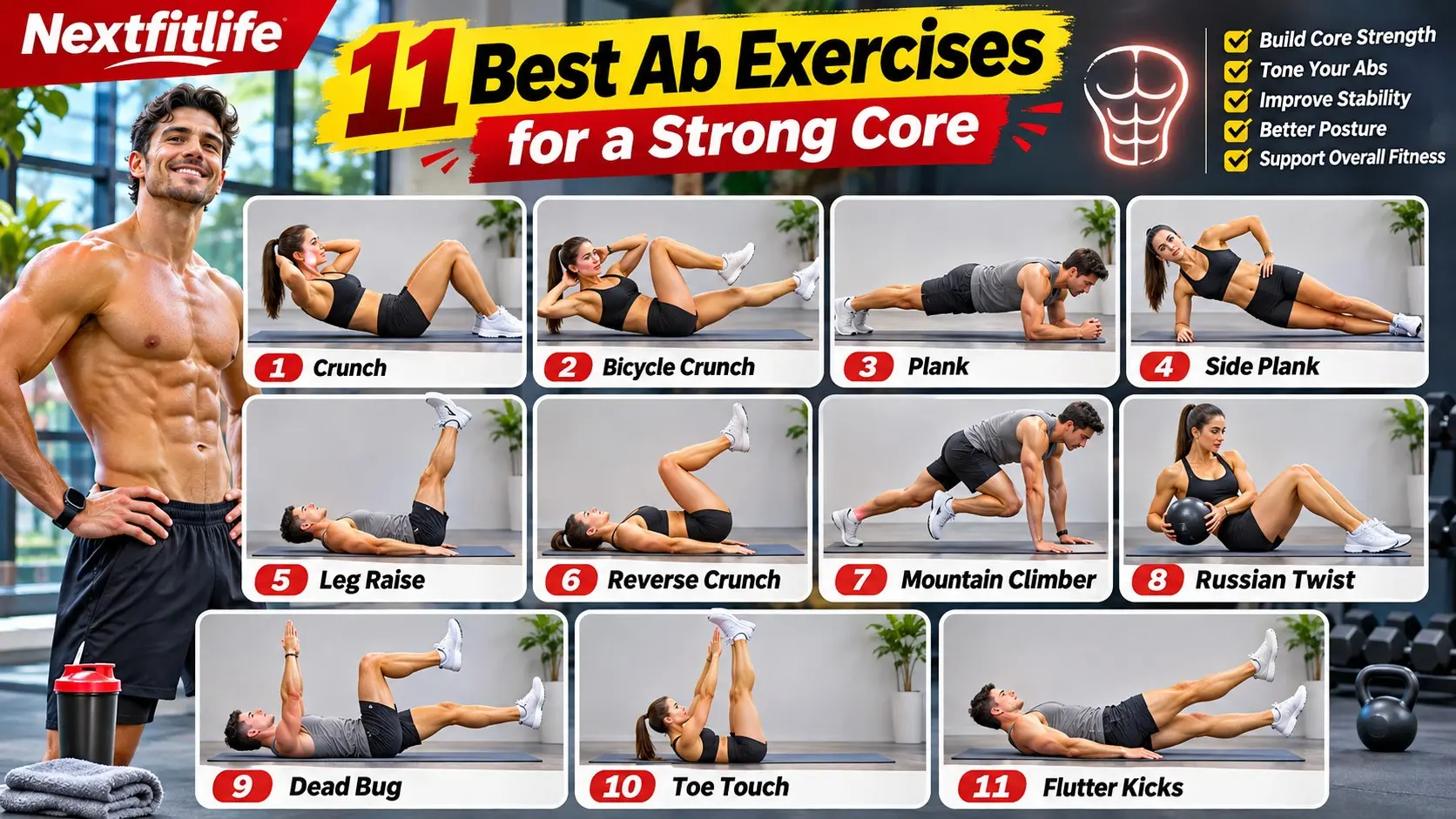
11 Best Ab Exercises for a Strong Core
1. Dead Bug
Main focus: anti extension and trunk control.
- Lie on your back.
- Bring your knees above your hips.
- Raise your arms toward the ceiling.
- Slowly extend one leg and the opposite arm.
- Return to the start.
- Switch sides.
Keep your lower back comfortable and avoid rushing.
Starting target: 6 to 10 controlled repetitions per side.
A 2026 study found that abdominal muscle recruitment changes across core stabilization tasks, with the dead bug producing a different activation pattern from bird dog and simpler abdominal bracing positions.
2. Forearm Plank
Main focus: anti extension.
- Place your forearms on the floor.
- Extend your legs behind you.
- Keep your ribs and pelvis controlled.
- Squeeze your glutes gently.
- Keep breathing.
Starting target: 15 to 30 seconds.
You do not need to hold a plank for several minutes. When the exercise becomes easy, a harder variation may be more useful than simply adding more time.
3. Side Plank
Main focus: obliques and lateral stability.
- Lie on one side.
- Support yourself on your forearm.
- Use bent knees for an easier version.
- Lift your hips.
- Keep your body controlled.
Starting target: 10 to 25 seconds per side.
Research comparing common core exercises has found that side plank variations can strongly challenge the lateral abdominal wall.
4. Bird Dog
Main focus: trunk control, back muscles, hips, and coordination.
- Start on your hands and knees.
- Extend one arm forward.
- Extend the opposite leg backward.
- Keep your hips level.
- Return slowly.
- Switch sides.
Starting target: 6 to 10 repetitions per side.
A 2024 study found that bird dog and side plank variations produced large changes in the thickness of several deep trunk muscles during testing.
5. Reverse Crunch
Main focus: abdominal flexion with pelvic control.
- Lie on your back.
- Bend your knees.
- Bring your knees toward your chest.
- Gently curl your pelvis upward.
- Lower slowly.
Avoid swinging your legs for momentum.
Starting target: 8 to 15 repetitions.
6. Pallof Press
Main focus: anti rotation.
- Attach a resistance band securely beside you.
- Hold the band at your chest.
- Press your hands forward.
- Do not let your trunk rotate toward the anchor.
- Return slowly.
Starting target: 8 to 12 repetitions per side or a 10 to 20 second hold.
7. Farmer Carry
Main focus: loaded core stability and grip.
- Hold a weight in each hand.
- Stand tall.
- Walk with controlled steps.
- Keep your ribs stacked over your pelvis.
- Avoid leaning.
Starting target: 20 to 40 seconds.
This exercise trains your core while your whole body is moving.
8. Hollow Body Hold
Main focus: strong anti extension control.
- Lie on your back.
- Gently bring your ribs toward your pelvis.
- Lift your shoulders slightly.
- Keep your legs bent for an easier version.
- Hold without letting your lower back arch strongly.
Starting target: 10 to 20 seconds.
This is harder than it looks. Start small.
9. Slow Mountain Climber
Main focus: anti extension with controlled hip movement.
- Start in a high plank.
- Bring one knee slowly toward your chest.
- Return it.
- Switch legs.
- Keep your hips controlled.
Starting target: 6 to 12 repetitions per side.
Slow movement makes this a core exercise rather than only a cardio drill.
10. Bear Plank Shoulder Tap
Main focus: anti rotation and trunk stability.
- Start on hands and knees.
- Lift your knees slightly off the floor.
- Tap one shoulder with the opposite hand.
- Return the hand.
- Switch sides.
Try to keep your hips from twisting.
Starting target: 6 to 10 taps per side.
11. Controlled Knee Raise
Main focus: abdominal control and hip flexion.
You can perform this from a captain's chair, supported hanging position, or Roman chair setup.
- Brace your trunk.
- Raise your knees slowly.
- Avoid swinging.
- Lower under control.
Starting target: 6 to 12 repetitions.
If hanging bothers your shoulders, choose a floor based exercise instead.
Simple Beginner Abs Workout
| Exercise | Dose | Focus |
|---|---|---|
| Dead Bug | 8 each side | Anti extension |
| Bird Dog | 8 each side | Control |
| Forearm Plank | 20 seconds | Core stability |
| Side Plank | 15 seconds each side | Lateral stability |
| Reverse Crunch | 10 reps | Flexion |
Complete two rounds and rest when needed.
Intermediate Abs Workout
Once the beginner exercises feel controlled, try:
- Dead bug: 10 each side
- Pallof press: 10 each side
- Reverse crunch: 12 reps
- Bear plank shoulder tap: 8 each side
- Farmer carry: 30 to 45 seconds
- Hollow hold: 15 to 25 seconds
Complete two or three rounds.
How Often Should You Train Abs?
You do not have to train your abs every day.
For general fitness, two to four focused core sessions each week can work well depending on your total training program.
CDC recommends muscle strengthening activity at least two days each week and includes the abdomen among the major muscle groups that should be trained.
Your core also works during squats, rows, carries, presses, lunges, and many other compound exercises.
How Long Should an Abs Workout Last?
A useful abs session can take 10 to 20 minutes.
More time is not automatically better.
Choose several high quality exercises and perform them with control.
A short session that you can progress is better than 30 minutes of random crunches.
Can Ab Workouts Flatten Your Stomach?
They can make your abdominal muscles stronger, but they cannot reliably choose where your body removes fat.
If your goal is a leaner waist, combine core training with:
- Overall resistance training
- Aerobic activity
- Walking
- Appropriate calorie intake
- Protein rich foods
- Fiber rich foods
- Enough sleep
A 2025 systematic review and meta analysis found that sustained exercise programs can reduce both abdominal visceral and subcutaneous fat in adults with overweight or obesity.
That supports regular exercise for reducing abdominal fat overall, but it does not mean that doing crunches selectively burns the fat directly above your abs.
For overall fat loss, see our How to Burn Fat Fast and Lose Stubborn Fat guides.
Do Planks Burn Belly Fat?
No exercise directly melts belly fat from one selected area.
Planks train core stability and abdominal endurance.
They can be part of a fat loss program, but the fat loss effect comes from the complete exercise and nutrition plan.
Are Crunches Bad for You?
Not automatically.
Healthy people may tolerate controlled spinal flexion exercises well.
The question is whether the exercise suits your body, history, and goal.
If repeated flexion causes back or neck pain, use other core exercises and get professional advice when symptoms persist.
Why Dead Bugs, Planks, and Bird Dogs Feel Different
Different exercises recruit the abdominal wall in different ways.
A 2026 study comparing abdominal drawing in, dead bug, and bird dog exercises found that muscle activation changed significantly by posture. The dead bug produced greater activation of several measured abdominal muscles, while bird dog and simpler positions produced different ratios of deep to superficial abdominal activity.
The lesson is simple: there is no single perfect core exercise.
A varied routine can train different functions.
Does an Unstable Surface Make an Ab Exercise Better?
Not automatically.
Balance balls and unstable surfaces can make some exercises harder, but harder does not always mean better.
For strength, the exercise must still allow you to produce useful tension and control.
Use instability when it serves a clear purpose, not because every exercise needs to wobble.
How to Progress the Best Abs Workout
Progressive overload applies to core training too.
You can progress by:
- Adding a few repetitions
- Holding slightly longer
- Adding resistance
- Using a longer lever
- Choosing a harder variation
- Increasing carry weight
- Adding another set
Change one factor at a time.
Common Abs Workout Mistakes
Doing Only Crunches
Your core also needs anti extension, anti rotation, and lateral stability work.
Trying to Spot Reduce Belly Fat
Core exercises strengthen muscles. Overall fat loss determines how much abdominal fat you carry.
Holding a Plank Forever
When long holds become easy, progress the exercise instead of simply chasing more minutes.
Moving Too Fast
Controlled repetitions usually make it easier to maintain trunk position and feel the intended muscles.
Holding Your Breath
Keep breathing during core exercises.
Ignoring Full Body Strength
Rows, squats, presses, lunges, and carries also challenge the core.
Never Adding Resistance
Core muscles respond to progressive training like other muscles.
Training Through Sharp Pain
Exercise effort is expected. Sharp, severe, or worsening pain is not.
When Should You Stop an Abs Exercise?
Stop and reassess if an exercise causes:
- Sharp back pain
- Severe neck pain
- Numbness or tingling
- Severe groin pain
- Loss of bladder or bowel control
- Fainting
- Chest pain
Seek urgent medical care for severe neurological symptoms, loss of bladder or bowel control, chest pain, or other serious symptoms.
Conclusion
The best abs workout is not five random crunch variations and it is not a shortcut for losing belly fat.
A better routine trains flexion, anti extension, anti rotation, lateral stability, and loaded control. Dead bugs, planks, side planks, bird dogs, reverse crunches, Pallof presses, and carries give you a much broader core stimulus.
Your next step: choose five exercises from this guide, complete two controlled rounds, and repeat the workout two or three times this week.
References and Sources
- Centers for Disease Control and Prevention. Adult Activity: An Overview. Guidance on aerobic activity and muscle strengthening for all major muscle groups, including the abdomen.
https://www.cdc.gov/physical-activity-basics/guidelines/adults.html - American College of Sports Medicine. Resistance Training Guidelines Update 2026. Current evidence on resistance training, progressive loading, strength, hypertrophy, and home based training.
https://acsm.org/resistance-training-guidelines-update-2026/ - Lee K. Effects of Core Stability Training on Deep Stabilizing Muscle Function and Neuromuscular Control. 2025 randomized controlled trial.
https://pubmed.ncbi.nlm.nih.gov/40142175/ - Prentice CLS and colleagues. A Dose Response Analysis of Exercise Prescription Variables for Lateral Abdominal Muscle Thickness and Activation. 2024 systematic review.
https://pubmed.ncbi.nlm.nih.gov/38763566/ - Igarashi Y and colleagues. An Exercise Program to Reduce Abdominal Visceral and Subcutaneous Fat in Adults With Overweight and Obesity. 2025 systematic review and meta analysis of randomized controlled trials.
https://pubmed.ncbi.nlm.nih.gov/41109785/
Explore More Fitness Guides
- Best Ab Exercises
- Best Ab Exercises for Men Over 50
- Isometric Exercises
- Isometric Training Exercises
- NextFitLife Fitness Hub
- Strength Training and Muscle Building Guide
- Balance Exercises
- Injury Prevention Exercises
- How to Burn Fat Fast
- Lose Stubborn Fat
- Low Impact Exercises to Burn Fat at Home
Frequently Asked Questions
What is the best abs workout?
A balanced abs workout combines exercises such as dead bugs, planks, side planks, reverse crunches, Pallof presses, bird dogs, and loaded carries so the core is trained through several functions.
What are the best exercises for abs?
Useful choices include dead bugs, forearm planks, side planks, bird dogs, reverse crunches, Pallof presses, farmer carries, hollow holds, slow mountain climbers, bear plank shoulder taps, and controlled knee raises.
Can ab workouts give you a flat stomach?
Ab workouts can strengthen and develop the abdominal muscles, but they cannot reliably remove fat from the stomach alone. Overall body fat loss is needed for a leaner waist.
Do planks burn belly fat?
Planks strengthen the core but do not selectively burn belly fat. They can be part of a complete exercise and fat loss program.
How often should I train my abs?
Two to four focused core sessions each week can work well for many people, depending on training volume, recovery, and the rest of the strength program.
How long should an abs workout take?
A focused core workout can often be completed in about 10 to 20 minutes. Exercise quality and progression matter more than making the session very long.
Are crunches enough for a strong core?
No. Crunches mainly train trunk flexion. A complete program should also include anti extension, anti rotation, lateral stability, and loaded exercises.
Are dead bugs good for abs?
Yes. Dead bugs train abdominal control while the arms and legs move and can be progressed by increasing the lever length or adding resistance.
Which exercise is best for lower abs?
There is no separate lower ab muscle. The rectus abdominis works as one muscle, although exercises such as reverse crunches and controlled knee raises can emphasize pelvic movement and feel stronger in the lower abdomen.
How do I make ab exercises harder?
Add repetitions, resistance, longer levers, harder variations, heavier carries, or another set while keeping good form and normal breathing.

