
Last Updated:
August 20, 2026
Next Review:
August 2027, or sooner if major tinnitus, hearing, imaging, or referral guidance changes
Written and Source Checked by:
Adel Galal, Founder and Lead Writer of NextFitLife
Medical Review Status:
This article has not been formally reviewed by a physician, ear specialist, audiologist, pharmacist, dentist, or another licensed healthcare professional.
Your room is quiet.
Maybe it hisses.
Maybe it sounds like humming or roaring.
You may wonder:
Why is this happening?
There is no single answer.
Tinnitus causes can be different from one person to another.
The sound is often linked with a change somewhere in the hearing system.
Hearing loss is one of the strongest links.
Loud sound is another common factor.
But tinnitus may also appear with earwax, an ear infection, some medicines, jaw problems, injury, or certain medical conditions.
Sometimes no clear cause is found.
Most tinnitus is not caused by a dangerous disease.
Still, the pattern matters.
Tinnitus that follows your pulse is different from steady ringing.
Tinnitus in one ear deserves more attention than equal ringing in both ears.
Tinnitus with sudden hearing loss needs urgent care.
This guide explains the most important causes in simple words.
Quick Answer: What Causes Tinnitus?
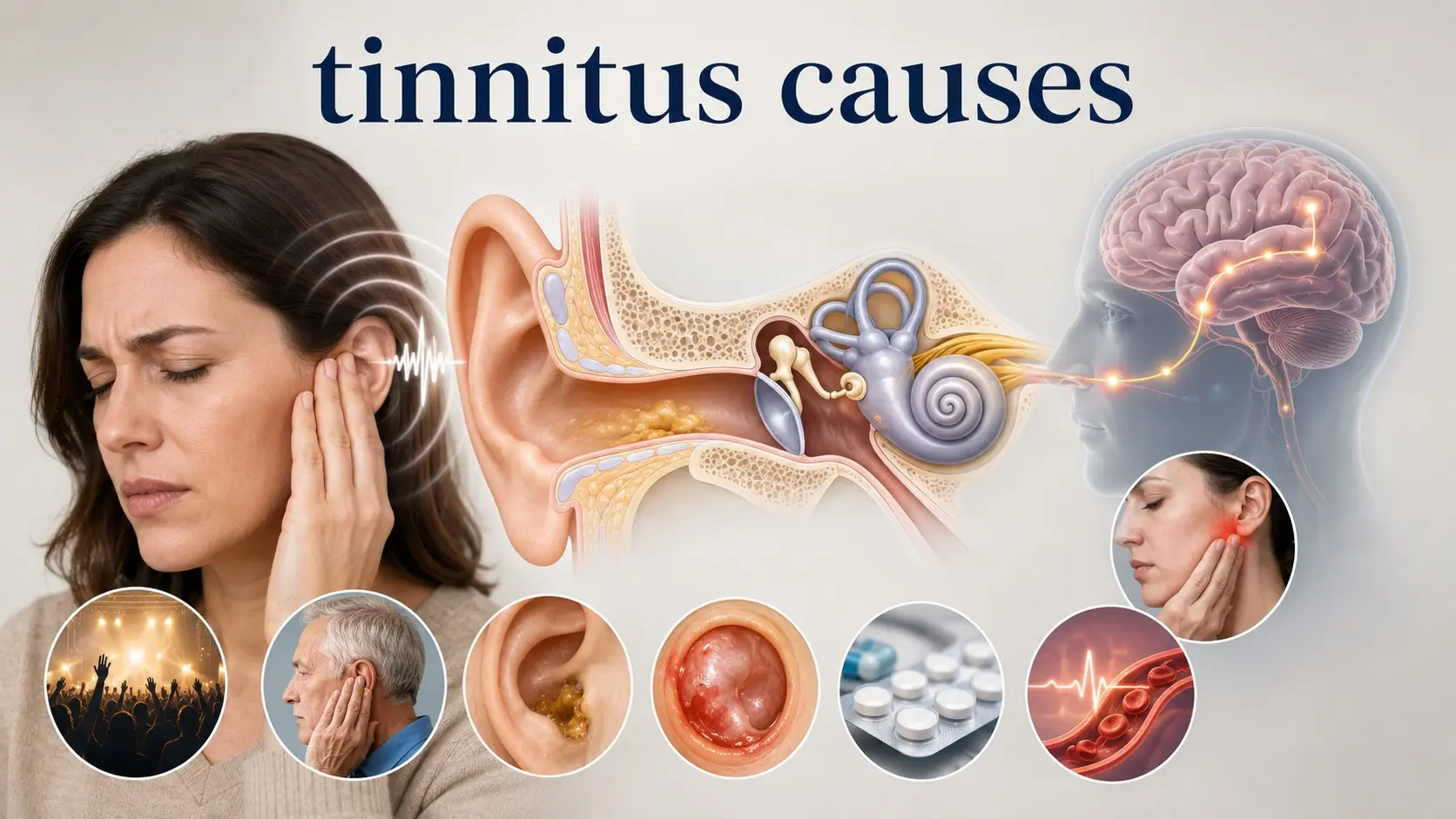
Common tinnitus causes include:
- Hearing loss
- Loud noise exposure
- Earwax buildup
- An ear infection
- Some medicines
- Head or neck injury
- Jaw joint problems
- Ménière’s disease and some other inner ear conditions
- Blood vessel problems that may cause pulsatile tinnitus
- Less common nerve, tumor, or medical conditions
Some people develop tinnitus without a clear cause.
A hearing test and medical history can help narrow down the reason.
Medical note:
This content is for general educational purposes and does not replace professional medical advice, diagnosis, or treatment. Consult an appropriately qualified healthcare professional for personal medical concerns. This article explains published guidance and does not provide a personal clinical assessment. Always consult qualified medical professionals for diagnosis and treatment of any health condition.
What Is Tinnitus?
Tinnitus means hearing sound when there is no matching sound outside your body.
It is often called ringing in the ears.
But ringing is only one sound.
Tinnitus may sound like:
- Ringing
- Buzzing
- Hissing
- Roaring
- Whistling
- Humming
- Clicking
- Squealing
The sound may be in one ear.
It may be in both ears.
It may seem to come from inside the head.
It may come and go.
Or it may stay for a long time.
Tinnitus lasting three months or longer is often called chronic tinnitus.
Why Can Tinnitus Happen?
The exact brain process behind tinnitus is still being studied.
One leading idea starts with changes in sound signals.
Damage in the ear may reduce the normal sound information sent to the brain.
The hearing system may then change how it processes signals.
The result can be a sound that feels very real even though there is no matching outside sound.
This helps explain why tinnitus is strongly linked with hearing loss.
But it is not the only possible pathway.
10 Common Tinnitus Causes
1. Hearing Loss
Hearing loss is one of the most common conditions linked with tinnitus.
Many people with tinnitus have some degree of hearing loss.
You may not know it is there.
You may still hear normal conversation.
But certain pitches may be harder to hear.
Age can play a role.
Noise can play a role.
Other ear conditions can also affect hearing.
Possible clues include:
- Speech sounds unclear
- People seem to mumble
- You turn up the TV
- You struggle in noisy places
- One ear seems weaker
- You ask people to repeat themselves
A professional hearing test can show whether hearing loss is present.
Read more:
Hearing Loss
.
2. Loud Noise Exposure
Loud noise is another major tinnitus trigger.
You may notice temporary ringing after:
- A concert
- A nightclub
- Fireworks
- Power tools
- Heavy machinery
- A very loud sporting event
Tinnitus may also follow years of loud sound at work or during hobbies.
Repeated noise can damage the inner ear.
This can lead to noise induced hearing loss.
Some people also develop tinnitus.
Can One Very Loud Sound Cause Tinnitus?
Yes.
A blast, gunshot, explosion, or other extreme sound can damage hearing very quickly.
New tinnitus after a severe sound exposure deserves medical or hearing assessment if it does not settle or if hearing has changed.
3. Earwax Buildup
Earwax is normal.
It protects the ear canal.
But too much wax can block sound.
An earwax buildup may cause:
- Blocked hearing
- Ear fullness
- Muffled sound
- Ear discomfort
- Tinnitus
Tinnitus may improve when impacted wax is the cause, and the wax is safely removed.
Do not dig wax out with cotton swabs or sharp objects.
4. Ear Infection or Middle Ear Fluid
An ear infection can affect the way sound moves through the ear.
Fluid may also collect behind the eardrum.
This may cause:
- Ear pain
- Pressure
- Muffled hearing
- Tinnitus
- Drainage in some cases
Tinnitus linked with infection may improve when the underlying problem clears.
Persistent pain, fever, drainage, or hearing loss should be checked.
5. Medicines
Some medicines can cause or worsen tinnitus.
Medicines that may damage hearing are sometimes described as ototoxic medicines.
NIDCD lists medicine groups that have been linked with tinnitus.
These can include some:
- Anti inflammatory medicines
- Antibiotics
- Cancer medicines
- Malaria medicines
- Antidepressants
Dose can matter.
Timing can matter.
Other health problems can matter too.
Do not stop a medicine just because tinnitus started.
Talk to the healthcare professional who prescribed it.
6. Head or Neck Injury
A head or neck injury can affect:
- The ear
- The hearing nerve
- The jaw
- Muscles
- Brain areas involved in sound processing
Tinnitus may begin after:
- A fall
- A car crash
- A sports injury
- A blow to the head
- A neck injury
Tinnitus after a significant head injury needs medical assessment.
Seek urgent care if it comes with confusion, weakness, severe dizziness, hearing loss, severe headache, or other serious symptoms.
7. Jaw Joint Problems
The jaw joint sits very close to the ear.
It is called the temporomandibular joint.
A TMJ disorder may cause or worsen tinnitus in some people.
Jaw clenching and tooth grinding can also contribute.
Clues include:
- Jaw pain
- Jaw stiffness
- Clicking while chewing
- Grinding teeth
- Face pain
- Tinnitus that changes when the jaw moves
What Is Somatosensory Tinnitus?
Some tinnitus changes when the body moves.
This is called somatosensory tinnitus.
The sound may change when you:
- Move your jaw
- Clench your teeth
- Turn your neck
- Move your head
- Touch certain areas
A real jaw or neck problem may need its own assessment.
8. Ménière’s Disease and Other Inner Ear Problems
Ménière’s disease is an inner ear disorder.
Tinnitus can be one of its symptoms.
Other possible symptoms include:
- Hearing changes
- Vertigo
- Ear fullness
- Balance problems
Tinnitus alone does not mean you have Ménière’s disease.
The full symptom pattern matters.
9. Blood Vessel Problems and Pulsatile Tinnitus
Some tinnitus sounds rhythmic.
It may seem to follow your heartbeat.
This is called pulsatile tinnitus.
It is different from normal steady ringing.
Possible causes can involve blood flow near the ear or head.
Examples include:
- Changes in blood vessels
- High blood pressure
- Atherosclerosis
- Some blood vessel malformations
- Some changes in pressure inside the head
- Anemia in selected cases
Do not try to identify the cause yourself.
Persistent pulse like tinnitus needs medical evaluation.
NICE recommends imaging for pulsatile tinnitus.
10. Less Common Nerve, Tumor, and Medical Conditions
Most tinnitus is not caused by a tumor.
Still, some uncommon conditions can cause tinnitus.
Vestibular Schwannoma
A vestibular schwannoma is a noncancerous tumor affecting a nerve between the inner ear and brain.
It is also called an acoustic neuroma.
Possible symptoms can include:
- One sided tinnitus
- Hearing loss in one ear
- Balance problems
Most people with one-sided tinnitus do not have a vestibular schwannoma.
Persistent one-sided tinnitus still deserves proper evaluation.
Other Medical Conditions
Tinnitus has also been linked with some chronic health conditions.
NIDCD lists examples including:
- Diabetes
- Migraine
- Thyroid disorders
- Anemia
- Some autoimmune disorders
A link does not mean that one of these conditions is the cause in every person.
Can Stress Cause Tinnitus?
Stress and tinnitus have a complicated relationship.
Stress may make tinnitus more noticeable.
Tinnitus can also create more stress.
This can form a cycle.
WHO includes stress and emotional trauma among factors that may be relevant to tinnitus.
But stress should not automatically be blamed when a new ear sound starts.
Hearing and medical causes may still need assessment.
Can Anxiety Cause Ringing in the Ears?
Anxiety may increase attention to tinnitus.
It may also make the sound feel more intrusive.
But a person with tinnitus and anxiety should not be told the sound is “just anxiety.”
Persistent tinnitus still deserves appropriate hearing and medical assessment.
Can Tinnitus Start Without Hearing Loss?
Yes.
Not every person with tinnitus has obvious hearing loss.
But hearing loss is common enough that a hearing assessment is useful.
You may have changes at certain sound pitches without noticing them in everyday conversation.
Why Is Tinnitus Only in One Ear?
One-sided tinnitus can have simple causes.
Examples include:
- Earwax in one ear
- An ear infection
- Different hearing levels between the ears
- An ear injury
Less common causes also exist.
That is why persistent tinnitus in only one ear deserves assessment.
NICE says persistent unilateral tinnitus can be referred for specialist tinnitus assessment.
What Causes Tinnitus in Both Ears?
Tinnitus in both ears is often linked with:
- Age related hearing loss
- Loud noise exposure
- Some medicines
- Other hearing changes
Equal steady tinnitus in both ears without other warning signs is usually approached differently from persistent one sided or pulse like tinnitus.
Why Does Tinnitus Sound Like My Heartbeat?
A heartbeat sound may be pulsatile tinnitus.
The sound may be:
- Whooshing
- Thumping
- Beating
- Pulse like
It may match your heartbeat.
Blood flow problems are among the possible causes.
Persistent pulsatile tinnitus should be medically evaluated.
What Causes Sudden Tinnitus?
Sudden tinnitus may follow:
- Loud sound exposure
- Ear injury
- Ear infection
- A medicine change
- Head trauma
- A sudden hearing problem
The most important question is:
Did your hearing suddenly change too?
Sudden Hearing Loss With Tinnitus Needs Urgent Care
Do not assume sudden muffled hearing is earwax.
Do not assume it is congestion.
Sudden hearing loss can occur with tinnitus.
Some people also notice:
- Ear fullness
- A sudden pop
- Dizziness
- Vertigo
Seek urgent medical care if hearing suddenly drops.
Can Tinnitus Be Caused by Ear Pressure?
Pressure or middle ear problems can sometimes occur with tinnitus.
You may also notice:
- Ear popping
- Crackling
- Fullness
- Muffled hearing
Colds, allergies, and Eustachian tube problems may affect middle ear pressure.
Read:
Ear Crackling
.
Can Ear Drainage Cause Tinnitus?
Tinnitus can occur with ear conditions that also cause drainage.
Possible examples include:
- Ear infection
- Outer ear inflammation
- Eardrum problems
Tinnitus with persistent drainage, pain, fever, or hearing loss deserves medical assessment.
Read:
Wet Ears in the Morning
.
Can Ear Bleeding and Tinnitus Happen Together?
Yes.
This may happen with:
- Ear canal injury
- Eardrum injury
- Pressure injury
- Head trauma
- Severe sound trauma
Blood from inside the ear should not be ignored.
Read:
Ear Bleeding
.
Does Tinnitus Always Have a Cause?
No clear cause is found in every person.
This can be frustrating.
It does not mean the sound is imaginary.
Tinnitus is a real perception.
The hearing system and brain can produce the sound even when a single physical cause cannot be identified.
How Does a Doctor Look for Tinnitus Causes?
The first step is usually your history.
A healthcare professional may ask:
- When did the tinnitus start?
- Was it sudden or gradual?
- Is it in one ear or both?
- Does it follow your heartbeat?
- Has hearing changed?
- Do you have ear pain?
- Do you have drainage?
- Do you have vertigo?
- Did you have recent loud noise exposure?
- Did you have a head or neck injury?
- Does jaw movement change the sound?
- What medicines do you take?
Ear Examination
A doctor may look into the ear.
This can help find:
- Earwax
- Infection
- Fluid
- An eardrum problem
- Another visible ear problem
Why a Hearing Test Matters
NICE recommends an audiological assessment for people with tinnitus.
A hearing test can show:
- Whether hearing loss is present
- Which ear is affected
- Which pitches are affected
- Whether one ear differs from the other
An audiologist can perform detailed hearing testing.
When Is Tympanometry Used?
Tympanometry checks the movement of the eardrum and middle ear.
NICE says it may be considered when middle ear problems or Eustachian tube problems are suspected.
It is not needed for every person with tinnitus.
Does Tinnitus Always Need an MRI?
No.
The need for imaging depends on the pattern.
Steady Tinnitus in Both Ears
NICE does not recommend routine imaging for symmetrical steady tinnitus when there are no other neurological, ear, head, or neck warning signs.
Persistent Tinnitus in One Ear
MRI may be considered for persistent one-sided or asymmetric tinnitus.
Tinnitus With Other Warning Signs
Imaging may be recommended when tinnitus comes with certain:
- Neurological symptoms
- Ear findings
- Head or neck findings
- Asymmetric hearing loss
Pulsatile Tinnitus
NICE recommends imaging for pulsatile tinnitus.
The type of scan depends on the suspected cause.
When Should You See a Doctor for Tinnitus?
Arrange medical advice if:
- Tinnitus happens regularly
- It is constant
- It is getting worse
- It is only in one ear
- It follows your heartbeat
- You notice hearing loss
- You have persistent dizziness
- You have ear pain
- You have ear drainage
- It is affecting sleep
- It is affecting work
- It causes major distress
When Is Tinnitus Urgent?
Seek urgent medical care when tinnitus occurs with:
- Sudden hearing loss
- Facial weakness
- Severe new vertigo
- New neurological symptoms
- A significant head injury
Persistent tinnitus that follows your pulse also needs prompt medical assessment.
Common Myths About Tinnitus Causes
Myth: Tinnitus Always Means Ear Damage
No.
Many cases are linked with hearing changes, but tinnitus can have other causes too.
Myth: Tinnitus Always Means You Are Going Deaf
No.
Tinnitus and hearing loss often occur together.
But tinnitus does not automatically mean severe hearing loss.
Myth: Earwax Is Always the Cause
No.
Earwax is only one possible cause.
Myth: Stress Is Always the Cause
No.
Stress may make tinnitus more noticeable.
It should not be used to explain every new case.
Myth: Tinnitus in One Ear Means a Tumor
No.
Most one-sided tinnitus is not caused by a tumour.
Persistent one-sided tinnitus should still be assessed.
Myth: Pulse-Like Tinnitus Is Just Normal Ringing
No.
Pulsatile tinnitus has different possible causes and should be medically evaluated.
Myth: Every Person With Tinnitus Needs a Scan
No.
Imaging depends on the symptoms and tinnitus pattern.
Myth: A Medicine Must Be Stopped if Tinnitus Starts
No.
Do not stop an important medicine on your own.
Speak with the prescriber.
A Simple Tinnitus Cause Checklist
Before an appointment, write down:
- The date tinnitus started
- Whether it started suddenly
- Which ear is affected
- What the sound is like
- Whether it follows your pulse
- Whether hearing changed
- Recent loud noise exposure
- Recent ear infection
- Recent head or neck injury
- Jaw pain or tooth grinding
- All medicines
- All supplements
- Dizziness or vertigo
- Ear pain
- Ear drainage
This can help a healthcare professional narrow down possible causes of tinnitus.
How I Research Tinnitus Causes
I have spent more than fifteen years researching and writing about health and wellness.
I also bring more than thirty years of personal experience with fitness, nutrition, sleep habits, and everyday wellness.
Tinnitus is a good example of why one symptom should not be treated as one diagnosis.
Two people may both hear ringing.
One may have hearing loss.
Another may have earwax.
Another may notice a sound linked with the pulse.
Those patterns do not deserve the same explanation.
That is why I research tinnitus causes by looking first at the pattern.
I ask:
Is it one ear or both?
Is hearing different?
Did it begin after noise?
Does the sound follow the heartbeat?
Does the jaw change it?
Did a medicine change?
Are there warning signs?
Before focusing on NextFitLife, I spent twenty nine years in information technology management.
That work trained me to troubleshoot systems.
I learned to separate symptoms from causes.
I learned to compare evidence.
I learned not to assume the first explanation is always the correct one.
I use the same structured approach when I research hearing and ear topics.
For this guide, I compared information from WHO, NIDCD, NICE, NHS, and the VA and DoD tinnitus guidelines.
My goal is not to diagnose readers.
My goal is to explain the main possibilities, remove unnecessary fear, and make warning signs easy to recognize.
References and High Authority Sources
The medical information in this guide was checked against these five public and high authority sources.
World Health Organization
Deafness and Hearing Loss: Tinnitus.This WHO resource explains common tinnitus causes including age related hearing loss, loud sound, ear infection, earwax, ototoxic medicine, head or neck injury, jaw tension, Ménière’s disease, and rarer causes.
National Institute on Deafness and Other Communication Disorders
Tinnitus.This NIDCD resource explains tinnitus symptoms, hearing loss, noise exposure, medicines, earwax, infection, injury, jaw problems, Ménière’s disease, blood vessel problems, tumours, chronic conditions, diagnosis, and treatment.
National Institute for Health and Care Excellence
Tinnitus: Assessment and Management. NICE guideline NG155.This guideline covers hearing assessment, referral, one sided tinnitus, pulsatile tinnitus, sudden hearing loss, tympanometry, and when imaging may be appropriate.
NHS
Tinnitus.This public health guide explains tinnitus symptoms, earwax, ear infection, hearing assessment, pulsatile tinnitus, and urgent warning signs including sudden hearing loss, vertigo, and head injury.
United States Department of Veterans Affairs and Department of Defense
Clinical Practice Guideline for Tinnitus. 2024.This evidence based guideline provides clinical pathways for tinnitus evaluation and management and includes twenty five recommendations.
Source Review Date:
August 20, 2026
These organizations do not endorse NextFitLife.
Conclusion
There are many possible tinnitus causes.
Hearing loss and loud sound are common links.
Earwax, infection, medicines, injury, jaw problems, inner ear conditions, and blood vessel problems can also play a role.
Sometimes no clear cause is found.
Do not diagnose tinnitus from the sound alone.
Look at the full pattern.
One ear matters.
Your pulse matters.
Hearing changes matter.
Dizziness matters.
A recent injury matters.
Your next step:
If you are trying to understand your tinnitus causes, write down when the sound started, which ear is affected, whether it follows your pulse, whether hearing changed, and any recent noise, medicine, jaw, or injury changes. Take that information to a qualified healthcare professional or audiologist if the tinnitus persists or worries you.
Editorial Policies and Trust
Frequently Asked Questions About Tinnitus Causes
What is the most common cause of tinnitus?
Hearing loss is strongly linked with tinnitus. Loud sound exposure and age related hearing changes are common factors, but tinnitus can have many other causes.
Can hearing loss cause tinnitus?
Yes. Many people with tinnitus have some degree of hearing loss, even when they have not noticed it yet.
Can loud noise cause tinnitus?
Yes. Tinnitus can start after one very loud sound or after repeated loud sound exposure over time.
Can earwax cause tinnitus?
Yes. Impacted earwax can block the ear canal and may cause tinnitus, muffled hearing, or ear fullness.
Can an ear infection cause tinnitus?
Yes. An ear infection or middle ear fluid can sometimes trigger tinnitus and hearing changes.
Can medicines cause tinnitus?
Yes. Some medicines are linked with tinnitus, especially at certain doses. Do not stop a prescribed medicine without talking to the prescriber.
Can stress cause tinnitus?
Stress may contribute to tinnitus in some people and can make existing tinnitus feel more noticeable. It should not automatically be assumed to be the only cause.
Can anxiety make tinnitus worse?
Yes. Anxiety can increase attention to tinnitus and make the sound feel harder to ignore.
Can jaw problems cause tinnitus?
Yes. Jaw clenching, tooth grinding, or a jaw joint problem can cause or worsen tinnitus in selected people.
Why does my tinnitus change when I move my jaw?
Tinnitus that changes with jaw, head, or neck movement may have a somatosensory component.
Can Ménière’s disease cause tinnitus?
Yes. Tinnitus can occur with Ménière’s disease, along with hearing changes, vertigo, and ear fullness.
What causes pulse like tinnitus?
Pulsatile tinnitus can be linked with changes in blood flow or other physical conditions near the ear or head. Persistent pulse like tinnitus needs medical assessment.
Can high blood pressure cause tinnitus?
Blood pressure and blood vessel problems can be relevant to some forms of tinnitus, especially pulsatile tinnitus. A healthcare professional should assess the full pattern.
Can a head injury cause tinnitus?
Yes. Head or neck injuries can affect the ear, hearing nerve, jaw, muscles, or brain areas involved in sound.
Can tinnitus be caused by a tumour?
Rarely. A vestibular schwannoma or another tumour can cause tinnitus, often with other features such as hearing loss on one side. Most tinnitus is not caused by a tumour.
Why do I have tinnitus in only one ear?
One-sided tinnitus may come from simple causes such as wax or different hearing levels, but persistent tinnitus in one ear should be medically assessed.
Does tinnitus always mean hearing loss?
No. Tinnitus and hearing loss often occur together, but tinnitus can also occur without obvious hearing loss.
Can tinnitus occur for no known reason?
Yes. Sometimes no clear cause is found even after assessment.
Do I need a hearing test for tinnitus?
A hearing assessment is useful because tinnitus often occurs with hearing loss. NICE recommends audiological assessment for people with tinnitus.
Do I need an MRI for tinnitus?
Not everyone needs imaging. Scans are more likely to be considered for pulsatile tinnitus, persistent one sided tinnitus, asymmetric hearing loss, or other concerning signs.
When is tinnitus an emergency?
Seek urgent medical care if tinnitus occurs with sudden hearing loss, severe new vertigo, facial weakness, new neurological symptoms, or after a significant head injury.
Where can I learn about tinnitus treatment?
Read the NextFitLife Tinnitus Treatment guide for information about hearing aids, CBT, sound support, sleep, specialist care, and treatments that do not have good evidence.
Medical Disclaimer
NextFitLife provides general educational information.
It does not diagnose tinnitus, hearing loss, Ménière’s disease, a jaw condition, a blood vessel condition, ear disease, medicine-related hearing injury, a tumour, or another medical problem.
The cause of tinnitus cannot be confirmed from an online article.
Always speak with an appropriately qualified healthcare professional about persistent tinnitus, one-sided tinnitus, pulsatile tinnitus, hearing changes, ear pain, dizziness, medicine concerns, or other symptoms.
Do not delay urgent medical care for sudden hearing loss, severe new vertigo, neurological symptoms, or significant head injury.

Health & wellness writer with 30+ years of experience in nutrition, fitness, and healthy aging. Founder of NextFitLife.com — evidence-based health guidance.