
Published on: Aug 11, 2024
Updated: November 2, 2026
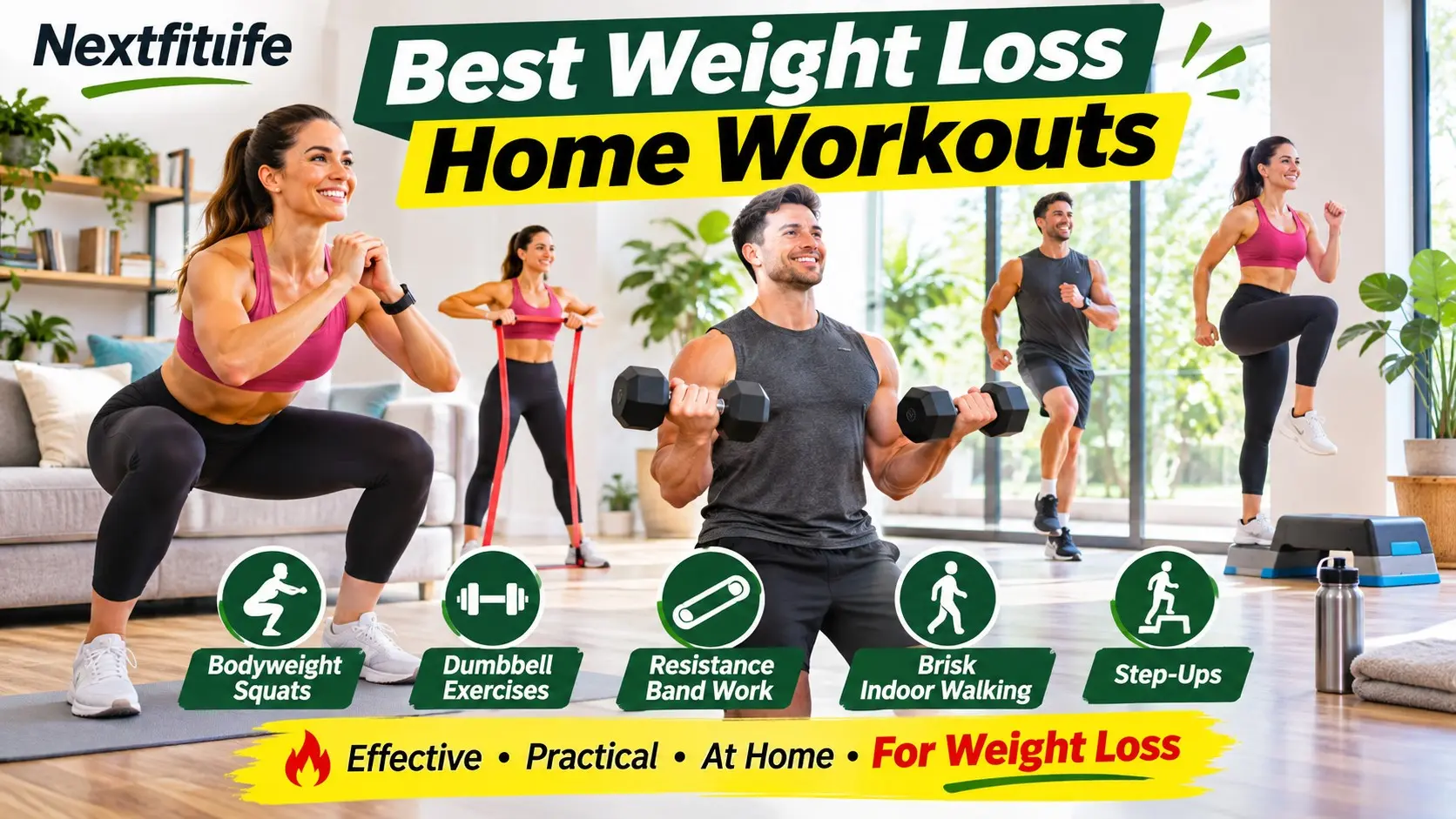
The Best Weight Loss Home Workouts do not need a gym, a treadmill, or a living room full of equipment.
They also do not need to leave you exhausted.
A strong home plan combines aerobic activity with strength work. This helps you use more energy, improve fitness, and protect muscle while you work toward a healthy calorie deficit.
Exercise alone does not guarantee weight loss. Food intake, sleep, daily movement, health, medicines, and consistency also matter.
This article is for general information and education. It does not replace medical advice, diagnosis, or treatment.
Quick answer: The Best Weight Loss Home Workouts include brisk walking, bodyweight strength, dumbbell training, resistance bands, low-impact cardio, walking intervals, dance, step workouts, short circuits, Pilates, yoga mobility, and mixed cardio plus strength sessions. The best plan is the one you can repeat while also keeping your food intake aligned with your weight goal.
Safety first: Stop exercising and seek urgent medical help for chest pain, fainting, severe shortness of breath, sudden weakness, severe dizziness, or a serious injury. Ask a healthcare professional before starting a harder program if you have heart disease, uncontrolled blood pressure, severe joint pain, recent surgery, pregnancy, or another condition that may affect safe exercise.
Table of Contents
- Can home workouts really help with weight loss?
- How exercise supports fat loss
- 12 best weight loss home workouts
- Brisk indoor walking
- Bodyweight strength
- Dumbbell full body workout
- Resistance band workout
- Low impact cardio
- Walking intervals
- Dance cardio
- Step workout
- Short interval circuit
- Pilates core routine
- Yoga and mobility
- Cardio plus strength workout
- Best weekly home workout plan
- How long should workouts be?
- Cardio versus strength
- How hard should you exercise?
- Nutrition for weight loss
- Common mistakes
- Frequently asked questions
Can Home Workouts Really Help With Weight Loss?
Yes.
Home workouts can increase the amount of energy your body uses and help you become fitter without travelling to a gym.
The location does not decide whether an exercise works.
Your total activity, effort, progression, food intake, and consistency matter more.
The CDC notes that physical activity increases calorie use. When this happens alongside lower calorie intake, it can help create the calorie deficit needed for weight loss.
Does Exercise Alone Cause Weight Loss?
Sometimes exercise can produce weight loss, but it is usually not the strongest tool by itself.
Most weight loss comes from reducing calorie intake.
Exercise still matters because it can:
- Increase energy use
- Improve fitness
- Build or protect muscle
- Support long term weight maintenance
- Improve heart and metabolic health
For the food side of the plan, see the NextFitLife Weight Loss Guide.
Why Strength Training Matters During Weight Loss
Losing weight can include loss of fat and lean tissue.
Resistance training helps protect muscle while you lose weight.
A 2025 systematic review found that adding resistance exercise to dietary weight loss helped preserve fat-free mass and increased fat mass loss compared with diet alone.
This is why a home weight loss plan should not be cardio only.
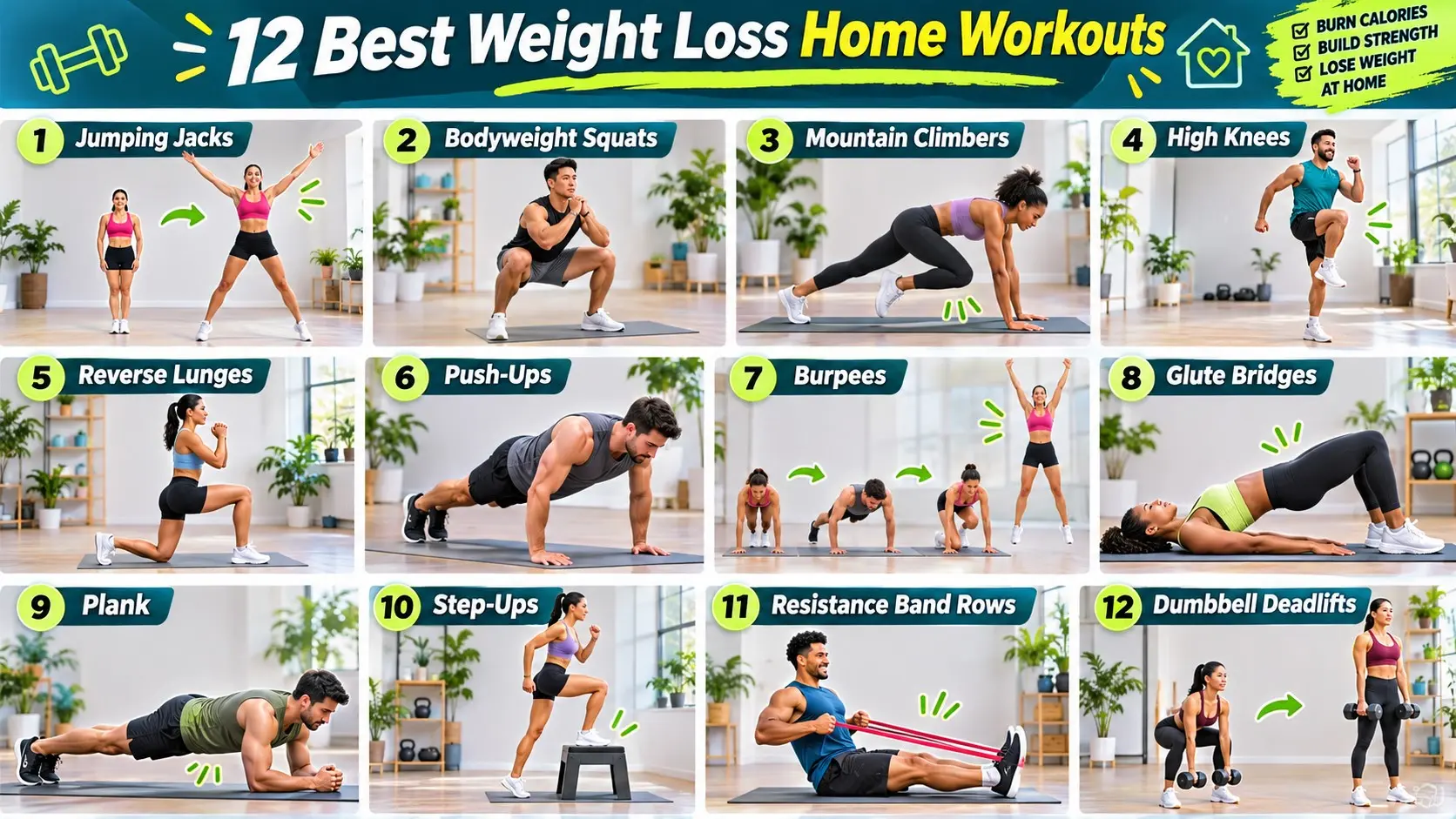
12 Best Weight Loss Home Workouts
1. Brisk Indoor Walking
You do not need a treadmill.
Walk around your home, march in place, or use a clear hallway.
Try:
- 5 minutes of easy walking
- 15 to 20 minutes brisk walking
- 5 minutes easy walking
A brisk pace should make you breathe harder while still allowing you to talk.
See Indoor Walking Exercise for more ideas.
2. Bodyweight Strength Workout
This simple bodyweight workout trains major muscle groups.
- Chair squat: 8 to 15 reps
- Wall or counter push up: 8 to 15 reps
- Glute bridge: 10 to 15 reps
- Supported split squat: 6 to 12 each side
- Bird dog: 6 to 10 each side
Repeat one to three rounds depending on your level.
3. Dumbbell Full Body Workout
A pair of dumbbells can create an effective home strength training session.
- Goblet squat: 8 to 12 reps
- Dumbbell row: 8 to 12 each side
- Dumbbell floor press: 8 to 12 reps
- Romanian deadlift: 8 to 12 reps
- Farmer carry: 20 to 40 seconds
Do two or three sets with good form.
4. Resistance Band Workout
Resistance bands are useful when space is limited.
Try:
- Band squat
- Band row
- Band chest press
- Band hip abduction
- Band curl
Do 8 to 15 controlled repetitions of each exercise.
5. Low Impact Cardio Workout
Jumping is not required for a good cardio session.
Try five minutes of:
- Marching
- Side steps
- Step touch
- Low knee lifts
- Easy walking
Repeat the sequence two to four times.
This is a useful choice if high impact exercise does not feel good.
6. Walking Intervals
Intervals can be done without sprinting.
- Walk easily for 5 minutes.
- Walk briskly for 1 minute.
- Walk comfortably for 2 minutes.
- Repeat 4 to 6 times.
- Finish with easy walking.
See Walking Techniques for Weight Loss.
7. Dance Cardio
Dance can be a useful form of cardio at home.
Choose music you enjoy and keep the moves simple.
A good session can look like:
- 5 minutes of easy movement
- 15 to 25 minutes of dance
- 5 minutes of easier movement
You do not need perfect choreography.
8. Step Workout
A low stable step can increase effort with no need much space.
Try:
- Step up right leg
- Step up left leg
- March in place
- Side step
- Recover with easy walking
Use a rail or wall if balance is limited.
9. Short Interval Circuit
Intervals do not need to mean all out effort.
Try 30 seconds of work and 30 to 60 seconds of easy movement.
- Chair squat
- Wall push up
- Brisk march
- Step up
- Band row
Repeat two to four rounds.
You should still be able to control each movement.
10. Pilates Core Routine
Pilates can improve core control and movement quality.
Try:
- Pelvic tilt
- Dead bug
- Bird dog
- Glute bridge
- Side-lying leg lift
Pilates does not target belly fat directly.
Use it for strength, control, and mobility.
11. Yoga and Mobility Routine
Yoga is not the highest-calorie workout, but it can help you stay active and move comfortably.
Try:
- Cat cow
- Supported downward dog
- Warrior II
- Chair pose
- Gentle side stretch
See Best Yoga Moves for Beginners.
12. Cardio Plus Strength Workout
This is one of the most balanced options.
- 5 minutes brisk walking
- 10 squats
- 10 wall push-ups
- 10 rows
- 10 hip hinges
- 5 minutes brisk walking
- Repeat the strength exercises
Current research supports combining aerobic and resistance exercise for body composition.
12 Home Workouts at a Glance
| Workout | Main Benefit | Suggested Time |
|---|---|---|
| Indoor walking | Aerobic fitness | 20 to 30 min |
| Bodyweight strength | Muscle support | 15 to 25 min |
| Dumbbell workout | Strength | 20 to 30 min |
| Resistance bands | Full body strength | 15 to 25 min |
| Low-impact cardio | Cardio | 15 to 25 min |
| Walking intervals | Cardio progression | 20 to 30 min |
| Dance cardio | Enjoyable aerobic work | 20 to 30 min |
| Step workout | Cardio plus legs | 15 to 20 min |
| Short intervals | Time-efficient fitness | 10 to 20 min |
| Pilates | Core control | 15 to 25 min |
| Yoga | Mobility and recovery | 10 to 30 min |
| Cardio plus strength | Balanced fitness | 25 to 35 min |
What Is the Best Home Workout for Fat Loss?
There is no single winner.
A 2025 meta-analysis comparing aerobic, resistance, and combined exercise found that aerobic and combined training produced greater absolute fat mass reductions than resistance training alone, while resistance training helped preserve lean mass.
This supports a simple approach.
Use both cardio and strength.
Is HIIT the Best Workout for Weight Loss?
No.
HIIT can improve fitness and can be time-efficient, but it is not required.
Moderate cardio, walking, strength work, and mixed training can also support fat loss.
HIIT may be harder to recover from and may not suit beginners or people with joint problems.
Do You Need Burpees?
No.
Burpees are only one exercise.
You can raise your heart rate with brisk walking, step-ups, marching, cycling, dancing, or simple circuits.
Is Tabata Necessary?
No.
True Tabata uses very intense work.
You do not need maximum effort intervals to lose weight.
Beginners can use longer rest periods and moderate effort.
Does Jump Rope Burn More Fat?
Jump rope can use a lot of energy, but that does not make it the best choice for everyone.
It is high impact and may not suit people with joint pain, poor balance, or little training experience.
Walking or low-impact cardio can be easier to repeat.
Can You Lose Belly Fat With Home Workouts?
You can reduce overall body fat with a good weight loss plan.
You cannot choose to remove only belly fat.
Planks, crunches, and core work can strengthen abdominal muscles, but they do not force your body to burn fat from your stomach.
Read How to Lose Belly Fat Naturally Without Exercise for the nutrition side of abdominal fat loss.
How Long Should a Home Workout Be?
There is no required length.
A useful session might last:
- 10 minutes on a busy day
- 20 minutes for a short workout
- 30 minutes for a fuller session
- Longer when you enjoy it and recover well
Short workouts still count.
Is 30 Minutes Enough?
Yes.
A 30-minute home session can contribute usefully to your weekly activity.
It does not need to burn a fixed number of calories.
Calorie use varies with body size, fitness, exercise type, duration, and intensity.
How Much Exercise Should Adults Aim For?
Adults should work toward at least 150 minutes of moderate aerobic activity each week.
They should also do muscle strengthening work on at least two days.
You can divide the activity across the week.
A Simple Beginner Weekly Home Plan
| Day | Workout |
|---|---|
| Monday | 25-minute brisk indoor walk |
| Tuesday | 20-minute bodyweight strength workout |
| Wednesday | 20-minute low-impact cardio |
| Thursday | Rest or gentle yoga |
| Friday | 20-minute strength workout |
| Saturday | 30-minute walk or dance cardio |
| Sunday | Easy movement or rest |
A Stronger Weekly Plan
Once you have a base, you can use:
- Three aerobic sessions
- Two strength sessions
- One optional mixed session
- One easier recovery day
You do not need hard intervals every day.
How Hard Should You Exercise?
For moderate cardio, you should breathe faster while still being able to talk.
For strength work, the final repetitions should feel challenging while your form stays good.
You do not need to reach complete failure in every set.
How Do You Progress a Home Workout?
Your body adapts when the challenge increases over time.
You can progress by:
- Adding repetitions
- Adding another set
- Using more resistance
- Walking a little longer
- Using a stronger band
- Taking a slightly harder exercise option
Change one thing at a time.
Can Home Strength Training Protect Muscle?
Yes.
A 2025 pilot trial studied people with overweight or obesity during dietary weight loss and found that home-based resistance training could improve strength and help support body composition.
You do not need large gym machines to train muscle.
Is Aerobic Exercise or Strength Better?
They do different jobs.
Aerobic exercise can increase energy use and improve cardiovascular fitness.
Resistance training improves strength and helps preserve lean tissue.
Using both gives you a more complete plan.
Does Exercise Increase Metabolism for Hours?
Hard exercise can temporarily raise energy use after a session.
However, this effect should not be treated as a major weight loss shortcut.
Total weekly activity and food intake matter much more.
How Many Calories Does a Home Workout Burn?
There is no honest single number.
Calories used depend on:
- Body size
- Exercise type
- Fitness
- Duration
- Intensity
- Movement efficiency
A claim that every person burns 200 to 400 calories in the same workout is not reliable.
Do You Need to Sweat to Lose Weight?
No.
Sweat cools your body.
It does not measure how much body fat you lost.
Does More Soreness Mean Better Fat Loss?
No.
Muscle soreness is not a score for workout quality.
A useful workout can work without making it painful to move the next day.
What Should You Eat With Home Workouts?
Exercise supports weight loss, but food intake remains important.
Build meals around:
- Protein-rich foods
- Vegetables
- Whole fruit
- Beans
- Whole grains
- Sensible amounts of healthy fats
Do You Need a High Protein Diet?
You need enough protein, but you do not need an extreme diet.
Protein can support fullness and help protect lean tissue while losing weight.
Good foods include eggs, fish, poultry, yogurt, beans, lentils, tofu, and cottage cheese.
Can You Lose Weight Without Changing Your Diet?
It is possible for some people, but it is often harder.
CDC notes that most weight loss comes from reducing calorie intake.
Exercise works best when food habits support the same goal.
Is Fasted Exercise Better for Fat Loss?
No clear advantage has been shown for overall body composition.
A 2025 systematic review found no clear body composition or strength benefit from resistance training in a fasted state compared with a fed state.
Choose the timing that helps you train well.
What Equipment Do You Need?
You can start with very little.
Useful options include:
- Exercise mat
- Resistance bands
- Dumbbells
- A stable step
- A sturdy chair
Do not use unstable furniture for exercise.
Common Home Workout Mistakes
1. Doing HIIT Every Day
Your body needs recovery. Hard intervals are optional.
2. Doing Only Cardio
Add resistance work to support muscle.
3. Doing Only Strength Work
Add aerobic activity for heart fitness and extra movement.
4. Believing Sweat Equals Fat Loss
Sweat is mainly about cooling your body.
5. Using Unstable Furniture
Use a sturdy chair, step, or wall.
6. Never Increasing the Challenge
Your body needs gradual progression.
7. Copying Advanced Workouts
Choose moves that match your current fitness.
8. Ignoring Food Intake
Exercise does not cancel unlimited calories.
9. Expecting Belly Fat to Disappear First
You cannot choose where your body loses fat.
10. Quitting After One Slow Week
Weight loss does not happen at a perfect rate every week.
Home Weight Loss Workout Checklist
- Choose cardio you enjoy.
- Strength train at least twice each week.
- Start with manageable sessions.
- Use low-impact options when needed.
- Progress slowly.
- Use a safe exercise space.
- Track weekly activity.
- Keep food intake aligned with your goal.
- Sleep enough.
- Take recovery days.
- Do not chase calorie burn numbers.
- Focus on consistency.
Conclusion
The Best Weight Loss Home Workouts are not the routines with the most burpees, the most sweat, or the biggest calorie claim.
The best plan combines movement you can repeat with strength training that helps protect muscle.
Walking, dumbbells, resistance bands, low-impact cardio, dance, step workouts, and short circuits can all work at home.
For better weight loss results, combine that activity with a sustainable eating pattern that creates an appropriate calorie deficit.
Your next step: choose one cardio workout and one strength workout from this guide. Put both on your calendar this week, then build from there.
References and Sources
- Centers for Disease Control and Prevention. Physical Activity and Your Weight and Health.
https://www.cdc.gov/healthy-weight-growth/physical-activity/ - Centers for Disease Control and Prevention. What Counts as Physical Activity for Adults.
https://www.cdc.gov/physical-activity-basics/adding-adults/what-counts.html - Binmahfoz A, et al. Effect of Resistance Exercise on Body Composition During Dietary Weight Loss, 2025.
https://pubmed.ncbi.nlm.nih.gov/40909191/ - Comparison of Concurrent, Resistance, or Aerobic Training on Body Fat Loss. Systematic Review and Meta-Analysis, 2025.
https://pubmed.ncbi.nlm.nih.gov/40405489/ - Effects of Calorie Restriction With and Without Strength, Endurance or Mixed Training. Systematic Review, 2026.
https://pubmed.ncbi.nlm.nih.gov/42144246/ - The Effects of a Home-Based Resistance Training Programme During Weight Loss. Randomized Pilot Trial, 2025.
https://pubmed.ncbi.nlm.nih.gov/40760444/ - Resistance Training Performed in the Fasted State Compared With the Fed State. Systematic Review, 2025.
https://pubmed.ncbi.nlm.nih.gov/41316673/ - Effectiveness of Dietary, Physical Activity, and Lifestyle Interventions on Weight and Cardiometabolic Outcomes. Umbrella Review, 2026.
https://pubmed.ncbi.nlm.nih.gov/42733605/
Internal Links + Hub
- NextFitLife Fitness Hub
- Fitness Program Guide
- Home Workouts and Equipment Guide
- Complete Weight Loss Guide
- Weight Management and Metabolism Hub
- Easy but Effective Workout Routines
- Quick Effective Workout Routines
- Strength Training Exercises at Home for Beginners
- Simple Strength Training Exercises at Home
- Indoor Walking Exercise
- Walking Routine to Lose Weight
- Walking Workout Plan for Weight Loss
- Walking Techniques for Weight Loss
- Healthy Eating Lifestyle
- Fastest Safe Way to Lose Weight
About the Author
Adel Galal is the founder and lead writer of NextFitLife.com and the founder of Parnthub.com.
He is a father of four, three sons and a daughter, and a grandfather of four, with more than 33 years of hands-on family experience. Adel is based in Cairo, Egypt.
He has maintained a personal interest in health, fitness, nutrition, walking, strength training, weight management, sleep, wellness, and healthy aging for more than 30 years and has more than 15 years of health and wellness writing experience.
His work focuses on reviewing trusted sources, separating practical fitness guidance from exaggerated calorie burn and fat loss claims, and turning research into simple steps readers can use at home.
Adel is not a doctor, physical therapist, registered dietitian, certified personal trainer, exercise physiologist, or other licensed healthcare professional. NextFitLife content is for general information and education and does not replace personal medical, training, or nutrition advice.
Learn more about Adel and NextFitLife on the About Us page.
Frequently Asked Questions
What are the Best Weight Loss Home Workouts?
The Best Weight Loss Home Workouts combine cardio and strength. Good choices include walking, bodyweight strength, dumbbells, resistance bands, dance, step workouts and mixed circuits.
Can you lose weight with home workouts?
Yes. Home workouts can increase calorie use and support fitness, but food intake usually also needs to support a calorie deficit.
What home workout burns the most fat?
There is no single workout that always burns the most fat. Total activity, duration, effort, food intake and consistency matter more.
Is HIIT best for weight loss?
No. HIIT can be useful, but moderate cardio and combined cardio plus strength training can also support weight loss.
Do I need burpees to lose weight?
No. Walking, dance, step workouts, cycling and low-impact circuits can all raise your heart rate.
Is Tabata necessary for weight loss?
No. Tabata is only one form of high-intensity interval training.
Is 30 minutes of home exercise enough?
Yes. Thirty minutes can contribute usefully to your weekly activity when done consistently.
Do short workouts count?
Yes. Short workouts add to your total physical activity and can make regular exercise easier to maintain.
Is strength training good for weight loss?
Yes. Resistance training helps support strength and preserve lean tissue during weight loss.
Is cardio better than strength for fat loss?
Cardio can increase energy use, while strength training helps protect muscle. Combining both is a strong approach.
Can you lose belly fat with home workouts?
You can reduce overall body fat, but you cannot choose to lose fat only from your belly.
Do planks burn belly fat?
No. Planks strengthen the core but do not directly remove fat from the stomach.
Does sweating mean I am burning more fat?
No. Sweating is mainly your body's cooling response.
How many calories does a home workout burn?
There is no fixed number. Calorie use varies with body size, workout type, duration and intensity.
Can I lose weight without changing my diet?
It is possible, but weight loss is usually easier when food intake also supports a calorie deficit.
How often should I work out at home?
Adults should generally work toward at least 150 minutes of moderate aerobic activity each week plus strength work on at least two days.
Is walking at home effective?
Yes. Indoor walking and marching can improve fitness and increase daily energy use.
Are resistance bands enough for strength training?
Yes. Bands can provide useful resistance when the exercises become challenging enough.
Can dumbbells help with weight loss?
Dumbbells help build and preserve muscle. They can be part of a balanced weight loss program.
Is dance good for weight loss?
Dance can be a useful aerobic activity, especially when you enjoy it enough to repeat it regularly.
Is fasted exercise better for fat loss?
Current evidence does not show a clear overall body composition advantage from training in a fasted state.
Should beginners do high-intensity workouts?
Not necessarily. Beginners can start with walking, low-impact cardio and basic strength exercises before adding harder intervals.
What equipment do I need for home workouts?
You can start with bodyweight. A mat, bands, dumbbells, a sturdy chair and a stable step can add more options.
How fast can home workouts change my weight?
There is no fixed timeline. Weight change depends on food intake, activity, starting weight, health, sleep, medicines and consistency.

Health & wellness writer with 30+ years of experience in nutrition, fitness, and healthy aging. Founder of NextFitLife.com — evidence-based health guidance.

