Published on: July 2024
Last updated: September 13, 2026
Next review: September 2027, or sooner if important digestive health, IBS, microbiome, or nutrition guidance changes
Written and source-checked by: Adel Galal, Founder and Lead Writer at NextFitLife
Medical review status: This article has not been medically reviewed by a doctor, gastroenterologist, or registered dietitian.
No single food destroys your gut.
That is the first thing I would change about most “gut killer” lists.
Your digestive system is more complicated than that.
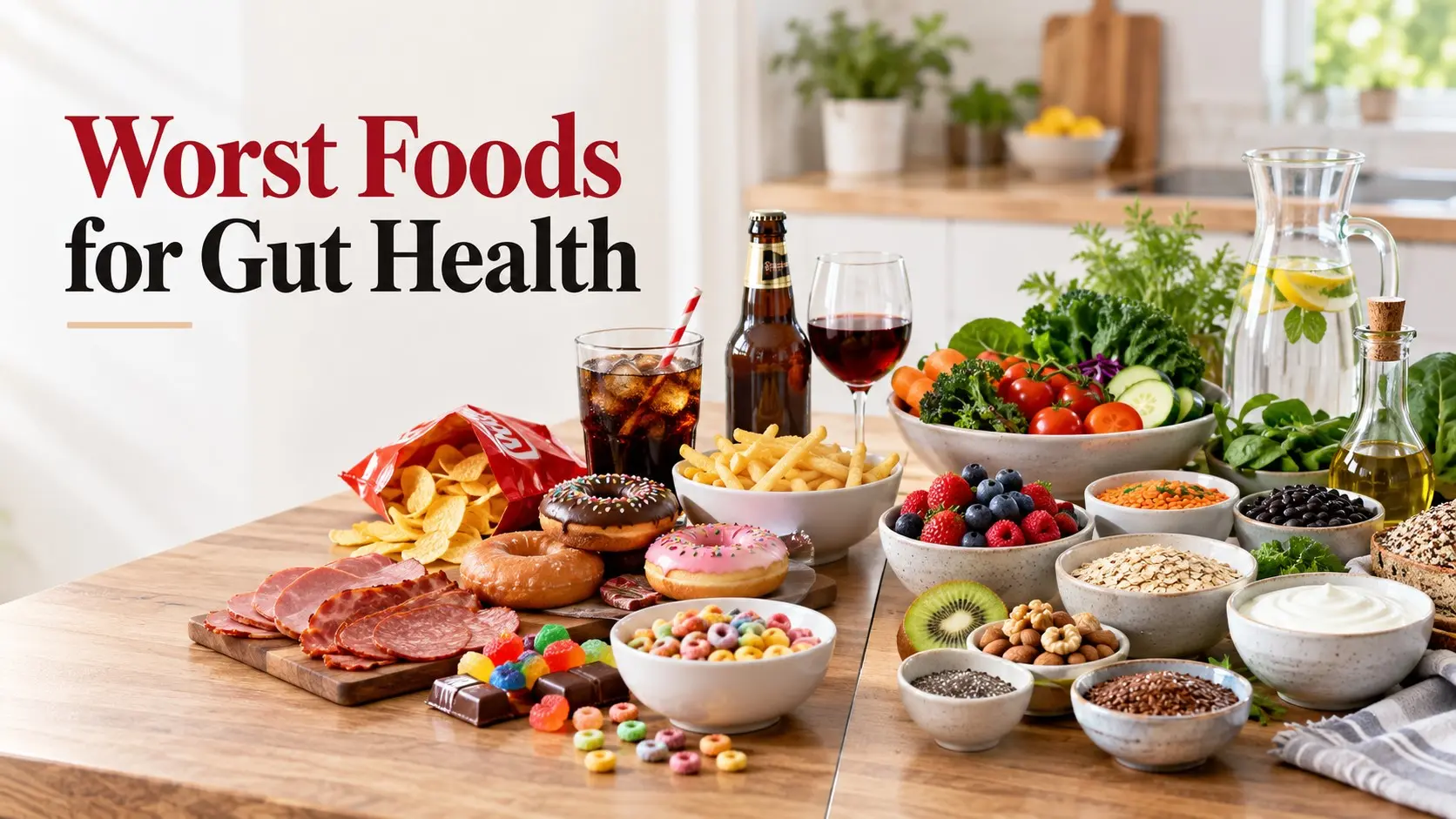
The Worst Foods for Gut Health are better understood as foods and eating patterns that can crowd out fiber rich foods, worsen digestive symptoms, or be linked with less favorable gut health when eaten frequently.
Think ultra processed snacks.
Sugary drinks.
Processed meat.
Heavy alcohol intake.
Repeated low fiber meals.
Then there are personal triggers.
Lactose can cause gas and diarrhea if you are lactose intolerant.
High FODMAP foods can worsen IBS symptoms in some people.
That does not make milk, onions, beans, apples, or wheat “bad for every gut.”
Food tolerance varies from person to person.
Important medical note: This content is for general educational purposes and does not replace professional medical advice, diagnosis, or treatment. Consult an appropriately qualified healthcare professional for personal medical concerns. This article explains published guidance and does not provide a personal clinical assessment. Always consult qualified medical professionals for diagnosis and treatment of any health condition.
Digestive symptoms can come from constipation, infection, IBS, celiac disease, inflammatory bowel disease, lactose intolerance, medicine, reflux, gallbladder disease, pancreatic disease, food allergy, bowel obstruction, or other causes. Do not use a food list to diagnose yourself.
What Are the Worst Foods for Gut Health?
Quick answer: The Worst Foods for Gut Health are usually not one specific food. The bigger concern is a regular pattern high in ultra processed foods, processed meats, sugary drinks, alcohol, fried foods, and refined low fiber foods. Sugar alcohols, lactose, and high FODMAP foods can also trigger symptoms in sensitive people without being harmful to everyone.
That is the answer I trust more than “never eat these seven foods again.”
Gut Health Is Not the Same as Never Feeling Bloated
A healthy gut is not a stomach that never makes noise.
Gas happens.
Bowel habits vary.
A large bean meal can create gas even though beans provide useful dietary fiber.
Broccoli can cause bloating in one person and feel completely normal in another.
This is why gut health needs two separate questions.
Question one: What does your long term eating pattern provide?
Question two: Which foods trigger your personal symptoms?
Those are not always the same foods.
What Does a Healthy Gut Diet Look Like?
The strongest general advice is not exciting.
Eat a varied diet.
Use vegetables.
Eat fruit.
Use beans and lentils when tolerated.
Choose whole grains.
Add nuts and seeds.
Include suitable protein foods.
Use unsaturated fats.
Drink enough fluid.
WHO updated its healthy diet guidance in January 2026.
It recommends a varied pattern built mainly around minimally processed foods.
For people older than age 10, WHO recommends at least 25 grams of naturally occurring dietary fiber each day.
That fiber comes from foods such as vegetables, fruit, pulses, and whole grains.
For a full digestion guide, visit the NextFitLife Gut Health Foods Hub.
9 Food Traps That Can Work Against Gut Health
| Food or Pattern | Main Concern | Better Approach |
|---|---|---|
| 1. Ultra processed food heavy diets | Often low in fiber and high in refined ingredients, salt, sugar, and some additives | Build most meals from minimally processed foods |
| 2. Frequent processed meat | Associated with less favorable microbiome patterns and other health risks | Use beans, lentils, fish, poultry, tofu, eggs, and less processed protein choices |
| 3. Sugary drinks and frequent sweets | Add free sugars while often replacing more nutrient rich food | Use water and whole foods more often |
| 4. Deep fried and very heavy meals | Can worsen fullness, reflux, nausea, or digestive discomfort in some people | Bake, roast, steam, grill, or lightly pan cook more often |
| 5. Excess alcohol | Can disrupt the intestinal barrier and gut microbiota | Drink less or avoid alcohol |
| 6. Low fiber refined food patterns | Provide less substrate for fiber fermenting gut microbes and may worsen constipation | Use oats, whole grains, fruit, vegetables, beans, nuts, and seeds |
| 7. Large amounts of sugar alcohols | Can cause gas, bloating, and diarrhea in sensitive people | Reduce the amount and check products for sorbitol, mannitol, xylitol, and maltitol |
| 8. Lactose if you are lactose intolerant | Can cause gas, bloating, abdominal pain, and diarrhea | Try smaller portions, lactose free products, or lactase when appropriate |
| 9. High FODMAP foods if you have IBS | Some fermentable carbohydrates can trigger IBS symptoms | Use a structured short low FODMAP trial with reintroduction when appropriate |
1. A Diet Dominated by Ultra Processed Foods
I would put this first.
Not because every packaged food is toxic.
It is not.
The problem is the full pattern.
An ultra processed food heavy diet can be low in fiber and high in refined starch, free sugars, sodium, unhealthy fats, and multiple additives.
That combination leaves less room for foods that feed the gut with fiber and varied plant compounds.
A 2025 scientific review examined current evidence linking ultra processed foods with changes in the gut microbiome and intestinal barrier.
The authors found growing evidence of associations with microbial changes and gut barrier effects.
They also stressed an important limit.
Much of the evidence is observational, experimental, or focused on individual additives.
We still need more long term human trials.
That is a better message than “one packet of chips destroys your good bacteria.”
Examples of Foods That Can Dominate an Ultra Processed Diet
- Packaged sweet snacks
- Some sugary breakfast cereals
- Instant noodles
- Many packaged desserts
- Some processed frozen meals
- Sweetened drinks
- Some processed meat products
The word “some” matters.
Processing exists on a spectrum.
Frozen vegetables are processed too.
Plain yogurt is processed.
Canned beans are processed.
Those foods can still be useful.
The issue is not simply whether a factory touched the food.
2. Frequent Processed Meat
Processed meat includes products preserved by methods such as curing, smoking, or adding preservatives.
Examples include some:
- Bacon
- Sausages
- Hot dogs
- Salami
- Deli meats
A large 2025 human microbiome study involving 9,669 participants found that higher processed red meat intake was associated with lower microbial diversity and many differences in gut bacterial species.
That does not prove processed meat alone caused every microbiome change.
The study was observational.
But processed meat also has broader reasons to limit it within a healthy eating pattern.
I would not replace every meat food with another packaged “health” product.
Use simple alternatives more often:
- Beans
- Lentils
- Tofu
- Eggs
- Fish
- Chicken
- Plain yogurt
Read the 2025 processed meat and gut microbiome study.
3. Sugary Drinks and Frequent High Sugar Snacks
Sugar is another topic that gets exaggerated online.
You will hear that sugar “feeds bad bacteria.”
The biology is much more complicated.
A sugary drink does not instantly poison your microbiome.
The bigger concern is a repeated diet high in free sugars and low in nutrient rich foods.
WHO recommends keeping free sugar below 10 percent of daily energy.
It says reducing intake further can offer additional health benefits.
Common sources include:
- Soft drinks
- Sweetened energy drinks
- Sweetened juice drinks
- Candy
- Cakes
- Biscuits
- Sweet pastries
Whole fruit is different.
Fruit gives you water, fiber, vitamins, minerals, and plant compounds.
Do not remove berries or apples because someone told you “sugar feeds bad gut bacteria.”
4. Deep Fried and Very Heavy Meals
Fried food does not destroy the gut microbiome after one meal.
But large fatty meals can feel rough on digestion.
They can worsen:
- Fullness
- Nausea
- Reflux
- Indigestion
- Abdominal discomfort
This matters especially if you already have reflux, functional dyspepsia, gallbladder problems, or another digestive condition.
WHO also recommends limiting foods high in unhealthy fats and replacing saturated and trans fats with unsaturated fat sources.
Use these cooking methods more often:
- Baking
- Roasting
- Steaming
- Boiling
- Grilling
- Light pan cooking
You do not need to fear every drop of cooking oil.
5. Excess Alcohol
This one has stronger gut evidence.
Alcohol affects more than the liver.
A 2025 review from the National Institute on Alcohol Abuse and Alcoholism describes how chronic alcohol exposure can alter the intestinal barrier, gut microbes, immune function, and microbial movement across the gut wall.
NIAAA also states that alcohol can damage the epithelial lining of the gastrointestinal tract and promote inflammation.
That does not mean one occasional drink produces the same changes as chronic heavy drinking.
Dose matters.
Pattern matters.
For gut health, less alcohol is the simpler choice.
6. A Low Fiber Pattern Built Around Refined Foods
This may matter more than obsessing over one ingredient.
Your gut microbes interact with what reaches the colon.
Dietary fiber from plant foods is especially important.
Fiber rich foods include:
- Beans
- Lentils
- Oats
- Whole grains
- Vegetables
- Fruit
- Nuts
- Seeds
A diet built mainly around white bread, sweets, low fiber cereals, snack foods, and refined convenience foods may simply provide too little fiber.
That can also make constipation harder for some people.
WHO recommends at least 25 grams of naturally occurring fiber daily for people over age 10.
Increase fiber gradually.
Going from almost no fiber to giant bean bowls overnight can create a lot of gas.
For practical options, visit the Gut Health and Digestion Foods Hub.
7. Sugar Alcohols Can Be Rough on Sensitive Guts
This is more precise than saying all artificial sweeteners are bad for your microbiome.
Some sweeteners ending in “ol” are polyols.
Examples include:
- Sorbitol
- Mannitol
- Xylitol
- Maltitol
These are also FODMAPs.
NIDDK lists them among carbohydrates that can trigger symptoms in some people with IBS.
They can appear in:
- Sugar free gum
- Sugar free candy
- Protein bars
- Low sugar desserts
- Some diet foods
If a product gives you gas or diarrhea, read the ingredient list.
You may have found the reason.
Are Artificial Sweeteners Bad for Everyone's Gut?
No.
The evidence is not strong enough for that statement.
Different sweeteners behave differently.
Different people respond differently.
Human microbiome studies are still developing.
I would not tell everyone to replace an artificial sweetener with honey and call that automatically healthier.
Honey is still a free sugar.
A better goal is reducing the need for very sweet food overall.
8. Dairy Is Only a Problem if Dairy Is a Problem for You
Dairy is not one of the worst foods for everyone’s gut.
Dairy foods are not harmful to everyone's gut.
Plain yogurt and kefir can even provide live microorganisms when the product contains active cultures.
The real issue for many people is lactose intolerance.
When someone has lactose malabsorption, lactose can reach the colon without being fully digested.
That can cause:
- Gas
- Bloating
- Abdominal pain
- Diarrhea
- Nausea
NIDDK notes that many people with lactose intolerance can still tolerate some lactose.
You may not need to remove every dairy food.
Options can include:
- Smaller servings
- Lactose free milk
- Lactose free yogurt
- Some hard cheeses
- Lactase products when appropriate
9. High FODMAP Foods Are IBS Triggers, Not Gut Killers
This is the correction I care about most.
Garlic is not a bad food.
Onions are not bad foods.
Beans are not bad foods.
Apples are not bad foods.
Many of these foods provide fiber and plant compounds.
But they contain fermentable carbohydrates called FODMAPs.
In people with IBS, certain FODMAPs can trigger:
- Bloating
- Gas
- Abdominal pain
- Diarrhea
- Other bowel symptoms
NIDDK describes a low FODMAP diet as one dietary option doctors may suggest for IBS.
The process is not meant to become a permanent extreme restriction.
Foods are usually reintroduced to identify personal triggers and tolerated amounts.
For easier meal ideas, see Foods That Can Reduce Bloating.
High FODMAP Does Not Mean Unhealthy
Some high FODMAP foods are extremely nutritious.
Examples include:
- Beans
- Lentils
- Garlic
- Onions
- Apples
- Pears
- Some whole grain foods
If you digest them well, there is no reason to remove them because a gut health list told you to.
Is Gluten Bad for Gut Health?
No, not for everyone.
Gluten needs to be avoided in celiac disease.
Some people without celiac disease also report wheat or gluten related symptoms.
But cutting gluten from everyone's diet is not evidence based.
Whole wheat and other whole grains provide fiber.
If you think gluten is causing symptoms, speak with a healthcare professional before removing it completely.
This matters because starting a gluten free diet before celiac testing can affect test results.
Are Eggs Bad for Gut Health?
No.
Eggs are not automatically bad for the gut.
They provide protein, vitamin B12, choline, selenium, and other nutrients.
They contain little fiber, so they should not be the whole diet.
If you have an egg allergy or notice repeat symptoms after eating eggs, that is an individual issue.
Are Seed Oils Gut Killers?
No.
This is another internet claim that needs restraint.
There is no strong evidence that normal amounts of common unsaturated plant oils destroy the human gut microbiome.
WHO recommends replacing saturated and trans fats with unsaturated fats.
That includes many plant oils.
A deep fried ultra processed diet is different from cooking vegetables with a normal amount of plant oil.
Does Bone Broth Heal the Gut?
There is no good human evidence that bone broth repairs every damaged intestinal lining.
Bone broth can be food.
It can provide fluid and some nutrients.
It is not a treatment for IBS, celiac disease, inflammatory bowel disease, ulcer disease, infection, or intestinal injury.
No single food “seals” the gut.
Can Probiotic Foods Fix a Bad Diet?
No.
Yogurt, kefir, kimchi, sauerkraut, miso, and other fermented foods can fit into a varied diet.
But not every fermented product contains live organisms by the time you eat it.
And one probiotic food does not cancel a diet with little fiber and few plant foods.
Think pattern first.
What Should You Eat Instead?
I would not build a “gut healing” diet.
I would build a normal nutritious diet that your digestive system tolerates.
| Eat Less Often | Try More Often |
|---|---|
| Sugary drinks | Water, sparkling water, or unsweetened drinks |
| Processed meat | Beans, lentils, tofu, eggs, fish, poultry |
| Low fiber sweet cereal | Oats or a higher fiber cereal |
| Packaged sweet snacks | Fruit, yogurt, nuts, oats, or simple homemade snacks |
| Frequent deep fried meals | Roasted, baked, grilled, steamed, or lightly cooked meals |
| Heavy alcohol intake | Water or alcohol free drinks |
| Refined low fiber meals | Vegetables, whole grains, beans, fruit, nuts, and seeds |
Five Foods I Would Add Before Buying a Gut Supplement
Supplements get attention.
Basic food gets results much more reliably.
1. Oats
Oats provide soluble fiber.
They are easy to use at breakfast.
2. Beans or Lentils
They provide fiber and plant protein.
Increase slowly if you are not used to them.
3. Berries or Kiwi
They provide fiber, water, vitamins, and plant compounds.
4. Vegetables
Use different colors.
There is no single best gut vegetable.
5. Plain Yogurt if You Tolerate Dairy
Choose a product with live cultures when you want fermented dairy.
Lactose free versions can work for some people with lactose intolerance.
For broader healthy food choices, visit the NextFitLife Healthy Foods Guide.
Fiber Is Good, but More Is Not Always Better
This sounds contradictory.
It is not.
Fiber is important for digestive health.
But rapidly increasing fiber can cause gas and bloating.
People with some digestive conditions may need a more specific plan.
If you have severe abdominal pain, vomiting, marked swelling, or cannot pass stool or gas, do not simply add a huge amount of fiber.
Seek medical care.
What About Fermented Foods?
Fermented foods can be useful.
Examples include:
- Yogurt
- Kefir
- Kimchi
- Sauerkraut
- Miso
- Tempeh
But fermentation does not guarantee a probiotic effect.
Heat, storage, preparation, and processing can reduce or remove live microorganisms.
Choose foods because they fit your diet.
Do not expect one spoonful of fermented food to reset the microbiome.
A Simple Gut Supportive Day
| Meal | Simple Idea |
|---|---|
| Breakfast | Oats with plain yogurt, berries, and chia seeds |
| Lunch | Lentil bowl with rice, vegetables, and olive oil |
| Snack | Kiwi with a small handful of nuts |
| Dinner | Fish or tofu with potatoes, broccoli, carrots, and olive oil |
This is only an example.
If you have IBS, lactose intolerance, celiac disease, or another digestive condition, your tolerated foods may be different.
Do You Need to Avoid Every Food on This List?
No.
This article is about patterns and symptoms.
An occasional fried meal does not ruin your gut.
A birthday cake does not erase your microbiome.
A glass of soda does not kill every beneficial bacterium.
Food fear is not gut health.
Build the normal diet first.
When Is an Elimination Diet Useful?
An elimination diet can help when it answers a clear question.
For example:
- Does lactose trigger symptoms?
- Which FODMAP groups trigger IBS symptoms?
- Is a diagnosed allergy present?
Removing six food groups forever because digestion feels “off” is different.
Overrestriction can reduce diet variety and make eating difficult.
Use structured elimination and reintroduction when possible.
Keep a Simple Food and Symptom Record
You do not need an expensive gut test to begin looking for patterns.
For one or two weeks, write down:
- What you ate
- Approximate portion
- When symptoms started
- Bloating
- Pain
- Gas
- Stool changes
- Alcohol
- Medicines
- Stress
Do not use the diary to become afraid of food.
Use it to find repeat patterns.
Do You Need a Microbiome Test?
Commercial microbiome testing is interesting.
It is not yet a universal diagnostic tool for everyday bloating or constipation.
Your stool microbes can change with diet, medicine, travel, illness, and many other factors.
A colorful microbiome report does not automatically tell you what disease you have or exactly what you should eat.
Start with symptoms, medical history, normal clinical testing when needed, and a realistic diet.
When Gut Symptoms Need Medical Care
Do not blame every symptom on food.
Seek medical care if you develop:
- Blood in stool
- Black stool
- Severe or constant abdominal pain
- Persistent vomiting
- Fever with significant digestive symptoms
- Signs of dehydration
- Unexplained weight loss
- Trouble swallowing
- Persistent diarrhea
- Persistent constipation with concerning symptoms
- Symptoms that regularly wake you from sleep
These symptoms deserve proper assessment.
My Practical Approach to Gut Health
I do not start by banning ten foods.
I start with the pattern.
Is the person eating vegetables?
Fruit?
Beans or other fiber foods?
Whole grains?
Enough fluid?
Is most food coming from packages?
Is alcohol frequent?
Then I look at personal symptoms.
Does milk cause gas?
Do onions trigger IBS symptoms?
Does a giant fried meal cause reflux?
This approach is more useful than calling foods “gut killers.”
Conclusion
The Worst Foods for Gut Health are not a fixed list of foods every person must ban.
The bigger concern is a repeated pattern high in ultra processed foods, processed meats, sugary drinks, alcohol, fried foods, and low fiber choices.
Then personalize.
Limit lactose if you are lactose intolerant.
Use a structured low FODMAP approach if IBS calls for it.
Do not remove gluten without a reason.
And do not fear beans, dairy, onions, or fruit just because another person's gut dislikes them.
Your next step: Look at your last three days of food. Instead of banning everything, identify one low-fibre processed food you eat often and replace it with one whole-food source of fibre this week.
References and Sources
The following accessible sources were used to research and fact-check this guide:
- World Health Organization. Healthy Diet. Updated January 26, 2026.Current WHO guidance covers dietary diversity, minimally processed foods, fibre, free sugars, fats, whole grains, vegetables, fruit, and pulses.Read the WHO Healthy Diet Fact Sheet
- National Institute of Diabetes and Digestive and Kidney Diseases. Eating, Diet, and Nutrition for Irritable Bowel Syndrome.NIDDK explains fibre, gluten, low FODMAP diets, polyols, and why specific fermentable carbohydrates can trigger IBS symptoms in some people.Read the NIDDK IBS Nutrition Guide
- National Institute of Diabetes and Digestive and Kidney Diseases. Lactose Intolerance.NIDDK explains lactose malabsorption, symptoms, dietary management, lactose free options, and why many people can tolerate some lactose.Read the NIDDK Lactose Intolerance Guide
- National Institute on Alcohol Abuse and Alcoholism. Influence of Alcohol on the Intestinal Immune System. 2025.This review covers alcohol related changes in the gut microbiome, intestinal barrier, microbial movement, and intestinal immune function.Read the NIAAA Alcohol and Gut Review
- Rondinella D and colleagues. The Detrimental Impact of Ultra-Processed Foods on the Human Gut Microbiome and Gut Barrier. Nutrients. 2025.This open access review examines current human and experimental evidence linking ultra processed food patterns and selected food additives with gut microbiota and intestinal barrier changes.Read the Full Open Access 2025 Review
Continue Reading on NextFitLife
Use these related NextFitLife guides to build a wider digestive and nutrition plan:
- Gut Health Foods and Digestion HubExplore fiber, constipation, diarrhea, IBS, fermented foods, probiotics, bloating, hydration, and digestive warning signs.
- Foods That Can Reduce BloatingReview simple foods that may be easier to tolerate when bloating is linked with IBS, lactose intolerance, or fermentable carbohydrates.
- Top Healthy Foods GuideBuild meals around vegetables, fruit, beans, lentils, whole grains, fish, eggs, tofu, yogurt, nuts, seeds, and olive oil.
- Nutrition and Vitamins HubExplore food sources, vitamins, minerals, deficiencies, supplements, interactions, and food first nutrition.
- Weight Loss and Metabolism HubLearn how fiber, protein, meal quality, activity, sleep, and realistic eating patterns fit into weight management.
Main digestion hub: Visit the NextFitLife Gut Health Foods and Digestion Hub for the complete digestive nutrition library.
About the Author
Adel Galal is the Founder and Lead Writer at NextFitLife.
He has more than 30 years of personal interest in nutrition, fitness, healthy aging, and practical wellness topics.
His work combines real life experience, extensive research, and consultation with healthcare providers.
For digestive health articles, he checks claims against public health guidance, gastroenterology resources, government health sources, systematic reviews, and human research.
He also separates a food that causes symptoms in one person from a food that is harmful to everyone.
Adel is not a doctor, dermatologist, gastroenterologist, registered dietitian, pharmacist, allergist, or licensed healthcare professional.
This article provides general nutrition education and does not diagnose IBS, celiac disease, inflammatory bowel disease, food allergy, lactose intolerance, infection, or another digestive condition.
Learn more about Adel Galal, NextFitLife, and the site's editorial approach on the About Us page.
Frequently Asked Questions
What are the worst foods for gut health?
The main foods and patterns to limit include diets dominated by ultra processed foods, processed meats, sugary drinks, heavy alcohol intake, frequent fried meals, and low fiber refined foods. Personal triggers such as lactose and high FODMAP foods depend on the person.
Are ultra processed foods bad for the gut?
A diet high in ultra processed foods is often low in fiber and high in refined ingredients, free sugar, sodium, unhealthy fats, and some additives. Research links these patterns with microbiome and intestinal barrier changes, although more long term human trials are needed.
Is processed meat bad for gut health?
Recent human research has associated higher processed red meat intake with lower gut microbial diversity and many changes in gut bacterial species. The evidence is largely observational, so it does not prove one processed meat serving damages the microbiome.
Does sugar destroy good gut bacteria?
No. That claim is too simple. A frequent diet high in free sugars and low in fiber is a bigger concern than one sweet food. Whole fruit should not be treated like sugary soda or candy.
Is alcohol bad for the gut?
Chronic heavy alcohol use can alter the gut microbiome, disrupt the intestinal barrier, affect immune function, and promote inflammation. The risk depends on the amount and pattern of drinking.
Are fried foods bad for digestion?
Large fatty or fried meals can worsen fullness, reflux, nausea, indigestion, or discomfort in some people. An occasional fried food does not permanently damage the gut.
Are artificial sweeteners bad for gut bacteria?
Human evidence differs between sweeteners and is still developing. It is too broad to say every artificial sweetener damages the gut. Sugar alcohols such as sorbitol and mannitol can cause gas and diarrhea in sensitive people.
Is dairy bad for gut health?
No. Dairy is not harmful to everyone's gut. Lactose can cause bloating, gas, abdominal pain, and diarrhea in people with lactose intolerance. Many people can tolerate some lactose or use lactose free products.
Is yogurt good for gut health?
Plain yogurt can provide protein, calcium, and live cultures when the product contains them. It can fit a healthy diet if you tolerate dairy. One yogurt does not repair every digestive problem.
Are high FODMAP foods unhealthy?
No. Many high FODMAP foods are nutritious. They can trigger symptoms in some people with IBS because of how their carbohydrates are absorbed and fermented.
Is garlic bad for gut health?
No. Garlic is nutritious but high in certain FODMAP carbohydrates. It may trigger IBS symptoms in sensitive people while being well tolerated by others.
Are onions bad for the gut?
No. Onions provide plant compounds and fermentable carbohydrates. They can trigger bloating or pain in some people with IBS but are not harmful to everyone's gut.
Are beans bad for gut health?
No. Beans provide fiber and plant protein. They can produce gas, especially when intake rises quickly, and some people with IBS may need different portions during a low FODMAP trial.
Is gluten bad for the gut?
Gluten must be avoided in celiac disease. Some people have other wheat related symptoms, but gluten is not harmful to everyone. Do not start a strict gluten free diet before celiac testing without professional advice.
Are eggs bad for gut health?
No. Eggs provide protein and several nutrients. They contain little fiber, so a balanced diet should also include fiber rich plant foods. Egg allergy is a separate issue.
Do seed oils damage the gut?
There is no strong evidence that normal amounts of common unsaturated plant oils destroy the human gut microbiome. Overall diet quality matters more.
Does bone broth heal the gut?
No strong human evidence shows that bone broth heals every damaged gut lining. It can be a food, but it is not a treatment for IBS, celiac disease, inflammatory bowel disease, infection, or other digestive diseases.
What foods help gut health?
Useful foods can include vegetables, fruit, beans, lentils, oats, whole grains, nuts, seeds, plain yogurt or kefir when tolerated, and other minimally processed foods that suit your digestion.
How much fiber should I eat?
WHO's 2026 guidance recommends at least 25 grams of naturally occurring dietary fiber per day for people older than age 10. Individual needs may differ with medical conditions.
When should I see a doctor for digestive symptoms?
Seek medical care for blood in stool, black stool, severe or constant pain, persistent vomiting, dehydration, fever, unexplained weight loss, trouble swallowing, or persistent bowel changes.

Health & wellness writer with 30+ years of experience in nutrition, fitness, and healthy aging. Founder of NextFitLife.com — evidence-based health guidance.