
Published on: March 13, 2024
Updated on: October 26, 2026
Want a stronger grip that does not quit halfway through a row, carry, pull up, or heavy set? The best forearm workouts train more than one small part of your arm. They challenge your fingers, wrists, forearm flexors, forearm extensors, and the muscles that help you hold, squeeze, and control weight.
The simple answer is this: combine carries and hangs for grip strength, wrist curls and extensions for direct forearm work, reverse and hammer curls for the upper forearm, and pinch or finger work for the hands. Most people do not need a separate daily forearm session. Two or three short sessions each week are enough for a practical starting point.
This guide gives you 17 exercises, clear form steps, useful set and rep ranges, home and gym options, and simple plans for strength, muscle, and everyday function.
This article is for general information and education. It does not replace medical advice, diagnosis, or treatment.
Quick Answer: What Are the Best Forearm Workouts?
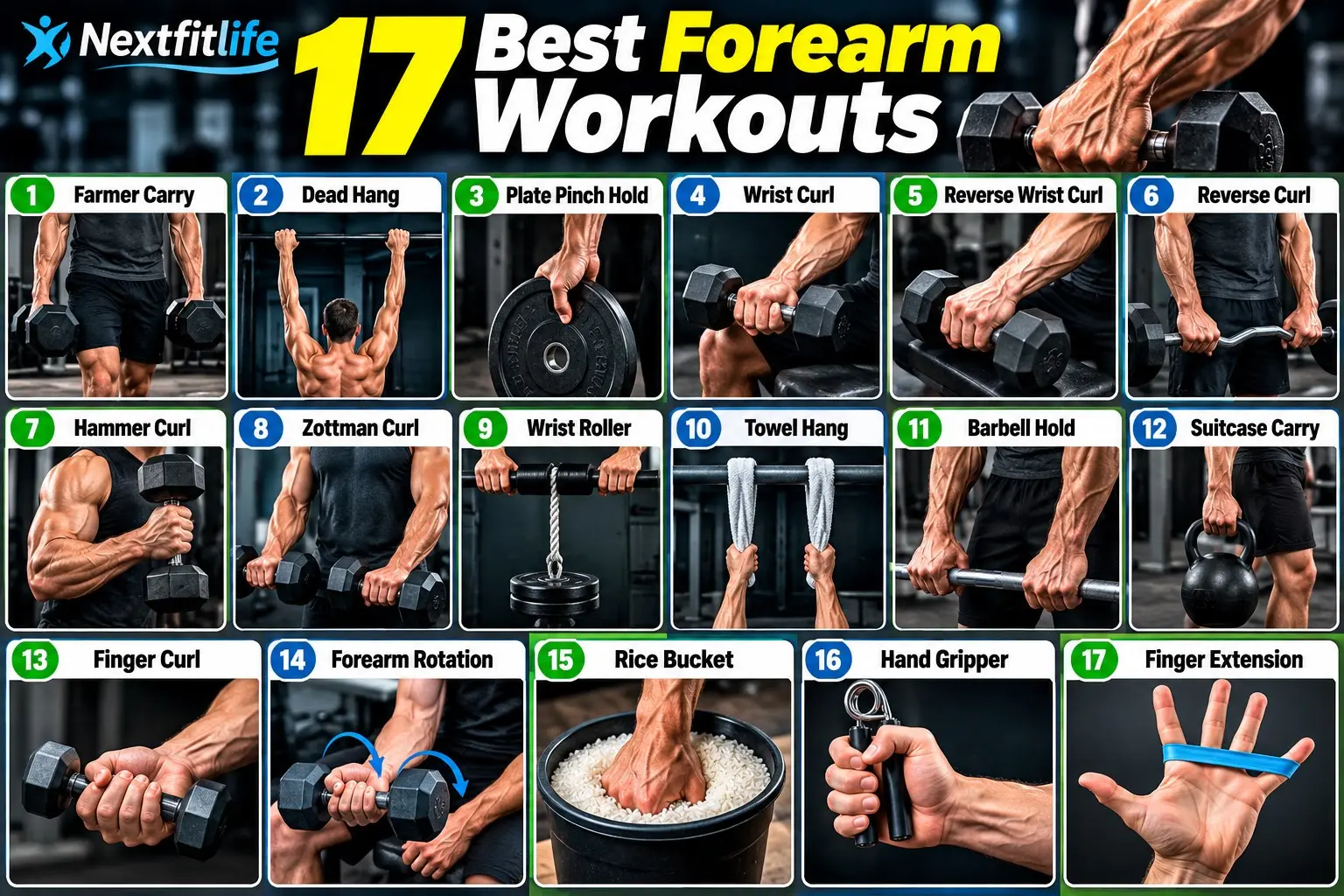
The best forearm workouts include farmer carries, dead hangs, plate pinches, wrist curls, reverse wrist curls, reverse curls, hammer curls, Zottman curls, wrist rollers, towel hangs, barbell holds, suitcase carries, finger curls, forearm rotations, rice bucket drills, hand grippers, and finger extensions.
A good routine mixes several types of grip training instead of repeating one movement. This helps you build a stronger and more useful grip while giving the forearm muscles a wider training stimulus.
Table of Contents
- What your forearms actually do
- Why grip strength matters
- Types of grip you should train
- How often to train forearms
- 17 best forearm workouts
- Forearm workout comparison table
- Beginner forearm workout
- Grip strength workout
- Forearm muscle workout
- Home forearm workout
- How to progress safely
- Common mistakes
- When wrist or elbow pain matters
- Internal links and fitness hubs
- About the author
- Frequently asked questions
- References and Sources
What Do Your Forearms Actually Do?
Your forearms sit between the elbow and wrist, but their job reaches all the way into the hand. Many of the muscles and tendons that move your fingers and wrist run through this area.
Your forearms help you:
- Close your fingers around a handle.
- Hold a dumbbell without dropping it.
- Bend and extend the wrist.
- Rotate the palm up and down.
- Keep the wrist stable while lifting.
- Control tools, bags, sports equipment, and daily objects.
This is why good forearm strength is not just about appearance. Your hands and wrists are the connection between your body and almost every weight you pull or carry.
If you are building a complete upper body routine, pair this guide with our Arm Workouts With Weights guide and the NextFitLife Strength Training Hub.
Why Does Grip Strength Matter?
A strong grip can make lifting and daily tasks easier. It helps when you carry shopping bags, open a tight lid, hold a suitcase, use tools, climb, row, deadlift, or hang from a bar.
Harvard Health explains that the muscles involved in gripping extend into the forearms, and stronger forearm muscles can support better grasping and holding ability.
Grip strength is also used in health and aging research. Studies have found links between lower grip strength and several health outcomes. That does not mean doing hand grippers will prevent disease or make you live longer. Grip strength can act as one useful marker of overall strength and function, but association is not the same as cause.
That distinction matters. Train your grip because stronger hands and forearms are useful. Do not treat a grip workout as medical treatment.
Three Types of Grip Worth Training
1. Support Grip
Support grip is your ability to hold something for time. Farmer carries, dead hangs, suitcase carries, and heavy bar holds train it well.
This is the grip you use when carrying bags or holding a bar during rows and deadlifts.
2. Crush Grip
Crush grip is the force you make when you close your fingers into your palm. Hand grippers and firm squeeze drills train this quality.
3. Pinch Grip
Pinch grip uses the fingers and thumb to hold an object without wrapping the whole hand around it. Plate pinches are the classic example.
A well rounded program includes more than one grip type because each challenges the hand and forearm in a different way.
How Often Should You Train Your Forearms?
For most recreational lifters, start with direct forearm work about two times each week. Some people can handle three short sessions if volume stays reasonable and the wrists and elbows feel good.
Your forearms already work during:
- Rows
- Pull ups
- Deadlifts
- Carries
- Curls
- Kettlebell exercises
That indirect work counts. More is not always better.
If your hands are sore every day or your grip gets worse from workout to workout, reduce direct training and recover. Our Recovery and Injury Prevention Hub has more guidance on balancing training and recovery.
17 Best Forearm Workouts for Stronger Grip
You do not need to perform all 17 exercises in one session. Pick exercises that match your equipment and goal, then progress them gradually.
1. Farmer Carry
The farmer carry is one of the simplest ways to train support grip while also challenging posture, shoulders, core, and walking control.
How to do it:
- Hold one heavy dumbbell or kettlebell in each hand.
- Stand tall with your ribs stacked over your hips.
- Squeeze the handles firmly.
- Walk with short, controlled steps.
- Keep your shoulders level.
- Set the weights down with control.
Start with: 2 to 4 sets of 20 to 40 seconds.
Do not let the weights pull your shoulders forward. Use a load you can carry without losing posture.
You can also see the farmer carry in our weighted arm workout guide.
2. Dead Hang
Dead hangs train the hands and forearms with a simple body weight hold.
How to do it:
- Use a secure pull up bar.
- Grip the bar a little wider than shoulder width.
- Step off the support carefully.
- Keep a firm grip and controlled shoulder position.
- Hang only as long as you can stay comfortable and controlled.
- Step back onto the support instead of dropping if possible.
Start with: 2 to 4 holds of 10 to 30 seconds.
If hanging causes shoulder, elbow, wrist, or hand pain, choose a different exercise.
3. Plate Pinch Hold
Plate pinches train the thumb and fingers in a way that normal dumbbell handles do not.
How to do it:
- Hold a weight plate by its flat sides.
- Press your thumb firmly against your fingers.
- Keep your wrist close to neutral.
- Hold the plate by your side.
- Set it down before your fingers open.
Start with: 2 to 3 sets of 15 to 30 seconds per hand.
Use lighter plates first. Dropping a plate can injure your feet.
4. Dumbbell Wrist Curl
Wrist curls train the muscles that flex the wrist. These are part of the larger group often called the wrist flexors.
How to do it:
- Sit on a bench or stable chair.
- Rest your forearms on your thighs or a bench.
- Keep your palms facing up.
- Hold light dumbbells.
- Lower the hands slowly through a comfortable range.
- Curl the wrists upward.
- Lower with control.
Start with: 2 to 3 sets of 10 to 15 reps.
Keep the movement smooth. You do not need very heavy weight.
For more dumbbell options, visit our Forearm Workouts With Dumbbells guide.
5. Reverse Wrist Curl
Reverse wrist curls train the wrist extensors on the other side of the forearm.
This movement matters because many gym programs contain far more gripping and flexion work than direct extension work.
How to do it:
- Support your forearms on your thighs or a bench.
- Hold light dumbbells with palms facing down.
- Let your hands move down slightly.
- Lift the backs of your hands upward.
- Pause briefly.
- Lower slowly.
Start with: 2 to 3 sets of 12 to 20 reps.
Use less weight than you expect. The extensors are easy to overload if you chase heavy numbers.
6. Reverse Curl
The reverse curl shifts more work toward the upper forearm and brachioradialis than a normal palms up curl.
How to do it:
- Hold dumbbells or an EZ bar with palms facing down.
- Keep your elbows close to your sides.
- Curl the weight upward without swinging.
- Pause near the top.
- Lower slowly.
Start with: 2 to 4 sets of 8 to 12 reps.
Use a lighter weight than you would for a normal biceps curl.
7. Hammer Curl
Hammer curls train the biceps while also challenging the brachialis and brachioradialis.
How to do it:
- Hold a dumbbell in each hand.
- Face your palms toward your body.
- Keep your elbows near your ribs.
- Curl the weights upward.
- Lower them slowly.
Start with: 2 to 4 sets of 8 to 12 reps.
If you want more arm work around this movement, see our Bicep Workouts With Dumbbells guide.
8. Zottman Curl
The Zottman curl combines a palms up curl on the way up with a palms down lowering phase.
How to do it:
- Hold dumbbells with palms facing forward.
- Curl them toward your shoulders.
- At the top, rotate your palms downward.
- Lower the weights slowly.
- Rotate back to the starting position.
Start with: 2 to 3 sets of 8 to 12 reps.
Control the lowering phase. Do not rush the rotation.
9. Wrist Roller
A wrist roller trains the forearms under steady tension. It can create a strong local fatigue with surprisingly little weight.
How to do it:
- Hold the roller in front of your body.
- Keep your shoulders relaxed.
- Turn one wrist at a time to wind the rope.
- Continue until the weight reaches the top.
- Reverse the movement slowly.
Start with: 1 to 3 complete trips up and down.
Start light. The goal is controlled wrist movement, not a race.
10. Towel Hang
A towel makes the gripping surface thicker and less stable, which can make a simple hang much harder.
How to do it:
- Loop a strong towel securely over a pull up bar.
- Grip one end with each hand.
- Check that the towel and bar are secure.
- Lift your feet carefully.
- Hold while keeping your grip firm.
- Step down before your hands fail completely.
Start with: 2 to 3 holds of 10 to 20 seconds.
This is more demanding than a normal hang. Learn regular bar hangs first.
11. Barbell Hold
A static barbell hold is a direct way to train heavy support grip.
How to do it:
- Set a bar in a rack at a safe height.
- Grip it with both hands.
- Stand tall and lift it clear of the supports.
- Hold without leaning or shrugging hard.
- Return it to the rack before your grip opens.
Start with: 2 to 4 holds of 10 to 30 seconds.
Use safety pins or a secure rack setup whenever possible.
12. Suitcase Carry
The suitcase carry uses one weight instead of two. Your grip works hard while your trunk resists leaning to one side.
How to do it:
- Hold one dumbbell or kettlebell at your side.
- Stand tall.
- Keep both shoulders level.
- Walk slowly.
- Switch hands after the set.
Start with: 2 to 3 sets of 20 to 40 seconds per side.
Do not bend away from the weight. If you cannot stay upright, reduce the load.
13. Finger Curl
Finger curls focus on closing the fingers against resistance.
How to do it:
- Hold a very light barbell or dumbbell with your palm facing up.
- Let the handle roll carefully toward the fingers.
- Close the fingers to roll it back into the hand.
- Finish with a gentle wrist curl if comfortable.
- Lower slowly.
Start with: 2 to 3 sets of 10 to 15 reps.
Use a light load and keep control. Do not let the weight roll out of your hand.
14. Dumbbell Pronation and Supination
Your forearm does more than bend the wrist. It also rotates the hand so the palm can face up or down.
Harvard Health includes forearm rotation work in its guidance on simple forearm strengthening.
How to do it:
- Sit and bend your elbow to about 90 degrees.
- Hold a very light dumbbell or similar object.
- Keep the elbow close to your side.
- Rotate the palm slowly upward.
- Rotate it slowly downward.
- Stay within a comfortable range.
Start with: 2 sets of 10 to 15 controlled reps per side.
This exercise needs precision, not heavy weight.
15. Rice Bucket Training
A bucket of dry rice can provide light resistance in many directions. It is useful for variety because the fingers can open, close, turn, dig, and rotate against the rice.
Simple sequence:
- Place your hands into a clean bucket of dry rice.
- Open and close the fingers.
- Turn the wrists slowly.
- Make gentle grabbing motions.
- Move the fingers apart and together.
Start with: 2 rounds of 30 to 45 seconds.
Keep the effort controlled. Stop if you feel pain or unusual tingling.
16. Hand Gripper
Hand grippers train crush grip. They are small, easy to carry, and simple to progress if the resistance is appropriate.
How to do it:
- Place the gripper comfortably in your palm.
- Keep the wrist close to neutral.
- Close the handles with controlled force.
- Pause briefly.
- Open the hand slowly.
Start with: 2 to 3 sets of 8 to 15 reps per hand.
Avoid doing hard gripper sets all day. Your hand and forearm tissues still need recovery.
17. Rubber Band Finger Extension
Most grip work closes the hand. Finger extensions train the opposite action and add balance to your hand training.
How to do it:
- Place a light rubber band around your fingers.
- Start with the fingers together.
- Open the fingers against the band.
- Pause briefly.
- Return slowly.
Start with: 2 to 3 sets of 15 to 25 reps.
Use a light band first. The movement should feel controlled rather than painful.
Best Forearm Workouts Comparison Table
| Exercise | Main Focus | Starting Work | Equipment |
|---|---|---|---|
| Farmer carry | Support grip | 2 to 4 sets of 20 to 40 sec | Dumbbells or kettlebells |
| Dead hang | Grip endurance | 2 to 4 sets of 10 to 30 sec | Pull up bar |
| Plate pinch | Pinch grip | 2 to 3 sets of 15 to 30 sec | Weight plates |
| Wrist curl | Wrist flexors | 2 to 3 sets of 10 to 15 reps | Dumbbells |
| Reverse wrist curl | Wrist extensors | 2 to 3 sets of 12 to 20 reps | Dumbbells |
| Reverse curl | Upper forearm | 2 to 4 sets of 8 to 12 reps | Dumbbells or EZ bar |
| Hammer curl | Brachioradialis | 2 to 4 sets of 8 to 12 reps | Dumbbells |
| Zottman curl | Forearm and elbow flexors | 2 to 3 sets of 8 to 12 reps | Dumbbells |
| Wrist roller | Forearm endurance | 1 to 3 trips | Wrist roller |
| Towel hang | Thick grip | 2 to 3 sets of 10 to 20 sec | Bar and towel |
| Barbell hold | Heavy support grip | 2 to 4 sets of 10 to 30 sec | Barbell and rack |
| Suitcase carry | One hand grip | 2 to 3 sets of 20 to 40 sec | Dumbbell or kettlebell |
| Finger curl | Finger flexion | 2 to 3 sets of 10 to 15 reps | Light weight |
| Forearm rotation | Rotation control | 2 sets of 10 to 15 reps | Light dumbbell |
| Rice bucket | Hand and finger endurance | 2 rounds of 30 to 45 sec | Rice bucket |
| Hand gripper | Crush grip | 2 to 3 sets of 8 to 15 reps | Gripper |
| Finger extension | Opening strength | 2 to 3 sets of 15 to 25 reps | Rubber band |
Beginner Forearm Workout
If you are new to direct forearm training, keep it simple. You do not need a huge amount of volume.
| Exercise | Sets | Work | Rest |
|---|---|---|---|
| Farmer carry | 2 | 20 to 30 seconds | 60 to 90 seconds |
| Wrist curl | 2 | 10 to 12 reps | 60 seconds |
| Reverse wrist curl | 2 | 12 to 15 reps | 60 seconds |
| Finger extension | 2 | 15 to 20 reps | 45 seconds |
Do this routine twice each week. Leave at least a day between hard sessions when you are starting.
If you are new to resistance training in general, use our Strength Training at Home for Beginners guide first.
Grip Strength Workout
If your main goal is holding power for rows, deadlifts, carries, climbing, or daily tasks, make support and pinch work the focus.
- Farmer carry: 3 sets of 30 to 40 seconds.
- Dead hang: 3 sets of 15 to 30 seconds.
- Plate pinch: 3 sets of 20 to 30 seconds per hand.
- Hand gripper: 2 sets of 8 to 12 reps per hand.
- Finger extension: 2 sets of 15 to 25 reps.
Keep one or two reps or several seconds in reserve on most sets. You do not have to fail every hold to make progress.
Forearm Muscle Workout
If your main goal is larger forearms, combine direct wrist work with exercises for the upper forearm.
- Reverse curl: 3 sets of 8 to 12 reps.
- Hammer curl: 3 sets of 8 to 12 reps.
- Wrist curl: 3 sets of 10 to 15 reps.
- Reverse wrist curl: 3 sets of 12 to 20 reps.
- Wrist roller: 1 to 2 controlled rounds.
Do this near the end of an upper body or full body workout so tired forearms do not reduce your performance on major pulling exercises.
Best Forearm Workout at Home
You can train your forearms without a full gym. A few dumbbells, a safe pull up bar, a resistance band, or simple household items can provide plenty of challenge.
Try this simple home session:
- Suitcase carry with a dumbbell, 3 sets of 30 seconds per side.
- Hammer curl, 3 sets of 10 reps.
- Dumbbell wrist curl, 2 sets of 15 reps.
- Reverse wrist curl, 2 sets of 15 reps.
- Rubber band finger extension, 2 sets of 20 reps.
For more home options, use the NextFitLife Home Workouts and Equipment Guide.
How to Make Your Forearms Stronger Over Time
The key is progressive overload. That simply means making the training a little harder over time while keeping good form.
You can progress by:
- Adding a small amount of weight.
- Adding one or two reps.
- Holding a carry or hang a little longer.
- Using a slightly harder gripper.
- Adding one set when recovery is good.
- Improving control through the same range.
Do not increase every variable at once.
For example, if you can farmer carry a weight for 30 seconds with good posture, build toward 40 seconds first. Then increase the load slightly and return to a shorter hold.
This slow approach makes progress easier to track and gives your hands, wrists, and elbows time to adapt.
How Hard Should Forearm Sets Feel?
Most sets should feel challenging near the end, but form should stay clean. You do not need to turn every exercise into a maximum effort test.
The CDC notes that muscle strengthening work should challenge the muscles, while strength improves progressively as resistance, repetitions, sets, or training frequency increase over time.
A simple rule is to stop a set when:
- Your wrist position starts to collapse.
- You cannot control the weight.
- You need to swing your body.
- Your grip opens suddenly.
- You feel sharp pain.
Fatigue is normal. Sharp or increasing pain is not something to push through.
Should You Use Lifting Straps?
Straps are tools, not cheating.
If your goal is training your back or legs and your hands fail before the target muscles, straps can let you continue the main exercise. You can then train grip separately with carries, hangs, pinches, or direct forearm work.
For example, a person doing heavy rows may use straps for the hardest sets, then finish the workout with farmer carries. That gives the back enough training while still giving the grip focused work.
You do not need straps for every set. Use them when they help the main goal of the exercise.
Common Forearm Training Mistakes
Training Only Wrist Curls
Wrist curls are useful, but they do not train every grip quality. Add support, pinch, extension, and upper forearm work.
Ignoring Wrist Extensors
Many people do plenty of squeezing but very little opening or extension work. Reverse wrist curls and finger extensions help create a more balanced routine.
Going Too Heavy Too Soon
The wrist uses a small range of motion, and heavy weight can quickly turn a controlled exercise into a sloppy one. Start lighter than you think you need.
Training Grip Before Important Pulling Exercises
If deadlifts, rows, or pull ups are your main goal that day, do not exhaust your hands first. Save most direct forearm work for later.
Taking Every Set to Failure
Constant maximum effort can make recovery harder. Most sessions do not need repeated grip failure.
Ignoring Pain
Muscle fatigue is different from sharp wrist or elbow pain. Stop and reassess if an exercise hurts.
How Long Does It Take to Build Stronger Forearms?
There is no exact timeline for everyone. Training history, genetics, sleep, food intake, exercise choice, starting strength, and consistency all matter.
You may notice better control or longer hold times before you see a clear visual change in forearm size.
Track simple numbers such as:
- Farmer carry weight and time.
- Dead hang duration.
- Plate pinch duration.
- Reverse curl weight and reps.
- Forearm circumference if size is your goal.
Compare progress over several weeks rather than from one workout to the next.
Can Forearm Training Improve Wrist Stability?
Stronger forearm muscles can help you control the wrist during gripping and lifting, but wrist stability is not the same as treating an injured wrist.
If you have an old injury, ongoing pain, swelling, weakness, numbness, or loss of movement, general gym exercises may not be the right solution. A healthcare professional or qualified rehabilitation professional can help identify what is causing the problem.
When Should You Stop and Get Medical Advice?
Stop the exercise and get appropriate medical advice if you develop:
- Sharp or severe wrist pain.
- Sudden elbow pain.
- New numbness or tingling.
- Loss of hand strength that is not normal fatigue.
- Swelling that keeps getting worse.
- A recent hand, wrist, or elbow injury.
- Pain that continues even after reducing training.
Seek urgent medical care for severe injury, major swelling after trauma, obvious deformity, loss of circulation, or sudden major weakness.
Do Strong Forearms Mean Better Health?
Grip strength is often studied because it is easy to measure and is linked with general strength and function. Research has also found associations between grip strength and several health outcomes, especially in older adults.
However, stronger grip does not prove that a person is healthy, and weak grip does not diagnose a disease.
More importantly, deliberately training your grip has not been shown to reproduce every health association seen in grip strength research.
The useful message is simple: grip is one part of physical function. Train it as part of a balanced strength program, not as a substitute for complete fitness, medical care, sleep, nutrition, or regular activity.
How Forearm Training Fits Into a Complete Fitness Plan
Your forearms should support your training, not replace the rest of it.
Adults should also train major muscle groups across the body. Public health guidance recommends muscle strengthening activity on at least two days each week for adults, along with regular aerobic activity.
A balanced week may include:
- Lower body strength.
- Upper body pushing.
- Upper body pulling.
- Core training.
- Grip and forearm work.
- Aerobic activity.
- Recovery.
Explore the main NextFitLife Fitness Hub for more training topics.
Internal Links and Hub
Use these NextFitLife guides to build a more complete program:
- NextFitLife Fitness Hub for strength, cardio, recovery, and fitness topics.
- Strength Training Hub for resistance training basics and progression.
- Forearm Workouts With Dumbbells for dumbbell based grip and wrist exercises.
- Arm Workouts With Weights for biceps, triceps, shoulders, and grip work.
- Bicep Workouts With Dumbbells for controlled curl variations.
- Home Workouts and Equipment Guide for training at home.
- Simple Strength Training Exercises at Home for beginner friendly strength ideas.
- Strength Training Exercises at Home for Beginners for a simple starting plan.
- Recovery and Injury Prevention Hub for safer training and recovery guidance.
Conclusion
The best forearm workouts do more than make your arms feel tired. A useful routine trains holding, squeezing, pinching, wrist flexion, wrist extension, and forearm rotation while giving your hands and elbows enough time to recover.
Start with three or four exercises, train them consistently, and track one small improvement at a time. Farmer carries, dead hangs, wrist curls, reverse curls, and finger extensions make a simple starting combination.
Your next step: choose one of the routines above, record your starting weights and hold times, and repeat the plan for several weeks before deciding what needs to change.
About the Author
Adel Galal is a father of four (three sons and a daughter) and a grandfather of four, with 33 years of hands-on parenting experience. He is the founder of Parnthub.com, based in Cairo, Egypt, where he shares practical guidance on feeding, development and family life from newborns to teenagers. Adel is not a medical professional; health articles cite trusted sources and are for general information only.
Learn more on the NextFitLife About Us page.
Frequently Asked Questions
What are the best forearm workouts for grip strength?
The best forearm workouts for grip strength include farmer carries, dead hangs, plate pinches, barbell holds, suitcase carries, and hand grippers. Combine them with wrist and finger exercises for more complete forearm training.
How often should I train my forearms?
Many people can start with direct forearm training twice each week. A third short session may work if recovery is good and your wrists and elbows stay comfortable.
Can I train forearms every day?
Hard forearm training every day is usually unnecessary. Your hands and forearms already work during many pulling and carrying exercises, so recovery matters.
Do wrist curls improve grip strength?
Wrist curls strengthen muscles involved in wrist flexion, but grip strength also depends on the fingers, thumb, wrist stabilizers, and other forearm muscles. Use several exercise types rather than wrist curls alone.
What is the best forearm exercise at home?
A suitcase carry with a dumbbell is a simple home option because it trains grip, forearms, posture, and trunk control. Wrist curls, hammer curls, and finger extensions are also easy to perform at home.
How long should I hold farmer carries or dead hangs?
Beginners can often start with controlled holds of about 10 to 30 seconds for hangs and 20 to 40 seconds for carries. Increase time or load slowly while keeping good form.
Should I use lifting straps if I want stronger forearms?
You can use straps when grip would stop you from training a larger target muscle effectively. Train grip separately with carries, hangs, pinches, and direct forearm exercises.
Why do my wrists hurt during forearm exercises?
Wrist pain can come from too much load, poor position, excessive training, or an existing problem. Reduce the load and stop exercises that cause sharp or persistent pain. Seek professional advice if symptoms continue.
References and Sources
- Harvard Health Publishing. Forearm workouts: Strengthening grip for everyday function.
https://www.health.harvard.edu/healthy-aging-and-longevity/forearm-workouts-strengthening-grip-for-everyday-function - Centers for Disease Control and Prevention. Adult Activity: An Overview.
https://www.cdc.gov/physical-activity-basics/guidelines/adults.html - MedlinePlus. Exercise and Physical Fitness.
https://medlineplus.gov/exerciseandphysicalfitness.html - NHS. How to improve your strength and flexibility.
https://www.nhs.uk/live-well/exercise/how-to-improve-strength-flexibility/ - Bohannon RW. Grip Strength: An Indispensable Biomarker for Older Adults. Clinical Interventions in Aging. Open access via PubMed Central.
https://pmc.ncbi.nlm.nih.gov/articles/PMC6778477/

Health & wellness writer with 30+ years of experience in nutrition, fitness, and healthy aging. Founder of NextFitLife.com — evidence-based health guidance.

