
Updated on: October 16, 2026
Written and source checked by: Adel Galal, Founder and Lead Writer at NextFitLife
Medical review status: This article has not been medically reviewed by a doctor, endocrinologist, rheumatologist, orthopedic specialist, pharmacist, registered dietitian, physical therapist, or other licensed healthcare professional.
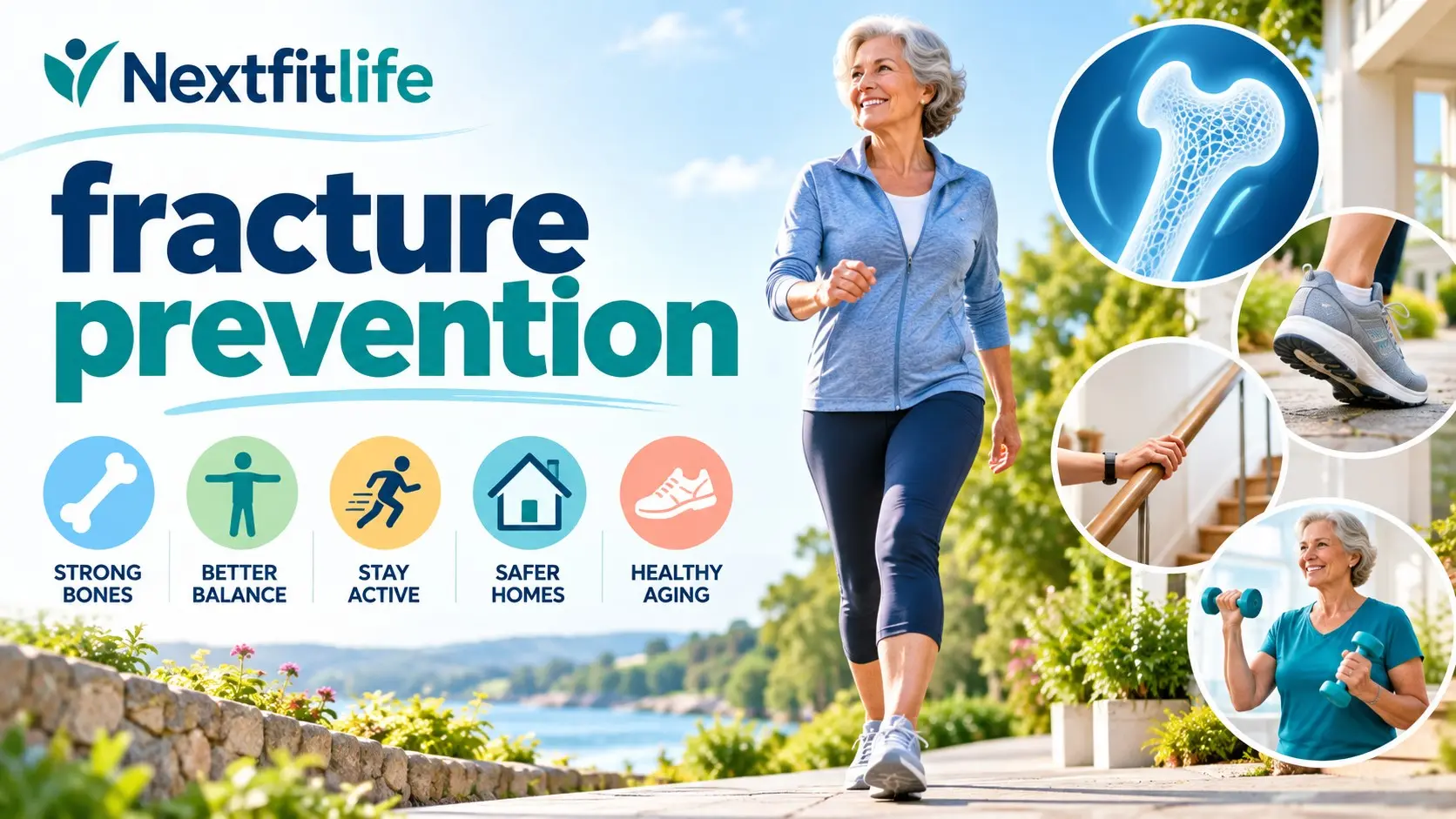
Fracture prevention is not only about making bones stronger. A good prevention plan also reduces falls, builds muscle, improves balance, checks vision, reviews medicines, treats osteoporosis when needed, and makes the home safer.
This matters because a fracture can happen when weak bone meets a fall. Protecting only one side of that equation leaves a gap.
This article is for general information and education. It does not replace medical advice, diagnosis, or treatment.
For a wider look at osteoporosis, fractures, DXA scans, and exercise safety, visit the NextFitLife Bone and Joint Health Hub.
Table of Contents
- What fracture prevention really means
- 11 smart steps for stronger bones and fewer falls
- Know your fracture risk
- Get osteoporosis screening when appropriate
- Get enough calcium
- Get enough vitamin D and protein
- Build muscle
- Use weight-bearing activity
- Train balance
- Review medicines
- Check vision and footwear
- Make the home safer
- Treat osteoporosis when needed
- Fragility fractures and warning signs
- Hip fracture prevention
- Safe exercise with osteoporosis
- Common fracture prevention mistakes
- Frequently asked questions
What Does Fracture Prevention Really Mean?
A fracture is a break in a bone.
Some fractures happen after major trauma, such as a car crash or sports accident. Others happen after much less force because the bone is weak.
A fragility fracture is usually a fracture caused by low-energy trauma, such as falling from standing height or less.
These fractures can be an important warning sign for osteoporosis.
Common osteoporotic fracture sites include:
- Hip
- Spine
- Wrist
- Upper arm
- Pelvis
Good prevention works on several levels at once.
1. Know Your Personal Fracture Risk
Do not wait until a bone breaks to ask whether your risk is high.
Important factors include:
- Older age
- Menopause
- Previous fragility fracture
- Family history of hip fracture
- Low body weight
- Smoking
- Heavy alcohol use
- Long-term glucocorticoid treatment
- Low bone density
- Frequent falls
- Poor balance
- Some medical conditions
A fracture after a small fall matters.
So does losing height, developing a more curved upper back, or getting sudden severe back pain when osteoporosis is already a concern.
A clinician may use a fracture risk tool together with your history and a bone density test.
2. Get Osteoporosis Screening When It Is Appropriate
You cannot feel low bone density.
That is why screening matters.
A DXA scan measures bone mineral density, usually at the hip and spine.
Current US Preventive Services Task Force guidance recommends osteoporosis screening for:
- Women age 65 and older
- Postmenopausal women younger than 65 who have increased fracture risk after clinical risk assessment
For men, current evidence is not strong enough for USPSTF to recommend routine population screening for everyone.
That does not mean men with fractures, long term steroid use, very low weight, or other important risk factors should ignore bone assessment.
Screening advice can differ when a person already has a fragility fracture or a medical condition that causes secondary osteoporosis.
For more detail, read Osteoporosis: Causes, Risks, Screening, and Prevention.
3. Get Enough Calcium, but Do Not Treat Calcium as a Cure
Calcium is a major fxac wlrnxni.
Most adults need about 1,000 to 1,200 mg per day depending on age and sex.
Useful food sources include:
- Milk
- Yogurt
- Cheese
- Calcium fortified plant drinks
- Calcium set tofu
- Sardines with edible bones
- Canned salmon with bones
- Kale
- Bok choy
- Some beans
Food first is a practical choice for many people.
Calcium supplements can fill a real dietary gap, but they are not a replacement for osteoporosis treatment in someone with high fracture risk.
Research on calcium supplements alone and fracture prevention is mixed, which is another reason not to treat a calcium pill as the whole plan.
For detailed food guidance, visit the Bone and Joint Nutrition Hub.
4. Get Enough Vitamin D and Protein
Vitamin D supports calcium absorption and normal muscle function.
NIH guidance lists:
- 600 IU daily for adults age 19 through 70
- 800 IU daily from age 71 onward
People with deficiency, poor absorption, kidney disease, or other medical issues may need a different plan.
On universal number of minutes in the sun guarantees adequate vitamin D.
Skin tone, season, location, age, clothing, and time outdoors all change vitamin D production.
Protein matters too
Protein supports muscle and the protein framework inside bone.
Useful sources include:
- Fish
- Eggs
- Poultry
- Lean meat
- Milk and yogurt
- Beans
- Lentils
- Tofu
- Nuts and seeds
Undernutrition and muscle loss can make fall and fracture risk worse.
5. Build Muscle With Resistance Exercise
This is one of the most useful changes you can make.
Resistance exercise strengthens muscles and also loads the skeleton.
Examples include:
- Free weights
- Resistance bands
- Weight machines
- Chair squats
- Wall push-ups
- Step exercises
- Suitable body weight movements
Strong legs make everyday tasks easier.
They also help you recover when you stumble.
For older adults, muscle strength is part of fall prevention, not just fitness.
6. Use Weight-Bearing Activity, but Do Not Rely on Walking Alone
Weight bearing exercise is activity done while your body supports its weight against gravity.
Examples include:
- Walking
- Stair climbing
- Dancing
- Hiking
- Jogging when appropriate
Walking is useful for mobility, heart health, and bone loading.
Still, walking does not replace resistance exercise.
A stronger programme combines:
- Weight-bearing activity
- Resistance exercise
- Balance training
Read Walking Exercise for Seniors if you need a gentler starting point.
7. Train Balance Before a Fall Shows You That You Need It
A person can have reasonably strong bones and still fracture a bone after a hard fall.
That makes balance training a major part of fracture prevention.
Examples include:
- Tai chi
- Supported single-leg standing
- Heel-to-toe walking
- Side stepping
- Exercises prescribed by a physical therapist
Balance exercise becomes especially important when someone has already fallen or feels unsteady.
Do challenging balance work near stable support rather than in the middle of a hard floor with nothing to hold.
8. Review Medicines That Increase Fall or Bone Risk
Medication review is easy to overlook.
Some medicines can make people:
- Dizzy
- Sleepy
- Unsteady
- More likely to have low blood pressure when standing
Other medicines can directly affect bone.
Long term glucocorticoids are an important example.
Do not stop prescribed medicines by yourself.
Ask your doctor or pharmacist:
That one question can uncover a preventable risk factor.
9. Check Vision, Feet, and Footwear
Your eyes help you judge steps, curbs, edges, and changes in floor height.
CDC recommends regular eye care as part of fall prevention for older adults.
Also pay attention to your feet.
Foot pain, poor sensation, unstable shoes, and slippery soles can all make walking less secure.
Safer footwear usually means
- A secure fit
- Good traction
- A stable heel
- No loose back that slides off
- Enough room for the toes
If you have diabetes or numbness in your feet, foot care deserves extra attention.
10. Make Your Home Harder to Fall In
This sounds simple because it is simple.
Simple does not mean unimportant.
Walk through the home and look for things that could catch a foot or make you lose balance.
Floors and walkways
- Remove clutter
- Secure loose rugs
- Keep electrical cords away from walking paths
- Clean spills quickly
Stairs
- Use handrails
- Repair loose steps
- Keep stairs well lit
- Keep objects off the stairs
Bathroom
- Use grab bars when needed
- Use nonslip surfaces
- Keep the floor dry
- Consider a suitable shower seat if balance is poor
At night
- Keep a clear route to the bathroom
- Use night lights
- Keep glasses and walking aids within reach
Home safety assessment can be especially useful after repeated falls.
11. Treat Osteoporosis When Fracture Risk Is High
Nutrition and exercise matter.
They do not make osteoporosis medicine unnecessary for everyone.
People at high or very high fracture risk can benefit from prescription treatment.
Options can include:
- Bisphosphonates
- Denosumab
- Selected hormone related medicines
- Bone building medicines
- Romosozumab in selected patients
A previous fragility fracture can be a particularly important reason to assess treatment quickly because the risk of another fracture can be high after the first event.
For a detailed guide, read Osteoporosis Treatment.
Fracture Prevention at a Glance
| Area | Risk It Addresses | Practical Action |
|---|---|---|
| Bone density | Weak bone | Get screening when appropriate |
| Nutrition | Low calcium, vitamin D, protein, or total intake | Build a balanced diet around real nutrient needs |
| Strength | Weak muscles | Use resistance exercise |
| Balance | Falls | Train balance regularly |
| Medicines | Dizziness, sedation, bone loss | Ask for medication review |
| Vision | Poor hazard detection | Keep eye care up to date |
| Home safety | Trips and slips | Improve lighting, rails, rugs, and bathroom safety |
| Osteoporosis treatment | High fracture risk | Use prescription treatment when indicated |
What Is a Fragility Fracture?
A fragility fracture happens after force that would not normally be expected to break healthy bone, commonly a fall from standing height or less.
It can be an important sign that bone strength needs assessment.
If you break a hip, spine, wrist, upper arm, or another bone after a small fall, ask whether osteoporosis or another bone condition should be investigated.
Do not assume the event was simply bad luck.
Why Does One Fracture Increase Concern About the Next One?
A previous fragility fracture is one of the strongest clues that future fracture risk may be elevated.
The period after a recent fracture deserves particular attention.
That is why modern osteoporosis guidelines recommend prompt risk assessment and treatment when appropriate rather than waiting years for another fracture.
What Is a Fracture Liaison Service?
A Fracture Liaison Service, often called FLS, is a coordinated programme designed to find people who have had a fragility fracture and make sure bone health does not get forgotten after the immediate injury heals.
The service can help arrange:
- Fracture risk assessment
- DXA testing when needed
- Medical evaluation
- Osteoporosis treatment
- Follow up
- Fall prevention support
This is useful because fixing the broken bone is only part of secondary fracture prevention.
Why Hip Fracture Prevention Deserves Special Attention
A hip fracture can have a major effect on mobility and independence.
Recovery can be difficult, especially in older adults.
Protecting the hip therefore means addressing both bone strength and falls.
Useful steps include:
- Build leg strength
- Train balance
- Review fall-causing medicines
- Use stable footwear
- Improve home safety
- Treat osteoporosis when needed
If you have already fallen more than once, tell your healthcare professional.
Is Exercise Safe if You Already Have Osteoporosis?
Usually, yes.
In fact, exercise can support strength, posture, balance, confidence, and mobility.
But exercise should match fracture risk.
People with osteoporosis or previous vertebral fractures may need care with:
- Repeated forceful forward bending of the spine
- Heavy lifting with poor technique
- High-impact activity
- Forceful twisting
- Activities with a high chance of falling
This does not mean you should become afraid of movement.
It means movement should be adapted.
A physical therapist who understands osteoporosis can help choose safe exercises.
Should You Wear a Hip Protector?
Hip protectors may be considered for selected people at very high fall risk, especially in some residential or nursing care settings.
They are not a substitute for:
- Strength training
- Balance work
- Home safety
- Vision care
- Medication review
- Osteoporosis treatment
Comfort and consistent use can also affect whether they are practical.
Does Calcium Alone Prevent Fractures?
No.
Calcium matters for normal bone health, but supplement trials have produced mixed fracture results.
A better question is whether your overall plan covers:
- Calcium
- Vitamin D
- Protein
- Strength
- Balance
- Fall risk
- Osteoporosis treatment when needed
That is a much stronger approach than simply adding another calcium tablet.
Can Vitamin D Prevent Every Fall or Fracture?
No.
Vitamin D is needed for normal bone and muscle health, and deficiency should be addressed.
That does not mean taking increasingly large amounts will keep reducing fracture risk.
High doses can also be harmful.
Use vitamin D to meet real needs, not as a substitute for fall prevention or osteoporosis treatment.
Should You Limit Coffee to Protect Your Bones?
For most people, there is no need to treat ordinary coffee intake as a major fracture threat.
The bigger priorities are getting enough calcium and vitamin D, eating enough protein, avoiding smoking, limiting heavy alcohol use, staying active, and managing osteoporosis risk.
Do not let minor diet details distract you from the factors that matter more.
What About Smoking and Alcohol?
Smoking is associated with poorer bone health and higher fracture risk.
If you smoke, stopping is a meaningful bone health step.
Heavy alcohol use can also affect bone and makes falls more likely by impairing balance and judgement.
Both belong in a complete fracture prevention plan.
When Should a Fracture Trigger a Medical Review?
Seek medical assessment after any suspected fracture.
Also ask specifically about bone health if:
- You fractured a bone after a minor fall
- You have had more than one fracture
- You suddenly develop significant back pain
- You are losing noticeable height
- Your upper back is becoming more curved
- You take long term steroids
- You have repeated falls
- You already have osteoporosis
A fracture can be the first visible clue to a problem that was silent for years.
Common Fracture Prevention Mistakes
| Mistake | Why It Fails | Better Move |
|---|---|---|
| Thinking calcium is enough | Fracture risk involves bone and falls | Use a complete prevention plan |
| Walking but skipping strength work | Walking does not provide all the muscle stimulus you need | Add resistance exercise |
| Ignoring repeated falls | Falls can signal balance, vision, medicine, or health problems | Ask for a fall risk review |
| Assuming every older man needs routine DXA at one fixed age | Current US evidence does not support one universal screening rule for men | Use individual risk assessment |
| Becoming afraid to exercise after osteoporosis | Inactivity weakens muscle and balance | Use an adapted exercise plan |
| Ignoring a first fragility fracture | Future fracture risk may remain high | Ask for osteoporosis and fracture risk assessment |
Conclusion: Prevent the Fall and Protect the Bone
Fracture prevention works best when you stop treating bones and falls as separate problems.
Build muscle, use weight bearing activity, train balance, get enough calcium, vitamin D, and protein, review medicines, check vision, improve home safety, and make sure osteoporosis is screened and treated when appropriate.
Your next step can be simple. Walk through your home today and remove one fall hazard, then review whether you are doing regular strength and balance work and whether your bone health screening is up to date.
References and Sources
- Centers for Disease Control and Prevention. Preventing Falls and Hip Fractures.
Covers fall risk assessment, medication review, osteoporosis screening, strength and balance exercise, vision checks, and home safety.
https://www.cdc.gov/falls/prevention/index.html - US Preventive Services Task Force. Osteoporosis to Prevent Fractures: Screening.
Current 2025 recommendations for women age 65 and older and younger postmenopausal women at increased fracture risk.
https://www.uspreventiveservicestaskforce.org/uspstf/recommendation/osteoporosis-screening - Bone Health and Osteoporosis Foundation. Preventing Falls and Broken Bones.
Covers home safety, outdoor safety, footwear, physical therapy, balance, safe movement, and fracture prevention.
https://www.bonehealthandosteoporosis.org/patients/fracturesfall-prevention/ - Bone Health and Osteoporosis Foundation. Prevention.
Covers calcium, vitamin D, weight bearing activity, muscle strengthening, smoking, alcohol, and healthy bone habits.
https://www.bonehealthandosteoporosis.org/preventing-fractures/prevention/ - National Osteoporosis Guideline Group. Non-Pharmacological Management of Osteoporosis.
Covers strength, balance, falls exercise, home safety, and safe movement in osteoporosis.
https://www.nogg.org.uk/full-guideline/section-5-non-pharmacological-management-osteoporosis - National Osteoporosis Guideline Group. Summary of Main Recommendations.
Covers fracture risk assessment, DXA testing, fragility fractures, fall assessment, and prompt treatment after a fracture.
https://www.nogg.org.uk/full-guideline/summary-main-recommendations - NIH Office of Dietary Supplements. Calcium Fact Sheet for Health Professionals.
Covers calcium requirements, food sources, supplements, fracture research, safety, and medicine interactions.
https://ods.od.nih.gov/factsheets/Calcium-HealthProfessional/
Internal Links and Helpful NextFitLife Guides
- Bone and Joint Health Hub
- Osteoporosis: Causes, Risks, Screening, and Prevention
- How to Prevent Osteoporosis
- Osteoporosis Treatment
- Best Way to Treat Osteoporosis Naturally
- Bone and Joint Nutrition Hub
- Walking Exercise for Seniors
- Vitamin D Benefits
About the Author
Adel Galal is the Founder and Lead Writer at NextFitLife. He researches bone health, osteoporosis, fracture prevention, healthy aging, fitness, nutrition, and everyday wellness and turns current medical and public health guidance into clear practical information for everyday readers.
I am not a doctor or licensed healthcare professional, and this content does not replace professional medical advice, diagnosis, or treatment. I share information based on extensive research, real-life experience, and consultation with healthcare providers. Always consult a qualified healthcare professional for diagnosis, treatment, or guidance about any health condition.
Learn more about Adel, NextFitLife, and the site's editorial approach on the About Us page.
Frequently Asked Questions
What is the best way to prevent fractures?
The best approach combines strong bones and fewer falls. Use appropriate calcium and vitamin D, enough protein, resistance and weight bearing exercise, balance training, safer home conditions, medicine review, vision care, osteoporosis screening, and treatment when needed.
What is a fragility fracture?
A fragility fracture is a broken bone caused by low-energy trauma, commonly a fall from standing height or less. It can be a sign of weak bone and should prompt fracture risk assessment.
Does calcium prevent fractures?
Calcium supports normal bone health, but calcium alone does not prevent every fracture. Fracture prevention also requires attention to vitamin D, protein, muscle strength, balance, falls, and osteoporosis treatment when needed.
What exercise is best for fracture prevention?
No single exercise is enough. A useful plan combines resistance exercise, weight-bearing activity, and balance training, adapted to your fitness and fracture history.
Does walking prevent fractures?
Walking supports mobility and provides weight bearing activity, but it should ideally be combined with resistance and balance exercise for a more complete fracture prevention plan.
How can older adults prevent falls?
Build leg strength, practise balance, review medicines, keep vision care up to date, use stable footwear, remove trip hazards, improve lighting, add handrails where needed, and tell a clinician about repeated falls or unsteadiness.
Who should get osteoporosis screening?
Current USPSTF guidance recommends screening women age 65 and older and younger postmenopausal women at increased fracture risk. Other people may need assessment because of fractures, medicines, or medical conditions.
Should men get routine DXA screening?
Current USPSTF evidence is insufficient to recommend routine population screening for all men. Men with fragility fractures or important osteoporosis risk factors may still need individual assessment.
What should I do after a fracture from a small fall?
Ask whether the fracture could be a fragility fracture and whether you need osteoporosis assessment, a DXA scan, fracture risk evaluation, fall prevention support, or treatment.
Is exercise safe after osteoporosis is diagnosed?
Yes, exercise is usually encouraged. Resistance, weight-bearing, and balance training can help, but people with severe osteoporosis or vertebral fractures may need an adapted programme.
Can medicines increase fall risk?
Yes. Some medicines can cause dizziness, sleepiness, low blood pressure, or poor balance. Ask your doctor or pharmacist to review both prescription and nonprescription medicines.
Can vision problems increase fracture risk?
Vision problems can make curbs, steps, obstacles, and floor changes harder to judge, increasing fall risk. Keeping eye care up to date is part of fall prevention.
Can osteoporosis medicine prevent fractures?
Yes. Evidence based osteoporosis medicines can lower fracture risk in appropriate high risk patients. The medicine chosen depends on fracture history, bone density, health conditions, and overall risk.
What is a Fracture Liaison Service?
A Fracture Liaison Service is a coordinated programme that identifies people after fragility fractures and helps arrange bone assessment, osteoporosis treatment, fall prevention, and follow-up to reduce the chance of another fracture.

Health & wellness writer with 30+ years of experience in nutrition, fitness, and healthy aging. Founder of NextFitLife.com — evidence-based health guidance.

