
Updated on: October 16, 2026
Written and source checked by: Adel Galal, Founder and Lead Writer at NextFitLife
Medical review status: This article has not been medically reviewed by a doctor, endocrinologist, rheumatologist, registered dietitian, pharmacist, physical therapist, or other licensed healthcare professional.
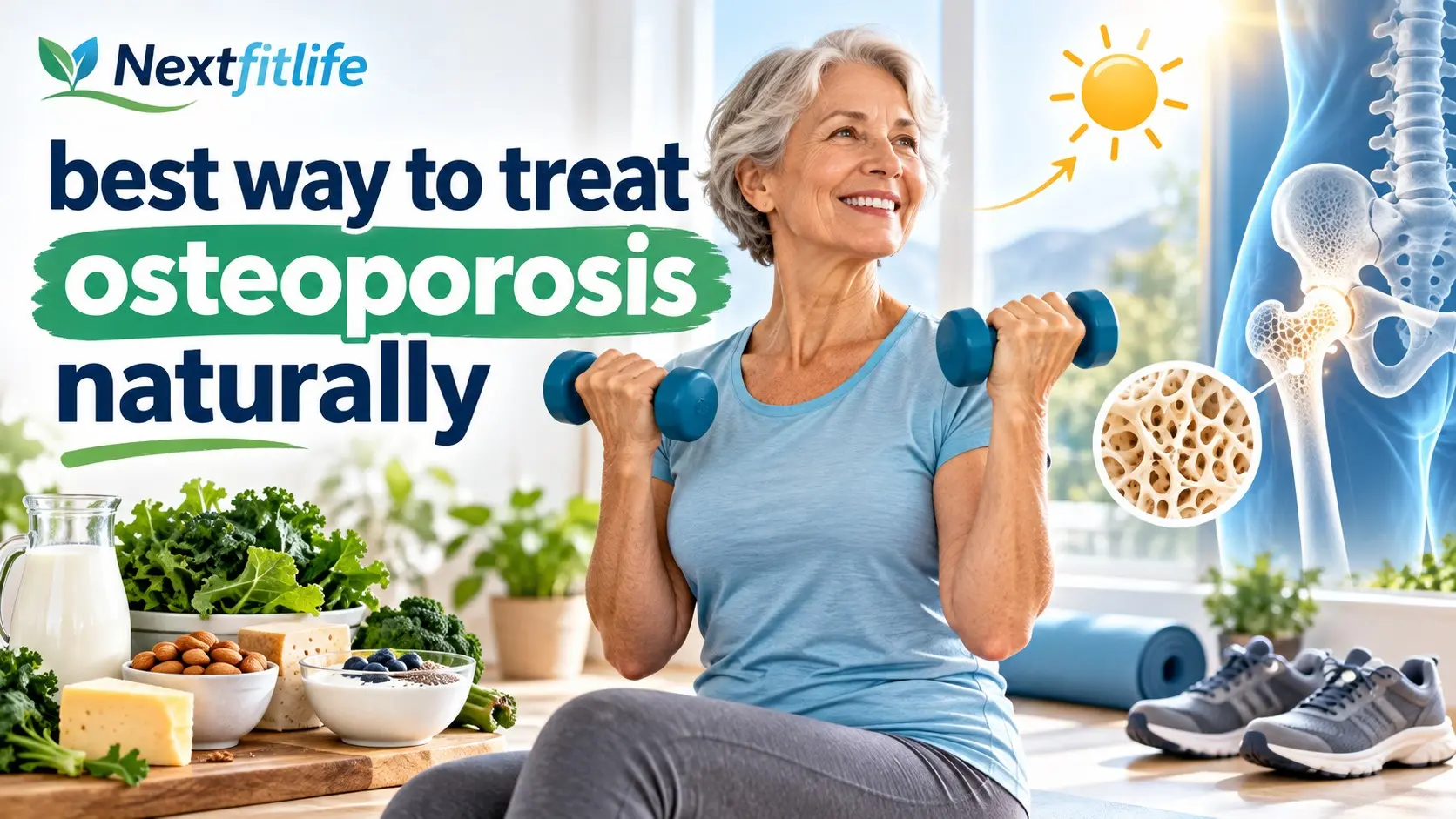
The best way to treat osteoporosis naturally is not to search for one supplement or one “bone building” food. The most useful lifestyle plan combines enough calcium and vitamin D, adequate protein, resistance and weight bearing exercise, balance training, fall prevention, no smoking, sensible alcohol use, healthy body weight, and treatment of any medical causes of bone loss.
But there is one limit that should be clear from the start: lifestyle care does not replace osteoporosis medicine when fracture risk is high.
This article is for general information and education. It does not replace medical advice, diagnosis, or treatment.
If you want the medical overview first, read Osteoporosis: Causes, Risks, Screening, and Prevention and the Bone and Joint Health Hub.
Table of Contents
- What natural osteoporosis treatment can and cannot do
- 11 proven lifestyle steps
- Get enough calcium
- Get enough vitamin D
- Eat enough protein
- Do resistance exercise
- Use weight bearing activity
- Train balance
- Prevent falls
- Stop smoking
- Limit excess alcohol
- Avoid undernutrition
- Treat secondary causes
- Supplements that deserve caution
- What walking can and cannot do
- When medicine is still needed
- Common myths
- Frequently asked questions
Can Osteoporosis Really Be Treated Naturally?
Yes, but the word “treated” needs context.
Lifestyle changes can support bone strength, muscle function, balance, and fall prevention. They can help slow avoidable bone loss and improve the conditions that protect you from fractures.
They do not reliably replace medicine in a person with established osteoporosis and high fracture risk.
That distinction matters.
Bone Health and Osteoporosis Foundation guidance describes osteoporosis treatment as a whole-person plan that can include calcium, vitamin D, exercise, home fall prevention, smoking cessation, alcohol moderation, and medicine when needed.
1. Get Enough Calcium From Food First
Calcium is a major mineral in bone.
Adults commonly need about 1,000 to 1,200 mg each day depending on age and sex.
Useful calcium rich foods include:
- Milk
- Yogurt
- Cheese
- Calcium fortified soy or other suitable plant drinks
- Calcium set tofu
- Sardines with edible bones
- Canned salmon with bones
- Kale
- Bok choy
- Some beans
Food first makes sense because those foods can also provide protein and other nutrients.
A supplement is most useful when there is a real gap between what you eat and what you need.
For more detail, use the Bone and Joint Nutrition Hub.
2. Get Enough Vitamin D Without Guessing From Sunlight
Vitamin D helps your body absorb calcium and supports muscle function.
NIH guidance lists 600 IU daily for adults age 19 through 70 and 800 IU daily from age 71 onward.
Food sources include:
- Fatty fish
- Fortified milk
- Fortified plant drinks
- Some fortified cereals
- Egg yolks
- Some mushrooms
Sunlight can help the body make vitamin D, but there is no universal “10 minutes three times a week” rule that works for everyone.
Skin tone, age, season, latitude, clothing, sunscreen use, and time outdoors all change vitamin D production.
If deficiency is a concern, testing and clinician guidance are more useful than guessing.
Read more in the Vitamin D Benefits Guide.
3. Eat Enough Protein to Protect Bone and Muscle
Bones are not made from minerals alone.
They have a protein framework too.
Protein also protects muscle, and stronger muscles help you stay steady and reduce fall risk.
Useful sources include:
- Fish
- Eggs
- Poultry
- Lean meat
- Milk and yogurt
- Beans
- Lentils
- Tofu
- Soy foods
- Nuts and seeds
Do not combine osteoporosis with an aggressive low calorie diet that strips away muscle.
Bone health and muscle health are connected.
4. Resistance Exercise Is One of the Most Useful Natural Tools
This is the lifestyle step I would not skip.
Resistance exercise makes muscles pull against bone.
Examples include:
- Free weights
- Resistance bands
- Weight machines
- Chair squats
- Wall push ups
- Step exercises
- Body weight movements
CDC guidance for older adults includes muscle strengthening activity at least two days per week as part of a complete activity plan.
If you already have vertebral fractures, severe osteoporosis, pain, or major balance problems, the exercise programme should be adapted.
A physical therapist who understands osteoporosis can help with that.
5. Add Weight Bearing Activity
Weight bearing exercise means activity done while your skeleton supports your body against gravity.
Examples include:
- Walking
- Stair climbing
- Dancing
- Hiking
- Jogging when appropriate
Walking is useful, but it should not be the entire programme.
The stronger approach is:
That combination supports bone, muscle, mobility, and fall prevention.
6. Train Balance, Especially as You Get Older
A fracture is not only about bone density.
It is also about falling.
Balance training can include:
- Tai chi
- Supported single leg standing
- Heel to toe walking
- Structured balance classes
- Physical therapy exercises
CDC specifically recommends balance activity for older adults because it helps reduce falls and injuries from falls.
If you already feel unsteady, do not practice challenging balance moves alone beside hard furniture or stairs.
7. Treat Fall Prevention as Part of Bone Treatment
You can improve bone density and still break a bone if you fall hard enough.
That is why fall prevention belongs in any serious osteoporosis plan.
At home
- Improve lighting
- Clear clutter
- Secure loose rugs
- Use handrails
- Add nonslip bathroom surfaces
- Clean spills quickly
- Keep frequently used items easy to reach
For your health
- Review medicines that cause dizziness or sleepiness
- Have vision checked
- Build leg strength
- Use suitable footwear
- Tell your clinician if you feel unsteady
CDC fall prevention guidance also recommends medicine review and strength and balance exercise for older adults.
8. Stop Smoking
Smoking works against bone health.
It is associated with higher fracture risk and poorer bone strength.
If you smoke, stopping is a more meaningful bone health step than buying a “bone detox” supplement.
If quitting is difficult, ask for structured cessation support.
9. Limit Excess Alcohol
Heavy alcohol use affects bone and also increases the chance of falling.
The second point is easy to overlook.
Alcohol can affect balance, judgement, and reaction time.
If osteoporosis is already present, repeated falls are something worth reducing.
10. Avoid Being Underweight or Undernourished
Very low body weight is a recognized osteoporosis risk factor.
So is poor overall nutrition.
Bone needs:
- Enough total energy
- Protein
- Calcium
- Vitamin D
- Other vitamins and minerals
Muscle also needs enough food.
If weight loss is one of your goals, protect muscle with enough protein and suitable resistance exercise.
For a broader plan, see the Weight Management and Metabolism Hub.
11. Look for Medical Causes of Bone Loss
Some osteoporosis has a secondary cause.
Examples include:
- Long term glucocorticoid treatment
- Celiac disease
- Some thyroid disorders
- Parathyroid disease
- Low sex hormone levels
- Some kidney disorders
- Malabsorption
- Some cancers
- Some cancer treatments
If one of these is driving bone loss, no “natural” plan is complete until that issue is addressed.
This is one reason osteoporosis deserves a medical review rather than supplement shopping alone.
Natural Osteoporosis Care at a Glance
| Lifestyle Step | What It Supports | What It Cannot Replace |
|---|---|---|
| Calcium rich foods | Normal bone mineral needs | Prescription treatment when fracture risk is high |
| Vitamin D adequacy | Calcium absorption and muscle function | DXA or fracture risk assessment |
| Resistance exercise | Muscle and bone loading | Medicine for high fracture risk |
| Walking | Weight bearing activity and mobility | Strength training |
| Balance work | Fall reduction | Bone density treatment |
| Smoking cessation | Reduces an avoidable bone risk factor | Medical care after a fracture |
Can Walking Alone Treat Osteoporosis?
No.
Walking is useful because it is weight bearing and helps maintain mobility.
But walking alone does not provide the same muscle loading as resistance exercise.
It also does not replace balance work.
A more complete plan includes:
- Walking or another weight bearing activity
- Resistance training
- Balance exercise
- Fall prevention
For older adults, read Walking Exercise for Seniors.
Can Yoga Help Osteoporosis?
Yoga can help mobility, balance, and strength in some people.
But the type of movement matters.
If you have vertebral osteoporosis or previous spinal fractures, loaded forward bending, deep spinal flexion, and forceful twisting can be inappropriate for some people.
Use an instructor or physical therapist who understands osteoporosis.
Do not assume every yoga pose is automatically bone safe.
What About Tai Chi?
Tai chi is especially useful for balance and coordination.
It can fit well into a fall prevention plan.
Its main value in osteoporosis is not that it dramatically builds bone density. Its value is helping you stay steady and reduce fall risk.
Should You Take Calcium Supplements?
Not automatically.
First estimate how much calcium you get from food.
If intake is low, a supplement can fill the gap.
More is not automatically better.
Ask a clinician or pharmacist before supplementing if you have:
- Kidney disease
- Kidney stones
- High blood calcium
- Complex medical problems
- Medicines that interact with calcium
NIH notes that calcium can interact with some medicines, including thyroid medicine and certain antibiotics.
Does Vitamin K2 Treat Osteoporosis Naturally?
Vitamin K2 is often marketed far more strongly than the evidence supports.
Vitamin K is involved in proteins that participate in bone biology.
That does not mean a K2 supplement cures osteoporosis or can replace prescription treatment.
The common claim that K2 simply “moves calcium from your arteries into your bones” is too simplistic.
If you take warfarin, do not make major changes to vitamin K intake without speaking with the healthcare team managing your anticoagulation.
For a full explanation, read Vitamin K2 Benefits.
Does Magnesium Rebuild Bone?
Magnesium has normal roles in bone and many other body functions.
But magnesium supplements do not rebuild osteoporotic bone on their own.
Food sources include:
- Nuts
- Seeds
- Beans
- Whole grains
- Leafy vegetables
A balanced diet usually makes more sense than treating osteoporosis with a large stack of individual supplements.
What Is the Best Drink for Osteoporosis?
There is no special drink that treats osteoporosis.
Milk and fortified plant drinks can be useful because they can provide calcium, vitamin D, and protein depending on the product.
Check the label.
A glass of fortified milk can support the diet.
It cannot replace fracture prevention medicine when medicine is indicated.
Does Caffeine Need to Be Avoided?
No blanket ban is needed for most adults.
The larger issues are whether your total diet provides enough calcium and whether caffeine intake is excessive.
There is no good reason to replace every cup of coffee with an herbal drink because someone called caffeine a “bone toxin.”
Focus on the whole diet.
Can Osteoporosis Be Reversed Naturally?
This phrase needs caution.
Exercise and nutrition can support bone health and sometimes improve bone density.
That is not the same as proving osteoporosis has been cured.
Someone who already had a fragility fracture may remain at increased future fracture risk even if the next DXA result improves.
A better goal is:
When Natural Care Is Not Enough
This section is the most important limit in the article.
Prescription osteoporosis medicine may be needed when you have:
- A hip fracture
- A vertebral fracture
- Another fragility fracture
- Bone density in the osteoporosis range
- High calculated fracture risk
- Very low bone density
- Long term glucocorticoid exposure
Modern osteoporosis medicines can reduce fracture risk.
They include:
- Bisphosphonates
- Denosumab
- Selected hormone related treatments
- Bone building medicines
- Romosozumab in selected high risk patients
For a detailed medicine guide, see Osteoporosis Treatment.
Do Not Stop Osteoporosis Medicine to “Go Natural”
Stopping treatment on your own is not a harmless experiment.
This is especially important with denosumab.
Stopping or delaying denosumab without a transition plan can cause rapid bone loss and increase vertebral fracture risk.
If you want to change treatment, make the plan with the clinician who manages your osteoporosis.
A Practical Natural Osteoporosis Routine
Daily
- Eat calcium rich foods
- Include protein at meals
- Get suitable movement
- Take prescribed medicine correctly
- Reduce fall hazards
Several Times Each Week
- Do resistance exercise
- Do weight bearing activity
- Practice balance safely
Periodically
- Review medicines that affect bone or balance
- Review calcium and vitamin D intake
- Discuss new falls or fractures
- Follow your clinician's DXA and treatment plan
Common Natural Osteoporosis Mistakes
| Mistake | Why It Fails | Better Move |
|---|---|---|
| Relying only on calcium | Fracture risk involves much more than calcium intake | Use a whole bone and fall prevention plan |
| Walking but never strength training | Muscle strengthening provides a different training stimulus | Add suitable resistance exercise |
| Taking large supplement stacks | More is not always safer or more effective | Fill real nutrient gaps |
| Using fixed sunlight rules | Vitamin D production differs greatly between people | Use dietary guidance and testing when appropriate |
| Stopping osteoporosis medicine | Fracture risk can rise again | Change treatment only with a medical plan |
| Ignoring falls | A fall can cause a fracture even during treatment | Train balance and improve home safety |
Conclusion: Use Natural Care as Support, Not a Substitute
The best way to treat osteoporosis naturally is to build a serious lifestyle plan around calcium and vitamin D adequacy, enough protein, resistance exercise, weight bearing activity, balance work, fall prevention, no smoking, sensible alcohol use, and treatment of medical causes of bone loss.
The limit matters just as much as the benefits.
If you already have osteoporosis, a fragility fracture, very low bone density, or high fracture risk, ask your clinician whether prescription treatment is needed alongside these habits.
Your next step can be simple: review your calcium intake, add safe resistance exercise, check your fall risks, and make sure your osteoporosis treatment plan is still appropriate.
References and Sources
- Bone Health and Osteoporosis Foundation. Treatment for Osteoporosis.
Explains why osteoporosis care uses a whole person approach with nutrition, exercise, fall prevention, smoking and alcohol changes, and medicine when needed.
https://www.bonehealthandosteoporosis.org/patients/treatment/ - Bone Health and Osteoporosis Foundation. Calcium and Vitamin D.
Covers calcium from food, vitamin D, supplements, healthy lifestyle, and the role of medication after osteoporosis diagnosis.
https://www.bonehealthandosteoporosis.org/patients/treatment/calciumvitamin-d/get-the-facts-on-calcium-and-vitamin-d/ - NIH Office of Dietary Supplements. Calcium Fact Sheet for Health Professionals.
Covers calcium requirements, food sources, supplements, absorption, health effects, and medicine interactions.
https://ods.od.nih.gov/factsheets/Calcium-HealthProfessional/ - NIH Office of Dietary Supplements. Vitamin D Fact Sheet for Health Professionals.
Covers vitamin D recommendations, deficiency, food sources, supplements, and bone health.
https://ods.od.nih.gov/factsheets/VitaminD-HealthProfessional/ - CDC. What Counts as Physical Activity for Older Adults.
Covers muscle strengthening, balance work, aerobic activity, and physical activity targets for older adults.
https://www.cdc.gov/physical-activity-basics/adding-older-adults/what-counts.html - CDC. Preventing Falls and Hip Fractures.
Covers medicine review, osteoporosis screening, strength exercise, balance work, and fall prevention.
https://www.cdc.gov/falls/prevention/index.html - NextFitLife Bone and Joint Health Hub.
Provides the site's medical hub for osteoporosis, DXA scans, fractures, exercise safety, diagnosis, and treatment.
https://nextfitlife.com/bone-joint-health/
Internal Links and Helpful NextFitLife Guides
- Osteoporosis: Causes, Risks, Screening, and Prevention
- Osteoporosis Treatment
- How to Prevent Osteoporosis
- Bone and Joint Health Hub
- Bone and Joint Nutrition Hub
- Vitamins for Strong Bones and Joints
- Vitamin D Benefits
- Vitamin K2 Benefits
- Walking Exercise for Seniors
About the Author
Adel Galal is the Founder and Lead Writer at NextFitLife. He researches bone health, nutrition, fitness, healthy aging, exercise, and evidence based wellness and turns current medical and public health guidance into clear practical information for everyday readers.
I am not a doctor or licensed healthcare professional, and this content does not replace professional medical advice, diagnosis, or treatment. I share information based on extensive research, real life experience, and consultation with healthcare providers. Always consult a qualified healthcare professional for diagnosis, treatment, or guidance about any health condition.
Learn more about Adel, NextFitLife, and the site's editorial approach on the About Us page.
Frequently Asked Questions
What is the best way to treat osteoporosis naturally?
The best natural support combines enough calcium and vitamin D, adequate protein, resistance and weight bearing exercise, balance training, fall prevention, no smoking, sensible alcohol use, and treatment of medical causes of bone loss.
Can osteoporosis be treated without medicine?
Some people at lower fracture risk may rely mainly on lifestyle care and monitoring. Established osteoporosis, fragility fractures, or high fracture risk often require prescription medicine as well.
Can osteoporosis be reversed naturally?
Bone density can improve in some people with exercise, nutrition, and treatment, but this should not be described as a guaranteed natural cure. The main goal is to reduce fracture risk.
What is the best natural exercise for osteoporosis?
No single exercise is best. A useful programme combines resistance exercise, weight bearing activity, and balance training, adapted to your fracture history and ability.
Is walking good for osteoporosis?
Yes. Walking is useful weight bearing activity and supports mobility, but it should ideally be combined with resistance and balance exercise.
Can yoga help osteoporosis?
Yoga can support strength, balance, and mobility, but some spinal movements may need modification in people with vertebral osteoporosis or previous spine fractures.
Does vitamin K2 cure osteoporosis?
No. Vitamin K participates in bone biology, but K2 supplements do not replace DXA testing, exercise, fall prevention, or osteoporosis medicine when treatment is needed.
Does magnesium rebuild bone?
Magnesium supports normal body functions including bone biology, but magnesium supplements alone do not rebuild osteoporotic bone.
What is the best drink for osteoporosis?
There is no special osteoporosis drink. Milk and suitable fortified plant drinks can provide calcium, vitamin D, and protein, depending on the product.
Should I take calcium supplements?
Not automatically. Try to meet calcium needs from food first and use supplements when there is a real shortfall or your clinician recommends them.
Should I stop coffee if I have osteoporosis?
Most people do not need to avoid coffee completely. The larger priorities are adequate calcium and vitamin D intake, exercise, smoking avoidance, alcohol moderation, and appropriate medical treatment.
Can I stop osteoporosis medicine and treat it naturally instead?
Do not stop prescribed osteoporosis medicine without medical advice. This is especially important with denosumab because unplanned discontinuation can lead to rapid bone loss and increased vertebral fracture risk.
How long does it take to strengthen bones naturally?
Bone changes slowly over months and years. Muscle strength and balance can improve sooner, but there is no reliable short timeline for rebuilding bone density.
What lifestyle change matters most for osteoporosis?
There is no single winner. Resistance exercise, calcium and vitamin D adequacy, enough protein, fall prevention, smoking cessation, and treatment of medical risk factors work together.

Health & wellness writer with 30+ years of experience in nutrition, fitness, and healthy aging. Founder of NextFitLife.com — evidence-based health guidance.

