Last Updated: September 1, 2026
Sources Checked: September 1, 2026
Next Review: September 2027, or sooner if major blood pressure or autonomic guidance changes
Written and Source Checked by: Adel Galal, Founder and Lead Writer at NextFitLife
Review Status: Updated using current cardiovascular guidance, autonomic research, and major medical sources. This article has not been independently medically reviewed by a licensed clinician.
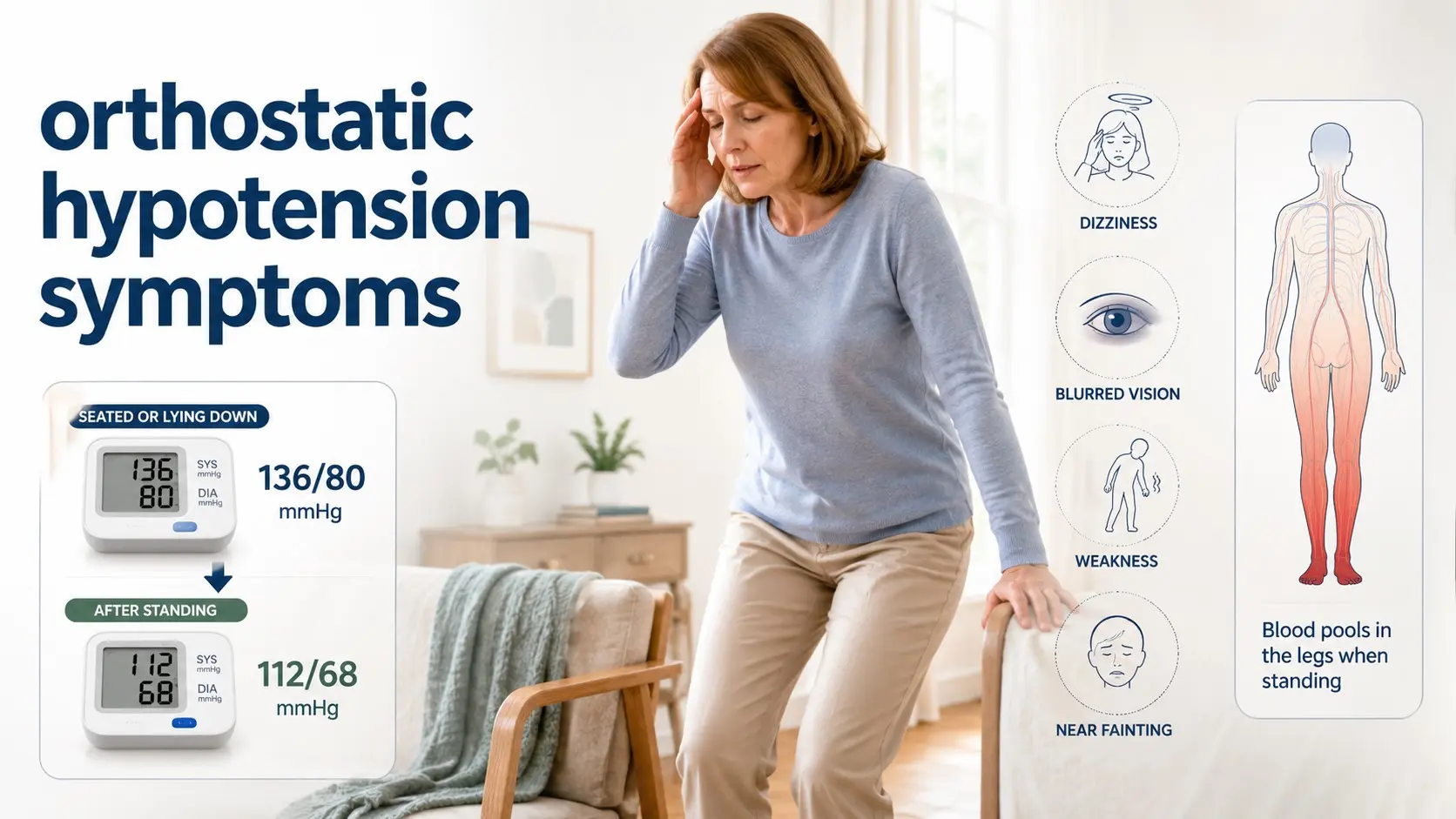
orthostatic hypotension symptoms usually start after you stand up.
You may feel dizzy.
Your vision may dim.
Your legs may feel weak.
You may feel close to fainting.
Then you sit or lie down, and the symptoms improve.
That pattern matters because orthostatic hypotension is about a fall in blood pressure after standing.
You do not need to have low blood pressure all day.
Quick Answer: What Are Orthostatic Hypotension Symptoms?
Orthostatic hypotension symptoms include dizziness, lightheadedness, blurred or dim vision, weakness, nausea, confusion, fatigue, neck or shoulder pain, near fainting, or fainting after standing. Symptoms often improve after sitting or lying down. Diagnosis depends on the blood pressure change after standing, not one low resting reading.
Medical note: I am not a dermatologist or A doctor, and this content does not replace professional medical advice. What I share comes from real-life experience, extensive research, and consultation with healthcare providers. Always consult qualified medical professionals for diagnosis and treatment of any health condition.
Why Can Standing Up Make You Dizzy?
Gravity changes blood flow very quickly.
When you are lying down, blood returns to your heart with less effort.
Stand up and some blood moves toward your legs and abdomen.
Your heart briefly receives less blood.
Your body normally corrects this almost at once.
Pressure sensors called baroreceptors detect the change.
Your blood vessels tighten.
Your heart rate adjusts.
Blood flow to your brain is maintained.
With orthostatic hypotension, this response is not strong enough or something interferes with it.
Your blood pressure falls.
Your brain gets less blood for a short time.
You feel lightheaded, weak, or faint.
This topic belongs mainly in our Heart and Cardiovascular Health Hub, where you can explore blood pressure, circulation, heart symptoms, and cardiovascular safety.
What Blood Pressure Drop Counts as Orthostatic Hypotension?
The standard clinical definition is based on a sustained blood pressure fall after standing.
The usual threshold is:
20 mm Hg or more in systolic blood pressure
or
10 mm Hg or more in diastolic blood pressure
within three minutes of standing after lying down.
This is why the diagnosis is not based only on whether your pressure is below 90 over 60.
You can begin with normal or high blood pressure and still have a large orthostatic fall.
Example
Lying down: 138 over 82.
Standing: 114 over 70.
The systolic pressure fell 24 mm Hg.
The standing pressure is not extremely low.
But the change meets the usual systolic definition.
The American Heart Association also notes that orthostatic hypotension can occur in people who already have hypertension.
Orthostatic Hypotension Is Not the Same as Low Blood Pressure All Day
This distinction is easy to miss.
One person may normally have a blood pressure around 90 over 60 and feel completely well.
Another person may begin at 145 over 85, stand up, and experience a large pressure fall with dizziness.
The second pattern can fit orthostatic hypotension even though the final number does not look very low.
For more context about the lower blood pressure number, read Low Diastolic Blood Pressure.
What Does Orthostatic Dizziness Feel Like?
People use the word dizzy for many sensations.
With orthostatic dizziness, the description is often closer to:
- I feel faint when I stand.
- My vision goes grey.
- I need to grab something.
- My legs suddenly feel weak.
- I feel as if I might pass out.
- Everything improves when I sit down.
That pattern is different from classic vertigo, where you may feel as though you or the room is spinning.
The timing after standing is a major clue.
What Are the Main Orthostatic Hypotension Symptoms?
Dizziness is the best known symptom.
It is not the only one.
Recognized postural hypotension symptoms include:
- Dizziness
- Lightheadedness
- Blurred vision
- Dimmed or grey vision
- Weakness
- Fatigue
- Confusion
- Difficulty thinking clearly
- Nausea
- Headache
- Palpitations
- Shortness of breath
- Chest discomfort
- Neck pain
- Shoulder pain
- Near fainting
- Fainting
Symptoms happen because upright blood flow is not being maintained well enough.
Why Can Your Vision Go Dark When You Stand?
Your brain and eyes need continuous blood flow.
When blood pressure falls quickly, your vision can briefly change.
You may notice:
- Blurred vision
- Grey vision
- Dim vision
- Tunnel vision
- A darkening feeling just before fainting
If this happens mainly after standing and improves after sitting or lying down, the positional pattern is useful information for your healthcare professional.
Sudden persistent vision loss is different and requires urgent medical assessment.
Can Orthostatic Hypotension Cause Brain Fog?
Yes.
Some people do not describe obvious dizziness.
They feel slow.
They cannot think clearly.
They feel suddenly exhausted while upright.
Research reviews describe cognitive slowing as one possible presentation of orthostatic hypotension.
This can be especially confusing in older adults.
A person may seem unsteady, tired, or mentally slow without saying that they feel dizzy.
What Is Coat Hanger Pain?
This is an unusual symptom that deserves more attention.
Coat hanger pain means aching across the neck, shoulders, and upper back while you are upright.
The painful area roughly follows the shape of a coat hanger.
It is recognized as one possible symptom of orthostatic hypotension.
If neck and shoulder discomfort repeatedly appears when you stand and improves when you lie down, tell your healthcare professional about that pattern.
Do not assume all neck pain comes from blood pressure.
Muscle, joint, nerve, and spine problems are much more common explanations.
Can Orthostatic Hypotension Cause Nausea?
Yes.
Nausea after standing can occur with orthostatic hypotension.
You may also feel hot, sweaty, weak, or shaky.
Those symptoms can look similar to anxiety, dehydration, low blood sugar, or a vasovagal episode.
The standing trigger helps narrow the possibilities.
Can You Have Orthostatic Hypotension Without Feeling Dizzy?
Yes.
Symptoms are not required for the blood pressure abnormality to exist.
Some people meet the blood pressure criteria during testing but do not notice symptoms at that moment.
This matters in people with:
- Unexplained falls
- Autonomic nervous system disorders
- Older age
- Diabetes
- Parkinson disease
A lack of dizziness does not always mean the blood pressure response is normal.
Why Are Symptoms Often Worse in the Morning?
Morning episodes are common.
Cleveland Clinic notes that orthostatic hypotension can be more noticeable in the morning.
You have also spent many hours lying down.
Then you move from bed to standing in a few seconds.
If this happens to you, do not jump straight out of bed.
Sit first.
Let your body adjust.
Then stand while holding something stable if needed.
Why Can a Hot Shower Make You Dizzy?
Heat opens blood vessels near your skin.
This can make it harder to maintain blood pressure after standing.
Hot weather can do the same thing.
So can a hot bath or hot tub.
If you are also dehydrated, the effect can be stronger.
This explains why some people feel fine before a shower and suddenly become lightheaded when they stand in a hot bathroom.
How Does Dehydration Cause Orthostatic Hypotension?
Your circulation needs enough fluid volume.
Lose too much fluid and there is less blood available to maintain pressure when you stand.
Common causes include:
- Vomiting
- Diarrhea
- Heavy sweating
- Fever
- Not drinking enough
- Long periods of exercise
- Some medicines
Dehydration and blood pressure are closely connected.
An isolated episode after a stomach illness is very different from standing dizziness that happens every day for months.
Which Medicines Can Make Standing Dizziness Worse?
Medication review is a major part of the evaluation.
Medicines that can contribute include some:
- Diuretics
- Alpha blockers
- Beta blockers
- Calcium channel blockers
- ACE inhibitors
- Angiotensin receptor blockers
- Nitrates
- Other vasodilators
- Some antidepressants
- Some antipsychotic medicines
- Parkinson medicines
- Some erectile dysfunction medicines
- Opioids
This does not mean these medicines are unsafe.
They may be medically necessary.
The dose, timing, hydration, other medicines, and your health conditions all matter.
Do not stop a prescription medicine because you become dizzy after standing.
Ask the prescribing clinician to review it.
Can Diabetes Cause Orthostatic Hypotension?
Yes.
Long term diabetes can damage nerves that control automatic body functions.
This is called autonomic neuropathy.
Those nerves help your blood vessels and heart respond when you stand.
If that response becomes weak, blood pressure can fall.
Diabetes is therefore one possible cause of orthostatic hypotension.
For broader metabolic health information, start from the NextFitLife Health Hub, which organizes all 22 Health sub hubs.
What Is Neurogenic Orthostatic Hypotension?
Neurogenic orthostatic hypotension happens when the autonomic nervous system does not produce the normal response to standing.
It can occur with conditions such as:
- Parkinson disease
- Multiple system atrophy
- Pure autonomic failure
- Some peripheral neuropathies
- Diabetic autonomic neuropathy
- Some spinal cord disorders
The mechanism is different from simple dehydration.
With dehydration, your heart rate often rises as your body tries to compensate.
With neurogenic orthostatic hypotension, that compensatory heart rate response may be smaller because the autonomic reflex itself is impaired.
Autonomic disorders also connect with NextFitLife's Special Health Topics Hub.
Is Orthostatic Hypotension the Same as POTS?
No.
This distinction matters.
Both can make you feel terrible while standing.
Both can cause:
- Dizziness
- Weakness
- Brain fog
- Palpitations
- Fatigue
- Exercise difficulty
But the defining measurements are different.
Classic orthostatic hypotension requires the characteristic blood pressure drop.
POTS involves a sustained rise in heart rate after standing without the classic orthostatic blood pressure fall.
Johns Hopkins describes a heart rate rise of at least 30 beats per minute in adults within the first 10 minutes of standing as part of the POTS criteria.
For adolescents, the threshold is 40 beats per minute.
POTS is diagnosed only after orthostatic hypotension, acute dehydration, and blood loss are excluded.
Do not diagnose either condition from a smartwatch alone.
Is Every Head Rush After Standing Orthostatic Hypotension?
No.
A very brief head rush can happen in otherwise healthy people.
There is also a recognized condition called initial orthostatic hypotension.
The blood pressure fall happens within about 15 seconds of standing.
Symptoms can disappear quickly.
A normal home cuff may miss this because the cuff cannot inflate and calculate the pressure fast enough.
This explains a frustrating experience:
You stand.
Your vision dims.
You feel faint.
Thirty seconds later the blood pressure machine shows a normal value.
The normal value does not prove nothing happened.
Are There Different Types of Orthostatic Hypotension?
Yes.
The timing helps classify the problem.
Initial Orthostatic Hypotension
The pressure falls almost immediately after standing.
This occurs within about 15 seconds.
Classic Orthostatic Hypotension
The qualifying blood pressure drop occurs within three minutes of standing.
This is the form most people mean by orthostatic hypotension.
Delayed Orthostatic Hypotension
The abnormal pressure fall occurs after more than three minutes upright.
This is why a normal three minute office test does not explain every case of repeated standing symptoms.
Why Can Symptoms Be Worse After Eating?
Digestion changes blood flow.
After a meal, more blood moves toward the digestive system.
Some people develop postprandial hypotension, which means blood pressure falls after eating.
This is more common in older adults and in some people with autonomic problems.
If standing dizziness repeatedly appears after breakfast, lunch, or dinner, write that pattern down.
Meal timing can help a clinician understand what is happening.
How Do Doctors Check Orthostatic Blood Pressure?
A correct basic test compares lying and standing values.
A common clinical method is:
- Lie flat and rest for about five minutes.
- Measure blood pressure and heart rate.
- Stand carefully.
- Repeat measurements while standing.
- Continue assessment through three minutes.
A sustained decrease of at least 20 mm Hg systolic or 10 mm Hg diastolic meets the usual definition.
Supine to standing testing creates a stronger circulatory challenge than simply measuring from sitting to standing.
Can You Check Orthostatic Blood Pressure at Home?
You can collect useful information at home.
Safety comes first.
Do not perform a standing test alone if you recently fainted or feel likely to fall.
If you can stand safely:
- Lie quietly for five minutes.
- Measure blood pressure and pulse.
- Stand carefully near something stable.
- Repeat the measurement while upright.
- Record the numbers.
- Record your symptoms.
- Note the time, meals, exercise, heat, and medicines.
A home record can help your healthcare professional.
It cannot identify every type of orthostatic disorder.
What If Your Home Blood Pressure Test Looks Normal?
A normal home result does not end the investigation when symptoms keep happening.
The episode may appear:
- Immediately after standing
- Later than three minutes
- Early in the morning
- After eating
- After exercise
- After medicine
- During heat exposure
- Only when dehydrated
Initial orthostatic hypotension can happen too quickly for an ordinary cuff.
Delayed orthostatic hypotension can happen after a standard short check has ended.
If suspicion remains high, formal testing may be needed.
What Is a Tilt Table Test?
A tilt table test allows clinicians to study your blood pressure and heart rate while your body is moved from lying toward an upright position.
It can help when:
- Symptoms strongly suggest an orthostatic disorder but routine testing is normal
- Standing testing is unsafe
- Delayed orthostatic hypotension is suspected
- Fainting remains unexplained
- Different forms of orthostatic intolerance need to be separated
The test is performed in a controlled medical setting.
What Else Can Cause Dizziness When You Stand?
Standing dizziness does not prove orthostatic hypotension.
Other possible causes include:
- Dehydration
- POTS
- Vasovagal fainting
- Anemia
- Blood loss
- Low blood sugar
- Heart rhythm disorders
- Medication effects
- Inner ear disorders
- Neurologic problems
- Some autonomic disorders
The timing and the measured blood pressure change help separate these possibilities.
Dizziness and Vertigo Are Not the Same Thing
Describe the feeling rather than using only the word dizzy.
Orthostatic lightheadedness often feels like:
- You may faint
- Your vision is fading
- Your legs feel weak
- You need to sit down
Vertigo more often feels as if you or the room is spinning.
The distinction is not perfect.
But it gives your healthcare professional better information.
Should You Drink More Water?
If dehydration is part of the cause, correcting dehydration makes sense.
But repeated orthostatic hypotension deserves more than the advice to drink water.
The cause may be:
- Medication
- Autonomic disease
- Blood loss
- Heart disease
- Endocrine disease
- Neuropathy
- Another medical problem
Hydration is part of the answer only when it fits the cause.
Should You Eat More Salt?
Do not add large amounts of salt without medical advice.
More sodium can help some people with orthostatic hypotension.
It is not appropriate for everyone.
Extra sodium can be a problem if you have:
- High blood pressure
- Heart failure
- Kidney disease
- Fluid retention
- Another condition requiring sodium restriction
The American Heart Association emphasizes that treating orthostatic hypotension in people with hypertension can be complex.
Individual assessment matters.
What Should You Do When Symptoms Start?
Do not try to push through a near faint.
Sit down.
Lie down if you can do so safely.
Symptoms of orthostatic hypotension often improve when you return to a seated or lying position.
Other practical steps can include:
- Stand up more slowly
- Pause before walking
- Use support when you first stand
- Avoid very hot showers if they trigger symptoms
- Stay hydrated when appropriate
- Record recurring episodes
Repeated symptoms still need an explanation.
Can Muscle Tensing Help When You Feel Faint?
Some people with orthostatic symptoms use physical counter pressure movements.
These movements tense large muscles and can help support blood pressure temporarily.
Examples can include leg crossing or tightening leg and abdominal muscles.
They are not a substitute for diagnosis.
If you have frequent fainting or a cardiovascular condition, ask a clinician which strategies are safe for you.
Why Do Frequent Episodes Matter More Than One Head Rush?
One isolated episode can have a simple explanation.
You were dehydrated.
You stood quickly after lying down for hours.
You were in intense heat.
You had been sick.
Daily symptoms for several months tell a different story.
Mayo Clinic and Cleveland Clinic both recommend medical evaluation when dizziness after standing happens repeatedly.
Fainting deserves even more attention.
Why Are Falls a Serious Risk?
You do not need to completely lose consciousness to fall.
A few seconds of:
- Dimmed vision
- Weak legs
- Poor balance
- Confusion
- Near fainting
can be enough.
Orthostatic hypotension is linked with falls, especially in older adults.
If you have unexplained falls, tell your healthcare professional whether they happened soon after standing.
For more prevention guidance later in life, explore the healthy aging section through the NextFitLife Health Hub.
When Should Orthostatic Hypotension Be Checked?
Arrange medical assessment when:
- Symptoms happen often
- You faint
- You repeatedly nearly faint
- The episodes are getting worse
- You have unexplained falls
- Your symptoms started after a medicine change
- Your daily activity is affected
- You have heart disease
- You have diabetes
- You have Parkinson disease or another neurologic disorder
A symptom diary can help.
Write down:
- Time of day
- What you were doing
- Whether you had eaten
- Blood pressure if available
- Heart rate
- Medicines
- Heat exposure
- How long symptoms lasted
Patterns are useful.
Which Symptoms Need Urgent Medical Help?
Do not assume serious symptoms are simply low blood pressure.
Seek urgent medical care for dizziness or fainting with:
- Chest pain
- Severe shortness of breath
- Major bleeding
- Black or bloody stool
- Persistent confusion
- Signs of shock
- Serious injury after a fall
- A new serious irregular heartbeat
- Prolonged loss of consciousness
Sudden face drooping, one sided weakness, speech trouble, or sudden severe vision problems can be signs of stroke.
Those symptoms require emergency assessment.
Do not wait for a home blood pressure test.
Orthostatic Hypotension and Low Diastolic Pressure Are Different
A low bottom number while sitting does not automatically mean orthostatic hypotension.
Orthostatic hypotension is about the pressure change after standing.
You can have:
- Normal resting pressure with orthostatic hypotension
- Low resting pressure without orthostatic hypotension
- Both at the same time
Read Low Diastolic Blood Pressure if your concern is specifically the bottom blood pressure number.
Orthostatic Hypotension and Pulse Pressure Are Different
Pulse pressure is the difference between your systolic and diastolic blood pressure numbers.
It does not diagnose orthostatic hypotension.
For example:
Blood pressure 120 over 80 has a pulse pressure of 40.
Orthostatic testing asks a different question.
How much did the pressure change after you stood up?
Read Pulse Pressure Meaning for that measurement.
Orthostatic Hypotension Is Not the Same as HRV
Heart rate variability measures small differences in timing between normal heartbeats.
Orthostatic hypotension measures a blood pressure response to standing.
They are different cardiovascular measurements.
A wearable HRV score cannot diagnose orthostatic hypotension.
For HRV, read Heart Rate Variability, Normal Range.
Can Exercise Affect Standing Blood Pressure?
Yes.
Blood pressure can remain lower for a period after exercise.
This is known as post-exercise hypotension.
If you stand quickly after a demanding workout, dehydration, heat, and post-exercise blood vessel dilation can combine and make you lightheaded.
That does not automatically mean you have chronic orthostatic hypotension.
For the exercise pattern, read Blood Pressure After Exercise.
You can also compare pulse recovery with Heart Rate Recovery After Exercise.
Common Orthostatic Hypotension Myths
Myth: Your Blood Pressure Must Be Below 90 Over 60
False.
The classic diagnosis is based on the drop after standing.
Myth: Orthostatic Hypotension Is Just Dizziness
False.
Symptoms can include weakness, blurred vision, nausea, cognitive slowing, neck and shoulder discomfort, near fainting, and fainting.
Myth: Every Head Rush Means Orthostatic Hypotension
False.
Many conditions can produce standing dizziness.
Myth: Orthostatic Hypotension and POTS Are the Same
False.
They have different diagnostic cardiovascular patterns.
Myth: Drinking More Water Fixes Every Case
False.
Management depends on the cause.
Myth: Everyone With Orthostatic Hypotension Should Eat More Salt
False.
Extra salt is not safe or appropriate for every person.
My Approach to Orthostatic Hypotension Symptoms
I think the biggest mistake is treating the word dizziness as the diagnosis.
Dizziness is only the starting clue.
My background in information technology management taught me to look at how data are collected before interpreting the result.
That same rule matters with blood pressure.
One sitting reading gives limited information when the problem happens after standing.
For this article, I reviewed current American Heart Association guidance, Cleveland Clinic's February 2026 update, American Family Physician clinical guidance, an open Lancet Neurology review, and Johns Hopkins guidance on POTS.
My practical questions are:
Does standing trigger the symptoms?
Does sitting or lying down improve them?
Does blood pressure actually fall?
What happens to heart rate?
Is medicine involved?
Could dehydration, blood loss, diabetes, or an autonomic disorder explain it?
That is much more useful than simply asking whether your blood pressure is low.
Conclusion: Orthostatic Hypotension Symptoms Need a Pattern
Orthostatic hypotension symptoms can include dizziness, blurred vision, weakness, nausea, brain fog, neck or shoulder discomfort, near fainting, and fainting after standing.
The diagnosis depends on the blood pressure response to standing.
It does not depend on one low resting number.
Your next step: If standing repeatedly makes you dizzy, record when it happens, review your medicines, and ask a healthcare professional to check your lying and standing blood pressure safely.
References and Sources
This article was checked against current medical guidance and publicly accessible research.
- Cleveland Clinic. Orthostatic Hypotension: Symptoms and Treatment.
Updated February 10, 2026. This medically reviewed source explains standing dizziness, blurred vision, weakness, nausea, palpitations, neck and shoulder pain, causes, heat triggers, diagnosis, treatment, and warning signs.
- American Heart Association. Orthostatic Hypotension in Adults With Hypertension.
This scientific statement explains the standard blood pressure definition, the relationship between orthostatic hypotension and hypertension, medication considerations, and the need to identify the underlying cause.
- American Family Physician. Orthostatic Hypotension: A Practical Approach.
This open clinical review covers symptoms, diagnosis, supine and standing blood pressure measurement, initial and delayed forms, medication causes, neurogenic disease, POTS, tilt table testing, and management.
- Wieling W, Kaufmann H, Claydon VE, and colleagues. Diagnosis and Treatment of Orthostatic Hypotension.
This open access review in Lancet Neurology explains the physiology, clinical presentations, initial, classic and delayed forms, autonomic causes, testing, and individualized management.
- Johns Hopkins Medicine. Postural Orthostatic Tachycardia Syndrome.
This source helps distinguish POTS from orthostatic hypotension and explains the standing heart rate criteria used in adults and adolescents.
Source Review Date: September 1, 2026
These organizations and researchers do not endorse NextFitLife.
Continue Reading on NextFitLife
Main Health Hub: NextFitLife Health Hub
Primary Sub Hub: Heart and Cardiovascular Health
Autonomic and Cross Topic Hub: Special Health Topics
About the Author
Adel Galal is the founder and lead writer of NextFitLife.
He has maintained a personal interest in health, fitness, nutrition, sleep, wellness, and healthy aging for more than 30 years.
His health and wellness writing experience spans more than 15 years.
Before focusing on NextFitLife, Adel spent 29 years working as an IT Manager for the Nestlé Egypt Region.
His professional background developed skills in data analysis, research organization, systems thinking, information management, structured review, and problem-solving.
At NextFitLife, he applies those skills to compare reputable medical sources, identify important limitations, separate established guidance from uncertain research, and explain complex health topics in clear language.
For this article, his focus is on explaining why standing dizziness should be interpreted through posture, blood pressure change, heart rate response, medicines, hydration, and symptoms rather than one isolated blood pressure number.
I am not a dermatologist or A doctor, and this content does not replace professional medical advice. What I share comes from real-life experience, extensive research, and consultation with healthcare providers. Always consult qualified medical professionals for diagnosis and treatment of any health condition.
Read more about Adel Galal, NextFitLife, and our editorial and source checking process.
Frequently Asked Questions About Orthostatic Hypotension Symptoms
What are the main orthostatic hypotension symptoms?
Common symptoms include dizziness, lightheadedness, blurred vision, weakness, fatigue, confusion, nausea, palpitations, neck or shoulder pain, near fainting, and fainting after standing.
How much does blood pressure need to drop for orthostatic hypotension?
The usual definition is a sustained drop of at least 20 mm Hg in systolic pressure or 10 mm Hg in diastolic pressure within three minutes of standing after lying down.
Do you need blood pressure below 90 over 60 to have orthostatic hypotension?
No. Orthostatic hypotension is based on the fall after standing. A person can begin with normal or high blood pressure and still meet the definition.
Why does my vision go dark when I stand?
A quick blood pressure fall can briefly reduce blood flow to the brain and eyes. This can cause dim, grey, blurred, or tunnel vision.
Can orthostatic hypotension cause brain fog?
Yes. Some people experience cognitive slowing, difficulty concentrating, fatigue, or confusion while upright.
Can orthostatic hypotension cause neck and shoulder pain?
Yes. Coat hanger pain is a recognized pattern of neck and shoulder discomfort that can occur during upright posture in some people with orthostatic hypotension.
Can orthostatic hypotension cause nausea?
Yes. Nausea, sweating, warmth, weakness, and other symptoms can occur during an orthostatic episode.
Can dehydration cause orthostatic hypotension?
Yes. Dehydration lowers circulating fluid volume and can make it harder for the body to maintain blood pressure when you stand.
Can blood pressure medicine cause standing dizziness?
Some blood pressure medicines and other drugs can contribute to orthostatic hypotension. Do not stop a prescribed medicine without speaking with the prescribing clinician.
Is orthostatic hypotension the same as POTS?
No. Orthostatic hypotension involves a qualifying blood pressure fall after standing. POTS involves an excessive sustained rise in heart rate without the classic orthostatic blood pressure drop.
Can a normal home blood pressure test miss orthostatic hypotension?
Yes. Initial orthostatic hypotension can happen too quickly for a standard cuff, while delayed orthostatic hypotension can occur after more than three minutes upright.
How is orthostatic hypotension tested?
A common test measures blood pressure and heart rate after about five minutes lying down and again after standing, with assessment through three minutes.
Should I eat more salt if I have orthostatic hypotension?
Do not increase salt substantially without medical advice. Extra sodium is not appropriate for everyone, especially people with hypertension, heart failure, kidney disease, or fluid restrictions.
When should dizziness after standing be checked by a doctor?
Get medical advice when episodes happen often, worsen, cause falls, include fainting, interfere with daily life, or begin after a medicine change.
When is standing dizziness an emergency?
Seek urgent help when dizziness or fainting occurs with chest pain, severe breathing difficulty, major bleeding, stroke symptoms, serious confusion, shock, severe injury, or prolonged loss of consciousness.
```

Health & wellness writer with 30+ years of experience in nutrition, fitness, and healthy aging. Founder of NextFitLife.com — evidence-based health guidance.