Last Updated: September 4, 2026
Sources Checked: September 4, 2026
Next Review: September 2027, or sooner if major asthma, exercise, or respiratory guidance changes
Written and Source Checked by: Adel Galal, Founder and Lead Writer at NextFitLife
Review Status: Updated using current exercise induced bronchoconstriction, asthma, sports respiratory, and upper airway guidance. This article has not been independently medically reviewed by a licensed clinician.
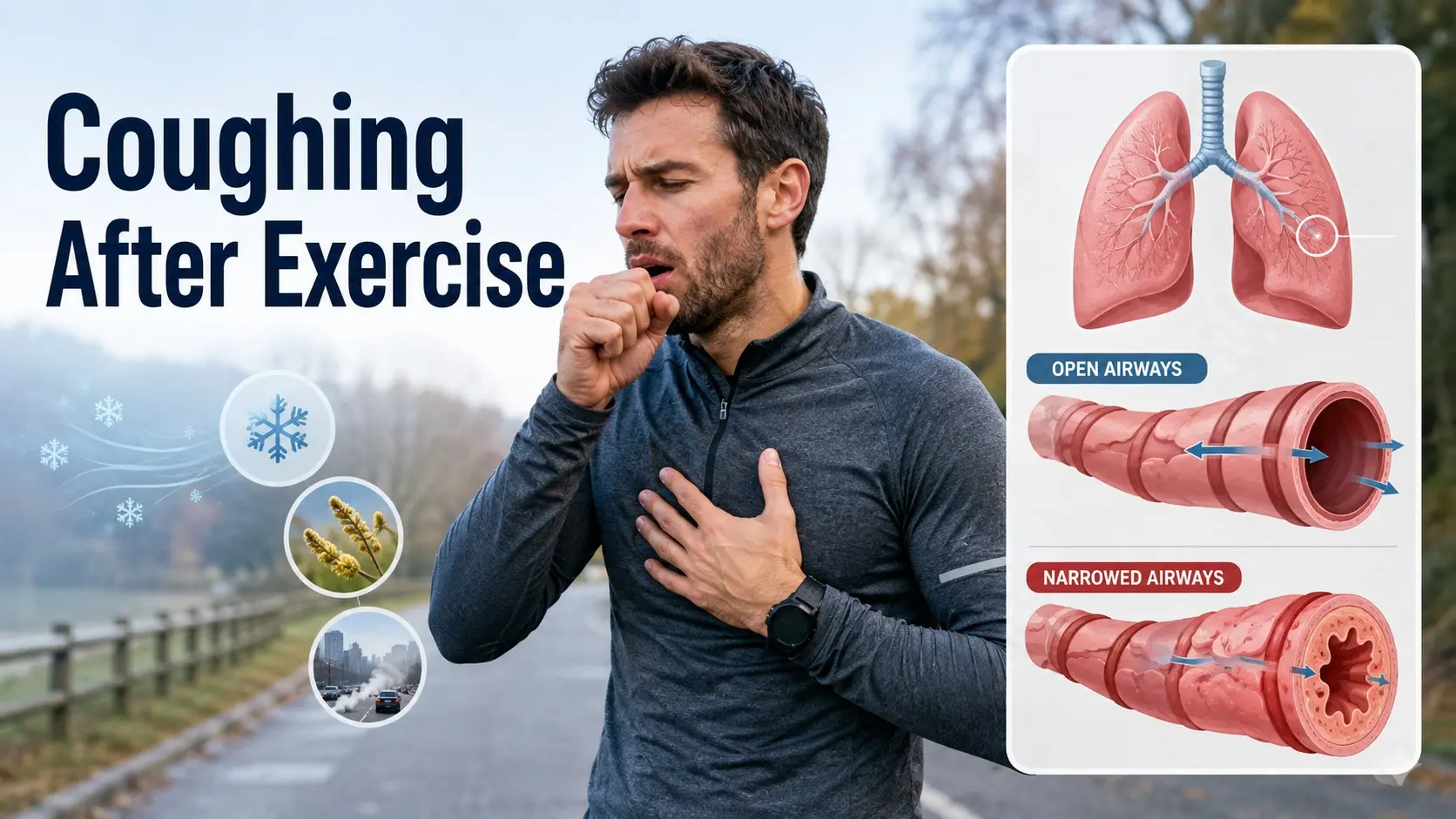
Coughing after exercise can happen when hard breathing dries and irritates sensitive airways.
One important cause is exercise-induced bronchoconstriction, also called EIB.
Asthma, allergies, a cold, dry air, pollution, a recent respiratory infection, and exercise-induced laryngeal obstruction can also cause symptoms.
The timing of the cough is one of your best clues.
Quick Answer: Why Do I cough after exercise?
Coughing after exercise is commonly linked with temporary airway narrowing, dry or cold air, asthma, allergies, airway irritation, or a recent respiratory infection. A cough that worsens shortly after exercise may fit EIB. Noisy breathing and throat tightness during peak effort can point more toward EILO.
Medical note: This content is for general educational purposes and does not replace professional medical advice, diagnosis, or treatment. Consult an appropriately qualified healthcare professional for personal medical concerns. This article explains published guidance and does not provide a personal clinical assessment. Always consult qualified medical professionals for diagnosis and treatment of any health condition.
Is Coughing After a workout normal?
A few coughs after a very hard workout do not automatically mean something is wrong.
Your breathing changes a lot during exercise.
You move much more air through your lungs.
You may also breathe more through your mouth.
That air can be:
- Cold
- Dry
- Full of pollen
- Polluted
- Smoky
- Dusty
Your airways have to warm and humidify all of it.
A sensitive airway can react with cough.
What I would not ignore is a cough that happens after most workouts.
Especially if it comes with wheezing after exercise, chest tightness, breathlessness, or falling performance.
For the wider respiratory cluster, visit the NextFitLife Lung and Respiratory Health Hub.
When Does the Cough Start?
This is where I would begin.
Not with an inhaler.
Not with a diagnosis.
With timing.
| Timing | What It Can Suggest |
|---|---|
| During hard exercise | Asthma, EIB, EILO, airway irritation, environmental triggers |
| Worst shortly after stopping | Exercise induced bronchoconstriction becomes more likely |
| Worst at peak effort with throat noise | Exercise induced laryngeal obstruction becomes more likely |
| Only during cold outdoor exercise | Dry cold air as an airway trigger |
| Only during high pollen days | Allergy or allergic asthma becomes more likely |
| After a recent cold | Airway sensitivity after respiratory infection |
| After eating before exercise | Reflux can contribute if other reflux symptoms are present |
The same word, cough, can come from several different mechanisms.
The timing helps separate them.
1. Exercise Induced Bronchoconstriction Is the Main Condition to Know
Exercise-induced bronchoconstriction means the airways temporarily narrow during or after physical activity.
You may also hear the older phrase exercise-induced asthma.
EIB is the better term.
Exercise does not create asthma.
And not every person with EIB has chronic asthma.
Common EIB symptoms include:
- Coughing
- Wheezing
- Chest tightness
- Shortness of breath
- Unexpected loss of exercise performance
Symptoms can begin during activity.
For many people, they become especially noticeable during the recovery period after exercise.
Why Can Exercise Narrow the Airways?
Hard exercise changes how you breathe.
Ventilation rises.
You pull large amounts of air into the lungs.
More mouth breathing also means less of that air gets warmed and humidified by the nose.
Water is lost from the airway surface.
In a susceptible airway, this drying process can trigger chemical signals that tighten airway muscle.
The airway narrows.
Then you cough or wheeze.
This is why cold air cough and EIB frequently overlap.
Cold Air Is Not the Whole Story
Winter runners notice the problem quickly.
Run hard outside.
Stop.
Your chest feels irritated.
Then coughing begins.
Cold air gets blamed.
But dryness is a big part of the mechanism.
Cold air usually contains less moisture than warm humid air.
That makes airway drying stronger during heavy breathing.
Mayo Clinic identifies cold dry air as a common exercise related airway trigger.
So does AAAAI.
Why Does the Cough Sometimes Start After You Stop?
This pattern is useful.
You finish the run.
Your legs feel fine.
You begin walking.
A few minutes later, your chest feels tight, and the cough starts.
That fits EIB better than a throat problem that appears only at maximum effort.
MedlinePlus explains that EIB symptoms commonly begin soon after exercise ends, although symptoms can occur during exercise too.
So record the timing.
It can help your healthcare professional choose the right test.
2. Asthma Can Hide Behind an Exercise Cough
Exercise is a common asthma trigger.
Sometimes exercise is also what exposes asthma that has not been diagnosed yet.
Look for symptoms outside workouts.
These can include:
- Night cough
- Cold air symptoms
- Wheezing around pollen
- Chest tightness around smoke
- Breathing problems during colds
- Symptoms after laughing
- Repeated need for prescribed reliever medicine
If these patterns are present, I would look beyond isolated EIB.
Read Silent Asthma: The Hidden Danger Lurking in Your Lungs for less obvious asthma patterns.
A Lack of Wheezing Does Not Rule Out Asthma
This matters.
Some people cough during or after exercise without obvious wheezing.
Asthma can still be present.
NextFitLife's current silent asthma guide explains that exercise-related breathlessness, reduced stamina, chest tightness, and cough can occur without a loud wheeze.
The answer is objective assessment.
Not assuming you are fine because nobody heard a whistle.
Exercise Symptoms Can Mean Asthma Control Needs Review
If you already have asthma and exercise suddenly becomes harder, pay attention.
More coughing or wheezing can be a sign that control has changed.
Ask:
- Am I getting night symptoms?
- Am I using my prescribed reliever more?
- Has pollen exposure increased?
- Did I recently have an infection?
- Am I taking controlled treatment as prescribed?
- Is my inhaler technique correct?
Repeated symptoms should not become your normal training routine.
Follow your written asthma action plan and contact the clinician managing your asthma when symptoms change.
3. Exercise Induced Laryngeal Obstruction Can Look Like Asthma
This is one of the most useful distinctions in the article.
Exercise induced laryngeal obstruction, or EILO, affects the upper airway around the larynx.
During intense exercise, parts of the larynx narrow when they should remain open.
That creates breathing difficulty.
People can be told they have exercise-induced asthma when the real problem is EILO.
Sometimes both are present.
How Does EILO Feel?
Think throat more than chest.
Potential clues include:
- Throat tightness
- A choking feeling
- Noisy breathing while breathing in
- Voice changes
- Breathing difficulty at peak effort
- Symptoms that settle quickly after stopping
The breathing sound is often inspiratory.
That means it is stronger while breathing in.
This is different from the classic lower airway wheeze that is usually stronger while breathing out.
EIB and EILO Have Different Timing
| Feature | EIB | EILO |
|---|---|---|
| Main location | Lower airways | Larynx and upper airway |
| Cough | Common | Possible |
| Chest tightness | Common | Less typical |
| Throat tightness | Less typical | Common |
| Breathing noise | More often while breathing out | More often while breathing in |
| Timing | Can become worse after exercise | Usually strongest during intense effort |
| Recovery | Can continue after stopping | Often settles quickly after stopping |
| Useful testing | Exercise challenge with lung function testing | Continuous laryngoscopy during exercise |
This distinction can prevent years of treating the wrong airway.
How Is EILO Diagnosed?
The preferred test is called continuous laryngoscopy during exercise.
A small flexible camera is used to view the larynx while the person performs exercise intense enough to reproduce symptoms.
This matters because the larynx can look normal while resting.
The abnormal narrowing appears during strenuous exercise.
Open sports medicine guidance identifies continuous laryngoscopy during exercise as the preferred diagnostic method for EILO.
4. Allergies Can Turn a Normal Workout Into a Coughing Fit
Spring is a good example.
You run through an area full of pollen.
Your breathing rate rises.
You inhale far more pollen than you would while sitting outside.
Now your nose and airways react.
Clues include:
- Sneezing
- Runny nose
- Itchy eyes
- Blocked nose
- Postnasal drainage
- Cough
- Wheezing
If the same workout causes no trouble on low pollen days, that pattern is useful.
Allergic Asthma Can Be an Exercise Problem Too
Allergens can trigger airway narrowing in someone with asthma.
Exercise then increases the amount of allergen reaching the respiratory system.
This combination can make symptoms look as though exercise alone caused the problem.
That is why I would record:
Where you trained.
The weather.
Pollen conditions.
Whether nasal symptoms appeared.
Whether the same symptoms happen indoors.
5. Postnasal Drainage Can Trigger Cough Without a Lung Problem
The cough does not always begin in the chest.
Rhinitis can increase mucus around the nose and throat.
Exercise can make nasal symptoms more noticeable.
Then mucus reaches the throat.
You stop running.
You clear your throat repeatedly.
Then the cough begins.
Postnasal drip after exercise becomes more likely when you also have:
- Runny nose
- Throat clearing
- Sneezing
- Mucus behind the throat
- Little or no chest tightness
6. Your Training Environment Can Trigger the Cough
Look around before blaming your lungs.
Where did you exercise?
Beside traffic?
Inside a dusty gym?
In a chlorinated pool?
During wildfire smoke?
On a freezing dry morning?
During high pollen conditions?
High ventilation means you inhale more of whatever is in the air.
Common triggers include:
- Cold dry air
- Air pollution
- Smoke
- Pollen
- Dust
- Chemical fumes
- Pool related irritants
If you cough outdoors but not on a treadmill, that difference matters.
Why Do Swimmers and Winter Athletes Get Special Attention?
Their air exposure is unusual.
Winter athletes repeatedly breathe enormous volumes of cold, dry air.
Competitive swimmers spend long periods around pool-related chemicals and moist air containing irritants.
Research in athletes has linked these training environments with higher levels of airway irritation and respiratory symptoms.
That does not mean running in winter or swimming is bad for you.
It means the environment belongs in the health history.
7. A Recent Respiratory Infection Can Leave the Airways Sensitive
You had a cold.
The fever is gone.
You feel mostly better.
You run again.
Then the coughing returns.
This is plausible because recovering airways can stay sensitive after a respiratory infection.
Exercise increases airflow.
That air can trigger a cough reflex that is still sensitive.
If you still have fever, strong fatigue, chest congestion, or a severe hacking cough, hard training is not a good recovery strategy.
How Can You Tell This From EIB?
Ask whether the cough happens outside exercise too.
A recovering respiratory infection can cause:
- Cough at rest
- Sore throat
- Runny nose
- Fatigue
- Mucus
- Chest irritation
EIB becomes more convincing when exercise itself reliably reproduces cough, wheezing, chest tightness, or breathlessness even when you otherwise feel well.
8. Air Pollution Can Matter More During Exercise
Your breathing rate rises during exercise.
That means exposure rises too.
A road that feels harmless during a slow walk can feel very different during interval running.
Pollution can irritate the respiratory tract.
People with asthma or sensitive airways can react more strongly.
If roadside running causes symptoms but indoor training does not, mention that pattern.
Consider moving hard sessions away from heavy traffic or poor air quality days.
9. Reflux Can Cause Cough but Should Not Be the First Guess
Reflux belongs on the list.
I would keep it lower unless the pattern fits.
Look for:
- Heartburn
- Sour taste
- Regurgitation
- Hoarseness
- Throat clearing
- Cough after eating before exercise
- Symptoms during bending or abdominal exercise
Exercise related cough has stronger evidence for airway, nasal, infection, and environmental causes.
If meals are a clear trigger, read Cough After Eating: Reflux, Swallowing and Aspiration.
10. Sometimes Exercise Simply Exposes Irritated Airways
Not everyone who coughs after exercise has measurable bronchoconstriction.
This is useful.
Exercise can expose an already irritated airway to:
- Dry air
- Pollution
- Cold temperatures
- Heavy ventilation
- Airborne allergens
You can therefore have a real exercise-induced cough without every test confirming asthma or EIB.
That is another reason symptoms alone should not create the diagnosis.
Does Coughing After Exercise Mean You Are Unfit?
No.
Poor fitness can make you breathe harder.
It can make exercise feel uncomfortable.
It does not automatically explain repeated coughing.
Elite athletes develop EIB.
People without chronic asthma develop EIB.
Fit people can also have EILO.
Fitness level is not a diagnostic test.
Does Coughing Mean Your Lungs Are Getting Stronger?
No.
A coughing fit is not a training adaptation you need to earn.
Exercise can improve fitness.
Repeated respiratory symptoms are still symptoms.
If every hard workout ends with coughing, chest tightness, or wheezing, investigate the pattern.
Why Does Running Trigger Cough More Than Weight Training?
Running can keep ventilation high for a long time.
So can cycling, football, and other endurance activities.
More ventilation means more airway drying.
It also means more exposure to pollen, smoke, dust, or pollution.
Weight training often uses shorter effort periods with rest between sets.
That usually creates a different ventilation pattern.
This is why coughing after running can be more obvious than coughing after slower strength work.
Can You Prevent Coughing After Exercise?
You can reduce several common triggers.
Start with:
- A gradual warm-up
- A gradual cool down
- Avoiding smoke
- Checking outdoor air quality
- Reducing exposure on high pollen days if allergies affect you
- Protecting your mouth and nose during very cold, dry weather
- Avoiding hard training while significantly ill
- Following your asthma action plan if you have one
These steps reduce triggers.
They do not replace diagnosis when symptoms repeat.
A Warm Up Is More Than Stretching
Think breathing.
The goal is to raise ventilation gradually.
Start easy.
Walk.
Jog.
Add short increases in effort.
Then begin the main workout.
Mayo Clinic recommends a variable intensity warm-up as one strategy for people with EIB.
Standing still and stretching does not create the same respiratory warm-up.
Can Covering Your Mouth Help in Cold Weather?
Yes, for some people.
A scarf or suitable face covering can help warm and humidify the air you breathe.
This reduces the amount of cold dry air reaching the lower airways.
MedlinePlus recommends protecting the nose and mouth during exercise in cold dry conditions when EIB is a problem.
This is an environmental strategy.
It is not a replacement for prescribed asthma treatment.
Should You Breathe Through Your Nose?
At lower exercise intensity, nasal breathing can warm and humidify air more effectively.
During hard exercise, many people cannot meet their ventilation needs through the nose alone.
Do not force nasal breathing during a hard session if it makes you feel starved for air.
Use it as a practical tool when intensity allows.
Should You Use an Inhaler Before Exercise?
Only according to your prescribed treatment plan.
Some people with diagnosed EIB or asthma use prescribed medicine before exercise.
Other people need controlled treatment because the problem is part of broader asthma.
Do not borrow another person's inhaler.
Do not assume one coughing episode proves you need asthma medicine.
If exercise symptoms repeat, get assessed.
Symptoms Alone Do Not Prove EIB
This is one of the key safety points.
Cough.
Wheeze.
Chest tightness.
Breathlessness.
They suggest EIB.
They do not confirm it.
EILO, nasal disease, infection, environmental exposure, and other conditions can mimic the same complaint.
Objective testing reduces guesswork.
How Is Exercise-Induced Bronchoconstriction Diagnosed?
History comes first.
A clinician may ask:
- When does the cough start?
- During exercise or afterward?
- Does cold air trigger it?
- Is there wheezing?
- Do you have night symptoms?
- Do allergies affect you?
- Do you have asthma?
- Does it happen indoors?
- Does pollution change the symptoms?
Then lung function can be measured.
Spirometry measures how much air you can blow out and how quickly you can blow it out.
If resting spirometry does not explain the problem, an exercise or other bronchial challenge can be used.
What Is an Exercise Challenge Test?
The goal is simple.
Reproduce the trigger.
Then measure the airway response.
Lung function is measured before exercise.
You perform exercise intense enough to raise ventilation.
Lung function is checked again during recovery.
A significant exercise-related fall in airflow can support the diagnosis of EIB.
The healthcare professional interprets the result using accepted testing criteria.
What If Resting Spirometry Is Normal?
That does not automatically rule out EIB.
You can breathe normally while sitting in the clinic.
Your symptoms happen after running.
That is why challenge testing exists.
It tests the airway around the situation that actually causes symptoms.
What If Asthma Testing Is Normal but Exercise Still Feels Hard?
Think about EILO.
Especially when symptoms:
- Peak during hard exercise
- Feel centered in the throat
- Produce loud breathing while breathing in
- Disappear quickly after stopping
The best test is a continuous visualization of the larynx during exercise.
This prevents upper airway symptoms from being treated as lower airway asthma.
What If Cough Is the Only Symptom?
EIB can cause cough without dramatic wheezing.
But an isolated cough is not specific enough to diagnose EIB.
Other possibilities include:
- Rhinitis
- Recent respiratory infection
- Environmental irritation
- Asthma
- EIB
- Upper airway problems
Use the same pattern approach.
Timing.
Environment.
Frequency.
Other symptoms.
What If You Cough Up Phlegm After Exercise?
Now look at the mucus too.
A productive cough can appear with:
- Respiratory infection
- Chronic airway disease
- Postnasal drainage
- Airway inflammation
- Heavy mucus production
The mucus color alone cannot tell you whether the problem is bacterial.
For a detailed guide, read Phlegm Color Chart: What Mucus Colors May Mean.
If the mucus is mainly white, see White Phlegm: Signs, Causes and Treatment Options.
Can You Keep Exercising if You Have EIB?
Usually, yes.
Properly managed EIB should not mean giving up physical activity.
People with asthma and EIB compete in demanding sports.
The goal is good symptom control.
That can include:
- Correct diagnosis
- A good warm up
- Reducing environmental triggers
- Following prescribed treatment
- Managing underlying asthma
Exercise should build health.
You should not need to accept uncontrolled coughing attacks as the price of being active.
When Should You Stop the Workout?
Stop if you develop:
- Significant chest tightness
- Worsening wheezing
- Breathing difficulty beyond expected exertion
- Dizziness
- Severe coughing that interferes with breathing
If you have asthma, follow your written asthma action plan.
Do not push through symptoms because the workout is almost finished.
When Should Coughing After Exercise Be Checked?
Arrange medical assessment if:
- The cough happens after most workouts
- The problem is becoming worse
- You also wheeze
- You have chest tightness
- Your exercise performance is falling
- You develop nighttime symptoms
- Cold air reliably triggers symptoms
- You already have asthma and symptoms are increasing
- Your prescribed treatment is not working as expected
- The noise seems to come mainly from the throat
Repeated cough after workout deserves a cause.
When Is Coughing During Exercise an Emergency?
Seek urgent medical help for severe or rapidly worsening breathing difficulty.
Warning signs include:
- Severe trouble breathing
- Blue or grey lips or skin
- Severe chest pain
- Fainting
- Confusion
- Rapidly worsening wheezing
- Symptoms that do not improve after following your prescribed asthma emergency plan
- Significant coughing of blood
Do not continue exercising during a severe breathing event.
Coughing After Exercise and Heart Rate Recovery Are Different Signals
Your heart rate should fall during recovery.
Your airways should also settle.
But these measurements answer different questions.
Heart rate recovery tells you how quickly your pulse falls after exercise.
Exercise cough points toward the airway, nose, throat, environment, or another respiratory trigger.
For cardiovascular recovery, read Heart Rate Recovery After Exercise: What Your Drop Means.
Coughing After Exercise and Blood Pressure Recovery Are Different Too
A blood pressure reading after exercise tells you about cardiovascular recovery.
It cannot diagnose EIB.
Likewise, coughing does not tell you whether post workout blood pressure is normal.
Read Blood Pressure After Exercise: What Is Normal During Recovery.
Keep cardiovascular and respiratory signals separate.
That helps you avoid making one symptom explain everything.
Coughing After Exercise and Wheezing Are Related but Different
Cough is a reflex.
Wheezing is a musical breathing sound caused by narrowed airways.
EIB can cause both.
Asthma can cause both.
You can also cough after exercise without wheezing.
If wheezing is the main symptom, read Wheezing at Night: Asthma, Reflux and Other Causes.
Common Coughing After Exercise Myths
Myth: Exercise-Induced Bronchoconstriction Means You Have Asthma
False.
EIB can happen in people without chronic asthma.
Myth: Coughing After Running Means You Are Unfit
False.
Fitness level does not diagnose or exclude an airway problem.
Myth: Cold Air Alone Causes EIB
Too simple.
Airway drying during heavy ventilation is a major part of the mechanism.
Myth: Every Exercise Cough Is EIB
False.
Rhinitis, recent infection, pollution, allergies, and EILO can also cause exercise-related symptoms.
Myth: No Wheezing Means No Asthma
False.
Some asthma presentations are cough-dominant or have very little obvious wheezing.
Myth: A Loud Breathing Sound During Exercise Means Asthma
False.
Inspiratory throat noise can point toward EILO.
Myth: People With Asthma Should Avoid Exercise
False.
Good asthma and EIB management should allow most people to remain physically active.
My Approach to Coughing After Exercise
I start with four questions.
When?
During peak effort?
Or during recovery?
Where?
Cold air?
A pool?
A dusty gym?
A polluted road?
What else?
Wheezing?
Chest tightness?
Runny nose?
Throat noise?
Phlegm?
Fever?
How often?
Once after a brutal workout?
Or every training session?
My background in information technology management taught me to separate similar problems by sequence, environment, and repeatable patterns.
I apply that same method when researching health topics for NextFitLife.
For this article, I compared current information from Mayo Clinic, AAAAI, MedlinePlus, the American Lung Association, and open sports medicine research on EILO.
The distinction I would remember is simple.
If symptoms become worse after hard exercise, EIB moves higher on the list.
If throat tightness and noisy breathing peak during hard exercise and fade quickly after stopping, EILO moves higher.
Then test rather than guess.
Conclusion: Find the Cause of Coughing After Exercise
Coughing after exercise is worth investigating when it becomes a repeated pattern.
Start with timing, environment, and accompanying symptoms.
If the cough regularly appears with wheezing, chest tightness, or unusual breathlessness, ask about objective testing for EIB rather than assuming it is normal.
If noisy breathing and throat tightness peak during hard effort, mention EILO too.
Your next step: Record which workout triggers the cough, when it starts, how long it lasts, and whether wheezing, chest tightness, throat noise, allergies, or mucus appear. Take that pattern to a qualified healthcare professional if symptoms repeat.
References and Sources
This article was checked against current and publicly accessible asthma, exercise, respiratory, and sports medicine sources.
- Mayo Clinic. Exercise-Induced Asthma.Mayo Clinic explains exercise-induced bronchoconstriction, common symptoms, dry air and environmental triggers, diagnostic testing, warm-up strategies, and prescription treatment options.Read Mayo Clinic Exercise-Induced Bronchoconstriction Guidance
- American Academy of Allergy, Asthma and Immunology. Asthma and Exercise.AAAAI explains EIB triggers, exercise symptoms, asthma overlap, environmental factors, prevention, and objective testing.Read AAAAI Asthma and Exercise Guidance
- MedlinePlus. Exercise Induced Asthma.MedlinePlus explains that exercise can trigger temporary airway narrowing, that EIB can occur without chronic asthma, and that symptoms often begin soon after exercise ends.Read MedlinePlus EIB Guidance
- American Lung Association. Asthma and Exercise.The American Lung Association explains how people with asthma can remain active, how exercise symptoms should be managed, and when coughing, chest tightness, or breathlessness should prompt a review of asthma control.Road America Lung Association Asthma and Exercise Guidance
- International Olympic Committee Sports Medicine Review. Exercise-Induced Laryngeal Obstruction in Athletes.This open access review explains how EILO can mimic asthma and EIB, why symptoms tend to peak during intense exercise, and why continuous laryngoscopy during exercise is the preferred diagnostic test.Read the Open Access EILO Review
Source Review Date: September 4, 2026
These organizations and researchers do not endorse NextFitLife.
Continue Reading on NextFitLife
Main Health Hub: NextFitLife Health
Primary Sub Hub: Lung and Respiratory Health
Fitness Hub: NextFitLife Fitness
Heart Hub: Heart and Cardiovascular Health
- Silent Asthma: The Hidden Danger Lurking in Your Lungs
- Wheezing at Night: Asthma, Reflux and Other Causes
- Phlegm Color Chart: What Mucus Colors May Mean
- Dry Cough at Night: 10 Causes and When to Get Help
- Cough After Eating: Reflux, Swallowing and Aspiration
- Heart Rate Recovery After Exercise
- Blood Pressure After Exercise
About the Author
Adel Galal is the founder and lead writer of NextFitLife.
NextFitLife is an independent health and wellness website created to help adults understand health, fitness, foods and nutrition, beauty, and healthy aging in clear language.
Adel has maintained a personal interest in health, fitness, nutrition, sleep, wellness, and healthy aging for more than 30 years.
His health and wellness writing experience spans more than 15 years.
Before founding NextFitLife, Adel spent 29 years working as an IT Manager for the Nestlé Egypt Region.
His professional background developed skills in data analysis, research organization, systems thinking, information management, structured review, and problem solving.
At NextFitLife, he applies those skills to compare credible medical sources, separate similar symptom patterns, identify limits in evidence, and explain health information in plain language.
For this article, his focus is on preventing every exercise cough from being labelled asthma. The article separates EIB from asthma, EILO, allergies, infection, environmental irritation, and other possible causes.
This content is for general educational purposes and does not replace professional medical advice, diagnosis, or treatment. Consult an appropriately qualified healthcare professional for personal medical concerns. This article explains published guidance and does not provide a personal clinical assessment. Always consult qualified medical professionals for diagnosis and treatment of any health condition.
Read more about Adel Galal, NextFitLife, and our editorial and source checking process.
Frequently Asked Questions About Coughing After Exercise
Why do I cough after exercise?
Common reasons include exercise induced bronchoconstriction, asthma, cold dry air, allergies, airway irritation, pollution, or a recent respiratory infection.
What is exercise-induced bronchoconstriction?
Exercise-induced bronchoconstriction is temporary narrowing of the lower airways during or after exercise. It can cause cough, wheezing, chest tightness, and shortness of breath.
Is exercise-induced bronchoconstriction the same as asthma?
No. Many people with asthma have EIB, but EIB can also occur in people who do not otherwise have chronic asthma.
Why do I cough more after I stop running?
EIB symptoms can become more noticeable during the recovery period after hard exercise. This timing can help distinguish EIB from some upper airway problems.
Why does cold air make me cough when running?
Cold air is usually dry. Heavy breathing increases airway water loss, which can trigger airway narrowing and cough in susceptible people.
Can allergies cause coughing after exercise?
Yes. Pollen and other allergens can trigger nasal symptoms, asthma, and airway irritation. Exercise increases the amount of air and allergens you inhale.
Can exercise cause asthma?
No. Exercise can trigger airway narrowing in people with asthma or EIB, but exercise itself does not create asthma.
What is EILO?
Exercise induced laryngeal obstruction is temporary narrowing around the larynx during hard exercise. It can cause throat tightness, noisy breathing while breathing in, and breathing difficulty near peak effort.
How is EILO different from EIB?
EILO usually peaks during intense exercise and often improves quickly after stopping. EIB can become more obvious after exercise and affects the lower airways.
How is EIB diagnosed?
Diagnosis can include symptom history, spirometry, and an exercise or other bronchial challenge that measures airway function before and after the trigger.
Can spirometry be normal if I have EIB?
Yes. Resting lung function can be normal between exercise episodes, which is why exercise or bronchial challenge testing can be useful.
Should I use an inhaler before exercising?
Use prescription inhalers only according to your own treatment plan. Do not borrow another person's inhaler because repeated coughing has several causes.
Can warming up reduce coughing after exercise?
A gradual warm-up can help some people with EIB. It also gives the respiratory system time to move from resting ventilation toward harder exercise.
Can I keep exercising if I have EIB?
Yes. Correctly diagnosed and controlled EIB should allow most people to remain physically active.
Does coughing after exercise mean I am unfit?
No. Fit people and athletes can develop EIB, asthma, allergies, or EILO. Fitness level alone does not explain repeated coughing.
When should coughing after exercise be checked?
Arrange medical review if the cough occurs after most workouts, gets worse, reduces performance, or comes with wheezing, chest tightness, nighttime symptoms, or unusual breathlessness.
When is exercise-related coughing an emergency?
Seek urgent medical help for severe or rapidly worsening breathing difficulty, blue or grey lips, fainting, severe chest pain, significant coughing of blood, or symptoms that do not improve after following a prescribed asthma emergency plan.

Health & wellness writer with 30+ years of experience in nutrition, fitness, and healthy aging. Founder of NextFitLife.com — evidence-based health guidance.