Published: September 13, 2026
Last updated: September 13, 2026
Next review: September 2027, or sooner if major vitamin K or anticoagulant guidance changes
Written and source checked by: Adel Galal, Founder and Lead Writer at NextFitLife
Medical review status: This article has not been medically reviewed by a doctor, pharmacist, or registered dietitian.
Vitamin K1 is surprisingly easy to get from food.
You do not need an exotic powder.
You probably do not need a supplement.
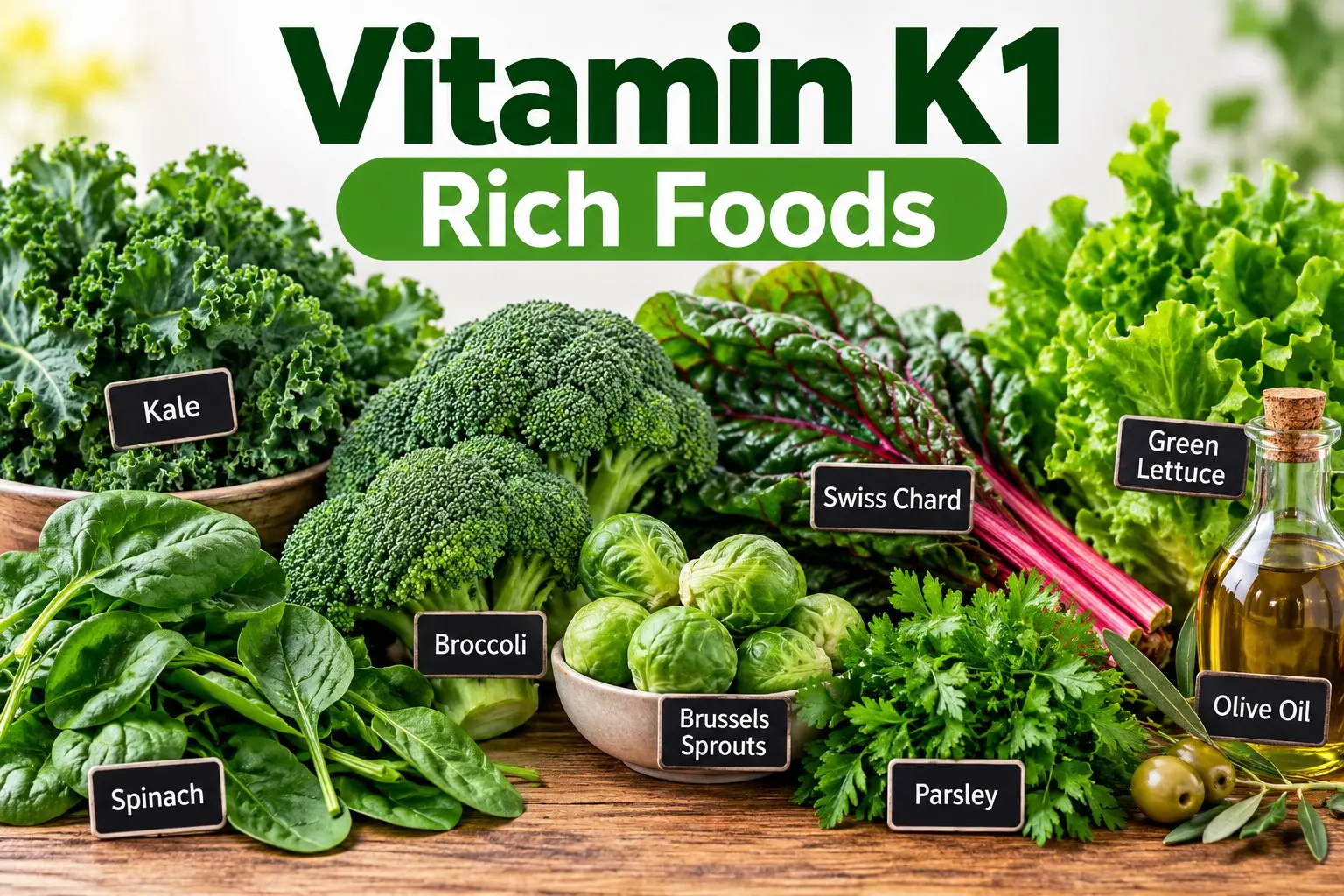
The richest Vitamin K1 Rich Foods are ordinary green vegetables such as collard greens, turnip greens, spinach, kale, and broccoli.
Some soy foods, vegetable oils, nuts, fruit, and other vegetables provide smaller amounts.
The part that causes confusion is not finding vitamin K1.
It is understanding the difference between K1 and K2, comparing different serving sizes, and knowing what to do if you take warfarin.
Important medical note: I am not a dermatologist or A doctor, and this content does not replace professional medical advice. What I share comes from real-life experience, extensive research, and consultation with healthcare providers. Always consult qualified medical professionals for diagnosis and treatment of any health condition.
If you take warfarin, another anticoagulant, have a bleeding disorder, have a condition that affects fat absorption, have undergone bariatric surgery, or use vitamin K supplements, discuss major dietary changes with your doctor, pharmacist, dietitian, or anticoagulation clinic.
What Are the Best Vitamin K1 Rich Foods?
Quick answer: The best Vitamin K1 Rich Foods are collard greens, turnip greens, spinach, kale, broccoli, roasted soybeans, carrot juice, soybean oil, edamame, pumpkin, pomegranate juice, okra, pine nuts, blueberries, and lettuce. Green leafy vegetables provide the largest amounts of vitamin K1, also called phylloquinone.
That answer covers most people.
A normal serving of spinach, broccoli, kale, collards, or turnip greens can provide a large share of your daily vitamin K needs.
Sometimes one serving provides more than the full daily amount.
That is not a problem for most healthy people.
What Is Vitamin K1?
Vitamin K1 is also called phylloquinone.
It is one form of vitamin K.
Plants make vitamin K1.
The richest food sources are leafy green vegetables.
Vitamin K belongs to the group of fat soluble vitamins.
That means its absorption is linked with dietary fat.
Your body uses vitamin K to activate proteins needed for normal blood clotting.
Vitamin K also activates proteins involved in bone metabolism and other body processes.
Vitamin K1 and Vitamin K2 Are Different Forms
This is where many food lists get messy.
Vitamin K1 is phylloquinone.
Vitamin K2 refers to compounds called menaquinones.
| Feature | Vitamin K1 | Vitamin K2 |
|---|---|---|
| Main name | Phylloquinone | Menaquinones |
| Main food sources | Leafy greens, vegetables, vegetable oils, some fruit | Natto, some fermented foods, and some animal foods |
| Examples | Spinach, kale, collards, broccoli | MK 4, MK 7, MK 8, MK 9 |
| Official separate daily target | No separate K1 target | No separate K2 target |
The adult vitamin K recommendation is for total vitamin K.
It is not a separate requirement for K1.
If you want to understand K2 in more detail, read the NextFitLife Vitamin K2 Guide.
How Much Vitamin K Do Adults Need?
The United States National Institutes of Health uses an Adequate Intake for vitamin K because there was not enough evidence to establish a Recommended Dietary Allowance.
For adults, the current amounts are:
| Life Stage | Adequate Intake |
|---|---|
| Adult men age 19 and older | 120 mcg per day |
| Adult women age 19 and older | 90 mcg per day |
| Pregnancy age 19 and older | 90 mcg per day |
| Breastfeeding age 19 and older | 90 mcg per day |
The United States Daily Value used on food and supplement labels is 120 mcg.
Again, these numbers are for total vitamin K.
They are not separate K1 requirements.
15 Vitamin K1 Rich Foods Worth Knowing
The amounts below come from the NIH Office of Dietary Supplements food table.
These entries report phylloquinone, which is vitamin K1.
Food values can vary with variety, preparation, growing conditions, storage, and serving size.
| Food | Serving | Vitamin K1 | Percent Daily Value |
|---|---|---|---|
| 1. Collard greens | 1 half cup, frozen and boiled | 530 mcg | 442% |
| 2. Turnip greens | 1 half cup, frozen and boiled | 426 mcg | 355% |
| 3. Spinach | 1 cup, raw | 145 mcg | 121% |
| 4. Kale | 1 cup, raw | 113 mcg | 94% |
| 5. Broccoli | 1 half cup, chopped and boiled | 110 mcg | 92% |
| 6. Roasted soybeans | 1 half cup | 43 mcg | 36% |
| 7. Carrot juice | 3 quarters cup | 28 mcg | 23% |
| 8. Soybean oil | 1 tablespoon | 25 mcg | 21% |
| 9. Edamame | 1 half cup, prepared | 21 mcg | 18% |
| 10. Pumpkin | 1 half cup, canned | 20 mcg | 17% |
| 11. Pomegranate juice | 3 quarters cup | 19 mcg | 16% |
| 12. Okra | 1 half cup, raw | 16 mcg | 13% |
| 13. Pine nuts | 1 ounce | 15 mcg | 13% |
| 14. Blueberries | 1 half cup, raw | 14 mcg | 12% |
| 15. Iceberg lettuce | 1 cup, raw | 14 mcg | 12% |
1. Collard Greens Are Extremely Rich in Vitamin K1
Collard greens sit near the top of the list.
Half a cup of boiled frozen collards provides about 530 mcg of K1.
That is more than four times the Daily Value.
You do not need a giant serving.
Serve collards with beans, fish, chicken, tofu, eggs, potatoes, or grains.
A little oil can also improve vitamin K absorption.
2. Turnip Greens Are Nearly as Concentrated
Half a cup of boiled frozen turnip greens provides around 426 mcg.
That makes them another very concentrated K1 food.
Cook them with garlic.
Add them to soup.
Mix them into beans.
Use the cooking method you actually enjoy.
3. Spinach Can Meet a Full Day by Itself
One cup of raw spinach provides about 145 mcg.
That is more than the 120 mcg Daily Value.
Spinach is useful because it fits almost anywhere.
Add it to:
- Eggs
- Lentils
- Pasta
- Rice
- Soup
- Salad
You do not need to eat it plain.
4. Kale Is Another Excellent Source
One cup of raw kale provides about 113 mcg.
That is close to the full Daily Value.
Massage raw kale with a little olive oil.
Cook it into soup.
Add it to beans.
Or choose another green if you dislike kale.
There is no special health prize for forcing yourself to eat one specific vegetable.
5. Broccoli Gives You K1 Without a Bowl of Leaves
Half a cup of cooked broccoli provides about 110 mcg.
That makes broccoli one of the easiest alternatives for people who do not enjoy leafy greens.
Use it with:
- Fish
- Chicken
- Eggs
- Tofu
- Rice
- Pasta
- Potatoes
6. Roasted Soybeans Add K1 Plus Protein
Half a cup of roasted soybeans provides about 43 mcg of K1.
That is far less than collards or spinach.
It still counts.
Soybeans also provide protein, fibre, minerals, and other nutrients.
Nutrition works across the full meal.
7. Carrot Juice Contains a Moderate Amount
Three quarters of a cup of carrot juice provides about 28 mcg.
That is more K1 than a single medium raw carrot.
This does not automatically make juice healthier.
Whole carrots keep their full food structure and fibre.
Choose based on the complete meal.
8. Soybean Oil Is a Vitamin K1 Source Too
One tablespoon provides around 25 mcg.
This illustrates something useful about vitamin K.
It is a fat soluble vitamin.
Vegetable oils can provide K1 and help the body absorb K1 from vegetables.
You do not need extra oil just to chase vitamin K.
A normal amount in a meal is enough.
9. Edamame Contributes K1 and Plant Protein
Half a cup of prepared edamame provides around 21 mcg.
Edamame also gives you plant protein and fibre.
Add it to salads, vegetable bowls, or grain bowls.
Or eat it as a simple side.
10. Pumpkin Adds a Smaller Amount
Half a cup of canned pumpkin provides about 20 mcg.
Pumpkin will not compete with spinach.
It does not need to.
Use it in soup, oats, yogurt, sauces, or baked dishes.
11. Pomegranate Juice Provides Some K1
Three-quarters of a cup provides around 19 mcg.
Fruit juice is not where most vitamin K1 comes from.
Leafy greens remain much stronger.
If you drink juice, remember that whole fruit usually provides more fibre.
12. Okra Is Another Vegetable Source
Half a cup of raw okra contains about 16 mcg.
Okra fits well with tomatoes, lentils, beans, rice, and stews.
It is not one of the richest sources.
It still contributes to the total diet.
13. Pine Nuts Add K1 and Fat
One ounce provides around 15 mcg.
Pine nuts also contain fat.
That makes them a natural partner for leafy greens.
Pesto is a good example.
Greens provide K1.
Nuts and oil provide fat that helps absorption.
14. Blueberries Contain a Small Amount
Half a cup provides around 14 mcg.
Blueberries are not a replacement for spinach when K1 is your goal.
They simply contribute another small amount.
15. Even Iceberg Lettuce Counts
One cup provides around 14 mcg.
Iceberg is sometimes dismissed because darker greens contain more nutrients.
I would rather see someone eat iceberg regularly than avoid salad because they think only kale counts.
Add spinach, broccoli, beans, avocado, or another vegetable when you want more nutrition.
You Probably Do Not Need to Count Vitamin K1
For most healthy adults, counting every microgram makes eating harder than it needs to be.
One cup of raw spinach already provides more than the adult Daily Value.
A serving of broccoli comes close.
Collards and turnip greens provide several times that amount.
Eat vegetables regularly.
Rotate your choices.
That is usually enough.
The major exception is warfarin, where consistency deserves more attention.
Eating Some Fat Improves Vitamin K1 Absorption
K1 from vegetables is not absorbed as efficiently as free vitamin K from oils or supplements.
Plant K1 is tightly held within plant structures.
Eating vegetables with some dietary fat improves absorption.
You do not need a high-fat meal.
Try:
- Spinach with olive oil
- Broccoli with tahini
- Kale with avocado
- Greens with eggs
- Salad with nuts or seeds
- Vegetables with yogurt dressing
That is enough.
Raw or Cooked Greens: Which Have More Vitamin K?
This question is easy to answer badly.
Serving size changes everything.
Cooking greens makes them shrink.
Half a cup of cooked greens can contain far more actual leaves than half a cup of raw greens.
So a cooked serving often looks much more concentrated on a nutrition table.
That does not mean cooking magically created vitamin K.
The food became more compact.
Eat both raw and cooked vegetables.
Choose the style you enjoy.
Does Cooking Destroy Vitamin K1?
Normal cooking does not make vegetables useless as vitamin K sources.
Cooked greens remain among the richest K1 foods.
The NIH table itself lists cooked collards, cooked turnip greens, and cooked broccoli among the highest sources.
So do not avoid cooked vegetables because you think every vitamin disappears with heat.
Does Vitamin K1 Help Bones?
Vitamin K is required to activate several proteins.
One of them is osteocalcin, a protein involved in bone metabolism.
That makes vitamin K biologically relevant to bones.
But biology and treatment are not the same thing.
Research on vitamin K intake, supplements, bone density, and fractures is mixed.
A 2025 systematic review and meta analysis found a trend toward lower fracture risk with higher dietary vitamin K intake.
The authors also said more research is needed.
So eat your greens.
Do not treat kale like osteoporosis medicine.
Bone health also depends on calcium, vitamin D, protein, exercise, hormones, age, medicines, smoking, alcohol, and other factors.
For a wider view, explore the NextFitLife Bone and Joint Health Hub.
Does Vitamin K1 Protect the Heart?
Researchers study vitamin K because some vitamin K-dependent proteins are involved in vascular biology.
That does not mean K1 supplements have been proven to prevent heart attacks or arterial calcification.
The research remains active.
For heart health, the wider pattern still matters much more.
That includes blood pressure, cholesterol, blood glucose, smoking, activity, sleep, body weight, medicines, and diet quality.
If You Take Warfarin, Do Not Automatically Stop Eating Greens
This is the most important practical warning.
Warfarin works by interfering with vitamin K related clotting pathways.
A sudden major change in your vitamin K intake can change how the medicine works.
That does not usually mean avoiding spinach, broccoli, kale, or other green vegetables.
The goal is consistent vitamin K intake.
If you normally eat green vegetables several times each week, keep the pattern reasonably steady.
Do not suddenly remove every green food.
Do not suddenly start drinking a very large green smoothie every morning without telling your anticoagulation team.
Your warfarin dose can be managed around a stable eating pattern.
What Does Consistent Vitamin K Intake Mean?
It does not mean eating exactly 120 mcg every day.
It means avoiding large swings.
For example:
| Eating Pattern | Better Approach With Warfarin |
|---|---|
| You normally eat spinach four times each week | Keep a similar routine |
| You almost never eat greens | Talk to your anticoagulation team before suddenly adding large daily portions |
| You want to start daily green smoothies | Discuss the change before starting |
| You want to stop all vitamin K foods | Do not make the change without professional advice |
If your warfarin clinic gives you a specific plan, follow that plan instead of a general article.
Do All Blood Thinners Interact With Vitamin K?
No.
This is another point worth clearing up.
The classic food interaction is with vitamin K antagonist medicines such as warfarin.
NHS guidance says the same food restrictions do not usually apply to newer anticoagulants such as:
- Apixaban
- Dabigatran
- Edoxaban
- Rivaroxaban
Still, anticoagulant treatment is personal.
Ask your doctor or pharmacist about your exact medicine.
Do You Need a Vitamin K1 Supplement?
Most healthy adults do not.
Vitamin K deficiency is uncommon in healthy adults eating a varied diet.
Supplements may be relevant when a healthcare professional identifies a specific need.
People with certain absorption problems can have greater difficulty obtaining enough vitamin K.
Examples can include conditions that interfere with fat absorption.
People who have had bariatric surgery can also require individual nutrition monitoring.
Do not take a vitamin K supplement casually if you use warfarin.
Can You Get Too Much Vitamin K1 From Food?
No upper intake limit has been established for vitamin K.
The available evidence has not shown ordinary vitamin K intake from food to have the kind of toxicity seen with excessive amounts of some other fat soluble vitamins.
That does not mean unlimited supplements are useful.
There is no reason to chase huge K1 doses if your diet already provides enough.
Medication interactions remain the bigger practical concern.
Who Is More Likely to Develop Vitamin K Deficiency?
Deficiency is unusual in healthy adults.
Risk can rise when vitamin K absorption or metabolism is disturbed.
Situations that deserve medical attention include:
- Significant fat malabsorption
- Some digestive diseases
- Short bowel problems
- Some bariatric surgery situations
- Long periods of poor food intake
- Some medicine interactions
Do not diagnose vitamin K deficiency from bruising alone.
Easy bruising and bleeding have many possible causes.
What Are Signs of Severe Vitamin K Deficiency?
Severe deficiency can interfere with normal blood clotting.
Possible signs can include unusual bleeding or easy bruising.
These symptoms are not specific to vitamin K.
Seek medical care for unexplained bleeding, blood in stool, black stool, vomiting blood, severe bruising, prolonged bleeding, or another concerning change.
Can Antibiotics Affect Vitamin K?
Some antibiotics can affect vitamin K status, especially during prolonged treatment.
They can change gut bacteria.
Some antibiotics can also interfere with vitamin K activity.
Most people taking a short antibiotic course do not need to buy vitamin K supplements.
If treatment is prolonged or your diet is poor, discuss the issue with your healthcare professional.
A Simple Food-First Vitamin K1 Day
You can get plenty without counting every microgram.
| Meal | Simple K1 Foods |
|---|---|
| Breakfast | Eggs with spinach and tomato |
| Lunch | Broccoli, edamame, rice, and tofu with tahini |
| Snack | Blueberries with plain yogurt |
| Dinner | Chicken, fish, beans, or tofu with collard greens and potatoes |
This is an example.
You do not need to eat all these foods every day.
One serving of a rich leafy green may already provide more than your daily Adequate Intake.
Three Easy Ways to Improve K1 Intake
Add Greens to Food You Already Eat
Put spinach into eggs.
Add kale to soup.
Add broccoli to pasta or rice.
Use a Little Healthy Fat
Add olive oil, avocado, tahini, nuts, seeds, eggs, or another suitable fat source.
This supports vitamin K absorption.
Rotate Instead of Obsessing
Spinach today.
Broccoli tomorrow.
Collards later in the week.
Variety gives you more than vitamin K alone.
Common Vitamin K1 Mistakes
Thinking 120 mcg Is a K1 Requirement
It is not.
The Adequate Intake is for total vitamin K.
Mixing K1 and K2 Food Lists
Spinach and kale are mainly K1 foods.
Natto is famous for K2.
They should not be presented as the same thing.
Avoiding All Greens on Warfarin
The goal is usually consistency rather than avoidance.
Assuming Raw Is Always Better
Cooked greens remain excellent sources.
Taking a Supplement Without a Reason
Most healthy adults can obtain vitamin K from food.
Treating Vitamin K as Osteoporosis Medicine
Vitamin K supports bone-related proteins.
That does not make a K1 supplement a replacement for osteoporosis assessment or treatment.
My Practical Approach to Vitamin K1
I would keep this simple.
Eat green vegetables regularly.
Add a normal source of fat.
Rotate your produce.
Do not panic when one serving exceeds 100 percent of the Daily Value.
Do not take high-dose supplements just because vitamin K is important.
And if you use warfarin, keep the amount of vitamin K you eat reasonably consistent and involve your anticoagulation team before making a major change.
That is more useful than memorizing every microgram in your refrigerator.
Conclusion
Vitamin K1 Rich Foods are easy to find.
Collard greens, turnip greens, spinach, kale, and broccoli lead the list.
Soy foods, vegetable oils, okra, nuts, fruit, and other vegetables contribute smaller amounts.
Eat K1 foods with some dietary fat to support absorption.
Focus on food first unless a healthcare professional identifies a reason for supplementation.
Your next step: Add one green vegetable to your next main meal. If you take warfarin, keep your usual vitamin K pattern steady and discuss major changes with your anticoagulation team instead of avoiding greens.
References and Sources
The following accessible sources were used to research and fact-check this guide:
- National Institutes of Health Office of Dietary Supplements. Vitamin K Fact Sheet for Health Professionals.This is the main source for K1 and K2 definitions, Adequate Intakes, food amounts, absorption, deficiency, medicines, and warfarin interactions.Read the NIH Vitamin K Health Professional Fact Sheet
- National Institutes of Health Office of Dietary Supplements. Vitamin K Consumer Fact Sheet.This plain language guide covers vitamin K needs, food sources, deficiency, supplements, and why people taking warfarin need consistent intake.Read the NIH Vitamin K Consumer Guide
- NHS. Warfarin.Current NHS guidance explains that vitamin K rich foods such as broccoli and spinach can still be eaten while taking warfarin, but major dietary changes should be discussed with the warfarin clinic.Read the NHS Warfarin Guide
- NHS. Anticoagulant Medicines: Considerations.This guide explains the importance of keeping green vegetable intake consistent with warfarin and notes that the same food restrictions do not usually apply to apixaban, dabigatran, edoxaban, or rivaroxaban.Read the NHS Anticoagulant Guidance
- Haghighat MML, Haghpanah B, Milajerdi A. Dietary Vitamin K Intake and Fracture Risk: A Systematic Review and Dose-Response Meta-Analysis on the Interplay With Vitamin D. 2025.This recent review evaluated six studies involving 93,776 people. It found a trend toward lower fracture risk with higher dietary vitamin K intake while emphasizing that more research is still needed.Read the 2025 Vitamin K and Fracture Meta-Analysis
Continue Reading on NextFitLife
Use these related NextFitLife guides to build a wider food first nutrition plan:
- Nutrition and Vitamins HubExplore vitamin K, vitamin D, vitamin B12, iron, folate, calcium, magnesium, zinc, food sources, deficiencies, supplements, and medication interactions.
- Vitamin K2 BenefitsLearn how K2 differs from K1, where menaquinones are found, and why vitamin K2 is often discussed with bone and cardiovascular nutrition.
- Bone and Joint Health HubBuild a broader bone health plan around calcium, vitamin D, vitamin K, magnesium, protein, movement, and medical care when needed.
- Vitamin A Rich FoodsCompare leafy greens, orange vegetables, eggs, dairy foods, fish, and other sources of vitamin A activity.
- Nutrition Tips for Improving Your HealthUse practical food habits to improve vegetable intake, protein, fiber, healthy fats, hydration, and meal quality.
Main nutrition hub: Visit the NextFitLife Nutrition and Vitamins Hub for more vitamin food guides, deficiency questions, supplement safety, and medication interactions.
About the Author
Adel Galal is the Founder of NextFitLife and a health and wellness writer with more than 30 years of experience following nutrition, fitness, and healthy aging topics.
He focuses on making nutrition information easier to understand and use in real life.
His work combines real life experience, extensive research, and consultation with healthcare providers.
For vitamin and mineral articles, he checks recognized government nutrition references, current medication guidance, systematic reviews, and established public health sources before turning the evidence into practical food choices.
Adel is not a doctor, dermatologist, pharmacist, registered dietitian, or licensed healthcare professional.
This article provides general nutrition education and does not replace individualized medical advice, anticoagulation management, diagnosis, or treatment.
Learn more about Adel, NextFitLife, and the site's editorial approach on the About Us page.
Frequently Asked Questions
What foods are highest in vitamin K1?
Collard greens, turnip greens, spinach, kale, and broccoli are among the richest common vitamin K1 foods. Collards and turnip greens provide several times the adult Daily Value in a typical cooked serving.
What is vitamin K1 called?
Vitamin K1 is called phylloquinone. It is found mainly in plant foods, especially green leafy vegetables and some vegetable oils.
How much vitamin K1 do I need each day?
There is no separate official daily requirement for K1 alone. The Adequate Intake for total vitamin K is 120 mcg for adult men and 90 mcg for adult women.
Is spinach high in vitamin K1?
Yes. One cup of raw spinach provides about 145 mcg of vitamin K1 according to the NIH food table.
Is broccoli high in vitamin K1?
Yes. Half a cup of boiled broccoli provides about 110 mcg of vitamin K1.
Is kale high in vitamin K1?
Yes. One cup of raw kale provides about 113 mcg of vitamin K1.
What is the difference between vitamin K1 and K2?
K1 is phylloquinone and comes mainly from plants, especially leafy greens. K2 refers to menaquinones found in fermented foods and some animal foods. Current daily vitamin K recommendations do not set separate targets for K1 and K2.
Does eating fat improve vitamin K absorption?
Yes. Vitamin K is fat soluble. Eating K1 rich vegetables with some dietary fat can improve vitamin K absorption.
Is raw spinach better than cooked spinach for vitamin K?
Both can be excellent sources. Cooked greens shrink, so a small cooked serving can contain much more actual plant material than the same volume of raw greens.
Does cooking destroy vitamin K1?
Normal cooking does not remove all vitamin K1. Cooked collards, turnip greens, and broccoli remain some of the richest sources in the NIH food table.
Should I avoid spinach if I take warfarin?
Usually no. People taking warfarin can generally eat vitamin K rich foods, but the amount should stay reasonably consistent. Discuss major diet changes with your anticoagulation team.
Why does vitamin K affect warfarin?
Warfarin works through vitamin K-related blood clotting pathways. Large sudden changes in vitamin K intake can change the medicine's anticoagulant effect.
Do apixaban and rivaroxaban interact with vitamin K foods?
The vitamin K food restrictions used with warfarin do not usually apply to newer anticoagulants such as apixaban, dabigatran, edoxaban, and rivaroxaban. Ask your doctor or pharmacist about your exact medicine.
Do I need a vitamin K1 supplement?
Most healthy adults can get enough vitamin K from food. Supplements may be needed in specific medical situations, but they should not be started casually when warfarin or another medicine is involved.
Can you get too much vitamin K1 from vegetables?
No upper intake limit has been established for vitamin K because toxicity from ordinary intake appears low. Medication interactions, especially with warfarin, remain the main practical concern.
Does vitamin K1 strengthen bones?
Vitamin K is needed to activate proteins involved in bone metabolism. Research on whether higher intake or supplements reduce fractures or improve bone density is still mixed, so vitamin K should not replace osteoporosis treatment.
What causes vitamin K deficiency?
Vitamin K deficiency is rare in healthy adults. Risk can rise with conditions that reduce fat absorption, some digestive diseases, some bariatric surgery situations, prolonged poor intake, or certain medicines.
Can antibiotics lower vitamin K?
Some antibiotics can affect vitamin K status, especially when treatment is prolonged. Most short courses do not require vitamin K supplementation unless a healthcare professional identifies a need.
Are blueberries a good vitamin K1 food?
Blueberries provide some vitamin K1, but much less than leafy greens. Half a cup provides about 14 mcg in the NIH table.
Can vegans get enough vitamin K1?
Yes. Vitamin K1 is abundant in plant foods. Spinach, kale, collards, broccoli, soybeans, edamame, vegetable oils, okra, lettuce, and some fruits all provide it.

Health & wellness writer with 30+ years of experience in nutrition, fitness, and healthy aging. Founder of NextFitLife.com — evidence-based health guidance.