
Published on: November 22, 2026
Yin yoga is slow, quiet, and simple on the surface. You settle into mostly floor based poses, use little muscle effort, and stay for longer than you would in a normal stretch.
That does not mean you should push as far as possible. A good Yin practice uses time and stillness, not pain, to create the challenge.
Quick answer: Yin yoga uses slow floor poses held for longer periods while the muscles stay fairly relaxed. Beginners should use props, start with shorter holds, and stay in a mild to moderate stretch. Sharp pain, pinching, numbness, tingling, or joint pain means the pose should be changed or stopped.
This article is for general information and education. It does not replace medical advice, diagnosis, or treatment.
Stop the pose if you feel sharp pain, burning, electric pain, increasing numbness, strong tingling, joint instability, or pain that gets worse as you stay still. People with recent surgery, major injuries, severe osteoporosis, significant joint instability, or movement limits from a medical condition should get individual guidance before starting.
If you are new to yoga as a whole, start with the NextFitLife Yoga for Beginners Guide.
Table of Contents
- What is Yin yoga?
- How Yin yoga works
- How long to hold poses
- What a Yin stretch should feel like
- Is Yin yoga good for beginners?
- 11 gentle Yin yoga poses
- 20 minute beginner routine
- Yin yoga vs restorative yoga
- Yin yoga vs Vinyasa
- Realistic Yin yoga benefits
- Flexibility and fascia claims
- How often to practice
- Yin yoga before bed
- Who should be careful?
- Common mistakes
- Conclusion
- References and Sources
- Internal Links and NextFitLife Hubs
- About the Author
- Frequently Asked Questions
What Is Yin Yoga?
Yin yoga is a slow style of yoga built around stillness and longer holds.
Most poses are done sitting or lying on the floor. You move into a comfortable range, reduce muscle effort, breathe normally, and stay there for a while.
Common focus areas include the hips, thighs, hamstrings, lower back, and spine.
Teachers often describe Yin as gentle loading of connective tissue around joints while the larger muscles stay fairly relaxed.
That is a useful way to understand the style, but it should not be turned into an exaggerated medical claim.
We do not have strong clinical evidence showing that a few minutes in one pose permanently reshapes fascia or fixes joint problems.
How Is Yin Yoga Different From Normal Stretching?
The biggest difference is time.
In a normal mobility session, you may move in and out of a stretch within seconds. Yin asks you to settle, stay, and notice what happens as the body becomes quieter.
It also uses less muscular effort than active mobility work.
A good Yin pose should not feel like a strength exercise. If your thighs, shoulders, or stomach are working hard just to hold the position, add support or choose an easier version.
For a broader guide to flexibility work, see Yoga and Flexibility.
How Long Should You Hold Yin Yoga Poses?
Long holds are part of Yin, but beginners do not need to start with five or ten minutes.
A better first step is:
- About 60 to 90 seconds for a new pose
- About 2 minutes when the position stays comfortable
- Up to 3 minutes as you gain experience
- Longer holds only when your joints and tissues tolerate them well
Some established Yin classes use holds of several minutes, and Cleveland Clinic describes the style as stretching for roughly three minutes to nearly ten minutes at a time.
That does not mean a beginner needs the longest version.
Best beginner rule: leave a pose while it still feels controlled. Do not wait for pain just because the timer has not finished.
If you want more detail about stretch timing, read How Long to Hold a Stretch.
What Should a Yin Yoga Pose Feel Like?
A Yin stretch should be noticeable but manageable.
You might feel broad pulling, pressure, or a steady stretch across a large area.
Those sensations should remain calm enough that you can breathe normally.
Usually Acceptable
- Mild pulling
- A broad stretch
- Gentle pressure
- A sensation that settles as you breathe
Come Out of the Pose
- Sharp pain
- Pinching
- Burning
- Electric or shooting pain
- Increasing numbness
- Strong tingling
- Joint pain
- A feeling that the joint is unstable
NCCIH advises people not to push yoga beyond their comfort level and notes that sprains and strains are among the most common yoga injuries.
Is Yin Yoga Good for Beginners?
Yes, with one warning: slow does not always mean easy.
Cleveland Clinic includes Yin among styles that can appeal to beginners because of its slow pace. The longer holds can still feel strong, though, especially in the hips and thighs.
A beginner friendly Yin practice should let you:
- Use pillows and blocks
- Keep the knees bent
- Reduce the depth of a pose
- Leave before the timer ends
- Skip a position that stresses a joint
- Choose a simpler version without feeling that you failed
You can also use the Yoga Poses for Beginners Guide to learn easier pose shapes first.
11 Gentle Yin Yoga Poses for Beginners
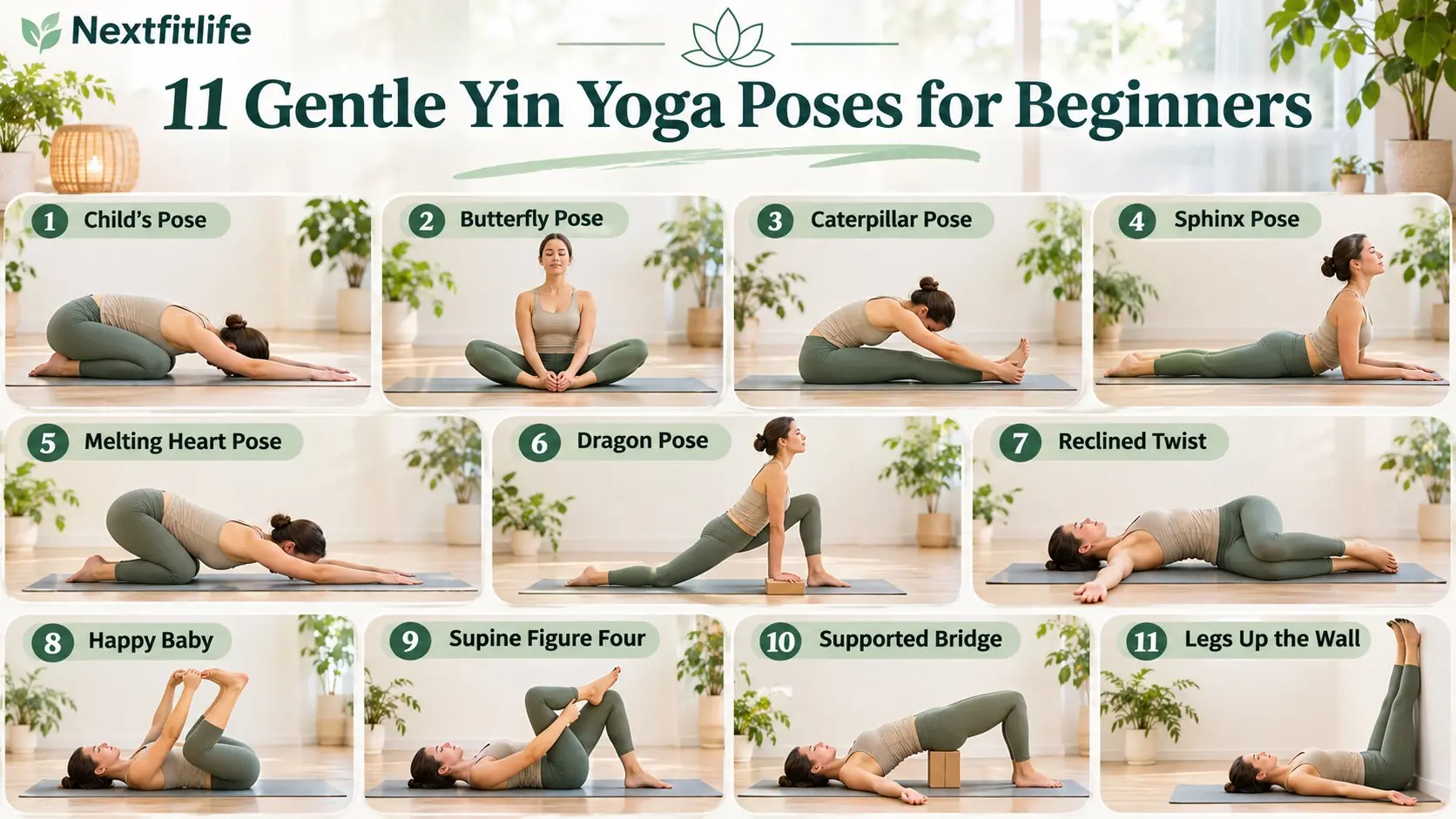
1. Butterfly Pose
Sit on the floor and bring the soles of your feet toward each other.
Let the knees move outward without pushing them down. Move your feet farther away if the hips or knees feel tight.
You can stay upright or lean forward gently.
A pillow beneath the chest can make the pose much easier.
Beginner hold: 1 to 2 minutes.
2. Caterpillar Pose
Sit with both legs in front of you.
Keep a soft bend in the knees and allow the upper body to fold forward only as far as feels easy.
You do not need to touch your toes.
Use a pillow on your thighs if you want support.
Beginner hold: 1 to 2 minutes.
3. Supported Child's Pose
Come onto your knees and move them to a comfortable width.
Rest your chest and head on a pillow or bolster rather than forcing your torso toward the floor.
Beginner hold: about 2 minutes.
If knee bending hurts, skip the pose.
For shoulder options, see Yoga for Stiff Shoulders.
4. Sphinx Pose
Lie on your stomach and place your forearms on the floor.
Keep the elbows under or slightly in front of the shoulders.
Let the chest lift gently while the pelvis stays on the mat.
Move the elbows farther forward if the lower back feels compressed.
Beginner hold: about 1 minute.
5. Dragon Pose
Step one foot forward into a low lunge and keep the back knee on the floor.
Place your hands on yoga blocks rather than dropping deeply toward the floor.
Stay higher than you think you need to at first.
Beginner hold: about 1 minute on each side.
For more hip focused options, see Yoga for Tight Hips.
6. Reclined Figure Four
Lie on your back and cross one ankle over the opposite thigh.
You can stay there or bring the lower leg gently toward you.
This gives you control over how much stretch reaches the outer hip.
Beginner hold: 1 to 2 minutes on each side.
7. Half Butterfly
Sit with one leg extended and bend the other knee so the foot comes toward the inner thigh.
Lean forward toward the long leg only as far as feels comfortable.
Keep the long knee bent if the hamstring feels too strong.
Beginner hold: 1 to 2 minutes per side.
8. Shoelace Pose
Sit with one knee stacked over the other if your hips allow it.
If the knees feel twisted or compressed, choose an easy cross leg position instead.
You can stay upright or lean forward slightly.
Beginner hold: about 1 minute.
Knee pain is a reason to choose Reclined Figure Four instead.
9. Supported Supine Twist
Lie on your back with both knees bent.
Let the knees move to one side and place a pillow underneath them.
Keep both shoulders comfortable rather than forcing them flat.
Beginner hold: 1 to 2 minutes on each side.
10. Legs on a Chair
Lie on your back and rest your calves on a stable chair or the edge of a bed.
This position asks very little from flexibility and works well between stronger poses.
Beginner hold: 2 to 3 minutes.
11. Savasana
Finish lying on your back or side.
Place a pillow under your knees if that makes the lower back more comfortable.
Let your breathing return to normal.
Beginner hold: 3 to 5 minutes.
A 20 Minute Yin Yoga Routine for Beginners
You do not need all 11 poses in one session.
| Time | Pose | Main Focus |
|---|---|---|
| 2 minutes | Butterfly | Hips and inner thighs |
| 2 minutes | Caterpillar | Back of legs and quiet forward fold |
| 1 minute | Sphinx | Gentle backbend |
| 2 minutes | Dragon | 1 minute per side |
| 4 minutes | Reclined Figure Four | 2 minutes per side |
| 4 minutes | Supported Twist | 2 minutes per side |
| 5 minutes | Savasana | Quiet finish |
Take a brief pause when changing sides or moving to the next pose.
If 20 minutes feels too long, cut every hold in half.
If you sit for much of the day, you can also combine this routine with Yoga for Desk Workers.
Yin Yoga vs Restorative Yoga
These two styles are often mixed together because both are slow and mostly floor based.
The aim is different.
| Feature | Yin Yoga | Restorative Yoga |
|---|---|---|
| Main aim | Slow passive stretching and stillness | Deep comfort and rest |
| Sensation | Mild to moderate stretch | Very little stretch |
| Props | Used to manage depth | Used heavily to support the body |
| Muscle effort | Low | Very low |
| Best choice when | You want stillness with a clear stretch | You want comfort with almost no stretch |
If your main goal is winding down before sleep, see Restorative Yoga Before Bed.
Yin Yoga vs Vinyasa Yoga
Vinyasa keeps you moving. Yin asks you to stay.
Vinyasa uses more muscular effort, balance, transitions, and repeated movement. Yin uses fewer poses and longer periods of stillness.
Neither style is better for everyone.
If you want cardio like movement and active strength, Yin will not give you much of that. If you want a slower session built around passive stretching, Yin is the closer match.
What Are the Real Yin Yoga Benefits?
The safest answer is more modest than many wellness pages suggest.
It Gives You Time to Stretch
The most obvious benefit is that Yin gives you time.
Instead of rushing through stretches, you stay long enough to notice whether the pose becomes easier, stays the same, or starts to irritate a joint.
That makes Yin a practical way to include slow mobility and stretching in your week.
It May Support Short Term Relaxation
The slow pace and quiet breathing can feel calming.
There is also limited direct research.
A randomized trial involving 105 stressed adults compared Yin yoga, Yin yoga combined with mindfulness and education, and a control group.
After five weeks, the Yin yoga group showed greater reductions in anxiety and sleep problems than the control group.
The participants practiced for 60 minutes twice per week.
That result is useful, but one small program does not prove Yin yoga treats anxiety disorders or chronic insomnia.
It May Reduce State Anxiety
A 2024 study followed 48 women during a 10 week online Yin yoga program.
State anxiety fell after the sessions and was lower in the Yin group at the end of the program.
Trait anxiety did not show the same clear between group improvement.
This suggests a possible short term calming effect, but the evidence is still limited.
It Can Improve Body Awareness
Long holds give you time to notice what your body is doing.
You may catch yourself clenching your jaw, gripping your toes, holding your breath, or pushing farther because you think deeper must be better.
That kind of body awareness can be useful in any movement practice.
Does Yin Yoga Improve Flexibility?
Repeated stretching can improve range of motion, so it is reasonable to use Yin as one way to practice flexibility.
What is less clear is whether Yin has a special flexibility effect that other stretching methods do not.
The direct Yin specific research base is still small.
A sensible claim is:
Yin yoga gives you a structured way to spend more time in slow, passive stretches.
I would not claim that Yin permanently “opens” a joint or creates a unique flexibility effect that no other form of stretching can provide.
Does Yin Yoga Release Fascia?
Fascia is real connective tissue, and physical loading affects body tissues.
But “releasing fascia” is not a precise event that researchers routinely measure during a Yin pose.
Yin teaching often talks about placing gentle stress on connective tissue.
That can be a helpful practice idea.
It should not become a claim that a three minute stretch has been proven to permanently remodel fascia.
What About Meridians and Energy Channels?
Some Yin classes use concepts from traditional Chinese medicine, including meridians and qi.
Those ideas belong to a traditional framework.
They are not established anatomical structures in conventional medical science.
You can enjoy the philosophy without presenting it as proven anatomy.
How Often Should Beginners Practice Yin Yoga?
You do not need an hour every day.
A sensible beginner schedule is one or two short sessions each week.
Try:
- 15 to 25 minutes
- Once or twice per week
- Short holds first
- More time only when your body responds well
The five week randomized Yin study used two 60 minute sessions per week, but that does not prove two hours weekly is an ideal dose for everyone.
Your recovery from strength training, running, other yoga, and daily activity matters too.
Should You Do Yin Yoga Before or After Exercise?
I prefer longer Yin work after training or on a separate easy day.
If you are about to lift weights, sprint, jump, or do hard sport, use an active warm up first.
A long passive stretch is not the warm up I would choose for explosive work.
Save the deeper stillness for later.
For more detail, see Stretching Before or After Workout.
Can You Do Yin Yoga Before Bed?
Yes, if the practice settles you.
Keep the poses mild rather than treating bedtime as a flexibility challenge.
Good options include:
- Butterfly
- Reclined Figure Four
- Supported Twist
- Legs on a Chair
- Savasana
If you want almost no stretch, restorative yoga is usually the better bedtime choice.
See Restorative Yoga Before Bed for a gentler wind down sequence.
Who Should Be Careful With Yin Yoga?
NCCIH says yoga is generally safe for healthy people when practiced properly, but injuries do occur.
Talk with a healthcare professional or qualified instructor about modifications if you have:
- A recent injury
- Recent surgery
- Significant joint instability
- Severe osteoporosis
- A joint replacement
- Ongoing nerve symptoms
- Major back or neck problems
- Pregnancy with movement restrictions
- A health condition that limits certain positions
Older adults may also need more support and shorter ranges.
Is Yin Yoga Good for Hypermobile People?
More flexibility is not always what a very flexible person needs.
If your joints already move through a large range, going deeper just because you can may add stress without giving you better control.
A person with significant hypermobility may benefit more from strength, stability, and smaller ranges than from chasing deeper passive stretches.
Use shorter holds, more support, and stay well away from the end of your joint range.
If joint instability causes pain or repeated injury, get individual guidance.
Common Yin Yoga Mistakes
Going to Your Deepest Stretch Immediately
Start with room to move.
A position that feels mild in the first ten seconds can become much stronger after two minutes.
Staying Because the Timer Says So
Your body matters more than the clock.
Leave the pose early when needed.
Confusing Pain With Progress
Sharp pain is not a sign that the pose is working better.
Refusing Props
Yoga props are tools, not shortcuts.
A pillow or block can reduce strain and make a pose more useful.
Copying Someone Else's Shape
People have different hip sockets, limb lengths, injury histories, and natural ranges.
Your pose does not need to look identical to another person's.
Coming Out Too Fast
Move slowly when leaving a long hold.
A joint may feel temporarily stiff after staying in one position for several minutes.
What Props Do You Need?
You can start with things you already own.
Useful props include:
- One or two pillows
- A folded blanket
- Yoga blocks
- A bolster
- A yoga strap
You do not need all of them.
The job of a prop is simple: reduce strain or stop your body from dropping farther than feels useful.
A Simple First Week Plan
| Day | Plan | Goal |
|---|---|---|
| Day 1 | 15 minute Yin session | Learn comfortable ranges |
| Day 2 | Normal activity | Notice how your joints feel |
| Day 3 | Rest or walking | Recover |
| Day 4 | 20 minute Yin session | Repeat the easiest poses |
| Day 5 | Normal activity | Avoid making stretching a chore |
| Day 6 | Optional gentle mobility | Move without deep holds |
| Day 7 | Rest or repeat two favorite poses | Build a routine you enjoy |
After the first week, ask one useful question: do your body and joints feel better after the practice?
If the answer is yes, build slowly. If a joint feels irritated for hours afterward, reduce the range or hold time.
Conclusion
Yin yoga works best when patience matters more than depth.
Use short holds at first, support yourself with props, and stay away from sharp pain or unstable joint positions. The practice can give you a calm way to work on stretching and body awareness without pretending that every pose has a special medical effect.
Your next step: try Butterfly, Reclined Figure Four, Supported Twist, and Savasana for about 15 minutes. If you feel good later that day and the next morning, build from there.
References and Sources
- National Center for Complementary and Integrative Health. Yoga: Effectiveness and Safety.
https://www.nccih.nih.gov/health/yoga-effectiveness-and-safety - Cleveland Clinic. Yoga for Beginners: Postures and Styles to Get Started.
https://health.clevelandclinic.org/yoga-for-beginners - Cleveland Clinic. How to Find the Best Yoga Class for You.
https://health.clevelandclinic.org/how-to-find-the-best-yoga-class-for-you - Somere K, Munkevics M, Krams R, et al. The Effect of Yin Yoga Intervention on State and Trait Anxiety During the COVID 19 Pandemic. Frontiers in Psychiatry. 2024.
https://pubmed.ncbi.nlm.nih.gov/38550540/ - Hylander F, Johansson M, Daukantaitė D, Ruggeri K. Five Week Yin Yoga Based Interventions Decreased Plasma Adrenomedullin and Increased Psychological Health in Stressed Adults. PLOS ONE. 2018.
https://pmc.ncbi.nlm.nih.gov/articles/PMC6051627/
Internal Links and NextFitLife Hubs
- Yoga and Flexibility Hub
- Yoga for Beginners
- Yoga Poses for Beginners
- Yoga Exercises at Home
- Yoga for Tight Hips
- Yoga for Stiff Shoulders
- Yoga for Desk Workers
- Restorative Yoga Before Bed
- How Long to Hold a Stretch
- Stretching Before or After Workout
- About NextFitLife
Frequently Asked Questions
What is Yin yoga?
Yin yoga is a slow yoga style that uses mostly seated and lying poses held for longer periods. The muscles stay fairly relaxed while you settle into a mild to moderate stretch.
Is Yin yoga good for beginners?
Yes. Beginners can practice Yin yoga safely when they use shorter holds, props, comfortable ranges, and stop when they feel sharp pain, pinching, numbness, or joint pain.
How long should a beginner hold a Yin yoga pose?
A beginner can start around 60 to 90 seconds and move toward two or three minutes when a pose stays comfortable. Longer is not automatically better.
What are good Yin yoga poses for beginners?
Good beginner choices include Butterfly, Caterpillar, Supported Child's Pose, Sphinx, Reclined Figure Four, Half Butterfly, Supported Twist, Legs on a Chair, and Savasana.
What are the benefits of Yin yoga?
Yin yoga gives you a structured way to practice slow stretching, stillness, and body awareness. Small studies also suggest possible benefits for short term anxiety and sleep problems, but the evidence is still limited.
Does Yin yoga improve flexibility?
It can be a useful way to spend more time stretching, which may support range of motion. Research has not shown that Yin has a unique flexibility effect that other stretching methods cannot provide.
Is Yin yoga the same as restorative yoga?
No. Yin usually includes a noticeable passive stretch, while restorative yoga uses more support and aims for very little physical strain.
Can I do Yin yoga every day?
You do not need to. Beginners can start with one or two short sessions each week and increase only when their joints and tissues respond well.
Can I do Yin yoga before bed?
Yes, if it helps you settle. Keep the stretches mild and choose comfortable poses such as Butterfly, Reclined Figure Four, Supported Twist, and Savasana.
Does Yin yoga release fascia?
Yin teaching often describes gentle loading of connective tissue, but claims that a pose permanently releases or remodels fascia are stronger than current clinical evidence supports.

