

Published on:
Suitcase carry form looks simple: hold one weight beside you and walk. The hard part is keeping your body from leaning, twisting, shrugging, or rushing as the weight pulls on one side.
A good suitcase carry uses a load you can control. Stand tall, keep your shoulders and hips level, hold the weight close to your side, walk with normal steps, breathe steadily, then put the weight down with the same care you used to pick it up.
Quick answer: Hold one dumbbell or kettlebell at your side, brace your trunk, keep your ribs stacked over your pelvis, and walk without leaning toward or away from the weight. Start lighter than your grip allows. End the carry when posture changes, the weight swings, or you cannot keep your steps smooth.
This article is for general information and education. It does not replace medical advice, diagnosis, treatment, or an individualized rehabilitation or exercise plan.
Stop and get appropriate medical advice if loaded carrying causes sharp or severe back pain, new numbness or tingling, increasing leg weakness, pain after a major injury, fever with back pain, trouble urinating, or loss of bladder or bowel control. Do not use a suitcase carry to test how much pain you can tolerate.
If you are building a wider strength program, start with the NextFitLife Strength Training and Muscle Building Guide. The suitcase carry works best as one part of a complete program rather than as a replacement for squats, hinges, pushes, pulls, and other basic patterns.
Table of Contents
- What a suitcase carry is
- Muscles worked
- Why one sided loading feels different
- How to do a suitcase carry
- 9 smart form tips
- Common mistakes
- How heavy to go
- Time, distance, and sets
- Beginner progressions
- Suitcase carry versus farmer carry
- Core and grip benefits
- Back safety
- Suitcase carry for beginners
- Where it fits in a workout
- Common claims and evidence
- Conclusion
- References and Sources
- Internal Links and NextFitLife Hubs
- About the Author
- Frequently Asked Questions
What Is a Suitcase Carry?
A suitcase carry is a loaded walking exercise performed with a weight in one hand.
The name comes from the obvious comparison: you carry the dumbbell or kettlebell the way you might carry a suitcase beside your leg.
The exercise is also called a one arm carry or unilateral loaded carry.
What makes it different from a farmer carry is the uneven load.
In a farmer carry, you hold a weight in each hand. In a suitcase carry, one side is loaded while the other side is free.
That uneven load tries to pull the body sideways. Your job is to keep walking without allowing a large side bend.
This is sometimes described as anti lateral flexion. Lateral flexion simply means bending the trunk sideways. Anti lateral flexion means your trunk muscles are working to resist that side bend.
What Muscles Does the Suitcase Carry Work?
The suitcase carry is not a true isolation exercise.
Your hand, forearm, shoulder, trunk, hips, and legs all contribute while you walk.
Grip and Forearms
Your fingers and forearm muscles must hold the handle for the entire carry.
This makes grip fatigue one of the easiest things to notice.
If grip strength is a major goal, see Grip Strength Exercises for additional options.
Obliques and Other Trunk Muscles
Your abdominal and back muscles help keep the torso controlled while the weight pulls on one side.
Research comparing loaded carries and static holds has found significant trunk muscle activity during suitcase carries.
That does not mean one muscle does all the work. The pattern changes with load, walking mechanics, body shape, and technique.
Back Muscles
Muscles along the spine help maintain trunk position as you walk.
This is one reason a suitcase carry can feel very different from holding a light dumbbell while standing still.
Hip Muscles
Your hip muscles help control the pelvis while each leg accepts your body weight.
A study of walking with a unilateral weight found increased hip abductor activity on the side opposite the carried load.
The hip abductors are muscles that help control the pelvis and move the leg away from the body's midline.
Legs
Your legs still have to walk.
Quads, hamstrings, calves, and other lower-body muscles do their normal walking work while dealing with the added load.
Why Does Carrying One Weight Feel So Different?
Symmetry changes the job.
If you hold equal weights in both hands, the downward forces are more balanced from side to side.
Put the whole external load in one hand and your body must control a much larger uneven moment.
That is the reason the suitcase carry can challenge your trunk even though you are not doing a visible side bend.
It also explains why you should not assume that a weight you can farmer carry comfortably in each hand is automatically appropriate for a suitcase carry.
Research on carrying mechanics has found that one-hand carrying can create more lumbar loading than splitting the same total weight between two hands.
That is not a reason to fear the exercise. It is a reason to respect the load.
How to Do a Suitcase Carry Correctly
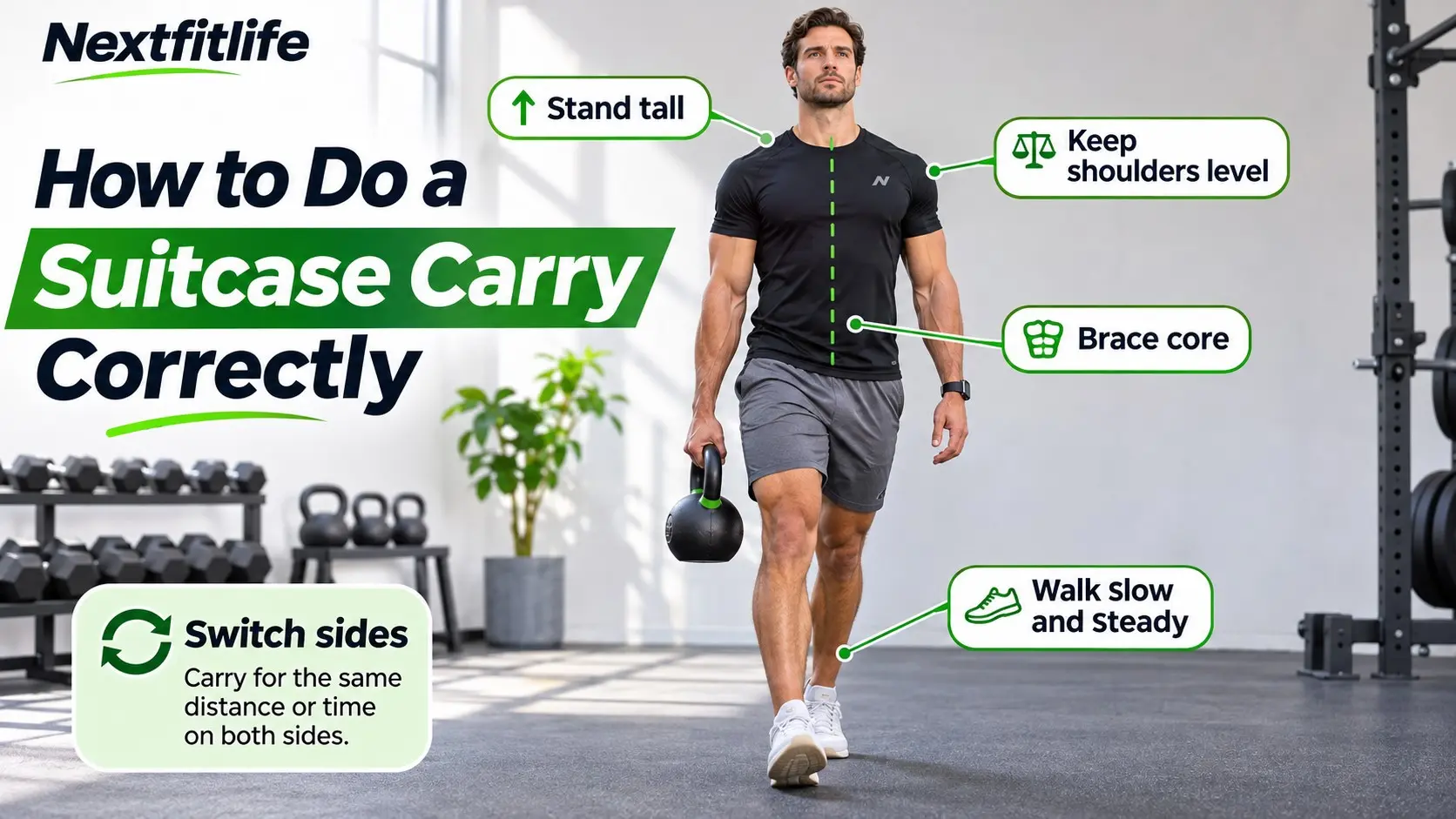
Step 1: Place the Weight Beside You
Use one dumbbell or kettlebell.
Set it beside one foot where you can reach it without twisting.
Leave enough open space in front of you for a straight walking path.
Step 2: Pick It Up With Control
Hinge at the hips and bend the knees enough to reach the handle.
Keep the weight close to your body as you stand.
Do not grab a heavy dumbbell from the floor while twisting sideways.
Step 3: Stand Tall Before You Walk
Pause after standing.
Keep your shoulders level. Let the weighted arm hang naturally.
Your ribs should sit over your pelvis rather than flaring upward.
Look forward.
Step 4: Brace Without Freezing
Create enough trunk tension to stay upright.
Think of gently preparing for someone to push you from the side.
You do not need to suck your stomach in hard or hold your breath for the entire walk.
Step 5: Walk Normally
Take controlled, natural steps.
Keep the weight close to your leg without repeatedly banging it into your thigh.
Your shoulders and hips should continue facing forward.
Step 6: Stop Before Your Posture Breaks
Do not wait until you are stumbling.
If you begin leaning, shortening one step, shrugging the loaded shoulder, or losing your grip, the carry has already become too difficult.
Step 7: Put the Weight Down Carefully
Stop walking first.
Set your feet, hinge at the hips, bend your knees as needed, and place the weight down under control.
Then switch hands.
9 Smart Form Tips for a Better Suitcase Carry
1. Stay Tall Instead of Leaning Away
The most common mistake is trying to escape the weight by leaning in the opposite direction.
That can make the exercise look easier because your body creates a counterbalance.
The goal is different.
Stand as normally as you can while resisting a large sideways shift.
If you cannot stay upright, reduce the weight.
2. Do Not Collapse Toward the Weight
Leaning toward the loaded side is the opposite error.
Keep both shoulders at a similar height and avoid letting one side of the pelvis drop.
Perfectly rigid symmetry is not required during normal human walking, but a visible persistent lean is a sign the load may be too heavy.
3. Keep the Loaded Shoulder Quiet
You do not need to shrug the dumbbell toward your ear.
Let the arm hang long while the shoulder stays controlled.
A small natural movement while walking is fine.
What you want to avoid is holding a constant exaggerated shrug just to keep the weight from feeling heavy.
4. Keep the Wrist Neutral
Grip the handle firmly while keeping the wrist close to straight.
Do not let a heavy dumbbell drag the wrist into a large backward bend.
If your wrist position changes long before your trunk becomes challenged, grip or load may be the limiting factor.
5. Keep the Weight Near Your Side
The farther a load sits from your body, the harder it can be to control.
Let the weight hang beside your hip rather than deliberately holding it several inches away.
Biomechanical carrying research supports the general principle that load position influences spinal demand.
6. Walk With Normal Steps
Do not turn the carry into a tightrope walk unless you are performing a different drill on purpose.
Use a normal comfortable step width.
Your feet should move the way they do during controlled walking.
7. Do Not Race
Speed hides mistakes.
Walk slowly enough that you can notice the position of your trunk, shoulder, and weight.
NSCA coaching guidance for loaded carries also emphasizes an upright torso and slow, controlled walking.
8. Breathe While You Carry
Brace your trunk, but keep breathing.
For ordinary fitness carries, you usually do not need to hold one breath for the whole distance.
If the load is so heavy that you cannot breathe normally or keep posture under control, it is probably too aggressive for a beginner carry.
9. Match Both Sides
Walk the same distance or time with each hand unless you have a specific professionally designed reason not to.
If one side feels much harder, note it.
Do not automatically double the work on the weaker side.
A large difference can reflect grip, coordination, pain, previous injury, or simple unfamiliarity.
Common Suitcase Carry Mistakes
| Mistake | What You See | Fix |
|---|---|---|
| Leaning away | Torso tilts away from the dumbbell | Use less weight and stay tall |
| Collapsing toward the weight | Loaded shoulder and hip drop | Reduce load or distance |
| Shrugging | Shoulder stays pulled toward the ear | Keep the arm long and shoulder controlled |
| Weight swinging | Dumbbell moves forward and backward | Slow down and shorten the carry |
| Walking too fast | Steps become rushed and unstable | Use a controlled normal walking pace |
| Twisting to pick up the weight | Torso rotates while lifting from the floor | Face the weight and hinge under control |
| Going too heavy | Posture fails within a few steps | Choose a load you can carry cleanly |
How Heavy Should a Suitcase Carry Be?
There is no single body-weight percentage that fits every healthy adult.
Your grip, training history, body size, available dumbbells, walking space, back history, and purpose of the exercise all change the answer.
A safer starting rule is based on form.
Choose a weight that feels meaningful but lets you:
- Stand upright before taking the first step
- Keep your shoulders close to level
- Walk without a large sideways lean
- Keep a firm grip
- Use normal steps
- Breathe steadily
- Put the weight down without twisting
If all seven disappear as soon as you start walking, the dumbbell is too heavy for that version.
If you can walk forever without noticing the load, it is probably too light to provide much strength challenge.
Should You Use RPE for Suitcase Carries?
Yes, if you already understand effort ratings.
An RPE, or rating of perceived exertion, is a way to describe how hard a set feels.
For beginners, I would keep suitcase carries moderately challenging at first.
You should finish knowing you did work, but still feel that your posture was under control.
Once your technique is consistent, harder carries can be used depending on your goal.
For a full explanation, see RPE Scale for Strength Training.
How Long or How Far Should You Carry?
Suitcase carries can be programmed by distance or time.
Neither method is inherently better.
For a beginner, simple starting options include:
- 10 to 20 seconds per side
- About 10 to 20 meters per side
- 1 or 2 controlled rounds
Those are practical starting points, not clinical rules.
If the carry is easy, increase one variable.
You could walk a little farther, carry a little longer, or use a slightly heavier load.
Do not increase all three at the same time.
How Many Sets Should You Do?
For general fitness, two or three rounds per side can be enough once you are familiar with the movement.
There is no reason every suitcase carry workout needs five exhausting sets.
Current ACSM guidance on resistance training emphasizes consistency and tailoring load and volume to the person's goal rather than using one rigid formula for everyone.
If the exercise is only a small accessory at the end of your workout, a couple of good carries may be more useful than turning it into a separate endurance event.
A Beginner Suitcase Carry Progression
Level 1: Suitcase Hold
Stand still with one manageable weight at your side.
Practice keeping your shoulders level and breathing normally for 10 to 20 seconds.
This removes the walking challenge.
Level 2: Short Suitcase Carry
Walk a short straight path for about 10 seconds per side.
Use a load that lets you turn or stop without rushing.
Level 3: Longer Carry
Extend the distance while keeping the same posture.
Grip may become the main limiting factor.
Level 4: Heavier Carry
Add a small amount of load and return to a shorter distance.
This is usually cleaner than increasing weight and distance together.
Level 5: Suitcase March
Hold the weight and march slowly in place or take deliberate marching steps.
This creates a longer single-leg support challenge.
Keep it controlled rather than lifting the knee as high as possible.
Level 6: Advanced Carry Variations
More advanced options include rack carries, bottoms-up carries, and overhead carries.
These add different shoulder, wrist, and trunk demands.
They are separate exercises rather than simply “better” suitcase carries.
Suitcase Carry Progression Table
| Level | Variation | Main Goal | Move On When |
|---|---|---|---|
| 1 | Static suitcase hold | Learn upright posture | You can breathe and stay level |
| 2 | Short carry | Add controlled walking | Steps remain even |
| 3 | Longer carry | Build work capacity | Posture stays stable to the finish |
| 4 | Heavier carry | Increase strength demand | No leaning or grip breakdown |
| 5 | Suitcase march | Increase single-leg control demand | Pelvis and trunk remain controlled |
Suitcase Carry vs Farmer Carry
Neither exercise is universally better.
They create different loading problems.
| Feature | Suitcase Carry | Farmer Carry |
|---|---|---|
| Load | One hand | Both hands |
| Main challenge | Resisting uneven side pull | Carrying balanced heavy loads |
| Grip | One hand at a time | Both hands at once |
| Trunk demand | More asymmetric | More symmetrical |
| Beginner option | Good after basic carrying control | Often easier to learn first |
NSCA coaching guidance suggests that a balanced farmer walk can be a useful starting point for someone who is deconditioned or returning from injury before progressing to a unilateral suitcase carry.
That makes sense because the suitcase version adds an asymmetry challenge.
Is the Suitcase Carry a Core Exercise?
Yes, if by core you mean the muscles that help control the trunk rather than only the six-pack muscle.
The suitcase carry asks the torso to resist a side bend while the body continues moving.
A 2024 muscle-activation study found meaningful activation of several trunk muscles during suitcase carries, including the external oblique, rectus abdominis, longissimus, and multifidus.
The carry also involves your grip, hips, and legs, so calling it only a core exercise understates what is happening.
If you want a wider program, see Core Exercise Routine.
Does the Suitcase Carry Train the Obliques?
Yes, the obliques are involved.
They help control the trunk as the one-sided load tries to alter your position.
But the exercise is not the same as a side bend.
You are trying to avoid a large visible bend rather than repeatedly creating one.
That is why coaches often classify the suitcase carry as an anti-lateral-flexion exercise.
Does the Suitcase Carry Improve Grip Strength?
It gives the hand and forearm a real gripping task.
Whether it improves grip depends on whether the load and duration are challenging enough and whether you progress them over time.
A very light dumbbell carried for ten seconds may do little for an experienced lifter.
The same load may be plenty for a beginner.
If grip always fails before your trunk is challenged, you can decide whether grip training is part of the goal.
For general fitness, letting the grip work is often useful.
Is the Suitcase Carry Good for Posture?
I would use more careful language.
The exercise trains you to control your torso while carrying an uneven load.
That is useful positional practice.
It does not prove that suitcase carries permanently “fix posture.”
Posture changes with task, fatigue, comfort, anatomy, habits, pain, and many other factors.
Use the carry to build strength and control rather than chasing one perfect standing shape all day.
Is the Suitcase Carry Safe for Your Back?
Healthy adults can include loaded carries in resistance training, but the load matters.
One-handed carrying creates different spinal demands from carrying equal weight in both hands.
Biomechanical research found greater modeled low-back compression when a load was carried in one hand than when the same total load was split between both hands.
That is precisely why “heavier is always better” is poor advice here.
Use a weight your body can control.
If you already have significant back pain or a diagnosed spinal condition, the right exercise and load depend on your situation.
What if Your Back Hurts During the Carry?
Stop the set.
You do not need to prove that you can walk through increasing pain.
If the discomfort was mild and clearly linked to a load that was too heavy, reducing the load may solve the problem.
If pain is sharp, severe, keeps returning, travels into a leg, or comes with numbness or weakness, get appropriate professional advice.
NIAMS also advises medical assessment for back pain associated with severe persistent pain, numbness, weakness, fever, injury, urinary problems, or unexplained weight loss.
Can Suitcase Carries Fix Back Pain?
They should not be sold as a universal back-pain treatment.
Strengthening and staying active can be part of care for many people with back pain, but the right exercise depends on the person and the cause of symptoms.
A suitcase carry may be used by a clinician or trainer in some programs.
That does not make it the correct choice for every painful back.
If carrying makes your symptoms worse, that information matters more than a social-media claim that the exercise is “functional.”
Can Beginners Do Suitcase Carries?
Yes, if they start with an appropriate load.
The movement itself is simple enough to learn, but the uneven load means beginners should not rush toward heavy dumbbells.
A good beginner sequence is:
- Learn a controlled hip hinge.
- Practice a light suitcase hold.
- Walk 10 to 20 seconds per side.
- Increase distance only when posture remains stable.
- Add weight gradually.
If you are new to resistance exercise, see Strength Training Exercises at Home for Beginners.
Can You Do Suitcase Carries at Home?
Yes.
You need one weight and enough safe walking space.
A dumbbell or kettlebell works well.
A properly secured heavy household object can work in a pinch, but awkward handles can become the limiting factor.
Make sure the floor is clear and not slippery.
A hallway can work if it gives you enough room to walk and turn without bumping furniture.
How Should You Turn Around?
Do not spin quickly around the loaded side.
Slow down before the end of the walking lane.
Take several small steps to turn while keeping the weight close.
If turning under load feels awkward, stop, set the weight down, turn around, pick it back up, and continue.
There is no rule saying the weight must stay in your hand through every turn.
Should the Free Arm Swing?
A small natural arm movement is fine.
You do not need to pin the free arm against your side.
At the same time, avoid throwing the arm far away from the body to create a large counterweight.
The aim is controlled walking, not creating a dramatic balancing pose.
Where Should Suitcase Carries Go in a Workout?
For most people, they work well after the main strength exercises.
A simple order might be:
- Main squat or hinge
- Upper-body push
- Upper-body pull
- Single-leg or accessory work
- Suitcase carries
You can also use a light carry earlier if it serves as movement practice.
Heavy carries done before deadlifts or rows may tire the grip, so exercise order should match your priority.
For more programming ideas, see Functional Strength Training Workout.
A Simple Four-Week Beginner Plan
Week 1
Use a light to moderate weight.
Perform 2 carries of about 10 seconds per side.
Focus only on staying upright and setting the weight down well.
Week 2
Keep the same weight and extend the carry toward 15 to 20 seconds per side.
If your grip or posture fails before that, keep the shorter distance.
Week 3
Add a small amount of weight and return to a shorter carry.
Do not increase weight and time together.
Week 4
Choose one progression.
You can add another round, increase the carry slightly, or add a small amount of load.
The goal is steady progression without changing the exercise into a tilted walk.
Progression rule: add difficulty only when your shoulders remain level, the weight stays controlled, your steps remain normal, and you can still put the weight down safely.
Common Suitcase Carry Claims: What Is Actually Supported?
| Claim | What We Can Say |
|---|---|
| It trains grip | Yes. The hand and forearm must hold the load for the full carry. |
| It challenges trunk muscles | Yes. Muscle-activation research supports meaningful trunk activity during loaded carries. |
| It trains anti-side-bending control | Yes. The one-sided load creates an asymmetric demand that the trunk must manage. |
| It fixes posture | Too strong. It trains control under load but does not prove a permanent posture correction. |
| It cures low-back pain | Not established. Back pain needs individual assessment when symptoms are significant or persistent. |
| Heavier is always better | No. One-sided carrying can substantially increase lumbar demand, and form should guide load selection. |
| It can fit functional strength training | Yes. It combines walking, grip, and trunk control under an external load. |
Conclusion
The suitcase carry is useful because one simple exercise asks your grip, trunk, hips, and legs to manage an uneven load while you keep walking normally.
Do not turn it into a test of how much weight you can drag down the gym floor. Stand tall, keep the load close, control your steps, breathe, and finish the set before your posture starts changing.
Your next step: choose a light dumbbell and try two carries of 10 to 20 seconds on each side. If you stay upright from the first step to the last and can set the weight down cleanly, progress one variable next time.
References and Sources
- American Council on Exercise. Suitcase Carry Exercise Library.
https://www.acefitness.org/resources/everyone/exercise-library/358/suitcase-carry/ - National Strength and Conditioning Association. Increase Hip and Trunk Stability with Loaded Carries for Injury Prevention, Rehabilitation, and Performance.
https://www.nsca.com/education/articles/nsca-coach/increase-hip-and-trunk-stability-with-loaded-carries/ - American College of Sports Medicine. Updated Resistance Training Guidelines. 2026.
https://acsm.org/resistance-training-guidelines-update-2026/ - The Quantification of Muscle Activation During the Loaded Carry Movement Pattern. 2024.
https://pubmed.ncbi.nlm.nih.gov/38665162/ - Hip and Trunk Muscle Activity and Mechanics During Walking With and Without Unilateral Weight.
https://pubmed.ncbi.nlm.nih.gov/34051700/ - Low Back Loads While Walking and Carrying: Comparing the Load Carried in One Hand or in Both Hands.
https://pubmed.ncbi.nlm.nih.gov/23384188/ - National Institute of Arthritis and Musculoskeletal and Skin Diseases. Living With Back Pain.
https://www.niams.nih.gov/community-outreach-initiative/understanding-muscle-health/living-with-back-pain
Internal Links and NextFitLife Hubs
- Strength Training and Muscle Building Guide
- Functional Strength Training Workout
- Core Exercise Routine
- Beginner Core Workout
- Grip Strength Exercises
- Strength Training for Desk Workers
- Strength Training Exercises at Home for Beginners
- RPE Scale for Strength Training
- About NextFitLife
Frequently Asked Questions
What is a suitcase carry?
A suitcase carry is a loaded walking exercise where you hold one dumbbell or kettlebell beside your body and walk while keeping your trunk upright. The one-sided load challenges grip and trunk control.
How do you do a suitcase carry correctly?
Pick up one weight with control, stand tall with level shoulders, brace your trunk, keep the weight beside your hip, and walk with smooth steps without leaning toward or away from the load. Put the weight down under control and repeat on the other side.
What muscles does the suitcase carry work?
The suitcase carry trains the grip and forearms while challenging the obliques, back muscles, other trunk muscles, hips, and legs as you control the uneven load during walking.
How heavy should a suitcase carry be?
There is no single ideal weight. Choose a load that feels challenging but still lets you keep level shoulders, normal steps, steady breathing, and an upright trunk for the entire carry.
How long should beginners do suitcase carries?
A practical starting point is about 10 to 20 seconds per side for one or two rounds. Increase time, distance, or load gradually while keeping the same form.
Is a suitcase carry a core exercise?
Yes. The uneven load makes the trunk resist sideways bending while you walk. Research also shows meaningful abdominal and back muscle activity during suitcase carries.
What is the difference between a suitcase carry and a farmer carry?
A suitcase carry uses one weight in one hand, creating an uneven trunk challenge. A farmer carry uses weights in both hands and creates a more balanced loading pattern.
Are suitcase carries safe for the lower back?
Healthy adults can use suitcase carries as resistance exercise when the load is appropriate. One-sided carrying creates greater asymmetric spinal demand than balanced carrying, so load and technique matter. Stop if the exercise causes significant or worsening pain.
Do suitcase carries fix posture?
They train trunk control while walking with an uneven load, but there is no strong evidence that suitcase carries alone permanently fix posture.
Should I lean away from the weight during a suitcase carry?
No. A large lean away from the weight is usually a sign that the load is too heavy or that you are using your body as a counterweight. Stay as upright and controlled as possible.