
Published on: January 11, 2024
Updated on: October 24, 2026
Arm Workouts work best when they train more than the biceps. Strong arms come from building the biceps, triceps, brachialis, forearms, and grip while also using a few pulling and pressing movements that let those muscles work together.
You do not need five arm days each week. You also do not need 15 curl variations in one session. A simple Arm Workouts plan can use two biceps exercises, two triceps exercises, one forearm or grip movement, and steady progression over time.
This updated guide gives you 21 exercises, beginner and intermediate routines, realistic sets and reps, and a clearer explanation of what actually drives arm strength and muscle growth.
This article is for general information and education. It does not replace medical advice, diagnosis, or treatment.
I am not a dermatologist or a doctor, and this content does not replace professional medical advice. What I share comes from real life experience, extensive research, and consultation with healthcare providers. Always consult qualified medical professionals for diagnosis and treatment of any health condition.
For broader training guidance, visit the NextFitLife Fitness Hub, Strength Training and Muscle Building Guide, and Arm Workouts with Weights.
Table of Contents
- Arm Workouts: Quick Answer
- What Muscles Do Arm Workouts Train?
- 21 Proven Arm Exercises
- Biceps
- Triceps
- Forearms and grip
- Compound arm work
- Best Arm Workouts by Goal
- Beginner Arm Workout
- Two-Day Arm Plan
- 20 Minute Arm Workout
- Sets, Reps, and Weight
- How Much Weekly Volume?
- Do You Need Failure?
- Can Arm Workouts Reduce Arm Fat?
- Common Mistakes
- Frequently Asked Questions
- References and Sources
Arm Workouts: Quick Answer
The best Arm Workouts train both sides of the upper arm and include at least some forearm or grip work.
A simple session can include:
- Dumbbell curl
- Hammer curl
- Overhead triceps extension
- Close grip press
- Farmer carry
For most people, this is more useful than doing many similar curls and extensions in the same workout.
What Muscles Do Arm Workouts Train?
Biceps Brachii
The biceps brachii has two heads and helps bend the elbow and turn the palm upward.
Brachialis
The brachialis sits beneath the biceps and is a strong elbow flexor.
Brachioradialis
The brachioradialis runs into the forearm and works strongly during neutral grip and pronated curling.
Triceps Brachii
The triceps brachii sits on the back of the upper arm and has three heads. Its main job is extending the elbow.
Forearm and Grip Muscles
The forearms help control the wrist and hand while your grip lets you hold dumbbells, barbells, cables, bags, and other loads.
A balanced arm program trains all of these areas instead of treating the biceps as the entire arm.
What Does Current Research Say About Arm Workouts?
The 2026 American College of Sports Medicine position stand reviewed 137 systematic reviews involving more than 30,000 adults.
Resistance training improved muscle strength and muscle hypertrophy across many different training styles.
For strength, heavier loading generally performs better. For muscle growth, adequate weekly training volume matters greatly.
Advanced techniques are optional. You do not need forced reps, complicated drop sets, or endless supersets to build strong arms.
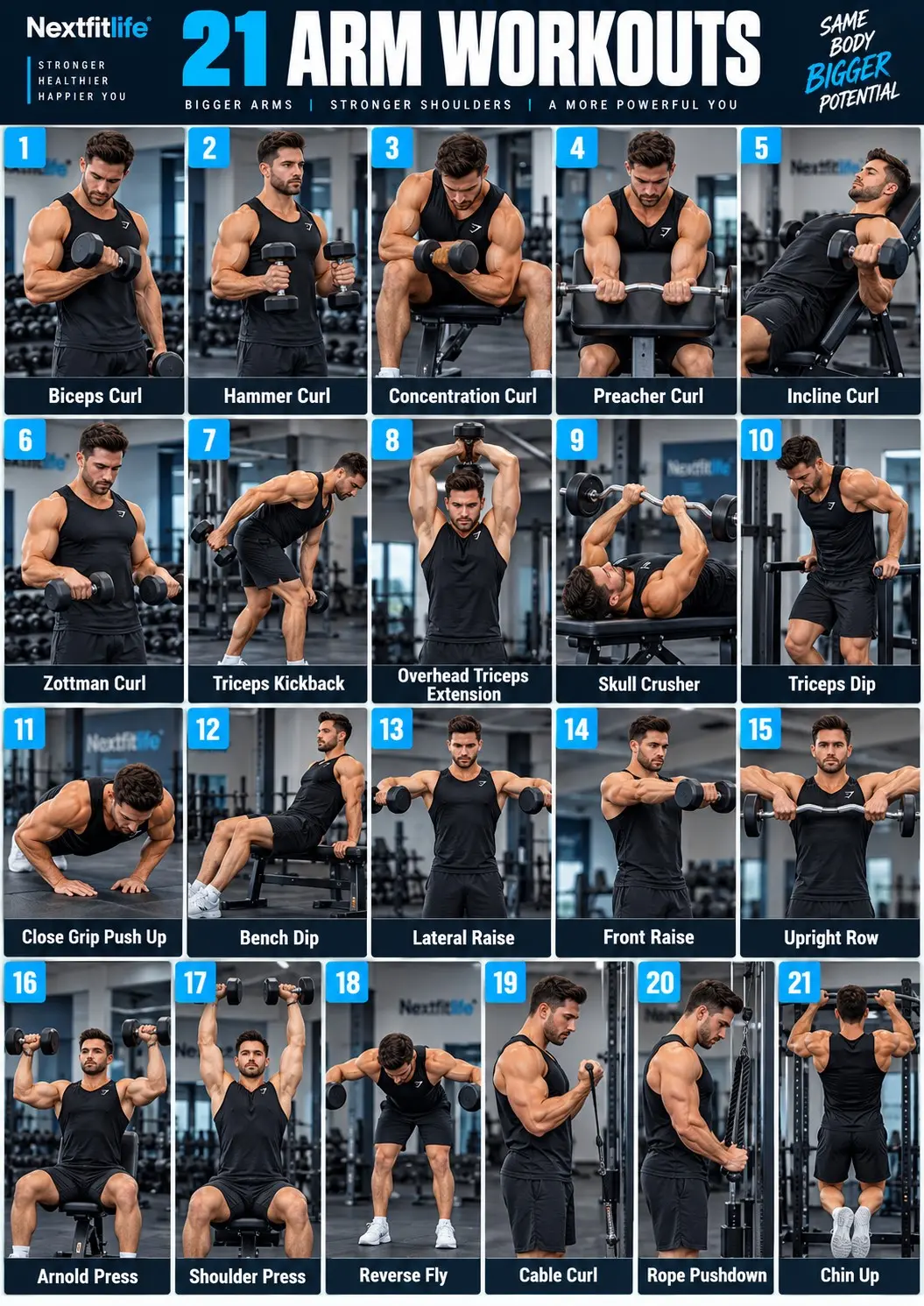
21 Exercise Arm Workout guide
1. Standing Dumbbell Curl
The standing curl is one of the simplest arm workout exercises for the biceps.
- Hold one dumbbell in each hand.
- Turn your palms forward.
- Keep your elbows near your sides.
- Curl the dumbbells upward.
- Lower with control.
Do not throw your hips forward to finish a heavy repetition.
2. Incline Dumbbell Curl
Sit against an incline bench and let the arms hang slightly behind the torso.
Curl without letting the upper arm swing forward.
A 2026 study found slightly greater biceps brachii hypertrophy with incline curls compared with preacher curls, although total elbow flexor growth was similar.
3. Preacher Curl
Rest your upper arm on a preacher pad and curl through a controlled range.
The same 2026 study found somewhat greater brachialis and brachioradialis growth with preacher curls than incline curls.
This does not make one exercise universally better. They provide slightly different training effects.
4. Hammer Curl
Hold the dumbbells with your palms facing each other.
The hammer curl trains elbow flexion while placing more demand on the brachialis and brachioradialis than a fully supinated curl.
This is a useful bridge between biceps and forearm training.
5. Reverse Curl
Use a palms-down grip and curl the weight upward.
You will usually need less weight than during a standard curl.
Keep your wrists controlled rather than letting them bend backward.
6. Concentration Curl
Sit down and train one arm at a time.
Rest the back of your upper arm near your inner thigh and curl with controlled motion.
This creates a stable setup that makes cheating difficult.
7. Cable Biceps Curl
A cable provides resistance throughout the movement and makes it easy to adjust the load in small steps.
Keep your elbows near your torso and avoid leaning backward.
8. Chin Up
A chin up is primarily a pulling exercise, but the biceps contribute strongly.
Grip the bar with your palms toward you and pull your body upward without swinging.
Use band assistance or a machine if full bodyweight repetitions are not yet possible.
For more direct biceps work, see Biceps Workouts With Dumbbells.
9. Overhead Triceps Extension
An overhead triceps extension places the long head of the triceps in a lengthened position.
Research comparing overhead and neutral arm cable extensions found greater triceps growth in the overhead condition, particularly for the long head.
Use a dumbbell or cable and keep the range comfortable.
10. One Arm Overhead Triceps Extension
Training one side at a time lets you use a lighter weight and focus on each elbow separately.
Keep your upper arm steady and extend the elbow under control.
11. Lying Triceps Extension
Lie on a bench or floor and hold dumbbells above you.
Bend your elbows so the weights travel toward either side of your head, then extend the arms.
Use a load that does not force painful elbow positions.
12. Cable Triceps Pushdown
Keep your elbows near your sides while you extend your arms downward.
Cable pushdowns are easy to scale and work well for controlled triceps volume.
13. Close Grip Dumbbell Press
Lie on a bench or floor and hold the dumbbells close to one another.
Press them upward while keeping your elbows reasonably close to your torso.
The chest and shoulders assist, but the triceps contribute strongly.
14. Close Grip Push Up
Place your hands closer than during a standard push up without forcing them into an uncomfortable position.
Lower your body under control and press back up.
Use a bench or wall to make the exercise easier.
15. Parallel Bar Dip
Dips can provide challenging triceps work, but they are not required.
Use them only if your shoulders and elbows tolerate the movement comfortably.
A controlled close-grip press is a perfectly good alternative.
16. Dumbbell Triceps Kickback
Hinge forward and keep the upper arm near your torso.
Extend the elbow until the arm straightens, then return slowly.
Kickbacks work best with lighter resistance because the hardest point occurs near full extension.
17. Reverse Wrist Curl
Support your forearms and lift the backs of your hands toward you.
This trains the wrist extensors.
Use light resistance because these muscles are much smaller than the biceps or triceps.
18. Wrist Curl
Support your forearms and curl your palms toward you using wrist flexion.
Do not let a heavy weight force an uncomfortable range.
19. Farmer Carry
The farmer carry is one of the simplest ways to develop grip strength.
- Hold weights at your sides.
- Stand tall.
- Grip firmly.
- Walk under control.
Your forearms, shoulders, and trunk all help stabilize the load.
For more grip options, see Best Forearm Exercises.
20. One Arm Dumbbell Row
A row is mainly a back exercise, but it provides meaningful indirect biceps and forearm work.
This matters when counting weekly arm volume.
Support one hand on a bench, pull the dumbbell toward your side, then lower it under control.
21. Neutral Grip Dumbbell Floor Press
This pressing movement trains the chest and triceps while allowing you to keep the wrists in a neutral position.
Lie on the floor, lower until your upper arms touch lightly, then press upward.
Best Arm Workouts Exercises by Goal
| Goal | Good Choice | Why |
|---|---|---|
| Biceps | Incline curl | Strong biceps loading in a lengthened position |
| Brachialis | Hammer or preacher curl | Useful elbow flexor variation |
| Triceps long head | Overhead extension | Loads triceps in a lengthened overhead position |
| Heavy triceps work | Close grip press | Allows more total resistance |
| Forearms | Reverse curl | Strong brachioradialis demand |
| Grip | Farmer carry | Sustained loaded grip |
| Home workout | Curl plus close grip push up | Minimal equipment |
Beginner Arm Workouts Routine
This beginner arm workout routine keeps the exercise list short enough to repeat and improve.
| Exercise | Sets | Target |
|---|---|---|
| Dumbbell curl | 2 | 8 to 15 reps |
| Hammer curl | 2 | 8 to 15 reps |
| Overhead triceps extension | 2 | 8 to 15 reps |
| Close grip floor press | 2 | 8 to 15 reps |
| Farmer carry | 2 | 20 to 40 seconds |
Two Day Arm Workouts Plan
Arm Workouts Day A
- Incline dumbbell curl: 3 sets
- Hammer curl: 2 sets
- Close grip press: 3 sets
- Overhead triceps extension: 2 sets
- Farmer carry: 2 rounds
Arm Workouts Day B
- Preacher curl: 3 sets
- Reverse curl: 2 sets
- Cable pushdown: 3 sets
- Lying triceps extension: 2 sets
- Wrist extension: 2 sets
Place at least one recovery day between demanding direct arm sessions.
20 Minute Arm Workouts Routine
| Time | Exercise |
|---|---|
| Minutes 1 to 3 | Warm up |
| Minutes 4 to 7 | Dumbbell curls |
| Minutes 8 to 11 | Close-grip press |
| Minutes 12 to 14 | Hammer curls |
| Minutes 15 to 17 | Overhead extensions |
| Minutes 18 to 19 | Farmer carry |
| Minute 20 | Cool down |
Use the minutes as training windows. Rest when needed instead of rushing through poor repetitions.
How Many Reps Should Arm Workouts Use?
You do not need one magic repetition range.
Moderate ranges such as 8 to 15 repetitions are convenient, but muscle growth can occur across a wider range when resistance is challenging enough.
Heavier loads are more specific to maximal strength development.
Choose a load you can control without swinging or changing technique dramatically.
How Much Weekly Arm Training Do You Need?
More training can produce more growth, but the benefit eventually slows.
A 2026 dose-response meta-analysis found that increasing weekly volume was associated with greater muscle growth and strength, but with diminishing returns.
ACSM's 2026 guidance uses about 10 weekly sets per muscle group as a useful reference when maximizing hypertrophy is the goal.
That is not a mandatory starting number.
Rows and chin ups already contribute indirect biceps work, while presses and push ups contribute indirect triceps work.
Beginners can start lower and add direct sets only when recovery and progress support it.
Should Arm Workouts Go to Failure?
No.
ACSM's 2026 review found that training to momentary muscular fatigue did not consistently improve outcomes.
Your sets should become challenging, but you do not need to force every set until the weight physically stops moving.
Leaving one or several good repetitions in reserve can still produce productive training.
Does Slow Tempo Build More Arm Muscle?
Moving with control is useful, but deliberately making every repetition extremely slow is not required.
A 2025 systematic review examined repetition tempo and muscle hypertrophy. The practical lesson is that there is no need to turn each rep into an exaggerated slow motion movement.
Control the lowering phase and avoid bouncing or throwing the weight.
Do You Need Supersets?
No.
Supersets can save time, especially when you pair a biceps exercise with a triceps exercise.
They are a scheduling tool, not a special muscle growth requirement.
The old version of this article counted supersets as if they were separate exercises. They are not.
A curl plus pushdown is still two exercises performed with shorter rest.
Do You Need Pre-Exhaustion?
No.
Pre-exhausting the arms before a compound lift is an optional technique, not a requirement for growth.
If your priority is getting stronger at a compound movement, tiring the target muscle first may make that lift worse.
Is Muscle Damage the Goal?
No.
You do not need to chase soreness or muscle damage.
The goal is to provide enough resistance to stimulate adaptation, recover, and gradually do more useful work over time.
Being very sore is not proof that an Arm Workouts session was better.
Can Arm Workouts Reduce Arm Fat?
Arm exercises can build muscle underneath the skin, which can change how your arms look.
They cannot reliably force fat to disappear only from the arms.
Body fat changes depend on overall energy balance, activity, nutrition, genetics, and time.
If fat loss is also one of your goals, see Weight Loss Immediately for a more realistic approach.
What Does Toning Your Arms Actually Mean?
There is no special type of muscle called a toned muscle.
The look people call toned usually comes from having enough muscle to create shape while having low enough body fat for that shape to be visible.
This means light weights for endless repetitions are not required.
Use resistance that becomes challenging and progress it over time.
10 Arm Workouts Mistakes to Avoid
1. Training Only Biceps
Triceps make up a large portion of your upper arm. Train both sides.
2. Doing Too Many Curl Variations
Two well-chosen curl patterns are usually enough for one workout.
3. Ignoring the Forearms
Use hammer curls, reverse curls, rows, or carries.
4. Swinging Heavy Weights
Reduce the load if your hips must launch every curl.
5. Treating Supersets as Magic
They save time but are not required for growth.
6. Training to Failure on Every Set
Hard sets can work without complete muscular failure.
7. Chasing Soreness
Soreness is not a reliable measure of workout quality.
8. Changing the Routine Every Week
Keep key exercises long enough to measure progress.
9. Ignoring Compound Work
Rows, chin ups, presses, and push ups contribute useful indirect arm training.
10. Training Through Joint Pain
Muscle effort is normal. Sharp elbow, shoulder, or wrist pain deserves a change in the exercise or professional assessment.
When Should You Stop an Arm Exercise?
Stop the movement and seek appropriate medical care for:
- Sudden severe pain
- A pop followed by bruising or weakness
- Visible deformity
- New numbness or persistent tingling
- Major swelling
- Sudden loss of grip strength
- Chest pain
- Fainting or severe shortness of breath
Conclusion: Arm Workouts
Arm Workouts do not need five training days, endless curls, or complicated intensity techniques.
Train the biceps, triceps, forearms, and grip with a few exercises you can progressively improve. Combine direct curls and extensions with useful compound pulling and pressing, then give your arms enough time to recover.
Your next step is simple: choose five exercises from this Arm Workouts guide and complete one controlled session this week.
References and Sources
- American College of Sports Medicine. Resistance Training Prescription for Muscle Function, Hypertrophy, and Physical Performance in Healthy Adults. 2026.
https://pubmed.ncbi.nlm.nih.gov/41843416/ - American College of Sports Medicine. Resistance Training Guidelines Update. 2026.
https://acsm.org/resistance-training-guidelines-update-2026/ - The Resistance Training Dose Response: Weekly Volume and Frequency for Hypertrophy and Strength. 2026.
https://pubmed.ncbi.nlm.nih.gov/41343037/ - Exercise-Specific Preferential Hypertrophy After Incline Versus Preacher Dumbbell Curl Training. 2026.
https://pubmed.ncbi.nlm.nih.gov/42829982/ - Triceps Brachii Hypertrophy After Overhead Versus Neutral Arm Elbow Extension Training.
https://pubmed.ncbi.nlm.nih.gov/35819335/ - Resistance Training Prescription for Muscle Strength and Hypertrophy: Systematic Review and Network Meta-Analysis.
https://pubmed.ncbi.nlm.nih.gov/37414459/ - How Slow Should You Go? Resistance Training Repetition Tempo and Muscle Hypertrophy. 2025.
https://pubmed.ncbi.nlm.nih.gov/42709703/
Internal Links + Hub
- NextFitLife Fitness Hub for strength, cardio, home workouts, and recovery guidance.
- Strength Training and Muscle Building for progressive resistance and muscle growth guidance.
- Arm Workouts with Weights for a dumbbell-focused arm training plan.
- Biceps Workouts With Dumbbells for more direct biceps training.
- Best Forearm Exercises for forearm and grip strength.
- Upper Body Workout for Women for broader upper body strength training.
- Chest Exercises With Dumbbells for pressing strength and triceps assistance work.
- Rear Delt Exercises with Dumbbells for posterior shoulder training.
- Dumbbell Workouts at Home for complete home strength sessions.
- Strength Training Exercises at Home for Beginners for beginner resistance training.
- Healthy and Active Lifestyle for sustainable movement, nutrition, sleep, and recovery habits.
- Physical Fitness and Mental Health for the wider benefits of regular physical activity.
About the Author
Adel Galal is a father of four, three sons and a daughter, and a grandfather of four, with 33 years of hands on parenting experience. He is the founder of Parnthub.com, based in Cairo, Egypt, where he shares practical guidance on feeding, development and family life from newborns to teenagers.
Adel is not a medical professional. Health articles cite trusted sources and are for general information only.
On NextFitLife, Adel researches and writes about strength training, home workouts, fitness, healthy aging, nutrition, and practical wellness habits with a focus on current evidence, realistic progression, and avoiding exaggerated fitness claims.
Learn more about Adel and NextFitLife on the About Us page.
Arm Workouts: Frequently Asked Questions
What are the best Arm Workouts?
The best Arm Workouts combine biceps curls, triceps extensions, compound pulling and pressing, and forearm or grip exercises. A simple session can include two biceps movements, two triceps movements, and one grip exercise.
How many exercises should an Arm Workouts session include?
Four to six well chosen exercises are enough for most people. More movements are not automatically better, especially when several exercises train the same muscles in nearly identical ways.
How often should I do Arm Workouts?
Two direct arm sessions per week work well for many people. Remember that your arms also work during rows, chin ups, presses, and push ups.
How many weekly sets should I do for arms?
There is no single number for everyone. Around 10 weekly sets per muscle group is a useful hypertrophy reference, but beginners can start lower because compound exercises also contribute indirect arm work.
Should I train biceps and triceps together?
Yes, if it suits your schedule. Training biceps and triceps in the same session is convenient, but separating them can work equally well.
What is better, incline curls or preacher curls?
Neither is universally better. A 2026 study found slightly greater biceps brachii growth with incline curls, while preacher curls produced somewhat greater brachialis and brachioradialis growth. Total elbow flexor growth was similar.
Are overhead triceps extensions good?
Yes. Research suggests that overhead elbow extensions can produce strong triceps growth, particularly in the long head, when the exercise is comfortable for your shoulders and elbows.
Do I need heavy weights for bigger arms?
No single load is required for muscle growth. Heavier loads are especially useful for maximal strength, while muscle growth can occur across a broader loading range when training is sufficiently challenging.
Do Arm Workouts need to reach failure?
No. Current evidence does not show that every set must reach complete muscular failure. Challenging controlled sets can build strength and muscle without forcing every set until movement stops.
Are supersets better for arm growth?
Not necessarily. Supersets are useful for saving time, but they are not required for muscle growth. They simply reduce the rest between paired exercises.
Can Arm Workouts reduce arm fat?
Arm training can build muscle and change arm shape, but it cannot reliably choose where body fat disappears. Overall nutrition, activity, energy balance, genetics, and time determine fat loss.
Can I build arms at home?
Yes. Dumbbell curls, hammer curls, overhead extensions, close grip push ups, rows, farmer carries, and wrist exercises can all be performed at home with simple equipment.
How long should an arm workout session last?
A focused arm workout can take 20 to 45 minutes. Exercise quality, weekly volume, progression, and recovery matter more than making the session long.
When should I stop an arm exercise?
Stop for sharp pain, sudden weakness, a pop followed by bruising, marked swelling, new numbness, persistent tingling, chest pain, fainting, or severe shortness of breath.

Health & wellness writer with 30+ years of experience in nutrition, fitness, and healthy aging. Founder of NextFitLife.com — evidence-based health guidance.

