Last Updated: July 12, 2026
Topic: Bicep Workouts with Dumbbells
Reading Time: About 10 minutes
Content Note: This article is for education only. It does not replace medical advice.
Bicep Workouts with Dumbbells can help you build stronger arms at home.
You do not need a gym.
You do not need heavy weights.
You do not need long workouts.
You need safe form.
You need steady reps.
You need a plan you can repeat.
This guide gives you simple dumbbell bicep exercises, form tips, beginner plans, and safety notes.
The goal is not to chase perfect arms.
The goal is to get stronger in a safe way.
Quick answer
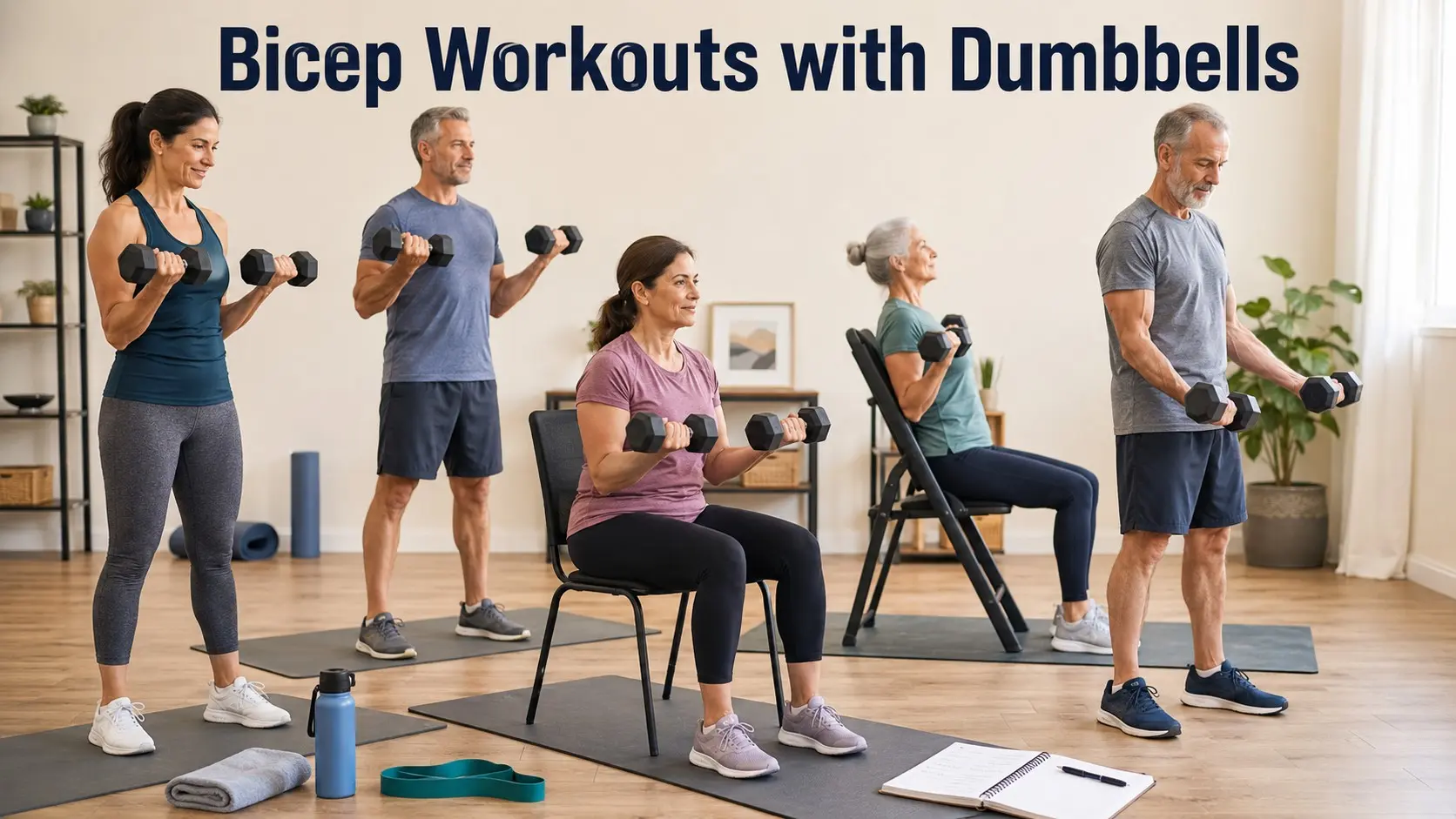
Good Bicep Workouts with Dumbbells include standard curls, hammer curls, seated curls, concentration curls, cross-body curls, slow-lowering curls, and light carry work.
Start with light dumbbells.
Train biceps 1 or 2 days each week.
Move slowly.
Keep your elbows controlled.
Stop if you feel sharp pain, numbness, chest pain, severe dizziness, or severe shortness of breath.
What are the biceps?
The biceps are muscles on the front of your upper arm.
They help bend your elbow.
They help turn your palm up.
They also help with pulling, lifting, and carrying.
This is why biceps exercises can help daily life.
Strong arms can make simple tasks easier.
Carrying bags can feel easier.
Lifting objects can feel easier.
Pulling and holding things can feel easier.
Why use dumbbells for biceps?
Dumbbells are simple.
They are easy to store.
They let each arm work on its own.
They can help you notice if one side feels weaker.
You can use light dumbbells at home and still get a useful workout.
This makes dumbbell arm workouts a good choice for many people.
Before you start
Start with your current level.
Do not swing the weights.
Do not train through sharp pain.
Do not copy someone lifting very heavy online.
Talk with a qualified healthcare professional before starting a new strength plan if you have shoulder pain, elbow pain, wrist pain, neck pain, back pain, chest pain, heart disease, recent surgery, dizziness, nerve symptoms, arthritis, or a long term health condition.
Stop exercise and seek help if you feel chest pain, fainting, severe shortness of breath, sudden weakness, severe dizziness, numbness, tingling that does not stop, or sharp pain.
How to choose the right dumbbell weight
Pick a weight you can control.
Your first set should feel steady.
Your last few reps should feel hard, but safe.
You should not need to lean back.
You should not need to swing.
You should not need to hold your breath.
If your form breaks, the weight is too heavy.
This is part of safe strength training.
Basic form rules
Use these rules for every curl.
- Stand or sit tall.
- Keep your shoulders relaxed.
- Keep your elbows close to your body.
- Lift with control.
- Lower slowly.
- Keep your wrists straight.
- Breathe while you move.
Good form matters more than heavy weight.
Warm up first
Warm up for 5 minutes before lifting.
- March in place for 60 seconds.
- Roll your shoulders 10 times.
- Open and close your hands 20 times.
- Do arm circles 10 times each way.
- Do 10 light band pulls if you have a band.
- Do one very light curl set.
This helps your body feel ready.
15 Bicep Workouts with Dumbbells
You do not need to do all 15 moves in one workout.
Pick 4 to 6 exercises.
Move slowly.
Rest when needed.
1. Standard dumbbell curl
This is the basic curl.
Learn this first.
How to do it
- Stand tall with one dumbbell in each hand.
- Keep palms facing forward.
- Brace your core.
- Curl the weights up slowly.
- Lower with control.
Do 8 to 12 reps.
This is a simple bicep curl variation.
2. Hammer curl
The hammer curl trains your biceps and forearms.
How to do it
- Hold dumbbells by your sides.
- Keep palms facing each other.
- Curl the weights up.
- Lower slowly.
Do 8 to 12 reps.
This is a useful hammer curl move for arm strength.
3. Seated dumbbell curl
Sitting can help you avoid swinging.
How to do it
- Sit on a stable chair.
- Hold dumbbells by your sides.
- Sit tall.
- Curl slowly.
- Lower with control.
Do 8 to 12 reps.
This is good for beginners.
4. Alternating dumbbell curl
This move lets one arm work at a time.
How to do it
- Stand tall.
- Curl the right dumbbell up.
- Lower it slowly.
- Curl the left dumbbell up.
- Keep switching sides.
Do 8 to 10 reps on each side.
This helps with control.
5. Cross-body hammer curl
This variation works the arm from a slightly different angle.
How to do it
- Hold dumbbells at your sides.
- Keep palms facing in.
- Curl one dumbbell across your body toward the opposite shoulder.
- Lower slowly.
- Switch sides.
Do 8 to 10 reps on each side.
Keep your shoulders relaxed.
6. Concentration curl
This move helps you focus on one arm.
How to do it
- Sit on a chair.
- Hold one dumbbell.
- Rest the back of your upper arm against your inner thigh.
- Curl the weight slowly.
- Lower with control.
- Switch sides.
Do 8 to 10 reps on each side.
This is a focused arm strength to move.
7. Slow lowering curl
This move uses a slow lower.
That can make light weights feel harder.
How to do it
- Curl the dumbbells up.
- Pause at the top.
- Lower for 3 seconds.
- Repeat with control.
Do 6 to 10 reps.
This helps you use time under tension.
8. Halfway curl
This move works the lower part of the curl.
How to do it
- Hold dumbbells by your sides.
- Curl only halfway up.
- Lower slowly.
Do 8 to 10 reps.
Use lightweight.
9. Top half curl
This move works the upper part of the curl.
How to do it
- Curl dumbbells to the top.
- Lower halfway down.
- Curl back up.
Do 8 to 10 reps.
Do not shrug your shoulders.
10. 21 style curl
This is more advanced.
Use light weights.
How to do it
- Do 7 halfway curls from bottom to middle.
- Do 7 halfway curls from the middle to the top.
- Do 7 full curls.
Stop if your form breaks.
This move can feel intense even with light dumbbells.
11. Reverse curl
This move trains forearms and arms.
How to do it
- Hold dumbbells with palms facing down.
- Keep elbows close.
- Curl up slowly.
- Lower with control.
Do 8 to 10 reps.
Use a lighter weight than normal curls.
This supports forearm strength.
12. Zottman curl
This is a curl with a twist at the top.
Use light weights.
How to do it
- Curl with palms up.
- At the top, turn palms down.
- Lower slowly.
- Turn palms up again at the bottom.
Do 6 to 8 reps.
Move slowly.
13. Seated incline style curl with chair
This is a gentle home version.
Use a stable chair and sit tall.
How to do it
- Sit with your back supported.
- Hold dumbbells at your sides.
- Let arms hang naturally.
- Curl slowly.
- Lower with control.
Do 8 to 10 reps.
Do not lean far back on an unsafe chair.
14. Isometric curl hold
This move trains control.
How to do it
- Curl the dumbbells halfway up.
- Hold for 10 to 20 seconds.
- Lower slowly.
Do 2 holds.
Keep breathing.
This is a simple isometric exercise.
15. Farmer carries
This move is not a curl.
But it helps grip, arms, shoulders, and posture.
How to do it
- Hold dumbbells at your sides.
- Stand tall.
- Brace your core.
- Walk slowly for 20 to 30 seconds.
Do 2 rounds.
This supports functional strength.
Beginner Bicep Workouts with Dumbbells Plan
Use this plan 1 or 2 days each week.
Rest at least 1 day between sessions.
Round 1
- Standard dumbbell curl, 8 to 12 reps
- Hammer curl, 8 to 12 reps
- Seated curl, 8 to 12 reps
Rest for 60 seconds.
Round 2
- Alternating curl, 8 reps each side
- Slow lowering curl, 6 to 10 reps
- Farmer carry, 20 to 30 seconds
Start with 1 round if you are new.
Build to 2 rounds.
Then build slowly when your body feels ready.
10-minute dumbbell bicep workout
Use this when time is short.
- Minute 1: Warm up arms and shoulders
- Minute 2: Standard curls
- Minute 3: Rest
- Minute 4: Hammer curls
- Minute 5: Rest
- Minute 6: Alternating curls
- Minute 7: Rest
- Minute 8: Slow lowering curls
- Minute 9: Farmer carries
- Minute 10: Easy shoulder rolls and breathing
This is a simple home bicep workout.
How often should you train biceps?
Many beginners can train biceps 1 or 2 days each week.
Your biceps also work during rows, carries, pull moves, and other upper body exercises.
You do not need to curl every day.
Rest helps your muscles recover.
How many reps should you do?
A simple starting range is 8 to 12 reps.
Use a weight you can control.
If 12 reps feel easy and your form is good, you may add a small amount of weight.
This is one way to use progressive overload.
Progressive overload means you make the workout a little harder over time.
How to make bicep curls easier
- Use lighter dumbbells.
- Sit on a chair.
- Do fewer reps.
- Rest longer.
- Use one arm at a time.
Easy still counts.
Good form is the goal.
How to make bicep curls harder
- Add 1 or 2 reps.
- Use a slightly heavier dumbbell.
- Lower the weight more slowly.
- Add one more set.
- Use a curl variation.
Only change one thing at a time.
Do not rush.
Common mistakes to avoid
- Swinging the weights
- Using weights that are too heavy
- Leaning back
- Shrugging the shoulders
- Bending the wrists too much
- Holding the breath
- Training through elbow pain
- Doing curls every day
Slow reps are better than messy reps.
Can bicep workouts help with weight loss?
Bicep workouts can build arm strength.
They can support a full fitness plan.
But they do not cause fat loss in one body area.
For weight goals, combine strength training with walking, balanced meals, sleep, and daily movement.
That is safer than chasing quick fixes.
What to do after a workout
Cool down for 3 to 5 minutes.
- Roll your shoulders.
- Open and close your hands.
- Stretch your forearms gently.
- Shake out your arms.
- Drink water.
This supports workout recovery.
My simple rule
Your arms should work.
Your body should not swing.
If you need to throw the weight up, it is too heavy.
If your elbow or wrist hurts, stop and adjust.
Clean reps build better strength.
Conclusion
Bicep Workouts with Dumbbells can help you build arm strength at home with simple moves and safe form.
Start with standard curls, hammer curls, seated curls, alternating curls, and farmer carries.
Use light weights.
Move slowly.
Rest well.
Your next step: choose 4 moves from this Bicep Workouts with Dumbbells guide and try one gentle round today with good form and steady breathing.
Related guides from NextFitLife
This article is part of our Fitness Hub. You may also want to visit our Strength Training & Muscle Building Guide, Home Workouts & Equipment Guide, and Fitness for Beginners Guide.
FAQ
What are the best bicep workouts with Dumbbells?
Good bicep workouts with Dumbbells include standard curls, hammer curls, seated curls, alternating curls, concentration curls, slow lowering curls, and farmer carries.
Can I build biceps at home with dumbbells?
Yes. You can build arm strength at home with light dumbbells, suitable form, steady reps, rest, and gradual progress.
How often should I train biceps?
Many beginners can train biceps 1 or 2 days each week. Rest between sessions and avoid training through pain.
What dumbbell weight should I start with?
Start with a lightweight you can control for 8 to 12 reps. If you need to swing or lean back, the weight is too heavy.
Do bicep curls burn arm fat?
Bicep curls train arm muscles, but they do not spot reduce arm fat. Fat loss depends on overall food habits, activity, sleep, and consistency.
Who should talk to a doctor before dumbbell bicep workouts?
Talk with a healthcare professional if you have shoulder pain, elbow pain, wrist pain, chest pain, heart disease, recent surgery, dizziness, nerve symptoms, or a long-term condition.
References and Sources
- Centers for Disease Control and Prevention. Adult Activity: An Overview.
- Mayo Clinic. Weight Training: Do's and Don'ts of Proper Technique.
- MedlinePlus. How to Avoid Exercise Injuries.
- American Heart Association. Strength and Resistance Training Exercise.
- Mayo Clinic. Strength Training: Get Stronger, Leaner, Healthier.

Health & wellness writer with 30+ years of experience in nutrition, fitness, and healthy aging. Founder of NextFitLife.com — evidence-based health guidance.