
Published on: Aug 9, 2024
Updated: November 2, 2026
The Best Exercises to Get Toned Legs do not need to be extreme.
You do not need endless running, daily HIIT, box jumps, or a workout that leaves your legs shaking for hours.
A more defined leg shape comes mainly from two things: building muscle and reducing enough body fat for that muscle to show.
That means your training should focus on the quads, hamstrings, glutes, calves, and hip muscles while your nutrition and overall activity support your body composition goals.
This article is for general information and education. It does not replace medical advice, diagnosis, or treatment.
Quick answer: The Best Exercises to Get Toned Legs are squats, split squats, Romanian deadlifts, step ups, hip thrusts, reverse lunges, lateral lunges, calf raises, hamstring curls, leg extensions, hip abduction, single leg deadlifts, wall sits, and brisk incline walking. For the best results, train your lower body two or three times each week and gradually increase the resistance, repetitions, or total work.
Important: “Toning” is not a separate type of muscle. The look people call toned usually means having enough muscle to create shape and a low enough body fat level for that shape to be visible. You cannot choose where your body loses fat first.
Table of Contents
- What does toned legs really mean?
- How resistance training changes leg shape
- 14 best exercises to get toned legs
- Squat
- Split squat
- Romanian deadlift
- Step up
- Hip thrust
- Reverse lunge
- Lateral lunge
- Calf raise
- Hamstring curl
- Leg extension
- Hip abduction
- Single leg deadlift
- Wall sit
- Incline walking
- Best workout plan
- How many sets and reps?
- How often should you train legs?
- Cardio and leg definition
- Nutrition for more defined legs
- Common mistakes
- Frequently asked questions
What Does “Toned Legs” Really Mean?
The word “toned” is useful in everyday language, but it is not a special type of muscle.
When people say they want toned legs, they usually mean they want their legs to look:
- Firmer
- More defined
- Stronger
- More shaped
That look usually comes from a mix of muscle growth and lower body fat.
Exercises can build the muscle.
They cannot force fat to disappear from only the thighs.
How Does Resistance Training Change Leg Shape?
Resistance training gives your muscles a reason to adapt.
When training is repeated and gradually becomes more challenging, muscle fibers can grow and become stronger.
The 2026 American College of Sports Medicine position stand reviewed 137 systematic reviews and found that resistance training reliably improves muscle strength, muscle size, power, and physical function.
For muscle growth, higher weekly training volume can help, but you do not need complicated routines or advanced training systems.
Consistency matters more.
Do Women Build Muscle Differently From Men?
Women and men can both build leg muscle.
A 2025 meta analysis found that relative gains in muscle size were broadly similar between men and women when they completed the same resistance training.
That means women do not need a special “toning only” routine made of tiny weights and hundreds of repetitions.
They can use progressive resistance training too.
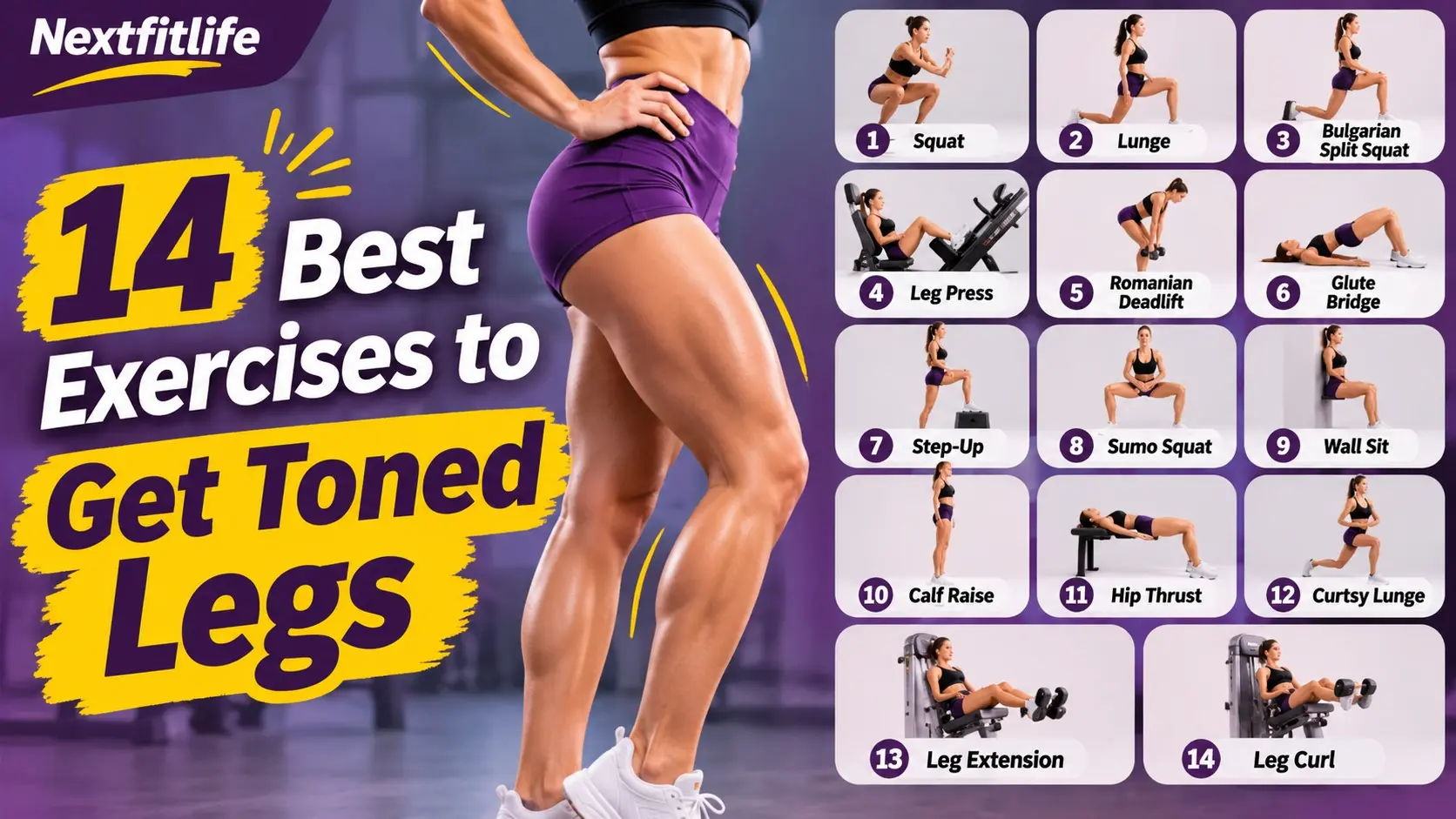
14 Best Exercises to Get Toned Legs
1. Squat
The squat trains the quads, glutes, and several supporting muscles around the hips and trunk.
How to do it:
- Stand with your feet at a comfortable width.
- Brace your trunk gently.
- Bend your hips and knees.
- Lower as far as you can with good control.
- Push through your feet to stand.
Start with a chair squat if needed.
Later you can use dumbbells, a kettlebell, or a barbell.
2. Split Squat
The split squat trains one leg more independently.
It works the quads and glutes while also challenging balance.
- Stand with one foot in front of the other.
- Keep most of your weight through the front leg.
- Lower both knees under control.
- Push back to the start.
Hold a chair or rail if balance is limited.
3. Romanian Deadlift
The Romanian deadlift is one of the best exercises for the hamstrings and glutes.
- Hold dumbbells in front of your thighs.
- Keep your knees slightly bent.
- Push your hips backward.
- Keep your spine long.
- Stop when you feel a strong hamstring stretch.
- Stand by driving your hips forward.
The movement comes mainly from the hips, not from squatting down.
4. Step Up
Step ups train the quads and glutes while also working one leg at a time.
- Use a stable step.
- Place one foot fully on top.
- Push through that leg.
- Stand tall on the step.
- Lower slowly.
A lower step is easier.
A higher step creates more challenge.
5. Hip Thrust
The hip thrust focuses strongly on the glutes.
- Sit with your upper back against a bench or sofa.
- Keep your feet flat.
- Drive through your feet.
- Lift your hips.
- Squeeze the glutes gently at the top.
- Lower with control.
Begin with bodyweight before adding load.
For more glute work, see Upper Glute Exercises.
6. Reverse Lunge
A reverse lunge is often easier to control than a forward lunge.
- Stand tall.
- Step one foot backward.
- Lower both knees gently.
- Push through the front foot to return.
- Switch legs.
You do not need to force both knees to an exact 90 degree angle.
7. Lateral Lunge
The lateral lunge adds side to side movement.
It works the inner thighs, glutes, and quads.
- Stand tall.
- Step to one side.
- Push your hips back over the stepping leg.
- Keep the other leg more straight.
- Push back to center.
Start with a small range.
8. Calf Raise
Calf raises train the lower leg muscles that help with walking, running, jumping, and ankle control.
- Stand near a wall or counter.
- Rise onto your toes.
- Pause briefly.
- Lower slowly.
Progress by holding weight or using one leg when ready.
9. Hamstring Curl
A hamstring curl bends the knee against resistance.
You can use:
- A machine
- A resistance band
- A stability ball
- Sliding towels on a smooth floor
This complements hip hinge exercises such as Romanian deadlifts.
10. Leg Extension
The leg extension isolates the quadriceps.
Compound exercises should form the base of most leg programs, but isolation exercises can add useful training volume.
Use a machine or resistance band and move through a comfortable range.
11. Hip Abduction
Hip abduction trains the muscles on the outside of the hips, including the gluteus medius.
- Stand beside a chair.
- Move one leg out to the side.
- Keep your trunk tall.
- Return slowly.
You can add a resistance band as you get stronger.
12. Single Leg Romanian Deadlift
This exercise combines hamstring and glute work with balance.
- Stand on one leg.
- Keep the knee slightly bent.
- Push the hips backward.
- Let the other leg move behind you.
- Return to standing.
Hold a wall or chair if needed.
13. Wall Sit
A wall sit is an isometric exercise for the thighs.
- Place your back against a wall.
- Slide down slightly.
- Hold a comfortable position.
- Stand before your form breaks down.
You do not need to reach a perfect right angle at the knees.
14. Incline Walking
Incline walking is not a replacement for strength training, but it can add aerobic work while challenging the calves, glutes, and thighs.
Try:
- A gentle outdoor hill
- A treadmill incline
- Stairs
Keep your posture upright and choose an incline you can control.
14 Exercises at a Glance
| Exercise | Main Muscles | Best Use |
|---|---|---|
| Squat | Quads, glutes | Main strength move |
| Split squat | Quads, glutes | Single leg strength |
| Romanian deadlift | Hamstrings, glutes | Hip hinge strength |
| Step up | Quads, glutes | Functional leg strength |
| Hip thrust | Glutes | Glute growth |
| Reverse lunge | Quads, glutes | Single leg control |
| Lateral lunge | Glutes, adductors, quads | Side to side strength |
| Calf raise | Calves | Lower leg strength |
| Hamstring curl | Hamstrings | Isolation work |
| Leg extension | Quads | Extra quad volume |
| Hip abduction | Outer glutes | Hip stability |
| Single leg RDL | Hamstrings, glutes | Strength plus balance |
| Wall sit | Quads | Isometric endurance |
| Incline walking | Calves, glutes, thighs | Cardio support |
What Is the Best Lower Body Workout?
You do not need all 14 exercises in one session.
A strong beginner workout might include:
- Squat: 2 to 3 sets
- Romanian deadlift: 2 to 3 sets
- Step up: 2 sets each side
- Hip thrust: 2 to 3 sets
- Calf raise: 2 to 3 sets
That gives you a squat pattern, a hip hinge, unilateral work, glute work, and calf work.
A Second Lower Body Workout
If you train legs twice each week, your second session could use different movements.
- Split squat: 2 to 3 sets
- Hip thrust: 2 to 3 sets
- Hamstring curl: 2 to 3 sets
- Leg extension: 2 sets
- Hip abduction: 2 sets
This helps spread training volume across the week.
How Many Sets and Reps Should You Do?
For general muscle growth, many repetition ranges can work.
A practical starting point is:
- 8 to 15 repetitions for most exercises
- 2 to 3 sets per exercise
- 1 to 3 minutes of rest between harder sets
The final repetitions should feel challenging while your form stays controlled.
You do not have to train to complete failure.
How Much Weekly Volume Helps Muscle Growth?
The 2026 ACSM position stand found that higher weekly training volume supports greater muscle hypertrophy.
About 10 challenging sets per muscle group each week is a useful general target for people prioritizing muscle growth.
Beginners can grow with less.
You do not need to start at the maximum.
Do You Need Heavy Weights?
No single load is required for muscle growth.
Many forms of resistance can work when the sets become challenging enough.
You can use:
- Dumbbells
- Barbells
- Machines
- Resistance bands
- Bodyweight
Heavier weights are especially useful when strength is the main goal.
Do You Need to Train to Failure?
No.
Current evidence does not show that every set must reach complete failure for good muscle growth.
Stopping with one to three good repetitions still possible can work very well.
Does Slow Training Build More Muscle?
Not necessarily.
A 2026 systematic review found little overall difference in muscle growth between slower and faster repetition tempos.
Use a controlled speed that lets you maintain good technique.
Do Drop Sets or Advanced Methods Work Better?
They can work, but they are optional.
Recent evidence does not show that advanced methods consistently produce more muscle growth than traditional training when effort and volume are similar.
A simple progressive program is enough for most people.
How Often Should You Train Legs?
Two lower body sessions each week work well for many people.
Three can also work if you spread the volume and recover well.
CDC recommends muscle strengthening on at least two days each week for general health.
Do You Need a Leg Day?
No.
You can train your legs inside a full body routine.
For example:
- Squat
- Row
- Romanian deadlift
- Push up
- Calf raise
This works well when you have limited training days.
Can You Tone Legs at Home?
Yes.
You can use:
- Chair squats
- Split squats
- Glute bridges
- Step ups
- Resistance band hamstring curls
- Calf raises
See Simple Strength Training Exercises at Home.
Can Bodyweight Exercises Build Leg Muscle?
They can, especially for beginners.
As you get stronger, bodyweight movements may need progression.
You can:
- Add repetitions
- Add sets
- Slow the lowering phase slightly
- Use one leg more
- Add external resistance
Do Squats Tone Inner Thighs?
Squats train several thigh muscles, but they do not selectively remove fat from the inner thighs.
Lateral lunges and adductor focused exercises can strengthen the inner thigh muscles.
Fat loss remains a whole body process.
Do Lunges Make Your Legs Leaner?
Lunges build muscle and strength.
Whether your legs look leaner also depends on your overall body fat.
A lunge does not directly burn fat from the thigh being trained.
Does Running Tone Your Legs?
Running can improve fitness and train the legs, but it is not required for leg definition.
Strength training gives you a more direct way to build muscle.
If you enjoy running, use it as cardio rather than relying on it as your only leg training.
Does Cycling Tone Your Legs?
Cycling works the lower body and can improve endurance.
It may contribute to leg muscle development, especially for beginners.
Progressive resistance training is still a stronger tool if muscle growth is your main goal.
Is HIIT Needed for Toned Legs?
No.
HIIT can improve cardiovascular fitness, but it is not required for muscle definition.
You can build strong, defined legs with regular resistance training and moderate cardio.
Are Box Jumps Good for Toning?
Box jumps train power.
They are not necessary for leg muscle growth or definition.
People with poor balance, joint pain, or little training experience may be better served by step ups and strength training.
Does Cardio Help Leg Definition?
Cardio can help by increasing total energy use and supporting overall fat loss.
Useful options include:
- Brisk walking
- Incline walking
- Cycling
- Swimming
- Easy jogging
Cardio does not need to be extreme.
Can You Spot Reduce Thigh Fat?
No.
Training your thighs does not force the body to burn fat from the thighs first.
Your fat loss pattern depends partly on genetics and hormones.
Build muscle where you want shape and reduce overall body fat if fat loss is part of your goal.
How Long Does It Take to See More Defined Legs?
There is no guaranteed timeline.
You may notice strength improvements within several weeks.
Visible muscle and body composition changes usually take longer.
The timeline depends on:
- Your starting point
- Training history
- Nutrition
- Sleep
- Genetics
- Body fat level
- Training consistency
Do not expect a complete transformation in two weeks.
Can Women Train Legs Heavy?
Yes.
Women can benefit from progressive resistance training just as men can.
A 2026 systematic review found that resistance training significantly improved strength and body composition in women across adulthood.
Training should still be matched to experience and technique.
Will Strength Training Make My Legs Bulky?
Muscle growth is usually gradual.
Large increases in muscle size require months or years of consistent training, sufficient food, and progressive resistance.
You can adjust training volume if your goal changes.
Nutrition for More Defined Legs
Exercise builds the muscle.
Nutrition affects both muscle recovery and body fat.
Build meals around:
- Protein
- Vegetables
- Whole fruit
- Whole grains
- Beans
- Healthy fats
See Healthy Eating Lifestyle for more ideas.
How Much Protein Do You Need?
Protein supports muscle repair and growth.
Your needs depend on body size, activity, age, health, and total food intake.
You do not need to eat huge amounts.
Spread protein foods across your meals.
Do You Need a Calorie Deficit?
Only if reducing body fat is part of your goal.
If you want more visible muscle definition, losing some body fat may help.
Use a moderate calorie deficit rather than crash dieting.
Too aggressive a diet can make training and recovery harder.
A Simple 2 Day Leg Program
| Day | Exercise | Sets |
|---|---|---|
| Day 1 | Squat | 3 |
| Day 1 | Romanian deadlift | 3 |
| Day 1 | Step up | 2 each side |
| Day 1 | Calf raise | 3 |
| Day 2 | Split squat | 3 each side |
| Day 2 | Hip thrust | 3 |
| Day 2 | Hamstring curl | 2 to 3 |
| Day 2 | Hip abduction | 2 |
How to Progress the Plan
Progress does not mean changing the whole routine every week.
You can improve by:
- Adding one repetition
- Adding a small amount of weight
- Adding one set
- Using a stronger resistance band
- Improving your range of motion
- Using better control
Make one small change at a time.
Common Leg Training Mistakes
1. Doing Only Squats
Squats are useful, but hamstrings, calves, and glutes also need direct work.
2. Doing Only Cardio
Cardio helps fitness but is not the most direct muscle building tool.
3. Using the Same Weight Forever
Muscles need progressive challenge.
4. Training Legs Every Day
Muscle needs recovery.
5. Believing More Burn Means More Growth
A burning feeling is not a measure of muscle growth.
6. Doing HIIT Instead of Strength Training
HIIT and strength training have different goals.
7. Trying to Spot Reduce Thigh Fat
Fat loss cannot be targeted to one body part.
8. Changing Exercises Too Often
Keep key exercises long enough to improve them.
9. Ignoring Hamstrings
Strong legs need both the front and back of the thighs.
10. Expecting Results in Two Weeks
Strength may improve quickly, but visible body changes take time.
Leg Training Checklist
- Train the quads.
- Train the hamstrings.
- Train the glutes.
- Train the calves.
- Include single leg work.
- Use resistance that becomes challenging.
- Train legs at least twice each week.
- Increase difficulty gradually.
- Keep cardio separate from your main strength goal.
- Eat enough protein.
- Use a modest calorie deficit only if fat loss is needed.
- Give your legs time to recover.
Conclusion
The Best Exercises to Get Toned Legs are not the moves that create the most sweat or the biggest burning feeling.
They are the exercises that let you train the quads, glutes, hamstrings, and calves with enough resistance to improve over time.
Squats, split squats, Romanian deadlifts, step ups, hip thrusts, calf raises, and other simple lower body exercises can do that very well.
If you also want more visible definition, combine strength training with a sustainable nutrition plan that supports your body composition goal.
Your next step: choose five exercises from this guide and train them twice this week. Keep the form controlled, write down your repetitions, and aim to improve one small thing next time.
References and Sources
- American College of Sports Medicine. Resistance Training Prescription for Muscle Function, Hypertrophy, and Physical Performance in Healthy Adults, 2026.
https://pubmed.ncbi.nlm.nih.gov/41843416/ - American College of Sports Medicine. Updated Resistance Training Guidelines, 2026.
https://acsm.org/resistance-training-guidelines-update-2026/ - Centers for Disease Control and Prevention. What Counts as Physical Activity for Adults.
https://www.cdc.gov/physical-activity-basics/adding-adults/what-counts.html - It's Never Too Late: The Impact of Resistance Training on Strength and Body Composition in Females Across the Lifespan. Systematic Review and Meta Analysis, 2026.
https://pubmed.ncbi.nlm.nih.gov/41963141/ - Sex Differences in Absolute and Relative Changes in Muscle Size Following Resistance Training. Systematic Review and Meta Analysis, 2025.
https://pubmed.ncbi.nlm.nih.gov/40028215/ - How Slow Should You Go? Systematic Review and Meta Analysis of Resistance Training Tempo and Muscle Hypertrophy, 2026.
https://pubmed.ncbi.nlm.nih.gov/42709703/ - Effects of Advanced Resistance Training Systems on Muscle Hypertrophy and Strength. Systematic Review and Meta Analysis, 2026.
https://pubmed.ncbi.nlm.nih.gov/41718208/
Internal Links + Hub
- NextFitLife Fitness Hub
- Fitness Program Guide
- Best Compound Leg Exercises
- Upper Glute Exercises
- Simple Strength Training Exercises at Home
- Strength Training Exercises at Home for Beginners
- Workout Routines for Women
- Effective Workout Routines for Men
- Easy but Effective Workout Routines
- How to Maintain Muscle Mass
- Healthy Eating Lifestyle
- Complete Weight Loss Guide
About the Author
Adel Galal is the founder and lead writer of NextFitLife.com and the founder of Parnthub.com.
He is a father of four, three sons and a daughter, and a grandfather of four, with more than 33 years of hands on family experience. Adel is based in Cairo, Egypt.
He has maintained a personal interest in health, fitness, nutrition, strength training, walking, sleep, wellness, and healthy aging for more than 30 years and has more than 15 years of health and wellness writing experience.
His work focuses on reviewing trusted sources, separating useful training guidance from exaggerated fitness claims, and turning research into practical steps readers can apply in real life.
Adel is not a doctor, physical therapist, exercise physiologist, certified personal trainer, registered dietitian, or other licensed healthcare professional. NextFitLife content is for general information and education and does not replace individual medical, exercise, or nutrition advice.
Learn more about Adel and NextFitLife on the About Us page.
Frequently Asked Questions
What are the Best Exercises to Get Toned Legs?
The Best Exercises to Get Toned Legs include squats, split squats, Romanian deadlifts, step ups, hip thrusts, lunges, calf raises, hamstring curls, hip abduction, and other progressive resistance exercises.
What does toned legs mean?
Toned legs usually means having enough muscle for shape and a low enough body fat level for that muscle to look more defined.
Can you tone your legs without losing weight?
You can build leg muscle without losing weight. How defined your legs look will also depend on your body fat level.
Can you spot reduce thigh fat?
No. Exercises can strengthen the thighs, but fat loss cannot be targeted to one specific area.
Are squats good for toned legs?
Yes. Squats train the quads and glutes and can be progressed with added resistance.
Are lunges good for toned legs?
Yes. Lunges and split squats build lower body muscle and improve single leg strength.
Are Romanian deadlifts good for legs?
Yes. They are one of the best exercises for training the hamstrings and glutes.
Are step ups good for leg definition?
Step ups build leg and glute strength, which can contribute to a more defined lower body.
Do hip thrusts help tone legs?
Hip thrusts mainly build the glutes. They are useful when glute development is part of your lower body goal.
Do calf raises really work?
Yes. Calf raises directly train the calf muscles and can be progressed with added load.
Is running necessary for toned legs?
No. Running is optional. Progressive resistance training is a more direct tool for building leg muscle.
Does cycling tone your legs?
Cycling trains the lower body and may add some muscle, especially in beginners, but strength training is better for maximizing muscle growth.
Do you need HIIT for toned legs?
No. HIIT is not necessary for muscle definition or leg strength.
Are box jumps needed for leg definition?
No. Box jumps are mainly a power exercise. Squats, step ups, and other resistance exercises are more important for building muscle.
How many times a week should I train legs?
Two lower body sessions each week work well for many people. Three may work if recovery and total volume are managed.
How many sets should I do?
Two to three sets per exercise is a practical starting point. Weekly volume can increase as your experience grows.
How many reps should I do?
Eight to fifteen repetitions works well for many exercises, although muscle growth can occur across a wider range when sets are challenging.
Do I need heavy weights?
No. Different loads can build muscle. Heavier loads are especially useful for maximal strength, while moderate and lighter resistance can also build muscle when used effectively.
Do I need to train to failure?
No. You can build muscle without taking every set to complete failure.
Can bodyweight exercises tone legs?
Yes, especially for beginners. Over time you may need harder variations or added resistance.
Can I get toned legs at home?
Yes. Chair squats, split squats, bridges, step ups, resistance bands, and calf raises can create an effective home leg program.
How long does it take to see leg definition?
There is no fixed timeline. Strength can improve within weeks, while visible muscle and body composition changes usually take longer.
Will heavy leg training make women bulky?
Not automatically. Muscle growth is gradual and depends on training volume, nutrition, genetics, and time.
What should I eat for more defined legs?
Use a balanced diet with enough protein, vegetables, fruit, whole grains, and other nutrient rich foods. Use a modest calorie deficit if reducing body fat is part of your goal.
What is the biggest leg training mistake?
Using the same easy resistance forever. Muscles need gradual progression to keep adapting.

Health & wellness writer with 30+ years of experience in nutrition, fitness, and healthy aging. Founder of NextFitLife.com — evidence-based health guidance.

