
Published on: March 12, 2025
Updated on: November 4, 2026
Strength training weight loss women can be an effective approach when resistance exercise is combined with healthy eating, regular movement, and enough recovery.
Lifting weights can improve strength, support lean mass, and help change body composition. It can also reduce fat mass over time. However, strength training is not a magic fat burning switch, and it does not automatically beat cardio for weight loss.
The best results usually come from combining resistance training with an overall calorie deficit, enough protein, regular aerobic activity, and a plan you can repeat.
This guide gives you 12 practical exercises plus 3 core training habits, beginner and intermediate routines, nutrition guidance, cardio advice, menopause context, postpartum safety, and realistic expectations.
Important: This article is for general information and education. It does not replace medical advice, diagnosis, or treatment.
Table of Contents
- Quick Answer
- Does Strength Training Help Women Lose Weight?
- How Strength Training Changes Body Composition
- 15 Proven Moves and Habits
- Beginner Workout
- Intermediate Workout
- How Often to Train
- Sets and Reps
- Progressive Overload
- Strength Training vs Cardio
- Nutrition for Fat Loss
- Protein for Women
- Women Over 40 and Menopause
- Postpartum Training
- Common Myths
- Common Mistakes
- Conclusion
- References and Sources
- Internal Links + Fitness Hub
- About the Author
- Frequently Asked Questions
Quick Answer: Can Strength Training Help Women Lose Weight?
Yes. Strength training for women can support weight loss and fat loss, especially when it is combined with a sustainable calorie deficit and regular aerobic activity.
A large 2026 systematic review found that resistance training improved strength, increased functional mass, and reduced fat mass in women across adulthood.
Strength training is especially useful because weight loss should not be judged only by the scale. You can lose fat while maintaining or gaining muscle, which may change how your clothes fit and how strong you feel even when scale weight moves slowly.
For a broader fat loss plan, read our Weight Loss Strategies and Basic Weight Loss Tips.
How Strength Training Changes Body Composition
Body composition describes the balance of fat mass, lean tissue, bone, and other tissues in your body.
Resistance training can help women:
- Improve muscular strength
- Maintain or build lean tissue
- Improve physical function
- Reduce fat mass over time
- Support bone health
- Improve movement confidence
A 2026 meta analysis including 4,019 women found significant improvements in strength and body composition in both premenopausal and postmenopausal women.
That is a much stronger claim than saying lifting simply “tones” the body.
Does Strength Training Burn Fat All Day?
Not in the dramatic way fitness marketing sometimes suggests.
Resistance training uses energy during the workout, and recovery also requires energy. Building more lean tissue can slightly affect resting energy needs.
However, these effects do not mean one lifting session causes large amounts of fat to disappear for the next 24 hours.
Fat loss still depends mostly on your overall energy balance across days and weeks.
Better goal: use strength training to become stronger, support muscle, and improve body composition while nutrition and total activity support fat loss.
15 Proven Strength Training Moves and Habits for Women
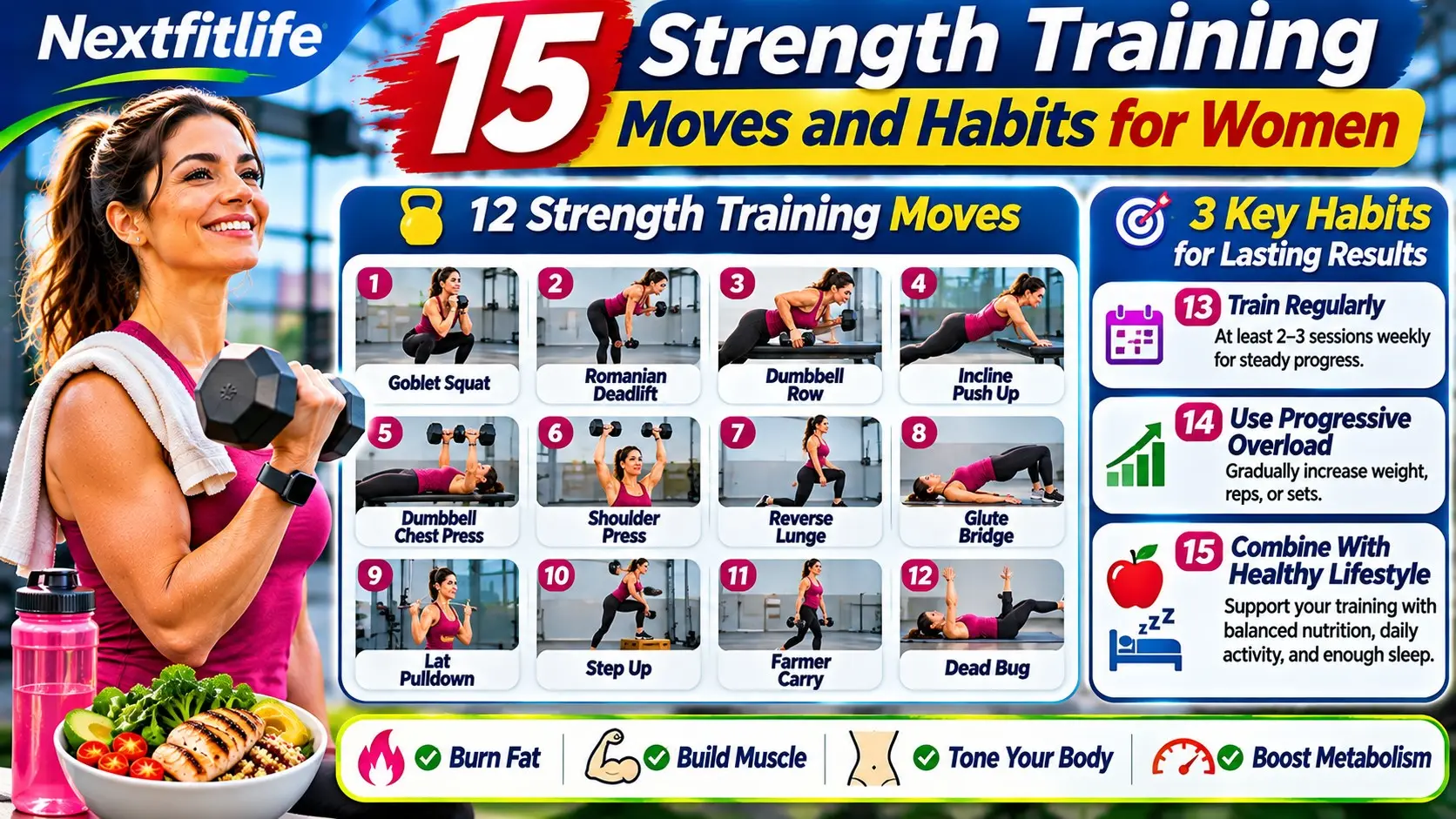
1. Goblet Squat
The goblet squat trains your thighs, glutes, and core while keeping the weight in front of your body.
- Hold one dumbbell close to your chest.
- Stand with your feet in a comfortable position.
- Sit your hips down and back.
- Keep your knees tracking naturally over your feet.
- Stand back up with control.
Starting target: 2 to 3 sets of 8 to 12 repetitions.
2. Romanian Deadlift
This movement trains the hamstrings, glutes, and back of the body.
- Hold dumbbells in front of your thighs.
- Keep a soft bend in your knees.
- Push your hips backward.
- Lower the weights while keeping them close to your legs.
- Stop when you feel a comfortable hamstring stretch.
- Stand tall by driving your hips forward.
Starting target: 2 to 3 sets of 8 to 12 repetitions.
3. Dumbbell Row
The dumbbell row trains the upper back and arms.
- Support one hand on a bench or sturdy surface.
- Hold a dumbbell in the other hand.
- Pull the weight toward your side.
- Lower it under control.
Starting target: 2 to 3 sets of 8 to 15 repetitions per side.
For more back training, see our Best Back Workouts for Women.
4. Incline Push Up
An incline push up is a useful beginner pressing exercise.
- Place your hands on a stable bench or counter.
- Walk your feet back.
- Keep your body in a straight line.
- Lower your chest toward the surface.
- Press back up.
Starting target: 2 to 3 sets of 6 to 15 repetitions.
5. Dumbbell Chest Press
The dumbbell chest press trains the chest, shoulders, and triceps.
- Lie on a bench or the floor.
- Hold one dumbbell in each hand.
- Press the weights upward.
- Lower them slowly.
Starting target: 2 to 3 sets of 8 to 12 repetitions.
6. Dumbbell Shoulder Press
This movement trains your shoulders and triceps.
- Stand or sit tall.
- Hold the dumbbells near shoulder height.
- Press them overhead.
- Lower them with control.
Starting target: 2 to 3 sets of 8 to 12 repetitions.
Our Upper Body Workout for Women includes more pressing and pulling options.
7. Reverse Lunge
Reverse lunges train the legs and glutes while challenging balance.
- Stand tall.
- Step one foot backward.
- Lower into a comfortable lunge.
- Push through the front foot to return.
Starting target: 2 sets of 6 to 10 repetitions per leg.
Hold onto a stable surface if balance is difficult.
8. Glute Bridge
The glute bridge trains the glutes and hip muscles.
- Lie on your back with knees bent.
- Place your feet on the floor.
- Lift your hips.
- Pause briefly.
- Lower with control.
Starting target: 2 to 3 sets of 10 to 15 repetitions.
9. Lat Pulldown or Band Pulldown
This vertical pulling movement trains your upper back and arms.
Use a cable machine or a safely anchored resistance band.
Starting target: 2 to 3 sets of 8 to 15 repetitions.
10. Step Up
Step ups train the thighs, glutes, and balance.
- Use a stable low step.
- Place one foot fully on the step.
- Stand up through that leg.
- Step down under control.
Starting target: 2 sets of 8 to 12 repetitions per leg.
11. Farmer Carry
A farmer carry is simple but useful for grip, trunk stability, and whole body strength.
- Hold dumbbells by your sides.
- Stand tall.
- Walk with controlled steps.
Starting target: 20 to 40 seconds per set.
12. Dead Bug
The dead bug trains trunk control without repeated spinal bending.
- Lie on your back.
- Lift your arms and legs.
- Slowly lower one arm and the opposite leg.
- Return and switch sides.
Starting target: 6 to 10 controlled repetitions per side.
13. Train at Least Twice Per Week
CDC recommends muscle strengthening activity on at least two days each week.
You do not need to train every day.
Two full body workouts are enough to start.
14. Use Progressive Overload
Progressive overload means gradually making training harder as you become stronger.
You can:
- Add one repetition.
- Add a small amount of weight.
- Add a set.
- Improve your range of motion.
- Use better control.
Do not increase everything at once.
15. Combine Strength Training With Nutrition and Cardio
Strength training is only one part of a fat loss plan.
For weight loss, combine it with:
- A sustainable calorie deficit
- Protein rich foods
- Vegetables and fiber
- Walking
- Other aerobic activity
- Enough sleep
Beginner Strength Training Weight Loss Women Workout
| Exercise | Sets | Reps |
|---|---|---|
| Goblet Squat | 2 | 8 to 12 |
| Dumbbell Row | 2 | 8 to 12 each side |
| Incline Push Up | 2 | 6 to 12 |
| Glute Bridge | 2 | 10 to 15 |
| Dead Bug | 2 | 6 to 10 each side |
Perform this workout twice each week with at least one recovery day between sessions.
Intermediate Women’s Strength Workout
| Exercise | Sets | Reps |
|---|---|---|
| Goblet Squat | 3 | 8 to 12 |
| Romanian Deadlift | 3 | 8 to 12 |
| Dumbbell Chest Press | 3 | 8 to 12 |
| Dumbbell Row | 3 | 8 to 12 each side |
| Reverse Lunge | 2 | 8 to 10 each leg |
| Farmer Carry | 3 | 30 to 45 seconds |
How Often Should Women Strength Train?
Two to three full body workouts per week work well for many women.
CDC recommends at least two days of muscle strengthening activity each week.
A simple schedule could be:
- Monday: Strength
- Tuesday: Walking or cardio
- Wednesday: Recovery
- Thursday: Strength
- Friday: Walking or cardio
- Saturday: Optional activity
- Sunday: Recovery
You do not need to lift seven days per week.
How Many Sets and Reps Should Women Do?
There is no special female only repetition range.
A useful starting guide is:
- 6 to 10 repetitions for heavier strength work
- 8 to 15 repetitions for general training
- 12 to 20 repetitions for some lighter accessory exercises
Several rep ranges can build strength and muscle when the sets are challenging enough.
Current ACSM guidance suggests that people focused on muscle growth may benefit from higher weekly volume, with around 10 weekly sets per muscle group serving as a useful general target.
Beginners can make good progress with less.
How Heavy Should Women Lift?
Use a resistance that lets you perform your target repetitions with good form while still feeling challenged near the end of the set.
The weight should not be so light that you could easily perform another 20 repetitions.
It also should not be so heavy that your form breaks down immediately.
As you become stronger, increase the load gradually.
Will Strength Training Make Women Bulky?
Not automatically.
Building a large amount of muscle usually requires substantial training volume, progressive resistance, enough calories, and time.
Most beginner women who start lifting will first notice improvements in strength, confidence, and muscle firmness rather than suddenly developing a bodybuilding physique.
If muscle growth is your goal, you can intentionally train for it. If it is not, you can use a lower training volume while still becoming stronger.
Strength Training vs Cardio for Women’s Weight Loss
You do not need to choose one.
A 2026 network meta analysis involving 2,315 women with overweight or obesity found that several forms of exercise improved body fat outcomes.
Aerobic exercise, HIIT, and combined aerobic plus resistance exercise all had useful effects.
Resistance training ranked favorably for lean mass, while aerobic based approaches performed strongly for several fat related outcomes.
The practical answer is simple:
- Use strength training to support muscle and strength.
- Use aerobic exercise to improve fitness and increase activity.
- Use nutrition to help create the calorie deficit needed for weight loss.
Our Walking for Weight Loss guide gives an easy cardio option.
Do Women Need HIIT to Lose Fat?
No.
HIIT can be useful if you enjoy it and can recover from it, but it is not required.
Brisk walking, cycling, swimming, dancing, and other forms of aerobic activity can all contribute to your weekly activity.
CDC recommends at least 150 minutes of moderate aerobic activity or 75 minutes of vigorous activity each week, plus two days of strength work.
Nutrition for Strength Training and Weight Loss
Exercise cannot fully compensate for an eating pattern that consistently provides more energy than you need.
For weight loss, focus on a moderate calorie deficit.
Build meals around:
- Vegetables
- Whole fruit
- Protein rich foods
- Beans and lentils
- Whole grains
- Sensible portions of healthy fats
For practical ideas, read our Best Vegetables for Weight Loss.
How Much Protein Do Women Need?
Protein helps provide amino acids used to maintain and build lean tissue.
Good sources include:
- Fish
- Chicken
- Eggs
- Greek yogurt
- Beans
- Lentils
- Tofu
- Soy foods
You do not need protein powder if you can meet your needs through food.
If you have kidney disease or another condition that changes your protein needs, ask a healthcare professional for individual guidance.
Does the 30 30 30 Rule Work for Women?
The popular 30 30 30 rule usually means eating 30 grams of protein within 30 minutes of waking and doing 30 minutes of low intensity exercise.
There is no strong evidence showing that this exact formula causes special fat loss or creates a unique hormonal advantage.
Protein and morning activity can both fit a healthy routine, but you do not need to follow that exact timing to lose fat.
What About the 6 12 25 Method?
The 6 12 25 method combines low, moderate, and high repetition exercises for the same muscle group.
It can be challenging, but it is not required for weight loss or muscle gain.
Beginners will usually do better with a simpler program they can progress consistently.
The 2026 ACSM guidance also notes that complicated methods are often optional for the average healthy adult.
Strength Training for Women Over 40
Resistance training becomes especially valuable as women age because maintaining strength and lean tissue supports healthy aging and daily function.
A 2026 meta analysis found that resistance training improved strength and body composition in both premenopausal and postmenopausal women.
The researchers found no significant difference in strength gains between the two groups.
This means women can benefit from strength training across adulthood.
Also see our Best Way to Lose Weight After 40.
Strength Training During Menopause
Menopause can change body fat distribution and may contribute to more abdominal fat, while aging related changes in activity and energy needs can also affect body weight.
Resistance training can support strength and lean tissue during this stage of life.
Women do not need a completely different set of exercises simply because they are postmenopausal.
Training should still be individualized based on health, fitness, experience, joint comfort, and goals.
Strength Training After Pregnancy
Postpartum strength training should not be treated as a rapid baby weight loss program.
Recovery is individual.
Timing depends on:
- Type of delivery
- Healing
- Pelvic floor symptoms
- Abdominal symptoms
- Pain
- Medical complications
A healthcare professional or qualified pelvic health clinician can help if you have pain, pelvic pressure, urinary leakage, significant abdominal separation concerns, or other symptoms.
Once you are ready, begin gradually and rebuild basic movement strength before chasing hard workouts.
How Long Before Women See Results?
There is no guaranteed timeline.
You may notice strength improvements before visible body changes.
Changes depend on:
- Training consistency
- Starting fitness
- Food intake
- Total activity
- Sleep
- Genetics
- Menstrual and hormonal factors
Judge progress over months rather than expecting a transformation in two weeks.
How to Track Progress Without Obsessing Over the Scale
Track more than body weight.
Useful measures include:
- Strength
- Repetitions
- Training weight
- Waist measurement
- How clothes fit
- Walking fitness
- Energy
Scale weight may stay stable while fat mass decreases and lean tissue improves.
Common Strength Training Mistakes Women Make
Using the Same Light Weight Forever
If an exercise becomes very easy, increase the challenge gradually.
Changing Workouts Every Week
Keep key exercises long enough to measure progression.
Doing Only Lower Body Exercises
Train your back, chest, shoulders, arms, legs, hips, and trunk.
Thinking Cardio Is Useless
Aerobic exercise offers important health and fat loss benefits.
Training Hard Every Day
Recovery helps you perform well in future workouts.
Ignoring Nutrition
Weight loss still requires attention to total energy intake.
Expecting Immediate Scale Loss
Strength training may improve body composition even when body weight changes slowly.
Training Through Sharp Pain
Stop and assess sharp or worsening pain rather than assuming it is normal exercise soreness.
When Should You Stop a Workout?
Normal muscle effort is different from concerning symptoms.
Stop exercising and seek appropriate medical care if you develop:
- Chest pain or pressure
- Fainting
- Severe unusual shortness of breath
- Sudden severe joint pain
- A major injury
- New severe weakness
- New significant numbness
If you are pregnant, postpartum, recovering from surgery, or managing a major medical condition, get individual exercise guidance when needed.
Conclusion
Strength training weight loss women works best as part of a complete plan. Resistance training can improve strength, support lean tissue, and reduce fat mass, but lasting weight loss still depends on nutrition, activity, recovery, and consistency.
You do not need extreme cardio, tiny pink dumbbells, complicated rep systems, or a special female fat burning workout.
Your next step: choose five exercises from this guide and complete two full body strength sessions this week. Add regular walking and build your nutrition around foods you can maintain long term.
References and Sources
- Isenmann E and colleagues. It's Never Too Late: The Impact of Resistance Training on Strength and Body Composition in Females Across the Lifespan. 2026 systematic review and meta analysis of 126 studies and 4,019 women.
https://pubmed.ncbi.nlm.nih.gov/41963141/ - Effects of Different Exercise Interventions on Body Composition in Women With Overweight and Obesity. 2026 systematic review and network meta analysis of 43 randomized controlled trials involving 2,315 women.
https://pubmed.ncbi.nlm.nih.gov/42309659/ - American College of Sports Medicine. Updated Resistance Training Guidelines, 2026. Current guidance on strength, hypertrophy, training volume, progression, equipment, and consistent resistance training.
https://acsm.org/resistance-training-guidelines-update-2026/ - Centers for Disease Control and Prevention. Adult Activity: An Overview. Adults need at least 150 minutes of moderate aerobic activity each week and at least two days of muscle strengthening activity.
https://www.cdc.gov/physical-activity-basics/guidelines/adults.html - Centers for Disease Control and Prevention. Physical Activity and Your Weight and Health. Explains the relationship between physical activity, calorie use, calorie deficit, weight loss, and weight maintenance.
https://www.cdc.gov/healthy-weight-growth/physical-activity/
Internal Links + Fitness Hub
- NextFitLife Fitness Hub
- Strength Training and Muscle Building Guide
- Upper Body Workout for Women
- Best Back Workouts for Women
- Best Way to Lose Weight After 40
- Walking for Weight Loss
- Low Impact Exercises to Burn Fat at Home
- Basic Weight Loss Tips
- Weight Loss Strategies
- Lose Stubborn Fat
- Best Vegetables for Weight Loss
- Injury Prevention Exercises
About the Author
Adel Galal is a father of four, three sons and a daughter, and a grandfather of four, with 33 years of hands on parenting experience. He is the founder of Parnthub.com, based in Cairo, Egypt, where he shares practical guidance on feeding, development and family life from newborns to teenagers.
Adel is not a medical professional. Health articles cite trusted sources and are for general information only.
Learn more on the NextFitLife About Us page.
Frequently Asked Questions
Can women lose weight with strength training?
Yes. Strength training can support fat loss and improve body composition, especially when paired with a sustainable calorie deficit and regular aerobic activity.
Does strength training burn more fat than cardio for women?
Not always. Aerobic exercise, resistance training, HIIT, and combined programs can all improve body composition. The best plan often combines strength training with aerobic activity and healthy eating.
Will lifting weights make women bulky?
Not automatically. Large muscle gains usually require substantial training volume, progressive resistance, enough calories, and time. Most beginners first notice improved strength and muscle firmness.
How many days per week should women strength train?
Two to three full body sessions per week work well for many women. CDC recommends muscle strengthening activity on at least two days each week.
How heavy should women lift for weight loss?
Use a resistance that makes your target repetitions challenging while allowing good technique. Increase the load gradually as you become stronger.
What are the best strength exercises for women trying to lose weight?
Useful choices include squats, Romanian deadlifts, rows, push ups, chest presses, shoulder presses, lunges, step ups, pulldowns, carries, glute bridges, and core exercises.
Does the 30 30 30 rule help women lose fat?
There is no strong evidence that the exact 30 30 30 formula has a special fat loss effect. Protein and low intensity activity can fit a healthy routine without following that specific timing.
Is the 6 12 25 workout good for women?
It can be used as an advanced training method, but it is not required for fat loss or muscle gain. Beginners usually benefit more from a simpler program with consistent progression.
Does strength training work after menopause?
Yes. A 2026 meta analysis found that resistance training improved strength and body composition in both premenopausal and postmenopausal women.
Can women lose fat and gain muscle at the same time?
It can happen, especially in beginners, people returning to training, and some people with higher body fat levels. Progress depends on training, nutrition, recovery, and individual response.

Health & wellness writer with 30+ years of experience in nutrition, fitness, and healthy aging. Founder of NextFitLife.com — evidence-based health guidance.

