
Last Updated: September 1, 2026
Sources Checked: September 1, 2026
Next Review: September 2027, or sooner if major blood pressure guidance changes
Written and Source Checked by: Adel Galal, Founder and Lead Writer at NextFitLife
Review Status: Updated using the 2025 American hypertension guideline, current cardiovascular guidance, home blood pressure recommendations, and open clinical research. This article has not been independently medically reviewed by a licensed clinician.
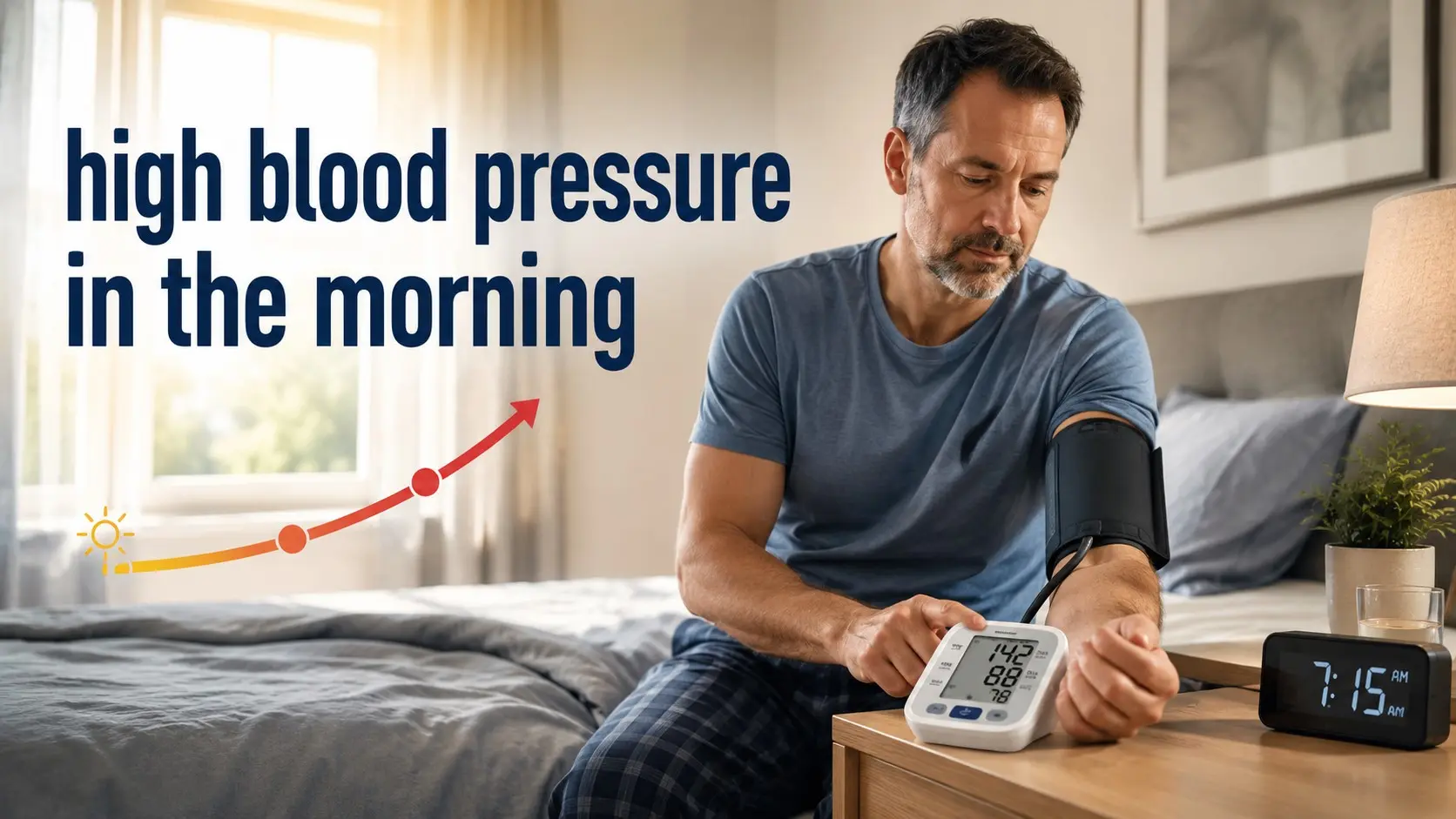
high blood pressure in the morning can happen because blood pressure naturally rises as your body wakes up.
That rise is normal.
Repeated high readings are different.
They can point to hypertension that is not fully controlled, poor sleep, sleep apnea, medicine issues, or blood pressure that stayed high during the night.
Before blaming your heart, make sure the measurement itself is reliable.
Quick Answer: Why Is Blood Pressure High in the Morning?
High blood pressure in the morning can reflect the normal rise that happens as you wake, but repeated high readings deserve attention. Poor measurement, sleep apnea, poor sleep, missed medicine, kidney disease, diabetes, stress, and blood pressure that remains high overnight can all contribute to the pattern.
Medical note: I am not a dermatologist or A doctor, and this content does not replace professional medical advice. What I share comes from real-life experience, extensive research, and consultation with healthcare providers. Always consult qualified medical professionals for diagnosis and treatment of any health condition.
Why Does Blood Pressure Rise After Waking?
Your blood pressure is not meant to stay at one number all day.
It follows a daily rhythm.
During sleep, blood pressure is usually lower.
As morning approaches, your body prepares to wake.
Your nervous system becomes more active.
Hormones change.
Your heart and blood vessels prepare for sitting, standing, walking, eating, and beginning the day.
Blood pressure starts to rise.
Mayo Clinic explains that pressure normally begins rising a few hours before waking and continues to increase during the day.
This natural change is part of your circadian blood pressure pattern.
For the broader relationship between sleep and cardiovascular health, read Sleep and Heart Health.
You can also explore the Heart and Cardiovascular Health Hub for more blood pressure and circulation guides.
A Normal Morning Rise Is Not the Same as Morning Hypertension
These terms sound similar.
They do not mean exactly the same thing.
Morning blood pressure rise is the normal increase that happens as you move from sleep to wakefulness.
Morning hypertension means your blood pressure is repeatedly high during the morning.
Morning blood pressure surge describes how much pressure rises from nighttime or the period before waking to the period after waking.
A person can have one without the others.
That distinction matters.
What Blood Pressure Is High in 2026?
The current American Heart Association and American College of Cardiology guideline was published in 2025.
It keeps these adult blood pressure categories:
| Category | Systolic Pressure | Diastolic Pressure |
|---|---|---|
| Normal | Below 120 | Below 80 |
| Elevated | 120 to 129 | Below 80 |
| Stage 1 hypertension | 130 to 139 | 80 to 89 |
| Stage 2 hypertension | 140 or higher | 90 or higher |
These categories apply to properly measured averages.
They are not meant to turn one morning reading into a diagnosis.
The current guideline also emphasizes home blood pressure monitoring as part of proper blood pressure management.
Does One High Morning Reading Mean You Have Hypertension?
No.
One measurement is one moment.
Your pressure can change because you:
- Just walked across the room
- Did not rest before checking
- Needed to use the bathroom
- Were talking
- Had caffeine
- Smoked
- Exercised
- Felt anxious
- Used the wrong cuff size
That is why I would never diagnose morning hypertension from one home reading.
Repeated careful measurements tell you much more.
Is 135 Over 85 Morning Hypertension?
You will see 135 over 85 used on many websites.
That number comes from older home blood pressure and morning hypertension recommendations.
It is still useful historical context.
But I would not treat it as the only modern cutoff.
The current 2025 American guideline defines Stage 1 hypertension from an average pressure of 130 over 80.
Different countries and monitoring methods also use different thresholds.
So do not mix numbers from different guidelines and assume they all answer the same question.
Use the target recommended for your health history and treatment plan.
Is 130 Over 80 High in the Morning?
Under the current American classification, an average pressure of 130 systolic or 80 diastolic falls into Stage 1 hypertension.
One reading of 130 over 80 does not mean you have confirmed hypertension.
Imagine this:
Monday: 131 over 80.
Tuesday: 118 over 73.
Wednesday: 121 over 76.
That is different from seeing 134 over 84 every morning for two weeks.
The average matters.
Is 140 Over 90 High in the Morning?
Yes.
An average pressure of at least 140 systolic or 90 diastolic falls within Stage 2 hypertension under the current American classification.
If properly taken morning measurements keep landing in this range, show the record to your healthcare professional.
This is especially important if you already take blood pressure medicine.
What About 150 Over 90 in the Morning?
That is clearly high.
Do not panic over one reading.
Check your technique.
Sit quietly.
Repeat the measurement.
If similar readings continue over several days, contact your healthcare professional.
Do not take an extra tablet unless your clinician has already given you a specific plan for doing so.
What If Morning Blood Pressure Is 160 Over 100?
A repeated pressure around 160 over 100 deserves medical review.
First make sure the reading is real.
Rest quietly.
Check your cuff position.
Repeat the measurement.
If pressures remain around this level, contact your healthcare professional rather than waiting for weeks.
If you are already taking treatment, the pattern can suggest that your blood pressure control needs review.
What If Blood Pressure Is Over 180 Over 120?
This requires more caution.
The American Heart Association classifies pressure above 180 over 120 as severe hypertension.
If you get a reading above this level, sit quietly and repeat it after at least one minute.
If it remains very high, contact a healthcare professional promptly.
If a pressure above 180 over 120 comes with:
- Chest pain
- Shortness of breath
- New weakness
- Numbness
- Vision change
- Difficulty speaking
- Severe neurologic symptoms
seek emergency medical help.
Do not wait to see whether the pressure improves later in the day.
Morning Hypertension Is Different From a Morning Blood Pressure Surge
This difference is important.
Imagine two adults.
Example One
Nighttime pressure: 105 over 65.
Morning pressure: 138 over 82.
That is a noticeable increase.
Example Two
Nighttime pressure: 138 over 84.
Morning pressure: 142 over 86.
The morning increase is much smaller.
But the second person was already hypertensive during sleep.
A small morning rise does not automatically mean a healthier daily blood pressure pattern.
What Is the Morning Blood Pressure Surge?
The morning blood pressure surge is the increase in pressure around the time you wake.
Researchers have measured it in several ways.
Some compare morning pressure with the lowest nighttime value.
Others compare the hours after waking with the hours before waking.
That creates a problem.
There is no single universal calculation.
An open systematic review found seven different definitions across the research it examined.
It also found no clear universal threshold that tells us exactly when a surge becomes pathological.
This is why I would not tell you that a surge of one exact number is automatically dangerous.
Does a Large Morning Surge Increase Stroke Risk?
The research suggests an association.
But the details matter.
The systematic review found that larger morning surges were associated with greater stroke risk when researchers treated the surge as a continuous measure.
Results became less consistent when studies tried to divide people into normal and abnormal groups using fixed thresholds.
That tells me something practical.
Do not chase one magic surge value.
Focus on controlling your blood pressure across the whole day and night.
Your Morning Pressure Can Be High Because It Never Fell at Night
This is another point that gets missed.
Normal blood pressure usually falls while you sleep.
This is sometimes called nighttime dipping.
Mayo Clinic describes a fall of less than 10 percent during sleep as a nondipping blood pressure pattern.
If your pressure stays high overnight, you can wake with a high number without having an unusually large morning surge.
That is why a morning home reading cannot tell you exactly what happened all night.
What Is Nocturnal Hypertension?
Nocturnal hypertension means blood pressure remains too high during sleep.
This matters because blood pressure should normally fall at night.
A person with normal office readings can still have abnormal nighttime pressure.
That is one reason sleep and blood pressure deserve to be considered together.
Read Sleep and Heart Health for the wider connection.
How Can You Measure Blood Pressure While You Sleep?
You cannot do this well with an ordinary home cuff while sleeping.
The usual medical tool is ambulatory blood pressure monitoring.
This is often called ABPM.
You wear a portable cuff for about 24 hours.
It measures your pressure many times while you:
- Work
- Walk
- Rest
- Eat
- Sleep
The result can reveal:
- Daytime hypertension
- Nighttime hypertension
- Nondipping
- Morning hypertension
- Masked hypertension
- Large daily changes
If your morning pattern makes little sense, ABPM can answer questions that an ordinary home reading cannot.
Could Your Morning Blood Pressure Reading Be Wrong?
Yes.
And I would check this before searching for a rare disease.
Blood pressure measurement is easy to distort.
Your reading can rise if you:
- Measure immediately after walking
- Talk during the test
- Drink coffee first
- Smoke first
- Exercise first
- Have a full bladder
- Cross your legs
- Do not support your back
- Let your arm hang below heart level
- Use a cuff that is too small
- Place the cuff over clothing
Before worrying about high blood pressure after waking, make sure the reading deserves to be trusted.
How Should You Measure Blood Pressure in the Morning?
I would keep the routine simple and repeatable.
- Use the bathroom first.
- Avoid coffee before the measurement.
- Do not exercise first.
- Sit quietly for at least five minutes.
- Keep your back supported.
- Place both feet flat on the floor.
- Use a validated upper arm cuff on bare skin.
- Support your arm at heart level.
- Do not talk.
- Take two readings one minute apart.
- Record both readings.
The American Heart Association recommends two readings one minute apart when measuring at home.
Consistency gives you a useful trend.
Random checking does not.
Should You Check Blood Pressure the Second You Wake Up?
No.
You do not need to measure while you are still lying in bed.
But do not wait until after coffee, a shower, exercise, breakfast, and an argument either.
Use the bathroom.
Sit correctly.
Rest quietly for five minutes.
Then measure.
The goal is a repeatable resting morning measurement.
Why Does a Full Bladder Matter?
A full bladder can temporarily raise blood pressure.
This is a simple measurement problem that can easily happen first thing in the morning.
Use the bathroom before checking.
It makes the morning routine more consistent.
Can Coffee Raise Morning Blood Pressure?
Caffeine can temporarily raise blood pressure in some people.
That makes a post coffee reading harder to compare with a pre coffee reading from yesterday.
The American Heart Association recommends avoiding caffeine for at least 30 minutes before a resting blood pressure measurement.
This does not mean everyone with hypertension must stop coffee.
It means measurement conditions should stay consistent.
Can Morning Stress Raise Blood Pressure?
Yes.
Your alarm goes off.
You check email.
You are late.
You rush around the house.
Then you sit for 30 seconds and check your pressure.
That is not a rested measurement.
Stress and activity can temporarily raise blood pressure.
Five quiet minutes before measuring make the result more useful.
Can Poor Sleep Raise Morning Blood Pressure?
Yes.
Poor sleep can interfere with the normal fall in nighttime blood pressure.
It can also increase sympathetic nervous system activity.
One poor night does not diagnose hypertension.
But repeated high morning pressure plus poor sleep is more interesting.
Look for:
- Frequent waking
- Short sleep
- Loud snoring
- Morning headaches
- Daytime sleepiness
- Breathing pauses during sleep
That leads to another important cause.
Sleep Apnea Can Keep Morning Blood Pressure High
Obstructive sleep apnea interrupts breathing during sleep.
Oxygen levels change.
Your nervous system becomes more active.
Sleep becomes fragmented.
Blood pressure can stay higher than expected during the night.
Mayo Clinic lists obstructive sleep apnea among conditions linked with abnormal daily blood pressure patterns.
If you have persistent morning hypertension plus loud snoring, gasping, breathing pauses, morning headaches, or major daytime sleepiness, tell your healthcare professional.
Do not treat the morning number and ignore the sleep problem.
Can Kidney Disease Cause High Morning Blood Pressure?
Yes.
Your kidneys play a major role in controlling fluid, sodium, hormones, and blood pressure.
Kidney disease can contribute to difficult blood pressure control.
Mayo Clinic includes kidney disease among conditions associated with irregular daily pressure patterns.
A high morning reading does not prove that your kidneys are damaged.
Persistent hypertension can justify a wider medical evaluation based on your history and other findings.
For kidney focused guidance, use the Kidney Health and Disease Hub.
Can Diabetes Affect Morning Blood Pressure?
Yes.
Diabetes and hypertension frequently occur together.
Diabetes can also affect the kidneys, blood vessels, and autonomic nervous system.
Mayo Clinic includes diabetes among conditions associated with abnormal daily blood pressure patterns.
If you have diabetes, morning pressure is only one part of your cardiovascular risk picture.
For more, visit the Diabetes and Blood Sugar Management Hub.
Can Thyroid Disease Change Blood Pressure Patterns?
Yes.
Thyroid hormones affect heart rate, metabolism, and cardiovascular function.
Mayo Clinic lists thyroid disease as one possible contributor to abnormal daily blood pressure patterns.
A morning pattern cannot diagnose a thyroid problem.
Blood tests and clinical assessment are needed if thyroid disease is suspected.
Can Shift Work Affect Morning Blood Pressure?
Yes.
Your biological morning does not always match the clock.
A night worker who sleeps from 8 AM to 3 PM has a very different sleep wake cycle from someone who sleeps at night.
This can change circadian rhythms, sleep quality, stress, meals, and blood pressure patterns.
Do not force a standard 7 AM blood pressure routine onto a schedule built around night work.
The useful measurement period is tied to your waking routine.
Shift work and other cross system issues are covered in the Special Health Topics Hub.
Could Blood Pressure Medicine Be Wearing Off Before Morning?
It is possible.
A medicine must provide enough control across the period it is meant to cover.
Morning hypertension in someone already receiving treatment can raise questions about:
- Medicine choice
- Dose
- Duration of action
- Missed doses
- Drug combinations
- Interactions
- Sleep apnea
- Underlying disease
The correct next step is a medication review.
It is not changing the prescription yourself.
Should You Move Blood Pressure Medicine to Bedtime?
Not automatically.
This is one piece of internet advice I would not follow blindly.
The large TIME randomized trial compared evening and morning use of usual blood pressure medicines.
It found no difference in major cardiovascular outcomes.
The 2025 BedMed trial reached a similar conclusion.
Bedtime administration was safe in the trial, but it did not reduce major cardiovascular events or death compared with morning dosing.
That means the evidence does not support one universal rule saying everyone should take blood pressure medicine at night.
Take your medicine at the time recommended by your prescriber.
If morning readings stay high, show the pattern to the clinician and let them decide whether the medicine, dose, duration, combination, or timing needs adjustment.
What If You Miss Blood Pressure Medicine?
Missed doses can produce inconsistent blood pressure control.
If you have been prescribed treatment, taking it reliably matters.
If adherence is difficult because of:
- Side effects
- Cost
- Work schedule
- Forgetfulness
- Too many tablets
- A complicated routine
tell your healthcare team.
That is a treatment problem that can often be improved.
Do not hide missed doses and then assume the medicine itself has failed.
Can Cold Medicine Raise Morning Blood Pressure?
Some products can.
Decongestants can raise blood pressure in some people.
Some nonprescription pain medicines can also affect blood pressure.
If your morning readings suddenly become higher, review everything you started recently.
That includes:
- Cold medicine
- Pain relievers
- Supplements
- Energy products
- Prescription medicines
Do not look only at medicines labeled for blood pressure.
What If the First Morning Reading Is High and the Second Is Lower?
This happens often.
Do not keep measuring until you find a number you like.
Take two careful readings about one minute apart.
Record both.
For example:
First reading: 148 over 88.
Second reading: 137 over 82.
That difference shows why one reading is a poor summary of your blood pressure.
The American Heart Association recommends multiple readings because each measurement is only a snapshot.
Should You Average Your Morning Blood Pressure?
Yes, if your clinician is using home monitoring to assess your blood pressure.
Averages are more useful than picking your highest or lowest result.
A structured home record can include morning and evening measurements over several days.
Use the same technique each time.
This gives your healthcare professional a better picture than a random collection of readings taken whenever you feel worried.
A Seven Day Log Can Show the Pattern
I prefer a structured record.
For about one week, write down:
- Date
- Time
- First morning reading
- Second morning reading
- Evening readings
- Medication timing
- Sleep quality
- Caffeine timing
- Exercise
- Symptoms
You do not need to measure every hour.
You need comparable readings.
A pattern beats panic checking.
Can High Morning Blood Pressure Cause Headaches?
Most ordinary hypertension does not cause a clear symptom.
You cannot tell whether your blood pressure is high simply from how your head feels.
Morning headaches have many possible causes.
Sleep apnea is one.
Migraine is another.
Poor sleep is another.
Very severe hypertension with neurologic or cardiovascular symptoms is a different situation.
Measure rather than guessing.
Can Anxiety Explain High Morning Blood Pressure?
Anxiety can temporarily raise blood pressure.
It cannot automatically explain repeated high readings measured properly over many days.
I would avoid both extremes.
Do not dismiss every high number as anxiety.
Do not diagnose yourself with chronic hypertension after one stressful morning.
Collect better data.
What Is Masked Hypertension?
Masked hypertension means your pressure can look normal in the medical office but be high outside it.
Morning home measurements can help reveal this pattern.
The 2025 guideline places strong emphasis on home blood pressure monitoring because out of office measurements provide information the clinic cannot always capture.
If your office readings are normal but your carefully measured home averages remain high, tell your healthcare professional.
What Is White Coat Hypertension?
White coat hypertension is the opposite pattern.
Your pressure is high around medical visits but lower during normal life.
This is another reason home and ambulatory data are useful.
One location does not always describe your full blood pressure pattern.
Is Morning Blood Pressure More Important Than Evening Blood Pressure?
I would not choose one.
Morning pressure matters.
Evening pressure matters.
Nighttime pressure matters.
Your average matters.
Your cardiovascular system runs 24 hours a day.
The goal is not to produce one perfect reading after waking.
The goal is reliable blood pressure control across your daily cycle.
Can Exercise Change Morning Blood Pressure?
Yes.
Exercise changes cardiovascular function for a period after activity.
Do not complete a workout and immediately call the next reading your resting blood pressure.
The American Heart Association recommends avoiding exercise for at least 30 minutes before measuring resting blood pressure.
For the exercise specific pattern, read Blood Pressure After Exercise.
You can also compare cardiovascular recovery with Heart Rate Recovery After Exercise.
What If Blood Pressure Falls When You Get Out of Bed?
That is a different pattern.
If you become dizzy after standing and your pressure drops rather than rises, think about an orthostatic problem.
Orthostatic hypotension refers to a qualifying blood pressure fall after standing.
Read Orthostatic Hypotension Symptoms if dizziness after getting out of bed is your main concern.
High Morning Blood Pressure and Pulse Pressure Are Different
Pulse pressure is the difference between your systolic and diastolic numbers.
For example:
150 over 80 gives a pulse pressure of 70.
That calculation tells you nothing about how much your blood pressure rose after waking.
Different number.
Different question.
Read Pulse Pressure Meaning.
What If Only the Bottom Number Is High?
A morning blood pressure reading can be abnormal because:
- The systolic number is high
- The diastolic number is high
- Both are high
If your main concern is a repeated high bottom number, read High Diastolic Blood Pressure.
If your bottom number is unusually low, see Low Diastolic Blood Pressure.
Does Sleeping Heart Rate Tell You Anything About Morning Pressure?
Heart rate and blood pressure are related cardiovascular signals.
They are not interchangeable.
A low sleeping heart rate does not tell you whether your morning blood pressure will be high.
For sleeping pulse, read Normal Heart Rate During Sleep.
For heartbeat interval patterns, read Heart Rate Variability Normal Range.
Lifestyle Changes Help the Pattern Over Time
The 2025 hypertension guideline strongly supports lifestyle changes for preventing and treating high blood pressure.
These include:
- A heart healthy eating pattern
- Reducing excess sodium
- Adequate dietary potassium when medically appropriate
- Regular physical activity
- Healthy weight management
- Stress management
- Reducing or avoiding alcohol
These are long term strategies.
They are not emergency tricks for making today's cuff number fall.
Do not exercise hard, drink excessive water, or take supplements because one morning reading frightened you.
For sustainable habits, use the General Wellness and Lifestyle Hub.
Common High Blood Pressure in the Morning Myths
Myth: Any Morning Rise Is Dangerous
False.
Blood pressure normally rises as you wake.
Myth: 135 Over 85 Is the Only Morning Hypertension Cutoff
False.
Different guidelines and monitoring methods use different thresholds.
Myth: A Large Morning Surge Has One Dangerous Number
False.
Research uses several definitions, and there is no universal pathological cutoff.
Myth: Bedtime Blood Pressure Medicine Is Always Better
False.
Large randomized trials do not show a universal cardiovascular advantage from routine bedtime dosing.
Myth: One High Reading Means You Have Hypertension
False.
Diagnosis depends on properly measured averages and clinical context.
Myth: If You Feel Fine, Your Blood Pressure Must Be Normal
False.
High blood pressure often has no obvious symptoms.
My Approach to High Blood Pressure in the Morning
I think the easiest mistake is treating the clock as the diagnosis.
Morning matters.
Measurement quality comes first.
Then the pattern matters.
My background in information technology management trained me to check the quality of data before interpreting what the numbers mean.
I now use the same approach when researching health information for NextFitLife.
For this guide, I compared the current 2025 American blood pressure guideline, American Heart Association home monitoring guidance, Mayo Clinic information about daily blood pressure patterns, open research on the morning blood pressure surge, and randomized clinical trials about medication timing.
My sequence is simple.
First, prove the morning measurement is reliable.
Second, see whether the pattern repeats.
Third, compare morning with evening.
Fourth, ask what may be happening during sleep.
Fifth, review medicine and sleep without changing treatment on your own.
That produces much better information than reacting to one frightening number.
Conclusion: High Blood Pressure in the Morning Needs a Pattern
high blood pressure in the morning can be part of the normal wake response, but repeated high readings deserve attention.
Measure correctly.
Take two readings.
Track morning and evening values.
Do not change medicine timing on your own.
Your next step: Build a consistent home blood pressure record and show repeated high morning readings to your healthcare professional. Ask whether medication review, sleep apnea assessment, or 24-hour ambulatory monitoring would help explain the pattern.
References and Sources
This article was checked against current cardiovascular guidance and publicly accessible medical research.
- American Heart Association and American College of Cardiology. 2025 High Blood Pressure Guideline.This is the current major American adult hypertension guideline. It provides the modern blood pressure categories, treatment targets, lifestyle recommendations, home monitoring guidance, and recommendations for severe hypertension.
- Mayo Clinic. Blood Pressure: Does It Have a Daily Pattern?Mayo Clinic explains the normal daily blood pressure rhythm, the rise before waking, nighttime blood pressure, nondipping, morning hypertension, sleep apnea, kidney disease, diabetes, thyroid disease, and the role of 24 hour monitoring.
- American Heart Association. Home Blood Pressure Monitoring.This current patient resource explains validated upper arm monitors, correct cuff placement, repeated readings, recording results, and proper home measurement technique.
- Sheppard JP and colleagues. Prognostic Significance of the Morning Blood Pressure Surge in Clinical Practice: A Systematic Review.This open access review examined definitions of the morning blood pressure surge and cardiovascular outcomes. It found seven definitions and no clear universal pathological threshold.
- Mackenzie IS and colleagues. Cardiovascular Outcomes With Evening Versus Morning Antihypertensive Dosing: The TIME Study.This large open-access randomized trial found no cardiovascular outcome advantage from routine evening dosing compared with morning dosing of usual blood pressure medicines.
Additional Current Evidence: The 2025 BedMed randomized trial also found no reduction in death or major cardiovascular events from routine bedtime dosing compared with morning administration.
Source Review Date: September 1, 2026
These organizations and researchers do not endorse NextFitLife.
Continue Reading on NextFitLife
Main Health Hub: NextFitLife Health Hub
Primary Sub Hub: Heart and Cardiovascular Health
Sleep and Wellness: General Wellness and Lifestyle
About the Author
Adel Galal is the founder and lead writer at NextFitLife.
NextFitLife publishes evidence-informed guidance about health, fitness, foods and nutrition, sleep, cardiovascular health, beauty, and healthy aging for adults.
Adel has maintained a personal interest in health, fitness, nutrition, sleep, wellness, and healthy aging for more than 30 years.
He has written about health and wellness for more than 15 years.
Before focusing on NextFitLife, Adel spent 29 years working in information technology management.
That background developed his skills in data analysis, structured research, source comparison, information management, systems thinking, and problem solving.
At NextFitLife, he uses those skills to compare reputable medical sources, check how health measurements are collected, separate association from proof, and make uncertainty clear when research does not support a simple answer.
For this article, his focus is on explaining why one morning blood pressure number should not be interpreted without checking measurement technique, repeated readings, nighttime blood pressure, sleep, medication, and the wider cardiovascular pattern.
I am not a dermatologist or A doctor, and this content does not replace professional medical advice. What I share comes from real-life experience, extensive research, and consultation with healthcare providers. Always consult qualified medical professionals for diagnosis and treatment of any health condition.
Read more about Adel Galal, NextFitLife, and our editorial and source checking process.
Frequently Asked Questions About High Blood Pressure in the Morning
Why is my blood pressure high in the morning?
Blood pressure normally rises as your body wakes. Repeated high morning readings can also be linked with hypertension, poor sleep, sleep apnea, missed medicine, nighttime hypertension, kidney disease, diabetes, stress, or measurement problems.
Is blood pressure naturally higher after waking?
Blood pressure normally begins rising before you wake and continues to increase as daytime activity begins. A normal rise is different from repeated morning hypertension.
Is 130 over 80 high in the morning?
Under the current American guideline, an average blood pressure of 130 systolic or 80 diastolic falls within Stage 1 hypertension. One isolated reading does not confirm hypertension.
Is 140 over 90 high in the morning?
Yes. An average pressure of 140 systolic or 90 diastolic meets Stage 2 hypertension criteria under the current American classification.
What is the morning blood pressure surge?
The morning blood pressure surge is the increase in pressure from sleep or the period before waking to the hours after waking. Researchers use several methods to calculate it.
Is there a dangerous morning blood pressure surge number?
No universal cutoff has been established. Research uses several definitions, and systematic review evidence does not support one single pathological threshold.
What is nondipping blood pressure?
Nondipping means blood pressure fails to fall normally during sleep. Mayo Clinic describes a nighttime reduction of less than 10 percent as a nondipping pattern.
Can sleep apnea cause high blood pressure in the morning?
Yes. Sleep apnea can increase nervous system activity, disturb normal nighttime blood pressure reduction, and contribute to high nighttime and morning pressure.
Can poor sleep raise morning blood pressure?
Yes. Poor or fragmented sleep can interfere with normal nighttime cardiovascular regulation and contribute to higher morning readings.
Should I take blood pressure medicine at night if my morning reading is high?
Do not change medicine timing on your own. Large randomized trials have not shown a universal cardiovascular advantage from routine bedtime dosing compared with morning dosing.
Can coffee raise my morning blood pressure reading?
Caffeine can temporarily raise blood pressure in some people. Avoid caffeine for at least 30 minutes before a resting blood pressure measurement.
How should I check blood pressure in the morning?
Use the bathroom, sit quietly for five minutes, keep your back supported and feet flat, support your arm at heart level, use a validated upper arm cuff, and take two readings one minute apart.
Why is my second blood pressure reading lower?
The first reading can be higher because you have not fully relaxed. This is one reason the American Heart Association recommends taking multiple readings and recording them.
Can kidney disease cause morning hypertension?
Kidney disease can contribute to difficult blood pressure control and abnormal daily blood pressure patterns, but one morning reading cannot diagnose kidney disease.
When should high morning blood pressure be checked by a doctor?
Get medical advice when properly measured morning readings remain high over several days, especially if you already take treatment or have diabetes, kidney disease, heart disease, or sleep apnea symptoms.
When is very high morning blood pressure an emergency?
A reading above 180 over 120 with chest pain, breathing difficulty, new weakness, numbness, vision change, speech trouble, or other serious symptoms requires emergency medical help.

Health & wellness writer with 30+ years of experience in nutrition, fitness, and healthy aging. Founder of NextFitLife.com — evidence-based health guidance.