Last Updated: September 1, 2026
Sources Checked: September 1, 2026
Next Review: September 2027, or sooner if major blood pressure guidance changes
Written and Source Checked by: Adel Galal, Founder and Lead Writer at NextFitLife
Review Status: Updated using current American Heart Association guidance, NICE hypertension guidance, and recent open cardiovascular research. This article has not been independently medically reviewed by a licensed clinician.
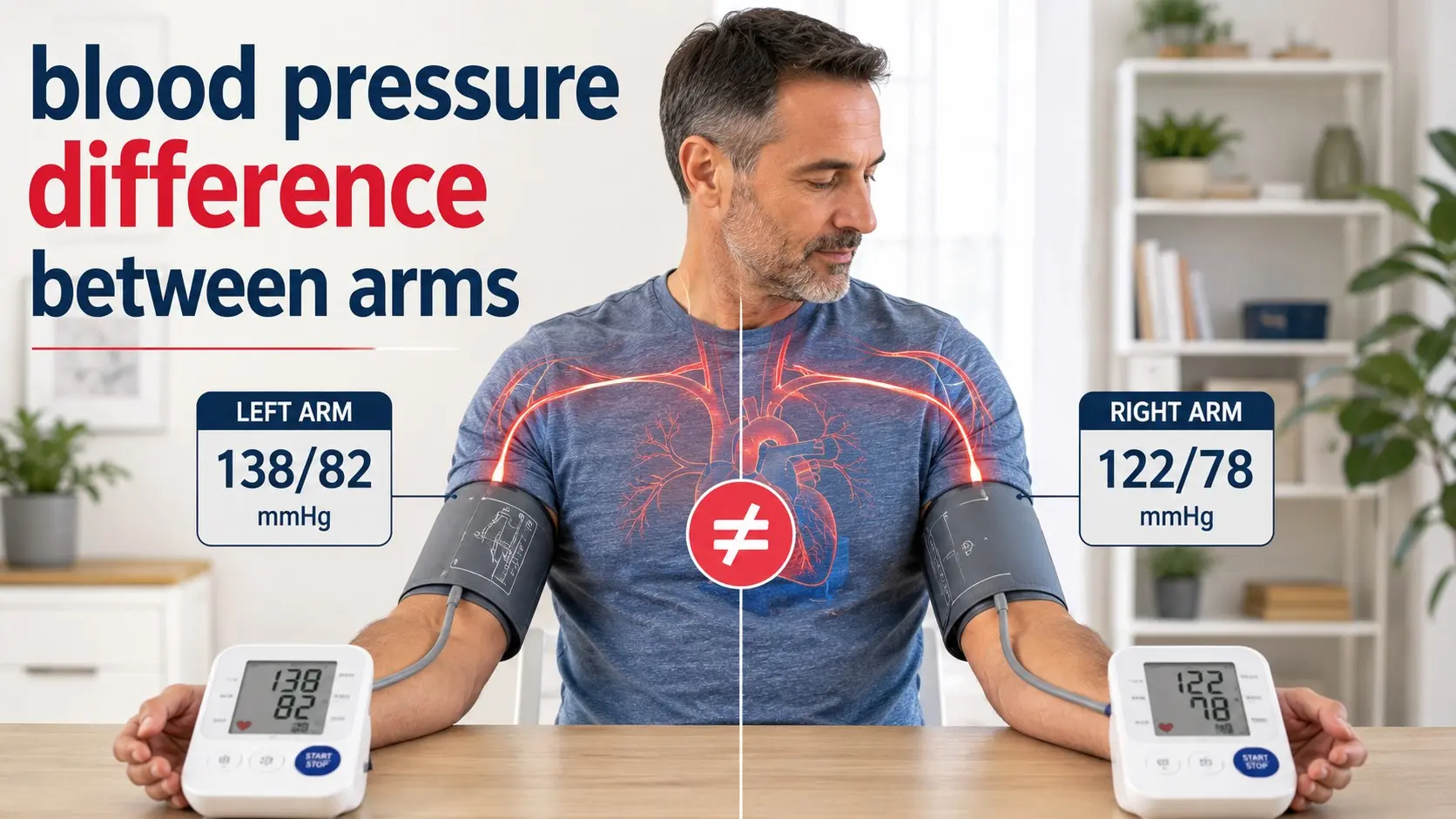
blood pressure difference between arms is common when the gap is small or appears only once.
The issue becomes more useful when the same arm keeps reading higher.
A repeated systolic difference around 10 mm Hg deserves attention.
A difference above 15 mm Hg should be confirmed.
If the gap remains, future blood pressure checks should usually use the arm with the higher reading.
Quick Answer: How Much Difference Between Arms Is Normal?
Blood pressure difference between arms is often small. A repeated systolic gap around 10 mm Hg or more deserves attention. NICE advises repeating measurements when the difference is above 15 mm Hg. If it stays above 15, future readings should use the arm with the higher pressure.
Medical note: I am not a dermatologist or A doctor, and this content does not replace professional medical advice. What I share comes from real-life experience, extensive research, and consultation with healthcare providers. Always consult qualified medical professionals for diagnosis and treatment of any health condition.
Why Can Blood Pressure Be Different in Each Arm?
Your arms are supplied by different branches of your arterial system.
The readings do not need to match perfectly.
Blood pressure also changes from minute to minute.
A small difference can come from:
- Normal body variation
- Measurement order
- Arm position
- Cuff size
- Talking
- Muscle tension
- Not resting long enough
So if one arm reads 126 over 78 and the other reads 122 over 76, I would not treat that as a warning sign.
The more useful question is whether the gap is larger and keeps appearing.
This article belongs to the NextFitLife Heart and Cardiovascular Health Hub, where you can explore blood pressure, circulation, heart rhythm, and cardiovascular risk.
What Is a Normal Blood Pressure Difference Between Arms?
There is no rule saying both arms must show the exact same number.
The strongest modern research focuses on the systolic interarm difference.
The large INTERPRESS analysis combined data from more than 53,000 people.
It proposed 10 mm Hg as the upper limit of normal for systolic difference between arms.
This does not mean 10 mm Hg proves disease.
It means larger persistent differences become more useful as cardiovascular risk markers.
| Systolic Difference | Practical Meaning |
|---|---|
| Less than 10 mm Hg | Usually a small difference |
| Around 10 to 15 mm Hg | Repeat carefully and document the pattern |
| More than 15 mm Hg | Confirm with repeat measurements and use the higher arm if persistent |
| 20 mm Hg or more | Persistent gaps deserve medical assessment for possible vascular causes |
These are practical guideposts.
They are not diagnostic cutoffs for blocked arteries.
Why Do Some Sources Say 10 mm Hg and Others Say 15?
Because the numbers answer different questions.
Research on cardiovascular risk suggests that a repeated systolic difference around 10 mm Hg deserves attention.
NICE uses a more practical clinical threshold.
Its hypertension guidance says to measure both arms.
If the difference is more than 15 mm Hg, repeat both measurements.
If it remains above 15 mm Hg, use the arm with the higher pressure for future checks.
So 10 and 15 are not really competing numbers.
Think of them this way:
10 mm Hg is a useful cardiovascular signal.
15 mm Hg is a clear practical trigger for confirmation and choosing the higher arm.
One Pair of Readings Is Not Enough
This is where home monitoring can create unnecessary fear.
Imagine:
Right arm: 144 over 84.
Left arm: 129 over 80.
That is a 15 mm Hg systolic gap.
Now you rest longer and repeat the comparison.
Right arm: 134 over 81.
Left arm: 131 over 80.
The gap is now only 3 mm Hg.
The first pair did not prove an arterial blockage.
The repeated pattern matters more.
Why Measuring One Arm First Can Create a False Gap
This is one of the easiest mistakes to miss.
Your first blood pressure reading can be higher because you are still settling down.
Then you measure the second arm a minute later.
You are calmer.
The second reading falls.
It can look as if the first arm is truly higher.
The American Heart Association measurement statement specifically warns that sequential readings can show an artificial difference because the person becomes more accustomed to the measurement.
This is why one arm should not be declared the higher arm from one rushed comparison.
Does Measuring Both Arms at the Same Time Help?
Yes, in research.
Simultaneous measurements reduce the effect of blood pressure changing between the first and second reading.
Most people do not have two identical monitors at home.
You do not need them.
The practical approach is simpler.
Use one validated upper arm monitor.
Measure carefully.
Compare both arms.
Then repeat the comparison on another occasion.
A stable pattern is more useful than one perfect experiment.
Which Arm Should You Use for Future Blood Pressure Checks?
Use the higher arm once the difference has been confirmed.
This is a key recommendation from major blood pressure guidance.
The American Heart Association says both arms should be checked during initial assessment.
Future readings should then use the arm with the higher pressure.
Mayo Clinic gives the same practical advice.
Why?
Because the lower arm can underestimate your actual systemic blood pressure.
This is especially important if you are being evaluated or treated for hypertension.
Using the Lower Arm Can Hide High Blood Pressure
Consider this example.
Right arm: 142 over 84.
Left arm: 126 over 78.
If you always use the left arm, your pressure looks much better.
That can affect:
- Hypertension diagnosis
- Treatment decisions
- Medication changes
- Assessment of blood pressure control
- Cardiovascular risk estimates
A recent 2025 ECHORN cohort study showed why this matters.
Using the higher arm rather than the lower arm moved about 1 in 10 participants across the 130 mm Hg systolic threshold.
That is not a tiny technical detail.
Arm choice can change how blood pressure is classified.
Does It Matter Whether the Left or Right Arm Is Higher?
Usually, no.
Your left arm is not supposed to be higher.
Your right arm is not supposed to be higher.
The important points are:
- How large is the gap?
- Does it repeat?
- Is the same arm consistently higher?
- Are there symptoms?
- Do you have vascular risk factors?
The magnitude and consistency matter more than the side.
What If the Right Arm Is 10 mm Hg Higher?
Repeat the comparison.
For example:
Right arm: 132 over 78.
Left arm: 122 over 77.
That is a 10 mm Hg systolic gap.
If the next comparison shows only 3 or 4 mm Hg, the first result was probably not very informative.
If the right arm stays about 10 to 12 mm Hg higher on repeated careful checks, document it.
Use the higher arm for future blood pressure tracking.
Mention the pattern during your cardiovascular assessment.
What If One Arm Is 15 mm Hg Higher?
I would confirm it.
NICE recommends repeating both arms when the difference is more than 15 mm Hg.
If the gap stays above 15 mm Hg, future measurements should use the arm with the higher pressure.
A persistent gap this size is not proof of blocked arteries.
But it deserves more attention than a 3 mm Hg difference.
What About a 20 mm Hg Difference?
A repeated 20 mm Hg difference deserves medical review.
Large persistent gaps are more likely to reflect a real physiological difference than a small one-time mismatch.
A clinician may review:
- Your pulses
- Your arm symptoms
- Your blood pressure history
- Smoking history
- Diabetes
- Cholesterol
- Kidney health
- Other signs of vascular disease
Further vascular testing is based on the full picture.
Not everyone with a 20 mm Hg home difference has a blocked artery.
Why Can One Arm Read Lower?
This is a point many people get backwards.
Suppose:
Right arm: 150 over 82.
Left arm: 121 over 78.
You might assume the right arm is the abnormal one because the number is high.
That is not always true.
If an artery supplying the left arm is narrowed, pressure beyond that narrowing can be lower.
The lower arm can therefore be the arm affected by reduced blood flow.
That is another reason clinicians use the higher blood pressure arm when managing systemic hypertension.
What Can Cause a Persistent Difference Between Arms?
A persistent gap can have several explanations.
One is arterial narrowing.
Possible vascular causes include:
- Subclavian artery stenosis
- Peripheral artery disease
- Upper limb arterial obstruction
- Coarctation of the aorta
- Some forms of vascular inflammation
- Other structural arterial problems
These are possibilities.
A blood pressure cuff cannot tell you which cause is present.
What Is Subclavian Artery Stenosis?
The subclavian arteries help carry blood toward your arms.
If one becomes narrowed, blood pressure can become lower in that arm.
This is called subclavian artery stenosis.
A large persistent arm difference can be a clue.
It is not a diagnosis.
Not every interarm difference comes from one obvious arterial blockage.
Blood vessel stiffness, generalized atherosclerosis, measurement variation, and other vascular factors can also play a role.
Can a Difference Between Arms Signal Peripheral Artery Disease?
It can be associated with it.
Peripheral artery disease means arteries supplying the limbs have become narrowed.
People with larger interarm pressure differences are more likely to have other signs of vascular disease.
But an arm difference by itself is not accurate enough to diagnose PAD.
Think of it as a cardiovascular clue.
Not a final test.
What Is the Ankle Brachial Index?
If vascular disease is suspected, doctors can compare pressure at the ankle with pressure in the arm.
This is called the ankle-brachial index.
It is commonly used when checking for reduced blood flow to the legs.
An interarm difference can add to the reason for a vascular assessment.
It does not replace the proper tests.
Is a Blood Pressure Difference Between Arms Linked to Heart Risk?
Yes, at the population level.
The INTERPRESS collaboration included more than 53,000 people from 24 studies.
Larger systolic interarm differences were associated with higher cardiovascular event rates and higher mortality.
The relationship remained after researchers accounted for common cardiovascular risk factors.
But do not turn that into a personal prediction.
A 12 mm Hg difference does not tell you that a heart attack is coming.
It tells you that a persistent larger difference belongs in your wider cardiovascular risk assessment.
What Does the Latest 2025 Research Add?
A newer open study from the ECHORN cohort looked at almost 3,000 adults aged 40 and older.
Blood pressure was measured in both arms at the same time.
About 10.7 percent had a systolic arm difference of at least 10 mm Hg.
About 3.3 percent had a systolic difference of at least 15 mm Hg.
More interestingly, using the higher arm rather than the lower arm moved 10.3 percent of participants from below to above the 130 mm Hg systolic threshold.
That reinforces a very practical lesson.
The arm you use can change whether your blood pressure looks controlled.
Is a 10 mm Hg Difference Dangerous?
I would not call it dangerous.
I would call it worth repeating.
The INTERPRESS collaboration proposed 10 mm Hg as the upper limit of normal for systolic difference.
Risk rises gradually.
There is no cliff at exactly 10.
Your total cardiovascular picture still matters.
That includes:
- Age
- Smoking
- Blood pressure
- Diabetes
- Cholesterol
- Kidney function
- Existing heart or vascular disease
Is a 15 mm Hg Difference More Concerning?
Yes, especially when it repeats.
NICE uses more than 15 mm Hg as the threshold for repeat bilateral measurement.
If the difference remains above 15, use the higher arm.
A 2023 open meta analysis also found that larger systolic interarm differences were associated with cardiovascular and all cause mortality in cohort studies.
That is an association.
It does not prove that the arm difference itself causes those outcomes.
How Common Is a 10 mm Hg Arm Difference?
It is not rare.
The American Heart Association measurement statement cites pooled simultaneous measurement data showing a systolic difference of at least 10 mm Hg in about 11 percent of people with hypertension.
The rate was about 4 percent in the general population.
The recent ECHORN study also found a systolic difference of at least 10 mm Hg in about 1 in 9 participants.
So the finding is common enough that checking both arms makes sense.
Why Is the Difference More Common With Hypertension?
People with hypertension are more likely to have vascular changes over time.
These can include arterial stiffness and atherosclerosis.
This helps explain why larger arm differences appear more often in people with high blood pressure.
There is another problem too.
If a person with hypertension keeps measuring only the lower arm, treatment can look more successful than it really is.
For daily blood pressure patterns, read High Blood Pressure in the Morning.
Does Diabetes Make an Arm Difference More Important?
Diabetes increases cardiovascular and vascular risk.
Research has also found significant arm differences more often in people with diabetes.
That does not mean an interarm difference proves diabetic vascular disease.
It means the result belongs inside a wider risk assessment.
For more, visit the Diabetes and Blood Sugar Management Hub.
What About Kidney Disease?
Kidney disease and cardiovascular disease often overlap.
People with chronic kidney disease can also have a greater burden of vascular disease.
A repeated arm difference in someone with kidney disease therefore deserves context.
The arm difference itself is not a kidney test.
For kidney topics, visit the Kidney Health and Disease Hub.
Can Arm Dominance Explain the Difference?
Not reliably.
Your dominant arm is not automatically supposed to have higher blood pressure.
If you are right handed, a persistent 20 mm Hg gap should not simply be dismissed as normal because the right arm is stronger.
Small differences can be normal.
Large repeated differences deserve better measurement and interpretation.
Can Different Arm Sizes Create a False Difference?
Yes.
Cuff size matters.
A cuff that is too small can give a falsely high reading.
If one upper arm is much larger than the other, make sure the cuff fits each arm correctly.
This is part of good blood pressure measurement accuracy.
The current 2025 American hypertension guideline stresses accurate technique and appropriate cuff sizing because measurement error can change diagnosis and treatment.
Can Arm Position Change the Reading?
Yes.
Both arms need similar positioning.
Your arm should be supported.
The cuff should be around heart level.
Your back should be supported.
Your feet should be flat on the floor.
Do not talk during the measurement.
If one arm hangs at your side while the other rests correctly on a table, you are not making a fair comparison.
How Should You Compare Both Arms at Home?
Use a calm, repeatable method.
- Avoid exercise, smoking, and caffeine for at least 30 minutes.
- Use the bathroom first.
- Sit quietly for at least five minutes.
- Use a validated upper arm monitor.
- Make sure the cuff fits.
- Support your back and feet.
- Support the arm at heart level.
- Measure one arm without talking.
- Allow a short rest.
- Measure the other arm the same way.
- Record both results.
- Repeat the comparison on another day.
You are looking for consistency.
Not one dramatic pair of numbers.
Should You Check Both Arms Every Day?
Usually, no.
The purpose of checking both arms is to find out whether a meaningful persistent difference exists.
Once the higher arm is established, use that arm for routine home monitoring.
Switching randomly between arms can make your blood pressure record harder to interpret.
What If the Higher Arm Changes Every Time?
That makes a fixed arterial problem less convincing.
Monday: right arm higher.
Tuesday: left arm higher.
Wednesday: almost no difference.
This pattern can reflect:
- Normal blood pressure variation
- Measurement order
- Cuff placement
- Different arm position
- Stress
- Not resting long enough
A persistent vascular difference is more convincing when the same arm remains lower or higher.
Should You Focus on Systolic or Diastolic Difference?
Both numbers matter.
But most cardiovascular outcome research focuses on the top number.
That is the systolic interarm difference.
The American Heart Association considers a persistent systolic or diastolic difference of at least 10 mm Hg clinically meaningful.
Still, the evidence linking arm differences with long term cardiovascular risk is stronger for systolic pressure.
What Does a Diastolic Difference Between Arms Mean?
The bottom number can differ too.
A single diastolic difference does not diagnose vascular disease.
Repeat it under good conditions.
If the same arm repeatedly shows a large diastolic difference as well as a systolic difference, include that information when you speak with your healthcare professional.
For focused guidance on the bottom number, read High Diastolic Blood Pressure and Low Diastolic Blood Pressure.
What If One Arm Shows Hypertension and the Other Does Not?
Use the higher arm after confirming the difference.
Example:
Right arm: 136 over 82.
Left arm: 122 over 76.
The right arm meets current American Stage 1 hypertension criteria.
The left arm does not.
Choosing the lower arm could therefore change how your blood pressure is classified.
This is one reason measuring both arms belongs in a proper initial cardiovascular assessment.
Can a Blood Pressure Difference Cause Arm Symptoms?
The number difference itself often causes no symptoms.
If reduced blood flow is present, you may notice:
- Arm fatigue
- Weakness
- Pain with arm use
- Coldness
- A weaker pulse
A persistent lower pressure in one arm plus these symptoms deserves medical assessment.
The concern is the blood flow problem behind the pressure difference.
When Is a New Difference Between Arms an Emergency?
A chronic painless difference found during routine monitoring is usually not an emergency.
A new large difference with severe symptoms is different.
Seek emergency medical help if a new major arm difference appears with:
- Sudden severe chest pain
- Sudden severe upper back pain
- Fainting
- Severe shortness of breath
- Sudden weakness on one side
- New trouble speaking
- Sudden major vision problems
These symptoms can signal a serious cardiovascular or vascular emergency.
Do not stay home repeating the cuff readings.
What Tests Can Be Used If the Difference Persists?
The first step is often simple.
Repeat the blood pressure properly.
If a large difference remains, a clinician can examine:
- Arm pulses
- Blood pressure in both arms
- Heart and vascular sounds
- Arm temperature and circulation
- Other cardiovascular risk factors
Depending on the findings, testing can include:
- Ankle-brachial index
- Vascular ultrasound
- Other arterial imaging
Testing is chosen for the person.
Not everyone with a 10 or 12 mm Hg difference needs imaging.
Does the Difference Itself Need Treatment?
Usually, no.
You treat the cause or the risk factor.
That can mean:
- Controlling high blood pressure
- Managing cholesterol
- Stopping smoking
- Managing diabetes
- Treating peripheral artery disease
- Evaluating a significant arterial narrowing
- Using the higher arm for future blood pressure checks
The goal is not to make the two arm numbers identical.
Does Exercise Change the Arm Difference?
Exercise changes blood pressure.
Do not compare your arms immediately after a workout and call that your resting interarm difference.
Let your cardiovascular system recover.
Measure under resting conditions.
For the separate exercise pattern, read Blood Pressure After Exercise.
What About Morning Blood Pressure?
Morning blood pressure has its own daily pattern.
Do not measure one arm immediately after waking, walk around, then measure the other arm several minutes later.
The difference might reflect time and activity rather than your arteries.
If your main concern is pressure after waking, read High Blood Pressure in the Morning.
Interarm Difference and Pulse Pressure Are Different
These measurements sound related.
They answer different questions.
Suppose:
Right arm: 150 over 80.
Left arm: 132 over 78.
The systolic difference between arms is 18 mm Hg.
The pulse pressure in the right arm is 70 mm Hg.
Interarm blood pressure difference compares one arm with the other.
Pulse pressure compares the top and bottom number in one reading.
Read Pulse Pressure Meaning for that measurement.
Arm Difference and Orthostatic Hypotension Are Different Too
Orthostatic hypotension asks what happens when you stand up.
Interarm comparison asks whether your left and right arm pressures differ under similar conditions.
Different test.
Different physiology.
Different question.
If standing causes dizziness or a pressure drop, read Orthostatic Hypotension Symptoms.
Common Blood Pressure Difference Between Arms Myths
Myth: Both Arms Must Have the Same Blood Pressure
False.
Small differences are common.
Myth: A 10 mm Hg Difference Means an Artery Is Blocked
False.
A persistent 10 mm Hg difference is a cardiovascular clue, not a diagnosis.
Myth: 15 mm Hg Is the Only Number That Matters
False.
Ten mm Hg has research value, while more than 15 mm Hg is an important practical repeat threshold in NICE guidance.
Myth: Always Use the Lower Arm Because It Gives the Better Number
False.
Use the higher arm after the difference is confirmed.
Myth: Your Dominant Arm Should Be Higher
False.
Hand dominance does not explain a large persistent difference.
Myth: One Large Difference Proves Vascular Disease
False.
Measurement technique and repeatability come first.
My Approach to Blood Pressure Difference Between Arms
I would not interpret the gap before checking the measurement.
My background in information technology management trained me to ask whether data were collected correctly before making decisions from them.
The same rule works here.
One reading can be noisy.
A repeated pattern is more useful.
For this article, I compared current American Heart Association blood pressure guidance, NICE recommendations, the large INTERPRESS analysis, recent mortality research, and the 2025 ECHORN cohort study.
My approach is simple.
First, measure both arms correctly.
Second, repeat the comparison.
Third, identify the higher arm.
Fourth, use that arm for future monitoring.
Fifth, discuss a persistent large difference with a healthcare professional.
That is more useful than choosing whichever arm gives the number you prefer.
Conclusion: Blood Pressure Difference Between Arms Needs Repeat Checks
blood pressure difference between arms matters most when the gap is persistent.
A small one time difference is common.
A repeated systolic difference around 10 mm Hg deserves attention.
A difference above 15 mm Hg should be confirmed.
If one arm stays higher, use that arm for future blood pressure monitoring.
Your next step: Compare both arms under the same resting conditions on more than one occasion. If a meaningful gap remains, take the record to a healthcare professional and ask whether cardiovascular or vascular assessment is needed.
References and Sources
This article was checked against current blood pressure guidance and open cardiovascular research.
- American Heart Association and American College of Cardiology. 2025 High Blood Pressure Guideline.This current free-access guideline covers accurate blood pressure measurement, hypertension diagnosis, treatment, and modern cardiovascular risk management.
- American Heart Association. Measurement of Blood Pressure in Humans.This open scientific statement explains measuring both arms, using the higher arm for future readings, the clinical meaning of persistent differences, measurement order, cuff size, and proper technique.
Read the Open American Heart Association Measurement Statement
- NICE. Hypertension in Adults: Diagnosis and Management.NICE recommends measuring both arms. If the difference is more than 15 mm Hg, measurements should be repeated. If the gap remains above 15 mm Hg, later blood pressure readings should use the higher arm.
- INTERPRESS IPD Collaboration. Interarm Systolic Difference and Cardiovascular Outcomes.This large open analysis combined data from 24 studies and more than 53,000 participants. It found that larger systolic interarm differences were associated with cardiovascular events and mortality and proposed 10 mm Hg as the upper limit of normal.
- ECHORN Cohort Study. Interarm Blood Pressure Difference and Risk Assessment.This open 2025 study measured both arms simultaneously in almost 3,000 adults. It found that using the higher rather than the lower arm changed blood pressure classification for a meaningful share of participants.
Source Review Date: September 1, 2026
These organizations and researchers do not endorse NextFitLife.
Continue Reading on NextFitLife
Main Health Hub: NextFitLife Health Hub
Primary Sub Hub: Heart and Cardiovascular Health
- High Blood Pressure in the Morning
- Orthostatic Hypotension Symptoms
- High Diastolic Blood Pressure
- Low Diastolic Blood Pressure
- Pulse Pressure Meaning
- Blood Pressure After Exercise
- Heart Rate Recovery After Exercise
- Heart Rate Variability Normal Range
- Normal Heart Rate During Sleep
- Heart Health After 50
About the Author
Adel Galal is the founder and lead writer at NextFitLife.
NextFitLife publishes evidence-informed guidance about health, fitness, foods and nutrition, beauty, cardiovascular health, sleep, and healthy aging for adults.
Before focusing on NextFitLife, Adel spent 29 years working in information technology management.
That background developed his skills in data review, structured research, systems thinking, source comparison, information management, and problem solving.
He now applies those skills to health research by checking how measurements are made, comparing guidance from reputable medical sources, separating association from proof, and making uncertainty clear.
For this article, his focus is on explaining why one pair of arm readings is not enough, why the higher arm matters for future monitoring, and why a persistent difference should be placed inside a wider cardiovascular assessment.
I am not a dermatologist or A doctor, and this content does not replace professional medical advice. What I share comes from real-life experience, extensive research, and consultation with healthcare providers. Always consult qualified medical professionals for diagnosis and treatment of any health condition.
Read more about Adel Galal, NextFitLife, and our editorial and source checking process.
Frequently Asked Questions About Blood Pressure Difference Between Arms
Is it normal to have different blood pressure in each arm?
Yes. Small differences are common. A repeated systolic difference around 10 mm Hg or more deserves more attention.
How much blood pressure difference between arms is normal?
Research suggests that a systolic difference below about 10 mm Hg is usually the most reassuring range. Larger repeated gaps deserve confirmation.
Is a 10 mm Hg difference between arms concerning?
A repeated 10 mm Hg systolic difference is worth documenting. The INTERPRESS analysis proposed 10 mm Hg as the upper limit of normal.
What does a 15 mm Hg difference between arms mean?
NICE recommends repeating measurements when the difference is more than 15 mm Hg. If it remains above 15, future blood pressure checks should use the higher arm.
Is a 20 mm Hg difference between arms serious?
A persistent 20 mm Hg difference deserves medical assessment because larger gaps are more likely to reflect a real vascular difference than ordinary measurement variation.
Which arm should I use to measure blood pressure?
Measure both arms initially. Once a persistent difference is confirmed, use the arm with the higher blood pressure for future monitoring.
Does it matter whether the left or right arm is higher?
The side itself usually matters less than the size and consistency of the difference. Either arm can be higher.
Can the lower arm be the abnormal arm?
Yes. If an artery supplying one arm is narrowed, pressure can be lower beyond the narrowing. This is one reason the higher arm is used for systemic blood pressure monitoring.
Can different cuff sizes cause different arm readings?
Yes. A cuff that does not fit correctly can distort blood pressure. Make sure the cuff is appropriate for each upper arm.
Can arm position change blood pressure?
Yes. The arm should be supported near heart level. Different arm positions can create an artificial pressure difference.
Should I measure both arms every day?
Usually no. Compare both arms initially and repeat if needed. Once the higher arm is established, routine monitoring can use that arm.
Can a blood pressure difference between arms mean blocked arteries?
A persistent large difference can be associated with arterial narrowing, but it does not prove that an artery is blocked. Further assessment depends on the full clinical picture.
What is subclavian artery stenosis?
Subclavian artery stenosis is narrowing in an artery that supplies the arm. It can produce a lower blood pressure reading in the affected arm.
Is blood pressure difference between arms linked to heart disease?
Large persistent systolic differences are associated with greater cardiovascular risk in population studies. The difference is a risk marker, not a prediction of an individual heart attack.
When should a difference between arms be checked by a doctor?
Discuss a repeated difference around 10 mm Hg or more during cardiovascular assessment. Persistent differences above 15 mm Hg deserve clear documentation, and larger gaps may require further evaluation.
When is a difference between arms an emergency?
Seek emergency help if a new major arm difference occurs with sudden severe chest or upper back pain, fainting, severe shortness of breath, or stroke symptoms.
```

Health & wellness writer with 30+ years of experience in nutrition, fitness, and healthy aging. Founder of NextFitLife.com — evidence-based health guidance.