First published: September 28, 2026
Last updated: September 28, 2026
Written and source- checked by: Adel Galal, Founder and Lead Writer at NextFitLife
Medical review status: This article has not been medically reviewed by a doctor, endocrinologist, registered dietitian, nephrologist, pharmacist, or osteoporosis specialist.
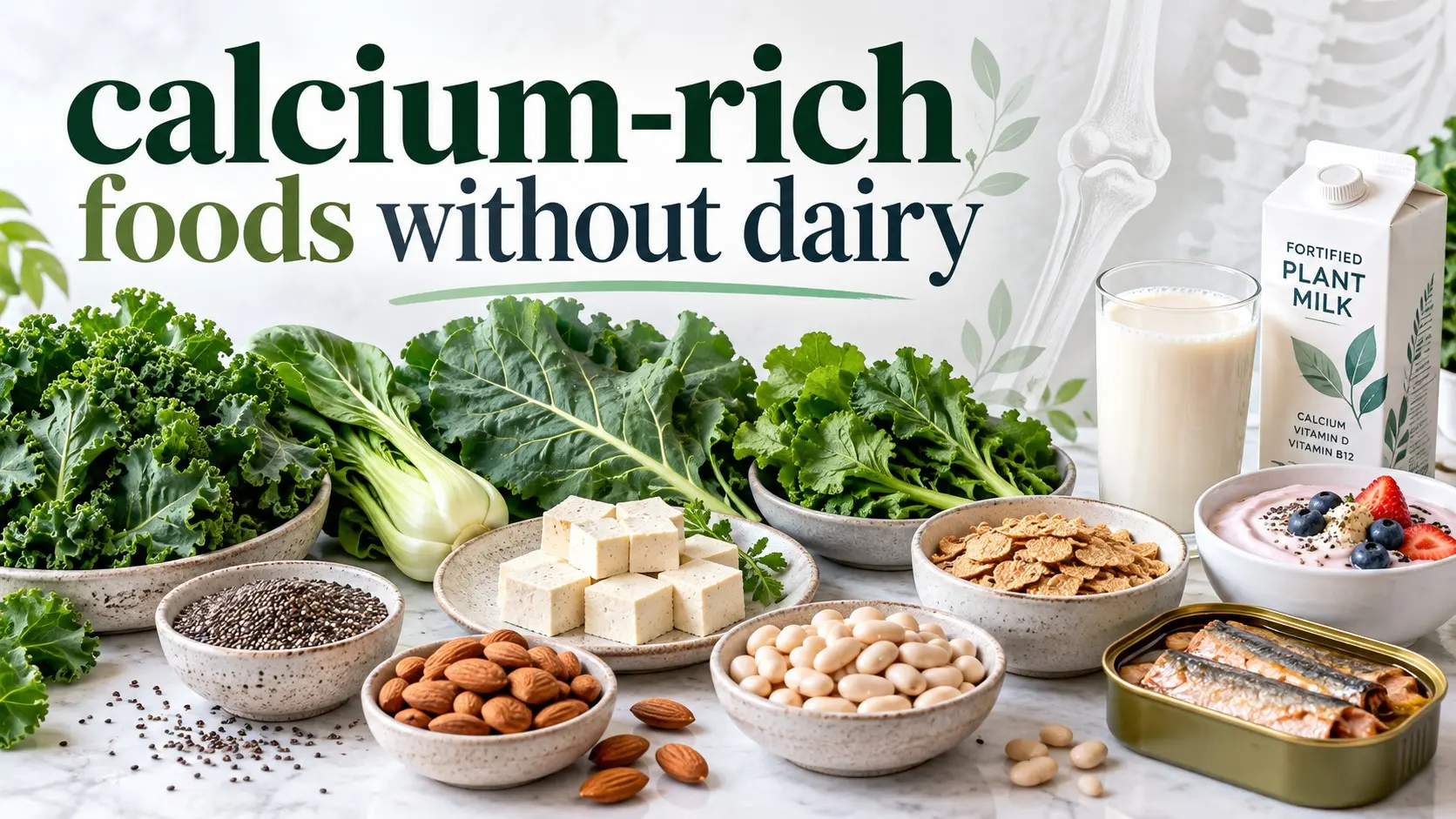
You can get enough calcium without milk, cheese, or yogurt. The easiest approach is to build your day around two or three dependable calcium sources such as fortified soy milk, calcium set tofu, low oxalate greens, or fish with edible bones, then let nuts, seeds, beans, and other foods add smaller amounts.
That is far more practical than trying to get all your calcium from spinach or almonds.
Quick answer: Good calcium-rich foods without dairy include fortified soy and other plant drinks, calcium set tofu, sardines, canned salmon with bones, collard greens, bok choy, kale, turnip greens, chia seeds, almonds, beans, fortified plant yogurt, fortified cereal, and calcium fortified orange juice. Check labels because fortified foods and tofu can vary greatly.
The part that deserves more attention is absorption.
A food may contain calcium on paper but provide much less usable calcium if compounds such as oxalate bind the mineral. Spinach is the classic example. It is a healthy vegetable, but it is not the calcium source I would use to carry your daily target.
Medical notice: I am not a dermatologist or A doctor, and this content does not replace professional medical advice. What I share comes from real-life experience, extensive research, and consultation with healthcare providers. Always consult qualified medical professionals for diagnosis and treatment of any health condition.
Table of Contents
- How much calcium you need
- 15 reliable dairy free calcium sources
- Which foods provide the most usable calcium
- Why spinach is a poor calcium anchor
- How to read fortified food labels
- Dairy free versus vegan calcium
- A practical 1,000 mg day
- Easy meal ideas
- Vitamin D and calcium absorption
- Calcium for children without dairy
- Calcium during pregnancy
- Calcium supplements and dosing
- Medication interactions
- Kidney stone and kidney disease safety
- Common mistakes
- References and Sources
- Related NextFitLife guides
- About the author
- Frequently asked questions
How Much Calcium Do You Need?
Your calcium target changes with age and sex.
For most adults ages 19 to 50, the recommended amount is 1,000 mg per day. Women ages 51 to 70 need 1,200 mg, while men in that age group need 1,000 mg. Adults 71 and older need 1,200 mg.
| Life Stage | Recommended Calcium |
|---|---|
| Children 1 to 3 | 700 mg per day |
| Children 4 to 8 | 1,000 mg per day |
| Ages 9 to 18 | 1,300 mg per day |
| Adults 19 to 50 | 1,000 mg per day |
| Men 51 to 70 | 1,000 mg per day |
| Women 51 to 70 | 1,200 mg per day |
| Adults 71 and older | 1,200 mg per day |
| Pregnant or breastfeeding adults | 1,000 mg per day |
Pregnancy does not automatically double calcium needs.
Pregnant and breastfeeding adults ages 19 to 50 still have a recommended intake of 1,000 mg per day.
For broader vitamin and mineral guidance, visit the NextFitLife Nutrition & Vitamins Hub.
15 Reliable Calcium-Rich Foods Without Dairy
1. Calcium Fortified Soy Milk
If I had to pick one easy dairy replacement for calcium, fortified soy milk would be near the top.
A standard cup of calcium fortified soy milk can provide about 300 mg of calcium. Some fortified products provide more.
Soy also stands out because it usually provides substantially more protein than almond, rice, or many oat drinks.
Check the nutrition label.
Do not assume the word “soy” means calcium has been added.
Shake fortified drinks before pouring if the package tells you to. Calcium can settle toward the bottom of some cartons.
2. Other fortified plant drinks
Fortified almond, oat, rice, pea, and other plant drinks can also provide meaningful calcium.
But the range is wide.
One carton may provide around 300 mg per cup. Another may provide very little.
Compare:
- Calcium per serving
- Vitamin D
- Protein
- Vitamin B12
- Added sugar
If a plant drink replaces dairy in your everyday diet, calcium is only one part of the comparison.
3. Calcium Set Tofu
Tofu can be an excellent source, but this is where labels matter even more.
Tofu made with calcium sulfate may contain several hundred milligrams of calcium in a normal portion.
Tofu made with a different coagulant can contain much less.
Check the ingredients for calcium sulfate and then check the nutrition label for the actual calcium amount.
This makes calcium set tofu one of the most useful vegan calcium foods because it also provides protein.
4. Sardines with soft bones
If your diet is dairy free but not vegan, sardines are hard to beat.
Three ounces of canned sardines with the edible bones provide about 325 mg of calcium.
The soft bones are where much of that calcium comes from.
Mash sardines into toast, add them to pasta, or serve them with potatoes and vegetables.
5. Canned Salmon With Bones
Canned salmon can also supply calcium when the soft bones are included.
Fresh boneless salmon does not provide the same calcium amount.
The bones in canned salmon are soft enough to mash into the fish, so you do not have to eat obvious pieces of bone.
Use it in salmon cakes, sandwiches, salads, or grain bowls.
6. Collard Greens
Collards give you something spinach does not: a useful amount of calcium with relatively good absorption.
Cooked collard greens can contribute meaningfully to daily calcium intake.
Serve them with beans, rice, lentils, fish, tofu, or roasted vegetables.
They also fit naturally into the NextFitLife Bone & Joint Health Hub approach, which looks beyond one nutrient and includes protein, vitamin D, magnesium, and movement.
7. Bok Choy
Bok choy is not the highest calcium vegetable by raw milligrams, but it has a major advantage.
Its calcium is well absorbed because bok choy is low in oxalate.
One cup of shredded bok choy provides about 74 mg of calcium in standard reference data.
That amount sounds modest, but usable calcium matters more than an impressive number trapped by oxalate.
8. Kale
Kale is another low oxalate green that fits a calcium focused diet.
Add it to soups, bean dishes, pasta, grain bowls, or stir fries.
Kale should not be treated as a magic bone food. It is simply a useful vegetable that combines calcium with vitamin K, fibre, and other nutrients.
For more on calcium related bone nutrition, read the NextFitLife Vitamin K2 Benefits Guide.
9. Turnip Greens
Half a cup of cooked turnip greens provides about 100 mg of calcium.
That makes them an easy side dish when you want another low dairy calcium source without relying on fortified products at every meal.
Use them in soups, stews, or alongside beans and grains.
10. Chia Seeds
Chia seeds contain meaningful calcium and are easy to add to breakfast.
They work well in oatmeal, chia pudding, smoothies, or overnight oats.
I would treat chia as a supporting calcium source rather than the main source because portions are small.
A breakfast made with fortified soy milk plus chia makes much more sense than expecting a spoonful of chia to cover the day.
11. Almonds
A quarter cup of almonds provides about 100 mg of calcium in MedlinePlus reference data.
That is useful, but almonds are another supporting source rather than a replacement for a 300 mg fortified drink.
Use them because you enjoy them and because they provide healthy fats, protein, magnesium, and fibre too.
12. White Beans and Other Dried Beans
Beans contribute calcium while also supplying fibre, protein, iron, and other minerals.
The calcium amount differs by bean and serving size.
Use beans in:
- Soup
- Chili
- Grain bowls
- Salads
- Bean dips
- Tomato-based stews
They are especially useful because they improve the overall nutritional quality of a dairy free diet even when they are not your largest calcium source.
13. Fortified Plant Yogurt
Plant yogurt can be a useful calcium source, or almost useless for calcium.
It depends on the product.
Some plant yogurts are fortified to levels similar to dairy yogurt. Others contain little added calcium.
Read the nutrition label before treating the product as one of your main calcium foods.
If it is replacing yogurt nutritionally, also compare protein, vitamin D, vitamin B12, and added sugar.
14. Calcium Fortified Breakfast Cereal
Some breakfast cereals contain added calcium.
The amount varies widely, so this is another label food.
A practical breakfast can combine:
- Fortified cereal
- Fortified soy milk
- Fruit
- Nuts or seeds
That can put a large share of the day's calcium into one normal meal with no need a supplement.
15. Calcium Fortified Orange Juice
Some calcium fortified orange juices provide around 300 to 350 mg per cup.
Ordinary orange juice does not automatically provide the same amount.
Check the label.
This can be useful for someone who dislikes plant milk, although I would not tell everyone to drink juice simply for calcium. Whole fruit is usually a better everyday fruit choice, and people managing blood glucose may prefer a lower sugar calcium source.
Quick Comparison: Which Sources Do the Most Work?
| Food | Typical Calcium | Best Use | Main Caution |
|---|---|---|---|
| Fortified soy milk | About 300 mg per cup in common fortified products | Daily calcium anchor | Check label and shake if directed |
| Calcium set tofu | Can provide several hundred mg per serving | Calcium plus protein | Varies by coagulant and brand |
| Sardines with bones | About 325 mg per 3 ounces | High calcium non vegan choice | Must include edible bones |
| Turnip greens | About 100 mg per 1/2 cup cooked | Low oxalate vegetable source | Not enough alone |
| Almonds | About 100 mg per 1/4 cup | Supporting source | Calorie dense |
| Bok choy | About 74 mg per cup shredded | Well absorbed vegetable calcium | Modest amount per serving |
| Fortified orange juice | Often about 300 to 350 mg per cup | Alternative fortified source | Check sugar and label |
The values above are guides, not promises.
Fortified drinks, tofu, cereal, juice, and plant yogurt vary enough that the package label should always override a generic table.
Why spinach is not a Great Calcium Strategy?
This is where nutrient tables can fool you.
Spinach contains calcium, but it also contains a large amount of oxalate.
Oxalate binds calcium in the digestive tract and reduces the amount your body can absorb.
Research estimates calcium absorption from spinach at only about 5%.
By comparison, calcium absorption from low oxalate vegetables such as bok choy and kale is much higher.
That does not make spinach unhealthy.
Keep eating spinach if you enjoy it.
Just do not count it as the major food carrying your calcium target.
What does bioavailable calcium mean?
Calcium bioavailability refers to how much of the calcium in food your body can absorb and use.
The number on a food label tells you how much calcium is present.
It does not tell you exactly how much reaches your bloodstream.
Absorption is influenced by:
- Oxalate
- Phytate
- Vitamin D status
- Calcium dose
- Age
- The specific calcium compound used in fortified food
This is why a smaller serving of bok choy can still be useful even when spinach appears to contain more calcium.
How to Read a Plant Milk Label
Turn the carton around before buying it.
If calcium is one of your reasons for choosing the drink, look for a meaningful amount per normal serving.
I would compare five things:
- Calcium
- Vitamin D
- Protein
- Vitamin B12
- Added sugar
A calcium fortified soy drink can be nutritionally very different from an unfortified coconut drink, even though both sit in the same supermarket aisle.
For broader food label and nutrition guidance, read 24 Proven Nutrition Tips for Better Health.
Dairy Free Is Not the Same as Vegan
This distinction sounds obvious, but many calcium lists mix the two.
A dairy free diet can still include:
- Sardines
- Salmon
- Eggs
- Meat
- Poultry
A vegan diet excludes all animal foods.
That means sardines and canned salmon are dairy free calcium sources but not vegan calcium sources.
For a vegan calcium plan, focus more heavily on:
- Fortified plant beverages
- Calcium set tofu
- Bok choy
- Kale
- Collards
- Turnip greens
- Beans
- Chia
- Almonds
- Fortified foods
A Practical 1,000 mg Dairy Free Day
You do not need to eat fifteen calcium foods every day.
Two or three strong sources plus several smaller ones can do the job.
| Meal | Example | Calcium Role |
|---|---|---|
| Breakfast | Oats made with 1 cup fortified soy milk plus chia seeds | The soy drink acts as the main calcium anchor |
| Lunch | Calcium set tofu with bok choy and rice | Tofu supplies a large amount, while bok choy adds highly absorbable calcium |
| Snack | Almonds or calcium fortified plant yogurt | Adds a smaller or moderate amount, depending on the product |
| Dinner | Beans with cooked collards or kale | Adds another useful plant calcium source |
Using typical food values, a day like this can reach roughly 1,000 mg.
The exact total depends on your brands and portions, so use the nutrition labels on fortified products rather than assuming the estimate fits your kitchen.
Five Easy Dairy Free Meal Ideas
Calcium Oat Bowl
Cook oats with fortified soy milk, then add chia seeds, berries, and sliced almonds.
The plant milk does most of the calcium work. The seeds and almonds add to it.
Tofu and Bok Choy Bowl
Use calcium set tofu with bok choy, rice, carrots, edamame, and a simple sauce.
This is one of the easiest completely vegan meals for combining calcium, protein, and vegetables.
Sardine Toast
Mash sardines with lemon, herbs, and a little olive oil, then serve on whole grain toast with vegetables.
Choose sardines with the soft bones included.
Salmon and Greens
Mix canned salmon with its soft bones into salmon cakes.
Serve with potatoes and cooked kale or collards.
Bean and Collard Soup
Combine white beans, collards, tomatoes, onion, herbs, and broth.
Add whole grain bread on the side.
This meal will not deliver as much calcium as a fortified drink plus tofu, but it contributes while also supplying fibre and protein.
Vitamin D Still Matters
Vitamin D helps your body absorb calcium.
This does not mean taking large vitamin D does makes calcium absorption unlimited.
Vitamin D needs are affected by diet, sunlight exposure, age, skin pigmentation, medical conditions, and other factors.
If you suspect deficiency, testing and professional guidance are better than guessing with high dose supplements.
The Bone & Joint Health Hub brings calcium, vitamin D, vitamin K, magnesium, protein, and exercise together instead of treating calcium as the whole bone health plan.
Calcium Alone Does Not Build Strong Bones
Bone health depends on more than calcium.
Useful parts of the bigger picture include:
- Vitamin D
- Enough protein
- Magnesium
- Vitamin K
- Weight bearing activity
- Resistance exercise
- Avoiding smoking
- Limiting excess alcohol
If you already have osteoporosis or osteopenia, food supports treatment but does not replace diagnosis, medication, or follow up.
Can children get enough calcium without dairy?
Yes, but children need more planning than adults because they also need enough protein, calories, vitamin D, vitamin B12, iodine, and other nutrients for growth.
Ages 4 to 8 need 1,000 mg of calcium per day.
Ages 9 to 18 need 1,300 mg.
A fortified soy drink is often more nutritionally similar to dairy milk than many low protein plant drinks, although individual products differ.
Look for:
- Calcium
- Vitamin D
- Protein
- Vitamin B12
- Iodine when available
- Low added sugar
A child with a milk allergy, vegan diet, poor growth, limited food range, or several allergies should have an age appropriate plan.
For more ideas, see 15 Best Foods for Kids and 12 Best Foods for Kids Growth.
What About Pregnancy?
Pregnant adults ages 19 to 50 need 1,000 mg of calcium per day.
A dairy free pregnancy can meet this target through fortified foods, calcium set tofu, low oxalate greens, beans, nuts, seeds, and appropriate fish choices.
Pregnancy changes more than calcium needs, so a very restricted diet should also be checked for:
- Protein
- Vitamin D
- Vitamin B12
- Iodine
- Iron
- Folate
Do not start large calcium does during pregnancy without considering what you already get from food and prenatal supplements.
Should you take a calcium supplement?
Food should usually be the first place to look.
A supplement makes more sense when there is a real gap between what you eat and what you need, or when a clinician recommends one for a specific medical reason.
If you already get close to your target from fortified drinks, tofu, greens, fish, and other foods, taking another 1,000 mg of calcium “for insurance” may be unnecessary.
The two common supplement forms are:
- Calcium carbonate
- Calcium citrate
Calcium carbonate is absorbed better with food.
Calcium citrate can be taken with or without food and may be easier to absorb in people with lower stomach acid.
Do not take huge calcium doses at Once
Calcium from supplements is absorbed best in amounts of about 500 mg or less at one time.
If a clinician has told you to take a larger daily amount, the dose may need to be divided.
Follow the actual prescription or supplement instructions rather than creating your own schedule from a blog.
How much calcium is too much?
The upper limit includes calcium from food, fortified products, beverages, and supplements combined.
| Age | Upper Limit |
|---|---|
| Adults 19 to 50 | 2,500 mg per day |
| Adults 51 and older | 2,000 mg per day |
Those numbers are safety ceilings, not intake goals.
If your recommended amount is 1,000 mg, there is no benefit in treating 2,500 mg as a better target.
Calcium supplements can interact with medicines
This section matters because mineral supplements are not harmless food substitutes.
Calcium supplements can interfere with several medicines.
Examples include:
- Levothyroxine
- Some quinolone antibiotics
- Dolutegravir
- Some osteoporosis medicines
NIH guidance notes that calcium carbonate can reduce levothyroxine absorption when taken too close to the medication.
Timing rules differ by medicine.
Ask your doctor or pharmacist how to separate your specific prescription from calcium supplements.
What if you have kidney stones?
Do not assume the solution is to remove calcium from food.
Food calcium and supplemental calcium are not always equivalent in kidney stone discussions.
Your stone type, urine calcium, sodium intake, fluid intake, kidney function, and other factors matter.
If you have a history of kidney stones, ask whether your calcium should come mainly from food and whether any supplement dose is appropriate.
What if you have kidney disease?
Kidney disease changes mineral balance.
Some people with chronic kidney disease may need individualized advice about calcium, phosphorus, vitamin D, and supplements.
Do not follow a generic “eat more calcium” plan if your kidney team has given you mineral limits.
Does lactose intolerance mean you need a Dairy Free Diet?
No.
Lactose intolerance is not the same as milk allergy.
Many people with lactose intolerance can tolerate:
- Lactose free milk
- Lactose free yogurt
- Some aged cheeses
- Small amounts of dairy with meals
If you prefer a completely dairy free diet, that is fine.
But lactose intolerance alone does not always require removing every dairy food.
A true cow's milk protein allergy is different and requires avoiding the responsible milk proteins.
Common Mistakes With Dairy Free Calcium
Mistake 1: Using Spinach as your main calcium vegetable
Spinach is nutritious, but its high oxalate content means very little of its calcium is absorbed.
Choose kale, bok choy, collards, or turnip greens when calcium is the goal.
Mistake 2: Assuming every plant milk is fortified
Read the label.
Two cartons that look similar can have completely different calcium and protein levels.
Mistake 3: Assuming Every Tofu Is High in Calcium
The coagulant matters.
Look for calcium sulfate and confirm the amount on the label.
Mistake 4: Expecting Almonds to Replace Milk Cup for Cup
Almonds contribute calcium, but normal portions usually provide much less than a well fortified plant drink.
Mistake 5: Taking a Large Supplement Without Counting Food
Your total intake includes calcium from every source.
Estimate your normal diet before filling a gap that may not exist.
Mistake 6: Ignoring Vitamin D
Calcium intake matters, but vitamin D supports its absorption.
Bone health also depends on movement, protein, hormones, age, and other nutrients.
Mistake 7: Treating Vegan and Dairy Free as the same diet
Sardines and canned salmon are dairy free, but they are not vegan.
Be clear about which diet you actually follow.
My Practical Recommendation
If you do not eat dairy, I would make the plan boringly simple.
Choose one dependable fortified food every day, such as calcium fortified soy milk or another well fortified plant drink.
Add calcium set tofu or another major source at a second meal.
Then use kale, bok choy, collards, beans, chia, almonds, or fish with bones to fill out the rest of the day.
You do not need a giant list.
You need a few sources you actually eat consistently.
Conclusion
Calcium-rich foods without dairy can meet normal calcium needs when you choose them deliberately. Fortified plant milk, calcium set tofu, low oxalate greens, sardines, canned salmon, beans, seeds, nuts, and fortified foods all have a place.
Your next step is to check one ordinary day of eating. Add the calcium from the labels and realistic portions you actually use. If you are regularly short, improve the food pattern first or ask a qualified professional whether a supplement sized to the real gap makes sense.
References and Sources
- National Institutes of Health, Office of Dietary Supplements.
Calcium Fact Sheet for Consumers.
Used for recommended calcium intake, food sources, upper limits, calcium supplement dosing, vitamin D, and medication interactions.
URL:
https://ods.od.nih.gov/factsheets/Calcium-Consumer/
- MedlinePlus.
Calcium in Diet.
Used for calcium amounts in fortified soy milk, sardines, turnip greens, almonds, bok choy, food sources, supplement forms, and the 500 mg supplement absorption guidance.
URL:
https://medlineplus.gov/ency/article/002412.htm
- National Institute of Arthritis and Musculoskeletal and Skin Diseases.
Calcium and Vitamin D: Important for Bone Health.
Used for bone health context and the relationship between calcium and vitamin D.
URL:
https://www.niams.nih.gov/health-topics/calcium-and-vitamin-d-important-bone-health
- Harvard T.H. Chan School of Public Health.
The Nutrition Source: Calcium.
Used for calcium absorption and the effect of oxalates in foods such as spinach compared with lower oxalate greens.
URL:
https://nutritionsource.hsph.harvard.edu/calcium/
- Zhao Y, Martin BR, Weaver CM.
Calcium Bioavailability of Calcium Carbonate Fortified Soymilk Is Equivalent to Cow's Milk in Young Women.
Journal of Nutrition.
Used for evidence that the calcium compound used in fortified soy milk can affect absorption and that calcium carbonate fortified soy milk can have absorption comparable with cow's milk under study conditions.
URL:
https://pubmed.ncbi.nlm.nih.gov/16177199/
Continue With NextFitLife Nutrition and Bone Health Guides
Use these related guides to build a complete food and bone health plan instead of focusing on calcium alone.
Nutrition and Vitamins
Bone and Joint Health
Calcium and Nutrition for Children
About the Author
Adel Galal is the founder and lead writer of NextFitLife. He researches and writes about nutrition, vitamins, minerals, digestive health, fitness, bone health, metabolic health, sleep, wellness, and healthy aging.
His approach is to compare popular nutrition claims with established medical and public health guidance, check real serving sizes, separate food content from actual absorption, and explain where product labels matter more than generic food lists.
For calcium, that means looking beyond a simple “high calcium foods” chart. Fortification, portion size, oxalate content, vitamin D, age, medication use, kidney health, and the rest of the diet all change how useful a calcium source is.
I am not a dermatologist or A doctor, and this content does not replace professional medical advice. What I share comes from real-life experience, extensive research, and consultation with healthcare providers. Always consult qualified medical professionals for diagnosis and treatment of any health condition.
Learn more about Adel Galal, NextFitLife, and the site's editorial approach on the NextFitLife About Us page.
Frequently Asked Questions About Calcium-Rich Foods Without Dairy
Can you get enough calcium without dairy?
Yes. Fortified plant drinks, calcium set tofu, sardines, canned salmon with bones, low oxalate greens, nuts, seeds, beans, and other fortified foods can provide enough calcium when they are used consistently across the day.
What is the best nondairy source of calcium?
There is no single best food, but calcium fortified soy milk and calcium set tofu are among the most practical because they can provide a large amount of calcium in a normal serving. Sardines with bones are another concentrated choice for people who eat fish.
What is the best vegan calcium source?
Fortified plant milk and calcium set tofu are especially useful vegan sources because they can provide several hundred milligrams per serving. Bok choy, kale, collards, turnip greens, chia, almonds, beans, and fortified foods can add more.
Is spinach high in calcium?
Spinach contains calcium, but much of it is poorly absorbed because spinach is high in oxalate. Low oxalate greens such as kale, bok choy, collards, and turnip greens are more useful calcium choices.
Is almond milk high in calcium?
Only if it is fortified. Some almond drinks contain around 300 mg or more per cup, while unfortified products contain much less. Check the label.
Is oat milk high in calcium?
Fortified oat drinks can provide a useful amount of calcium, but the amount varies by product. Check calcium, vitamin D, protein, vitamin B12, and added sugar on the label.
Is tofu high in calcium?
Some tofu is. Tofu prepared with calcium sulfate can be a strong calcium source, while tofu made with other coagulants may provide much less. Read both the ingredient list and nutrition label.
How much calcium is in sardines?
Three ounces of canned sardines with the soft edible bones provide about 325 mg of calcium in MedlinePlus reference data.
Are almonds a good calcium source?
Almonds contribute calcium. About one quarter cup provides around 100 mg in standard reference data. They are useful as a supporting source but usually provide less calcium per normal serving than fortified plant milk.
Does chia contain calcium?
Yes. Chia seeds contain meaningful calcium, but portions are usually small. They work best as one part of a calcium rich meal rather than the only calcium source.
Do beans contain calcium?
Yes. Dried beans and white beans can contribute calcium while also providing fibre, protein, and other minerals. The amount varies by type and serving size.
How much calcium do adults need?
Most adults ages 19 to 50 need 1,000 mg per day. Women ages 51 to 70 and all adults 71 and older need 1,200 mg. Men ages 51 to 70 need 1,000 mg.
How much calcium do teenagers need?
Teenagers ages 14 to 18 need 1,300 mg of calcium per day. Children ages 9 to 13 have the same 1,300 mg recommendation.
Do pregnant adults need extra calcium?
Pregnant adults ages 19 to 50 need 1,000 mg per day under current NIH recommendations. Pregnancy does not automatically mean doubling calcium intake.
Do I need a calcium supplement if I do not eat dairy?
Not automatically. First estimate how much calcium you get from food and fortified products. A supplement can help when there is a genuine gap or a clinician identifies a medical need.
How much calcium supplement should I take at one time?
Calcium supplements are absorbed best in doses of about 500 mg or less at one time. Follow your clinician's advice if you have been given a specific supplement plan.
What is the difference between calcium citrate and calcium carbonate?
Calcium carbonate is absorbed better when taken with food. Calcium citrate can be taken with or without food and may be easier to absorb for people with lower stomach acid.
Can calcium supplements interfere with medicines?
Yes. Calcium can interfere with medicines including levothyroxine, some antibiotics, dolutegravir, and certain osteoporosis treatments. Ask your doctor or pharmacist how to separate the doses.
Is more calcium always better for bones?
No. Calcium has an upper intake limit, and bone health also depends on vitamin D, protein, movement, hormones, age, and other factors. More calcium than you need does not automatically create stronger bones.

Health & wellness writer with 30+ years of experience in nutrition, fitness, and healthy aging. Founder of NextFitLife.com — evidence-based health guidance.